Æthelflæd, Lady of the Mercians

Books by Sharon Bennett Connolly
Æthelflæd (from The Cartulary and Customs of Abingdon Abbey, c. 1220)

12th June 2018 marked the 1100th anniversary of one of England’s greatest ever women. The daughter of Alfred the Great, Æthelflæd, Lady of the Mercians, led the resistance against Danish invasion, alongside her brother, Edward the Elder. And yet, she is virtually unknown to the people of today.

Æthelflæd was born about 870, the eldest child of King Alfred and his wife, Ealhswith. Alfred’s biographer, Asser, says Ealhswith was a member of the Mercian royal house through her mother, Eadburh. Around 886 Æthelflæd was married to Æthelred, ealdorman of Mercia and a trusted lieutenant of her father. Æthelred ruled over the English half of the Mercian kingdom, which had been dissected by the Vikings, but submitted to King Alfred’s overlordship. The marriage was a political alliance, intended to strengthen Saxon resistance to the Danes, who were now occupying Northumbria, Yorkshire and East Anglia. The resulting close relationship of Mercia and Wessex was only further strengthened by the renewed Viking attacks of the 890s.

During the early years of their marriage the young couple appear to have settled in London, the city that had been entrusted to Æthelred’s care by Alfred. Æthelflæd seems to have taken after her father – she was a strong, brave woman and is often regarded more as a partner to Æthelred than a meek, obedient wife. The couple jointly presided over provincial courts. The ‘Mercian Register’, a fragment of a Mercian chronicle, included in some versions of the Anglo-Saxon Chronicle, records that Æthelflæd was exercising regal powers in the region even before her husband’s death. In his final years Æthelred increasingly suffered from illness, during which time Æthelflæd assumed greater authority. The couple had only one child, a daughter, Ælfwynn. Writing 2 centuries later William of Malmesbury claimed the lack of more children was due to Æthelflæd’s avoidance of marital relations, possibly due to a fear of dying in childbirth. Malmesbury quotes her as saying it was ‘unbecoming a daughter of a king to give way to a delight, which after a time produced such painful consequences’. Æthelred died in 911, though whether this was from wounds received in battle or from illness remains unclear. He was buried at Gloucester.

Books by Sharon Bennett Connolly
Charter S 221 dated 901 of Æthelred and Ætheflæd donating land and a golden chalice to Much Wenlock Church

Wessex had already adjusted to a change in ruler when Æthelflæd’s father had died in 899 and had been succeeded by her younger brother, Edward ‘the Elder’. When Æthelred died, Edward was happy to support his sister as sole ruler of Mercia, but he took personal control of the cities of London and Oxford, cities that could be used as bases from which Edward would be able to launch campaigns against the Danes of the Midlands. The siblings seem to have had a trusting relationship for many years; Edward had entrusted his son Æthelstan, often viewed as the first king of England, to Æthelflæd and her husband, to be educated at the Mercian court.

The first woman to rule an Anglo-Saxon kingdom  – albeit as a client of her brother’s more powerful kingdom of Wessex, Æthelflæd was accorded the title the Lady of the Mercians. She proved to be a vital ally to her brother and the siblings worked together to combat the threats of the Danes. In 909, according to the Anglo-Saxon Chronicle, Edward sent an army, made up of West Saxons and Mercians, into Danish territory in the north. It was probably this army that brought back to Mercia the relics of St Oswald, the 7th century Northumbrian saint. They had been taken from Bardney in Lincolnshire and Æthelflæd had them translated to the new minster at Gloucester, which was renamed St Oswald in his honour.

Æthelflæd continued the policy, started by her father, of building burhs and established a ring of fortified centres around western Mercia. The burhs not only provided protection against the Danes, but served as bases from which to launch attacks on Danish occupied regions. Each burh could provide a refuge for all villagers within a 20-mile radius; it would have a large garrison, depot and its own water supply. During Æthelred’s lifetime, burhs had been established at ‘Bremesburh’, Worcester (between 887 and 899) and Chester (907). Later, on Æthelflæd’s orders, in 913, fortresses were built at several further sites, including Bridgnorth, Tamworth and Stafford, in response to Viking raids into Edward’s territories.

Edward built two further burhs at Buckingham in 914, plugging a defensive gap between Tamworth and Hertford. At the same time, Æthelflæd built one at Warwick and another at Eddisbury; this latter, with a new burh at Runcorn in 915, helped to strengthen her northern defences. While the Danes appeared to be the greatest risk, Æthelflæd did not neglect her defences along the Welsh border, building a burh at Chirbury and one at the now-lost location of ‘Wearburh’. In the same year, Edward fortified Bedford and in 916 he built a burh at Maldon to fortify Essex against seaborne raiding. While this building programme was going on, it also seems highly likely that Æthelflæd rebuilt and strengthened the defences of Gloucester and Hereford.
Books by Sharon Bennett Connolly
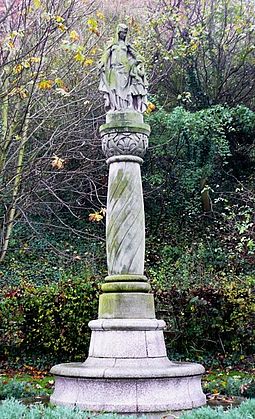
Statue of Æthelflæd and her nephew, Athelstan, Tamworth

Æthelflæd was no silent partner in Edward’s reconquest of England. Most remarkably, she personally led successful military campaigns against the Welsh, the Norse and the Danes of York. The Anglo-Saxon Chronicle relates that on the feast of St Cyriac the Martyr, 16 June 916, the abbot Egbert and his retainers, were murdered for no known reason. The Mercian abbot had been travelling in the Welsh mountain kingdom of Brycheiniog when he was attacked. Æthelflæd seems to have taken the murder as a personal affront; the abbot was, after all, under her protection. Three days later she invaded Wales; her army ravaged Brycheiniog, burning the little kingdom. Although King Tewdr escaped, Æthelflæd took his wife, Queen Angharad, as a hostage, with 33 others, many of whom were relatives of the Welsh king. Eventually, the king submitted to Æthelflæd, promising to serve her faithfully and to pay compensation. The incident not only demonstrates Æthelflæd’s commitment to her people, but also shows her strength and determination, attributes she was to put to good use against the Danes.

In 917 Æthelflæd turned her attention to those Danes. Danish forces had taken the offensive, raiding English territories. By the end of the year Edward had subdued East Anglia, with all the Scandinavian armies of the region submitting to him. While her brother was raiding in  the East Midlands, Æthelflæd led her forces across the West Midlands. She marched on the Viking stronghold of Derby, personally leading the army on campaign. It would be the first of the Danes’ ‘Five Boroughs’, which made up the Danelaw, to fall. Although she managed to successfully storm the fort, her army suffered heavy casualties, including four of her most trusted and senior thegns (thegns were the army’s commanders and officers). The Anglo-Saxon Chronicle reported; ‘With God’s help Ethelfleda, lady of Mercia, captured the fortress known as Derby with all its assets. Four of her favoured ministers were slain inside the gates’.¹

The Saxon victory was a great shock to the Danes. Their Viking myths told of an invincible woman who would appear at Ragnarok, the Norse apocalypse, and make brave warriors cower before her. Æthelflæd was relentless  – in early 918 she and her army moved on to Leicester, while Edward headed for Stamford. Leicester was the centre of a heavily settled Danish colony, and Æthelflæd ravaged the countryside around the settlement. The Danes had no choice but to surrender in the face of her indefatigable forces. However, she was magnanimous in victory, displaying mercy and charity by distributing alms as she progressed into town.

Books by Sharon Bennett Connolly
Æthelflæd in the thirteenth century Genealogical Chronicle of the English Kings

The inexorable advance of Æthelflæd’s army combined with her compassion for the defeated was to prove to be a clever strategy, demonstrating to those regions still controlled by the Danes that she was prepared to offer compromise if they would only submit to her. The Danes of York, the Viking capital, in particular, began to look at submitting to Æthelflæd as a serious option to avoid continued conflict. Their new king was Ragnall, a Viking pirate from Dublin, who had taken the throne by force; but the Danes knew that Edward and Æthelflæd would never make peace with him. In the summer of 918 the noblemen and magnates of York sent emissaries to Æthelflæd, promising that they would surrender to her.

In May, King Edward had marched his army to Stamford, building a new fort south of the river and accepting the surrender of the local Danes, who submitted to him as their new ruler. It was while he was still at Stamford that Edward received word of his sister, The Anglo-Saxon Chronicle made a cold, clinical report:

918 While he was there his sister Æthelflæd died at Tamworth two weeks before midsummer. The king took possession of Tamworth and the whole province of Mercia which she had governed.²

Æthelflæd died suddenly at Tamworth on 12 June 918. She was buried beside her husband, in the east chapel of the cathedral she had founded, St Oswald’s Minister, Gloucester. Although she did not live long enough to see the successful conclusion to the work she and her brother had carried out, her achievements cannot be lightly brushed off. Between 910 and 920 all Danish territories south of Yorkshire had been conquered. Her nephew Athelstan consolidated the kingdom that had been created by the efforts of Edward and Æthelflæd. If Æthelflæd did not live to see the extent of her success, neither did she live to see her daughter, Ælfwynn, nearly thirty and still unmarried, briefly become the nominal ruler of Mercia; only to be ‘deprived of all authority’ six months later and taken to Wessex, from where nothing more is heard of her.
Books by Sharon Bennett Connolly
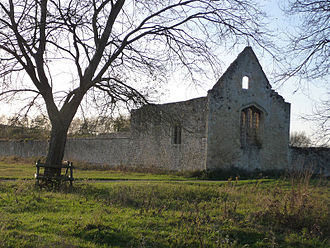
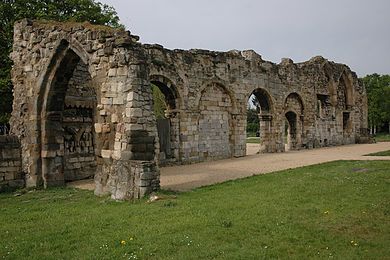
St Oswald’s Priory, Gloucester, where Æthelflæd and her husband are buried

The story of Æthelflæd mainly comes from the Mercian Register, embedded largely in the B, C and D texts of the Anglo-Saxon Chronicle. She appears only rarely in the primary text, text A, which focuses on Edward and Wessex. Text A tries to minimise Æthelflæd’s significance, but could not wholly obscure her achievements. She was, after all, the daughter of Alfred the Great, the wife of the ealdorman of Mercia and a prominent woman in her own right, in an era when this was an incredible rarity. It is thought that it was Æthelflæd, the Lady of the Mercians, who inspired the 10th century poem, ‘Judith’ who is ‘white and shining’, ‘noble and courageous’. In the poem, Æthelflæd is depicted as the ‘valorous virgin’ who struck off the head of the hostile foe with her gleaming sword and ‘ascribed the glory of all that to the Lord of Hosts’. Recognising her vital role in the creation of England, the 12th century Henry of Huntingdon declared Æthelflæd ‘to have been so powerful that in praise and exaltation of her wonderful gifts, some call her not only lady, but even king’. In a poem he described her as ‘worthy of a man’s name’ and ‘more illustrious than Caesar’, apparently high praise indeed – for a woman.

In the 21st century Æthelflæd’s story is becoming more widely known than it has ever been. She is one of the major influences of my book, Heroines of the Medieval World and appears, appropriately, in the chapter on Warrior Heroines. Joanna Arman’s non-fiction book The Warrior Queen: the Life and Legend of Æthelflæd, Daughter of Alfred the Great is well worth a perusalIn addition, with her appearance in Bernard Cornwell’s wonderful The Last Kingdom books and television series, and Annie Whitehead’s non-fiction book, Mercia: the rise and Fall of a Kingdom, as well as her novel, To Be A Queen, Æthelflæd’s story is finally being brought into the light. On the 1100th anniversary of her death, her incredible achievements were being celebrated in the heart of Mercia, in Gloucester and Tamworth. And not before time; Æthelflæd should be the inspiration for future generations of strong, influential women and stand out as an example of what can be achieved if you are determined enough.

*

Footnotes: ¹ The Anglo-Saxon Chronicles by Michael Swanton; ² ibid.

Pictures courtesy of Wikipedia

Further Reading: The Anglo-Saxon Chronicles by Michael Swanton; The Anglo-Saxon Chronicle by James Ingram; Chronicles of the Kings of England, From the Earliest Period to the Reign of King Stephen, c. 1090–1143 by William of Malmesbury; The Chronicle of Henry of Huntingdon by Thomas Forester; Alfred the Great by David Sturdy; Brewer’s British Royalty by David Williamson;  History Today Companion to British History Edited by Juliet Gardiner & Neil Wenborn; The mammoth Book of British kings & Queen by Mike Ashley; Britain’s Royal Families, the Complete Genealogy by Alison Weir; The Wordsworth Dictionary of British History by JP Kenyon; The Anglo-Saxons in 100 Facts by Martin Wall; Kings, Queens, Bones and Bastards by David Hilliam; The Oxford Companion to British History Edited by John Cannon; oxforddnb.com.

*

My Books

Signed, dedicated copies of all my books are available through my online bookshop.

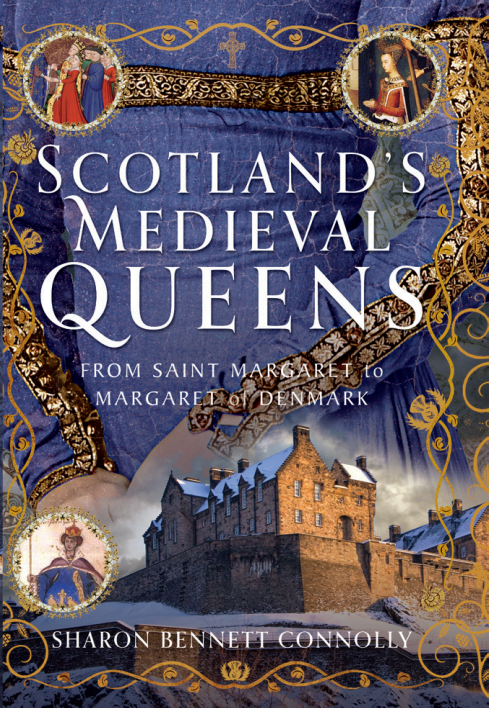
Out now: Scotland’s Medieval Queens

Books by Sharon Bennett Connolly

Scotland’s history is dramatic, violent and bloody. Being England’s northern neighbour has never been easy. Scotland’s queens have had to deal with war, murder, imprisonment, political rivalries and open betrayal. They have loved and lost, raised kings and queens, ruled and died for Scotland. From St Margaret, who became one of the patron saints of Scotland, to Elizabeth de Burgh and the dramatic story of the Scottish Wars of Independence, to the love story and tragedy of Joan Beaufort, to Margaret of Denmark and the dawn of the Renaissance, Scotland’s Medieval Queens have seen it all. This is the story of Scotland through their eyes.

Scotland’s Medieval Queens gives a thorough grounding in the history of the women who ruled Scotland at the side of its kings, often in the shadows, but just as interesting in their lives beyond the spotlight. It’s not a subject that has been widely covered, and Sharon is a pioneer in bringing that information into accessible history.’ Elizabeth Chadwick (New York Times bestselling author)

Available now from Amazon and Pen and Sword Books

Also by Sharon Bennett Connolly:

Books by Sharon Bennett Connolly

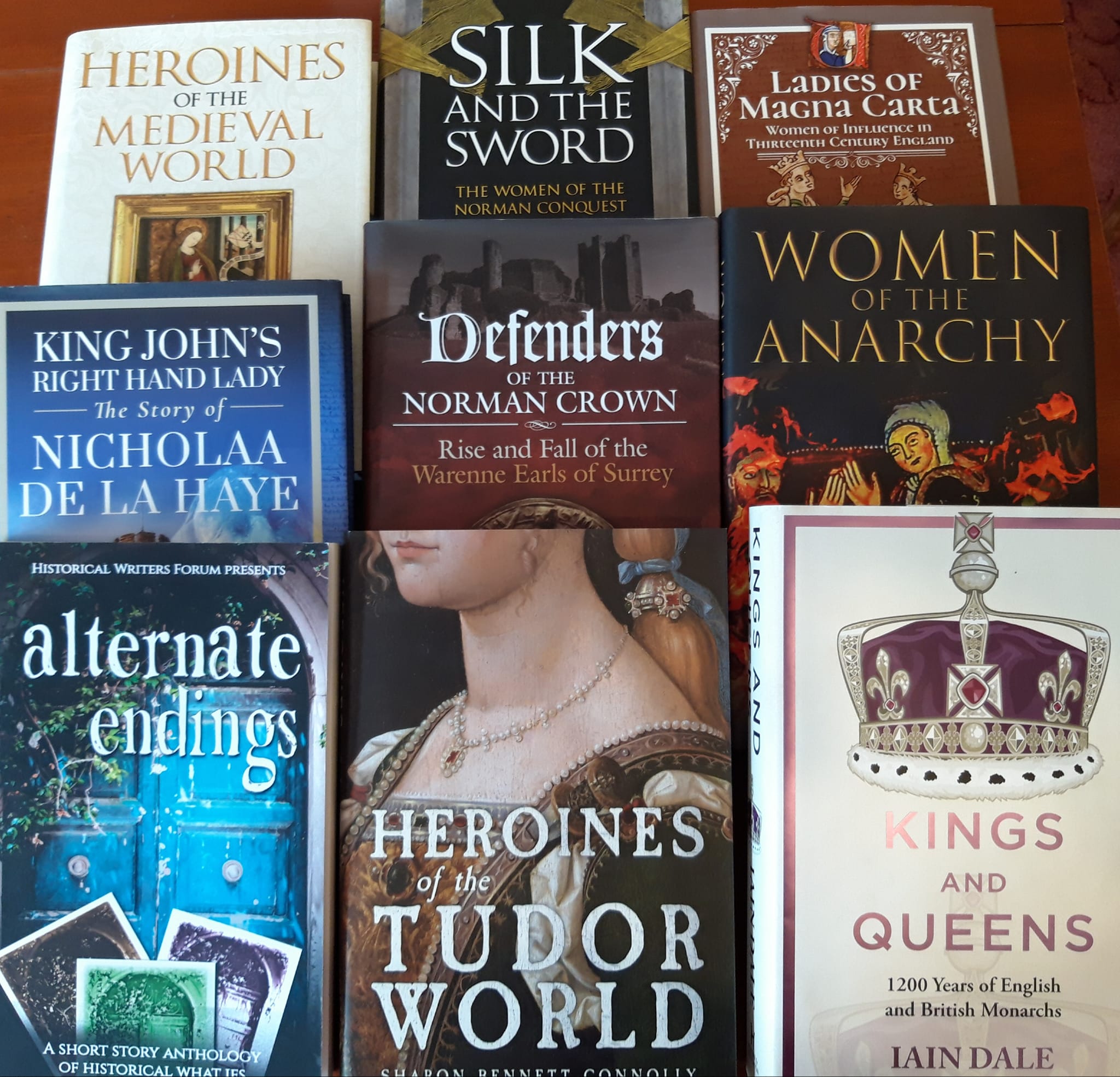
Heroines of the Tudor World tells the stories of the most remarkable women from European history in the time of the Tudor dynasty, 1485-1603. These are the women who ruled, the women who founded dynasties, the women who fought for religious freedom, their families and love. Heroines of the Tudor World is now available from Amberley Publishing and Amazon UK. Women of the Anarchy demonstrates how Empress Matilda and Matilda of Boulogne, unable to wield a sword themselves, were prime movers in this time of conflict and lawlessness. It shows how their strengths, weaknesses, and personal ambitions swung the fortunes of war one way – and then the other. Available from Bookshop.orgAmberley Publishing and Amazon UKKing John’s Right-Hand Lady: The Story of Nicholaa de la Haye is the story of a truly remarkable lady, the hereditary constable of Lincoln Castle and the first woman in England to be appointed sheriff in her own right. Available from all good bookshops Pen & Sword Booksbookshop.org and Amazon

Books by Sharon Bennett Connolly

Defenders of the Norman Crown: The Rise and Fall of the Warenne Earls of Surrey tells the fascinating story of the Warenne dynasty, from its origins in Normandy, through the Conquest, Magna Carta, the wars and marriages that led to its ultimate demise in the reign of Edward III. Available from Pen & Sword BooksAmazon in the UK and US, and Bookshop.orgLadies of Magna Carta: Women of Influence in Thirteenth Century England looks into the relationships of the various noble families of the 13th century, and how they were affected by the Barons’ Wars, Magna Carta and its aftermath; the bonds that were formed and those that were broken. It is now available in paperback and hardback from Pen & SwordAmazon, and Bookshop.orgHeroines of the Medieval World tells the stories of some of the most remarkable women from Medieval history, from Eleanor of Aquitaine to Julian of Norwich. Available now from Amberley Publishing and Amazon, and Bookshop.orgSilk and the Sword: The Women of the Norman Conquest traces the fortunes of the women who had a significant role to play in the momentous events of 1066. Available now from Amazon,  Amberley Publishing, and Bookshop.org.

Alternate Endings: An anthology of historical fiction short stories including Long Live the King… which is my take what might have happened had King John not died in October 1216. Available in paperback and kindle from Amazon.

Podcast:

A Slice of Medieval

Have a listen to the A Slice of Medieval podcast, which I co-host with Historical fiction novelist Derek Birks. Derek and I welcome guests, such as Bernard Cornwell and discuss a wide range of topics in medieval history, from significant events to the personalities involved.

Every episode is also now available on YouTube.

*

Don’t forget! Signed and dedicated copies of all my books are available through my online bookshop.

For forthcoming online and in-person talks, please check out my Events Page.

You can be the first to read new articles by clicking the ‘Follow’ button, liking our Facebook page or joining me on TwitterThreadsBluesky and Instagram.

*

©2018 Sharon Bennett Connolly FRHistS
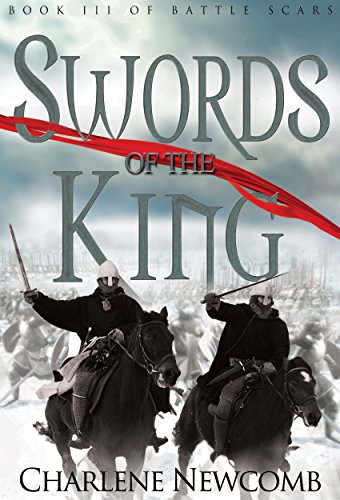
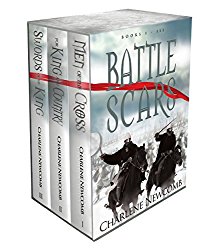
Book Corner: Swords of the King by Charlene Newcomb

Today over at The Review, you can read my thoughts on Charlene Newcomb’s fantastic new novel, Swords of the King, the third book in her Battle Scars series telling the story of two knights in the service of King Richard the Lionheart.

And there’s a fabulous giveaway –  an ebook boxset of the entire series to one lucky winner.

Here’s a taster:

Swords of the King  is the third instalment of Charlene Newcomb’s magnificent Battle Scars series which has followed Sir Henry de Grey and Sir Stephan de l’Aigle from the third Crusade to northern France in the service of King Richard the Lionheart of England. In Men of the Cross, we saw Henry and Stephan meet and get to know each other whilst experiencing the horrors of the Third Crusade. In For King and Country they were back in England, trying to thwart the evil machinations of Prince John whilst King Richard was stuck in a German prison. In Swords of the King, the two heroes are back together again, this time fighting in France alongside King Richard, with enemies within and without.

The story revolves around Plantagenet family crises and the machinations of Philip II of France and his attempts to disrupt Richard I’s policies and tactics. While many of characters have their own agenda, they must also work to implement King Richard’s; not an easy task when the French and enemies closer to home are ready to thwart you at every turn…


To read the full review of this fantastic novel – and to enter the prize draw and be in with a chance in this fantastic giveaway, simply visit The Review and leave a comment.

Good luck!

*

My books

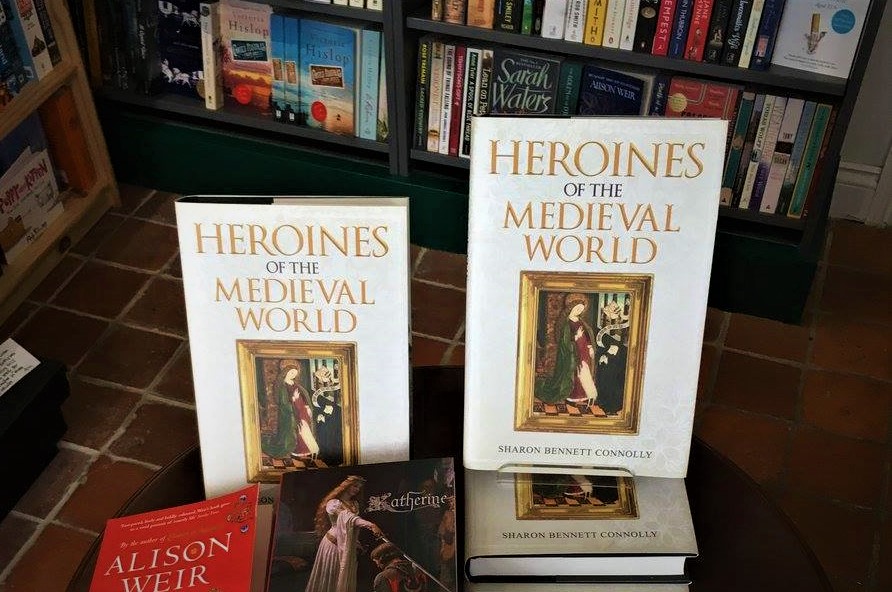
Heroines of the Medieval World,  is now available in hardback in the UK from both Amberley Publishing and Amazon UK. It is now available in Hardback from Amazon US  and worldwide from Book Depository.

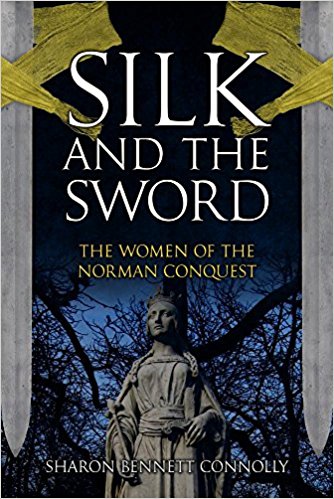
Silk and the Sword: the Women of the Norman Conquest will be released in the UK on 15 November 2018 and is available for pre-order on Amazon UKAmberley Publishing and Book Depository.

You can be the first to read new articles by clicking the ‘Follow’ button, liking our Facebook page or joining me on Twitter.

*

©2018 Sharon Bennett Connolly


My News

Hi all. I know I have been quiet recently, so I thought I would write a post with all my latest news.

Book News

Silk and the Sword: the Women of the Norman Conquest

I have been working hard to finish my latest book, Silk and the Sword: The Women of the Norman Conquest, which went off to the publishers yesterday. I have thoroughly enjoyed delving into the lives of the women of the 11th century and looking at the events of 1066 through their eyes.

Here’s the synopsis:

Everyone knows about the events of 1066; the story of invasion and conquest.

But what of the women?

Harold II of England had been with Edith Swan-neck for twenty years but in 1066, in order to strengthen his hold on the throne, he married Ealdgyth, sister of two earls. William of Normandy’s duchess, Matilda of Flanders had, supposedly, only agreed to marry the Duke after he’d pulled her pigtails and thrown her in the mud. Harald Hardrada had two wives – apparently at the same time.
So, who were these women? What was their real story? And what happened to them after 1066?

From Emma of Normandy, wife of both King Cnut and Æ II to Saint Margaret, a descendant of Alfred the Great himself, ‘Silk and the Sword’ traces the fortunes of the women who had a significant role to play in the momentous events of 1066.


Silk and the Sword: The Women of the Norman Conquest is due for release in the UK on 15 November 2018 and is available for pre-order on Amazon UK, Amberley Publishing and Book Depository. I have no date for the US release, but will keep you posted.

Heroines of the Medieval World

In other exciting news, Heroines of the Medieval World is released today in hardback the US and Canada, and is available from Amazon US.

These are the stories of women, famous, infamous and unknown, who shaped the course of medieval history.

Today, it is easy to think that all women from this era were downtrodden, retiring and obedient housewives, whose sole purpose was to give birth to children (preferably boys) and serve their husbands. Heroines of the Medieval World looks at the lives of the women who broke the mould: those who defied social norms and made their own future, consequently changing lives, society and even the course of history.

Some of the women are famous, such as Eleanor of Aquitaine, who was not only a duchess in her own right but also Queen Consort of France through her first marriage and Queen Consort of England through her second, in addition to being a crusader and a rebel.

Then there are the more obscure but no less remarkable figures such as Nicholaa de la Haye, who defended Lincoln Castle in the name of King John, and Maud de Braose, who spoke out against the same king’s excesses and whose death (or murder) was the inspiration for a clause in Magna Carta.

Women had to walk a fine line in the Middle Ages, but many learned to survive – even flourish – in this male-dominated world. Some led armies, while others made their influence felt in more subtle ways, but all made a contribution to their era and should be remembered for daring to defy and lead in a world that demanded they obey and follow.


Other News

I have recently confirmed two new projects that I will be working on over the next couple of years.

Ladies of the Magna Carta

Ladies of the Magna Carta will look at the wives and families of the barons who were involved in the creation and implementation of the 1215 Magna Carta, and will be published by Pen & Sword Books in 2020.

The De Warenne Earls of Surrey: From the Conquest to the Reign of Edward III

The De Warenne Earls of Surrey: From the Conquest to the Reign of Edward III is a biography of the De Warenne family, from the first Earl, William de Warenne, who fought for William the Conqueror at the Battle of Hastings, to the seventh and last earl, John de Warenne and his unfortunate wife, Joan of Bar.

Newark Book Festival

On Sunday 15 July, 2018, I will be appearing at the Newark Book Festival, Nottinghamshire, UK. I will be talking on a Historical Fiction panel with the wonderful Elizabeth Chadwick and hosted by Nick Quantrill.

It would be great to see you there.

Here’s the details::

Historical Fiction Panel
Elzabeth Chadwick & Sharon Bennett Connolly
Newark Town Hall
Sunday 15th July
3.15pm – 4.30pm
£5/£4 FESTIVAL FRIENDS
Festival Box Office: 01636 655755 palacenewark.com


*

My books

Heroines of the Medieval World,  is now available in hardback in the UK from both Amberley Publishing and Amazon UK. It is now available in Hardback from Amazon US  and worldwide from Book Depository.

Silk and the Sword: the Women of the Norman Conquest will be released in the UK on 15 November 2018 and is available for pre-order on Amazon UK, Amberley Publishing and Book Depository.

51PUe8rZWgL._SX332_BO1,204,203,200_


You can be the first to read new articles by clicking the ‘Follow’ button, liking our Facebook page or joining me on Twitter.

*

©2018 Sharon Bennett Connolly


Mother’s Day Treat

Sunday 11th March 2018 is Mother’s Day in the UK this year

Mum is everyone’s favourite Heroine, in whatever era, and I could not think of a better way to celebrate Mother’s Day than with a giveaway of a hardback copy of Heroines of the Medieval World.

About Heroines of the Medieval World

Heroines come in many different forms, and it is no less true for medieval heroines. They can be found in all areas of medieval life; from the dutiful wife and daughter to religious devotees, warriors and rulers. What makes them different compared to those of today are the limitations placed on them by those who directed their lives – their fathers, husbands, priests and kings. Women have always been an integral part of history, although when reading through the chronicles of the medieval world, you would be forgiven if you did not know it. We find that the vast majority of written references are focussed on men. The chronicles were written by men and, more often than not, written for men. It was men who ruled countries, fought wars, made laws and treaties, dominated religion and guaranteed – or tried to guarantee – the continued survival of their world. It was usually the men, but not all of them, who could read, who were trained to rule and who were expected to fight, to defend their people and their country…


If you would like to win a signed copy of Heroines of the Medieval World to give to your mum on Mother’s Day, or someone else’s mum – or even as a gift to yourself, simply leave a comment below or on my Facebook page and I will include you in the prize draw.

The draw will be made on Wednesday 7th March, so you should get the book in time for the day.

*

The winner is ….. Janet Carter.

The draw is now closed and I would like to thank everyone for taking part.

*

Heroines of the Medieval World,  is now available in hardback in the UK from both Amberley Publishing and Amazon UK and worldwide from Book Depository. It is also available on Kindle in both the UK and USA and will be available in Hardback from Amazon US from 1 May 2018.

You can be the first to read new articles by clicking the ‘Follow’ button, liking our Facebook page or joining me on Twitter.

*

©2018 Sharon Bennett Connolly

Guest Post: Catrin ferch Owain Glyn Dwr by David Santiuste

Guest post from David Santiuste

It is with great pleasure that I welcome historian David Santiuste to History … The Interesting Bits, with an article about Owain Glyn Dwr’s daughter, Catrin. Over to David.

Catrin ferch Owain Glyn Dŵr

The remains of Owain Glyn Dŵr’s house at Sycharth

I was very pleased to be invited to write something for History… The Interesting Bits – a blog I have followed for some time. Above all, I have appreciated Sharon’s efforts to raise awareness of some fascinating medieval women, whose stories are too often neglected. Another such woman is Catrin, a daughter of the Welsh hero Owain Glyn Dŵr, who ultimately paid a heavy price for her father’s ambitions.

Catrin was born after 1383, when Owain, then in his late twenties, married her mother, Margaret Hamner. Catrin was almost certainly one of his oldest legitimate children, although in time she would become part of a large family. Owain and Margaret had eleven children who survived infancy, in addition to Owain’s sons and daughters who were born outside marriage (probably when he was still a bachelor).

Catrin’s early years were presumably spent at her father’s house at Sycharth (near Oswestry). It was described by the bard Iolo Goch as a beautiful and lively place – ‘the fairest timber hall’ – where Owain offered lavish hospitality. Nevertheless, while he had evidently established himself as a man of some status, much of his early career was typical of the minor aristocracy. Through Owain, Catrin could claim descent from Welsh royalty, but her upbringing was surely intended to prepare her for an adult life within the same kind of setting – probably as the wife of a local gentleman who had connections with her family.

Naturally Catrin’s life changed in 1400, when her father launched a ferocious rebellion against King Henry IV of England. Sycharth was no longer safe – it was later destroyed by the English – although Catrin would soon find herself in much grander surroundings, as the rebels took control of many of Wales’s castles. Owain was acclaimed by his supporters as Prince of Wales, and for a time it must have seemed that Welsh independence had finally arrived.

In June 1402 Owain won a significant victory at the Battle of Bryn Glas, and the English commander, Edmund Mortimer, was taken prisoner. Edmund was treated with respect, and he became incensed when King Henry refused to pay his ransom – possibly because he was afraid of the Mortimers, whose strong claim to the throne had been passed over in his own favour. Edmund therefore decided to join Owain, who agreed to help him assert his nephew’s ‘right’ in England. The alliance was sealed in the time-honoured fashion, and Catrin became Edmund’s wife.

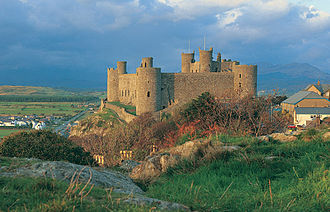
Catrin and Edmund had four children – a boy, Lionel, and three girls – although little else is known about their life together. However, their circumstances must have changed from 1405 onwards, as the English began to gain the upper hand in Wales. Owain avoided capture (his last recorded appearance was in 1412), but ultimately some of his family, including Catrin and Edmund, were pinned down at Harlech Castle. From this imposing fortress the Welsh continued to defy the English – and Edmund’s own exploits were celebrated by the bards – but the defenders were eventually starved into submission. The castle was surrendered in February 1409, by which point Edmund had already died.

Harlech Castle

After the fall of Harlech, Catrin and her surviving children were taken into custody, as was her mother, and they were later held in the Tower of London. They were all still there in June 1413, shortly after Henry V assumed the English throne, but Catrin passed away before the end of the year. The accounts of the Exchequer include a payment in December for her burial in St Swithin’s Church (which, intriguingly, is some distance from the Tower), together with her daughters.

Several historians, such as Terry Breverton, have suggested that Catrin and the others were put to death on the new king’s orders. This is partly based on the assumption that young Lionel was imprisoned with Catrin and subsequently disappeared; it is fair to say that Lionel, with his mixture of English and Welsh royal blood, might have posed a considerable threat to Henry if he had lived. Nevertheless, the evidence is ambiguous, as it is by no means clear that Lionel was taken at Harlech. It seems equally possible that he had already died, like his father – and that he was never in the Tower at all.

The fate of Catrin’s mother is also very uncertain, and one of Catrin’s daughters appears, in fact, to have outlived her; this is explicitly mentioned by the chronicler Adam of Usk, who was often well-informed. Besides, while Henry V could sometimes be a ruthless man, the notion that he ordered the murder of Catrin, and at least some of her children, does not sit well with the leniency he offered to other members of the Mortimer family (and even to Owain’s eldest son). Perhaps the conditions of Catrin’s imprisonment might have played a part, but it seems most likely that her death was due to natural causes.

Catrin was not entirely forgotten. She makes an interesting appearance, for example, in the first part of Shakespeare’s Henry IV. Edmund tells her fondly that ‘I understand thy kisses and thou mine’, but Catrin and her husband remain hampered by the language barrier between them. There is also tension between Catrin and her father, as they exchange words in Welsh, and one begins to suspect that Owain is not always a faithful translator. At last she tells her father that she will sing. Somewhat mollified, Owain instructs Edmund to rest his head in Catrin’s lap: so that she can ‘sing the song that pleaseth you, and on your eyelids crown the god of sleep.’

It is no longer clear what Shakespeare intended: the direction simply states that ‘here the lady sings a Welsh song’. Owain hopes, it would seem, that his daughter will provide a moment of calm before the storms ahead, and in many productions this is the effect achieved. She has been presented rather differently, however, in one recent American production. While her exhausted husband does rest his head in her lap, in this case Catrin’s song is no lullaby. Instead she offers a powerful lament, regretting man’s propensity for self-defeating war.

The memorial statue near the site of Catrin’s grave

In keeping with her father’s reputed gifts as a soothsayer, there is also an element of prophecy in the song, as Catrin rightly fears for the future of her ‘home’ (which is surely meant in a broader sense here). The text is adapted from a poem by Hedd Wyn a Welshman who was killed during the First World War, yet even those who cannot understand the words can still appreciate the sense of urgency and pathos. Previously denied the chance to speak directly to the audience, Catrin eventually finds a way to make her message plain.

Another writer to give Catrin a voice is Menna Elfyn, who has imagined her experience of captivity in a moving series of poems. At first Catrin is imprisoned with her children, but then her ‘chicks’ are taken from her: ‘without a farewell kiss, without wrapping them warmly’. ‘They were born to a traitor’, spits out one man, brusquely, although their fate remains uncertain (both for the reader and for Catrin). She pleads with the guards – ‘Take me too. There’s a knife in my heart’ – but she is left in her cell to meet a lonely end.

The medieval church of St Swithin’s was destroyed in the seventeenth century, during the Great Fire of London, and with it Catrin’s tomb. However, she is now represented by a modern statue, which can be found in a garden on the site of the church. The sculpture is intended not only as a commemoration of Catrin’s life, but also as a memorial to all the women and children who have suffered in war.

Sources

Terry Breverton, Owain Glyndŵr: The Story of the Last Prince of Wales (Stroud, 2009).

Chris Given-Wilson (ed.), The Chronicle of Adam of Usk, 1377-1421 (Oxford, 1997).

J.E. Lloyd, Owen Glendower (Owain Glyn Dŵr) (Oxford, 1931).

Menna Elfyn, Murmur (Tarset, 2012).

I would also like to thank Sara Hanna-Black for her help and encouragement.

All images from Wikipedia

About the Author

David Santiuste teaches history at the Centre for Open Learning, University of Edinburgh. His most recent book is The Hammer of the Scots. His other publications include Edward IV and the Wars of the Roses, as well as various articles.

David’s website can be found at davidsantiuste.com [insert link: https://davidsantiuste.com/], where he writes an occasional blog. You can follow him on Facebook at David Santiuste Historian or on Twitter @dbsantiuste.

The University of Edinburgh is a charitable body, registered in
Scotland, with registration number SC005336.


*

My Book:

Heroines of the Medieval World,  is now available in hardback in the UK from both Amberley Publishing and Amazon UK. It is also available on Kindle in both the UK and USA and will be available in Hardback from Amazon US from 1 May 2018. It can also be ordered worldwide from Book Depository.

23593407_1968209250117704_6252461679001074025_oa

You can be the first to read new articles by clicking the ‘Follow’ button, liking our Facebook page or joining me on Twitter.

*

©2018 Sharon Bennett Connolly


Sifting through history for interesting ladies!

Earlier this week, it was a pleasure to drop by Anna Belfrage‘s blog and have a chat about Heroines of the Medieval World and my love of history in general.

Anna posed some very interesting, thoughtful questions and finished off with a wonderful review of ‘Heroines’ – for which I am still smiling.

Here’s a taster of the interview:

Why this passion for history?

I honestly don’t know. I have always loved history – I just can’t get enough of it. The stories and the mysteries are so compelling. I love the ‘what ifs’. And it is something that is everywhere – you can go to Scotland, France, Russia, Canada and there is history.

Have you ever wished you could travel back in time to say hello to some of your favourite medieval heroines?

I would love to – so long as I can come back, I wouldn’t want to live in the past. I like my creature comforts too much. But it would be nice to sit at a table with Agnes of Dunbar and Nicholaa de la Haye and find out what made them so formidable. Or Eleanor of Aquitaine’s daughters and ask them what they really thought of their mum and dad – oh, that would be so interesting.

If you would like to read the entire interview and review, simply click here.

*

My Book:

Heroines of the Medieval World,  is now available in hardback in the UK from both Amberley Publishing and Amazon UK and worldwide from Book Depository. It is also available on Kindle in both the UK and USA and will be available in Hardback from Amazon US from 1 May 2018.

You can be the first to read new articles by clicking the ‘Follow’ button, liking our Facebook page or joining me on Twitter.

*

©2017 Sharon Bennett Connolly

The Countess who Chastised a King

300px-royal_arms_of_england_1154-1189-svg
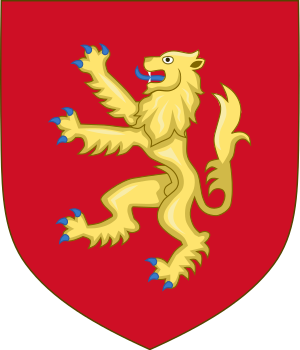
The arms of Hugh d’Aubigny, 5th Earl of Arundel

I recently came across the wonderful story of Isabel d’Aubigny, countess of Arundel, a woman who wouldn’t be cheated – even if it was by the king himself.

Isabel was born sometime in the late 1220s, the daughter of William de Warenne, 5th earl of Surrey and Warenne, and Matilda (or Maud) Marshal, daughter and co-heir of the Greatest Knight, William Marshal, earl of Pembroke. Through her grandfather, Hamelin Plantagenet, illegitimate half-brother of King Henry II, Isabel was a cousin of the king, Henry III.

With such impeccable parentage and family connections, it is no surprise that Isabel made a prestigious marriage. At no older than 8 years of age Isabel was married, in 1234, to 20-year-old Hugh d’Aubigny, 5th earl of Arundel. Hugh’s father, William, 3rd Earl of Arundel, had died in 1221, on his way home from the Fifth Crusade. William had been succeeded as 4th Earl by his oldest son and namesake, who died just 3 years after his father, aged just 21, leaving the earldom to his brother Hugh.

On their marriage, Isabel’s father granted the couple a manor at Marham in Norfolk, worth £40 a year in rent. The charter for this grant offers the only details available for the marriage. In 1242 Hugh accompanied the king on his expedition to Aquitaine. However, after just 9 years, on 7 May 1243, Hugh died; leaving Isabel, at 17 years of age, a childless widow, with a rather large dower.

Within weeks of her husband’s death, on 29th May, Isabel’s marriage was granted to Pierre de Genevre, a Savoyard favourite of the king, Henry III. However, the patent rolls show that provision was made for Isabel to remain unmarried should she so wish; although she would have to pay Pierre for the privilege. Given that she never remarried, she must have been more than happy to pay.

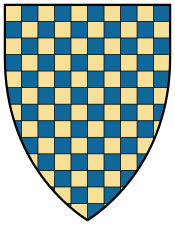
The de Warenne coat of arms

The Arundel inhheritance was divided between Hugh’s 4 sisters; Mabel, Isabel, Nicholaa and Cecily. The earldom itself went to Hugh’s nephew, his sister Isabel’s son, John FitzAlan. Isabel was well provided for, however, with her dower including the hundred and manor of Bourne in Lincolnshire, the manors of Wymondham and Kenninghall in Norfolk, Stansted in Essex and several properties in Norfolk and Buckinghamshire. Suffice to say, she was a very wealthy widow and would continue to be styled Countess of Arundel until her death.

In 1249, the same year as her mother died, Isabel founded the only English convent that was part of the Cistercian order. Established at Marham, two Cistercian abbots had inspected it in its first year. Isabel’s brother, John de Warenne, 6th Earl of Surrey, the Bishop of Norwich and Henry III himself all issued charters confirming the abbeys foundation. Along with other endowments, Isabel herself made 11 grants to the abbey in its early years, giving it a strong economic foundation. In 1252 Isabel was granted papal permission to visit the Cistercian house at Waverley to consult with him about her convent; Waverley’s annals record that she granted 4 marks and a cask of wine to the monks there.

Isabel was very protective of her property rights and went on the offensive when they were threatened, even if that meant going against the king. In 1252 Isabel did just that. One of her tenants, Thomas of Ingoldisthorpe, held a ¼ knight’s fee from Isabel at Fring and Snettisham; he also had property in the honour of Haughley, as an escheat from the crown. On his death in 1252 Henry III took all of Thomas’s lands in wardship until Thomas’s heir was of age, including Isabel’s ¼ knight’s fee. In March of 1252 Henry granted the wardship of the lands and marriage of the heir to his former treasurer and keeper of the king’s wardrobe, Peter Chaceporc. Had Thomas held his lands in chief from the king, Henry would have been within his rights to take prerogative wardship, however his land at Haughley was  held from the honour of Haughley, which only in the king’s hands as an escheat and Isabel had therefore been treated unjustly in being denied the wardship of his heirs.

Isabel took her grievances direct to the king, supposedly berating him for trampling on the rights laid out in Magna Carta. She is said to have asked:

‘Where are the liberties of England, so often recorded, so often granted, and so often ransomed?’¹

According to Matthew Paris, the chronicler and a personal friend of Isabel’s (though no particular fan of Henry), Henry scorned Isabel’s argument, ‘derisively and curling his nostrils’ and asked if the nobles of the realm had given her permission to speak on their behalf. Isabel argued that the king had given her the right to speak thus, in the articles granted in Magna Carta and accused the king of being a ‘shameless transgressor’ of the liberties laid down in the Great Charter, breaking his sworn oath to uphold its principles. At the end of the audience, Henry refused to be moved, ‘After listening to her [civilly] reproachful speech, the king was silent, and the countess, without obtaining or even asking for permission, returned home.’²

Arundel Castle

Isabel was one of the great nobles of England, the daughter of one earl and wife of another, and was obviously undaunted by an audience with the king. And although the king did not react to her reprimand immediately he did, eventually, admit that he may have been in the wrong, issuing a letter to her on 23 May 1253 saying:

‘Since the king has learnt that Thomas of Ingoldisthorpe, whose son and heir is in the custody of Peter Chaceporc by concession of the king, did not hold from the crown of the king in chief but from the honour of Haughley, which is in the hand of the king as his escheat, and that the same Thomas held from Hugh de Aubigny, once earl of Arundel, a quarter part of the fee of one knight with appurtenances in Fring and Snettisham and the service of which was assigned to Isabella, countess of Arundel, the widow of the foresaid earl, in dower, he has returned to the same countess custody of the foresaid quarter part of a fee with appurtenances; and the foresaid Peter is ordered to give the countess full seizin of the foresaid custody.’²

However, Isabel’s victory was incomplete, as in late 1253, while the king was overseas in Aquitaine, she instigated legal proceedings against Peter Chaceporc ‘for custody of Ingoldisthorpe’. Whether Chaceporc had not relinquished the land, or she believed she was entitled to more land than was returned to her, Isabel in fact lost the suit and was amerced £20 (30 marks) for a false claim. The writ was witnessed by Henry III’s queen, Eleanor of Provence, and his brother Richard, Earl of Cornwall.

As persistent as ever, and although he was overseas, Isabel appealed directly to the king, who responded with a pardon, although it seems he still smarted from the upbraiding she had given him earlier in the year:

‘3 April. Meilham. Henry, by the grace of God king of England, lord of Ireland, duke of Normandy and Aquitaine and count of Anjou sends greeting to his beloved consort E, by the same grace queen of England, lady of Ireland, duchess of Normandy and Aquitaine and countess of Anjou and to his beloved and faithful brother, R. earl of Cornwall. Know that we have pardoned our beloved and faithful Isabella countess of Arundel the 30m. at which she was amerced before our justices against our beloved and faithful … Peter Chaceporc, our Treasurer, for custody of Ingoldisthorpe. We, therefore, order you to cause the same countess to be quit of the aforesaid 30m. by our seal of England provided she says nothing opprobrious to us as she did when we were at Westminster and as we have signified to her by letter. Witness myself.’³

Holy Trinity Church, Marham

Isabel obviously had an eye for business, given that she could so concern herself with a ¼ knight’s fee out of the 60 that she held. A wealthy widow with impressive family connections, she was renowned not only for her religious endowment of the Cistercian convent at Marham, but also as a patron of religious texts, having commissioned at least 2 saints’ lives, including the life of St Richard of Wyche by Ralph Bocking. Isabel could count among her friends Richard Wych himself, the bishop of Chichester who was later canonised, and Matthew Paris. Paris translated  a life of Saint Edmund of Abingdon in to Anglo-Norman verse for Isabel’s personal use.

Isabel died shortly before 23 November 1282 and was laid to rest at her own foundation at Marham; her dower properties passed to her husband’s great-great nephew, Richard FitzAlan, 8th Earl of Arundel. Having spent almost 40 years as a childless widow, Isabel never remarried, her remarkable life dedicated to the patronage of her convent at Markham and religious writers, such as Paris and Bocking. This incredible woman stands out as the countess who reprimanded and humbled her king for his injustices.

*

Isabel’s remarkable story appears in my book, Defenders Of the Norman Crown: Rise and Fall of the Warenne Earls of Surrey.

Footnotes: 1. quoted by John A. Nichols in Oxforddnb.com; 2. quoted by Susanna Annesley in finerollshenry3.org.uk; 3. ibid.

*

Sources: John A. Nichols Oxforddnb.com; Susanna Annesley finerollshenry3.org.uk; Robert Bartlett England Under the Norman and Angevin Kings; Dan Jones The Plantagenets;David Williamson Brewer’s British Royalty; british-history.ac.uk; Early Yorkshire Charters Volume 8: The Honour of Warenne, Edited by William Farrer and Charles Travis Clay.

Pictures courtesy of Wikipedia: d’Aubigny arms by Sodocan; Warenne arms by Madboy74; Arundel Castle by Chensiyuan; Holy Trinity Church by John Billinger.

*

My Books

Signed, dedicated copies of all my books are available through my online bookshop.

Coming 30 January 2025: Scotland’s Medieval Queens

Scotland’s history is dramatic, violent and bloody. Being England’s northern neighbour has never been easy. Scotland’s queens have had to deal with war, murder, imprisonment, political rivalries and open betrayal. They have loved and lost, raised kings and queens, ruled and died for Scotland. From St Margaret, who became one of the patron saints of Scotland, to Elizabeth de Burgh and the dramatic story of the Scottish Wars of Independence, to the love story and tragedy of Joan Beaufort, to Margaret of Denmark and the dawn of the Renaissance, Scotland’s Medieval Queens have seen it all. This is the story of Scotland through their eyes.

Available for pre-order now.

Also by Sharon Bennett Connolly:

Heroines of the Tudor World tells the stories of the most remarkable women from European history in the time of the Tudor dynasty, 1485-1603. These are the women who ruled, the women who founded dynasties, the women who fought for religious freedom, their families and love. Heroines of the Tudor World is now available for pre-order from Amberley Publishing and Amazon UK. Women of the Anarchy demonstrates how Empress Matilda and Matilda of Boulogne, unable to wield a sword themselves, were prime movers in this time of conflict and lawlessness. It shows how their strengths, weaknesses, and personal ambitions swung the fortunes of war one way – and then the other. Available from Bookshop.orgAmberley Publishing and Amazon UKKing John’s Right-Hand Lady: The Story of Nicholaa de la Haye is the story of a truly remarkable lady, the hereditary constable of Lincoln Castle and the first woman in England to be appointed sheriff in her own right. Available from all good bookshops Pen & Sword Booksbookshop.org and Amazon

Defenders of the Norman Crown: The Rise and Fall of the Warenne Earls of Surrey tells the fascinating story of the Warenne dynasty, from its origins in Normandy, through the Conquest, Magna Carta, the wars and marriages that led to its ultimate demise in the reign of Edward III. Available from Pen & Sword BooksAmazon in the UK and US, and Bookshop.orgLadies of Magna Carta: Women of Influence in Thirteenth Century England looks into the relationships of the various noble families of the 13th century, and how they were affected by the Barons’ Wars, Magna Carta and its aftermath; the bonds that were formed and those that were broken. It is now available in paperback and hardback from Pen & SwordAmazon, and Bookshop.orgHeroines of the Medieval World tells the stories of some of the most remarkable women from Medieval history, from Eleanor of Aquitaine to Julian of Norwich. Available now from Amberley Publishing and Amazon, and Bookshop.orgSilk and the Sword: The Women of the Norman Conquest traces the fortunes of the women who had a significant role to play in the momentous events of 1066. Available now from Amazon,  Amberley Publishing, and Bookshop.org.

Alternate Endings: An anthology of historical fiction short stories including Long Live the King… which is my take what might have happened had King John not died in October 1216. Available in paperback and kindle from Amazon.

Podcast:

Have a listen to the A Slice of Medieval podcast, which I co-host with Historical fiction novelist Derek Birks. Derek and I welcome guests, such as Bernard Cornwell, and discuss a wide range of topics in medieval history, from significant events to the personalities involved.

*

Don’t forget! Signed and dedicated copies of all my books are available through my online bookshop.

For forthcoming online and in-person talks, please check out my Events Page.

You can be the first to read new articles by clicking the ‘Follow’ button, liking our Facebook page or joining me on TwitterThreadsBluesky and Instagram.

*

©2017 Sharon Bennett Connolly, FRHistS

‘Fair Rosamund’

Fair Rosamund by John William Waterhouse

The story of Rosamund de Clifford is shrouded in more legends than most medieval lives. After Eleanor of Aquitaine, she is the woman most associated with Henry II, king of England. In historical fiction, she is the woman who claimed his heart and stole him away from his queen. But who was she? How much of her story is real, how much is fantasy?

Rosamund de Clifford was probably born around 1140. She was the daughter of Walter de Clifford, a lord on the Welsh Marches, and his wife Margaret de Tosny. We know nothing of her childhood, she may have been educated at Godstow Abbey, but it is not certain; nor is when she actually met the king. The rest of her life is made of rumour and gossip.

Rosamund’s father served Henry II on campaign in Wales in the 1160s. It is possible that the king first met the young woman on a visit to de Clifford’s residence of Bredelais during the campaign. Some theories have Henry’s affair with Rosamund starting around 1165, the first Christmas that Henry spent apart from his queen, Eleanor of Aquitaine. Eleanor held her Christmas court at Angers while Henry was at Oxford. Henry had a tendency to be constantly on the move and it was unusual for him to be so immobile, which has led to suspicions that this was when his love affair with Rosamund began. However, there is evidence that Henry may also have been nursing some sort of injury, which would also curtail his movements.

Henry and Eleanor were to have one more child, John, born at Christmas 1166, which suggests the Christmas 1165 separation was more due to the logistics of ruling large domains than it was to Henry finding love elsewhere. However, there is a later story of Eleanor intending to have her lying in at the royal palace of Woodstock, only to find Rosamund in residence on her arrival and quickly relocating to Oxford to give birth.

Henry and Eleanor holding court

Henry was never a faithful husband and was known to have several illegitimate children, including William Longspée and Geoffrey, Archbishop of York. He numbered among his conquests Rohese, a daughter of the prominent de Clare family and Ida de Tosny, who later married Hugh Bigod, earl of Norfolk, and was mother of Longspée. If Henry and Rosamund did begin their relationship in the mid-1160s, they did a marvellous job of keeping the affair secret, as it was not made public until 1174.

Henry’s relationship with his queen soured considerably in the early 1170s with Eleanor taking the side of their sons and joining them in open rebellion in 1172-73. Henry managed to crush the rebellion and forgave his sons, but he was not so lenient with Eleanor. In 1174 he escorted her to England and installed her in Old Sarum, condemning her to what would be 15 years of imprisonment; she would only be released when her favourite son, Richard I, ascended the throne in 1189.

In the same year as Eleanor’s imprisonment, Henry’s relationship with Rosamund became common knowledge. She resided at the royal palace of Woodstock in Oxfordshire, which was extensively refurbished in the early 1170s. It was said that ‘King Henry had made for her a house of wonderful workmanship, a labyrinth of Daedelian design.’¹ There was said to be a labyrinth, a secret bower where Henry and Rosamund met and a well where Rosamund bathed. Rosamund’s Well can still be seen today in the grounds of Blenheim Palace, which now stands where Woodstock once stood.

Although it has come down through legend as a great love story, nothing is known of Rosamund’s feelings towards Henry, nor whether she any any say in her position as the king’s mistress. The chroniclers of the time, of course, painted her as the fallen woman, a seductress and adulteress. They created puns derived from her name; Rosamund, or rosa mundi meaning the rose of the world became rosa immunda – the unclean rose – and rosa immundi – the unchaste rose.

The ruins of Godstow Abbey

That poor Rosamund was blamed for Henry’s infidelity was a sign of the times; women were the daughters of Eve, temptation for honourable men who had no power to resist them. Rosamund’s early death was seen as a just punishment for her lascivious lifestyle. Rosamund ended her relationship with Henry in 1175/6 and withdrew to Godstow Abbey. It seems likely that she was already ill when she entered the priory and she died in 1176. Henry paid for a lavish tomb within the convent church, at which the nuns left floral tributes on a daily basis. In the years following Rosamund’s death, Henry endowed the convent with 2 churches at Wycombe and Bloxham, new buildings and substantial amounts of building materials. Rosamund’s father, Walter, granted the abbey mills and a meadow, for the souls of his wife and daughter.

Unfortunately, however, Rosamund was not allowed to rest in peace. In 1190 when  the saintly Bishop Hugh of Lincoln visited Godstow he was horrified that Rosamund’s tomb had a place of honour within the church and ordered her remains to be removed. The tomb was resited in the nun’s chapter house, with an accompanying inscription admonishing her lifestyle:

This tomb doth here enclose the world’s most beauteous Rose,

Rose passing sweet erewhile, now nought but odour vile.²

Eleanor prepares to poison Rosamund by Evelyn De Morgan

Rosamund’s early death – she was still only in her 30s – inspired legends of revenge; Eleanor has been variously accused of stabbing her in her bath and poisoning her. In one extravagant version, Rosamund was hidden in her secret bower within a maze but, with the help of a silken thread, a jealous Eleanor still found her and stabbed her while she bathed. In another the discarded queen forced Rosamund to drink from a poison cup. Of course, a closely guarded prisoner in Old Sarum or at Winchester as she was, it was impossible for Eleanor to do any such thing. But it makes for a good story!

Rosamund’s relationship with Henry probably lasted no more than 10 years and possibly as little as 3 years. She may have seen little of Henry in that time, as he was a constantly on the move and only spent a little over 3 of those 10 years in England in total. It is possible that Rosamund sometimes travelled with him, discreetly, although this seems unlikely given that no one knew of her until after Eleanor’s rebellion and imprisonment. There are some theories that suggest Henry had lost interest in Rosamund even before her death, and that was the reason for her retirement to Godstow. Although his lavish endowment of the Abbey may argue otherwise, Henry is said to have turned his attentions to his son Richard’s fiancée, Princess Alys, sister of Philip II of France.

Perhaps the truth of Rosamund’s story matters less than the legend and romance that has grown up around it. Maybe the story of unrequited love, secret trysts and hidden bowers are just as important to history than the sordid truth a woman seduced by a king with little say in the direction of her own life, denied husband, children and a future.

Maybe the romance is what makes the story more palatable.

The Ballad of Fair Rosamund

The Flower of the World

When as king Henry ruled this land,

The second of that name,

Besides the queene, he dearly loved

A faire and comely dame

Most peerless was her beautye founde,

Her favour, and her face;

A sweeter creature in this worlde

Could never prince embrace.

Her crisped lockes like threads of golds

Appeared to each man’s sight;

Her sparkling eyes, like Orient pearles,

Did cast a heavenlye light.

The blood within her crystal cheeks

Did such a colour drive,

As though the lillye and the rose

For mastership did strive.

Yea Rossamonde, fair Rosamonde,

Her name was called so,

To whom our queene, dame Ellinor,

Was known a deadly foe.

The king therefore, for her defence

Against the furious queene,

At Woodstocke builded such a bower,

The like was never seene.

Most curiously that bower was built

Of stone and timber strong,

An hundred and fifty doors

Did to this bower belong.

And they so cunningly contriv’d,

With turnings round about,

That none but with a clue of thread

Could enter in and out.³

*

Footnotes: ¹Polychronicon quoted in Oxforddnb.com; ² Speed quoted in Oxforddnb.com; ³Anonymous quoted in Eleanor, April Queen of Aquitaine by Douglas Boyd

Pictures courtesy of Wikipedia

Sources: Oxforddnb.com by T.A. Archer, rev by Elizabeth Hallam; Wordsworth Dictionary of British History by J.P. Kenyon; kings, Queens, Bones and Bastards by David Hilliam; England Under the Norman and Angevin Kings 1075-1225 by Robert Bartlett; King John by Marc Morris; The Devil’s Brood by Desmond Seward; The Greatest Knight by Thomas Asbridge; Eleanor, April Queen of Aquitaine by Douglas Boyd; Eleanor of Aquitaine by Alison Weir; The Plantagenet Chronicles Edited by Elizabeth Hallam.

*

My books

Signed, dedicated copies of all my books are available through my online bookshop.

Out Now! Women of the Anarchy

Two cousins. On the one side is Empress Matilda, or Maud. The sole surviving legitimate child of Henry I, she is fighting for her birthright and that of her children. On the other side is her cousin, Queen Matilda, supporting her husband, King Stephen, and fighting to see her own son inherit the English crown. Women of the Anarchy demonstrates how these women, unable to wield a sword, were prime movers in this time of conflict and lawlessness. It show how their strengths, weaknesses, and personal ambitions swung the fortunes of war one way – and then the other.

Available from Bookshop.orgAmberley Publishing and Amazon UK.

Coming on 15 June 2024: Heroines of the Tudor World

Heroines of the Tudor World tells the stories of the most remarkable women from European history in the time of the Tudor dynasty, 1485-1603. These are the women who ruled, the women who founded dynasties, the women who fought for religious freedom, their families and love. These are the women who made a difference, who influenced countries, kings and the Reformation. In the era dominated by the Renaissance and Reformation, Heroines of the Tudor World examines the threats and challenges faced by the women of the era, and how they overcame them. From writers to regents, from nuns to queens, Heroines of the Tudor World shines the spotlight on the women helped to shape Early Modern Europe.

Heroines of the Tudor World is now available for pre-order from Amberley Publishing and Amazon UK.

Also by Sharon Bennett Connolly:

King John’s Right-Hand Lady: The Story of Nicholaa de la Haye is the story of a truly remarkable lady, the hereditary constable of Lincoln Castle and the first woman in England to be appointed sheriff in her own right. It is is available from King John’s Right-Hand Lady: The Story of Nicholaa de la Haye is the story of a truly remarkable lady, the hereditary constable of Lincoln Castle and the first woman in England to be appointed sheriff in her own right. Available from all good bookshops or direct from Pen & Sword Booksbookshop.org and AmazonDefenders of the Norman Crown: The Rise and Fall of the Warenne Earls of Surrey tells the fascinating story of the Warenne dynasty, from its origins in Normandy, through the Conquest, Magna Carta, the wars and marriages that led to its ultimate demise in the reign of Edward III. Available from Pen & Sword BooksAmazon in the UK and US, and Bookshop.org

Ladies of Magna Carta: Women of Influence in Thirteenth Century England looks into the relationships of the various noble families of the 13th century, and how they were affected by the Barons’ Wars, Magna Carta and its aftermath; the bonds that were formed and those that were broken. It is now available in paperback and hardback from Pen & Sword,  Amazon, and Bookshop.orgHeroines of the Medieval World tells the stories of some of the most remarkable women from Medieval history, from Eleanor of Aquitaine to Julian of Norwich. Available now from Amberley Publishing and Amazon, and Bookshop.orgSilk and the Sword: The Women of the Norman Conquest traces the fortunes of the women who had a significant role to play in the momentous events of 1066. Available now from Amazon,  Amberley Publishing, and Bookshop.org.

Alternate Endings: An anthology of historical fiction short stories including Long Live the King… which is my take what might have happened had King John not died in October 1216. Available in paperback and kindle from Amazon.

Podcast:

Have a listen to the A Slice of Medieval podcast, which I co-host with Historical fiction novelist Derek Birks. Derek and I welcome guests, such as Bernard Cornwell and Elizabeth Chadwick, and discuss a wide range of topics in medieval history, from significant events to the personalities involved.

*

Don’t forget! Signed and dedicated copies of all my books are available through my online bookshop.

For forthcoming online and in-person talks, please check out my Events Page.

You can be the first to read new articles by clicking the ‘Follow’ button, liking our Facebook page or joining me on Twitter and Instagram.

*

©2017 Sharon Bennett Connolly FRHistS
Joan Makepeace, Scotland’s Lonely Queen

joan_queen_of_scotland1
Joan of the Tower, Queen of Scotland

In my research I frequently discover instances of happy medieval marriages – and even if a marriage was not based on love, it did not mean that it would not be successful. Indeed, in many such instances the young woman concerned found her own way of succeeding, whether it was through her children or the management of estates – or the fact that a lasting peace was achieved between her 2 countries.

Unfortunately for Joan of the Tower, later to be known as Joan Makepeace, her marriage achieved none of these things.

Joan was born in the Tower of London on 5 July, 1321; hence her rather dramatic name. She was the youngest of the 4 children of Edward II and his queen, Isabella of France, and had 2 older brothers and 1 sister. Her eldest brother, Edward, who was 9 years older than Joan, succeed his father as King Edward III in 1327, following Edward II’s deposition. While her 2nd brother, John of Eltham, was born in 1316 and died shortly after his 20th birthday, while campaigning against the Scots. Joan’s only sister, Eleanor of Woodstock, born in 1318, was only 3 years older than her baby sister and would go on to marry Reginald II, Count of Guelders.

Joan also had an illegitimate brother, Adam FitzRoy, a son of Edward II by an unknown woman. He was born in the early 1300s, but died whilst campaigning in Scotland with his father, in 1322.

Little Joan was named after her maternal grandmother, Queen Joan I of Navarre, wife of Philip IV of France. The king, also in London at the time of Joan’s birth, but not at the  Tower, granted an £80 respite on a £180 loan to Robert Staunton, the man who brought him news of the birth.¹ By 8th July Edward was visiting his wife and baby daughter at the Tower of London and stayed with them for several days.

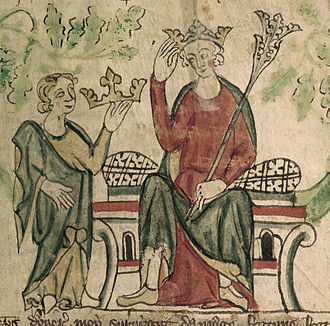
Joan’s father, Edward II

As the last of the children of Edward II and Isabella, it seems likely that the royal couple’s relationship changed shortly after her birth, their marriage heading for an irretrievable breakdown that would see the king deposed in favour of his son. Edward II was well known for having favourites; the first, Sir Piers Gaveston, met a sticky end in 1312, when he was murdered by barons angry at the influence he held over the king. Isabella’s estrangement with her husband followed the rise of a new favourite, Sir Hugh le Despenser, and, by the time of Joan’s birth, his influence on the king was gaining strength and alienating powerful barons at court. In March 1322 those barons were defeated at the Battle of Boroughbridge, Yorkshire, with many prominent barons killed, including the king’s erstwhile brother-in-law Humphrey de Bohun, earl of Hereford. The leader of the insurrection, the king’s cousin Thomas, earl of Lancaster, was executed 6 days later at Pontefract Castle.

Joan was, therefore, growing up amid a period of great turmoil, not only within England, but within her own family. It is doubtful that, as she grew, she was unaware of the atmosphere, but  Isabella and Edward were both loving parents and probably tried to shield their children as much as they could, ensuring stability in their everyday lives. Joan was soon placed  in the household of her older siblings, and put into the care of Matilda Pyrie,  who had once been nurse to her older brother, John of Eltham.

Sometime before February 1325, Joan and her sister were established in their own household, under the supervision of Isabel, Lady Hastings and her husband, Ralph Monthermer. Isabel was the younger sister of Edward II’s close companion, Hugh Despenser the Younger, and this act has often been seen by historians as the king removing the children from the queen’s custody. Although it could have been a malicious act it must be remembered, however, that Ralph Monthermer was the girls’ uncle-by-marriage through his first wife, Joan of Acre, Edward II’s sister, and it was a custom of the time that aristocratic children were fostered among the wider family.

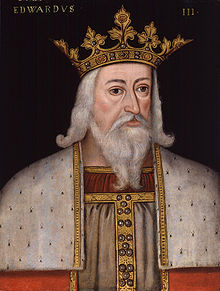
Joan’s brother Edward III

Joan and her elder sister, Eleanor, remained with Isabel even after Ralph’s death in the summer of 1325; however, the following year, they were given into the custody of Joan Jermy, sister-in-law of the king’s younger half-brother Thomas, Earl of Norfolk. Joan was the sister of Thomas’s wife, Alice Hales, and took charge of the girls’ household in January 1326, living alternately at Pleshey in Essex and Marlborough in Wiltshire.

As with all her siblings, Joan played a part in her father’s diplomatic plans; an attempt to form an alliance against France, Edward sought marriages in Spain for 3 of his 4 children. While Eleanor was to marry Alfonso XI of Castile, little Joan was proposed as the bride for the grandson of Jaime II of Aragon – the future Pedro IV – but this would come to nought.

By this time their mother, Isabella, was living at the French court, along with her eldest son, Edward, refusing to return to her husband whilst he still welcomed Hugh Despenser at his court. Within months Isabella and her companion (possibly her lover), Roger Mortimer, were to invade England and drive Edward II from his throne, putting an end to the proposed Spanish marriages. He was captured and imprisoned in Berkley Castle, forced to abdicate in favour of his eldest son, who was proclaimed King Edward III in 1327.

With her father exiled or murdered (his fate remains a bone of contention to this day), Joan became the central part of another plan – that of peace with Scotland. Isabella and her chief ally, Roger Mortimer, were now effectively ruling the kingdom for the young Edward III – still only in  his mid-teens. With the kingdom in disarray Isabella sought to end the interminable wars with Scotland, much to the young king’s disgust. Joan was offered as a bride for David, Robert the Bruce’s only son and heir, by his second wife, Elizabeth de Burgh.

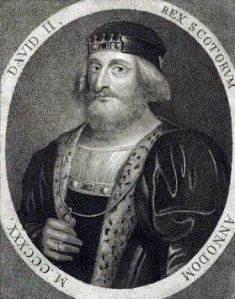
David II

The 1328 Treaty of Northampton was seen as a major humiliation by Edward III – and the 16-year-old king made sure his displeasure was known. However, he was forced to sign it, agreeing to Scotland’s recognition as an independent kingdom, the return of both the Ragman Roll (a document showing the individual acts of homage by the Scottish nobility) and the Stone of Scone (the traditional stone on which Scotland’s kings were crowned and which had sat in Westminster Abbey since being brought south by Edward I) and the marriage of Bruce’s 4-year-old son, David, to his 7-year-old sister, Joan.

Although the Stone of Scone and Ragman Roll were never returned to Scotland, the marriage between Joan and David did go ahead, although with a proviso that, should the marriage not be completed within 2 months of David reaching his 14th birthday, the treaty would be declared invalid. With neither king present – with Edward III refusing to attend, Robert the Bruce did likewise, claiming illness – the children were married at Berwick-on-Tweed on 17 July 1328, in the presence of Queen Isabella. The wedding was a lavish occasion, costing the Scots king over £2500.²

Following the wedding, and nicknamed Joan Makepeace by the Scots, Joan remained in Scotland with her child-groom. With Robert the Bruce’s death the following year, and David’s accession to the throne as David II, Joan and David attained the dubious record of being the youngest married monarchs in British history. They were crowned, jointly, at Scone Abbey in Perthshire, on 24th November 1331. It was the 1st time a Scottish Queen Consort was crowned.

Virtually nothing is known of Joan’s early years in Scotland. We can, I’m sure, assume she continued her education and maybe spent some time getting to know her husband. Scotland, however, was in turmoil and Edward III was not about to let his sister’s marriage get in the way of his own ambitions for the country. Unfortunately for Joan, Edward Balliol, son of the erstwhile king, John Balliol, and Isabella de Warenne, had a strong claim to the crown and was, as opposed to her young husband, a grown man with the backing of Edward III. What followed was a tug-of-war for Scotland’s crown, lasting many years.

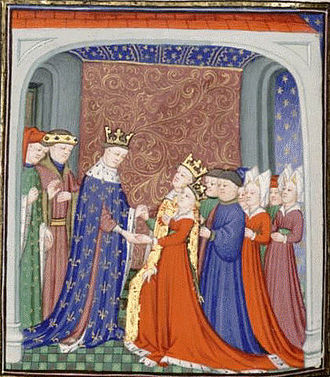
David II and Joan being greeted by Philip VI of France

David’s supporters suffered a heavy defeat at Halidon Hill in July 1333 and shortly after Joan, who was residing at Dumbarton at the time, and David were sent to France for their safety, where they spent the next 7 years. An ally of Scotland and first cousin of Joan’s mother, Philip VI of France gave the king and queen, and their Scottish attendants, accommodation in the famous Château Gaillard in Normandy.

Their return to Scotland, on 2nd June 1341, was greeted with widespread rejoicing that proved to be short-lived. When the French asked for help in their conflict with the English, David led his forces south. He fought valiantly in the disastrous battle at Neville’s Cross on 17th October 1346, but was captured by the English; he was escorted to a captivity in England that would last for the next 11 years, save for a short return to Scotland in 1351-52.

Joan and David’s marriage had proved to be an unhappy, loveless and childless union and, while a safe conduct was issued for Joan to visit her husband at Windsor for the St George’s Day celebrations of 1348, there is no evidence she took advantage of it. Although we know little of Joan’s movements, it seems she remained in Scotland at least some of the time, possibly held as a hostage to David’s safety by his Scottish allies. She may also have visited David in his captivity, taking it as an opportunity to visit with her own family, including her mother; Queen Isabella is said to have supported Joan financially while her husband was imprisoned, feeding and clothing her. Joan does not appear to have taken an active role in negotiations for David’s release, despite her close familial ties to the English court.

When David returned to Scotland he brought his lover, Katherine Mortimer, with him. They had met in England and it was said “The king loved her more than all other women, and on her account his queen was entirely neglected while he embraced his mistress.”³ Katherine met a grisly fate and was stabbed to death by the Earl of Atholl.

At Christmas 1357 Joan was issued with a safe conduct from Edward III “on business touching us and David” and again in May 1358 “by our licence for certain causes”.² Although the licences are understandably vague on the matter, Joan had, in fact, left David and Scotland.

All that remains of Joan’s burial place

Joan spent the rest of her life in England, living on a pension of £200 a year provided by her brother, Edward III. She renewed family connections and was able to visit her mother before Isabella’s death in August 1358. As Queen of Scotland, she occasionally acted on her husband’s behalf. In February 1359 David acknowledge her assistance in the respite of ransom payments granted by Edward III saying it was “at the great and diligent request and instance of our dear companion the Lady Joan his sister.”²

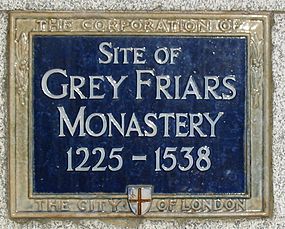
Little is known of Joan’s appearance or personality. Several years after her death she was described as “sweet, debonair, courteous, homely, pleasant and fair” by the chronicler Andrew of Wyntoun.² Having led an adventurous life, through no choice of her own, if unhappy in love, Joan of the Tower, Queen of Scotland, died at the age of 41 on 7th September 1362, and was buried in the Church of the Greyfriars, Newgate, in London, where her mother had been laid to rest just 4 years earlier.

Following his wife’s death David II married his lover, Margaret Drummond, the widow of Sir John Logie, but divorced her on 20th March 1370. He died, childless, at Edinburgh Castle in February 1371, aged 47, and was succeeded by the first of the Stewart kings, his nephew, Robert II, son of Robert the Bruce’s eldest daughter, Marjorie.

*

Footnotes: ¹Isabella of France: The Rebel Queen by Kathryn Warner; ² Oxforddnb.com; ³Walter Bower quoted in Oxforddnb.com

Sources: The Story of Scotland by Nigel Tranter; Brewer’s British Royalty by David Williamson; Kings & Queens of Britain by Joyce Marlow; Mammoth Book of British Kings & Queens by Mike Ashley; Oxford Companion to British History Edited by John Cannon; Britain’s Royal Families by Alison Weir; educationscotland.gov.uk/scotlandhistory; englishmonarchs.co.uk; berkshirehistory.com; thefreelancehistorywriter.com; The Perfect King by Ian Mortimer; Scotland, History of a Nation by David Ross; The Life & Times of Edward III by Paul Johnson; The Reign of Edward III by W.M. Ormrod; Isabella of France: The Rebel Queen by Kathryn Warner; Isabella and the Strange Death of Edward II by Paul Doherty; Edward II: The Unconventional King by Kathryn Warner; Oxforddnb.com.

*

My Books

Signed, dedicated copies of all my books are available through my online bookshop.

Out now: Scotland’s Medieval Queens

Scotland’s history is dramatic, violent and bloody. Being England’s northern neighbour has never been easy. Scotland’s queens have had to deal with war, murder, imprisonment, political rivalries and open betrayal. They have loved and lost, raised kings and queens, ruled and died for Scotland. From St Margaret, who became one of the patron saints of Scotland, to Elizabeth de Burgh and the dramatic story of the Scottish Wars of Independence, to the love story and tragedy of Joan Beaufort, to Margaret of Denmark and the dawn of the Renaissance, Scotland’s Medieval Queens have seen it all. This is the story of Scotland through their eyes.

Available now from Amazon and Pen and Sword Books

Also by Sharon Bennett Connolly:

Heroines of the Tudor World tells the stories of the most remarkable women from European history in the time of the Tudor dynasty, 1485-1603. These are the women who ruled, the women who founded dynasties, the women who fought for religious freedom, their families and love. Heroines of the Tudor World is now available for pre-order from Amberley Publishing and Amazon UK. Women of the Anarchy demonstrates how Empress Matilda and Matilda of Boulogne, unable to wield a sword themselves, were prime movers in this time of conflict and lawlessness. It shows how their strengths, weaknesses, and personal ambitions swung the fortunes of war one way – and then the other. Available from Bookshop.orgAmberley Publishing and Amazon UKKing John’s Right-Hand Lady: The Story of Nicholaa de la Haye is the story of a truly remarkable lady, the hereditary constable of Lincoln Castle and the first woman in England to be appointed sheriff in her own right. Available from all good bookshops Pen & Sword Booksbookshop.org and Amazon

Defenders of the Norman Crown: The Rise and Fall of the Warenne Earls of Surrey tells the fascinating story of the Warenne dynasty, from its origins in Normandy, through the Conquest, Magna Carta, the wars and marriages that led to its ultimate demise in the reign of Edward III. Available from Pen & Sword BooksAmazon in the UK and US, and Bookshop.orgLadies of Magna Carta: Women of Influence in Thirteenth Century England looks into the relationships of the various noble families of the 13th century, and how they were affected by the Barons’ Wars, Magna Carta and its aftermath; the bonds that were formed and those that were broken. It is now available in paperback and hardback from Pen & SwordAmazon, and Bookshop.orgHeroines of the Medieval World tells the stories of some of the most remarkable women from Medieval history, from Eleanor of Aquitaine to Julian of Norwich. Available now from Amberley Publishing and Amazon, and Bookshop.orgSilk and the Sword: The Women of the Norman Conquest traces the fortunes of the women who had a significant role to play in the momentous events of 1066. Available now from Amazon,  Amberley Publishing, and Bookshop.org.

Alternate Endings: An anthology of historical fiction short stories including Long Live the King… which is my take what might have happened had King John not died in October 1216. Available in paperback and kindle from Amazon.

Podcast:

Have a listen to the A Slice of Medieval podcast, which I co-host with Historical fiction novelist Derek Birks. Derek and I welcome guests, such as Bernard Cornwell and discuss a wide range of topics in medieval history, from significant events to the personalities involved. Every episode is also now available on YouTube.

*

Don’t forget! Signed and dedicated copies of all my books are available through my online bookshop.

For forthcoming online and in-person talks, please check out my Events Page.

You can be the first to read new articles by clicking the ‘Follow’ button, liking our Facebook page or joining me on Twitter and Instagram.

©2017 Sharon Bennett Connolly FRHistS
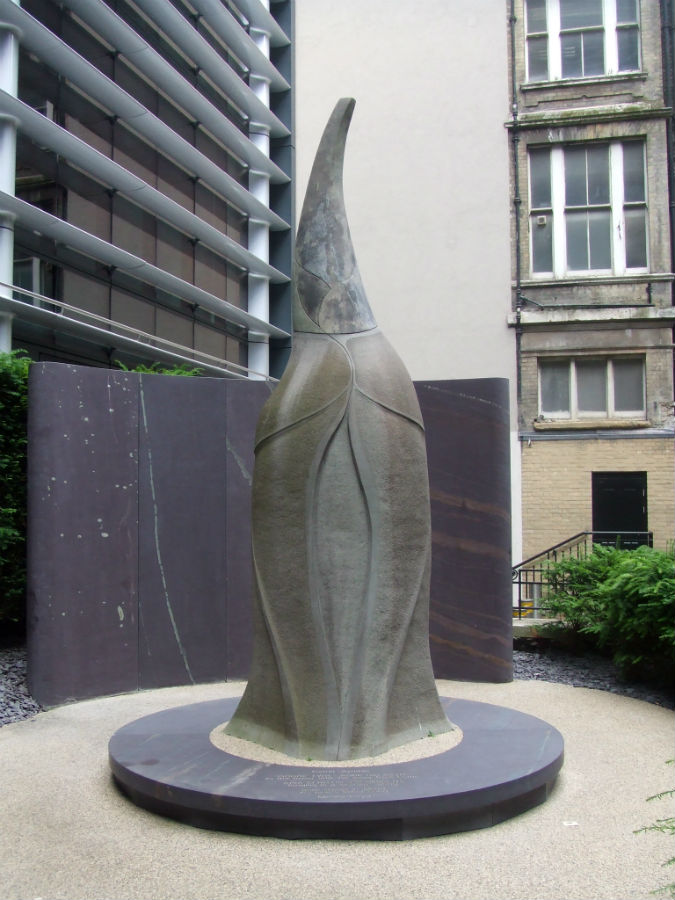
“The Lincoln Fair” – the Battle that Saved England

The Battle of Lincoln by Matthew Paris

Saturday 20th May, 2017, marked the 800th anniversary of one of Medieval England’s most decisive battles. The Second Battle of Lincoln, also known as “The Lincoln Fair”, rescued England from the clutches of Louis, Dauphin of France and future King Louis VIII.

England had been in turmoil during the last years of the reign of King John, with the barons trying to curtail the worst of his excesses. It had been hoped that the 1215 issuing of Magna Carta would prevent war, but when John reneged on the Great Charter, war was inevitable. England’s disgruntled barons even went so far as to write to Philip II, King of France, and invite his son, Louis, to come and claim the throne. Louis jumped at the chance and landed on England’s shores in 1216.

Strategically placed in the centre of the country, Lincoln was a target for the rebel barons and their French allies. An important Royalist stronghold, it was held by the redoubtable hereditary castellan, Lady Nicholaa de la Haye, who had been widowed in the early months of 1215. Lincoln Castle had already been under siege in 1216, when the northern rebels had been paid to go away. The rebels – including the King of Scotland – then fled north as John’s army advanced on the city. It was probably after the 1216 siege that Nicholaa made a show of relinquishing her post as castellan; however, John had other ideas:

And once it happened that after the war King John came to Lincoln and the said Lady Nicholaa went out of the eastern gate of the castle carrying the keys of the castle in her hand and met the king and offered the keys to him as her lord and said she was a woman of great age and was unable to bear such fatigue any longer and he besought her saying, “My beloved Nicholaa, I will that you keep the castle as hitherto until I shall order otherwise”.¹

John went even further to show his trust in Nicholaa, who was a long-time supporter of the unpopular king. As Louis consolidated his position in the south, John made an inspection of Lincoln castle in September 1216. He then moved south, losing his baggage as he crossed the Wash and falling ill as he travelled. After a brief stay at Swineshead Abbey, he made his way to Newark, where he died on the night of 18/19 October. Mere hours earlier, John had made history by appointing Nicholaa to the post of Sheriff of Lincolnshire. She was the first woman to ever be appointed sheriff in her own right. .

The Observatory Tower, Lincoln Castle

When John died, half of his country was occupied by a foreign invader and his throne now occupied by his 9-year-old son, Henry III. The only royal castles still in royalist hands were Windsor, Dover – and Lincoln. The elder statesman and notable soldier William Marshal, Earl of Pembroke was appointed Regent and set out to save the kingdom.

Following the coronation of young Henry, Magna Carta was reissued and some of the rebel barons returned to the fold, not wanting to make war on a 9-year-old king. However, Louis still had powerful supporters and did not seem keen to give up on his dream to rule England.

Louis’ forces, under the Comte de Perche, along with leading rebels Saher de Quincy, Earl of Wonchester, and Robert FitzWalter, marched north intending to relieve Mountsorel Castle, which was being besieged by the Earl of Chester. Fearing he was facing the entire French invading force, Chester had withdrawn as the French arrived and Perche’s forces diverted to Lincoln. Gilbert de Gant, on hearing news of John’s death, had occupied the city in late 1216 with a small force. He was now reinforced by Perche’s army and in early 1217, they laid siege to the castle. Now in her 60s, Nicholaa de la Haye took charge of the defences, with the help of her lieutenant, Sir Geoffrey de Serland.

For almost 3 months – from March to mid-May – siege machinery continuously bombarded the south and east walls of the castle. When the allied force proved insufficient to force a surrender, the French had to send for reinforcements. This meant that half of Louis’ entire army was now outside the gates of Lincoln Castle and provided William Marshal with an opportunity; one decisive battle against Louis’ forces at Lincoln could destroy the hopes of Louis and the rebel barons, once and for all.

DSCN5225
Nicholaa de la Haye, Lincoln Castle

Risking all on one battle was a gamble, but one that Marshal was determined to take. Spurred on by the chivalrous need to rescue a lady in distress – the formidable Lady Nicholaa – Marshal ordered his forces to muster at Newark by 17th May. While the young king, Henry III, waited at Nottingham, Marshal’s army prepared for war. The papal legate, Guala Bicchieri, absolved the Royalist army of all their sins – of all the sins they had committed since their birth – and excommunicated the French and rebel forces, before riding to join the king at Nottingham.

While at Newark, Marshal set out the order of battle, although not without some argument. The Norman contingent and Ranulf, earl of Chester, both claimed the right to lead the vanguard. However, when Ranulf threatened to withdraw his men, it was decided to acquiesce to his demands.

Lincoln is an unusual city; its castle and cathedral sit at the top of a hill, with the rest of the city to the south, at the hill’s base. In the 12th century it was enclosed in a rectangular wall, which had stood since Roman times,  with 5 gates, and the castle abutting the wall at the north-west corner. William Marshal decided not to attack Lincoln from the south, which would have meant heading up the Fosse Way (the old Roman road) and forcing a crossing of the River Witham, before climbing the steep slope to the castle and cathedral (so steep, the road going up is called Steep Hill to this day). Instead he chose to take a circuitous route, so he could come at the city from the north-west and attack close to the castle and cathedral, directly where the enemy troops were concentrated.

On the 19th May Marshal’s forces rode from Newark alongside the the River Trent and set up camp at Torksey, about 8 miles to the north of Lincoln, or Stow, depending on the source you read. Or, perhaps, both.

Coronation of Louis VIII and Blanche of Castile. Louis’ claim to England was through his wife, a granddaughter of Henry II

The English commanders included William Marshal, earl of Pembroke, his son, Young William Marshal, and nephew, John Marshal, in addition to Ranulf, Earl of Chester, William Longspée, Earl of Salisbury, Peter des Roches, Bishop of Winchester, and Faulkes de Breauté, King John’s mercenary captain. They led 406 knights, 317 crossbowmen and a large number of sergeants-at-arms, foot soldiers and camp followers.

Although Louis was in charge of the French forces in England, those in Lincoln were led by Thomas, Comte de Perche, himself a grandson of Henry II’s daughter Matilda, and therefore a cousin of King Henry III. Perche was also related to William Marshal; both were descended from sisters of Patrick, 1st earl of Salisbury. The commanders of the English rebels in the city included Robert FitzWalter and Saer de Quincey, Earl of Winchester. They led over 600 knights and several thousand infantry.

At various points in the lead up to the battle, William Marshal is known to have made some stirring speeches. When battle was imminent, he made one more;

Now listen, my lords! There is honour and glory to be won here, and I know that here we have the chance to free our land. It is true that you can win this battle. Our lands and our possessions those men have taken and seized by force. Shame be upon the man who does not strive, this very day, to put up a challenge, and may the Lord our God decide the matter. You see them here in your power. So much do I fully guarantee, that they are ours for the taking, whatever happens. If courage and bravery are not found wanting.

Coat of arms of William Marshal

And, if we die …, God, who knows who are his loyal servants, will place us today in paradise, of that I am completely certain. And, if we beat them, it is no lie to say that we will have won eternal glory for the rest of our lives and for our kin. And I shall tell you another fact which works very badly against them: they are excommunicated and for that reason all the more trapped. I can tell you that they will come to a sticky end as they descend into hell. There you see men who have started a war on God and the Holy Church. I can fully guarantee you this, that God has surrendered them into our hands.

Let us make haste and attack them, for it is truly time to do so!²

As with all battles, the information gets confusing as the fighting commences, timings get distorted and facts mixed. No two sources give exactly the same information. So the story of a battle is a matter of putting the pieces together and making sense of various snippets of information – much as it would have been for the commanders on the day.

In the dawn of 20th May the English Royalist army marched south towards Lincoln, probably climbing to the ridge at Stow so as not to have that climb nearer to Lincoln, with the enemy in sight. Marshal had hoped that, on reaching the plain in front of the city walls, the French and rebels would come out and meet him and a pitched battle would be fought outside of the city. Marshal was resting everything – the very future of England – on the outcome of that one battle. However, it seems that, although the allied leaders did come out and take a look at the forces arrayed before them, they then chose to stay inside the city walls and wait for the Royalists to come to them.

The West Gate of Lincoln Castle

William Marshal’s nephew, John Marshal was sent to the castle, to ascertain the situation within the city, but as he approached, Nicholaa’s deputy, Geoffrey de Serland, was making his way out to report to the English commanders that the castle was still in Nicholaa’s hands. It is not hard to imagine Nicholaa or her deputy climbing the tallest towers of the castle – perhaps the one now known as the Observatory Tower, used in Matthew Paris’s illustration – to watch out for an approaching relief force. Seeing the Marshal’s banners appearing in the north must have been an amazing feeling.

The castle itself had two main gates, one in the eastern wall and one in the west, with postern gates in the Lucy Tower to the south-east of the castle, the tower known as Cobb Hall to the north-east corner and another in the northern wall. On ascertaining that the castle still held, Peter des Roches then made his way inside, most likely by either the postern gate in Cobb Hall, or the one in the northern wall. Having met with Nicholaa de la Haye in the Lucy Tower, it seems he then made his way into the town via its postern gate, to check the defences and try to find a way into the city.

According to the Histoire, des Roches’ reconnaissance proved successful and he reported to Marshal that there was a gate within the north-west wall of the city, which, although blockaded, could be cleared. As Marshal set men to clearing the blockaded gate, the earl of Chester was sent to attack the North Gate as a diversion and Faulkes de Breauté took his crossbowmen into the castle via a postern gate and set them on the ramparts above the East Gate, so their bolts could fire down on the besiegers.

De Breauté fell into disgrace in 1224 and so the major source for the Battle of Lincoln – the Histoire de Guillaume le Maréschale – plays down his role in the battle. However, his crossbowmen managed to keep the French forces focussed on the castle, rather than Marshal’s forces outside the city. De Breauté did make a sortie out of the East Gate, to attack the besiegers, but was taken prisoner and had to be rescued by his own men; although at what stage of the battle this happened is uncertain.

The Histoire tells how it took several hours, it seems, for Marshal’s men to break through the gate. The 70-year-old William Marshal was so eager to lead the charge that he had to be reminded to don his helmet. Once safely helmeted, he led his men through the city gates and down Bailgate to approach the castle from the north, his men spilling into the space between castle and cathedral, where the main force of the besiegers were still firing missiles at the castle.

Lincoln Cathedral viewed from the Castle. The fiercest fighting was between the 2 great buildings

The English forces took the enemy so totally by surprise that one man – according to the Histoire he was the enemy’s ‘most expert stonethrower’² – thought they were allies and continued loading the siege machinery, only to have his head struck from his shoulders.

Almost simultaneously, it seems, the earl of Chester had broken through a gate to the northeast and arrived from behind the cathedral. Battle was joined on all sides. Vicious, close-quarter combat had erupted in the narrow streets, but the fiercest fighting was in front of the cathedral. In the midst of the melee, William Longspée took a blow from Robert of Roppesley, whose  lance broke against the earl. The aged Marshal dealt a blow to Roppesley that the knight who, having crawled to a nearby house ‘out of fear, [he] went to hide in an upper room as quickly as he could’.³

The Comte de Perche made his stand in front of the cathedral, rallying his troops; and it was there he took a blow from Reginald Croc which breached the eye slit of his helmet. Croc himself was badly wounded and died the same day. The Comte continued to fight, striking several blows to the Marshal’s helmet (the one he had almost forgotten to don), before falling from his horse. It was thought the Comte was merely stunned until someone tried to remove his helmet and it was discovered that the point of Croc’s sword had pierced the count’s eye and continued into his brain, killing him.

With the death of their leader,  the French and rebel barons lost heart and started pulling back. They fled downhill, to the south of the city. Although they briefly rallied, making an uphill assault, the battle was lost. There was a bottleneck as the defeated soldiers tried to escape through the city gates, made worse by a cow stuck in the South Gate and the bridge across the Witham as the enemy forces fled. The cow could not be moved and so the rebels butchered it – only to discover a dead cow was even harder to move. The rebel leaders, Saher de Quincey and Robert FitzWalter were both taken prisoner, as were many others. In total, about half of the enemy knights surrendered.

The battle had lasted no more than 6 hours.

The East Gate of Lincoln Castle

Sadly, in the aftermath of the battle, women took to the river with their children, in small boats, to escape the unwanted attentions of the victorious army. However, not knowing how to control the overloaded craft, many capsized and the women and children drowned.

The city, which had supported the rebels, was sacked, churches included; the excommunication seen as permission that everything was fair game. Although, one does wonder how much choice the citizens had in siding with the rebels and their French allies – survive or die would have been the reality. The battle earned the name ‘The Lincoln Fair,’ possibly because of the amount of plunder gained by the victorious English army.

Immediately the battle was won, William Marshal, earl of Pembroke, rode to Nottingham to inform the king of the victory. The Battle of Lincoln turned the tide of the war. On hearing of the battle, Louis immediately lifted his siege of Dover Castle and withdrew to London. His situation became desperate, his English allies were bristling against the idea of Louis giving English land as reward to his French commanders and were beginning to see the young Henry III as rightful king – after all, the son couldn’t be blamed for the actions of the father. In August of the same year Louis was soundly defeated at sea in the Battle of Sandwich, off the Kent coast. By September he had sued for peace and returned to France.

Lincoln Cathedral

In an incredible demonstration of ingratitude, within 4 days of the relief of the Castle, Nicholaa de la Haye’s position of Sheriff of Lincolnshire was given to the king’s uncle William Longspée, Earl of Salisbury, who took control of the city and seized the castle. Salisbury was the father-in-law of Nicholaa’s granddaughter – and heir – Idonea de Camville. However, not one to give up easily, Nicholaa travelled to court to remind the king’s regents of her services, and request her rights be restored to her. A compromise was eventually reached whereby Salisbury remained as Sheriff of the County, while Nicholaa held the city and the castle. Although Salisbury never gave hope of acquiring the castle, it was still in Nicholaa’s hands when he died in 1226.

The battle had been a magnificent victory for the 70-year-old regent, William Marshal, Earl of Pembroke, and is a testament to his claim to the title ‘The Greatest Knight’. He staked the fate of the country on this one battle and pulled off a decisive victory, saving his king and country. Although, he could not have achieved it, had Nicholaa not so stubbornly held onto Lincoln Castle.

*

Footnotes: ¹Irene Gladwin: The Sheriff; The Man and His Office; ²Histoire de Guillaume le Maréschal translated by Stewart Gregory; ³ Quoted in Thomas Asbridge’s The greatest Knight

All photos from Lincoln – Castle, Cathedral, Nicholaa de la Haye and Magna Carta, © Sharon Bennett Connolly 2015. All other pictures are courtesy of Wikipedia.

*

You can read more on the story of the 1217 Battle of Lincoln – and Nicholaa de la Haye in particular – in my book, King John’s Right Hand Lady: The Story of Nicholaa de la Haye. Or listen to the episode on Nicholaa de la Haye in our A Slice of Medieval podcast

*

Sources: King John by Marc Morris; Henry III The Son of Magna Carta by Matthew Lewis; The Demon’s Brood by Desmond Seward; The Greatest Knight by Thomas Asbridge; The Knight Who Saved England by Richard Brooks; The Plantagenet Chronicles edited by Elizabeth Hallam; Brassey’s Battles by John Laffin; 1215 The Year of Magna Carta by Danny Danziger & John Gillingham; The Life and times of King John by Maurice Ashley; The Story of Britain by Roy Strong; The Plantagenets, the Kings Who Made England by Dan Jones; England Under the Norman and Angevin Kings  by Robert Bartlett; lincolnshirelife.co.uk; catherinehanley.co.uk; magnacarta800th.com; lothene.org; lincolncastle.com; Nick Buckingham; The Sheriff: The Man and His Office by Irene Gladwin; Elizabeth Chadwick; swaton.org.uk; Histoire de Guillaume le Mareschal translated by Stewart Gregory, usna.edu.

*

My Books

Signed, dedicated copies of all my books are available through my online bookshop.

Out now: Scotland’s Medieval Queens

Scotland’s history is dramatic, violent and bloody. Being England’s northern neighbour has never been easy. Scotland’s queens have had to deal with war, murder, imprisonment, political rivalries and open betrayal. They have loved and lost, raised kings and queens, ruled and died for Scotland. From St Margaret, who became one of the patron saints of Scotland, to Elizabeth de Burgh and the dramatic story of the Scottish Wars of Independence, to the love story and tragedy of Joan Beaufort, to Margaret of Denmark and the dawn of the Renaissance, Scotland’s Medieval Queens have seen it all. This is the story of Scotland through their eyes.

Scotland’s Medieval Queens gives a thorough grounding in the history of the women who ruled Scotland at the side of its kings, often in the shadows, but just as interesting in their lives beyond the spotlight. It’s not a subject that has been widely covered, and Sharon is a pioneer in bringing that information into accessible history.’ Elizabeth Chadwick (New York Times bestselling author)

Available now from Amazon and Pen and Sword Books

Also by Sharon Bennett Connolly:

Heroines of the Tudor World tells the stories of the most remarkable women from European history in the time of the Tudor dynasty, 1485-1603. These are the women who ruled, the women who founded dynasties, the women who fought for religious freedom, their families and love. Heroines of the Tudor World is now available from Amberley Publishing and Amazon UK. Women of the Anarchy demonstrates how Empress Matilda and Matilda of Boulogne, unable to wield a sword themselves, were prime movers in this time of conflict and lawlessness. It shows how their strengths, weaknesses, and personal ambitions swung the fortunes of war one way – and then the other. Available from Bookshop.orgAmberley Publishing and Amazon UKKing John’s Right-Hand Lady: The Story of Nicholaa de la Haye is the story of a truly remarkable lady, the hereditary constable of Lincoln Castle and the first woman in England to be appointed sheriff in her own right. Available from all good bookshops Pen & Sword Booksbookshop.org and Amazon

Defenders of the Norman Crown: The Rise and Fall of the Warenne Earls of Surrey tells the fascinating story of the Warenne dynasty, from its origins in Normandy, through the Conquest, Magna Carta, the wars and marriages that led to its ultimate demise in the reign of Edward III. Available from Pen & Sword BooksAmazon in the UK and US, and Bookshop.orgLadies of Magna Carta: Women of Influence in Thirteenth Century England looks into the relationships of the various noble families of the 13th century, and how they were affected by the Barons’ Wars, Magna Carta and its aftermath; the bonds that were formed and those that were broken. It is now available in paperback and hardback from Pen & SwordAmazon, and Bookshop.orgHeroines of the Medieval World tells the stories of some of the most remarkable women from Medieval history, from Eleanor of Aquitaine to Julian of Norwich. Available now from Amberley Publishing and Amazon, and Bookshop.orgSilk and the Sword: The Women of the Norman Conquest traces the fortunes of the women who had a significant role to play in the momentous events of 1066. Available now from Amazon,  Amberley Publishing, and Bookshop.org.

Alternate Endings: An anthology of historical fiction short stories including Long Live the King… which is my take what might have happened had King John not died in October 1216. Available in paperback and kindle from Amazon.

Podcast:

Have a listen to the A Slice of Medieval podcast, which I co-host with Historical fiction novelist Derek Birks. Derek and I welcome guests, such as Bernard Cornwell and Michael Jecks, and discuss a wide range of topics in medieval history, from significant events to the personalities involved. Every episode is also now available on YouTube.

*

Don’t forget! Signed and dedicated copies of all my books are available through my online bookshop.

For forthcoming online and in-person talks, please check out my Events Page.

You can be the first to read new articles by clicking the ‘Follow’ button, liking our Facebook page or joining me on TwitterThreadsBluesky and Instagram.

©2017 Sharon Bennett Connolly FRHistS