Guest Post: Middleham Castle – Home to Kings and Kingmakers by Wendy Johnson

Today, it is a pleasure to welcome debut author, Wendy Johnson, to History…the Interesting Bits as part of her blog tour to celebrate the launch of Wendy’s first novel, The Traitor’s Son.

Middleham Castle – Home to Kings and Kingmakers

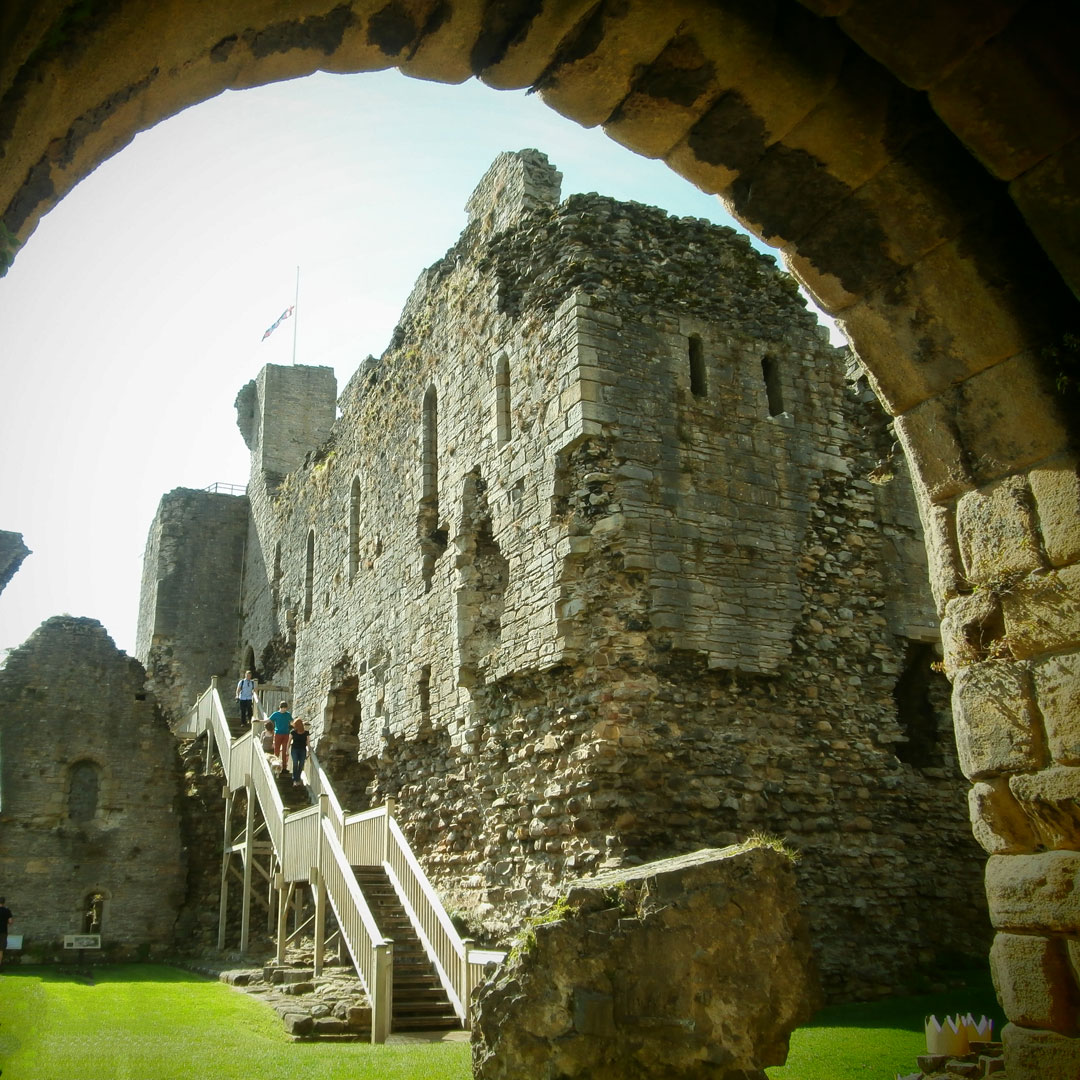
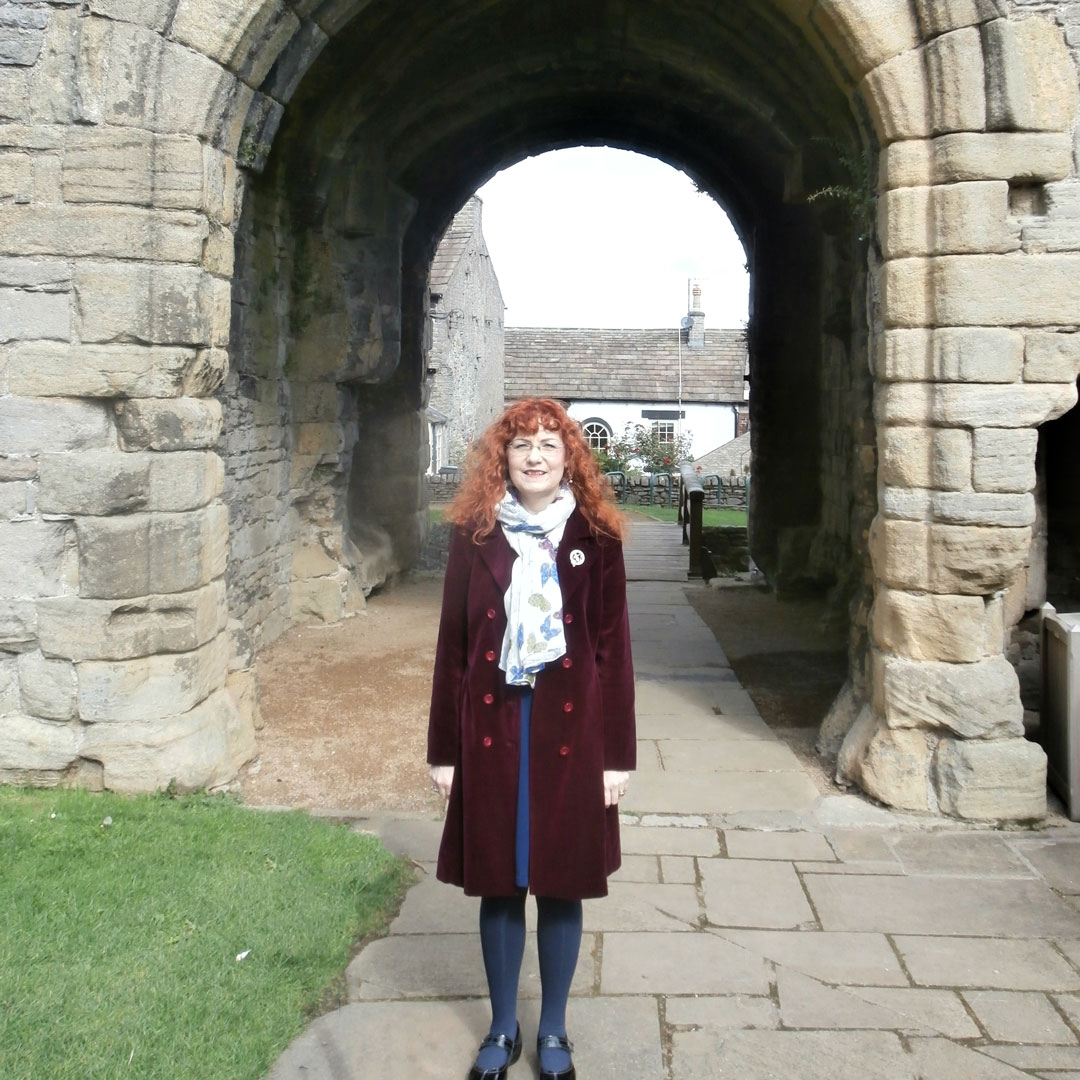
Middleham Castle, North Yorkshire, bastion of the illustrious Neville family and home to both Richard Neville, earl of Warwick and his cousin, the future Richard III, is an evocative and fascinating place.

Eleven miles from the market town of Richmond, and a stone’s throw from Leyburn, the castle stands at the heart of Middleham, amid Wensleydale’s rolling hills. The visitor’s first impression, on approaching its cavernous gatehouse, is that these ruins have witnessed the very essence of history, and if only walls could talk, they would have a treasure trove of secrets to reveal.

An earlier castle once stood on nearby William’s Hill, but the present edifice began to rise in the 1170s. The fortress came into the possession of the Neville family when Mary FitzRanulph married Robert Neville in the thirteenth century. However, Middleham appears to have been considered less important than Robert’s other castles at Raby and Sheriff Hutton.1 Later Nevilles made a number of improvements – heightening the towers and creating a new and larger gatehouse – but it was in the later fifteenth century that the castle became the home of some of the most influential figures of the Wars of the Roses: the three Richards.

Richard Neville, earl of Salisbury; Richard Neville, earl of Warwick; and Richard Plantagenet, duke of Gloucester were each caught up in one of the most dramatic periods of English history, when the crown changed hands from Lancaster to York, York to Lancaster, and back again in the course of only ten years.

Following the fateful Battle of Wakefield in 1460, Salisbury was captured and executed. His son, the enigmatic and forceful Earl of Warwick, was largely responsible for helping Edward IV, the first Yorkist king, to win the throne in 1461.

Richard duke of Gloucester, Edward’s youngest brother, who ascended the throne as Richard III, spent much of his life at Middleham. Installed in his cousin, Warwick’s, household at the age of twelve, Richard embarked on his knightly training under the earl’s tutelage, learning the military and social graces required of a chivalric warrior. At the age of twenty, following his marriage to Warwick’s daughter, Anne, Middleham became Richard’s favourite residence.

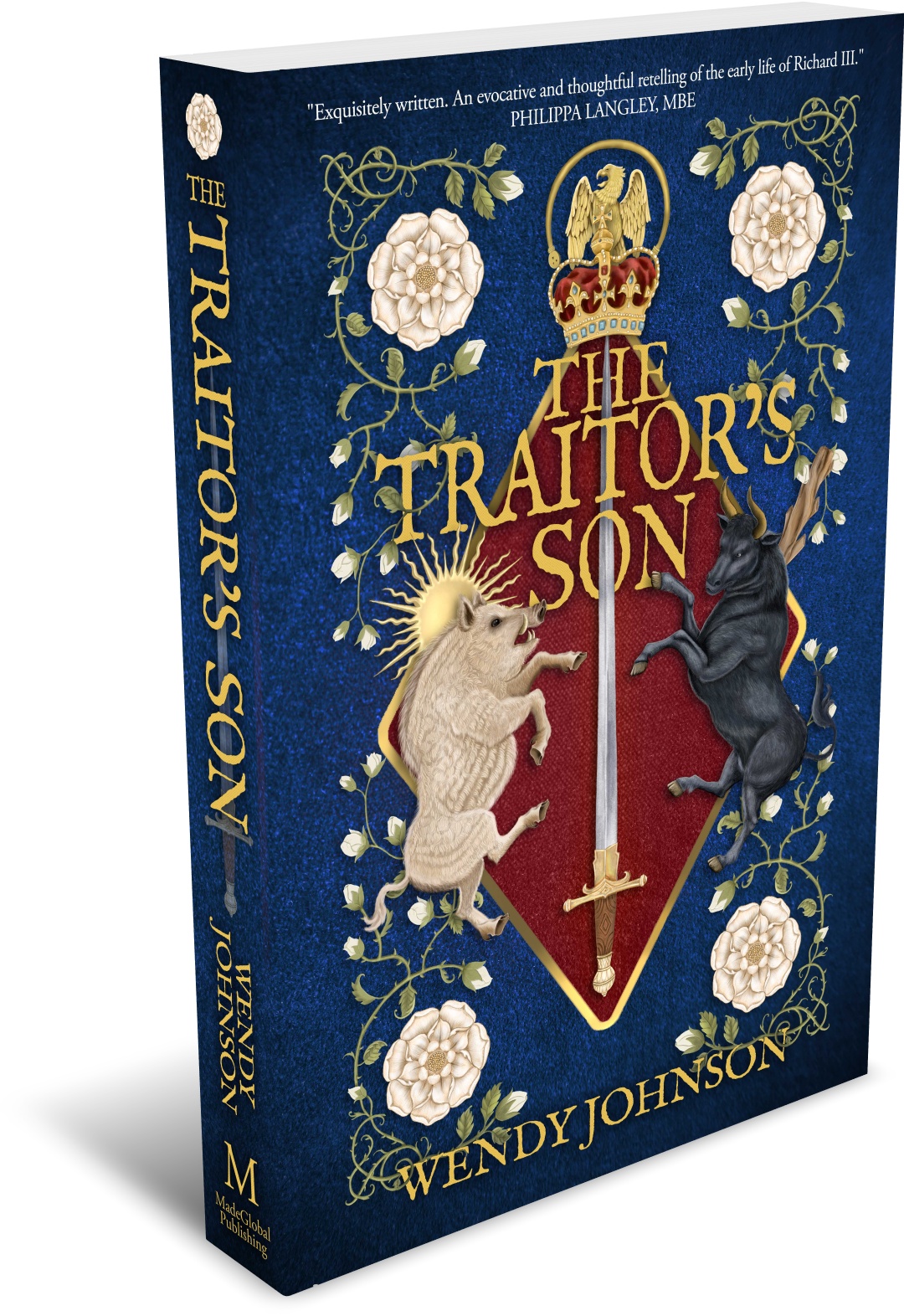
My debut novel, The Traitor’s Son, re-imagines these early years. As a grieving and fatherless boy, Richard finds solace in the company of his cousin, the Earl of Warwick, whose paternal influence repairs the boy’s shattered life. The castle of Middleham plays an important role in the novel – representing a new and, at first, unnerving, part in Richard’s journey, as he wonders whether he is able to live up to the earl’s expectations. I have chosen to illustrate Richard’s early feelings for Middleham and for his formidable cousin in the following scene, when the boy has been summoned into Warwick’s presence.

‘Belly lurching, he follows the earl’s man down the tight spiral and out into the bailey. Kitchen boys are throwing out slops, bandying jests, sniggering. As he approaches, they fall silent, snatching caps and bobbing knees. The air is cool, pungent with the scent of verdure and horse dung, birds chirruping in the violet dusk. A solitary crow swoops from the keep, hops across the earth in the clumsy, jerking manner of his breed, then takes off again in the direction of the practice yard.

He should have fetched a cloak. It’s so much colder here in the land of the Nevilles, plagued as it is with a perpetual wind sweeping from the moors and striking like a whiplash. He shivers, wondering why Warwick has hauled him from what little comfort there is to be had on such a dismal evening. To draw conclusions on the day’s events? To tell him he has failed?

Torchlight bobs on towering stone as they mount the steps to the keep. Challenged twice in the ascent, he could be at Westminster, and Warwick a king at the heart of the labyrinth. Surely, he thinks, it’s the dread of the moment that gives this impression, the creeping suffocation of growing darkness, the brilliance of the wind-torn flames. Warwick is my cousin and my tutor; he is not my sovereign.

The Middleham known to both Richard and Warwick was larger than the ruined fabric we see today. In addition to the keep, towers and surrounding ranges, there would have been stables, an armoury, a blacksmith’s forge and many more domestic buildings all integral to the daily life of the castle, as well as to the role of its lord as upholder of his estates and a foremost figure in society. How magnificent that life was, can be gleaned by the splendour of the Middleham Jewel: a fifteenth century gold and sapphire pendent found in the vicinity of the castle in 1986. Current thinking is that the jewel belonged to a woman – the most likely candidate being Anne Beauchamp, Warwick’s countess, or possibly Anne Neville, Warwick’s daughter, and wife of Richard III. Although the original pendent is on display in the Yorkshire Museum, York, a replica has pride of place in the castle’s English Heritage shop.

I find that visualising the past can help stir the imagination, as one explores Middleham’s evocative and dramatic ruins. If you’ve never experienced Middleham’s magic for yourself, then try following in the footsteps of kings and kingmakers, you’ll not regret it.

About the book:

Click here to buy: The Traitor’s Son

Review quotes:

“Exquisitely written. An evocative and thoughtful retelling of the early life of Richard III.” Philippa Langley, MBE

Synopsis:

Caught between a king and a kingmaker, young Richard Plantagenet knows he’ll have to choose…

1461: Richard Duke of York, King by Right, has been branded a traitor and slain by his Lancastrian foes. For his eight-year-old son—Richard Plantagenet—England has become a dangerous place.

As the boy grapples with grief and uncertainty, his elder brother, Edward, defeats the enemy and claims the throne. Dazzled by his glorious sibling, young Richard soon discovers that imperfections lurk beneath his brother’s majestic façade. Enter Richard Neville, Earl of Warwick—cousin, tutor, luminary—whose life has given him everything but that which he truly craves: a son. A filial bond forms between man and boy as they fill the void in each other’s lives. Yet, when treachery tears their world asunder, Richard faces an agonizing dilemma: pledge allegiance to Edward—his blood brother and king—or to Warwick, the father figure who has shaped his life and affections.

Painfully trapped between duty and devotion, Richard faces a grim reality: whatever he decides will mean a fight to the death.

In “The Traitor’s Son”, Wendy Johnson masterfully weaves a tapestry of loyalty, love, and sacrifice against the backdrop of England’s turbulent history. Through the eyes of a young Richard III, readers are transported into a world where every choice is fraught with peril, and the bonds of kinship are tested to their limits. As Richard Plantagenet navigates the explosive tensions within his own family, readers are swept along on a journey of intrigue and passion that will leave them spellbound until the final page.

Note: 1. https://www.english-heritage.org.uk/visit/places/middleham-castle/history/

Images:

1) Middleham Castle from the Gatehouse (Wendy Johnson); 2) Middleham Castle: North Range (Wendy Johnson); 3) Middleham Castle: Towards the Gatehouse (Wendy Johnson).

About the author:

Wendy has a lifelong passion for medieval history, its people, and for bringing their incredible stories to life. Her specific areas of interest are the fifteenth century, the Wars of the Roses, and Richard III in particular. She enjoys narratives which immerse the reader in the past, and tries faithfully to recreate the later Middle Ages within in her own writing. She has contributed to a number of historical anthologies and was a runner up in the Woman and Home Short Story Competition 2008.

A member of the Richard III Society since 1986, Wendy is also a founder member of Philippa Langley’s Looking for Richard Project, which located the king’s lost grave in 2012. She co-authored Finding Richard III: the Official Account of Research by the Retrieval and Reburial Project in 2014, and in 2019 received the Richard III Society’s Robert Hamblin Award.

THE TRAITOR’S SON, volume one in a Richard III trilogy, is Wendy’s debut novel and she is currently working on the sequel.

*

My Books:

Signed, dedicated copies of all my books are available through my online bookshop.

Out Now! Women of the Anarchy
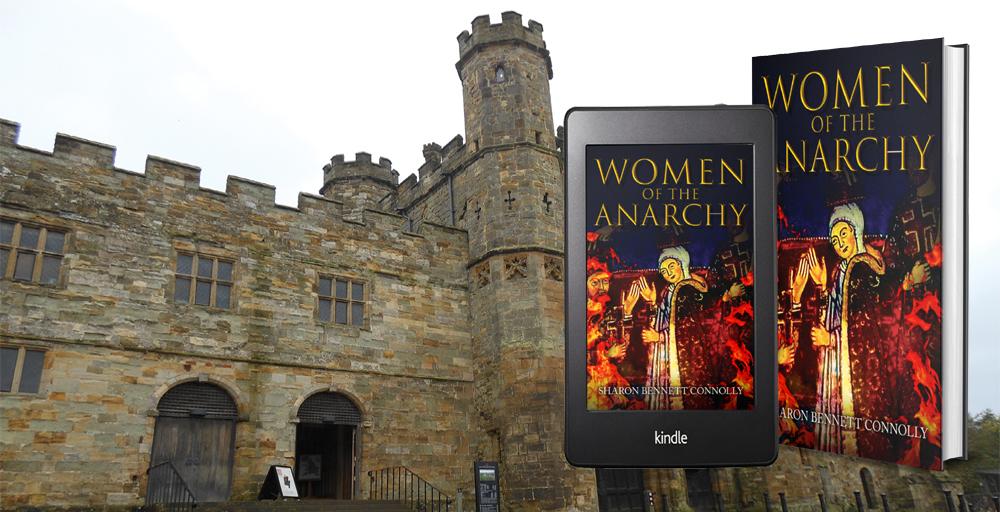
Two cousins. On the one side is Empress Matilda, or Maud. The sole surviving legitimate child of Henry I, she is fighting for her birthright and that of her children. On the other side is her cousin, Queen Matilda, supporting her husband, King Stephen, and fighting to see her own son inherit the English crown. Women of the Anarchy demonstrates how these women, unable to wield a sword, were prime movers in this time of conflict and lawlessness. It show how their strengths, weaknesses, and personal ambitions swung the fortunes of war one way – and then the other.

Available from Bookshop.orgAmberley Publishing and Amazon UK.

Coming on 15 June 2024: Heroines of the Tudor World
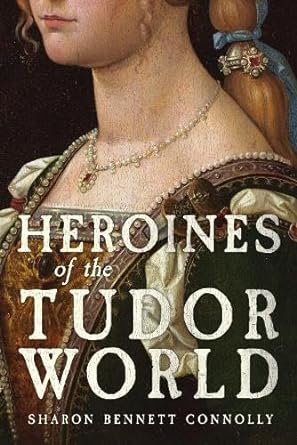
Heroines of the Tudor World tells the stories of the most remarkable women from European history in the time of the Tudor dynasty, 1485-1603. These are the women who ruled, the women who founded dynasties, the women who fought for religious freedom, their families and love. These are the women who made a difference, who influenced countries, kings and the Reformation. In the era dominated by the Renaissance and Reformation, Heroines of the Tudor World examines the threats and challenges faced by the women of the era, and how they overcame them. From writers to regents, from nuns to queens, Heroines of the Tudor World shines the spotlight on the women helped to shape Early Modern Europe.

Heroines of the Tudor World is now available for pre-order from Amberley Publishing and Amazon UK.

Also by Sharon Bennett Connolly:

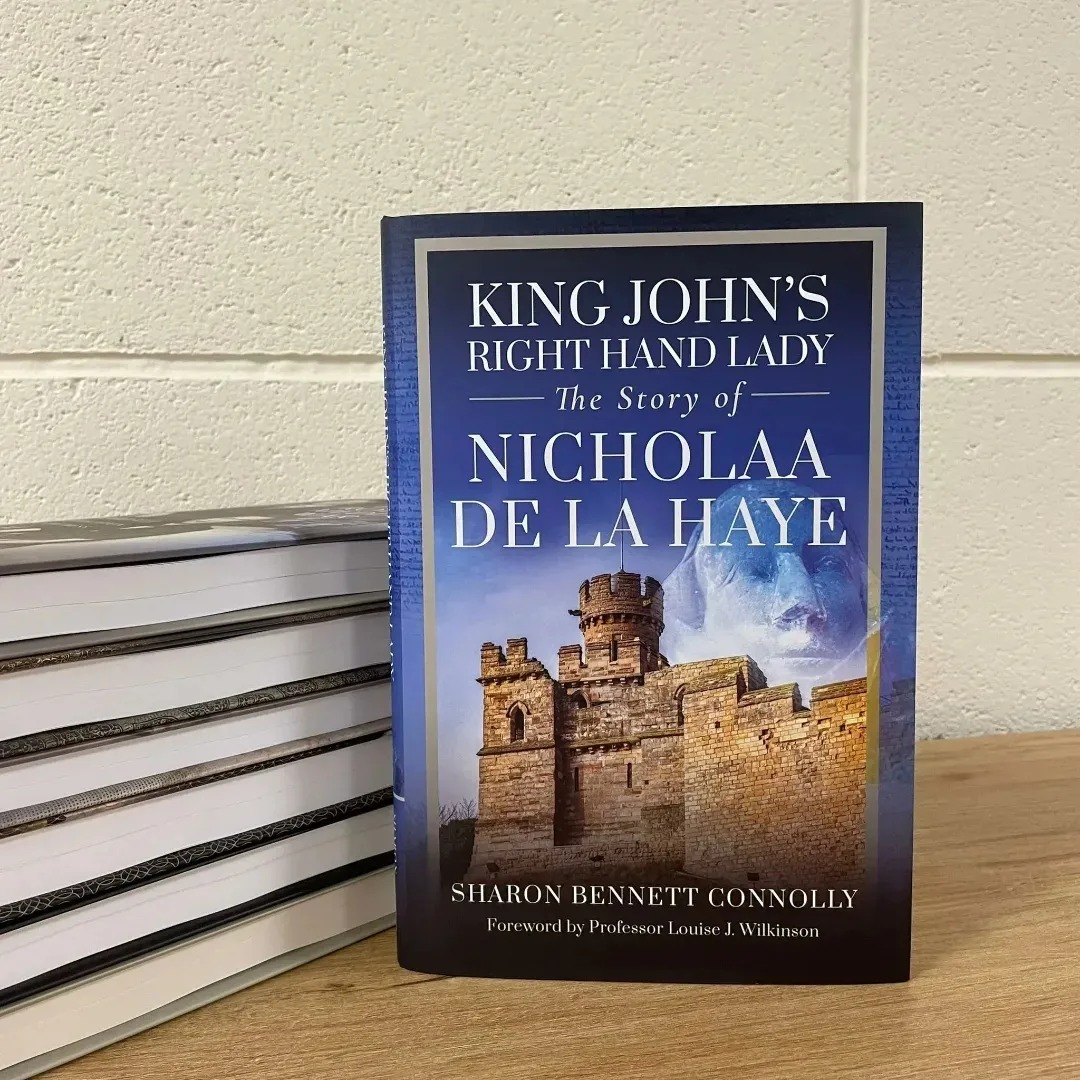
King John’s Right-Hand Lady: The Story of Nicholaa de la Haye is the story of a truly remarkable lady, the hereditary constable of Lincoln Castle and the first woman in England to be appointed sheriff in her own right. Available from all good bookshops or direct from Pen & Sword Booksbookshop.org and AmazonDefenders of the Norman Crown: The Rise and Fall of the Warenne Earls of Surrey tells the fascinating story of the Warenne dynasty, from its origins in Normandy, through the Conquest, Magna Carta, the wars and marriages that led to its ultimate demise in the reign of Edward III. Available from Pen & Sword BooksAmazon in the UK and US, and Bookshop.org

Ladies of Magna Carta: Women of Influence in Thirteenth Century England looks into the relationships of the various noble families of the 13th century, and how they were affected by the Barons’ Wars, Magna Carta and its aftermath; the bonds that were formed and those that were broken. It is now available in paperback and hardback from Pen & Sword,  Amazon, and Bookshop.orgHeroines of the Medieval World tells the stories of some of the most remarkable women from Medieval history, from Eleanor of Aquitaine to Julian of Norwich. Available now from Amberley Publishing and Amazon, and Bookshop.orgSilk and the Sword: The Women of the Norman Conquest traces the fortunes of the women who had a significant role to play in the momentous events of 1066. Available now from Amazon,  Amberley Publishing, and Bookshop.org.

Alternate Endings: An anthology of historical fiction short stories including Long Live the King… which is my take what might have happened had King John not died in October 1216. Available in paperback and kindle from Amazon.

Podcast:

Have a listen to the A Slice of Medieval podcast, which I co-host with Historical fiction novelist Derek Birks. Derek and I welcome guests, such as Bernard Cornwell and Elizabeth Chadwick, and discuss a wide range of topics in medieval history, from significant events to the personalities involved.

*

Don’t forget! Signed and dedicated copies of all my books are available through my online bookshop.

For forthcoming online and in-person talks, please check out my Events Page.

You can be the first to read new articles by clicking the ‘Follow’ button, liking our Facebook page or joining me on Twitter and Instagram.

*

©2024 Sharon Bennett Connolly FRHistS 

Guest Post: A Pilgrim’s Visit to Canterbury Cathedral by Toni Mount

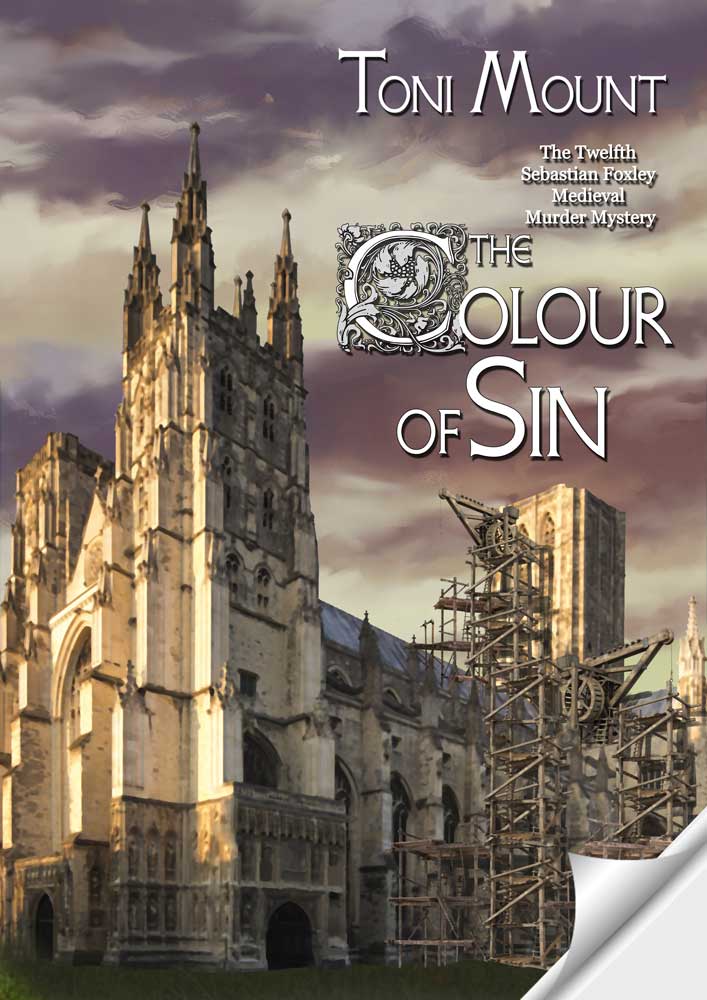
It is always a pleasure to welcome historian and author, Toni Mount, to History… the Interesting Bits. Toni enjoys really getting a deep understanding of her characters, the lives they lived and the places they visited. For “The Colour of Sin”, her main characters were off on pilgrimage and that meant a lot of interesting places to research. Here, Toni talks about Canterbury Cathedral and how pilgrimage actually worked. Over to Toni Mount…

A Pilgrim’s Visit to Canterbury Cathedral

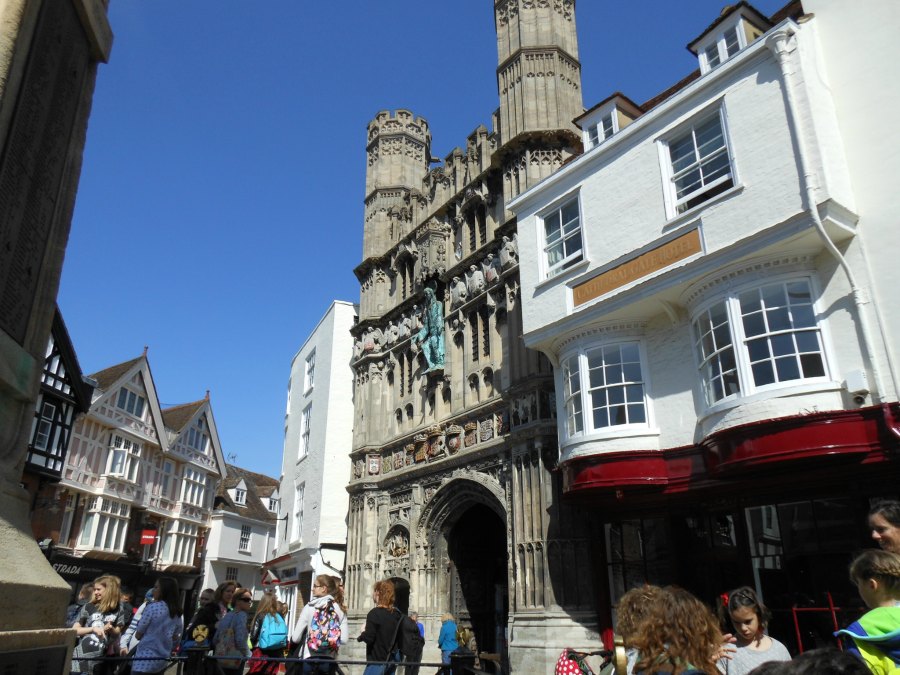
Christ Church Gate, Canterbury Cathedral

In order to research my new novel, The Colour of Sin, we visited Canterbury Cathedral. The story would involve our hero, Sebastian Foxley, taking his family on a pilgrimage to visit the shrine of St Thomas Becket in the cathedral, leaving behind his usual haunts in the City of London so a change of venue for him – and for me. I particularly wanted to get a feeling of what it would be like for a fifteenth-century pilgrim, to attempt to see things and experience them as he would have done. Fortunately, we had a wonderfully knowledgeable and helpful guide in Geoff Webb who was a mine of intriguing information.

Firstly, we had to remember that the cathedral was attached to a Benedictine monastery in those days so it was a far bigger larger complex of buildings, including the monks’ dormitory, rere-dorter or latrines, refectory, chapter house, infirmary, kitchen and other areas all of which would have been out-of-bounds to the pilgrims. Today, visitors can wander through the cloisters and view the garden with its water tower but for a pilgrim in 1480 this wouldn’t have been allowed. The magnificent chancel and choir were where the monks continued to hold their services throughout the day even as other areas of the cathedral were thronged with pilgrims. The same is the case today – most ordinary daily services are held in the choir but tourists may pass through whenever a service isn’t in progress, seeing some architectural wonders the medieval pilgrim would not have seen.

Secondly, how were the pilgrims ‘managed’ by the monks? Did they get a guided tour? Were they kept to a set route through the cathedral or could they wander off to admire the art works or the stained glass, or even the tomb or chantry chapel of someone important to them, personally? Geoff pointed out little windows high up, overlooking the place where Becket’s jewel-encrusted shrine would have stood. From here, the monks kept watch on the pilgrims gathered at the tomb, to make sure they behaved reverently and didn’t attempt to prise any gemstones from their settings as souvenirs. Elsewhere, stone seats were placed strategically for the similar purposes, where the monks could keep the crowds in order, if necessary.

The Nave, Canterbury Cathedral

Rather than a guided tour, there was a continuous line of pilgrims circling the cathedral, each following the one in front. On entering, the vast nave with its soaring fluted columns would have dragged every eye heavenwards. There would’ve been no seating but more than likely market stalls selling refreshments, pilgrim badges, phials of holy water and other saleable merchandise, the locals wouldn’t want to miss such a lucrative opportunity. The tour seems to have progressed along the side aisles, the north aisle having a specially constructed covered passage to take the pilgrims to the actual site of Becket’s martyrdom without disturbing the monks. Today, there is a plain stone table with a single candle burning upon it and a sculpture above representing the swords which slew Becket, forming an alarming jagged cross. This dates only to the 1990s but there would have been an altar here until the Reformation of 1538 destroyed it. Also, imprints on the floor show where memorial brasses were laid here, indicating important burials beneath. To the left is the chapel of Our Lady of the Martyrdom and St Blaise, newly constructed by the gifted mason and architect Richard Beke just thirty years before our hero, Seb Foxley’s pilgrimage.

In the area of the Martyrdom a flight of steps leads down to the crypt. For fifty years after he was slain, Becket’s tomb was down here among the Norman semi-circular arches of the 11th-century cathedral with its short, substantial round pillars, each with unique pattern and decoration, awaiting the completion of the ‘modern’ Trinity Chapel overhead. In 1220, the archbishop’s remains were ‘translated’ upstairs to the purpose-built and fabulous shrine. A later Chapel of Our Lady Undercroft was constructed down here in the mid-14th century by the royal architect, Henry Yevele, for Edward, the Black Prince. The prince wished to be buried here but, when he predeceased his father, Edward III, the king insisted that his eldest son, hero of Crecy and Poitiers, wouldn’t be hidden away in the undercroft but should share the prestigious Trinity Chapel with Becket, where every pilgrim would pass by the prince’s tomb and, hopefully, pray for his soul.

View in the Trinity Chapel, of the candle identifying the site of the shrine to St Thomas a Becket.

Beyond the Chapel of Our Lady Undercroft, towards the east, is the original site of Becket’s tomb between 1170 and 1220, still revered today with a candle burning on the floor and, beyond that, the circular Jesus Chapel, dedicated to Christ and his mother, the Virgin Mary. Pilgrims would have visited the undercroft as part of their ‘tour’. Graffiti adorn some of the walls beside the site of the tomb, among them a most artistic rendering of St John with his emblem of a majestic eagle. It’s thought that the graffiti were scratched in the stone by bored monks, spending hours here, watching the earlier pilgrims and making sure they didn’t do anything untoward in God’s house.

Also in the undercroft we saw a real jewel: St Gabriel’s Chapel. Its medieval wall paintings were encased in stone back in the 12th century because the wall was thought to be about to collapse – so Seb would have missed seeing them. Incidentally, this action kept them safe from the destruction of the Reformation and preserved them from the Puritan zealots of the Civil War, too. Now these once-forgotten paintings are revealed. To us, they are a marvel but to our medieval pilgrims they wouldn’t be unusual because the cathedral – and most parish churches – would have been painted with vivid murals, telling stories from the Bible for those who couldn’t read. St Gabriel’s other highlight is the glorious carvings on its central column, sharp, pristine and amusing, animals playing musical instruments, weird beasts and monsters conjured from the mason’s imagination.

Next door is the Black Prince’s Chantry Chapel where he planned prayers would be said forever for him and his beloved wife, Joan of Kent. Sadly for him, nine years after the prince’s death, in her will Joan requested burial beside her first husband and first love, Thomas Holland, Earl of Kent, at the Greyfriars, Stamford, Lincolnshire, and this was granted. The prince’s chantry is now used for services held in French. The Black Prince would have spoken courtly French so perhaps this is appropriate.

The magnificent stained glass of Canterbury Cathedral

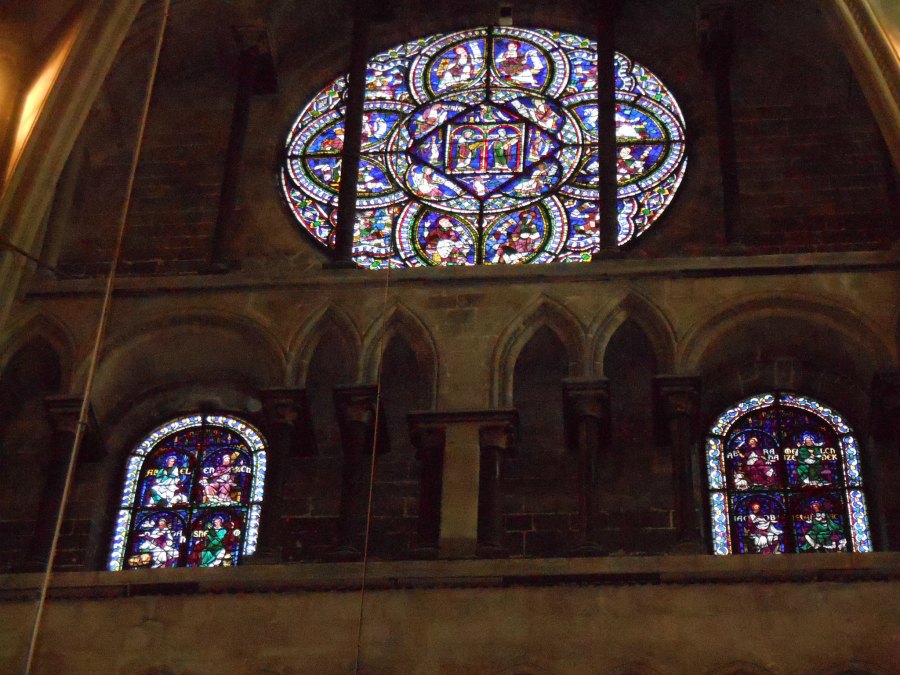
Back up to the north aisle, we passed tombs of this archbishop and that, including that of Archbishop Chichele with its cadaver or memento mori beneath it, reminding all that no one escapes death. Next along is the tomb of Archbishop Thomas Bourchier, incumbent at the time of Seb’s visit. Bourchier was getting on in years so it’s quite possible that his tomb could have been under construction in 1480. Along the way, Geoff pointed out the glorious medieval stained glass windows. The Yorkist Royal window is famous, showing Edward IV kneeling with his two legitimate sons (the Princes in the Tower) behind him and facing his wife, Elizabeth Woodville, and their five daughters opposite. It was commissioned by Edward and glazed c.1480 so I don’t know whether Seb could have stood and admired this brand new window.

We climbed the steep stone stairs, dished and worn by the feet of countless pilgrims – I believe the pilgrim circuit ran anticlockwise, so they would have walked down these steps on the north side – up to the Trinity Chapel, now lacking the sumptuous shrine with its colonnaded openings through which pilgrims could reach in and touch the martyr’s coffin within for that moment of extra closeness to sainthood, to beseech Becket to put in a good word to God on their behalf. All around us were the vivid gemstone colours of the Miracle Windows, recording Becket’s known miraculous healings required as testimony to qualify for canonisation by the pope. Geoff told us to look for the green box shown at the end of each miracle story – the cash box in which the healed individual would put his donation to the cathedral in thanks for his recovery and a reminder to the pilgrims to do the same. I imagine these green boxes were all along the pilgrims’ route, maybe chained and the lids locked so nobody could help themselves to the offerings.

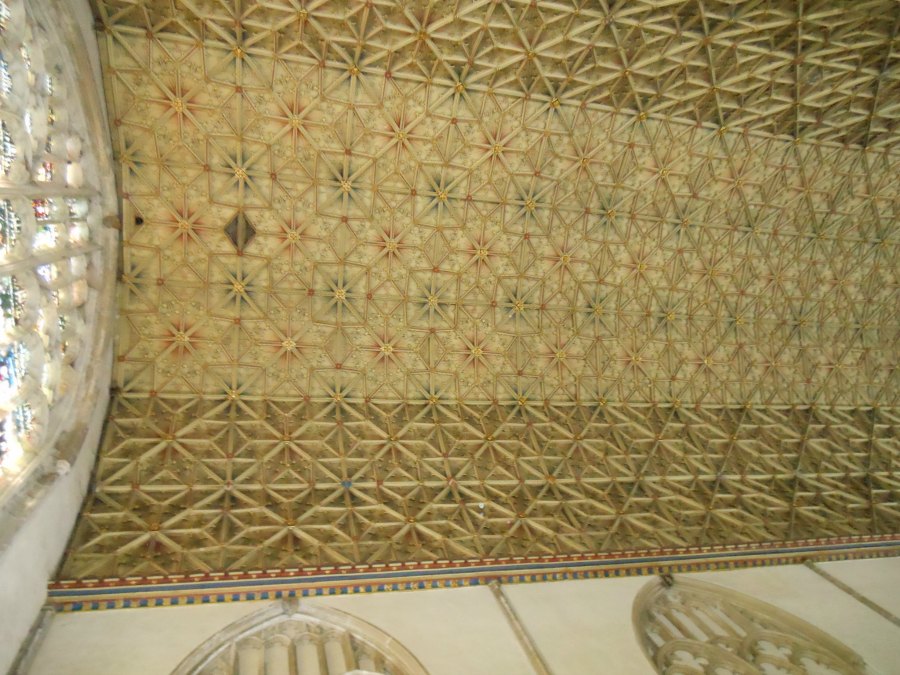
Ceiling of the Chapter House

Beyond the Trinity Chapel is the small, circular Corona Chapel, perhaps an even holier point of contact with St Thomas than the shrine. Corona means crown and it was here that the martyr’s severed crown of his head was kept in a jewelled reliquary, the remnant of his mortal remains most closely associated with the moment of his death since this injury killed him. Gory but holy. We were now on the south side of the cathedral.

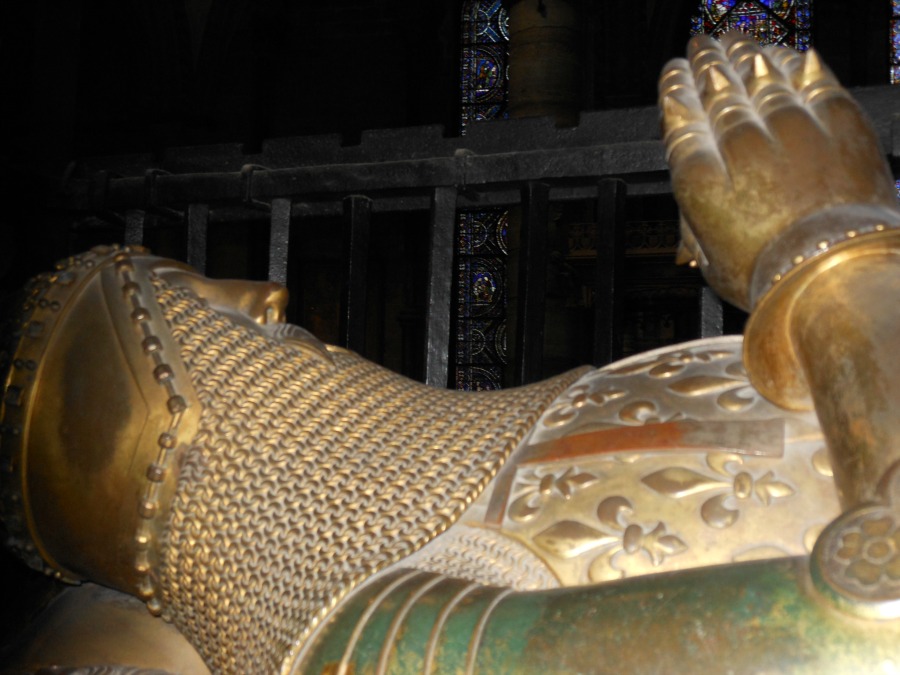
Here we passed the Black Prince’s tomb, directly opposite that of his nephew, Henry IV and his queen, Joan of Navarre. Henry IV was the first Lancastrian king and had ousted the Black Prince’s son, Richard II, from the throne in 1399 and done away with him. So Henry was greatly in need of prayers for his soul and turned the Chapel of St Edward the Confessor, the saintly king, into a chantry for himself. The Black Prince’s likeness lies in full armour, hands together in prayer, gazing up forever at the tester above him, just as in a medieval bed. The tester is painted with the image of the Trinity for which the prince had special reverence, even clinging to life in his last illness long enough to die on Trinity Sunday. Above the tester are modern but authentic replicas of his helmet, surcoat-of-arms (embroidered by the Royal School of Needlework), gauntlets and shield.

Walking back towards the Choir, Cardinal Archbishop John Morton, nemesis of King Richard III, has a finely painted tomb. Seb would have been spared the sight of his patron’s future enemy. Instead, knowing Seb, he would probably have spent ages gazing at the stained glass and the mural paintings, causing a bottle-neck in the orderly progress of pilgrims around the cathedral, being told to move along by an impatient Benedictine, back down another long flight of worn stone steps – the pilgrims would have climbed these on their knees up towards the shrine – to return to the south aisle of the nave.

Tomb of Edward, the Black Prince

Another intriguing piece of masonry is on the wall of the south aisle. It consists of three little blind arched arcades: two Norman round arches and a pointed one of the earliest style. Geoff suggested this was the mason’s demonstration piece to the dubious monks showing them how a pointed arch would work and look, being a thing never seen before in England. Maybe it’s true, maybe not, but it’s a good story.

A detour up more steps gave us a great view down the nave on one hand and the fantastic 14th-century Choir Screen on the other with its carved Lancastrian kings, constructed to give the monks more privacy as they worshipped while the pilgrims streamed by on either side. Here there’s a massive stone armchair – doesn’t look very comfortable – the seat of the Ostiarius or gate-keeper monk who guarded the entrance to the monks-only choir, making sure no pilgrim wandered in where they didn’t belong.

Outside in the Precinct, we saw the colonnade of huge Norman arches that were once the Infirmary and I have to mention a modern installation – an enormous but charming warhorse, made of off-cuts of fencing.

My thanks go to our marvellous guide, Geoff Webb, and to Melodie Robson for organising this brilliant tour around Canterbury Cathedral and inspiring me with ideas for the novel, The Colour of Sin.

To buy The Colour of Sin click here

Catch up on the ‘Colour of…’ series

Toni Mount’s Website

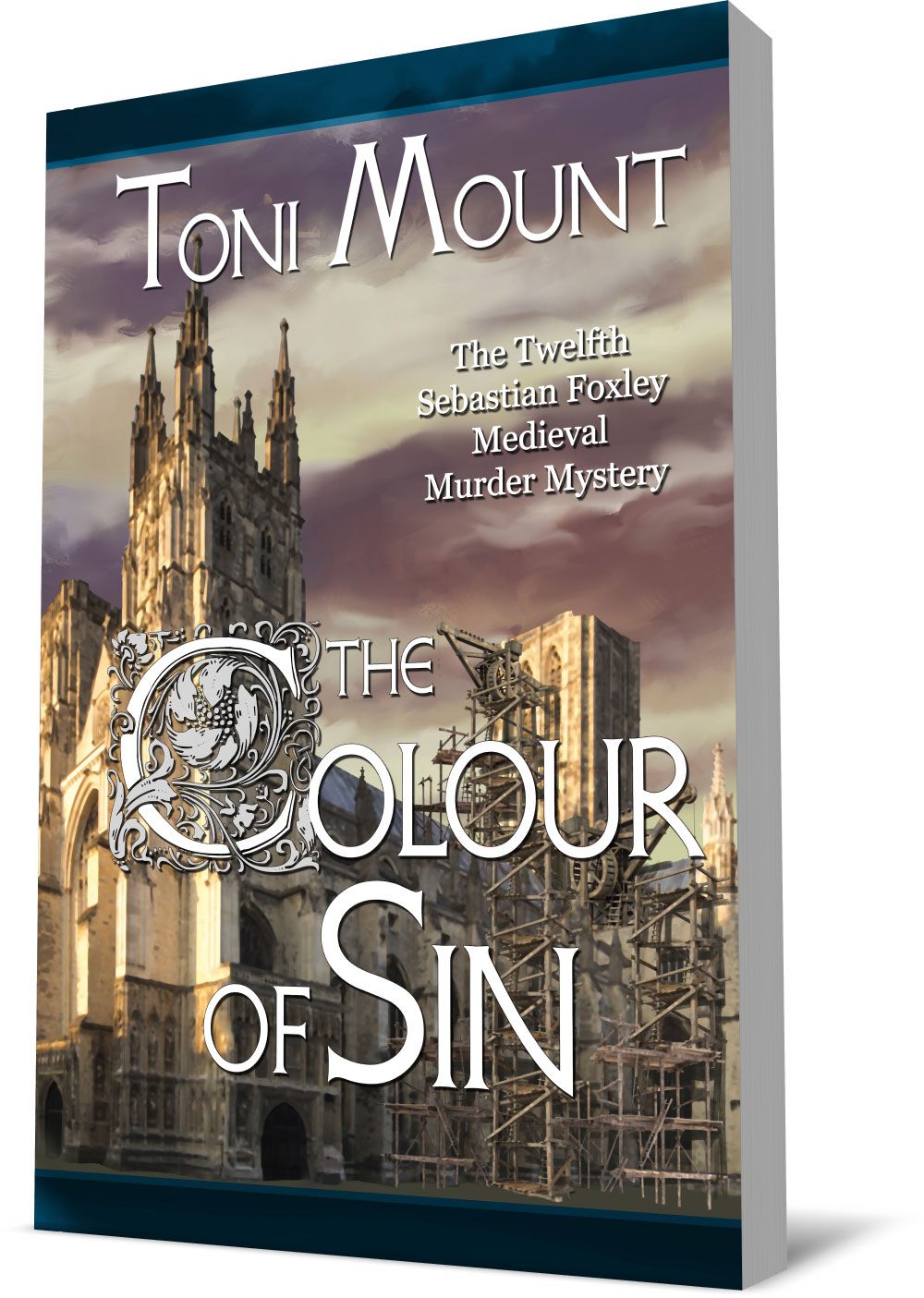
The Colour of Sin

Come with Seb Foxley, Rose and their enigmatic friend Kit, a priest with a shadowy past, as they join a diverse group of pilgrims on what should be an uplifting spiritual journey to Canterbury Cathedral.

Beset by natural disasters and unexplained deaths, the dangers become apparent. Encountering outlaws and a fearsome black cat, every step is fraught with peril.

Amidst the chaos, Seb finds himself grappling with the mysteries surrounding him, as well as his own demons, while Rose’s reunion with her family sets off a chain of events with unforeseen consequences.

But the greatest threat lies in the shadows, where sinister forces unleash evil upon the unsuspecting pilgrims. In a world where trust is a scarce commodity and even allies may harbour dark intentions, Seb must uncover the truth and protect his fellow travellers.

Prepare to be enthralled by a tale of betrayal, intrigue and redemption as Seb Foxley races against time to unravel the malevolent secrets hidden within the heart of the pilgrimage. Who can you trust when even friends prove false?

Praise for Toni Mount’s Sebastian Foxley Medieval Murder Mystery Series

“An evocative masterclass in storytelling.” – Tony Riches, author of The Tudor Trilogy

“It’s superb. What a plot. What characters” – Carol McGrath, author of the She-wolves trilogy

“Toni mount gives you a real sense of actually being there”

“an excellent mystery, with multi-layers of plot”

“Much better than the average period detective story.”

“Toni Mount brings characters leaping off the page… plots that twist and turn, I am in heaven when reading her books”

Competition: Poster Giveaway

Want the chance to win a unique poster of The Colour of Sin by Toni Mount, the twelfth book in her Sebastian Foxley Medieval Murder Mystery series? You’ll be the only person in the world to have this full colour poster! Enter here!

About the Author:

Toni Mount earned her Master’s Degree as a mature student at the University of Kent by completing original research into a unique 15th-century medical manuscript.

She is the author of several successful non-fiction books including the number one bestsellers, Everyday Life in Medieval London and How to Survive in Medieval England, which reflects her detailed knowledge of the lives of ordinary people in the Middle Ages.

Toni’s enthusiastic understanding of the period allows her to create accurate, atmospheric settings and realistic characters for her Sebastian Foxley medieval murder mysteries.

Toni’s first career was as a scientist and this brings an extra dimension to her novels. She writes regularly for The Richard III Society’s Ricardian Bulletin and a variety of history blogs and is a major contributor to MedievalCourses.com.

As well as writing, Toni teaches history to adults, is an enthusiastic member of two creative writing groups and is a popular speaker to groups and societies.

The twelfth novel in Toni’s popular “Sebastian Foxley” murder mystery series, The Colour of Sin, is set in the ancient cathedral city of Canterbury, Kent.

*

My Books:

Signed, dedicated copies of all my books are available through my online bookshop.

Out Now! Women of the Anarchy

Two cousins. On the one side is Empress Matilda, or Maud. The sole surviving legitimate child of Henry I, she is fighting for her birthright and that of her children. On the other side is her cousin, Queen Matilda, supporting her husband, King Stephen, and fighting to see her own son inherit the English crown. Women of the Anarchy demonstrates how these women, unable to wield a sword, were prime movers in this time of conflict and lawlessness. It show how their strengths, weaknesses, and personal ambitions swung the fortunes of war one way – and then the other.

Available from Bookshop.orgAmberley Publishing and Amazon UK.

Coming on 15 June 2024: Heroines of the Tudor World

Heroines of the Tudor World tells the stories of the most remarkable women from European history in the time of the Tudor dynasty, 1485-1603. These are the women who ruled, the women who founded dynasties, the women who fought for religious freedom, their families and love. These are the women who made a difference, who influenced countries, kings and the Reformation. In the era dominated by the Renaissance and Reformation, Heroines of the Tudor World examines the threats and challenges faced by the women of the era, and how they overcame them. From writers to regents, from nuns to queens, Heroines of the Tudor World shines the spotlight on the women helped to shape Early Modern Europe.

Heroines of the Tudor World is now available for pre-order from Amberley Publishing and Amazon UK.

Also by Sharon Bennett Connolly:

King John’s Right-Hand Lady: The Story of Nicholaa de la Haye is the story of a truly remarkable lady, the hereditary constable of Lincoln Castle and the first woman in England to be appointed sheriff in her own right. Available from all good bookshops or direct from Pen & Sword Booksbookshop.org and AmazonDefenders of the Norman Crown: The Rise and Fall of the Warenne Earls of Surrey tells the fascinating story of the Warenne dynasty, from its origins in Normandy, through the Conquest, Magna Carta, the wars and marriages that led to its ultimate demise in the reign of Edward III. Available from Pen & Sword BooksAmazon in the UK and US, and Bookshop.org

Ladies of Magna Carta: Women of Influence in Thirteenth Century England looks into the relationships of the various noble families of the 13th century, and how they were affected by the Barons’ Wars, Magna Carta and its aftermath; the bonds that were formed and those that were broken. It is now available in paperback and hardback from Pen & Sword,  Amazon, and Bookshop.orgHeroines of the Medieval World tells the stories of some of the most remarkable women from Medieval history, from Eleanor of Aquitaine to Julian of Norwich. Available now from Amberley Publishing and Amazon, and Bookshop.orgSilk and the Sword: The Women of the Norman Conquest traces the fortunes of the women who had a significant role to play in the momentous events of 1066. Available now from Amazon,  Amberley Publishing, and Bookshop.org.

Alternate Endings: An anthology of historical fiction short stories including Long Live the King… which is my take what might have happened had King John not died in October 1216. Available in paperback and kindle from Amazon.

Podcast:

Have a listen to the A Slice of Medieval podcast, which I co-host with Historical fiction novelist Derek Birks. Derek and I welcome guests, such as Bernard Cornwell and Elizabeth Chadwick, and discuss a wide range of topics in medieval history, from significant events to the personalities involved.

*

Don’t forget! Signed and dedicated copies of all my books are available through my online bookshop.

For forthcoming online and in-person talks, please check out my Events Page.

You can be the first to read new articles by clicking the ‘Follow’ button, liking our Facebook page or joining me on Twitter and Instagram.

*

©2024 Sharon Bennett Connolly FRHistS and Toni Mount.

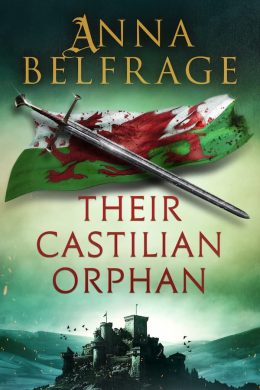
Book Corner: Their Castilian Orphan by Anna Belfrage

It is 1294 and Eustace de Lamont is back in England after five years in exile. He will stop at nothing to ruin Robert FitzStephan and his wife, Noor d’Outremer.

Robert’s half brother, Eustace de Lamont, has not mellowed during his absence. He is more ruthless than ever, and this time he targets Robert’s and Noor’s foster son, Lionel.

Lionel is serving King Edward as a page when Eustace appears at court. Not only does Lionel become the horrified witness to Eustace’s violent streak, Eustace also starts voicing his suspicions about Lionel’s parentage. The truth about Lionel’s heritage is explosive—should King Edward find out, all would be lost for Robert and Noor.

In October of 1294, Wales rises in rebellion. Robert must leave his family unprotected to fight the Welsh rebels on the king’s behalf, comforted only by the fact that Eustace too is called to fight.

Except that Eustace has no intention of allowing his duty to his king—or a mere rebellion—come between him and his desire to destroy Robert FitzStephan . . .

Bring tissues!

Whenever I hear there is a new Anna Belfrage novel coming, I know I am in for an emotional ride.

Anna Belfrage is back with the fourth and final instalment of her The Castilian Saga series, Their Castilian Orphan, and it is another tearjerker. Action-packed, Their Castilian Orphan has a riveting storyline set in England in the 1290s and Edward I’s campaign into Wales.

The two heroes, Robert FitzStephan and his wife, Noor d’Outremer, great-niece of Queen Eleanor of Castile, are faced with the dangers inherent in serving the king on campaign whilst having to fend off the nefarious machinations of Robert’s hate-filled half-brother Eustace de Lamont. And the spite of Eustace’s impressionable young wife. But Robert is not Eustace’s only target and he misses no opportunity to make life uncomfortable for their foster son, Lionel, who is beginning to suspect that his past is not the one he has been told…

Robert and Noor have certainly had their ups and downs. It has not been easy, serving Edward I and his formidable queen, Eleanor of Castile. They have their scars, both mental and physical. Robert has also had to deal with the stigma of illegitimacy and the malice of his jealous brother. Eustace might be legitimate, and a baron, but Robert is the better soldier who has earned the respect of his peers because of his abilities. That irks Eustace – especially when everyone is keen to compare the brothers and find Eustace wanting.

Intrigue, sibling rivalry and war, combined with Anna Belfrage’s engaging writing style means that Their Castilian Orphan has all the ingredients for an absolutely fabulous reading adventure.

He was halfway down the long flight of stairs leading to the hall when he heard someone call his name.

“Lionel!”

Mama came flying towards him, and moments later he was enveloped in her arms, his face squished against her bosom. She released him and clasped him by the shoulders. “Look at you – you’ve grown! You’re so tall!”

Nay, he wasn’t, but Mama was short. If he stood on his toes, the top of his head reached her brow.

“Lionel, lad.” Papa greeted him as effusively as Mama had done.

“How is your back?” Mama asked.

Lionel groaned. “It was nothing.” Of course, Roger Mortimer had to tell them!

“You did not send us word,” Mama said, her mouth wobbling for an instant. “We didn’t know, were not offered the opportunity to care for you.”

Lionel shuffled on his feet. “I…” A movement on the far side of the bailey offered an opportunity to change the subject. “Eustace de Lamont id back!” he blurted, pointing at the man in question.

“Aye, we know,” Papa said, sounding grim.

“I saw him -“

“Hush,” Papa said firmly. “We talk of such matters when we are alone.”

“He has wed,” Lionel said, pulling a face. “Soaking Sally says she may be comely but has the personality of an aggravated viper.”

“Well, they should suit, then,” Mama said. “Hopefully they bite each other to death.”

Lionel blinked. Never had he heard Mama sound so vicious. And then he saw how Papa settled his arm round her, whispering something in her ear, and her stance softened.

Lionel moved closer to her. Of course. Mama was afraid. With Eustace de Lamont back, she feared for her husband. Last time had left Papa with a nasty scar to his thigh and a slight limp. Next time… No, there could not be a next time because Mama was right: Eustace de Lamont was a serpent in human disguise.

Five years of exile and dire warnings from the king to stay away from Robert and his family fall on deaf ears when Eustace returns from his exile. With Robert drawn into Edward I’s wars, this time in Wales, and their foster son, Lionel, in service to the king as a page, the family are once again at the heart of events. And a focus for Eustace’s murderous intentions. He is determined to destroy Robert and take all that he has. And he knows how to strike at their heart, by targeting Lionel and the young man’s Welsh lineage, making Lionel question his place in is family.

Their Castilian Orphan interweaves the fictional story with the historical fact, transporting the reader to the last decade of the 13th century, to an aging king, duped by the French, with peace at home threatened by the Welsh, who are chafing against the harsh English yoke.

I love the way Anna Belfrage melds the domestic lives and worries of Robert and Noor with the concerns of England as a nation. Life and duty are inseparable. Anna makes you love her characters, draws you into their lives, makes you a part or their family.

Engaging, absorbing, fascinating, exciting. And emotional. Anna Belfrage will take the reader through the full range of emotions before they get to the end of the book.

To buy the book:

Their Castilian Orphan is now available from Amazon

About the author:

Had Anna been allowed to choose, she’d have become a professional time-traveller. No luck there, so instead she became a financial professional with two absorbing interests; history and writing. These days, Anna combines an exciting day-job with a large family and her writing endeavours. Plus she always finds the time to try out new recipes, chase down obscure rose bushes and initiate a home renovation scheme or two.

Anna has authored the acclaimed time travelling series The Graham Saga , set in 17th century Scotland and Maryland, as well as the equally acclaimed medieval series The King’s Greatest Enemy.

Anna has also published The Wanderer, a fast-paced contemporary romantic suspense trilogy with paranormal and time-slip ingredients. Her September 2020 release, His Castilian Hawk is a story of loyalty and love set against the complications of Edward I’s invasion of Wales in the late 13th century.

Her most recent release, The Whirlpools of Time , is a time travel romance set against the backdrop of brewing rebellion in the Scottish highlands.

All of Anna’s books have been awarded the IndieBRAG Medallion, she has several Historical Novel Society Editor’s Choices, and one of her books won the HNS Indie Award in 2015. She is also the proud recipient of several Reader’s Favorite medals as well as having won various Gold, Silver and Bronze Coffee Pot Book Club awards.

If you want to know more about Anna, why not visit her website, https://www.annabelfrage.com

*

My Books:

Signed, dedicated copies of all my books are available through my online bookshop.

Out Now! Women of the Anarchy

Two cousins. On the one side is Empress Matilda, or Maud. The sole surviving legitimate child of Henry I, she is fighting for her birthright and that of her children. On the other side is her cousin, Queen Matilda, supporting her husband, King Stephen, and fighting to see her own son inherit the English crown. Women of the Anarchy demonstrates how these women, unable to wield a sword, were prime movers in this time of conflict and lawlessness. It show how their strengths, weaknesses, and personal ambitions swung the fortunes of war one way – and then the other.

Available from Bookshop.orgAmberley Publishing and Amazon UK.

Coming on 15 June 2024: Heroines of the Tudor World

Heroines of the Tudor World tells the stories of the most remarkable women from European history in the time of the Tudor dynasty, 1485-1603. These are the women who ruled, the women who founded dynasties, the women who fought for religious freedom, their families and love. These are the women who made a difference, who influenced countries, kings and the Reformation. In the era dominated by the Renaissance and Reformation, Heroines of the Tudor World examines the threats and challenges faced by the women of the era, and how they overcame them. From writers to regents, from nuns to queens, Heroines of the Tudor World shines the spotlight on the women helped to shape Early Modern Europe.

Heroines of the Tudor World is now available for pre-order from Amberley Publishing and Amazon UK.

Also by Sharon Bennett Connolly:

King John’s Right-Hand Lady: The Story of Nicholaa de la Haye is the story of a truly remarkable lady, the hereditary constable of Lincoln Castle and the first woman in England to be appointed sheriff in her own right. Available from all good bookshops or direct from Pen & Sword Booksbookshop.org and AmazonDefenders of the Norman Crown: The Rise and Fall of the Warenne Earls of Surrey tells the fascinating story of the Warenne dynasty, from its origins in Normandy, through the Conquest, Magna Carta, the wars and marriages that led to its ultimate demise in the reign of Edward III. Available from Pen & Sword BooksAmazon in the UK and US, and Bookshop.org

King John’s Right-Hand Lady: The Story of Nicholaa de la Haye is the story of a truly remarkable lady, the hereditary constable of Lincoln Castle and the first woman in England to be appointed sheriff in her own right. It is is available from King John’s Right-Hand Lady: The Story of Nicholaa de la Haye is the story of a truly remarkable lady, the hereditary constable of Lincoln Castle and the first woman in England to be appointed sheriff in her own right. Available from all good bookshops or direct from Pen & Sword Booksbookshop.org and AmazonDefenders of the Norman Crown: The Rise and Fall of the Warenne Earls of Surrey tells the fascinating story of the Warenne dynasty, from its origins in Normandy, through the Conquest, Magna Carta, the wars and marriages that led to its ultimate demise in the reign of Edward III. Available from Pen & Sword BooksAmazon in the UK and US, and Bookshop.org

Alternate Endings: An anthology of historical fiction short stories including Long Live the King… which is my take what might have happened had King John not died in October 1216. Available in paperback and kindle from Amazon.

Podcast:

Have a listen to the A Slice of Medieval podcast, which I co-host with Historical fiction novelist Derek Birks. Derek and I welcome guests, such as Bernard Cornwell and Elizabeth Chadwick, and discuss a wide range of topics in medieval history, from significant events to the personalities involved.

*

Don’t forget! Signed and dedicated copies of all my books are available through my online bookshop.

For forthcoming online and in-person talks, please check out my Events Page.

You can be the first to read new articles by clicking the ‘Follow’ button, liking our Facebook page or joining me on Twitter and Instagram.

*

©2024 Sharon Bennett Connolly FRHistS

Book Corner: Agricola: Invader by Simon Turney

The first volume in a thrilling new historical adventure series by Simon Turney, critically acclaimed author of Legion XXII and Sons of Rome.

58 AD, Rome. Agricola, teenage son of an impoverished yet distinguished noble family, has staked all his resources and reputation on a military career. His reward? A posting as tribune in the far-off northern province of Britannia.

Serving under renowned general Suetonius Paulinus, Agricola soon learns the brutality of life on the very edges of the empire, for the Celtic tribes of Britannia are far from vanquished.

To take control of the province, the Romans must defeat the ancient might of the druids – and the fury of the Iceni, warriors in their thousands led by a redoubtable queen named Boudicca…

I do like a good Simon Turney novel, and this is one of his best! I was a little dubious about Agricola: Invader, wondering if I would appreciate a book set in Roman Britain where the native Britons are the enemy. But the author drew me in with his first scenes, of sword practice and then an imaginary dinner party with some of the great and the good, including Vespasian, Paulinus and Agricola himself. It must have been a fun scene to write and you can tell that Simon Turney is enjoying himself. The scene serves another purpose, it sets up the greater story, whereby Agricola’s mother calls in old favours, using her dead husband’s connections to secure her 18-year-old son his first position in the Roman legions.

From those first scenes, Agricola leaves Rome to take up his appointment in Britannia. He faces jealousy and prejudice within the military hierarchy, while battling the druids and the native tribes, who are chafing under the Roman yoke. We do not meet Boudicca, although Agricola faces her revolt, which is a shame, to e honest. I was looking forward to Agricola and Boudicca staring each other down in a fictitious face-to-face. But no matter. This is Agricola’s story. We see Britannia’s history through his eyes, from the point of view of the great Roman war machine and the Pax Romana. Of the victors.

One cannot help but sympathise with our ancient ancestors but that does not diminish the story.

So, once they were settled onto a new ship, a trireme of the classis Britannica, he began to ask about their destination.

‘Tell me about Britannia,’ he began.

‘Firstly, stop calling it that.’

‘Why?’

‘Because Britannia is a Roman invention. If you want to understand my people you have to stop thinking like their conqueror. To my people it is just “the land” and we are “people of the land”. We have mostly come to think of ourselves in the tribal groups you acknowledge: the Silures, the Ordovices, the Demetae and so on. But here and there you will find small tribes that Rome considers Silurian while they themselves think otherwise. Indeed, you will find tribes who are part if the Silures and are content to recognise the fact, and yet still call themselves by their own ancient names.’

‘Now onder you could not mount an organised defence of your island when we came.’

Luci narrowed his eyes. ‘From what you tell me of your people’s history, you were no different.’

‘I’ll give you that. Perhaps Rome would not have taken Liguria and Gaul if we had managed to overcome our own hatreds and differences long enough to turn them on our enemy. Speaking as a product of their conquest, though, I’m not sure we would have survived without the order that Rome brings.’

A grunt was the only answer to that.

Agricola comes across – at first – as a typical teenager. He’s read the books and knows everything. He’s brash, confident, but is aware of a lack of knowledge of his destination. He even buys a slave, a Briton, to educate him on the people of the land he is to be stationed.

I like Agricola. I like his slave, Luci, even more. A pure invention of Simon Turney, Luci is a Silurian slave, purchased by Agricola in Rome. He has his own story to tell, which comes out in stages and is, at times, surprising. He gives Agricola an insight into the enemy’s minds and tactics, helping the young tribune out in potentially dangerous situations. The relationship between master and slave develops throughout the book. Luci is hardly the submissive, beaten slave. He knows his value, and his own abilities. As does Agricola. It is a fascinating relationship and a highlight of the book.

Simon Turney stays true to the history, depicting the strength and might of the Roman legions as the pacify Britannia. He expertly recreates the Roman campaign that swept across England and Wales.

Agricola: Invader is a riveting read and I am happy to hear that it is only the start of Agricola’s adventures. There’s more to follow! Simon Turney has a passion for the era that shines through on every page. His own enthusiasm for the subject will draw the reader in and leave them wanting more.

To buy Agricola: Invader

About the author:

Simon lives with his wife, children, rabbits and dog in rural North Yorkshire. Having spent much of his childhood visiting historic sites with his grandfather, a local photographer, Simon fell in love with the Roman heritage of the region, beginning with the world famous Hadrian’s Wall. His fascination with the ancient world snowballed from there with great interest in Egypt, Greece and Byzantium, though his focus has always been Rome. A born and bred Yorkshireman with a love of country, history and architecture, Simon spends most of his rare free time travelling the world visiting historic sites, writing, researching the ancient world and reading voraciously.

Simon’s early career meandered along an arcane and eclectic path of everything from the Ministry of Agriculture to computer network management before finally settling back into the ancient world. During those varied years, Simon returned to university study to complete an honours degree in classical history through the Open University. With what spare time he had available and a rekindled love of all things Roman, he set off on an epic journey to turn Caesar’s Gallic War diaries into a novel accessible to all. The first volume of Marius’ Mules was completed in 2003 and has garnered international success, bestseller status and rave reviews, spawning numerous sequels. Marius’ Mules is still one of Simon’s core series and although Roman fiction features highly he now has Byzantine, Fantasy and Medieval series, too, as well as several collaborations and short stories in other genres.

Now with in excess of 40 novels available and, Simon is a prolific writer, spanning genres and eras and releasing novels both independently and through renowned publishers including Canelo and Orion. Simon writes full time and is represented by MMB Creative literary agents.

Look out for Roman military novels featuring Caesar’s Gallic Wars in the form of the bestselling Marius’ Mules series, Roman thrillers in the Praetorian series, set during the troubled reign of Commodus, imperial intrigue in the Damned Emperors series and the Rise of Emperors series, epics of the Knights Templar, adventures around the 15th century Mediterranean world in the Ottoman Cycle, and a series of Historical Fantasy novels with a Roman flavour called the Tales of the Empire.

*

My Books:

Signed, dedicated copies of all my books are available through my online bookshop.

Out Now! Women of the Anarchy

Two cousins. On the one side is Empress Matilda, or Maud. The sole surviving legitimate child of Henry I, she is fighting for her birthright and that of her children. On the other side is her cousin, Queen Matilda, supporting her husband, King Stephen, and fighting to see her own son inherit the English crown. Women of the Anarchy demonstrates how these women, unable to wield a sword, were prime movers in this time of conflict and lawlessness. It show how their strengths, weaknesses, and personal ambitions swung the fortunes of war one way – and then the other.

Available from Bookshop.orgAmberley Publishing and Amazon UK.

Coming on 15 June 2024: Heroines of the Tudor World

Heroines of the Tudor World tells the stories of the most remarkable women from European history in the time of the Tudor dynasty, 1485-1603. These are the women who ruled, the women who founded dynasties, the women who fought for religious freedom, their families and love. These are the women who made a difference, who influenced countries, kings and the Reformation. In the era dominated by the Renaissance and Reformation, Heroines of the Tudor World examines the threats and challenges faced by the women of the era, and how they overcame them. From writers to regents, from nuns to queens, Heroines of the Tudor World shines the spotlight on the women helped to shape Early Modern Europe.

Heroines of the Tudor World is now available for pre-order from Amberley Publishing and Amazon UK.

Also by Sharon Bennett Connolly:

King John’s Right-Hand Lady: The Story of Nicholaa de la Haye is the story of a truly remarkable lady, the hereditary constable of Lincoln Castle and the first woman in England to be appointed sheriff in her own right. Available from all good bookshops or direct from Pen & Sword Booksbookshop.org and AmazonDefenders of the Norman Crown: The Rise and Fall of the Warenne Earls of Surrey tells the fascinating story of the Warenne dynasty, from its origins in Normandy, through the Conquest, Magna Carta, the wars and marriages that led to its ultimate demise in the reign of Edward III. Available from Pen & Sword BooksAmazon in the UK and US, and Bookshop.org

Ladies of Magna Carta: Women of Influence in Thirteenth Century England looks into the relationships of the various noble families of the 13th century, and how they were affected by the Barons’ Wars, Magna Carta and its aftermath; the bonds that were formed and those that were broken. It is now available in paperback and hardback from Pen & Sword,  Amazon, and Bookshop.orgHeroines of the Medieval World tells the stories of some of the most remarkable women from Medieval history, from Eleanor of Aquitaine to Julian of Norwich. Available now from Amberley Publishing and Amazon, and Bookshop.orgSilk and the Sword: The Women of the Norman Conquest traces the fortunes of the women who had a significant role to play in the momentous events of 1066. Available now from Amazon,  Amberley Publishing, and Bookshop.org.

Alternate Endings: An anthology of historical fiction short stories including Long Live the King… which is my take what might have happened had King John not died in October 1216. Available in paperback and kindle from Amazon.

Podcast:

Have a listen to the A Slice of Medieval podcast, which I co-host with Historical fiction novelist Derek Birks. Derek and I welcome guests, such as Bernard Cornwell and Elizabeth Chadwick, and discuss a wide range of topics in medieval history, from significant events to the personalities involved.

*

Don’t forget! Signed and dedicated copies of all my books are available through my online bookshop.

For forthcoming online and in-person talks, please check out my Events Page.

You can be the first to read new articles by clicking the ‘Follow’ button, liking our Facebook page or joining me on Twitter and Instagram.

*

©2024 Sharon Bennett Connolly FRHistS

Guest Post: The Ambassadress by Ronan Beckman

The Historical Writers Forum have released a new Anthology of short stories. You may remember that last year’s Anthology, Alternate Endings, included a short story about the final days of King John, by me! This year’s Anthology, Masterworks: Historical Fiction Inspired by Works of Art, will make you look at some famous artworks a little differently…

Today, I am joined by one of the contributors, Ronan Beckman, whose story is inspired by Emma Hamilton. Over to Ronan…

Do you remember what got you hooked onto a specific time period or aspect of history? I had just finished reading Amanda Foreman’s excellent biography Georgiana, The Duchess of Devonshire , which resulted in my addiction to everything about the Georgian-era but especially to women’s history in that time. Often relegated to the sidelines of history, Georgian times allowed women to begin to step into the spotlight – albeit in very slow, tiny steps. I began to voraciously read biographies of prominent ladies of that time. And one story that truly stood out for me was the life of a blacksmith’s daughter from Cheshire born as Amy Lyon. But the world knows her better as Emma, Lady Hamilton; lover of Admiral Nelson. Flora Fraser’s Beloved Emma laid out the incredible story of the amazing transformation of this pretty young woman into one of the most talked about celebrities of her age.

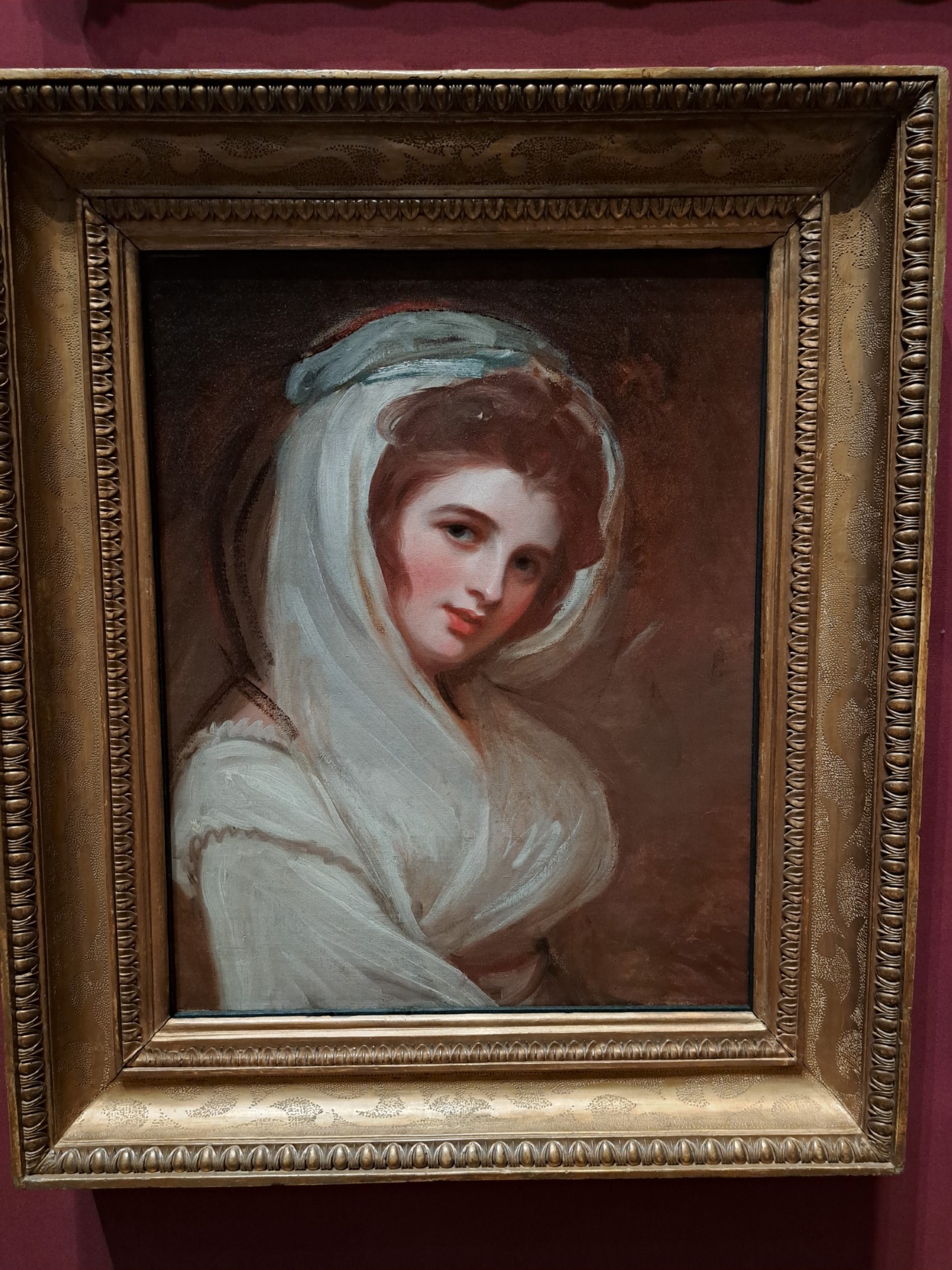
Portrait of Emma Hamilton by George Romney

Several years later, The National Maritime Museum in London put together a fabulous exhibition entitled Seduction & Celebrity that explored Emma Hamilton’s rise and fall, from beginning to end. One of the most noticeable aspects of the show was that there was ample material to display, primarily from one particular artist. George Romney was one of the most prominent society portrait painters of the late Georgian period. Although his talent was comparable to his well-respected contemporaries, such as Joshua Reynolds, Thomas Gainsborough and John Hoppner; he refused to participate in the antics associated with the Royal Academy of Arts and their annual exhibitions. Artists would become fiercely competitive as they all vied for the most prominent places within the show, hoping that their works would stand out from the rest. Romney wanted no part of this circus, and relied on his talent and reputation to gain custom amongst his wealthy clients. This worked out well for him, and he had no shortage of sitters. However, the tedium of producing staid portraiture of the elite classes began to prove tiresome.

How fortunate for Romney then that a customer, Sir Charles Greville, brought in a secret mistress that he had ensconced away in a humble, rural cottage in nearby Edgeware. The 16 year-old Amy Lyon had already experienced several tragedies in her young life; having found herself pregnant by another aristocratic man, Sir Henry Fetherstonhaugh, who promptly abandoned her. Greville came to the rescue, but on the proviso that she gave her baby away, living a life of thrift and economy whilst being at his beck and call. She had no room to negotiate and was grateful for this second chance. Greville sought to have her beauty be captured and admired on canvas, for him to be able to display to his friends. In effect, he wanted to boast “This heavenly goddess is mine, and you cannot even see her in the flesh. Don’t you envy me?”

Emma Hart by Romney

Romney was immediately enchanted by the charisma and stunning beauty of the newly renamed Emma Hart. Her presence reinvigorated his artwork. They embarked on a creative partnership that resulted in Romney’s finest and most creative output. In return, Emma was portrayed in various guises for posterity. She had to reinvent herself for each sitting, becoming a mythological creature or some historic character from long ago. Emma sat for dozens of paintings by Romney. She was his muse, allowing him to explore his craft beyond the confines of standard portraiture. Greville was happy to loan her modelling services to Romney, for it was increasing the value of his ‘ward’ that he had saved from a certain life of penury. Engravings had been made of some of Romney’s paintings, affording a glimpse of her allure to a wider audience. As her image was circulated, there was an increasing curiosity aroused throughout the capital city. Who was this charming being?

The drip-feed of artistic content provided opportunities for both Romney and Emma. Romney’s reputation and name was further advanced as well as inspiring his art to reach new levels of creativity. Emma became what may well be the very first Supermodel – a celebrity whose fame and notoriety was constantly on an upward trajectory. It seems apparent that Romney became infatuated with Emma. And perhaps Emma appreciated the advice and friendship of a man outside of the realm of the Ton, but who knew of the inner workings and mindset of the Upper Class who made up his clientele.

But this fame and notoriety was not appealing to Sir Charles Greville, who was seeking a wealthy heiress to supplement his dwindling finances. Being saddled with an infamous beauty as a mistress would not make him very appealing as a suitor to the respectable ladies that he wanted to pursue. Therefore, he duped Emma into travelling to Naples, to visit his uncle who was the serving British ambassador there. He had offered her to his uncle as a mistress, without her consent or knowledge. This separation severed the symbiotic artistic relationship between Emma and Romney for several years. Romney, who was prone to depression, was affected by her absence deeply. Although furious with Greville for abandoning her, Emma did make the best of her situation – enjoying her time in the royal court of Naples and eventually becoming quite fond of her ambassador.

In the summer of 1791, Emma returned to England to marry Sir William Hamilton and return to Naples as a respectable wife of the ambassador. During these brief few weeks, Emma reunited with her favourite artist, kick-starting a frenetic pace of artistic output as the painter and his muse were working together again. This brief slice in time intrigued me and I wanted to explore it further. I am fortunate enough to have seen many examples of Romney’s work with Emma as the model. You can feel the creative frisson embedded in these artworks. Romney’s paintings of Emma are seared with an energy that simply does not exist in his other portraits. There was something electric between these two individuals. Was it romantic? There is a feeling of magnetic attraction when one looks through Romney’s gaze in his portraits of Emma. I must say that even though Emma modelled for other great artists (Joshua Reynolds, Thomas Lawrence, Élisabeth Louise Vigée Le Brun, among many others), that spark of something special and extraordinary is just not there.

Romney self-portrait

The last painting that Romney painted of Emma was actually painted on her wedding day. Entitled The Ambassadress, the viewer is a witness to the complete transformation of Emma Hart into Lady Hamilton. As Vesuvius erupts in the dark background, one can imagine the well of emotions bursting forth from Romney’s paintbrush – being well aware that this was the last time that he would lay eyes upon the divine Emma he so cherished. Emma looks back at him, slightly pensive but very refined as she knows she is about to embark on a life of newfound respectability. There is so much wistful emotion silently conveyed in this moving portrait. What were those last moments like in Romney’s studio, as they parted ways for the final time?

The Ambassadress was the inspiration for my short story of the same name. It is one of eleven short stories in the Historical Writer Forum’s anthology entitled Masterworks. Eleven authors have written stories that have been influenced by a particular work of art. The result is a series of stories that takes the reader through time and place, from ancient Sumerian kingdoms to present day London. Available now through Amazon.

About the author:

Ronan Beckman is an American educator who has lived in the UK for over 30 years. His interest in history and genealogy helped to spark an interest in further developing the stories of some of the family he researched – resulting in his debut novel ‘An Actress of Repute’. Subsequently, he has become a bit obsessed with all things Georgian and Regency related. Further adventures are in the works for the character of Elizabeth Searle and her fellow actor friends. His latest project has been editing a transcript of a rare, out-of-print book by a Lancashire coal miner who became secretary of the TUC and a Member of Parliament. The new annotated version of Samuel Woods’ ‘Visions of the Mine’ contains biographical notes and historical images. Visit his blog at http://www.ronanbeckman.com.

*

My Books

Christmas is coming!

Signed, dedicated copies of all my books are available through my online bookshop.

Coming 15 January 2024: Women of the Anarchy

On the one side is Empress Matilda, or Maud. The sole surviving legitimate child of Henry I, she is fighting for her birthright and that of her children. On the other side is her cousin, Queen Matilda, supporting her husband, King Stephen, and fighting to see her own son inherit the English crown. Both women are granddaughters of St Margaret, Queen of Scotland and descendants of Alfred the Great of Wessex. Women of the Anarchy demonstrates how these women, unable to wield a sword, were prime movers in this time of conflict and lawlessness. It show how their strengths, weaknesses, and personal ambitions swung the fortunes of war one way – and then the other.

Available for pre-order from Amberley Publishing and Amazon UK.

Also by Sharon Bennett Connolly:

Out nowKing John’s Right-Hand Lady: The Story of Nicholaa de la Haye is the story of a truly remarkable lady. Nicholaa de la Haye was the hereditary constable of Lincoln Castle and the first woman in England to be appointed sheriff in her own right. Her strength and tenacity saved England at one of the lowest points in its history. Nicholaa de la Haye is one woman in English history whose story needs to be told…

King John’s Right-Hand Lady: The Story of Nicholaa de la Haye is now available from Pen & Sword Booksbookshop.org and Amazon.

Defenders of the Norman Crown: The Rise and Fall of the Warenne Earls of Surrey tells the fascinating story of the Warenne dynasty, of the successes and failures of one of the most powerful families in England, from its origins in Normandy, through the Conquest, Magna Carta, the wars and marriages that led to its ultimate demise in the reign of Edward III. Defenders of the Norman Crown: Rise and Fall of the Warenne Earls of Surrey is now available from Pen & Sword BooksAmazon in the UK and US, and Bookshop.org.

Ladies of Magna Carta: Women of Influence in Thirteenth Century England looks into the relationships of the various noble families of the 13th century, and how they were affected by the Barons’ Wars, Magna Carta and its aftermath; the bonds that were formed and those that were broken. It is now available in paperback and hardback from Pen & Sword,  Amazon, and Bookshop.org.

Heroines of the Medieval World tells the stories of some of the most remarkable women from Medieval history, from Eleanor of Aquitaine to Julian of Norwich. Available now from Amberley Publishing and Amazon, and Bookshop.org.

Silk and the Sword: The Women of the Norman Conquest traces the fortunes of the women who had a significant role to play in the momentous events of 1066. Available now from Amazon,  Amberley Publishing, and Bookshop.org.

Alternate Endings: An anthology of historical fiction short stories including Long Live the King… which is my take what might have happened had King John not died in October 1216. Available in paperback and kindle from Amazon.

Podcast:

Have a listen to the A Slice of Medieval podcast, which I co-host with Historical fiction novelist Derek Birks. Derek and I welcome guests, such as Bernard Cornwell, and discuss a wide range of topics in medieval history, from significant events to the personalities involved.

*

Don’t forget! Signed and dedicated copies of all my books are available through my online bookshop.

For forthcoming online and in-person talks, please check out my Events Page.

You can be the first to read new articles by clicking the ‘Follow’ button, liking our Facebook page or joining me on Twitter and Instagram.

*

©2023 Ronan Beckman and Sharon Bennett Connolly FRHistS

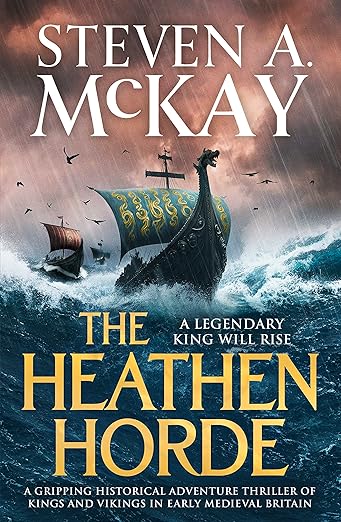
Book Corner: The Heathen Horde by Steven A. McKay

Heavy is the head that wears the crown.

Northumbria, AD 864. Viking warlord Ragnar Lothbrok is captured and killed in brutal fashion, an event that will shape the future of the nation for decades to come.

Mercia, AD 868Alfred, son of Wessex and heir to the throne, draws his first blood on the battlefield. It will not be his last.

A devastating scourge from the north is coming to Britain, one that will bring armies and entire kingdoms to their knees. Travelling along the whale road in their feared longships, the Great Heathen Army move fast, striking with a savagery unmatched, in a seemingly unstoppable tide of blood and iron.

One inexperienced warrior will prove the difference, a young man who will lead from the front and, in time, aspire to become the saviour of the Saxons… Alfred the Great.

A totally enrapturing historical adventure following the life of one of Britain’s most important ever kings.

Wow! Riveting start to what promises to be an excellent series. The Heathen Horde is a fabulous, gritty and entertaining story of how Alfred the Great became ‘Great.’

However…

I have to admit to a little trepidation when I started reading The Heathen Horde. Bernard Cornwell did such a fantastic job of recreating the period in his Last Kingdom series that I was not sure I was ready for another writer’s perspective. I was worried I would not warm to Steven A McKay’s version of the story.

How wrong I was!

And I am so happy that I gave it a go.

‘Look out, Alfred!’

The rider heard his brother’s warning just in time to raise his shield and the linden boards took the brunt of the axe which had been heading for his head, splinters flying as the wood shuddered, pain lancing through his arm. Baring his teeth in rage, Alfred swung his sword down, catching his attacker’s hand just as the axe had been about to strike again. There was a scream of pain as fingers were shorn through to the bone and then Alfred’s horse was past and cantering away from the battle.

‘Back,’ he grunted, tugging on the reins and bringing the horse around quickly. His heart was thudding in his chest and he felt light-headed but it was almost a joyful sensation. He was afraid, aye, but he was also excited, and eager to get back to the fight. He could see the axeman who’d tried to kill him, grimacing and eyeing his mangled hand as if he feared he might never hold a weapon properly again.

Alfred was charging back into the fight before he knew it, battle fever overtaking him at the realisation that he’d almost had his skull caved in. He headed straight for the axeman. The man had transferred his weapon to his left hand but could only wield it awkwardly and his wide eyes told of his fear at being forced to fight in such a manner. Alfred’s horse came alongside the Dane’s and, screaming an incoherent battle-cry, the young warrior smashed the edge of his blade into the enemy’s neck. The sheer force of the blow was enough to throw the man off his horse’s back despite the Dane’s long, mail neck guard. He lay on the ground, unmoving, as his mount bolted and the pounding hooves of the other combatants’ animals swirled around him.

Alfred grinned savagely, knowing that, if the Dane had somehow survived the attack and the fall, he wouldn’t last long before the weight of a horse crushed the life from him.

God be praised, one less sea-wolf to ravage Anglo-Saxon lands!

Admittedly, for the first 20 pages or so, I regularly found myself comparing Steven’s version of King Alfred to Bernard’s version. But I soon left The Last Kingdom behind and found myself enjoying The Heathen Horde for the fascinating story it is in its own right. Soon, I didn’t even notice Uhtred’s absence.

I love this version of King Alfred. His piety is evident, but not as all-consuming as Bernard Cornwell’s Alfred. His military and political prowess both play a greater role in the story. I even liked Alfred’s wife, Ælswith. The Heathen Horde starts when Alfred is merely a younger brother, not expecting to ever take the throne himself, serving his brother loyally and learning the art of war and politics. We see him grown into the role of military leader and develop his concept of a united kingdom – of England.

The story is rich in detail and brings the characters to life. I can’t wait for the next book in the series!

It ends tooooo soon! I need to know what happens next – now! 

The Heathen Horde is one of those books that you can’t wait to need to finish but want it never to end. It is unputdownable! I highly recommend you give it a go.

About the Author:

Steven A. McKay was born in Scotland in 1977. He is the author of two previous series of historical fiction, following Robin Hood and the warrior-druid Bellicus in post-Roman Britain. He plays the guitar, is the co-host of historical adventure podcast Rock, Paper, Swords! along with author Matthew Harffy, and lives just outside Glasgow with his wife and children.

To Buy the book: The Heathen Horde by Steven A. McKay is now available form Amazon.

*

My Books

Signed, dedicated copies of all my books are available through my online bookshop.

Out nowKing John’s Right-Hand Lady: The Story of Nicholaa de la Haye

In a time when men fought and women stayed home, Nicholaa de la Haye held Lincoln Castle against all-comers, gaining prominence in the First Baron’s War, the civil war that followed the sealing of Magna Carta in 1215. A truly remarkable lady, Nicholaa was the first woman to be appointed sheriff in her own right. Her strength and tenacity saved England at one of the lowest points in its history. Nicholaa de la Haye is one woman in English history whose story needs to be told…

King John’s Right-Hand Lady: The Story of Nicholaa de la Haye is now available from Pen & Sword Booksbookshop.org and Amazon.

Coming 15 January 2024: Women of the Anarchy

On the one side is Empress Matilda, or Maud. The sole surviving legitimate child of Henry I, she is fighting for her birthright and that of her children. On the other side is her cousin, Queen Matilda, supporting her husband, King Stephen, and fighting to see her own son inherit the English crown. Both women are granddaughters of St Margaret, Queen of Scotland and descendants of Alfred the Great of Wessex. Women of the Anarchy demonstrates how these women, unable to wield a sword, were prime movers in this time of conflict and lawlessness. It show how their strengths, weaknesses, and personal ambitions swung the fortunes of war one way – and then the other.

Available for pre-order from Amberley Publishing and Amazon UK.

Also by Sharon Bennett Connolly:

Defenders of the Norman Crown: The Rise and Fall of the Warenne Earls of Surrey tells the fascinating story of the Warenne dynasty, of the successes and failures of one of the most powerful families in England, from its origins in Normandy, through the Conquest, Magna Carta, the wars and marriages that led to its ultimate demise in the reign of Edward III. Defenders of the Norman Crown: Rise and Fall of the Warenne Earls of Surrey is now available from Pen & Sword BooksAmazon in the UK and US, and Bookshop.org.

Ladies of Magna Carta: Women of Influence in Thirteenth Century England looks into the relationships of the various noble families of the 13th century, and how they were affected by the Barons’ Wars, Magna Carta and its aftermath; the bonds that were formed and those that were broken. It is now available in paperback and hardback from Pen & Sword,  Amazon, and Bookshop.org.

Heroines of the Medieval World tells the stories of some of the most remarkable women from Medieval history, from Eleanor of Aquitaine to Julian of Norwich. Available now from Amberley Publishing and Amazon, and Bookshop.org.

Silk and the Sword: The Women of the Norman Conquest traces the fortunes of the women who had a significant role to play in the momentous events of 1066. Available now from Amazon,  Amberley Publishing, and Bookshop.org.

Alternate Endings: An anthology of historical fiction short stories including Long Live the King… which is my take what might have happened had King John not died in October 1216. Available in paperback and kindle from Amazon.

Podcast:

Have a listen to the A Slice of Medieval podcast, which I co-host with Historical fiction novelist Derek Birks. Derek and I welcome guests, such as Bernard Cornwell, and discuss a wide range of topics in medieval history, from significant events to the personalities involved.

*

Don’t forget! Signed and dedicated copies of all my books are available through my online bookshop.

For forthcoming online and in-person talks, please check out my Events Page.

You can be the first to read new articles by clicking the ‘Follow’ button, liking our Facebook page or joining me on Twitter and Instagram.

©2023 Sharon Bennett Connolly FRHistS 

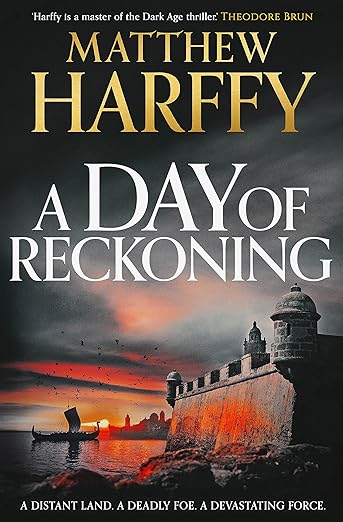
Book Corner: A Day of Reckoning by Matthew Harffy

Hunlaf battles peril and intrigue on a dangerous voyage to Muslim Spain.

AD 796
. Sailing in search of an object of great power, Hunlaf and his comrades are far from home when they are caught up in a violent skirmish against pirates.

After the bloody onslaught, an encounter with ships from Islamic Spain soon sees them escorted under guard to the city of Qadis, one of the jewels of the Emirate of Al-Andalus and the true destination of their voyage.

Hunlaf believes the Emir’s lands hold the key to his search, but there are dangerous games at play. To achieve his goal, Hunlaf and his allies must walk a difficult path where friends and enemies alike are not always what they seem – and where a weapon deadlier than any yet seen could change the future of all the kingdoms in Europe.

What a read! A Day of Reckoning by Matthew Harffy is another riveting story following the adventures of Hunlaf and his quest for the mystical book, The Treasure of Life, stolen from the island monastery of Lindisfarne. And, as usual, Hunlaf’s quest lands the monk-turned-warrior and his friends – the crew of the Brymsteda – in deep water, on sea and land!

Matthew Harffy takes us on a voyage to medieval, Islamic Spain in pursuit of the lost book, and on a secret mission for Charlemagne – a mission so secret that no one is exactly sure of its purpose, beyond escorting the emissary, Giso. Hunlaf must use his wits as well as his sword-arm to extricate himself and his friends from Spain in one piece.

Nothing goes to plan. But then, if it did, it would not be a Matthew Harffy novel, would it? Spiced up with a will-they-won’t-they love story, the betrayal of friend and foe alike and a storyline that will keep you engrossed to the very end, A Day of Reckoning is another Matthew Harffy triumph.

We all stared at the small man. I wondered who he was. He wore a nondescript robe and none of the trappings that would mark him out as a man of noble birth. No gold glimmered on his fingers or at his neck. But he met our gaze with assurance, and the way he had hidden within the room, utterly still and undetected until he chose to reveal himself, was unnerving.

“We are to take him back to Northumbria?” I said. ” Giso is to carry your response to Æthelred King?”

Alhwin flashed his teeth at me in a wide grin. His smile made me almost as nervous as Giso’s stealthy apparition.

“Giso will carry my response, but not to Northumbria.”

“But we are to return northward.”

“Is that so?” he asked, taking on the tone of a tutor speaking to a slow pupil. “What was it that you were commanded to do, Hunlaf?”

I thought back to the orders we had received from Lord Mancas. My eyes narrowed at the memory, again wondering at the depth of knowledge Alhwin possessed. Could he be so cunning?

“We were commanded to bring the message to you and then to wait for your response, that we might carry it aboard Brymsteda.”

“Ah, yes, the fabled ship that Runolf constructed. I would like to see it before you leave.” His smile broadened. “But I digress. You have fulfilled the first part of your king’s orders. I have received his message and other letters from Northumbria. And Giso here will bear my response. But my response is not for Æthelred or indeed anyone from my homeland. You must carry it southward. To al-Andalus.”

In A Day of Reckoning we learn more about the character and lives of Hunlaf’s crewmates. Friendships develop and are stretched to the limit. Hunlaf himself, a natural leader, is learning of the highs and lows of command. His character and beliefs are challenged by the exotic people of Muslim Spain.

Harffy recreates the sights, sounds and tensions of 8th century Spain to the extent that you can imagine yourself in the heart of the city of Qadiz (Cadiz), sensing the mix of languages, cultures and customs, smelling the spices amidst the fumes of Greek fire and burning flesh (it is a Matthew Harffy book, after all). Impeccably researched for the history, culture and politics of the 8th century Iberian peninsula, Matthew Harffy immerses the reader in this strange, exotic world, full of hidden dangers.

Whether or not all our heroes survive is down to a mixture of skill and luck and – well, you’ll have to read it to find out!

Matthew Harffy has honed and perfected his skills as a storyteller over the years, to such an extent that a fabulous week of reading is anticipated and expected when a new book is released. And A Day of Reckoning does not disappoint.

To Buy the Book:

A Day of Reckoning by Matthew Harffy is now available on Amazon.

About the author:

Matthew Harffy lived in Northumberland as a child and the area had a great impact on him. The rugged terrain, ruined castles and rocky coastline made it easy to imagine the past. Decades later, a documentary about Northumbria’s Golden Age sowed the kernel of an idea for a series of historical fiction novels. The first of them is the action-packed tale of vengeance and coming of age, THE SERPENT SWORD.

Matthew has worked in the IT industry, where he spent all day writing and editing, just not the words that most interested him. Prior to that he worked in Spain as an English teacher and translator. Matthew lives in Wiltshire, England, with his wife and their two daughters.

For all the latest news and exclusive competitions, join Matthew online: http://www.matthewharffy.com, twitter.com/@MatthewHarffy, http://www.facebook.com/MatthewHarffyAuthor.

*

My Books

Signed, dedicated copies of all my books are available through my online bookshop.

Out nowKing John’s Right-Hand Lady: The Story of Nicholaa de la Haye

In a time when men fought and women stayed home, Nicholaa de la Haye held Lincoln Castle against all-comers, gaining prominence in the First Baron’s War, the civil war that followed the sealing of Magna Carta in 1215. A truly remarkable lady, Nicholaa was the first woman to be appointed sheriff in her own right. Her strength and tenacity saved England at one of the lowest points in its history. Nicholaa de la Haye is one woman in English history whose story needs to be told…

King John’s Right-Hand Lady: The Story of Nicholaa de la Haye is now available from Pen & Sword Booksbookshop.org and Amazon.

Coming 15 January 2024: Women of the Anarchy

On the one side is Empress Matilda, or Maud. The sole surviving legitimate child of Henry I, she is fighting for her birthright and that of her children. On the other side is her cousin, Queen Matilda, supporting her husband, King Stephen, and fighting to see her own son inherit the English crown. Both women are granddaughters of St Margaret, Queen of Scotland and descendants of Alfred the Great of Wessex. Women of the Anarchy demonstrates how these women, unable to wield a sword, were prime movers in this time of conflict and lawlessness. It show how their strengths, weaknesses, and personal ambitions swung the fortunes of war one way – and then the other.

Available for pre-order from Amberley Publishing and Amazon UK.

Also by Sharon Bennett Connolly:

Defenders of the Norman Crown: The Rise and Fall of the Warenne Earls of Surrey tells the fascinating story of the Warenne dynasty, of the successes and failures of one of the most powerful families in England, from its origins in Normandy, through the Conquest, Magna Carta, the wars and marriages that led to its ultimate demise in the reign of Edward III. Defenders of the Norman Crown: Rise and Fall of the Warenne Earls of Surrey is now available from Pen & Sword BooksAmazon in the UK and US, and  Bookshop.org.

Ladies of Magna Carta: Women of Influence in Thirteenth Century England looks into the relationships of the various noble families of the 13th century, and how they were affected by the Barons’ Wars, Magna Carta and its aftermath; the bonds that were formed and those that were broken. It is now available in paperback and hardback from Pen & Sword,  Amazon, and Bookshop.org.

Heroines of the Medieval World tells the stories of some of the most remarkable women from Medieval history, from Eleanor of Aquitaine to Julian of Norwich. Available now from Amberley Publishing and Amazon, and Bookshop.org.

Silk and the Sword: The Women of the Norman Conquest traces the fortunes of the women who had a significant role to play in the momentous events of 1066. Available now from Amazon,  Amberley Publishing, and Bookshop.org.

Alternate Endings: An anthology of historical fiction short stories including Long Live the King… which is my take what might have happened had King John not died in October 1216. Available in paperback and kindle from Amazon.

Podcast:

Have a listen to the A Slice of Medieval podcast, which I co-host with Historical fiction novelist Derek Birks. Derek and I welcome guests, such as Bernard Cornwell, and discuss a wide range of topics in medieval history, from significant events to the personalities involved.

*

Don’t forget! Signed and dedicated copies of all my books are available through my online bookshop.

For forthcoming online and in-person talks, please check out my Events Page.

You can be the first to read new articles by clicking the ‘Follow’ button, liking our Facebook page or joining me on Twitter and Instagram.

©2023 Sharon Bennett Connolly FRHistS

Book Corner: Rogue by Charlene Newcomb

A knight sworn to keep a family secret.
A king who seeks revenge.
A daring plan to save one life…or condemn many.


England 1216AD. Sir Robert Fitzwilliam faithfully serves the English crown, but when the outlaw Allan a Dale, a childhood friend, is captured and thrown in the sheriff’s dungeons beneath Nottingham Castle, trouble is certain to follow.

Allan’s days are numbered. Nothing would please King John more than to see an old nemesis hanged. Nothing except watching Robert’s estranged father, Robin, dangling dead from a rope beside him.

When his father joins forces with the Hood gang to rescue Allan, enlisting the aid of friends and even the girl he loves, Robert must decide where his loyalties lie.

TALES OF ROBIN HOOD

Before there was Robin Hood, there was Allan of the Hood. You know their story – in Sherwood Forest, they rob from the rich and give to the poor. Rogue is a retelling of the origins of the Robin Hood legend set during a time of rebellion and invasion near the end of King John’s reign. It’s a thrilling adventure of loyalty, love, sacrifice, spies, and intrigue.

Anyone who follows me on Twitter or Facebook will know that I have a soft spot for Sherwood Forest and for the legend of Robin Hood. I live just down the road from the Forest and grew up visiting regularly. This year, I have even given two talks there, about Nicholaa de la Haye, who was a friend – or associate – of Philip Marc – the dastardly sheriff of Nottingham of Robin Hood legend. So when I hear of a new Robin Hood novel, I have to have it.

I was not going to pass up the chance of reading Rogue by Charlene Newcomb.

And I was not disappointed. Rogue offers a new take on the Robin Hood legend, with the main protagonist being Robin’s son, Robert, rather than Robin himself. Although it is a standalone novel, many of the characters from Charlene Newcomb’s previous Battle Scars series put in an appearance – it’s a, sort of, spin-off. Set in 1216, in the midst of the First Barons’ War, Rogue follows the adventures and dilemmas of Robert Fitz William, son of Sir Robin of Louviers – Robin Hood – who finds himself as a knight in the household of the Sheriff of Nottingham, and working to support the rule of King John, while his friends are the king’s sworn enemies.

Allan struck the thick mail on Marc’s arm. “Get off that arse and fight fair,”he shouted.

Robert was almost on him. “Hood, stop!”

If Allan heard Robert, he ignored him.

A heartbeat later, Robert reined in hard, severing Allan’s path to the sheriff. Robert didn’t remember grabbing his mace, but the wooden shaft was in his hand, his arm outstretched, the weapon’s spiked head sweeping toward Allan.

Robert aimed for his shoulder.

The sheriff—and King John—wanted Allan alive. Thank God for that. Outlaw or not, Robert could never kill him.

Allan blocked the blow, but the chain locked with Robert’s sword and sent their weapons into the air. Twisting round, Allan stepped on a downed tree and took a flying leap. He slammed into Robert, knocking them both to the ground.

Robert groaned, winded and shaken. Allan sprang to his feet, unfazed by the fall. He circled, but his sword was out of reach. As Robert stood, Allan lunged at Marc again, grabbing his saddle bow. Marc cursed, striking Allan’s head with his gauntlet. He drew his horse’s reins down hard. The animal jinked backwards, dragging Allan with him. Holding tight to the pommel, Allan kept his footing, but a branch cracked beneath his boot. He pitched wildly like a man swinging on a rope.

Clenching his teeth, Robert bulled toward Allan. He seized Allan’s arm and flung him across the road.

Allan collided with the ground, face first. Leaves and dirt flew into the air. Lurching sideways, Allan rolled and caught himself with his hands. He tried to scramble away, but Robert loomed large behind him. Allan’s knees collapsed beneath him, and Robert grabbed him. He whipped Allan to his back.

Robert slammed his fist into Allan’s jaw. Once. “Sorry.”Twice. “You shoulda’run.”

Withdrawing his sword, Robert drove the tip toward Allan’s face.

Allan blinked. “Robin?”

I have to admit, I found Rogue rather refreshing. It is a new take on the Robin Hood legend with the son of Robin taking centre stage and faced with a dilemma – how to serve the wicked King John as a man in the house hold of the sheriff of Nottingham, whilst still aiding his friends in the rescue of Allan a Dale, who has been captured by the sheriffs men and now languished in the dungeons of Nottingham Castle. There is as much action, intrigue and danger as any reader would expect from a Robin Hood story, and not everything goes as planned.

Charlene Newcomb has slipped Robin Hood into the story at a time of national crisis. Magna Carta was issued in 1215 – and revoked. England is in the midst of civil war – the Barons’ War – and the south is occupied by an invading French force under Prince Louis – invited by the revels to take the crown. King John’s situation is dire and the castle at Nottingham is trying to hold firm for the king.

Of course, nothing is ever straight forward! Robert is a complex character with father issues and deep feelings of abandonment from a childhood where Robin was off fighting for King Richard, unaware that he had a son at all. These feelings cause conflict within Robert as he tries to assimilate the absent father that Robin was to him with the noble hero Robin is to people Robert trusts and admires. Though he is not a child – far from it – Robert has to confronted the conflicting images he has of his father, if he is to survive. The contrasting scenes of father and son trying to get to know each other, to understand the other’s motives and find away to work together gives a depth to the story beyond the traditional adventure.

Rogue by Charlene Newcomb is a fabulous read. It is entertaining from start to finish. Replete with action, it will have the reader on the edge of their seat. And Nicholaa de la Haye gets a mention! As Rogue is set in 1216, we know Nicholaa is just a few miles away, defending Lincoln Castle. I can only hope she appears in her full glory in the sequel. (Hint, hint, Char!).

If you are looking for a good, adventurous read with action on every page, Rogue by Charlene Newcomb is perfect!

To Buy the Book:

Rogue is now available on Amazon in the UK and US

About the Author:

Charlene Newcomb, aka Char, writes historical fiction and science fiction. Her award-winning Battle Scars trilogy is set in the 12th century during the reign of Richard the Lionheart. Her writing roots are in the Star Wars Expanded Universe (aka Legends) where she published 10 short stories in the Star Wars Adventure Journal. She published the scifi/space opera Echoes of the Storm in 2020, and returns to medieval times with her latest novel Rogue in 2023.

Librarian (retired).

U.S. Navy veteran.

Mom to 3, grandma to 3.

*

My Books

Signed, dedicated copies of all my books are available through my online store.

Out nowKing John’s Right-Hand Lady: The Story of Nicholaa de la Haye

In a time when men fought and women stayed home, Nicholaa de la Haye held Lincoln Castle against all-comers, gaining prominence in the First Baron’s War, the civil war that followed the sealing of Magna Carta in 1215. A truly remarkable lady, Nicholaa was the first woman to be appointed sheriff in her own right. Her strength and tenacity saved England at one of the lowest points in its history. Nicholaa de la Haye is one woman in English history whose story needs to be told…

King John’s Right-Hand Lady: The Story of Nicholaa de la Haye is now available from Pen & Sword Booksbookshop.org and Amazon.

Coming 15 January 2024: Women of the Anarchy

On the one side is Empress Matilda, or Maud. The sole surviving legitimate child of Henry I, she is fighting for her birthright and that of her children. On the other side is her cousin, Queen Matilda, supporting her husband, King Stephen, and fighting to see her own son inherit the English crown. Both women are granddaughters of St Margaret, Queen of Scotland and descendants of Alfred the Great of Wessex. Women of the Anarchy demonstrates how these women, unable to wield a sword, were prime movers in this time of conflict and lawlessness. It show how their strengths, weaknesses, and personal ambitions swung the fortunes of war one way – and then the other.

Available for pre-order from Amberley Publishing and Amazon UK.

Also by Sharon Bennett Connolly:

Defenders of the Norman Crown: The Rise and Fall of the Warenne Earls of Surrey tells the fascinating story of the Warenne dynasty, of the successes and failures of one of the most powerful families in England, from its origins in Normandy, through the Conquest, Magna Carta, the wars and marriages that led to its ultimate demise in the reign of Edward III. Defenders of the Norman Crown: Rise and Fall of the Warenne Earls of Surrey is now available from Pen & Sword BooksAmazon in the UK and US, and  Bookshop.org.

Ladies of Magna Carta: Women of Influence in Thirteenth Century England looks into the relationships of the various noble families of the 13th century, and how they were affected by the Barons’ Wars, Magna Carta and its aftermath; the bonds that were formed and those that were broken. It is now available in paperback and hardback from Pen & Sword,  Amazon, and Bookshop.org.

Heroines of the Medieval World tells the stories of some of the most remarkable women from Medieval history, from Eleanor of Aquitaine to Julian of Norwich. Available now from Amberley Publishing and Amazon, and Bookshop.org.

Silk and the Sword: The Women of the Norman Conquest traces the fortunes of the women who had a significant role to play in the momentous events of 1066. Available now from Amazon,  Amberley Publishing, and Bookshop.org.

Alternate Endings: An anthology of historical fiction short stories including Long Live the King… which is my take what might have happened had King John not died in October 1216. Available in paperback and kindle from Amazon.

Podcast:

Have a listen to the A Slice of Medieval podcast, which I co-host with Historical fiction novelist Derek Birks. Derek and I welcome guests, such as Bernard Cornwell, and discuss a wide range of topics in medieval history, from significant events to the personalities involved.

*

Don’t forget! Signed and dedicated copies of all my books are available through my online store.

For forthcoming online and in-person talks, please check out my Events Page.

You can be the first to read new articles by clicking the ‘Follow’ button, liking our Facebook page or joining me on Twitter and Instagram.

©2023 Sharon Bennett Connolly FRHistS

Book Corner: The Night of the Wolf by Cassandra Clark

The ruthless reign of Henry IV and the clerical tyranny of Archbishop Arundel keep Brother Chandler and his friends under constant threat in this gripping medieval mystery featuring friar-sleuth Rodric Chandler.

Chester, 1400. Riding for his life, with a copy of Chaucer’s heretical Canterbury Tales in his possession, friar-sleuth Brother Chandler is ambushed on the road and wakes up in a stranger’s house.

Is his ‘rescuer’, wool merchant John Willoughby, friend . . . or foe? Willoughby declares that he, like Chandler, has renounced the self-crowned King Henry IV and will help Chandler get his dangerous belongings to safety. He seems trustworthy, but Chandler knows that if he’s caught by the King’s merciless censors together with the Tales, he’ll be burned at the stake.

But then Willoughby’s young wife perishes in a terrible accident at their house – or so it seems . . . Willoughby asks Chandler to help investigate if it was indeed an accident or if someone had a hidden agenda.

All Chandler wants to do is find safe haven for Chaucer’s Tales and return to London, but he accepts the case. Little does he know that it will lead to secrets being uncovered which will put not only Chandler but also those around him in unimaginable peril.

Incredible adventure!

I have to admit, there is a gap in my knowledge in medieval history around the reigns of Henry IV and Henry V. I have never liked Henry IV, despite the fact I love researching his father, John of Gaunt. I don’t know why? I have read some a handful on the first two Lancastrian kings, but never delved deeper into their lives and reigns. So, The Night of the Wolf by Cassandra Clark is a refreshing and fascinating story set in a period that is unfamiliar to me, though I may now have to look more deeply into Henry IV and the attitudes towards his usurpation of the throne from his cousin Richard II.

The Night of the Wolf is an intriguing murder mystery – if it is murder, that is, rather than an unfortunate accident – set after the accession of Henry IV and the death in Pontefract Castle of Richard II. The lead character is a monk who has fallen foul of King Henry in the past and is trying to stay under the radar of the authorities and stay alive.

Cassandra Clark’s hero of The Night of the Wolf, Brother Chandler, is a fascinating character, a renegade friar who has left his lover and child to keep them safe, and travelled north with a book written by Geoffrey Chaucer. Having escaped the pyre once, Chandler must find somewhere safe to secrete Chaucer’s works, and to keep himself out of the reach of the new king’s men. His personal mission is hampered when the lady of the house in which he is staying falls from a roof garden – or was pushed.

Brother Chandler is drawn into a web of lies and deceit that he must unravel.

Chandler hesitated to ask him if he might see the body. When he entered one of the small chambers in the new wing a trestle had been erected with a sheet covering the body. He felt he had no right to enter without permission but there was only a priest there and a nun with a companion crossing the yard and following Chandler inside. They were soon kneeling and murmuring through a prayer for the dead.

The priest got up and after few words to Chandler went over to the trestle and lifted the sheet to one side. Her body was horribly bruised. Chandler indicated that the sheet should be replaced. It told him nothing. After another prayer, he left.

The housekeeper was watching from the kitchen window as he crossed the yard and the flurried movement as he approached suggested that she was not alone. In fact most of the house servants seemed to have congregated round the big, square, scrubbed table where the kitcheners ate their meals. As one they rose to their feet when he entered. Again he had to explain about the task Willoughby had given him.

The housekeeper, a wide-hipped, red-haired woman of about fifty, wrapped in a large white apron took charge of him. ‘Sit, brother. We are honoured to have the opportunity to help you in this sad and terrible business …’And so on in the same tone he had already heard before.

It seemed to be the case that nobody knew anything, no one had seen anything, and they were all shocked and would never forget the terrible sight of the poor young mistress lying in the yard in a pool of blood.

‘The devil curses us,’one of the maids said. ‘It is a judgement,’and she began to sob.

‘Be quiet, Maud, you have done nothing to warrant judgement,’the housekeeper reproved. ‘You’re always drawing attention to yourself. It’s my view, brother,’she turned to Chandler, ‘that the poor thing tripped and fell, maybe going too near the edge of the roof in order to watch people passing by in the street. Why else would she go so near the edge?’

‘I understand your master had not yet instructed his men to finish their work there? Were they not about to fix up a railing of some sort?’

‘I believe so.’

‘We were told not to venture out there until it was safe.’ the tearful maid interrupted. ‘But Mistress Willoughby liked her own way and said she needed somewhere more peaceful than the noise of a wool merchant’s house with carts clattering into the yard all day.’

‘And you are…?’

Poor Brother Chandler tries not to get involved in the murderous events in Chester, he has enough problems of his own. But he cannot refuse the pleas of a grieving husband and embarks on an investigation that uncovers the divided loyalties and various intrigues of the leading citizens of Chester. Chandler is a sympathetic character, so easy to like that the reader finds themselves egging him but at the same time urging caution.

It is fascinating to read a murder mystery set in a time that must have been very unsettled for the ordinary Englishmen. A political coup and change in monarch that leaves the realm divided between the rightful king – as there had been rumours of Richard II’s death, but no confirmation – and the man who seized the throne. Cassandra Clark clearly demonstrates the suspicion and fear that must have abounded in 1400. No one knowing who to trust nor where individual loyalties lay. Betrayal lurked around every corner.

The Night of the Wolf is a fabulous, fast- paced, murder mystery that will keep the reader on the edge of their seat, or sitting up, reading, late into the night, desperate to discover the murderer and learn that Brother Chandler is safe, or not. With such a clever, intriguing plot, I defy any reader not to be mesmerised by Brother Chandler’s story.

About the Author

Cassandra Clark is an award-winning scriptwriter for theatre, radio and television, and the author of nine previous novels in the Hildegard of Meaux medieval mystery series. Running wild near the ruins of the Abbey of Meaux in the East Riding as a child became her inspiration for the series while the discovery in a dusty archive of the Chronicle of Meaux written in 1395 is the secret source for her research.

To buy the book: Amazon

*

My Books

Signed, dedicated copies of all my books are available, please get in touch by completing the contact me form.

Out nowKing John’s Right-Hand Lady: The Story of Nicholaa de la Haye

In a time when men fought and women stayed home, Nicholaa de la Haye held Lincoln Castle against all-comers, gaining prominence in the First Baron’s War, the civil war that followed the sealing of Magna Carta in 1215. A truly remarkable lady, Nicholaa was the first woman to be appointed sheriff in her own right. Her strength and tenacity saved England at one of the lowest points in its history. Nicholaa de la Haye is one woman in English history whose story needs to be told…

King John’s Right-Hand Lady: The Story of Nicholaa de la Haye is now available from Pen & Sword Booksbookshop.org and Amazon.

Coming 15 January 2024: Women of the Anarchy

On the one side is Empress Matilda, or Maud. The sole surviving legitimate child of Henry I, she is fighting for her birthright and that of her children. On the other side is her cousin, Queen Matilda, supporting her husband, King Stephen, and fighting to see her own son inherit the English crown. Both women are granddaughters of St Margaret, Queen of Scotland and descendants of Alfred the Great of Wessex. Women of the Anarchy demonstrates how these women, unable to wield a sword, were prime movers in this time of conflict and lawlessness. It show how their strengths, weaknesses, and personal ambitions swung the fortunes of war one way – and then the other.

Available for pre-order from Amberley Publishing and Amazon UK.

Also by Sharon Bennett Connolly:

Defenders of the Norman Crown: The Rise and Fall of the Warenne Earls of Surrey tells the fascinating story of the Warenne dynasty, of the successes and failures of one of the most powerful families in England, from its origins in Normandy, through the Conquest, Magna Carta, the wars and marriages that led to its ultimate demise in the reign of Edward III. Defenders of the Norman Crown: Rise and Fall of the Warenne Earls of Surrey is now available from Pen & Sword BooksAmazon in the UK and US, and  Bookshop.org.

Ladies of Magna Carta: Women of Influence in Thirteenth Century England looks into the relationships of the various noble families of the 13th century, and how they were affected by the Barons’ Wars, Magna Carta and its aftermath; the bonds that were formed and those that were broken. It is now available in paperback and hardback from Pen & Sword,  Amazon, and Bookshop.org.

Heroines of the Medieval World tells the stories of some of the most remarkable women from Medieval history, from Eleanor of Aquitaine to Julian of Norwich. Available now from Amberley Publishing and Amazon, and Bookshop.org.

Silk and the Sword: The Women of the Norman Conquest traces the fortunes of the women who had a significant role to play in the momentous events of 1066. Available now from Amazon,  Amberley Publishing, and Bookshop.org.

Alternate Endings: An anthology of historical fiction short stories including Long Live the King… which is my take what might have happened had King John not died in October 1216. Available in paperback and kindle from Amazon.

Podcast:

Have a listen to the A Slice of Medieval podcast, which I co-host with Historical fiction novelist Derek Birks. Derek and I welcome guests, such as Bernard Cornwell, and discuss a wide range of topics in medieval history, from significant events to the personalities involved.

*

For forthcoming online and in-person talks, please check out my Events Page.

You can be the first to read new articles by clicking the ‘Follow’ button, liking our Facebook page or joining me on Twitter and Instagram.

©2023 Sharon Bennett Connolly FRHistS

Book Corner: The King’s Jewel by Elizabeth Chadwick

Wales, 1093.

Meet Nesta, a woman trying to survive in a man’s world – a world where the men who would protect her are dead and banished.

The warm, comfortable family life of young Nesta, daughter of Prince Rhys of Deheubarth is destroyed when her father is killed and she is taken hostage. Her honour is further tarnished when she is taken as an unwilling concubine by King William’s ruthless younger brother Henry, who later ascends the throne under suspicious circumstances.

Gerald FitzWalter, an ambitious young knight is rewarded for his unwavering loyalty to his new King with Nesta’s hand in marriage. He is delighted, having always admired her from afar, but Nesta’s only comfort is her return to her beloved Wales where cannot help but be tempted by the handsome, charismatic and dangerous son of the Welsh prince, Owain. When he offers her the chance to join him in his plan to overthrow Norman rule she must choose between her duty and her desire . . .

The King’s Jewel by Elizabeth Chadwick recounts the story of Nesta ferch Rhys, the young Welsh princess who became the mistress of Henry I of England, bearing him at least one son. I first came across Nesta’s story when I was researching Heroines of the Medieval World. On the face of it, Nesta’s life appears exciting and adventurous but Elizabeth Chadwick tempers this with a clear understanding of how little control Nesta had over her own life.

Losing her father at an early age, the poor girl was a pawn in the hands of powerful men. She first appears in history as a concubine of King Henry I, though the exact dates of their relationship, the year it took place and how long it lasted, are unknown. What is known, is that Nesta had a son by Henry and that she married Gerald of Windsor as her first husband in the early 1100s. By 1109, she and Gerald had three children. By the end of her life, Nesta was the mother of no fewer than nine children by at least four different men. She had also endured an abduction by her cousin. As a Welsh heiress, in the face of Norman expansion, Nesta was never going to have a quiet life.

And Princess Nesta’s story has been brought to life by Elizabeth Chadwick’s The King’s Jewel, fleshing out the little we know to build a whole world and life around Nesta, telling a story that is both absorbing and historically accurate.

A short ride brought them to the settlement at Pembroke, where the women were thrust into a small room halfway up a stone lookout tower. A soldier tossed in their baggage, ransacked of all jewellery, fabric and trinkets. Straw pallets and coarse woollen blankets were thrown down for their slumber. The only light in the dismal chamber came from a slit of a window open to the air, and cresset lamps, burning smokily, sputtering tallow fat. The soldier returned, bringing bowls of barley broth and coarse bread, and then departed, closing and barring the door.

Nesta gazed at their bleak surroundings with a horrible, hollow sensation in her stomach. Two nights ago she had slept in a feather bed with fresh linen sheets and soft furs. She had enjoyed the clean, sweet light of beeswax candles and had washed her hands and face with rose water. She had belongings, wealth and status. Any man daring to fondle her haunch and laugh about it would have lost his hand for the insult.

‘What will happen to us?’ she asked her mother who was staring at the pallets in disgust.

‘If tehy had wanted to kill us, they would have done so by now,’ Gwladus said with a shrug. ‘I do not matter, unless I happen to be carrying another child, which I know I am not, but you are your father’s daughter, and that makes you valuable.’

Nesta folded her arms and shivered.

‘You had your first bleed at Christmas, and you are of an age to wed. Any of these Normans could take you to wife and lay claim to your father’s lands by their laws. You are not a hostage for your people, but a girl who brings with her the gift of stolen territory.’

Nesta went rigid. ‘I would never marry one of them – never!’

Gwladus shook her head. ‘What you want does not matter to them, but they cannot take what you already are inside. Hold your head high and remember your heritage. You are a pattern for others to emulate for courage and loyalty.’ She took three steps to Nesta and touched her cheek. ‘I am depending on you to carry this burden for your family’s pride.’

‘I won’t let you down.’ Nesta’s voice quivered for, despite her defiant words, she felt small, afraid and overwhelmed.

‘Oh, my beautiful girl.’ Gwladus hugged her hard and tears squeezed out from between her closed eyelids. ‘I know you will not. And you shall always have my love – always, whatever happens.’

Nesta drew in the familiar scent of her mother’s skin, seeking comfort. ‘I want it all to go away,’ she whispered.

‘I know you do. I know.’ Gwladus rocked her back and forth and kissed her cheek. ‘So do I. Dear Holy Virgin, so do I.’

As we have come to expect, The King’s Jewel is up to Elizabeth Chadwick’s usual superior standard of story-telling. Using what we do know of Nesta’s life, Elizabeth builds an engaging story of a young woman who makes the most of a life forced upon her, but whose instinct to rebel sees her make decisions that are not always in her own best interests. We are introduced to a girl who has lost almost everything, her father dead, brother in exile and mother condemned to a nunnery, and is at the mercy of her captors. From that frightened little girl, Elizabeth Chadwick creates a captivating story that will keep the reader enthralled to the very end.

The research is impeccable and I found myself nodding at the narrative more than once, knowing where Elizabeth found those little tidbits of information. And as I finished the book, I marvelled at how Elizabeth had managed to weave the few facts we do know seamlessly into the story, adding a strong element of authenticity to the elements of fiction.

The King’s Jewel is a thoroughly enjoyable novel, set in the heart of Wales against the backdrop of the Norman kings of England determined to stamp their authority on the wild country and its people. Nesta is, at once, the symbol of resistance and reluctant submission and her journey to find some kind of balance to her life is riveting.

The beauty of The King’s Jewel is that Elizabeth Chadwick brings Nesta to life, making her a real person in the eyes of the reader, eliciting sympathy for a young girl who has no control over her destiny, compassion for a woman making a marriage not of her choosing and understanding for the decisions made that led her down a dangerous path. Elizabeth understands the internal conflict that must have arisen for Nesta out of being married to a Norman, whilst wanting freedom for her Welsh homeland and people.

I cannot recommend it highly enough!

The King’s Jewel is available from Amazon.

About the Author:

New York Times bestselling author Elizabeth Chadwick lives in a cottage in the Vale of Belvoir in Nottinghamshire with her husband and their three dogs. Her first novel, The Wild Hunt, won a Betty Trask Award, To Defy a King won the Romantic Novelist Association’s Historical Novel Prize and The Scarlet Lion was nominated by Richard Lee – founder of the Historical Novel Society – as one of the top ten historical novels of the last decade. She often lectures at conferences and historical venues, has been consulted for television documentaries and is a member of the Royal Historical Society.

Keep in touch with Elizabeth via her website, her blogs or on social media.

http://www.elizabethchadwick.com
twitter: @chadwickauthor
facebook: ElizabethChadwick

*

My Books

Signed, dedicated copies of all my books are available, please get in touch by completing the contact me form.

Out nowKing John’s Right-Hand Lady: The Story of Nicholaa de la Haye

In a time when men fought and women stayed home, Nicholaa de la Haye held Lincoln Castle against all-comers, gaining prominence in the First Baron’s War, the civil war that followed the sealing of Magna Carta in 1215. A truly remarkable lady, Nicholaa was the first woman to be appointed sheriff in her own right. Her strength and tenacity saved England at one of the lowest points in its history. Nicholaa de la Haye is one woman in English history whose story needs to be told…

King John’s Right-Hand Lady: The Story of Nicholaa de la Haye is now available from Pen & Sword Booksbookshop.org and Amazon.

Coming 15 January 2024: Women of the Anarchy

On the one side is Empress Matilda, or Maud. The sole surviving legitimate child of Henry I, she is fighting for her birthright and that of her children. On the other side is her cousin, Queen Matilda, supporting her husband, King Stephen, and fighting to see her own son inherit the English crown. Both women are granddaughters of St Margaret, Queen of Scotland and descendants of Alfred the Great of Wessex. Women of the Anarchy demonstrates how these women, unable to wield a sword, were prime movers in this time of conflict and lawlessness. It show how their strengths, weaknesses, and personal ambitions swung the fortunes of war one way – and then the other.

Available for pre-order from Amberley Publishing and Amazon UK.

Also by Sharon Bennett Connolly:

Defenders of the Norman Crown: The Rise and Fall of the Warenne Earls of Surrey tells the fascinating story of the Warenne dynasty, of the successes and failures of one of the most powerful families in England, from its origins in Normandy, through the Conquest, Magna Carta, the wars and marriages that led to its ultimate demise in the reign of Edward III. Defenders of the Norman Crown: Rise and Fall of the Warenne Earls of Surrey is now available from Pen & Sword BooksAmazon in the UK and US, and  Bookshop.org.

Ladies of Magna Carta: Women of Influence in Thirteenth Century England looks into the relationships of the various noble families of the 13th century, and how they were affected by the Barons’ Wars, Magna Carta and its aftermath; the bonds that were formed and those that were broken. It is now available in paperback and hardback from Pen & Sword,  Amazon, and Bookshop.org.

Heroines of the Medieval World tells the stories of some of the most remarkable women from Medieval history, from Eleanor of Aquitaine to Julian of Norwich. Available now from Amberley Publishing and Amazon, and Bookshop.org.

Silk and the Sword: The Women of the Norman Conquest traces the fortunes of the women who had a significant role to play in the momentous events of 1066. Available now from Amazon,  Amberley Publishing, and Bookshop.org.

Alternate Endings: An anthology of historical fiction short stories including Long Live the King… which is my take what might have happened had King John not died in October 1216. Available in paperback and kindle from Amazon.

Podcast:

Have a listen to the A Slice of Medieval podcast, which I co-host with Historical fiction novelist Derek Birks. Derek and I welcome guests, such as Bernard Cornwell and discuss a wide range of topics in medieval history, from significant events to the personalities involved.

*

For forthcoming online and in-person talks, please check out my Events Page.

You can be the first to read new articles by clicking the ‘Follow’ button, liking our Facebook page or joining me on Twitter and Instagram.

©2023 Sharon Bennett Connolly FRHistS