Interview with Gemma Hollman, author of Women in the Middle Ages

This week, I have had the distinct pleasure of chatting with author and historian Gemma Hollman about her new book, Women in the Middle Ages: Illuminating the World of Peasants, Nuns, and Queen.

I cannot wait to get my hands on this book!

Sharon: Tell me about your new book, Women in the Middle Ages: Illuminating the World of Peasants, Nuns, and Queens

Gemma: The book is an illustrated history which aims to shed light on the lives of medieval women. Focusing on roughly 500 years, from 1000 – 1500, I take a look at European women from all levels of society. By using surviving artwork, we see what the visual record can tell us about these women that might be lost in the written record. We often have this idea that the medieval period was a male-dominated world, with women at the sidelines, but this is not quite the case and art is an excellent place to see this. Women appear everywhere in it, but they were also very often the makers of it, too. Women ran households, worked in taverns and textile hubs, invested money in businesses, created books and paintings, saved souls through their prayers and ruled countries. And in a visually-dominated culture, where the majority of people were illiterate, women were able to leave their mark on tapestries, manuscripts, beads, bowls, and more. The book is hopefully a marvellous romp through time with something for anyone, whether it’s your first time learning about medieval women, or the hundredth book you’ve read.

Sharon: What inspired you to write the book?

Gemma: My first two books were biographies, and I already had a vision for my third book as another biography, but I was also keen to do something more general. I was pondering how to do this, when a contact at Abbeville Press got in touch with me and let me know they were wanting to publish an art book centred on medieval women. This immediately sparked dozens of ideas in my head, and a chat with my future editor revealed that we had very similar visions for the book. It seemed like the perfect opportunity to dive in, and I relished the idea of doing such an image-heavy book. There are so many beautiful objects and artworks from the medieval period that I haven’t had the chance to showcase in my previous books, and I was excited to learn something new myself. I didn’t want to regret turning it down, so I didn’t!

Sharon: Do you have a favourite woman you highlighted in the book?
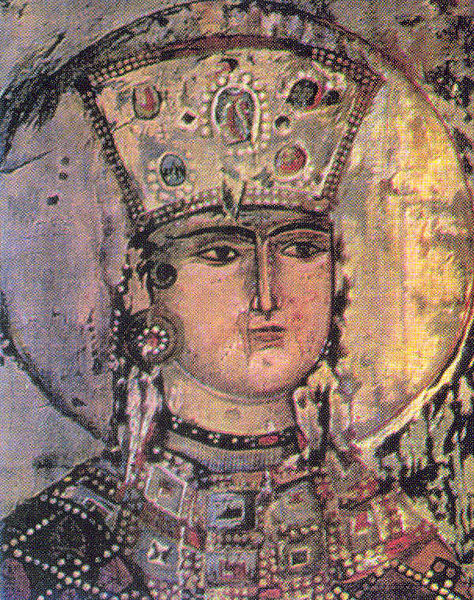
Tamar of Georgia

Gemma: Oh gosh, that’s such a difficult question because there are so many featured within! I don’t know that I can pick just one, but certainly one of my favourite stories is that of Astrid, Gunnvor and the Dynna Stone. The Dynna Stone is an 11th century runestone from Norway that commemorates a woman named Astrid. It was erected in her memory by her mother, Gunnvor, and commemorates Astrid as “the handiest maiden in Hadeland”, suggesting Astrid was skilled at some kind of craft. We know little else about the two women, but the runestone is also important as being one of the earliest instances of Christian pictorial art in the country. In a book about medieval women and art, having an object commissioned by a woman for her daughter, who may also have been an artist of some form, is really special.

Sharon: Who was the hardest person to write about?

Gemma: I don’t know that I struggled so much to write about a particular person – I cover so many countries and centuries that there was always someone you could find – but more particular groups of people. Being someone who specialises much more on Western Europe, it was easy to think of examples of significant people to write about, but I was keen that the book would make sure to cover as much of Europe as possible, and so I sometimes had to do some real digging to find an example of a woman who fit in with what I was talking about from different regions. In the same vein, it was sometimes tricky finding specific examples of women to use in my Peasants and Professionals section. Although we do know the names of some craftswomen from the later Middle Ages, due to increased record-keeping, finding names of ordinary, lower-class women is really, really difficult. There were often few reasons for these women to turn up in the written record. This is, of course, where the art was an excellent filler, as we at least have visual representations of them, but it was almost impossible to tell individual stories of particular women in the same way as in other chapters.

Sharon: Did you come across a particularly interesting or obscure character?

Gemma: One woman who really struck a chord with me was Marietta Barovier, who was part of a well-known Venetian glassmaking family. Her father had invented cristallo glass, and had clearly given equal weighting to the talents of his daughter as well as his son. When he died, he bestowed his workshop to his two children jointly. Marietta gained a significant reputation of her own, and in the 1480s she invented the rosette or chevron bead, which became an iconic Venetian glass bead. Women in Italy were in many ways more restricted in the world of work than other women in Europe, and yet here you have a woman who was not only allowed equal inheritance, but became famous in her own right for her exceptional skill.

Sharon: Was there a particular image or manuscript that struck you?
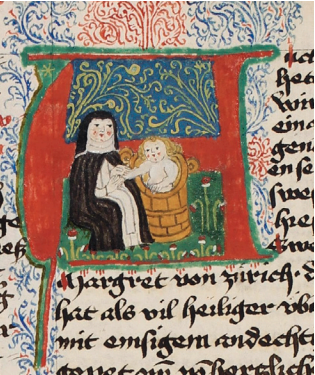
Margaret von Zurich

Gemma: Another difficult question as there are so many wonderful images! I think I’ll go with a simple little manuscript initial from a German nunnery. The picture shows a nun named Margaret von Zurich bathing the Christ Child in a barrel bath. It’s a very simple, small drawing, with some beautiful colour, and to modern eyes it is nothing extraordinary. But this small picture is actually incredibly subversive. The Catholic Church had forbidden women from touching Christ, and so not only was Margaret’s vision dangerous, but so was the recording of it in a manuscript. Religious women in Europe were often at the spearhead of reform and religious fervour, and this small drawing really succinctly demonstrates that.

Sharon: Did you have to leave anyone out through time constraints, lack of images or word count? If so, who?

Gemma: Oh, most certainly! The book is not very long by history book standards, and yet it aims to cover a continent and five centuries of history! I could have written so, so much more and there are always people you wish you could include or expand upon but can’t. In the early days of writing and researching, I realised I needed to find a way to narrow the scope a little to make the book somewhat more manageable, and so I made the decision to focus on Catholic Europe, which thus excluded many eastern countries. This was a disappointment as one woman I wrote about in a sample chapter was Queen Tamar of Georgia. She ruled from 1184 to 1213 and was the first woman to rule the country in her own right. Despite early objections to her reign, her time as queen went on to be seen as a Golden Age, and her story is so fascinating. It was a shame to have to cut her out, but maybe she can find her way in to a future project of mine!

Sharon: What was your biggest challenge when writing about women in history?
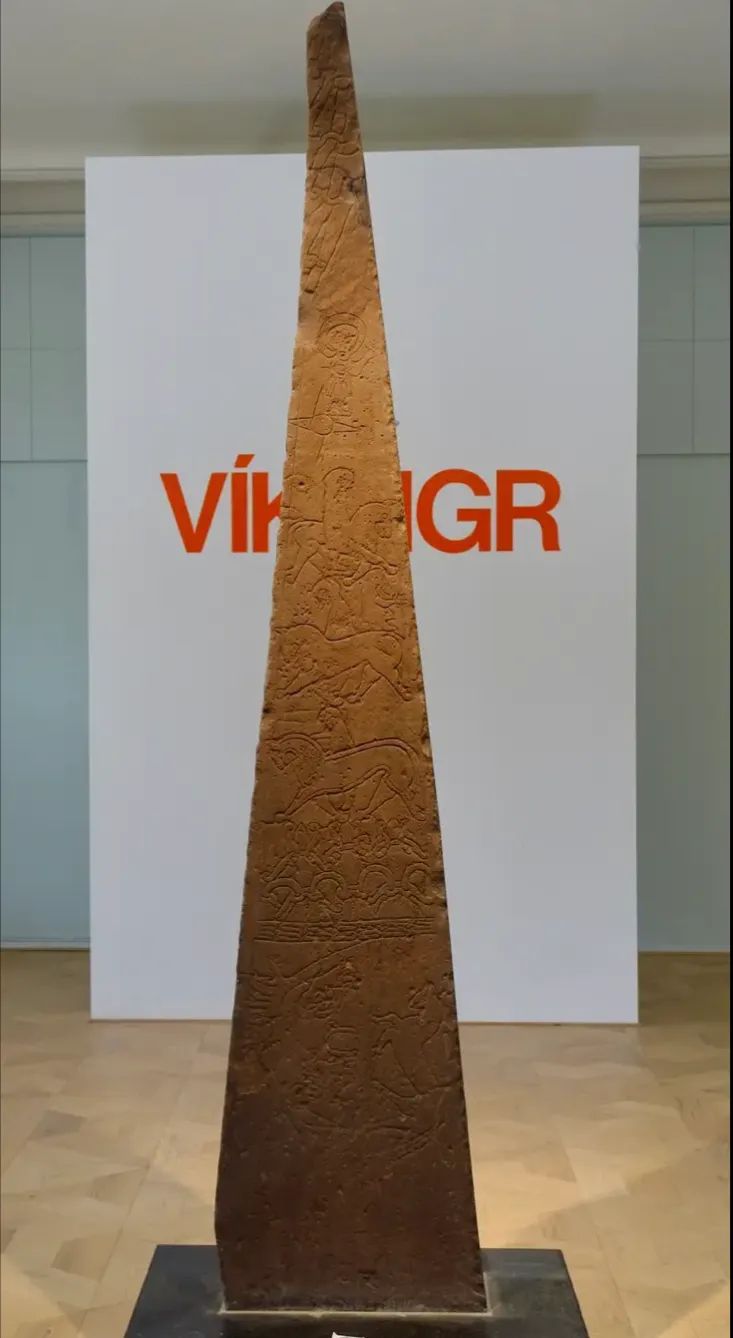
Dynna Stone

Gemma: I think for this book in particular, it was trying to correctly balance what women did, with what people at the time thought about what women did. There was a lot of misogyny in the Middle Ages and so lots of written sources or pieces of art criticise women for working too much, for being too involved in politics, for being too promiscuous, for being too…. But we also have to remember that just a fraction of what existed in the medieval period has survived to today, and the people creating these sources were sometimes the very people most likely to criticise women – monks sequestered away from the world, courtiers who didn’t like submitting to female authority, and so on. And so just because we might have some of these thoughts that have made it to today, it doesn’t mean that everyone or even the majority of people thought that. You don’t want to belittle the struggles that women at the time went through; some women did lose their kingdoms because people wanted a male ruler instead, and some peasant women who had to work in taverns to support their families were derided as prostitutes. But those female leaders also had thousands of men willing to fight for them, and there were popular ballads and texts that praised women for all the hard work they did to keep their families afloat. And you also want to try and avoid praising certain women for their exceptionalism, especially when some of their contemporaries used exceptionalism as back-handed compliments, a way to deride the rest of the female sex.

Sharon: What are you working on now?

Gemma: I am now busy getting started on my next book! I’ve gone back to England and will be looking at the court of Richard II, and I’m really excited to see which threads I’ll choose to pull at. It’s such an interesting and tumultuous reign, there is plenty to choose from! But I am definitely keen to return to a similar style book as Women in the Middle Ages in the future so my mind is already whirring with possibilities…

About the Author: 

Gemma Hollman is a historian and author of The Queen and the Mistress: The Women of Edward III and Royal Witches: From Joan of Navarre to Elizabeth Woodville. A Fellow of the Royal Historical Society, she works full-time in the heritage industry whilst running her historical blog, Just History Posts. You can find Gemma on Twitter: @GemmaHAuthor, and Facebook: facebook.com/JustHistoryPosts,

To Buy the book:

You can buy Women in the Middle Ages: Illuminating the World of Peasants, Nuns, and Queen in the UK from Waterstones and Amazon. And in the US from Barnes & Noble and Amazon.

*

My Books:

Signed, dedicated copies of all my books are available through my online store.

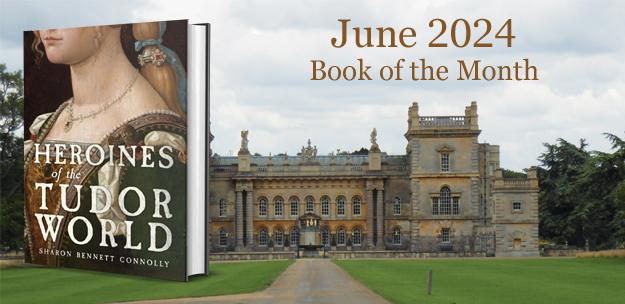
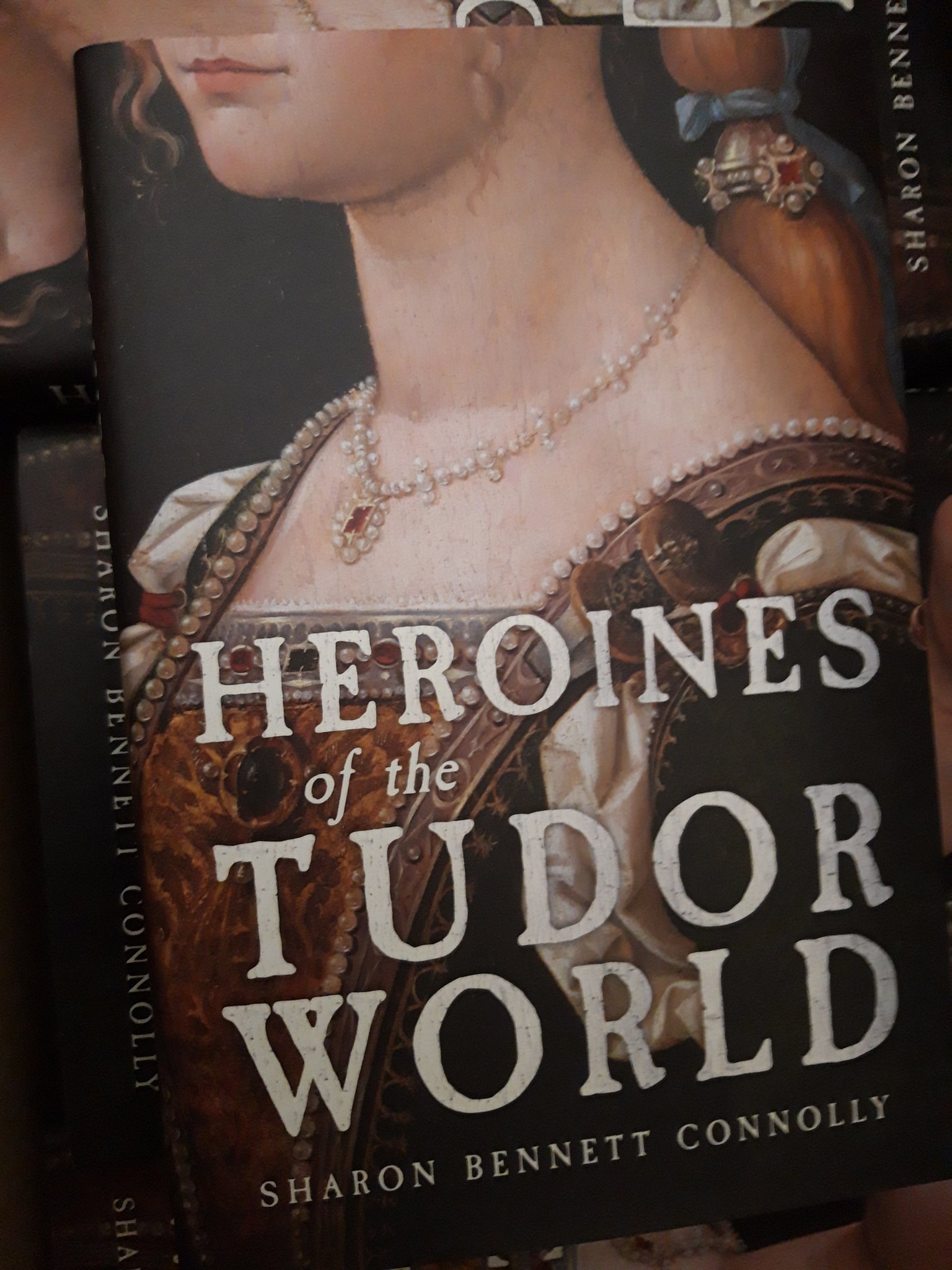
OUT NOW! Heroines of the Tudor World
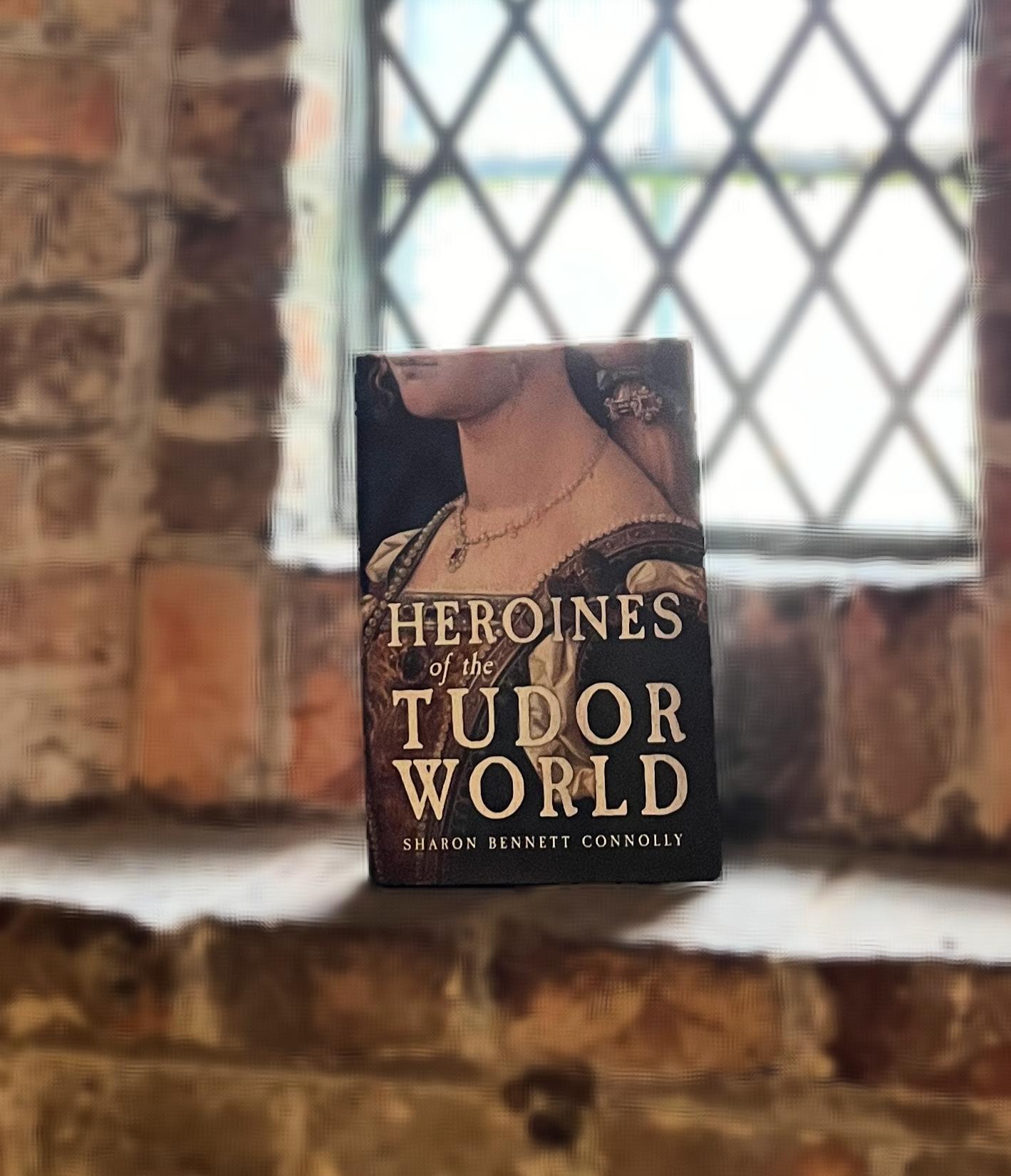
Heroines of the Tudor World tells the stories of the most remarkable women from European history in the time of the Tudor dynasty, 1485-1603. These are the women who ruled, the women who founded dynasties, the women who fought for religious freedom, their families and love. These are the women who made a difference, who influenced countries, kings and the Reformation. In the era dominated by the Renaissance and Reformation, Heroines of the Tudor World examines the threats and challenges faced by the women of the era, and how they overcame them. From writers to regents, from nuns to queens, Heroines of the Tudor World shines the spotlight on the women helped to shape Early Modern Europe.

Heroines of the Tudor World is now available for pre-order from Amberley Publishing and Amazon UK.

Coming 30 January 2025: Scotland’s Medieval Queens
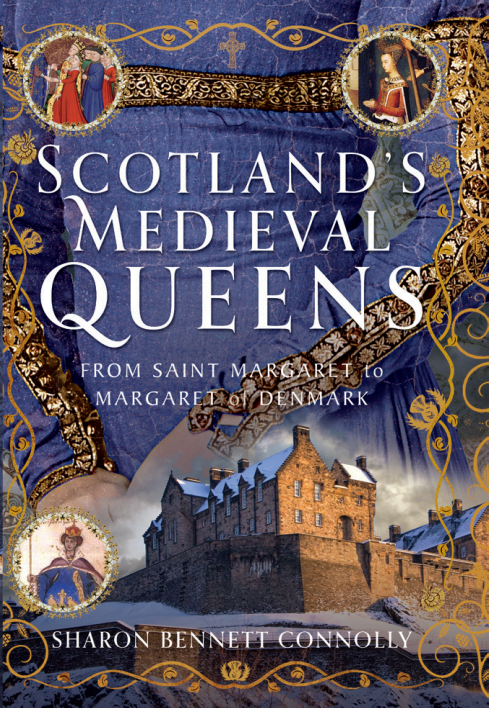
Scotland’s history is dramatic, violent and bloody. Being England’s northern neighbour has never been easy. Scotland’s queens have had to deal with war, murder, imprisonment, political rivalries and open betrayal. They have loved and lost, raised kings and queens, ruled and died for Scotland. From St Margaret, who became one of the patron saints of Scotland, to Elizabeth de Burgh and the dramatic story of the Scottish Wars of Independence, to the love story and tragedy of Joan Beaufort, to Margaret of Denmark and the dawn of the Renaissance, Scotland’s Medieval Queens have seen it all. This is the story of Scotland through their eyes.

Available for pre-order now.

Also by Sharon Bennett Connolly:
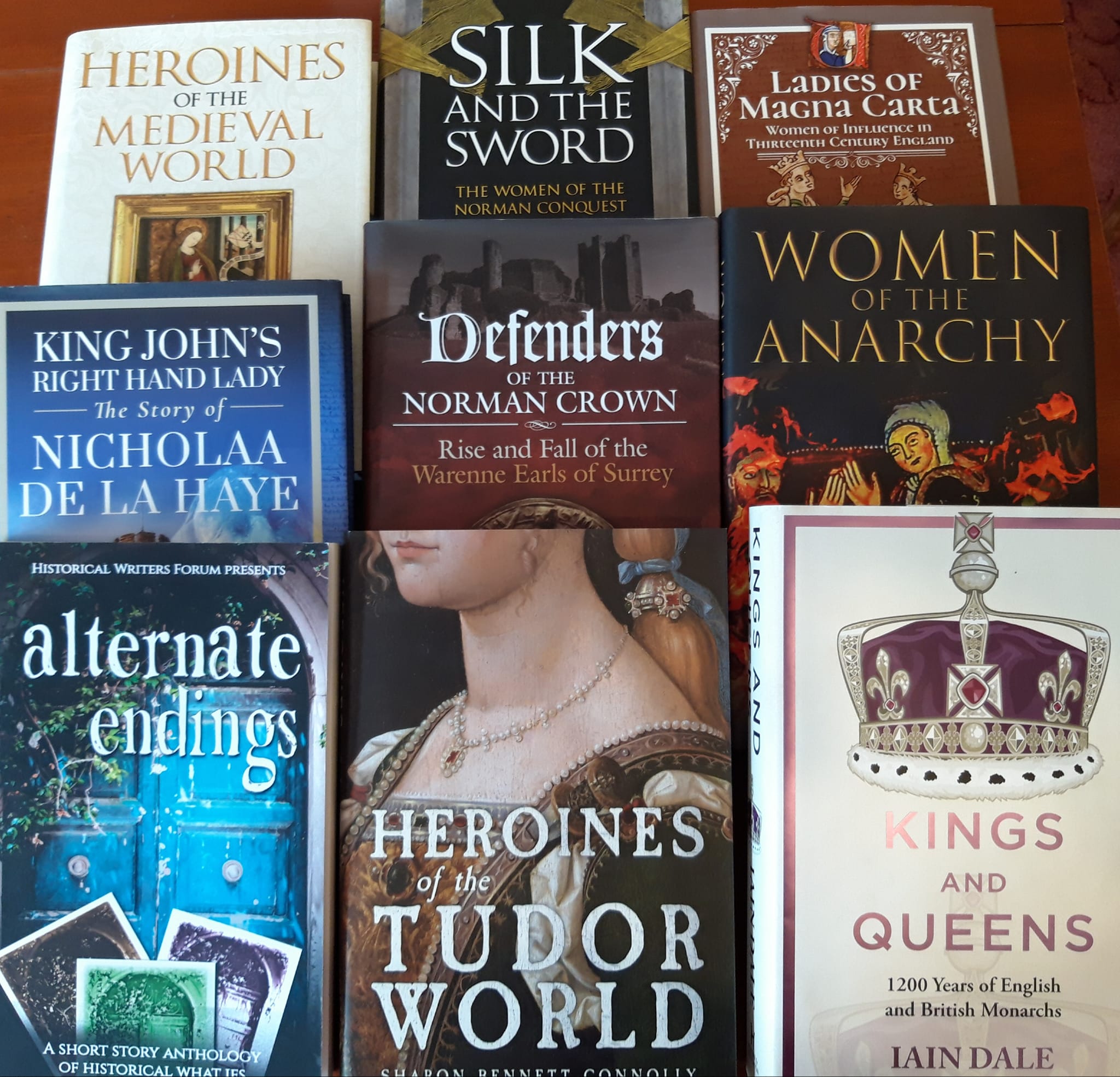
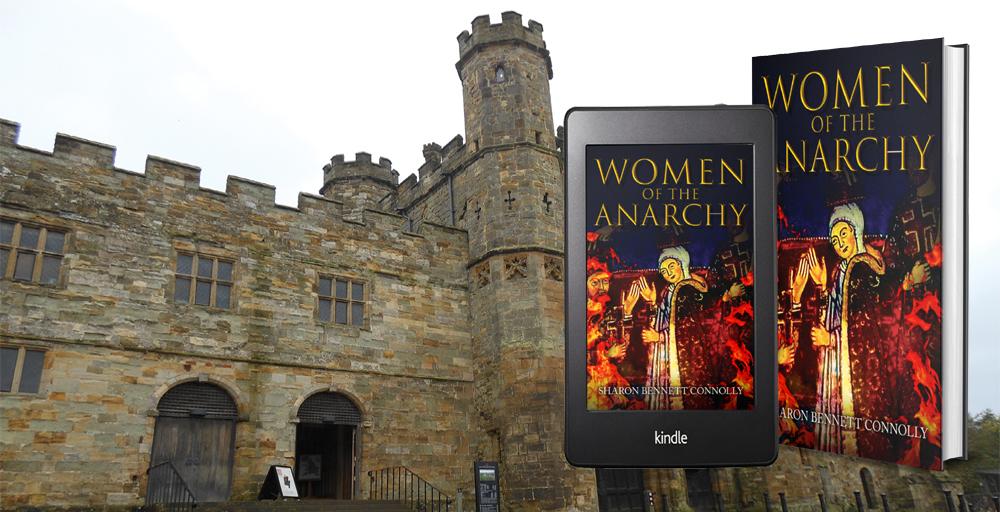
Women of the Anarchy demonstrates how Empress Matilda and Matilda of Boulogne, unable to wield a sword themselves, were prime movers in this time of conflict and lawlessness. It shows how their strengths, weaknesses, and personal ambitions swung the fortunes of war one way – and then the other. Available from Bookshop.orgAmberley Publishing and Amazon UKKing John’s Right-Hand Lady: The Story of Nicholaa de la Haye is the story of a truly remarkable lady, the hereditary constable of Lincoln Castle and the first woman in England to be appointed sheriff in her own right. Available from all good bookshops Pen & Sword Booksbookshop.org and AmazonDefenders of the Norman Crown: The Rise and Fall of the Warenne Earls of Surrey tells the fascinating story of the Warenne dynasty, from its origins in Normandy, through the Conquest, Magna Carta, the wars and marriages that led to its ultimate demise in the reign of Edward III. Available from Pen & Sword BooksAmazon in the UK and US, and Bookshop.org

Ladies of Magna Carta: Women of Influence in Thirteenth Century England looks into the relationships of the various noble families of the 13th century, and how they were affected by the Barons’ Wars, Magna Carta and its aftermath; the bonds that were formed and those that were broken. It is now available in paperback and hardback from Pen & SwordAmazon, and Bookshop.orgHeroines of the Medieval World tells the stories of some of the most remarkable women from Medieval history, from Eleanor of Aquitaine to Julian of Norwich. Available now from Amberley Publishing and Amazon, and Bookshop.orgSilk and the Sword: The Women of the Norman Conquest traces the fortunes of the women who had a significant role to play in the momentous events of 1066. Available now from Amazon,  Amberley Publishing, and Bookshop.org.

Alternate Endings: An anthology of historical fiction short stories including Long Live the King… which is my take what might have happened had King John not died in October 1216. Available in paperback and kindle from Amazon.

Podcast:

Have a listen to Gemma talking about the two women in the life of Edward III on the A Slice of Medieval podcast, which I co-host with Historical fiction novelist Derek Birks.

*

Don’t forget! Signed and dedicated copies of all my books are available through my online store.

For forthcoming online and in-person talks, please check out my Events Page.

You can be the first to read new articles by clicking the ‘Follow’ button, liking our Facebook page or joining me on TwitterThreads and Instagram.

*

©2024 Sharon Bennett Connolly FRHistS and Gemma Hollman

Guest Post: Empresses, Saints and Female-Kings: The Four Great-Granddaughters of King Ladislaus the Elbow-High by Katarzyna Ogrodnik-Fujcik

Today it is a pleasure to welcome my good friend, Kasia Ogrodnik to History…the Interesting Bits with a little bit of Polish history for us. I have been wanting to tell the story of King Jadwiga since writing about her in Heroines of the Medieval World. But Kasia is far better qualified to write about her compatriot, Poland’s famous female king and saint, and Jadwiga’s influential female relatives.

So, over to Kasia…

Empresses, Saints and Female-Kings: The Four Great-Granddaughters of King Ladislaus the Elbow-High

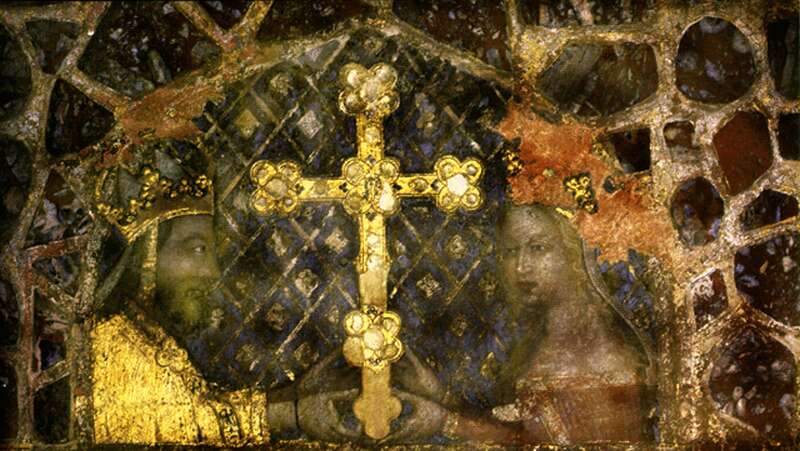
Charles IV, King of Bohemia and Holy Roman Emperor and Anna of Schweidnitz [Anna Świdnicka], c. 1357, Chapel of St. Katherine, Karlstejn

The night of 19 May 1365 saw a young girl leaving Pisa on horseback. With her hair loose, clad only in her nightgown she was galloping to safety after fire broke out in Palazzo degli Anziani. Judging by her looks no one would have guessed this girl was in fact Holy Roman Empress and Queen of Bohemia. 

Anna of Schweidnitz, Silesia (today Poland), was the only child of Duke Henry II, the grandson of King Ladislaus the Elbow-High of Cracow (Poland). Upon her father’s death she was placed under the care of his elder brother, her uncle, Bolko II the Small. The ruler of the small, but politically important duchy, Bolko was the last independent Silesian Piast. Since Charles IV of Luxembourg intended to annex the entirety of Silesia to the Kingdom of Bohemia, Bolko’s duchy, being the only missing part, was crucial to his plans. To secure the Schweidnitz inheritance Charles married Anna and this is how her journey began. Of course, she was not the only great-granddaughter of King Ladislaus to make an illustrious career. His three other great-granddaughters were to leave their marks on the world, too, and indelible ones. Two of them were to be crowned ”kings” and one proclaimed  saint. 

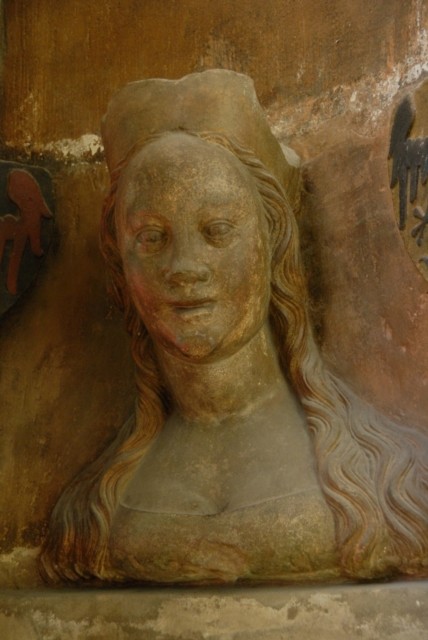
Anna of Schweidnitz [Anna Świdnicka], bust in St Vitus Cathedral, Prague, c. 1370

Anna of Schweidnitz (b.1339), Queen of Bohemia and Holy Roman Empress, was Charles IV of Luxembourg’s third wife. Initially she was betrothed to his son, Wenceslaus, but the boy died while still very young. His mother, Charles’s second wife died too shortly afterwards. To secure the Schweidnitz succession Charles decided to marry his late son’s fiancee himself. Anna was raised and educated at the splendid court of Queen Elizabeth of Poland (her late father’s aunt) at Buda, where she was sent by her uncle and official guardian, Duke Bolko II the Small. It was there where she and Charles were married in the closing days of  May 1353. Shortly afterwards the newlyweds returned to Prague and paid a visit to Schweidnitz, where the succession treaty was signed according to which the duchy was to be inherited by Anna and her children by Charles upon the death of her uncle Bolko and his wife Agnes of Habsburg. On 28 July 1353, Anna was crowned Queen of Bohemia and the following year, on 9 February 1354, Queen of Germany. The year 1355 saw the royal couple in Italy, where on Easter Sunday (5 April 1355) they were crowned Holy Roman Emperor and Holy Roman Empress in a splendid ceremony in the Basilica of Saint Peter, Rome.

Anna and Charles’s first child, a daughter, Elizabeth, was born in 1358. Charles was overjoyed, but Anna felt she failed her husband (which we know thanks to her surviving correspondence with Petrarch). A much awaited son and heir arrived three years later, named Wenceslaus, traditional name of the rulers of Bohemia. He was to become Charles’ beloved and favoured child. Anna died on 11 July 1362, in childbirth, aged 23. The child did not survive, either, and they were buried together in St Vitus Cathedral, Prague. Anna was remembered for her personal charm and sweet nature. Not only did she receive a bluestocking education, but she was also considered one of the style icons of her time, her reputation as a great beauty resting on the surviving images created during her lifetime and shortly after her untimely death. Tradition has it that of Charles’ four wives it was Anna he loved most. Stricken with grief upon her passing, he did not remarry until a political situation forced him to. His fourth wife was Anna’s kin, Elizabeth of Pomerania, also great-granddaughter of King Ladislaus the Elbow-High. 

Elizabeth of Pomerania (Eliška Pomořanská, Elżbieta Pomorska)

 
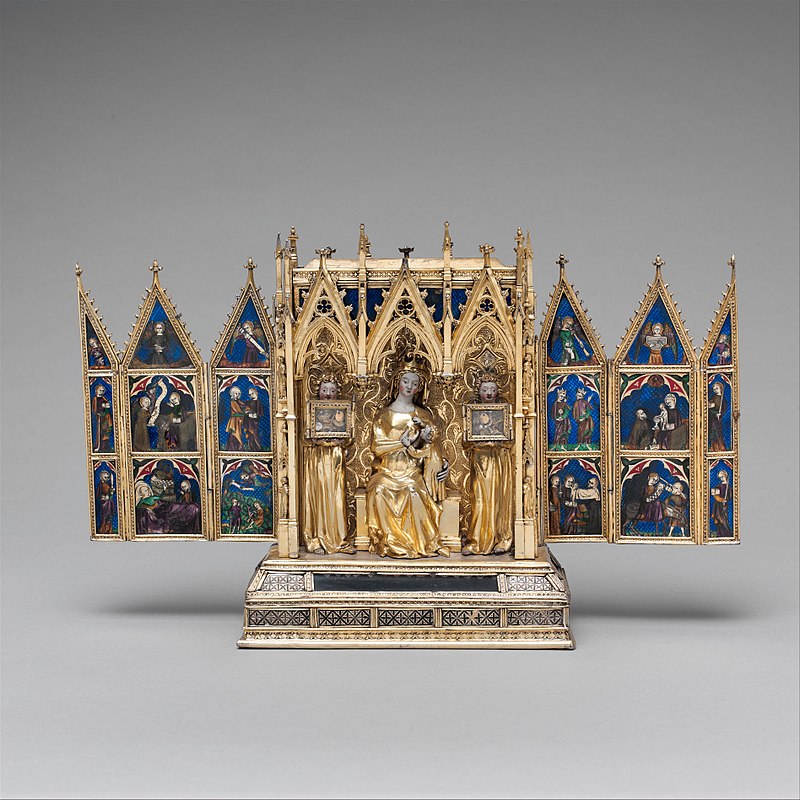
Reliquary Shrine of Elizabeth of Poland, Queen of Hungary, Maria and Jadwiga’s paternal grandmother, attributed to Jean de Touyl, ca. 1350 . Metropolitan Museum of Art, New York

Elizabeth was a daughter of Duke Bogusław the Great of Pomerania and Princess Elżbieta of Poland. In 1362 her maternal grandfather, King Casimir the Great of Poland together with his nephew, Louis the Great of Hungary, dukes of Austria and Bavaria formed a coalition against Charles IV of Luxembourg. The opposing parties found themselves on the verge of war, which did not break out, however, perhaps due to Anne of Schweidnitz’s untimely death. The rulers came to terms instead and a marriage was forged to consolidate their agreement. Charles was to marry Elizabeth. He was thrice her age, shorter than her and not very attractive. She was described as beautiful, full of life, and as fit as a fiddle. Stories had it that she could break horseshoes with her own hands. She was an avid horse rider and hunter. 

The wedding ceremony was celebrated in Kraków on 21 May 1363. Afterwards the couple travelled together to Prague where Elizabeth was crowned Queen of Bohemia. Five years later her imperial coronation at Rome followed. Despite the age difference she and Charles got along well, being married for fifteen years. Their union produced six children, four of whom were to reach adulthood. Charles and Elizabeth’s eldest child, a daughter Anne, was to marry Richard II and become Queen Consort of England. Their son, Sigismund was to be crowned King of Bohemia, Hungary and Holy Roman Emperor. Charles IV died in 1378. Elizabeth herself was to outlive her husband for fifteen years. She died in 1393 and like his three wives before her, she was buried in St Vitus Cathedral, Prague.

Mária [Mary] of Anjou, King of Hungary

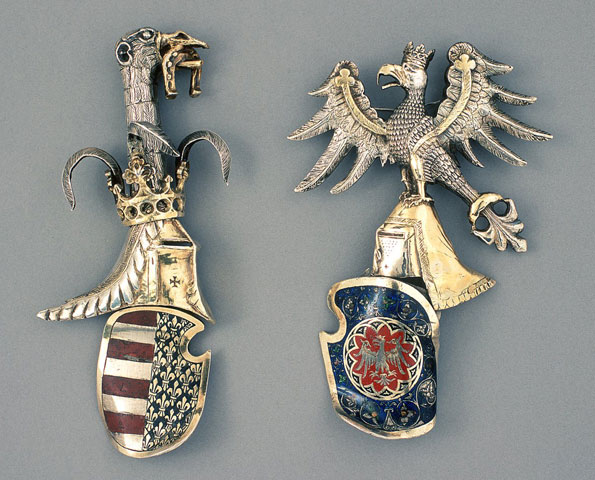
The coats of arms of Hungary and Poland, c. 1340. Treasury of Aachen Cathedral, Germany

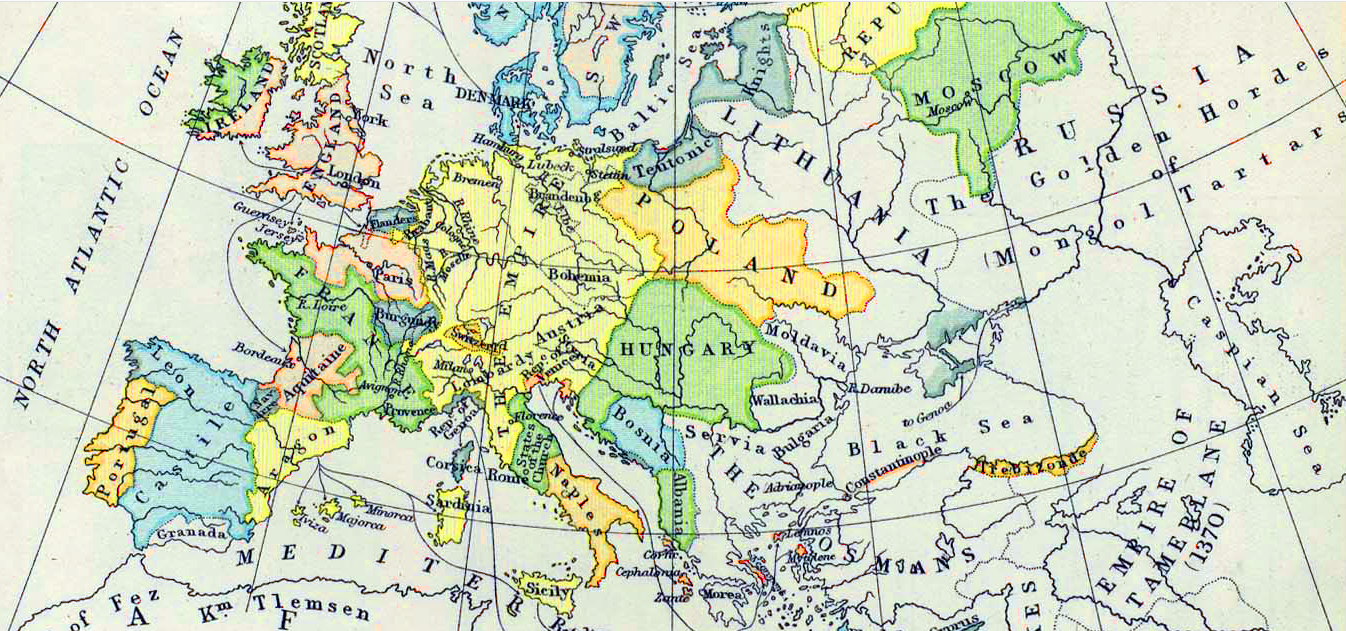
Mary was one of the three daughters of Louis the Great of Hungary and his second wife, Elizabeth of Bosnia. In 1379, Mary’s elder sister Catherine died, leaving her and her sister Jadwiga Louis’s sole surviving children. The matter of Polish succession had been on the agenda long before Mary was born. Upon King Casimir the Great’s death in 1370 his nephew, Mary’s father, Louis was crowned king of Poland. Initially it was Mary, who was to succeed him as the king of Poland, but the events took a different turn, and in the end she was replaced by her younger sister, Jadwiga [Hedwig]. 

Mary was crowned “king” of Hungary on 17 September 1382, seven days after her father’s death. However, the idea of a female monarch was not popular among the Hungarian nobility. Many nobles considered Charles III of Naples, Mary’s distant cousin, the lawful heir. 

Charles landed in Dalmatia in September 1385. In October Mary was married to Sigismund of Luxembourg, however, this  could not prevent Charles from entering the capital.  Mary was forced to renounce the throne and Charles’s coronation took place on 31 December 1385. He did not rule for long. Two months later, in February 1386, he was murdered, most probably at the instigation of Mary’s mother. Mary was restored, but in July she and her mother were captured by the dead king’s supporters. Famed for her beauty, but not for her political decisions, Mary’s mother met a violent end. After imprisonment by her opponents in Novigrad castle, she was found guilty of the murder of Charles III of Naples and strangled to death before her daughter’s own eyes, her body put on display, hanging on a rope from the castle walls. Mary survived and was rescued by her husband, Sigismund, who was crowned king of Hungary afterwards. Mary officially remained his co-ruler, but had no real influence on the government. She died on 17 May 1395 after falling from a horse during a hunting accident. She was pregnant at the time. Her prematurely born son did not survive either. 

Jadwiga [Hedwig] of Anjou, king and patron saint of Poland

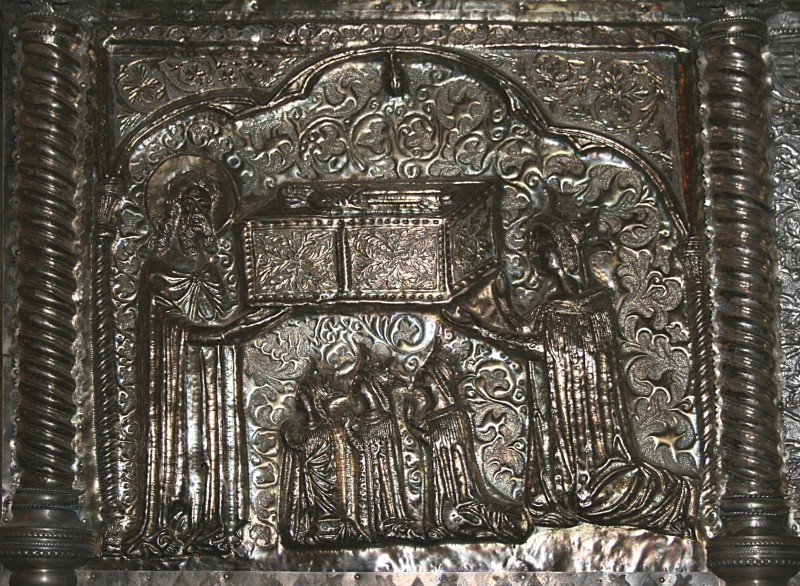
Jadwiga and Maria, their mother and their sister Catherine as depicted on the St Simeon’s casket, Zadar, Croatia

Mary’s younger sister, Hedwig was born on 18 February 1374, being the youngest of the three daughters of Louis the Great of Hungary and Elizabeth of Bosnia. 

Both Mary and Jadwiga received a bluestocking education, Jadwiga both at the cultivated court of Hungary and in Vienna, at the court of her future father-in-law. Not only could Jadwiga read and write, but she also spoke fluent Latin and German. As the king of Poland she owned a big library and always  showed an active and generous support of scholars and learning institutions.

Since Polish nobles did not like the idea of Mary’s consort, Sigismund of Bohemia, becoming de facto their king, they appealed to Elizabeth of Bosnia, the dowager queen, who had assumed regency, asking to send the younger of her two surviving daughters to Kraków. Elizabeth agreed and absolved the Polish nobles from the oath of loyalty they had pledged to Mary. 

Jadwiga’s coronation took place on 16 October 1384 in Wawel Cathedral, Kraków, where she was crowned ”king” of Poland. On 18 January 1385 the Lithuanian delegation came to the capital and a meeting was held with the representatives of the Polish nobility. Jadwiga was to marry the ruler of pagan Lithuania, Jogaila. In the opening days of 1386, Jadwiga publicly called off her engagement to Wilhelm Habsburg and married newly baptised Jogaila, who was to come down in history under his new name, Władysław Jagiełło [Ladislaus Jagiellon]. At the time of their wedding she was twelve, he was thirty-five. Władyslaw was crowned king on 4 March 1386. 

Despite her young age Jadwiga continued to play an active role in the administration and politics of her realm. She conducted the negotiations with the knights of the Teutonic Order, but also on the Hungarian front. Jadwiga conferred with her sister Mary on numerous occasions. Their meetings were held both in Hungary and in Lesser Poland. She also intervened in Lithuania, where she peacefully resolved dynastic disputes between the ruling fractions.

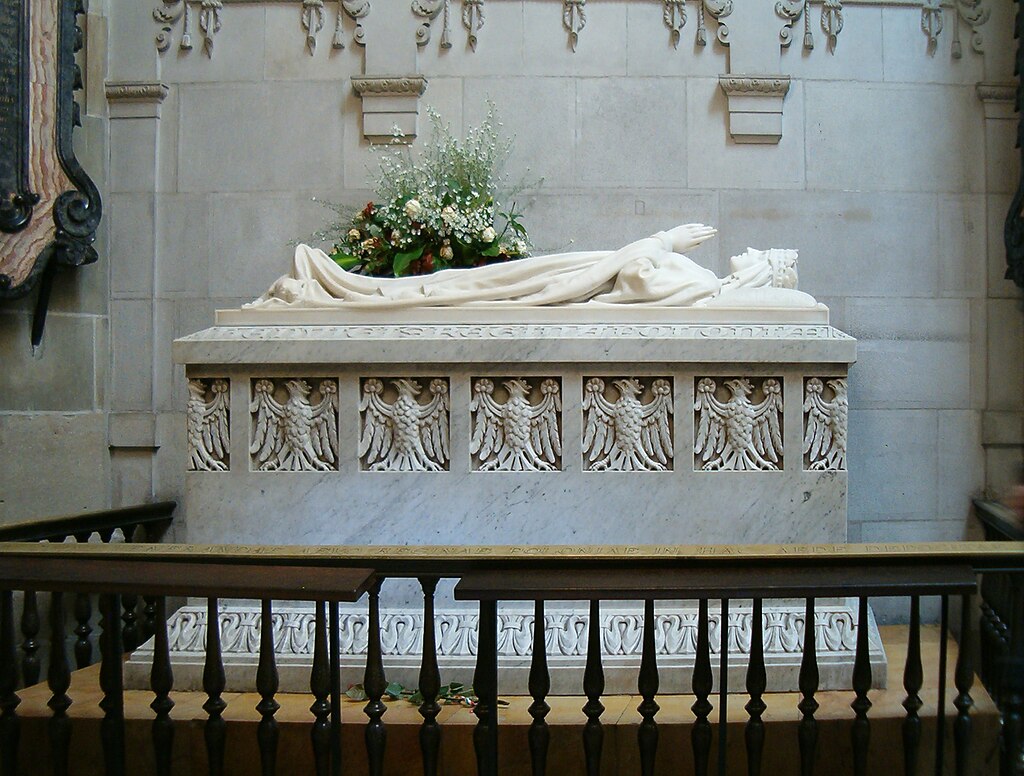
Jadwiga’s tomb effigy from 1902 by Antoni Madeyski, Wawel Cathedral, Kraków, Poland. The queen’s earthly remains were transferred here from her original resting place at the high altar in 1949 and stayed here till 1987. Then they were transferred to the altar with the Black Crucifix

She was famed for her charity and showing great care to the poor and the ill. Her active and generous support of scholars and learning institutions did not waver over the years. In her last will she donated all her jewelry, her rich dresses and other valuable objects to the Kraków Academy (the first Polish university founded by Kazimierz Wielki), now the Jagiellonian University. Additionally, she founded a dormitory for Polish students at the University of Prague. 

Jadwiga died from complications in childbirth on 17 July 1399. She was twenty-five at the time. Her daughter did not survive, either. Almost immediately after her death, Jadwiga’s tomb became the focus of miracles and the destination of pilgrimages. Her cult flourished, with her canonization first mentioned during the funeral ceremony. However, it was to take seven centuries before she was actually canonised by Pope John Paul II. Ever since she has been recognised as patron saint of Poland and considered Polish national hero. 

About the author:

Katarzyna Ogrodnik-Fujcik specializes in British literature and history, her area of expertise being the first Plantagenets (the Angevins). She lives in Poland. She writes for different magazines and websites on Polish and European Middle Ages. She runs a blog dedicated to Henry the Young King. She consulted a BBC documentary on William Marshal.

*

My Books:

Signed, dedicated copies of all my books are available through my online store.

OUT NOW! Heroines of the Tudor World

Heroines of the Tudor World tells the stories of the most remarkable women from European history in the time of the Tudor dynasty, 1485-1603. These are the women who ruled, the women who founded dynasties, the women who fought for religious freedom, their families and love. These are the women who made a difference, who influenced countries, kings and the Reformation. In the era dominated by the Renaissance and Reformation, Heroines of the Tudor World examines the threats and challenges faced by the women of the era, and how they overcame them. From writers to regents, from nuns to queens, Heroines of the Tudor World shines the spotlight on the women helped to shape Early Modern Europe.

Heroines of the Tudor World is now available for pre-order from Amberley Publishing and Amazon UK.

Coming 30 January 2025: Scotland’s Medieval Queens

Scotland’s history is dramatic, violent and bloody. Being England’s northern neighbour has never been easy. Scotland’s queens have had to deal with war, murder, imprisonment, political rivalries and open betrayal. They have loved and lost, raised kings and queens, ruled and died for Scotland. From St Margaret, who became one of the patron saints of Scotland, to Elizabeth de Burgh and the dramatic story of the Scottish Wars of Independence, to the love story and tragedy of Joan Beaufort, to Margaret of Denmark and the dawn of the Renaissance, Scotland’s Medieval Queens have seen it all. This is the story of Scotland through their eyes.

Available for pre-order now.

Also by Sharon Bennett Connolly:

Women of the Anarchy demonstrates how Empress Matilda and Matilda of Boulogne, unable to wield a sword themselves, were prime movers in this time of conflict and lawlessness. It shows how their strengths, weaknesses, and personal ambitions swung the fortunes of war one way – and then the other. Available from Bookshop.orgAmberley Publishing and Amazon UKKing John’s Right-Hand Lady: The Story of Nicholaa de la Haye is the story of a truly remarkable lady, the hereditary constable of Lincoln Castle and the first woman in England to be appointed sheriff in her own right. Available from all good bookshops Pen & Sword Booksbookshop.org and AmazonDefenders of the Norman Crown: The Rise and Fall of the Warenne Earls of Surrey tells the fascinating story of the Warenne dynasty, from its origins in Normandy, through the Conquest, Magna Carta, the wars and marriages that led to its ultimate demise in the reign of Edward III. Available from Pen & Sword BooksAmazon in the UK and US, and Bookshop.org

Ladies of Magna Carta: Women of Influence in Thirteenth Century England looks into the relationships of the various noble families of the 13th century, and how they were affected by the Barons’ Wars, Magna Carta and its aftermath; the bonds that were formed and those that were broken. It is now available in paperback and hardback from Pen & SwordAmazon, and Bookshop.orgHeroines of the Medieval World tells the stories of some of the most remarkable women from Medieval history, from Eleanor of Aquitaine to Julian of Norwich. Available now from Amberley Publishing and Amazon, and Bookshop.orgSilk and the Sword: The Women of the Norman Conquest traces the fortunes of the women who had a significant role to play in the momentous events of 1066. Available now from Amazon,  Amberley Publishing, and Bookshop.org.

Alternate Endings: An anthology of historical fiction short stories including Long Live the King… which is my take what might have happened had King John not died in October 1216. Available in paperback and kindle from Amazon.

Podcast:

Have a listen to the A Slice of Medieval podcast, which I co-host with Historical fiction novelist Derek Birks. Derek and I welcome guests, such as Bernard Cornwell, and discuss a wide range of topics in medieval history, from significant events to the personalities involved.

*

Don’t forget! Signed and dedicated copies of all my books are available through my online store.

For forthcoming online and in-person talks, please check out my Events Page.

You can be the first to read new articles by clicking the ‘Follow’ button, liking our Facebook page or joining me on TwitterThreads and Instagram.

*

©2024 Sharon Bennett Connolly FRHistS and Katarzyna Ogrodnik-Fujcik

Diane de Poitiers: Maitresse en Titre

Diane de Poitiers by Jean Clouet

Born in 1499, Diane de Poitiers was the widow of Louis de Brézé, Grand-Sénéschal of Normandy, 39 years her senior and a grandson of King Charles VII by his mistress, Agnes Sorèl; he was also reputedly the ugliest man in France. Diane de Poitiers had joined the court at the age of 14 and had married to Louis de Brézé, a rich and powerful widower, the following year. An attractive young woman, Diane had a natural elegance and was careful of her looks. She never used make-up to enhance her appearance, using only cold water on her face and body; she went to bed early and took regular outdoor exercise, avoiding excesses of any sort. When she came to court, Diane was a lady-in-waiting to Queen Claude of France. When Claude died, she served Francis I’s mother, Louise de Savoie and the Queen Eleanor of Austria, King Francis’ second wife. Widowed in 1531, Diane wore black and white – the colour of mourning – for the rest of her life, and she retained control of her husband’s finances, the king allowing her to manage all her inherited estates without the supervision of a male guardian or relative, thus allowing Diane to be financially independent.

The younger son of Francis I and Queen Claude, Henri had spent 4 years in captivity in Spain from the age of 7. Following Francis I’s defeat at the Battle of Pavia in 1525, in order to obtain his own freedom, the French king had agreed to give up his 2 sons, Henri and his older brother, Francis, as hostages and had them despatched to captivity in Madrid. It was, perhaps, not surprising that Henri had returned from his four years in Spain at the age of eleven ‘an unpolished and silent boy.’1 The king asked Diane de Poitiers to become his son’s tutor. She and the prince developed a strong bond which would eventually develop into a romantic relationship, despite the fact she was 19 years older than Henri.

In 1533, Henri was married to Catherine de Medici and a year later, Diane became one of his mistresses. And in 1536, at the age of 18, Henri’s older brother, Francis, died suddenly, making the young prince dauphin of France. Two years later, Henri fathered a daughter on another mistress, Filipa Duci, who was the sister of one of his Piedmontese grooms. The baby girl was named Diane de France, in tribute to Henri’s favourite mistress. With his marriage to Catherine de Medici still childless, the birth of an illegitimate daughter was proof, as far as Henri was concerned, that the fault did not lay with him. It was, however, a humiliation for Catherine.

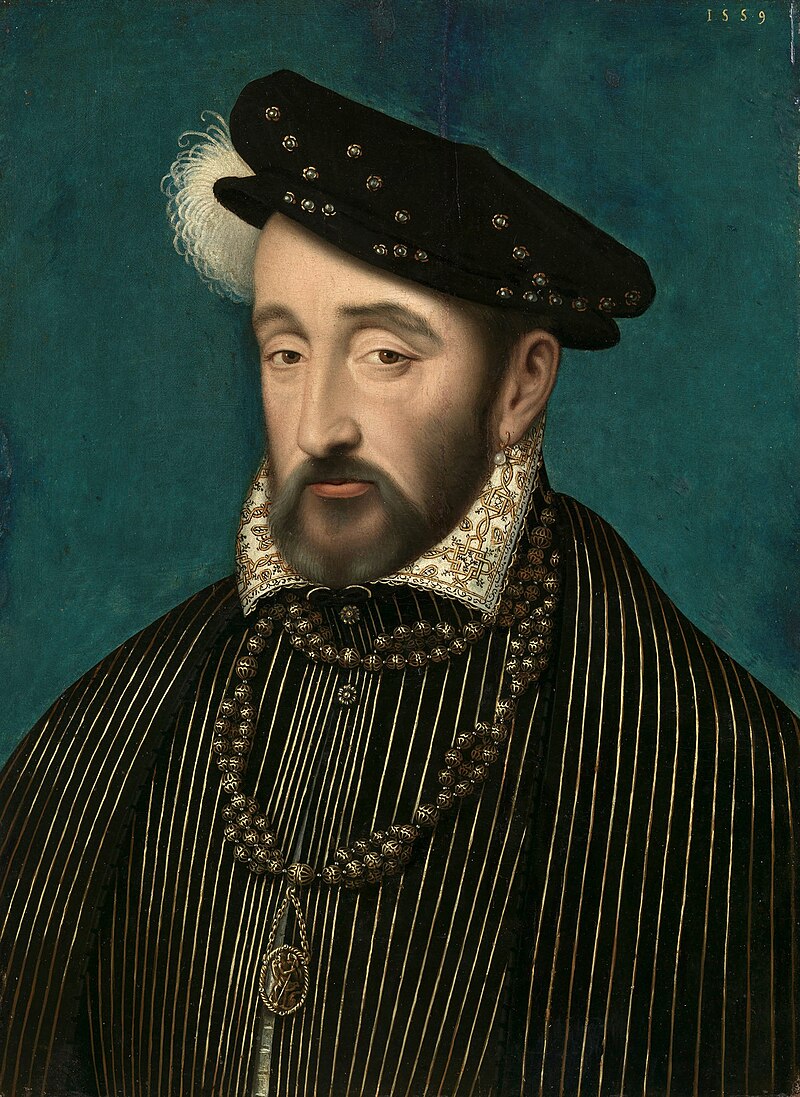
Henri II, King of France

Once Henri became dauphin, the apparent barrenness of the prince and his wife became a serious concern. Talk at court began to centre around the possible repudiation of Catherine. Diane and Catherine, mistress and wife, formed a truce in order to ward off any attempts to force Henri and Catherine to divorce; concerned that Catherine was failing in her duty to produce an heir and that, although Henri liked Catherine well enough, he was not passionate with her. Aware that her own position would be threatened by the arrival of a new bride for Henri, Diane determined to help Catherine. To resolve the situation, Diane offered the dauphine advice on Henri’s preferred sexual positions and how to arouse the prince’s passion. Awkward! When this did not work, Catherine had spy holes made in her chamber floor so that she could watch Henri, in the chamber below, with Diane. Historian Estelle Paranque explains that; ‘the sight of their intimate encounter only succeeded in deeply hurting the dauphine, however, who realised that Henri did not perform the sexual act the same way with her as he did with his mistress.’2

Diane continued to offer advice to Catherine, before eventually offering to stimulate the prince before sending him to his wife’s bedchamber. However awkward this must have been for both women, it apparently worked, with Catherine herself admitting to Henri showing more passion in their lovemaking. And by June 1543, Catherine was pregnant. A baby boy arrived on 19 January 1544, named Francis after his grandfather. And a year later, a baby girl named Elisabeth joined the little prince in the nursery. Catherine was finally able to feel safe from being discarded and abandoned. Ten children eventually filled the royal nursery, seven of whom reached adulthood.

In the autumn of 1544, probably somewhat to Catherine’s satisfaction, King Francis’ mistress, the duchesse d’Étampes, with whom Diane had a bitter rivalry, succeeded in arranging her banishment from court, after Henri had replaced one of the duchess’s protégés while campaigning against the English in Picardy. Diane retreated to her château at Anet, closely followed by a sulking Henri. She received permission to return to court the following year.

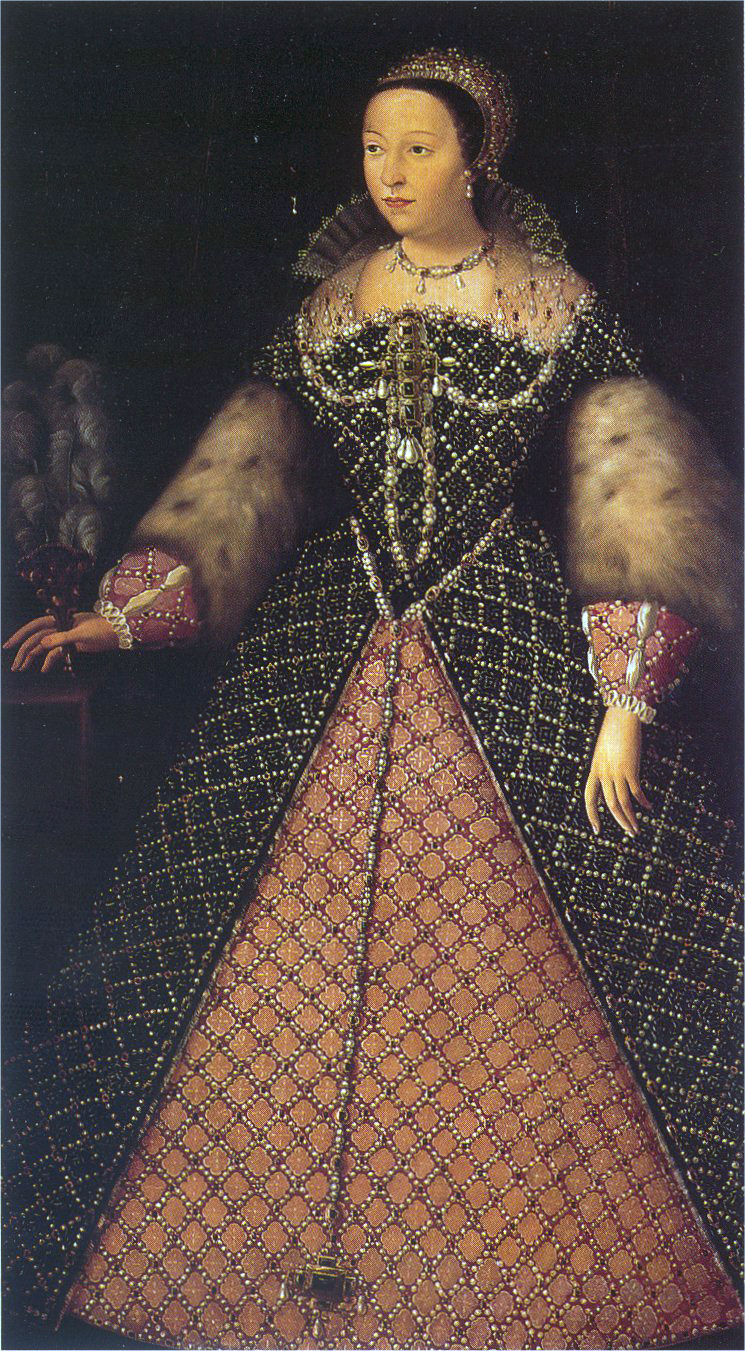
Catherine de Medicis, Queen of France

In spite of this, Catherine would remain in the shadow of Henri and Diane’s love throughout their marriage, with Henri continuing to shower his favourite mistress with patronage. He even had a monogram designed, interlacing the H and D of their names, and placed them everywhere he could. King Francis I died in 1547, and Henri was now King Henri II of France. But, while Catherine was now queen of France, she wielded little political influence and it was Diane’s star that rose still higher. She was made maitresse en titre and a permanent member of Henri’s privy council. She was showered with jewels and offices, as well as estates and other honours. The Venetian ambassador, Marino Cavalli noted Diane’s influence over the new king, stating that ‘this lady has made sure to indoctrinate, to correct, and counsel’ Henri.3 Wherever the king and queen were found, so too was Diane de Poitiers, walking right behind Catherine. In Paris, Diane was named in the same rank as the princesses of France, while in Rouen the aldermen brought her jewels and gifts made of gold and laid them at her feet. King Henri gave her the royal Château of Chenonceau, despite the protestations of Catherine, who thought it should be hers. Henri ignored Catherine’s pleas. Yet another slight the young queen had to endure due to her husband’s infatuation with Diane de Poitiers.

And it was to Diane that the responsibility of impressing foreign ambassadors fell. In 1550 the English ambassador, William Pickering, was staying at the French court, at that time at Diane’s Château of Anet. After his audience with the king, Diane entertained the ambassador, showing him the magnificence of her château. And in 1552, Venetian ambassador Lorenzo Contarini remarked on Diane’s influence at court; ‘she knows about everything and every single day, after dinner, the king looks for her and spends an hour and a half with her to discuss everything that has happened.’4 At tournaments, it was Diane’s colours that the king displayed, not those of his queen. Created Duchess of Valentinois by Henri II, she was, quite literally, the love of his life. Although the king never had children with his maitresse en titre, he did have children with other mistresses and, of course, his wife.

As Henri’s reign progressed, he began to show greater confidence in his queen, but Diane still managed to thwart the Catherine achieving significant power. In 1548 and in 1552, when Henri was out of the country on campaign, he entrusted Catherine with the regency of France. However, in 1548 Diane managed to persuade Henri to appoint Anne de Montmorency (a man) as co-regent and in 1552, she had Chancellor Bertrandi named as co-regent, effectively forcing Catherine to answer to him.

Château of Chenonceau, France

Catherine would, eventually get the upper hand.

The rivalry between Catherine de Medici and Diane de Poitiers would come to an abrupt end in the summer of 1559. In the March of that year, Henri had turned 40. He had spent the last 26 years of his life married to Catherine de Medici; for 25 of those years, he had been in love with Diane de Poitiers. On 22 June, Catherine and Henri’s daughter, Elisabeth, was married to Philip II, King of Spain, by proxy in Notre Dame Cathedral in Paris. The wedding was followed by a series of celebratory tournaments. In 1552, Catherine had been warned by Simeoni, the famous astrologer, that Henri would die in a duel in his 40th year, and that the wound would first blind him. This knowledge made a superstitious Catherine quite anxious as the jousts started. However, the king was always eager to impress his mistress with his prowess in the lists, wearing her colours of black and white. The king performed admirably against his first opponent, winning when he hit his brother-in-law, the duke of Savoy, in the chest and unhorsed him. The second bout was a draw, and it was after this that Catherine asked him to retire, but Diane de Poitiers encouraged the king to continue and in the next joust, though unhurt, Henri fell off his horse. The king insisted on going again, against the same opponent, Gabriel de Montgomery, and it was at this moment that King Henri II’s luck ran out.

Montgomery’s lance struck the king’s helmet, a fragment of the splintered lance having pierced Henri’s eye. Henri had fallen from his horse, and as his squires removed his helmet they revealed a face covered in blood. The mortally wounded king was carried to his chambers and placed in his bed, joined by Diane and Catherine, one at either side, both sobbing. Catherine called the renowned surgeon Ambroise Paré to attend the king, but after practicing the required surgery on executed prisoners, Paré had to tell the queen that the king could not be saved. Henri II lingered for 10 days, in agonising pain, before dying on 10 July 1559. He had been attended throughout by his queen. Henri is said to have called out for Diane, but she was not allowed to see him, nor attend the funeral. Diane was banished from court. Her influence ended with the king’s death and power now rested firmly in the hands of Queen Catherine, mother and regent to the new king, Francis II.

Diane’s tomb in the chapel at the Château d’Anet

On hearing of Henri’s death, Diane wrote to Catherine asking for ‘pardon for my past offences against your person’ and signing the letter ‘your most obedient and loyal subject.’5 Diane sent back some crown jewels, items that had been gifted to her by Henri, in the hope that the queen would be compassionate. Diane de Poitiers knew that without the king’s protection, she was vulnerable to Catherine’s malice. The queen was not spiteful, however, and allowed Diane to keep all that she had acquired in her years at court. Except for the Château of Chenonceau. Diane retreated to her château at Anet, where she had once entertained ambassadors and lived there, a virtual exile. She would die there in 1566, following a fall from her horse the year before. For a quarter of a century, Diane de Poitiers had enjoyed more influence as the king’s mistress than any other woman in France, including the queen. Henri II had showered affection, riches and power on the woman  who had held his heart, choosing to ignore the humiliations that he was heaping upon his wife.

The scandalous ménage-a-trois only ended with the king’s death.

*

Images:

Courtesy of Wikipedia

Notes:

1. Leonie Frieda, Catherine de Medici; 2. Estelle Paranque, Blood, Fire & Gold; 3. ibid; 4. ibid; 5. ibid

Select Bibliography:

Leonie Frieda, Catherine de Medici: A Biography; Estelle Paranque, Blood, Fire & Gold: The Story of Elizabeth I and Catherine de Medici; Jill Armitage, Four Queens and a Countess: Mary Queen of Scots, Elizabeth I, Mary I, Lady Jane Grey and Bess of Hardwick; Amy Licence, In Bed with the Tudors; Amy Licence, The Sixteenth Century in 100 Women; Erin Lawless, Forgotten Royal Women: The King and I; Estelle Paranque, ‘The French Royal Mistresses who made it about more than sex’, historyextra.com; Susan Abernethy, ‘Claude de Valois, Queen of France,’ thefreelancehistorywriter.com; ‘Queen Claude of France’ Royal Armouries.org; Sylvia Barbara Soberton, ‘Claude de France: Anne Boleyn’s Mistress,’ onthetudortrail.com; Goldstone, Nancy, The Rival Queens: Catherine de Medici, Her Daughter Marguerite de Valois and the Betrayal that Ignited a Kingdom

*

My Books

Signed, dedicated copies of all my books are available through my online bookshop.

OUT NOW! Heroines of the Tudor World

Heroines of the Tudor World tells the stories of the most remarkable women from European history in the time of the Tudor dynasty, 1485-1603. These are the women who ruled, the women who founded dynasties, the women who fought for religious freedom, their families and love. These are the women who made a difference, who influenced countries, kings and the Reformation. In the era dominated by the Renaissance and Reformation, Heroines of the Tudor World examines the threats and challenges faced by the women of the era, and how they overcame them. From writers to regents, from nuns to queens, Heroines of the Tudor World shines the spotlight on the women helped to shape Early Modern Europe.

Heroines of the Tudor World is now available for pre-order from Amberley Publishing and Amazon UK.

Also by Sharon Bennett Connolly:

Women of the Anarchy demonstrates how Empress Matilda and Matilda of Boulogne, unable to wield a sword themselves, were prime movers in this time of conflict and lawlessness. It shows how their strengths, weaknesses, and personal ambitions swung the fortunes of war one way – and then the other. Available from Bookshop.orgAmberley Publishing and Amazon UKKing John’s Right-Hand Lady: The Story of Nicholaa de la Haye is the story of a truly remarkable lady, the hereditary constable of Lincoln Castle and the first woman in England to be appointed sheriff in her own right. Available from all good bookshops Pen & Sword Booksbookshop.org and AmazonDefenders of the Norman Crown: The Rise and Fall of the Warenne Earls of Surrey tells the fascinating story of the Warenne dynasty, from its origins in Normandy, through the Conquest, Magna Carta, the wars and marriages that led to its ultimate demise in the reign of Edward III. Available from Pen & Sword BooksAmazon in the UK and US, and Bookshop.org

Ladies of Magna Carta: Women of Influence in Thirteenth Century England looks into the relationships of the various noble families of the 13th century, and how they were affected by the Barons’ Wars, Magna Carta and its aftermath; the bonds that were formed and those that were broken. It is now available in paperback and hardback from Pen & Sword,  Amazon, and Bookshop.orgHeroines of the Medieval World tells the stories of some of the most remarkable women from Medieval history, from Eleanor of Aquitaine to Julian of Norwich. Available now from Amberley Publishing and Amazon, and Bookshop.orgSilk and the Sword: The Women of the Norman Conquest traces the fortunes of the women who had a significant role to play in the momentous events of 1066. Available now from Amazon,  Amberley Publishing, and Bookshop.org.

Alternate Endings: An anthology of historical fiction short stories including Long Live the King… which is my take what might have happened had King John not died in October 1216. Available in paperback and kindle from Amazon.

Podcast:

Have a listen to the A Slice of Medieval podcast, which I co-host with Historical fiction novelist Derek Birks. Derek and I welcome guests, such as Bernard Cornwell and discuss a wide range of topics in medieval history, from significant events to the personalities involved. There are now over 40 episodes to listen to!

*

Don’t forget! Signed and dedicated copies of all my books are available through my online bookshop.

For forthcoming online and in-person talks, please check out my Events Page.

You can be the first to read new articles by clicking the ‘Follow’ button, liking our Facebook page or joining me on Twitter and Instagram.

©2024 Sharon Bennett Connolly FRHistS

    Lady Katherine Gordon, “Duchess of York”

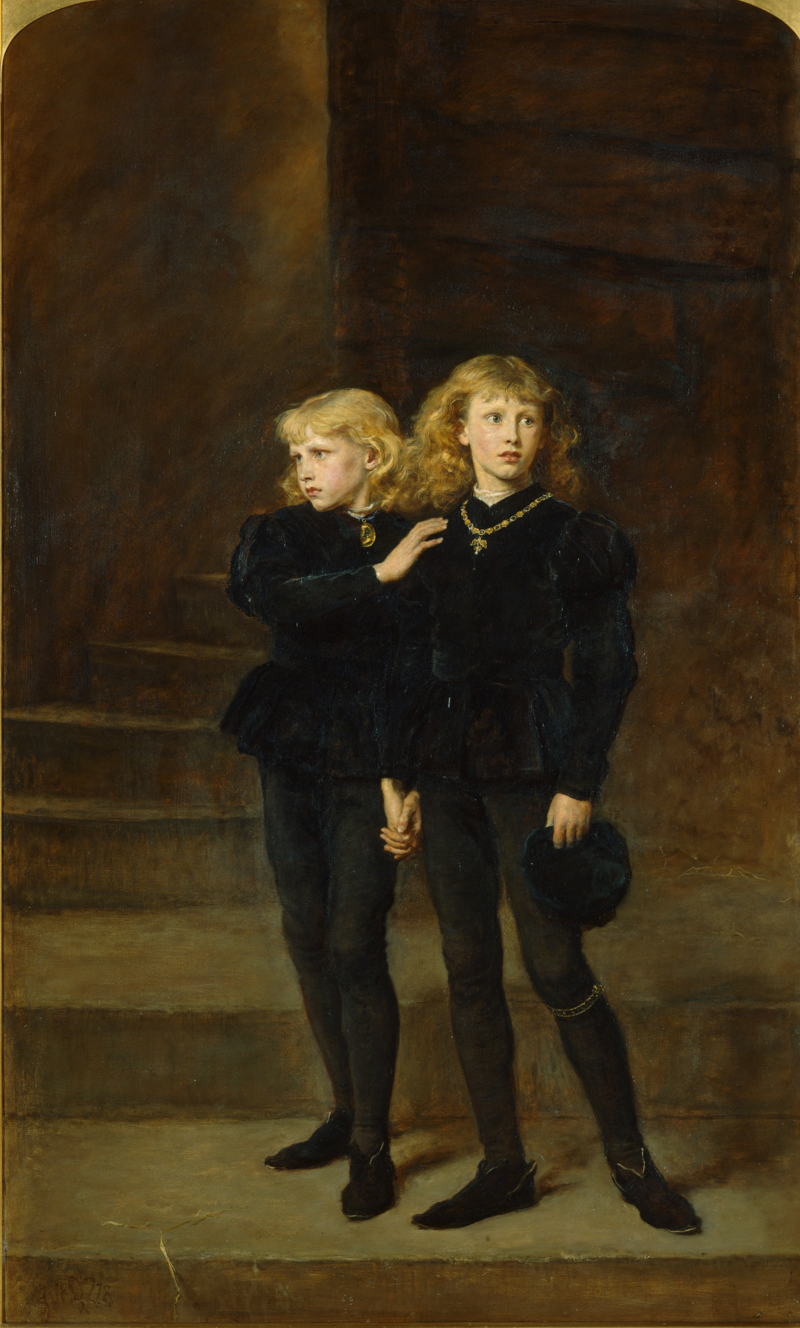
    The Two Princes Edward and Richard in the Tower, 1483 by Sir John Everett Millais

    I don’t usually start my articles with a disclaimer, but with this one, I think I will. The Princes in the Tower is always a hot topic, after all. So, I will warn you. Here, I am going to look into the life of Lady Katherine Gordon, rather than the veracity of the claim of her husband, Perkin Warbeck/Prince Richard, to being the younger of the two lost Princes. I am giving you the information and evidence that Katherine would have been presented with at the time, and not making any actual judgements. I will leave that to others who have spent much more time on the study of the Princes than I.

    Lady Katherine Gordon was, by all accounts, a beautiful woman, with connections, though distant, to the Scottish royal family. She was the daughter of George Gordon, second Earl of Huntly, and his third wife, Elizabeth Hay. George Gordon had previously been married to Annabella Stewart, a great-aunt of James IV, meaning that Katherine was distantly related to the king by marriage.

    Katherine first came to prominence in 1496, when she was given as a bride to Richard, Duke of York, the younger son of Edward IV and one of the Princes in the Tower. ‘Richard’ had recently emerged from hiding to claim the English throne, and after having spent some years on the Continent had been welcomed at the Scottish court in the autumn of 1495, probably simply to antagonise the English king, Henry VII, rather than in a genuine belief in his claim to be one of the lost princes. It would later be revealed that Richard was actually an impostor named Perkin Warbeck, from the Flemish city of Tournai. But that was by no means clear when he was residing at the Scottish court and several Continental royals, including the lost prince’s aunt Margaret of York, Duchess of Burgundy, had supported his claim to be Richard, Duke of York.

    King James IV was probably hedging his bets as to Richard’s real identity when he offered Katherine Gordon in marriage. Katherine had just enough royal credentials to be a suitable bride for an English prince but was not too royal that King James would be embarrassed should Richard prove to be an impostor. And if Richard was successful in overthrowing Henry VII and claiming the English throne, James would have a friend as his neighbour in England. For James, it was worth the gamble and for Richard, it meant that he could count on Scottish support. The Scots king welcomed Richard to court with all honours due to an English prince. He treated Richard like an honoured royal guest, dressed him like a king, gave him a pension and took him on a progress through the kingdom. There is a letter purportedly written by Prince Richard to Lady Katherine in December 1495, just weeks before their wedding, which suggests he is highly enthusiastic about the match:

    King Edward V and the Duke of York in the Tower of London by Paul Delaroche.

    Most noble lady, it is not without reason that all turn their eyes to you; that all admire, love, and obey you. For they see your two-fold virtues by which you are so much distinguished above all other morals. Whilst, on the one hand, they admire your riches and immutable prosperity, which secure to you the nobility of your lineage and the loftiness of your rank, they are, on the other hand, struck by your rather divine than human beauty, and believe that you are not born in our days, but descended from Heaven.

    All look at your face, so bright and serene that it gives splendour to the cloudy sky; all look at your eyes as brilliant as stars, which makes all pain to be forgotten, and turn despair into delight; all look at your neck, which outshines pearls; all look at your fine forehead, your purple light of youth, your fair hair; in one word, at the splendid perfection of your person; and looking at, they cannot choose but admire you; admiring, they cannot choose but love you; loving, they cannot choose but obey you.

    I shall, perhaps, be the happiest of all your admirers, and the happiest man on earth, since I have reason to hope you will think me worthy of your love. If I represent to my mind all your perfections, I am not only compelled to love, to adore, and to worship you, but love makes me your slave. Whether waking or sleeping, I cannot find rest or happiness except in your affection. All my hopes rest in you, and in you alone.

    Most noble lady, my soul, look mercifully down upon me your slave, who has ever been devoted to you from the first hour he saw you. Love is not an earthly thing, it is heaven born. Do not think it below yourself to obey love’s dictates. Not only kings, but also gods and goddesses have bent their necks beneath its yoke.

    I beseech you, most noble lady, to accept for ever one who in all things will cheerfully do your will as long as his days shall last. Farewell, my soul and my consolation. You, the brightest ornament of Scotland, farewell, farewell.1

    James IV, copy by Daniël Mijtens of a lost contemporary portrait

    The marriage between the man claiming to be Richard of York and Katherine Gordon was celebrated on 13 January 1496. Richard was given a white damask ‘spousing’ gown for the occasion. Other gifts included a purple damask-covered suit of armour, six servants, two trumpeters and a French armourer. Richard was also awarded an annual pension of £1, 344.2 The ceremony was followed by a series of jousts in which the king of Scots himself participated, though there is no evidence that Prince Richard did; he probably watched the jousts in the company of his bride. Katherine was now referred to as duchess of York. The newlyweds then travelled with the king to the palace at Falkland in Fife to wait out the winter in anticipation of the campaigning season and Richard’s invasion of England to claim the throne.

    James, too, was intent on invading England, despite pressure from both the Spanish and French monarchs. James insisted that the English had started the conflict by destroying his ships and cattle. In September 1496, James invaded Northumberland but returned to Scotland after only three days – no one in England had risen in support of Richard, Duke of York. As the year 1496 ended, Richard was no closer to invading England and was spending less time with King James, instead staying with his wife Katherine at Falkland Palace. In the meantime, King Henry VII’s spies had been at work on the Continent, discovering the true identity of Prince Richard.

    King James IV’s priorities now changed. He was seeking peace with Henry VII, and a bride. In July 1497, James was negotiating with Henry to marry the English king’s eldest daughter, Margaret, though she was only eight years old at the time. Henry VII made one of the conditions of the peace that James ‘delyvere unto us Perkyn Werbek’.3 Although the Scots king was amenable to the suggestion, Warbeck was not available to be handed over to the English.

    On 6 July, he and his wife set sail from Ayr after 19 months in Scotland. He left behind a brown horse, to be used to settle any debts that may still be outstanding. The ship, a French merchant vessel known as the Cukow, carried Warbeck, Katherine and 30 of Warbeck’s followers. Its hold was stocked with provisions including wine, bread, salt beef, mutton, cheese and fish. Although the king had not been present to bid them farewell, he had provided Katherine with some cloth to make a gown suitable for wearing aboard ship. What had spurred Warbeck to leave Scotland at this particular time is unclear. It may have been the burgeoning peace between James IV and Henry VII, or it may have been news of the Cornish uprising, which had erupted after King Henry had implemented a tax to raise funds for war against Scotland. It may be that Warbeck thought to join this rebellion.

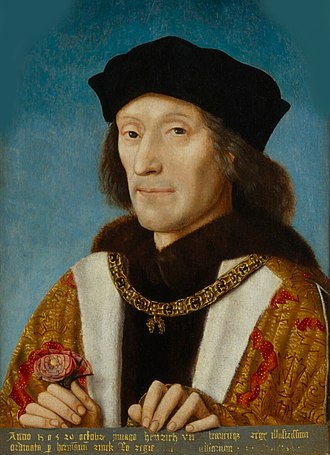
    Henry VII painted by an unknown artist

    Katherine and her pretender-prince sailed first for Ireland, arriving in Cork on 25 July 1497. After spending a month in Ireland trying to raise troops to their cause, they sailed for Cornwall, making landfall at Whitesand Bay on 7 September with a small flotilla with just a hundred or so people on board. Warbeck’s first action after landing was to make his way to the parish of St Buryan, four miles inland, where he left Katherine to await news of his military campaign. He then headed further into Cornwall, recruiting along the way. It is estimated that by the time he reached Bodmin, Warbeck had an army of between three and five thousand men. After failing to take Exeter from the earl of Devon, Warbeck and his forces marched towards Taunton. The earl of Devon then set off in pursuit and cut off his line of retreat back into Cornwall.

    Another royal army moved down from Oxfordshire into Somerset, reaching Glastonbury on 19 September, the same day Warbeck had reached Taunton – just twenty miles away. Warbeck was cornered and, losing his nerve, attempted to flee in the dead of night. With only sixty men, Warbeck sought sanctuary at Beaulieu Abbey in Hampshire on 22 September. Where most religious houses that offered sanctuary could only provide it for a limited period of forty days, Beaulieu was one of those with an exemption, which meant those seeking it could remain in sanctuary there for the remainder of their lives. By early October, Warbeck had been persuaded to surrender and under strong guard was taken to face the king, who was now at Taunton.

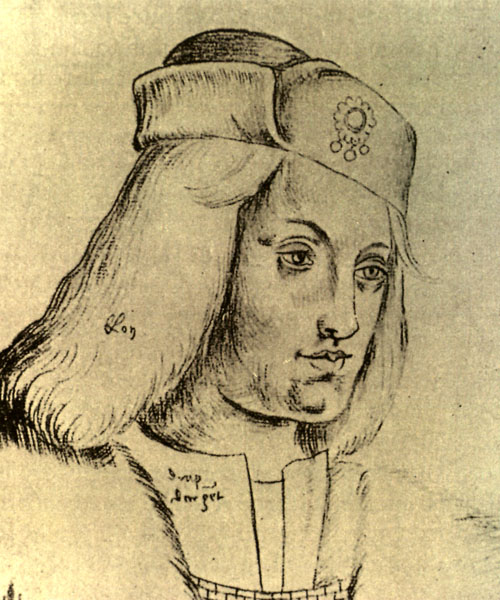
    16th-century copy by Jacques Le Boucq of the only known contemporary portrait of Warbeck, Library of Arras

    The king and his prisoner then proceeded to Exeter where Perkin Warbeck was reunited with his wife. Katherine had been retrieved from St Buryan’s by a force sent by King Henry. When she was found, she was dressed in robes of mourning, which may suggest that she had already been apprised of her husband’s failure, or that she had recently lost a child. We do not know. As the young woman was presented to Henry VII, she was ‘ashamed and tearful’.4 The chronicler Polydore Vergil described the meeting: ‘When the king saw the woman’s beauty he promptly judged her worthy to be among the captive hostages of a general rather than a common soldier.’5 The king perceived Katherine’s nobility and resolved to afford her a more honourable status than he had previously planned. This meant, inevitably, that she would be separated from Warbeck.

    Warbeck had been promised his life, but in the same interview the king insisted that Perkin Warbeck publicly admit, in front of his wife, the extent of his deception; that he was not, in fact, the duke of York, and that he was an impostor from Tournai. It may well be that Katherine was not wholly surprised by the confession. She must have heard the stories and accusations, but to hear the confession from her husband’s lips must have been hard to take. She was not duchess of York, she was Mrs Perkin Warbeck. The revelation put their very marriage in doubt. He had married her under a false identity, as Richard, Duke of York. Katherine put herself into the hands of the king.

    Henry VII treated Katherine kindly, though he would not send her back home to Scotland. Instead, she was sent to London to serve in the household of Queen Elizabeth. The king purchased horses and saddles for her journey and presented Katherine with new clothes, including a satin gown and a black velvet bonnet. Katherine arrived at Sheen on 21 October and was presented to the queen, the woman she had believed to be her sister-in-law until Warbeck had made his confession. Katherine was given a position in the queen’s household and a pension, not as the wife of the pretender, but in her own right as a high-ranking Scottish noblewoman. When the king returned to London, bringing Warbeck with him, the two lived separately within the royal household. They were well treated but not permitted to sleep together. Katherine also resumed her maiden name.

    Tower of London

    In June 1498, in spite of the lenient treatment he had received from the king, Perkin Warbeck chose to abscond from Westminster Palace. He was recaptured within a couple of days, having only reached the Carthusian priory at Sheen, just seven miles from Westminster. Although he still escaped the executioner’s axe, the king was no longer minded to be so lenient and sent Warbeck, after a spell in the stocks, to close confinement within the Tower of London.

    Katherine’s own situation does not appear to have been threatened by Warbeck’s recklessness and in June 1499 she accompanied the king and queen to Calais for a meeting with Archduke Philip and his wife Juana of Castile, the sister of their future daughter-in-law Catherine of Aragon. Later in the same year Perkin Warbeck, having tried to escape with fellow prisoner Edward, Earl of Warwick, was accused of conspiring against the king. And this time he was not going to get away with it. As it had been established that he was not noble, Warbeck was executed by hanging, not beheading, at Tyburn on 23 November 1499. Warwick was beheaded on Tower Hill five days later.

    Katherine’s marital status had been ambiguous since the discovery of Warbeck’s deception, but she was now definitively free to remarry. We know not whether she was saddened or relieved at the execution of Warbeck. She may have felt nostalgic for the short time they had been together, or grateful that the man who betrayed her was no longer able to cast a shadow over her life and future; or both. We will never know. Katherine remained at court and as one of the queen’s ladies was present at the betrothal ceremony of James IV and Margaret Tudor, held at Richmond in January 1502. When the queen, Elizabeth of York, died in February 1503 Katherine was one of the chief mourners at her funeral, accompanying the procession from the Tower of London to Westminster Abbey behind the queen’s sisters. And at the Abbey, she laid her pall on the coffin, again, after the queen’s sisters. After the queen’s death, Katherine remained at court, keeping the king company: she played cards with him, acquired medicines for him when he was ill and painted cloths and religious scenes to be held before him as he lay dying.

    Fyfield Manor, Berkshire, Katherine’s home with her last husband

    After Warbeck’s fall, Katherine Gordon had been taken prisoner, but her noble status had allowed her to be accepted at court as one of the queen’s ladies. Katherine never remarried in the lifetime of either Elizabeth of York or Henry VII. She was no longer a prisoner, but still not entirely free. Shortly before Henry VII’s death, Katherine was granted land in Berkshire, on the condition that she would not leave England. Following Henry VII’s death, sometime between 1510 and 1512 Katherine married James Strangeways, a Gentleman Usher of the King’s Chamber, but he died in 1516, leaving all his property to Katherine. The following year, Katherine married Matthew Craddock, a Welsh knight from Glamorganshire, obtaining permission to live with him in Wales; her promise to never leave England making such a request necessary. From 1525 to 1530, Katherine was employed in the household of Henry VIII’s daughter Mary as Chief Lady of the Privy Chamber. Katherine was widowed once again in 1531, with Craddock making her executor of his will and leaving her income from some of his Welsh properties in addition to 500 marks. Sometime before 1536 Katherine married for a fourth and final time. Her husband, Christopher Ashton, was a Gentleman Usher of the Privy Chamber. Katherine spent the last years of her life on her lands in Berkshire, at Fyfield Manor.

    St Nicholas Church, Fyfield, where Katherine was buried

    Survived by her last husband, she died on 14 October 1537, forty years almost to the day after Perkin Warbeck had been captured at Beaulieu Abbey. In her will she refers to all of her husbands, save Warbeck. She leaves bequests to Margaret Kyme, the daughter of Elizabeth of York’s sister, Cecily, to her servant, Philippa Hulls and to Alice Smyth, whom Katherine refers to as her sister.6 Perhaps she was a sister of one of Katherine’s husbands. There is no mention of any children and although there has been speculation that Katherine and Warbeck had a child, there is no evidence of this beyond a report by the Venetian ambassador Adrian Trevisano from September 1497,in which he says Warbeck had arrived in Cornwall ‘leaving behind his wife and children’.7 This may well have been a misunderstanding as there is no further mention of children from Trevisano or any other sources. Katherine was buried in the chancel of the church of St Nicholas at Fyfield. A tomb there, missing its brasses, is still referred to as Lady Gordon’s Monument.

    Lady Katherine Gordon had survived the fallout from her first husband’s rebellions and conspiracies and made a life for herself at the English court. She appears to have been considered a dupe to Warbeck’s plotting, rather than a co-conspirator. Her position as the daughter of a Scottish earl and a distant relative of the king of Scots afforded her the chance to make a new life for herself as one of the queen of England’s ladies and she grabbed the opportunity in both hands. She went from being a royal captive to a trusted and loved member of the English court. Not all female prisoners would be so fortunate.

    Notes:

    1. ‘December 1494’ in CSPM pp. 72-79 quoted in Nathen Amin, Henry VII and the Tudor Pretenders, p. 219; Nathen Amin, Henry VII and the Tudor Pretenders, p. 220; 3. ibid; 4. Bernard André quoted in ibid, p. 269; Polydore Vergil quoted in ibid, p. 269; 6. Susan Abernethy, ‘The Life of Lady Katherine Gordon’; 7. Nathen Amin, Henry VII and the Tudor Pretenders, p. 327

    Images:

    Courtesy of Wikipedia except the Tower of London which is  © 2024 Sharon Bennett Connolly FRHistS

    Further Reading:

    Nathen Amin, Henry VII and the Tudor Pretenders; Susan Abernethy, ‘The Life of Lady Katherine Gordon’; Amy Licence, The Sixteenth Century in 100 Women; Amy Licence, In Bed with the Tudors; Erin Lawless, Forgotten Royal Women: The King and I; David Loades, editor, Chronicles of the Tudor Kings: The Tudor Dynasty from 1485 to 1553: Henry VII, Henry VIII and Edward VI in the Words of their Contemporaries; David Ross, Scotland: History of a Nation; ODNB.com; Tracy Borman, The Private Lives of the Tudors; Sarah Gristwood, The Tudors in Love: The Courtly Code Behind the Last Medieval Dynasty; John Cannon, editor, The Oxford Companion to British History; Arthur D. Innes, A History of England Under the Tudors; J.D. Mackie, The Earlier Tudors 1485-1558.

    *

    My Books

    Signed, dedicated copies of all my books are available through my online bookshop.

    OUT NOW! Heroines of the Tudor World

    Heroines of the Tudor World tells the stories of the most remarkable women from European history in the time of the Tudor dynasty, 1485-1603. These are the women who ruled, the women who founded dynasties, the women who fought for religious freedom, their families and love. These are the women who made a difference, who influenced countries, kings and the Reformation. In the era dominated by the Renaissance and Reformation, Heroines of the Tudor World examines the threats and challenges faced by the women of the era, and how they overcame them. From writers to regents, from nuns to queens, Heroines of the Tudor World shines the spotlight on the women helped to shape Early Modern Europe.

    Heroines of the Tudor World is now available for pre-order from Amberley Publishing and Amazon UK.

    Women of the Anarchy

    Two cousins. On the one side is Empress Matilda, or Maud. The sole surviving legitimate child of Henry I, she is fighting for her birthright and that of her children. On the other side is her cousin, Queen Matilda, supporting her husband, King Stephen, and fighting to see her own son inherit the English crown. Women of the Anarchy demonstrates how these women, unable to wield a sword, were prime movers in this time of conflict and lawlessness. It show how their strengths, weaknesses, and personal ambitions swung the fortunes of war one way – and then the other.

    Available from Bookshop.orgAmberley Publishing and Amazon UK.

    Also by Sharon Bennett Connolly:

    King John’s Right-Hand Lady: The Story of Nicholaa de la Haye is the story of a truly remarkable lady, the hereditary constable of Lincoln Castle and the first woman in England to be appointed sheriff in her own right. Available from all good bookshops Pen & Sword Booksbookshop.org and AmazonDefenders of the Norman Crown: The Rise and Fall of the Warenne Earls of Surrey tells the fascinating story of the Warenne dynasty, from its origins in Normandy, through the Conquest, Magna Carta, the wars and marriages that led to its ultimate demise in the reign of Edward III. Available from Pen & Sword BooksAmazon in the UK and US, and Bookshop.org

    Ladies of Magna Carta: Women of Influence in Thirteenth Century England looks into the relationships of the various noble families of the 13th century, and how they were affected by the Barons’ Wars, Magna Carta and its aftermath; the bonds that were formed and those that were broken. It is now available in paperback and hardback from Pen & Sword,  Amazon, and Bookshop.orgHeroines of the Medieval World tells the stories of some of the most remarkable women from Medieval history, from Eleanor of Aquitaine to Julian of Norwich. Available now from Amberley Publishing and Amazon, and Bookshop.orgSilk and the Sword: The Women of the Norman Conquest traces the fortunes of the women who had a significant role to play in the momentous events of 1066. Available now from Amazon,  Amberley Publishing, and Bookshop.org.

    Alternate Endings: An anthology of historical fiction short stories including Long Live the King… which is my take what might have happened had King John not died in October 1216. Available in paperback and kindle from Amazon.

    Podcast:

    Have a listen to the A Slice of Medieval podcast, which I co-host with Historical fiction novelist Derek Birks. Derek and I welcome guests, such as Bernard Cornwell – and Tony Riches. We discuss a wide range of topics in medieval history, from significant events to the personalities involved.

    *

    Don’t forget! Signed and dedicated copies of all my books are available through my online bookshop.

    For forthcoming online and in-person talks, please check out my Events Page.

    You can be the first to read new articles by clicking the ‘Follow’ button, liking our Facebook page or joining me on Twitter and Instagram.

    *

    ©2024 Sharon Bennett Connolly FRHistS 

    Publication Day: Heroines of the Tudor World

    In 2017, when I published Heroines of the Medieval World, it was a dream come true – to actually write and publish a book! I never imagined, then, that I would still be writing books 7 years later, nor that I would get the opportunity to write a sequel!

    But here it is!

    Continue reading for a chance to win a signed copy of Heroines of the Tudor World in my Publication Day GIVEAWAY!

    Heroines of the Tudor World tells the stories of the most remarkable women from European history in the time of the Tudor dynasty, 1485-1603.

    These are the women who ruled, the women who founded dynasties, the women who fought for religious freedom, their families and love.

    These are the women who made a difference, who influenced countries, kings and the Reformation. In the era dominated by the Renaissance and Reformation, Heroines of the Tudor World examines the threats and challenges faced by the women of the era, and how they overcame them. Some famous, some infamous, some less well known, including Anne Boleyn, Elizabeth Barton, Catherine de Medici, Bess of Hardwick and Elizabeth I.

    From writers to regents, from nuns to queens, Heroines of the Tudor World shines the spotlight on the women helped to shape Early Modern Europe.

    I am so excited to be able to announce that Heroines of the Tudor World is now available from – everywhere! Including Amberley Publishing, Bookshop.org and Amazon UK.

    Publication Day GIVEAWAY!

    For the chance to win a signed copy of Heroines of the Tudor World simply leave a comment below.

    The draw fro the winner will be made at noon Friday 21 June 2024.

    Competition Closed: and the winner is Andria van Buskirk!

    Book Launch

    Do join me for the Heroines of the Tudor World book launch, including a talk and book signing will be held at the gorgeous historic venue, The Lincoln County Assembly Rooms, Monday 24 June, 2024, at 7pm.

    Tickets in-store or online from £7 – ticket with book deals available.

    To reserve your ticket, call in at Lindum Books on Bailgate, Lincoln, or click here!

    Reviews:

    And the first reviews are in – and amazing!

    Tony Riches was the first to give his views: ⭐️⭐️⭐️⭐️⭐️

    Heroines of the Tudor World is “is perfect for ‘dipping in’ at a random page or section – where you can be sure of discovering something interesting. I also liked the way some Tudor women pop up in several categories, highlighting the complexity of their lives.  As with her medieval heroines, some of the categories are thought provoking, such as the idea of heroic mistresses and scandalous heroines, but this makes for a lively and engaging read.” Read the whole 5* review over at The Writing Desk.

    And Medieval Madame, on Instagram, also gave Heroines of the Tudor World 5 stars: ⭐️⭐️⭐️⭐️⭐️

    “Automatically, when we think of the Tudor woman we tend to think of King Henry VIII’s wives, ladies in waiting or mistresses like Lady Jane Parker and Mary Boleyn. Yet so many women played a vital role, and they are lesser known but those who are more widely known don’t get enough recognition. Women, the weaker, frailer, gentler sex who should have a purpose: ‘stay at home, do embroidery, bear children – hope to survive!’ Not forgetting obey your Husband!

    This book centres around women who, either by chance or decision, step out of the mould society cast upon them, even if it meant death. Remember, the Tudor World was one of the most vicious times in English history.

    In this 12 chapter book, Sharon Bennett Connolly looks at many women from different backgrounds, and placed into chapters that’s what made their names live on. Take for example chapter 11 we see, “Literary Heroines,” here you can read about Margaret Roper, daughter of Sir Thomas More. Religious reformist, published, Queen Katherine Parr. Then French royalty who could well handle a quill!

    Other heroines include: Caterina Sforza, Elizabeth Barton, Katherine Willoughby, Mary Queen of Scots, Anne de Vere and so many more – the list is vast! That is what makes an interesting read. Whether by religion, royalty, nobility or scandal.

    Sharon has achieved another piece of thought provoking literature by shining a light on this enjoyable and contemporary read. As a sequel to her “Heroines of the Medieval World,” this certainly does not disappoint, and I enjoyed it equally.

    For an in-depth view on many resilient, defiant and warrior women, who could very well be the first step to what we know in modern times as feminism. This is it! This is an excellent read, most certainly in the top three reads of the year. Sharon has crafted her creative writing once more for our educational enjoyment.

    [Gifted] To Be Released 15 June 2024″

    All About History ⭐️⭐️⭐️⭐️

    All About History magazine gave Heroines of the Tudor World 4 stars, highlighting that the book ‘reminds readers that the lot of women in this era was not an easy one, but in these fascinating stories she reminds us too that there have always been women who dared to challenge the status quo. Whether standing up for country, crown, family or love, the women who spring to life in these pages are richly deserving of their place in history.’

    The first review on Amazon was ⭐️⭐️⭐️⭐️⭐️ from Helen Musson. It was short but oh so very, very sweet:

    Brilliant!

    And what an incredible review of Heroines of the Tudor World from Heidi Malagisi at Adventures of a Tudor Nerd:

    “Connolly gave her readers a thrilling look into the 16th century….my only complaint is that it was not a longer book…”If you have enjoyed Sharon Bennett Connolly’s previous books and you are a Tudor nerd, I highly suggest you read, ‘Heroines of the Tudor World.'”

    Interviews, podcasts and YouTube

    You can find me talking about my choice of Heroines of the Tudor World on some of the best Tudor podcasts:

    On Tudors Dynasty I may have mentioned to Rebecca Larsen that I don’t think much of Henry VIII. And I had a fabulous time, chatting with Natalie Grueninger over at On the Tudor Trail.

    And I am on Books & Brews, over on You Tube, talking about my favourite Heroines of the Past. You can even watch the outtakes!

    To Buy Heroines of the Tudor World

    You can order signed, dedicated copies of Women of the Anarchy through my online bookshop. Heroines of the Tudor World is now available from – everywhere! Including Amberley Publishing, Bookshop.org and Amazon UK.

    *

    Also by Sharon Bennett Connolly:

    Women of the Anarchy demonstrates how Empress Matilda and Matilda of Boulogne, unable to wield a sword, were prime movers in this time of conflict and lawlessness. It show how their strengths, weaknesses, and personal ambitions swung the fortunes of war one way – and then the other. Available from Bookshop.orgAmberley Publishing and Amazon UK. King John’s Right-Hand Lady: The Story of Nicholaa de la Haye is the story of a truly remarkable lady, the hereditary constable of Lincoln Castle and the first woman in England to be appointed sheriff in her own right. It is is available from Pen & Sword Booksbookshop.org and AmazonDefenders of the Norman Crown: The Rise and Fall of the Warenne Earls of Surrey tells the fascinating story of the Warenne dynasty, from its origins in Normandy, through the Conquest, Magna Carta, the wars and marriages that led to its ultimate demise in the reign of Edward III. Available from Pen & Sword BooksAmazon in the UK and US, and Bookshop.org.
    Ladies of Magna Carta: Women of Influence in Thirteenth Century England looks into the relationships of the various noble families of the 13th century, and how they were affected by the Barons’ Wars, Magna Carta and its aftermath; the bonds that were formed and those that were broken. It is now available in paperback and hardback from Pen & Sword,  Amazon, and Bookshop.orgHeroines of the Medieval World tells the stories of some of the most remarkable women from Medieval history, from Eleanor of Aquitaine to Julian of Norwich. Available now from Amberley Publishing and Amazon, and Bookshop.orgSilk and the Sword: The Women of the Norman Conquest traces the fortunes of the women who had a significant role to play in the momentous events of 1066. Available now from Amazon,  Amberley Publishing, and Bookshop.org.

    Alternate Endings: An anthology of historical fiction short stories including Long Live the King… which is my take what might have happened had King John not died in October 1216. Available in paperback and kindle from Amazon.

    Podcast:

    Have a listen to the A Slice of Medieval podcast, which I co-host with Historical fiction novelist Derek Birks. Derek and I welcome guests, such as Bernard Cornwell and discuss a wide range of topics in medieval history, from significant events to the personalities involved.

    *

    Don’t forget! Signed and dedicated copies of all my books are available through my online bookshop.

    For forthcoming online and in-person talks, please check out my Events Page.

    *You can be the first to read new articles by clicking the ‘Follow’ button, liking our Facebook page or joining me on Twitter and Instagram.

    *

    Article: 2024 © Sharon Bennett Connolly FRHistS

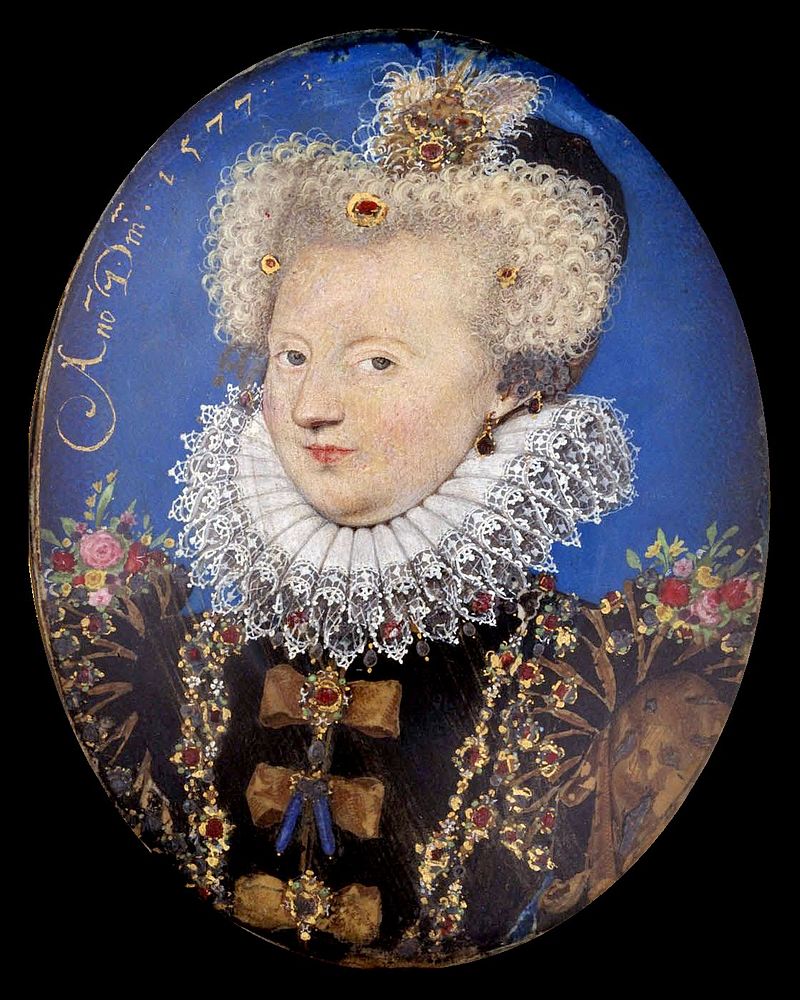
    La Reine Margot

    Marguerite de Valois by François Clouet

    As many of my readers will know, one of my favourite all-time writers is the brilliant Alexandre Dumas, the author of The Three Musketeers. Dumas also wrote of Marguerite de Valois, La Reine Margot, who appears in my latest book, Heroines of the Tudor World.

    Marguerite was the youngest surviving daughter of King Henri II of France and his queen, Catherine de Medici. She was born at the Château of St Germaine-en-Laye on 14 May 1553. She was her parents’ seventh child; their third daughter. She was raised alongside her two older sisters, Elisabeth (born in 1545) and Claude (born in 1547). Her brothers closest in age to her were Charles (born in 1550), Henri (born in 1551) and her younger brother Hercules (born in 1555), who would change his name to François when he was confirmed. Her brother, Henri, only two years older than her, was Marguerite’s closest family friendship as a child, though this did not last into adulthood. Henri would eventually rule France as King Henri III, succeeding to the throne on the death of his older brother Charles IX. Marguerite’s oldest brother was Francis – the future Francis II – who was born in 1544 and would go on to marry Mary, Queen of Scots. Another brother, Louis, died in 1550 at the age of just eighteen months.

    Marguerite experienced tragedy at an early age, when her father, Henri II, died in July 1559, ten days after a jousting accident in which a lance had pierced his eye. Marguerite was only six years old. The princess was well educated and studied literature, classics, history, and a number of ancient and contemporary languages.  She was also taught the complexities and dangers of sixteenth century politics and saw her mother acting as regent for her brother, Charles IX, becoming the most powerful person in France and a woman of international importance.

    As a teenager, Marguerite fell in love with Henry of Guise. He was a duke from a prominent family, but when they were found out, Henry was exiled from court and Marguerite was beaten so badly by her mother and brother, Charles IX, that her clothes were torn and ruined. The Guises might be a powerful family, and the most powerful Catholic faction at court, but their influence and popularity were a threat to the government of Catherine de Medici and the queen was not about to increase their prestige further by allowing the duke to marry her daughter.

    Marguerite was a princess of France and not free to follow her heart.

    Catherine de Medici with her children in 1561: 
    Francis, Charles IX, Margaret and Henry III

    The family had other plans for her marriage. Queen Catherine arranged with Jeanne d’Albret, Queen of Navarre, that Marguerite would marry her son, the Huguenot prince, Henri of Navarre. Although he had grown up at the French court, Henri’s mother had insisted that he be raised a Protestant. Henri was from the Bourbon branch of the French royal family and was the closest male relative to the throne after Marguerite’s brothers, he was the ‘First Prince of the Blood.’ Should her brothers die without producing heirs of their own, Henri of Navarre, though a Protestant, would be next in line to the throne. In 1572, when Marguerite and Henri married, Henri’s succession would have been only a distant possibility, with the twenty-two-year-old king, Charles IX, recently married himself and hoping for an heir; and two younger brothers to follow him should he not provide a son of his own.

    The marriage of Henri and Marguerite was intended to rebuild family ties and broker peace between the French Catholics and the Huguenots, the French Protestants. Since 1560, France had been riven by factions, with the powerful Guise family championing the prospect of eradicating Protestantism within France, backed by Spain and the papacy. The Bourbons, led by Henri of Navarre’s mother, Jeanne d’Albret, led the Huguenots, French Calvinists. As queen, Catherine de Medici tried for compromise, wanting France to be independent of foreign powers, such as Spain and the papacy. Tens of thousands of French had died in the religious wars, despite the signing of a number a peace treaties, which never held. The 1572 Peace of St Germain-en-Laye was to seal the treaty with a wedding.

    Of Marguerite, her future daughter-in-law, Jeanne d’Albret wrote:

    ‘As for her beauty, I agree she has a good figure but she holds herself in too much. As for her face, she uses so much help, it does irritate me, because she will ruin herself. But in this court make-up is normal just like in Spain.’1

    Henry of Navarre and Margaret of Valois

    Marguerite was a pawn in the midst of this political dispute. Born in December 1553, Henri was seven months younger than his bride. He and Marguerite were second cousins, both being the great-grandchildren of Charles, Count of Angoulême and his wife, Louise de Savoie. Marguerite descended from their son, Francis I, King of France, while Henri was descended from Francis’s sister, Marguerite d’Angoulême, Queen of Navarre. The young couple was betrothed in April 1572 and appeared to like each other at first, though it soon became evident that there was no chemistry between them, no physical attraction. It would be the first royal marriage between a Catholic and a Protestant. Henri’s mother, Jeanne d’Albret died before the wedding could take place, in June 1572, making Henri the new king of Navarre.

    The wedding ceremony took place at the cathedral of Notre-Dame in Paris, atop a platform that had been erected on the western façade of the church and hung with cloth of gold, so that everyone could watch; Protestant Henri refused to be married within the Catholic cathedral and so the wedding would be conducted outside. At three o’clock in the afternoon, the king of Navarre and his entourage made a stately procession to the church. Henri was dressed in a doublet and cape of rich yellow satin, embroidered with diamonds and pearls. He was escorted by two of the bride’s brothers, the dukes of Anjou and Alençon.

    The vast crowds were there to see Marguerite, described as ‘the greatest beauty in the world’ by a Neapolitan ambassador. She was led from the archbishop’s palace, close to the cathedral, by her brother, King Charles IX. The princess was wearing an ermine-trimmed gown of royal blue silk. Her fifteen-foot train was carried by three ladies-in-waiting. The ceremony was officiated by the Cardinal de Bourbon and when he asked Marguerite if she would take Henri as her husband, she refused to answer; her brother pushed her head so that she appeared to nod, and the cardinal took this to be her assent. The vows concluded, Marguerite and her party went inside the church to hear Mass, while Henri and his entourage waited outside.

    Henri III, King of Navarre, later to become King Henri IV of France

    There were three days of feasting to celebrate the marriage of Henri and Marguerite, the King and Queen of Navarre, before the peace was shattered by an assassination attempt on the Huguenot leader Gaspard de Coligny. Coligny was shot in the shoulder by the Sieur de Marevert. Firing from a house belonging to the duke de Guise, he had been aiming to kill. Coligny survived and was taken back to his lodgings, where the bullet was removed, the king sending his own physician to assist in Coligny’s treatment. Tensions were running high and Henri of Navarre and his attendants, staying at the Hôtel de Navarre, were nervous. On the morning of 24 August, Marguerite was woken by banging on her door, at which a blood-stained soldier staggered in, shouting ‘Navarre! Navarre!,’ pursued by two more men, armed with bows and arrows.

    The St Bartholomew’s Day Massacre was proceeding through the streets of Paris. Maurevert’s attempted assassination of Coligny, probably at the orders of Henry of Guise, had caused the King and his mother to fear that they would be blamed. In order to prevent reprisals, they chose to strike first, sending their soldiers against the Huguenot leadership. Coligny was among those killed, his body thrown out of the window of his lodgings and burned by the crowd. As other Huguenots were cut down, the Catholic Parisians joined in the bloodbath, slaughtering their Huguenot neighbours. Marguerite and her husband both made it to safety at the Louvre Palace, where they were protected by royal troops. Henri’s friends and attendants were not so lucky and were butchered within earshot of the newlyweds. As the violence spread to more cities in the following days and weeks, over 5,000 were killed.

    The leadership of the Huguenot faction had been dealt a serious blow. The older leaders were dead, murdered, and the younger leaders, Henri of Navarre and his cousin, Henri de Condé, were virtual prisoners, confined to the royal court and on 26 September 1572, Henri of Navarre renounced Protestantism. Four years later, he finally managed to flee the court, leaving his wife behind. Returning to the Protestant faith, he was now twenty-two and assumed the leadership of the Huguenots. Marguerite had remained at the French court following her husband’s flight. There’s was a rather liberal marriage, with neither one concerned if the other took lovers. Politically though, Marguerite worked in support of her husband, despite him being a Protestant and she being Catholic.

    The St Bartholomew’s Day massacre painted by  François Dubois, a Huguenot painter

    In 1578, Marguerite and her mother made a journey south, with Catherine de Medici hoping to build some bridges with the king of Navarre by delivering his wife to him. For the next five years, until 1583, Marguerite and Henri lived as husband and wife at Nérac, 100km south-east of Bordeaux. Initially, the marriage appeared to be experiencing a revival, but then Henri had an affair with on of Marguerite’s ladies, known as La Fosseuse, before moving onto a more serious relationship with Corisande de’Andouins, Countess of Guiche. In 1582 Henri III, King of France, summoned Marguerite back to court, with the hope that her husband would follow. Marguerite came but Henri did not.

    While back at the French court, Marguerite had an affair with Jacques de Harlay, Sieur de Champvallon, and there were rumours that she was pregnant by him. Marguerite was ordered to leave court by her brother and left Paris on 8 August. As she travelled south, her party was stopped by a troop of royal archers, who insulted Marguerite and arrested two of her ladies. They were questioned about Marguerite’s baby, if there was one. All trace of the child, whether she was pregnant or not, had disappeared. On 13 April, Marguerite was reunited with her husband at Port St Marie, just north of Nérac. Just two months later, they heard of the death of Marguerite’s youngest brother, Francis, Duke of Anjou, who was a close ally of Henri of Navarre.

    Francis’s death was a pivotal moment for the king of Navarre. He had been the heir of his brother Henri III and now, the heir was Henri of Navarre himself, at least until Henri III were to have a son of his own. The Holy Catholic League, however, funded by the king of Spain and the papacy, recognised the ageing and childless Cardinal de Bourbon as the heir to the throne. On 31 March 1585, the cardinal issued a proclamation promising to restore France to Catholicism and declaring that ‘subjects are not required to recognise or sustain the domination of a prince who has parted from the Catholic faith…’ On 9 September 1585 Pope Sixtus V excommunicated both Henri of Navarre and his cousin Condé – even though they were Protestants – and deprived them of their hereditary rights. He even declared that Henri had no right to the kingdom of Navarre. Henry of Guise was manoeuvring to promote his own candidacy for the throne of France by excluding Henri of Navarre.

    Marguerite de Valois painted by Nicholas Hilliard

    After the death of his brother Francis, Henri III was forced to make war on Navarre by Henry of Guise, thus starting the War of the Three Henries. It was at this point that Marguerite took her life and future into her own hands. Having realised that she could not be content living with Henri, she left his court and moved to Agen, claiming she wanted to devote herself to the celebration of Easter. She joined the Holy Catholic League and with 2,000 soldiers she took Agen and held it in the name of the League. But after a bout of plague was seen as the punishment of God for Marguerite rebelling against her husband and brother, and the destruction of the garrison gunpowder left the city indefensible, she was forced to abandon Agen and moved further inland to another of her fortresses at Carlat.

    As she left for Carlat, Marguerite was arrested by her brother’s forces under the command of the Marquis de Canillac, who escorted her to the great fortress at Usson. Marguerite charmed Canillac and within a year she was no longer a prisoner, but the sovereign lady of the territory, in the heart of the Auvergne. Marguerite spent the next 19 years living in Usson, as the Wars of Religion ground to their conclusion with a succession of deaths. The duke of Guise died in 1588, killed on the king’s orders. Catherine de Medici died in January 1589, just a few months before her 70th birthday. And in August 1589, King Henri III was assassinated by a Catholic enthusiast.

    This left Henri of Navarre as the victor, though the war continued for 4 more years, as the Catholic League refused to accept a Protestant king. In 1593 Henri’s conversion to Catholicism, supposedly with the words ‘Paris is worth a Mass,’ Henri of Navarre became King Henri IV of France, his coronation taking place in Chartres Cathedral in February 1594. The Edict of Nantes finally ended the Wars of Religion in 1598, establishing Catholicism as the state religion in France, but allowing Huguenots to worship freely in many parts of France (excluding Paris). Though she was no longer living with Henri, Marguerite, the last surviving child of Henri II and Catherine de Medici, was now Queen of France and Navarre, and she and Henri were back on good terms. She established her court at Usson, writing her memoirs and poetry and building a library.

    Henri IV, King of France and Navarre

    In 1593 Marguerite made an agreement with Henri whereby he would give her 50,000 francs a year and pay her debts of 200,000 écus in return for her applying for the annulment of their marriage; she cited her barrenness, consanguinity and that she was forced to marry against her will as grounds for the annulment. Though the annulment was not granted by the pope until 1599, it did eventually leave Henri free to marry again, to Marie de Medici, and produce the all-important heir – the future King Louis XIII. Although she had been a pawn to the political manoeuvrings of her mother on her marriage to Henri of Navarre, Marguerite had, to all intents and purposes, managed to forge her own path in her later years. Her agreement to the annulment of her marriage meant the continuation of the line of Henri IV and secured the future of France. Marguerite returned to Paris in 1605 and lived there until her death in 1615.

    Footnotes:

    1. Dominic Pierce, ‘The Unique Career of Marguerite de Valois, Queen of Navarre’, tudortimes.co.uk

    Images:

    Courtesy of Wikipedia

    Sources:

    Dominic Pierce, ‘The Unique Career of Marguerite de Valois, Queen of Navarre’, tudortimes.co.uk; Nancy Goldstone, The Rival Queens: Catherine de Medici, Her Daughter Marguerite de Valois and the Betrayal that Ignited a Kingdom; Frieda Leonie, Catherine de Medici: A Biography; Pierre Groubert, The Course of French History; Estelle Paranque, Blood, Fire & Gold: The Story of Elizabeth I and Catherine de Medici; Amanda Prahl, ‘Biography of Margaret of Valois, France’s Slandered Queen’, thoughtco.com; François Bayrou, Henri IV: Le Roi Libre; Alexandre Dumas, La Reine Margot.

    *

    My Books

    Signed, dedicated copies of all my books are available through my online bookshop.

    Coming on 15 June 2024: Heroines of the Tudor World

    Heroines of the Tudor World tells the stories of the most remarkable women from European history in the time of the Tudor dynasty, 1485-1603. These are the women who ruled, the women who founded dynasties, the women who fought for religious freedom, their families and love. These are the women who made a difference, who influenced countries, kings and the Reformation. In the era dominated by the Renaissance and Reformation, Heroines of the Tudor World examines the threats and challenges faced by the women of the era, and how they overcame them. From writers to regents, from nuns to queens, Heroines of the Tudor World shines the spotlight on the women helped to shape Early Modern Europe.

    Heroines of the Tudor World is now available for pre-order from Amberley Publishing and Amazon UK.

    Out Now! Women of the Anarchy

    Two cousins. On the one side is Empress Matilda, or Maud. The sole surviving legitimate child of Henry I, she is fighting for her birthright and that of her children. On the other side is her cousin, Queen Matilda, supporting her husband, King Stephen, and fighting to see her own son inherit the English crown. Women of the Anarchy demonstrates how these women, unable to wield a sword, were prime movers in this time of conflict and lawlessness. It show how their strengths, weaknesses, and personal ambitions swung the fortunes of war one way – and then the other.

    Available from Bookshop.orgAmberley Publishing and Amazon UK.

    Also by Sharon Bennett Connolly:

    King John’s Right-Hand Lady: The Story of Nicholaa de la Haye is the story of a truly remarkable lady, the hereditary constable of Lincoln Castle and the first woman in England to be appointed sheriff in her own right. Available from all good bookshops or direct from Pen & Sword Booksbookshop.org and AmazonDefenders of the Norman Crown: The Rise and Fall of the Warenne Earls of Surrey tells the fascinating story of the Warenne dynasty, from its origins in Normandy, through the Conquest, Magna Carta, the wars and marriages that led to its ultimate demise in the reign of Edward III. Available from Pen & Sword BooksAmazon in the UK and US, and Bookshop.org

    Ladies of Magna Carta: Women of Influence in Thirteenth Century England looks into the relationships of the various noble families of the 13th century, and how they were affected by the Barons’ Wars, Magna Carta and its aftermath; the bonds that were formed and those that were broken. It is now available in paperback and hardback from Pen & Sword,  Amazon, and Bookshop.orgHeroines of the Medieval World tells the stories of some of the most remarkable women from Medieval history, from Eleanor of Aquitaine to Julian of Norwich. Available now from Amberley Publishing and Amazon, and Bookshop.orgSilk and the Sword: The Women of the Norman Conquest traces the fortunes of the women who had a significant role to play in the momentous events of 1066. Available now from Amazon,  Amberley Publishing, and Bookshop.org.

    Alternate Endings: An anthology of historical fiction short stories including Long Live the King… which is my take what might have happened had King John not died in October 1216. Available in paperback and kindle from Amazon.

    Podcast:

    Have a listen to the A Slice of Medieval podcast, which I co-host with Historical fiction novelist Derek Birks. Derek and I welcome guests, such as Bernard Cornwell and discuss a wide range of topics in medieval history, from significant events to the personalities involved.

    *

    Don’t forget! Signed and dedicated copies of all my books are available through my online bookshop.

    For forthcoming online and in-person talks, please check out my Events Page.

    You can be the first to read new articles by clicking the ‘Follow’ button, liking our Facebook page or joining me on Twitter and Instagram.

    *

    ©2024 Sharon Bennett Connolly FRHistS.

    Book Corner: Arthur by Giles Kristian

    Years have passed since the clash of shieldwalls echoed across the land. The Saxons are now the lords of Britain. And yet the bards still sing of Arthur – ‘In our darkest time, when we need him most, shall he come again.’

    Yet old Beran has no love of bards’ songs. Nor of people, unless they are paying him to steal or kill. He is a mercenary, in the employ of the cutthroat Nabor ap Nabor, and he has been ordered to murder a boy fleeing a burning city. No ordinary boy either. No, this boy is the son of King Constantine and the grandson of High King Ambrosius. And he could be the hope of Britain…if he lives.

    Betraying his companions and returning to a world he thought he had left forever, Beran gives his word that he will take the boy to the one place that still holds out against the Saxons: Camelot.

    Crossing a hostile land, they will meet the runaway lovers, Tristan and Isolde. They will seek the help of Guivret, called the Little King, and the Saracen, Palamedes, who once rode beneath Arthur’s banner.

    Hunted by Saxons, Nabor ap Nabor, and Queen Morgana, this unlikely band must fight for their lives and for each other. For if there’s to be any hope for Britain, Beran must deliver the boy to Camelot. But to do that, he must also face his own past…

    Wow!

    Every now and then, a book comes along that stands head and shoulders above the rest. It draws you in. You cannot wait to finish it.

    And yet…

    Finishing it leaves you bereft.

    That is Giles Kristian’s Arthur.

    It is the third book in a series that was only meant to be a duology. After Lancelot and Camelot came out, I asked Giles if there would be an Arthur and he said, probably not – that he had covered Arthur’s story in the other two. He wasn’t sure there was anything more to add. And how could he do it? He would have to go back a rewrite Lancelot, but with Arthur as the focus. I understood his dilemma but it was disappointing that there would be no book dedicated to Arthur.

    But then, he must have found inspiration from somewhere, because we now have Arthur. Lancelot was fabulous. Camelot was gripping. Arthur is on a whole other level. The premise of the novel is inspired. Continuing the story into the next generation, with flashbacks to Arthur’s early life and career. The new story is cleverly woven into the old legends. Morgana is a villain trying to get her hands on the heir to the throne. The tragic love story of Tristan and Isolde is woven into the narrative, as are other parts of the Arthurian legend. And Beran, the old soldier, is the reluctant hero, who reluctantly finds himself in the role of Prince Erbin’s protector.

    ‘I’m hungry,’ the boy said.

    ‘I told you, I don’t have any food,’ Beran replied, looking for the stars to make sure they were still walking west. Two bats tumbled and flitted above, across a patch of dark sky.

    ‘But I’m hungry,’ the boy insisted.

    ‘What do you expect me to do about it?’ Beran growled.

    The boy’s face clenched in thought. ‘You must be good at setting traps,’ he said. ‘You outlaws live here in the forest, don’t you?’

    ‘I can feed myself. Didn’t ask for another mouth to feed.’

    ‘I’m a prince.’

    ‘A mouth’s a mouth.’

    Beran could almost feel the boy frowning in the dark from two feet away. ‘We could set a snare like my father’s hunters do. They catch hares and polecats and pine martens that way.’

    ‘Not any more they don’t,’ Beran said. ‘Look, boy, if we stop to set traps, we’re more likely to catch one of the bastards who’s after us. Or a Saxon. Or one of Queen Morgana’s spearmen. We’ve got to keep moving.’

    ‘So, we’re going to Camelot?’ the boy asked.

    The name struck Beran like a blow to the chest. He stopped and the boy stopped with him. ‘Why in Ban’s name would we go to Camelot?’ he asked.

    ‘Because that’s where Mother was taking me,’ the boy said, looking up at him, and Beran realized he had not even considered where the fugitives from Caer Colun had been bound with their treasures and this heir to the kingdom. It made sense, of course, for where else was safe in Britain for the son of Constantine the Battle King? The man who had modelled himself on the Roman generals who once ruled in the Dark Isles, and who had waged war against the Saxons for the last sixty years.

    ‘Lady Iselle wrote to my mother many times since my fatehr died, begging her to go to Camelot where we would be safe.’

    Another name, another blow. ‘So why didn’t you?’ Beran asked. Your mother must’ve known Caer Colun could not hold out for ever. Even if the great Constantine had still been alive.’

    ‘Mother said we would never abandon the people. Lady Iselle could not take all of them to live within Camelot’s walls.’

    ‘Well, your mother’s people are slaves now, or dead. Or living beneath the sky like us,’ Beran said.

    ‘How long will it take to get to Camelot?’ the boy asked.

    ‘We’re not going to Camelot.’

    Giles Kristian’s Arthur is a beautifully crafted story from start to finish, with twists and turns that will keep the reader on the edge of their seat and reading late into the night. And so you should. With enemies old and new, Beran has to avoid his former gang, stay clear of marauding Saxons and protect his charge from Queen Morgana’s men, who are hunting them relentlessly,

    I do not want to ruin the reading experience with spoilers, I promise, but I will say endings are often not as good as you want them to be. They fail to live up to the promise.

    That is not the case with Arthur.

    The ending is spectacular.

    They are everything you would expect of the legendary Arthur.

    You ride with him.

    You fight with him.

    You are screaming his name as you charge the enemy.

    It is perfection.

    If there is only one book you read this year, make sure it is Arthur by Giles Kristian.

    To buy Arthur on Amazon, click here.

    About the author:

    Family history (he is half Norwegian) and a passion for the fiction of Bernard Cornwell inspired GILES KRISTIAN to write. Set in the Viking world, his bestselling ‘Raven’ and ‘The Rise of Sigurd’ trilogies have been acclaimed by his peers, reviewers and readers alike. In The Bleeding Land and Brothers’ Fury, he tells the story of a family torn apart by the English Civil War. He also co-wrote Wilbur Smith’s No.1 bestseller, Golden Lion. His contemporary survival thriller, Where Blood Runs Cold, won the Wilbur Smith Adventure Writing Prize. With his SundaTimes bestseller Lancelot, Giles plunged into the rich waters of the Arthurian legend. His epic reimagining of our greatest island ‘history’ continued in Camelot and draws to a breath-taking close with Arthur.
    Giles Kristian lives in Leicestershire.
    To find out more, visit http://www.glieskristian.com. You can follow him on X @GilesKristian and Facebook/Giles Kristian

    *

    My Books

    Signed, dedicated copies of all my books are available through my online bookshop.

    Coming on 15 June 2024: Heroines of the Tudor World

    Heroines of the Tudor World tells the stories of the most remarkable women from European history in the time of the Tudor dynasty, 1485-1603. These are the women who ruled, the women who founded dynasties, the women who fought for religious freedom, their families and love. These are the women who made a difference, who influenced countries, kings and the Reformation. In the era dominated by the Renaissance and Reformation, Heroines of the Tudor World examines the threats and challenges faced by the women of the era, and how they overcame them. From writers to regents, from nuns to queens, Heroines of the Tudor World shines the spotlight on the women helped to shape Early Modern Europe.

    Heroines of the Tudor World is now available for pre-order from Amberley Publishing and Amazon UK.

    Out Now! Women of the Anarchy

    Two cousins. On the one side is Empress Matilda, or Maud. The sole surviving legitimate child of Henry I, she is fighting for her birthright and that of her children. On the other side is her cousin, Queen Matilda, supporting her husband, King Stephen, and fighting to see her own son inherit the English crown. Women of the Anarchy demonstrates how these women, unable to wield a sword, were prime movers in this time of conflict and lawlessness. It show how their strengths, weaknesses, and personal ambitions swung the fortunes of war one way – and then the other.

    Available from Bookshop.orgAmberley Publishing and Amazon UK.

    Also by Sharon Bennett Connolly:

    King John’s Right-Hand Lady: The Story of Nicholaa de la Haye is the story of a truly remarkable lady, the hereditary constable of Lincoln Castle and the first woman in England to be appointed sheriff in her own right. Available from all good bookshops or direct from Pen & Sword Booksbookshop.org and AmazonDefenders of the Norman Crown: The Rise and Fall of the Warenne Earls of Surrey tells the fascinating story of the Warenne dynasty, from its origins in Normandy, through the Conquest, Magna Carta, the wars and marriages that led to its ultimate demise in the reign of Edward III. Available from Pen & Sword BooksAmazon in the UK and US, and Bookshop.org

    Ladies of Magna Carta: Women of Influence in Thirteenth Century England looks into the relationships of the various noble families of the 13th century, and how they were affected by the Barons’ Wars, Magna Carta and its aftermath; the bonds that were formed and those that were broken. It is now available in paperback and hardback from Pen & Sword,  Amazon, and Bookshop.orgHeroines of the Medieval World tells the stories of some of the most remarkable women from Medieval history, from Eleanor of Aquitaine to Julian of Norwich. Available now from Amberley Publishing and Amazon, and Bookshop.orgSilk and the Sword: The Women of the Norman Conquest traces the fortunes of the women who had a significant role to play in the momentous events of 1066. Available now from Amazon,  Amberley Publishing, and Bookshop.org.

    Alternate Endings: An anthology of historical fiction short stories including Long Live the King… which is my take what might have happened had King John not died in October 1216. Available in paperback and kindle from Amazon.

    Podcast:

    Have a listen to the A Slice of Medieval podcast, which I co-host with Historical fiction novelist Derek Birks. Derek and I welcome guests, such as Bernard Cornwell and discuss a wide range of topics in medieval history, from significant events to the personalities involved.

    *

    Don’t forget! Signed and dedicated copies of all my books are available through my online bookshop.

    For forthcoming online and in-person talks, please check out my Events Page.

    You can be the first to read new articles by clicking the ‘Follow’ button, liking our Facebook page or joining me on Twitter and Instagram.

    *

    ©2024 Sharon Bennett Connolly FRHistS.

    Guest Post: Sarah Siddons by Jo Willett

    It is a pleasure to welcome Jo Willett back to History…the Interesting Bits with a guest post about the subject of her latest book, the Georgian actress Sarah Siddons:

    The famous actress Sarah Siddons, the Muse of Tragedy and the Queen of Drury Lane as she was known, was an expert on what we would today call brand control. The characters she played on stage were almost without exception highly moral, upstanding and noble. So, it was important that Sarah’s fans were encouraged to see her in the same light. In an age where many of her contemporary actresses on the London stage were either former sex workers or the mistresses of wealthy men (or both) Sarah ensured that every opportunity was taken to project the message that she was, by contrast, a happily married woman and a devoted mother.

    Sarah had met her husband-to-be, William Siddons, when he joined her parents’ travelling acting troupe. She was aged 11 and he was 23. Biographers have tended to gloss over how quickly it was before the two started having romantic feelings for each other, for obvious reasons, but her parents soon became aware that the two were in love. They were wary of the relationship, not because of the age difference – Sarah’s father was similarly several years older than her mother and they had also met when her mother was young – but because they could see that William was not a particularly good actor. The story of how Sarah’s parents attempted to separate the lovers bears all the hallmarks of having been romanticised by Sarah in later life. But whatever happened, Sarah’s parents eventually decided to give their reluctant consent, and Sarah and William Siddons were married in Coventry in November 1773, when Sarah was 18 years old. The Siddons would always affectionately refer to each other as Sal and Sid.

    So, Sarah was a married woman by the time she acquired fame and fortune as the greatest tragic actress of her generation. She had a false start at Drury Lane in David Garrick’s final season, but then rebuilt her career and returned to appear on stage at Drury Lane again, this time with Richard Brinsley Sheridan as manager, in 1782. Her first night was said to be one of the greatest ever seen on the British stage and she continued for some thirty years as the highest paid performer of her generation, mobbed by fans wherever she went. By 1782 she was already the mother of four children.

    Sarah Siddons as Euphrasia in The Grecian Daughter

    Sarah’s success enabled William to give up acting and to become her manager. In this role he proved himself often to be over-zealous in his demands for the fees he asked for her. The more Sarah earned in performance fees as the star, particularly in the regional theatres she toured every summer, the less was available to pay other actors in the company. Inevitably resentments festered. This was made worse when it appeared as if William had got Sarah out of appearing in ‘benefit’ performances, where the night’s takings went to a deserving actor in the cast. Her reputation suffered as a result, and she earned herself the nickname Lady Sarah Save-All.

    Even though Sarah was the sole breadwinner, everything she earned was legally in William’s name. There is no evidence she questioned this – it was just how things were at the time. But William was not always wise when it came to investing. One year, for instance, he lost nearly a third of Sarah’s annual earnings, speculating on a new building at Saddlers Wells. Sarah never complained but she did find herself increasingly exhausted by her punishing work schedule and her health certainly suffered as a result.

    It must also have been difficult for William that Sarah had such star status, whilst he was relatively unknown. She became the darling of King George III and his wife Queen Charlotte, for instance, but no mention was ever made of William’s having been introduced to the king and queen. It was as if he didn’t exist. Perhaps inevitably, William began to seek solace elsewhere. A friend called at the Siddons’ house one day to find Sarah weeping as she burned some papers which had alerted her to the fact her husband now had a mistress.

    In 1792, ten years after Sarah’s triumph at Drury Lane, Hester Piozzi, a friend of Sarah’s, wrote in a letter to a mutual friend that the famous actress’s recent bout of ill-health could be put down to the fact that William had given his wife a Sexually Transmitted Infection, probably syphilis. This was far from being an uncommon problem at the time, but without the wonders of modern medicine it was incurable. Despite this, the couple clearly patched things up between the two of them, as their final child, a daughter named Cecilia, was born the following year.

    Sarah Siddons as Lady MacBeth

    Sarah never seems to have mentioned her STI. The only hint at it remains to this day Hester Piozzi’s letter. She would have dreaded any news of it escaping into the public domain. Her reputation as a happily married woman, the essence of respectability, would have been dangerously undermined. She was attended by the Royal Physician, Sir Lucas Pepys, who advised her to spend time recuperating at a spa. From then on she often suffered from what her public were told was erisypelas, a condition of the skin. In my biography I suggest that this was a means of covering up the fact her syphilis was developing.

    But this was not the only problematic area in the Siddons’ relationship. Their two eldest daughters both suffered from increasingly serious diseases of the lungs, from which both of them were to die, Maria in 1798 and Sally in 1803. Sarah was able to rush to Maria’s bedside to be with her daughter for her last few weeks of life. But when Sally began to sicken during what would prove to be her last few months, her mother was on a long tour of Ireland. William wrote to his wife assuring her that Sally was recovering. He urged her to extend her tour from Dublin to Cork, specifically because there were bills to be met at home. Family life in London was proving to be particularly expensive at the time. Inevitably, and tragically, Sally worsened and died before her mother could make it back to be at her bedside for her end.

    Sarah was always exceptionally guarded in her personal correspondence about her feelings towards her husband, but she let her mask slip around this time. ‘I have suffered too much from a husband’s unkindness,’ she wrote, ‘not to detest the man who treats a creature ill that depends on her husband for all her comforts.’ Clearly she blamed William for what had happened.

    But Sarah herself was not entirely blameless. During her tour of Ireland she had met a young Spanish fencing master, Philomen Galindo. At first she could persuade herself that she was equally fond of Philomen and of his wife Catherine. But as the relationship developed, Catherine began to feel increasingly excluded and paranoid. Infatuated with Philomen, Sarah did her best to procure acting jobs for the couple in the new company of actors Sarah’s brother, the actor/manager John Philip Kemble, was putting together at Covent Garden. But John Philip made it very clear immediately that the Galindos were not the sort of people his celebrated sister should be associating with. It is impossible to prove whether Sarah was having a sexual relationship with Philomen Galindo, but his wife clearly thought she was. And when, several years later, Catherine had a pamphlet published, arguing her case and making public her side of the story, Sarah declined to sue for libel.

    Sarah Siddons as The Tragic Muse by Joshua Reynolds

    How much William knew about this is again hard to know, but it was just a year after their daughter Sally’s death, and just as Sarah had encouraged the Galindos to come to London on the false promise of finding jobs for them, that William and Sarah Siddons finally decided to separate. Very little adverse comment appeared in the press about this. All Sarah’s biographers up until now have played the separation right down and praised the actress for the dignity with which she handled the end of her marriage. One who was writing during Sarah’s lifetime wrote that William ‘retained at all times the sincerest regard for his incomparable lady.’ But the truth remained that the Siddons could no longer live with each other.

    William drew up his will at the same time. He had asked Sarah to tell him what she would like from it. But, as she herself put it: ‘I can expect nothing more than you yourself have designed’. Despite all her worldly success, her reputation as the greatest tragic actress of her generation, and her image as someone as morally upright as the tragic heroines she played each night on stage, in real life her future was just as in jeopardy as theirs, dependent for her security on the goodwill of the husband from whom she was parting.

    About the book:

    Sarah Siddons grew up as a member of a family troupe of travelling actors, always poor and often hungry, resorting to foraging for turnips to eat. But before she was 30 she had become a superstar, her fees greater than any actor – male or female – had previously achieved. Her rise was not easy. Her London debut, aged just 20, was a disaster and could have condemned her to poverty and anonymity. But the young actress – already a mother of two – rebuilt her career, returning triumphantly to the capital after years of remorseless provincial touring. She became Britain’s greatest tragic actress, electrifying audiences with her performances. Her shows were sell-outs. Adored by theatre audiences, writers, artists and the royal family alike, Sarah grasped the importance of her image. She made sure that every leading portrait painter captured her likeness, so that engravings could be sold to her adoring public. In an eighteenth-century world of vicious satire and gossip, she also battled to manage her reputation. Married young, she took constant pains to portray herself as a respectable and happily married woman, even though her marriage did not live up to this ideal. Sarah’s story is not just about rags to riches; this remarkable woman also redefined the world of theatre and became the first celebrity actress.

    Sarah Siddons: The First Celebrity Actress is available from Amazon

    About the author:

    Jo Willett has been an award-winning TV drama and comedy producer all her working life. Her credits range from the recent Manhunt, starring Martin Clunes, to Birds of a Feather. Her most relevant productions include Brief Encounters (a fictionalised story of the first women who ran Ann Summers parties in the 1980s), The Making of a Lady (an adaption of the Frances Hodgson Burnett novel _The Making of a Marchioness_), Bertie and Elizabeth (telling the story of the Queen Mother’s marriage) and the BAFTA-and-RTS Award-Winning A Rather English Marriage (starring Albert Finney, Tom Courtenay and Joanna Lumley, adapted from the novel of the same name by Angela Lambert). She studied English at Queens’ College Cambridge and has an MA in Arts Policy. She is married with a daughter, a son and a step-son. She lives in London. www.devoniaroad.co.uk.

    *

    My Books

    Signed, dedicated copies of all my books are available through my online bookshop.

    Coming on 15 June 2024: Heroines of the Tudor World

    Heroines of the Tudor World tells the stories of the most remarkable women from European history in the time of the Tudor dynasty, 1485-1603. These are the women who ruled, the women who founded dynasties, the women who fought for religious freedom, their families and love. These are the women who made a difference, who influenced countries, kings and the Reformation. In the era dominated by the Renaissance and Reformation, Heroines of the Tudor World examines the threats and challenges faced by the women of the era, and how they overcame them. From writers to regents, from nuns to queens, Heroines of the Tudor World shines the spotlight on the women helped to shape Early Modern Europe.

    Heroines of the Tudor World is now available for pre-order from Amberley Publishing and Amazon UK.

    Out Now! Women of the Anarchy

    Two cousins. On the one side is Empress Matilda, or Maud. The sole surviving legitimate child of Henry I, she is fighting for her birthright and that of her children. On the other side is her cousin, Queen Matilda, supporting her husband, King Stephen, and fighting to see her own son inherit the English crown. Women of the Anarchy demonstrates how these women, unable to wield a sword, were prime movers in this time of conflict and lawlessness. It show how their strengths, weaknesses, and personal ambitions swung the fortunes of war one way – and then the other.

    Available from Bookshop.orgAmberley Publishing and Amazon UK.

    Also by Sharon Bennett Connolly:

    King John’s Right-Hand Lady: The Story of Nicholaa de la Haye is the story of a truly remarkable lady, the hereditary constable of Lincoln Castle and the first woman in England to be appointed sheriff in her own right. Available from all good bookshops or direct from Pen & Sword Booksbookshop.org and AmazonDefenders of the Norman Crown: The Rise and Fall of the Warenne Earls of Surrey tells the fascinating story of the Warenne dynasty, from its origins in Normandy, through the Conquest, Magna Carta, the wars and marriages that led to its ultimate demise in the reign of Edward III. Available from Pen & Sword BooksAmazon in the UK and US, and Bookshop.org

    Ladies of Magna Carta: Women of Influence in Thirteenth Century England looks into the relationships of the various noble families of the 13th century, and how they were affected by the Barons’ Wars, Magna Carta and its aftermath; the bonds that were formed and those that were broken. It is now available in paperback and hardback from Pen & Sword,  Amazon, and Bookshop.orgHeroines of the Medieval World tells the stories of some of the most remarkable women from Medieval history, from Eleanor of Aquitaine to Julian of Norwich. Available now from Amberley Publishing and Amazon, and Bookshop.orgSilk and the Sword: The Women of the Norman Conquest traces the fortunes of the women who had a significant role to play in the momentous events of 1066. Available now from Amazon,  Amberley Publishing, and Bookshop.org.

    Alternate Endings: An anthology of historical fiction short stories including Long Live the King… which is my take what might have happened had King John not died in October 1216. Available in paperback and kindle from Amazon.

    Podcast:

    Have a listen to the A Slice of Medieval podcast, which I co-host with Historical fiction novelist Derek Birks. Derek and I welcome guests, such as Bernard Cornwell and discuss a wide range of topics in medieval history, from significant events to the personalities involved.

    *

    Don’t forget! Signed and dedicated copies of all my books are available through my online bookshop.

    For forthcoming online and in-person talks, please check out my Events Page.

    You can be the first to read new articles by clicking the ‘Follow’ button, liking our Facebook page or joining me on Twitter and Instagram.

    *

    ©2024 Jo Willett and Sharon Bennett Connolly FRHistS.

    Guest Post: Medieval Hungary by Katerina Dunne

    Today, it is a pleasure to welcome author Katerina Dunne to History…the Interesting Bits. With her fabulous novel, Lord of the Eyrie, Katerina introduced me to the fascinating history of medieval Hungary, something a knew very little about. And I wanted to know more. Katerina has just released a sequel, Return to the Eyrie and has joined me to give us a little historical background to her stories.

    Medieval Hungary by Katerina Dunne

    The history of medieval Hungary is fascinating, yet few in the English-speaking world know much about it. From groups of nomadic people raiding across Europe in the 9th – 10th century, the Hungarian conquerors settled in the Carpathian basin, converted to Christianity and, together with the peoples they found already living there, created a powerful multi-ethnic and multi-lingual kingdom, which at its peak stretched from Southern Poland to the Adriatic Sea and from lower Austria to Central Romania as the below map of 15th century Europe demonstrates:

    My two historical fiction novels, Lord of the Eyrie (released in February 2022) and Return to the Eyrie (released in April 2024) make up a family saga that spans forty years (1440 to 1480) and two generations. They are set mostly in Transylvania (a province of the medieval Kingdom of Hungary) The noble family is fictional, but I have presented them as branches of powerful baronial clans from Transylvania and Eastern Hungary, so they interact with real historical figures and participate in real historical events.

    The 15th century was a turbulent time for the Kingdom of Hungary due to internal conflict as well as the expansionist efforts of the Ottoman Empire towards the west and north. After the Ottoman conquest of Serbia and Bosnia, and the submission of Wallachia to the Sultan as a vassal state, Hungary became the last frontier holding back the Ottoman advance towards Central Europe.

    The years between 1440 and 1456 were dominated by the formidable personality of János Hunyadi, a lesser nobleman with obscure origins (likely Wallachian or possibly Cuman), whose military successes against the Ottomans elevated him to the ranks of the most powerful barons and earned him the title of Voivode (governor) of Transylvania and later Captain General and Regent of the Kingdom. At the peak of his power, Hunyadi was the richest landowner in the Kingdom of Hungary, holding about 2 million acres of land spread over 5 modern-day countries (Hungary, Romania, Serbia, Slovakia and Ukraine) He even loaned money to the king at times.

    János Hunyadi in the Chronica Hungarorum by János Thuróczy – picture from Wikipedia

    Although Hunyadi lost two major pitched battles against the Ottomans (the battle of Varna in 1444 and the battle of Kosovo in 1448), he achieved several victories against them in various campaigns and sieges. His last and biggest triumph was at the siege of Belgrade in July 1456, when the united forces of the city’s Serbian defenders, Hunyadi’s Transylvanian and mercenary army and a motley crowd of crusaders from lesser nobility, burghers, students, clergy and peasants defeated the mighty Sultan Mehmed the Second, the conqueror of Contstantinople. Hunyadi died in August 1456 of the plague which had spread in Belgrade in the aftermath of the siege.

    As it often happens, when a powerful leader dies, chaos ensues among those who strive to take advantage. Hunyadi’s eldest son, László, inherited his father’s vast estates and titles. However, Hunyadi’s old rival, Count Ulrich of Cilli (modern-day Celje in Slovenia) – who was the Hungarian king’s relative – was not going to let this go. Cilli and László Hunyadi got involved in an incident during the king’s visit to Belgrade (which was under the Hunyadi family’s control) that led to Cilli’s death. Although the king (also called László) forgave the younger Hunyadi, he changed his mind when he returned to his palace in Buda. Under the influence of several powerful barons who opposed the Hunyadi family, the king arrested both Hunyadi’s sons, László and fourteen-year-old Mátyás, in the spring of 1457. While he had László executed, he imprisoned Mátyás and many of their supporters.

    Furious about the events, Hunyadi’s widow, Erzsébet Szilágyi and her brother Mihály, started a rebellion in Transylvania which almost brought the kingdom to its knees. King László fled to Vienna but took Mátyás with him. When the king died suddenly at the young age of 17 from an illness, the Bohemian ruler George of Podebrady became Mátyás’ captor.

    But the king’s death meant that Hungary was in need of a new ruler. After intense negotiations (which probably included promises, bribes and intimidation), Erzsébet and Mihály Szilágyi won the support of the other barons and declared the absent young Mátyás as the new king in January 1458. The legend has it that the Royal Council deliberated in Buda Castle and made the public announcement while the crowds of lesser nobles stood literally on the river Danube, the waters of which had frozen solid.

    Following negotiations and a large ransom of 60,000 gold florins, Podebrady released Mátyás to his family, and the teenager was finally enthroned in February 1458. He could not be crowned though because the Hungarian Holy Crown was in the hands of the Holy Roman Emperor, Frederick III. How the crown had ended up there is another story—one of the most fascinating episodes in late medieval Hungarian history— which deserves a separate post. It took another four years and the astronomical sum of 80,000 gold florins to recover the crown. Mátyás was finally crowned with all the appropriate ceremony on 29 March 1464.

    King Mátyás Hunyadi in the Chronica Hungarorum by János Thuróczy – picture from Wikipedia

    He became known as Mátyás Corvinus (nicknamed The Raven King because of the Hunyadi coat of arms, which depicted a raven with a golden ring in its beak) One of the most important rulers in 15th century Europe, he brought the Italian Renaissance and Humanism to Hungary, upgraded the royal palance in Buda, established the famous Corvina Library and was the patron of many scholars and artists. Due to the fact that he was a member of the nobility rather than of royal blood, he faced strong opposition both from inside Hungary and from abroad (Holy Roman Empire, Bohemia and Poland) and he had to fight several wars to secure his grip on the throne. He kept a defensive stance towards the Ottomans, with relative success, and competed with them in his efforts to influence politics in neighbouring Wallachia, Moldavia and Bosnia. Mátyás is well-known for keeping Prince Vlad III of Wallachia (Vlad the Impaler) imprisoned for several years before finally releasing him in 1475 in order to place him on the Wallachian throne as an ally.

    Mátyás conquered Vienna in 1485 and was negotiating his possible future designation as Holy Roman Emperor when he died in April 1490.

    He has since become the subject of many legends not only in Hungary, but in several neighbouring Central European countries.

    About the books:

    János Hunyadi appears as a secondary character in my first book, Lord of the Eyrie, while King Mátyás plays a small but pivotal role in the sequel, Return to the Eyrie.

    Even though these are parts of a two-volume family saga, each book can be read as a standalone.

    Both novels are available in ebook and paperback format on Amazon:

    To Buy:

    Lord of the Eyrie is available from Amazon in the UK and the US.

    Return to the Eyrie is now available in the UK and the US.

    About the Author:

    Katerina Dunne is the pen-name of Katerina Vavoulidou. Originally from Athens, Greece, Katerina has been living in Ireland since 1999. She has a degree in English Language and Literature from the University of Athens, an MA in Film Studies from University College Dublin and an MPhil in Medieval History from Trinity College Dublin.

    Katerina is passionate about history, especially medieval history, and her main area of interest is 13th to 15th century Hungary. Although the main characters of her stories are fictional, Katerina uses real events and personalities as part of her narrative in order to bring to life the fascinating history of the medieval Kingdom of Hungary, a location and time period not so well-known to English-speaking readers.

    You can contact Katerina by email: through her FB page: and on Goodreads.

    *

    My Books:

    Signed, dedicated copies of all my books are available through my online bookshop.

    Out Now! Women of the Anarchy

    Two cousins. On the one side is Empress Matilda, or Maud. The sole surviving legitimate child of Henry I, she is fighting for her birthright and that of her children. On the other side is her cousin, Queen Matilda, supporting her husband, King Stephen, and fighting to see her own son inherit the English crown. Women of the Anarchy demonstrates how these women, unable to wield a sword, were prime movers in this time of conflict and lawlessness. It show how their strengths, weaknesses, and personal ambitions swung the fortunes of war one way – and then the other.

    Available from Bookshop.orgAmberley Publishing and Amazon UK.

    Coming on 15 June 2024: Heroines of the Tudor World

    Heroines of the Tudor World tells the stories of the most remarkable women from European history in the time of the Tudor dynasty, 1485-1603. These are the women who ruled, the women who founded dynasties, the women who fought for religious freedom, their families and love. These are the women who made a difference, who influenced countries, kings and the Reformation. In the era dominated by the Renaissance and Reformation, Heroines of the Tudor World examines the threats and challenges faced by the women of the era, and how they overcame them. From writers to regents, from nuns to queens, Heroines of the Tudor World shines the spotlight on the women helped to shape Early Modern Europe.

    Heroines of the Tudor World is now available for pre-order from Amberley Publishing and Amazon UK.

    Also by Sharon Bennett Connolly:

    King John’s Right-Hand Lady: The Story of Nicholaa de la Haye is the story of a truly remarkable lady, the hereditary constable of Lincoln Castle and the first woman in England to be appointed sheriff in her own right. Available from all good bookshops or direct from Pen & Sword Booksbookshop.org and AmazonDefenders of the Norman Crown: The Rise and Fall of the Warenne Earls of Surrey tells the fascinating story of the Warenne dynasty, from its origins in Normandy, through the Conquest, Magna Carta, the wars and marriages that led to its ultimate demise in the reign of Edward III. Available from Pen & Sword BooksAmazon in the UK and US, and Bookshop.org

    Ladies of Magna Carta: Women of Influence in Thirteenth Century England looks into the relationships of the various noble families of the 13th century, and how they were affected by the Barons’ Wars, Magna Carta and its aftermath; the bonds that were formed and those that were broken. It is now available in paperback and hardback from Pen & Sword,  Amazon, and Bookshop.orgHeroines of the Medieval World tells the stories of some of the most remarkable women from Medieval history, from Eleanor of Aquitaine to Julian of Norwich. Available now from Amberley Publishing and Amazon, and Bookshop.orgSilk and the Sword: The Women of the Norman Conquest traces the fortunes of the women who had a significant role to play in the momentous events of 1066. Available now from Amazon,  Amberley Publishing, and Bookshop.org.

    Alternate Endings: An anthology of historical fiction short stories including Long Live the King… which is my take what might have happened had King John not died in October 1216. Available in paperback and kindle from Amazon.

    Podcast:

    Have a listen to the A Slice of Medieval podcast, which I co-host with Historical fiction novelist Derek Birks. Derek and I welcome guests, such as Bernard Cornwell and Elizabeth Chadwick, and discuss a wide range of topics in medieval history, from significant events to the personalities involved.

    *

    Don’t forget! Signed and dedicated copies of all my books are available through my online bookshop.

    For forthcoming online and in-person talks, please check out my Events Page.

    You can be the first to read new articles by clicking the ‘Follow’ button, liking our Facebook page or joining me on Twitter and Instagram.

    *

    ©2024 Katerina Dunne and Sharon Bennett Connolly FRHistS.

    Book Corner: Anthony Woodville, Sophisticate or Schemer? by Danielle Burton

    The Woodville family are synonymous with the Wars of the Roses. While much has been published on the family as a whole, especially Elizabeth, wife of Edward IV, Anthony Woodville – the favourite sibling of Elizabeth – has been largely overlooked by history. He is famed for his arrest and execution in June 1483, but there is much more to learn from his life. Woodville was a man with an important cultural role. He was a knight, had a successful jousting career, and worked with the printing pioneer William Caxton. He was the printer’s only long-lasting patron in England and acted as translator for him, using the books printed by Caxton to educate Edward, Prince of Wales, the future Edward V.

    This book seeks to bring Anthony Woodville out of the shadows of history, giving him the recognition he deserves and challenging the negative perceptions around him by investigating his personality and personal achievements in military, diplomatic and literary capacities.

    I have always had the impression that Anthony Woodville would have stood out in any period of history. A Renaissance man, he championed the arts, patronised the printing press, was a renowned jouster and so well respected by his king that he was entrusted with the education and upbringing of the Prince of Wales – the future King Edward V.

    I do think Woodville would have stood out in any generation, but it didn’t hurt that his sister was Elizabeth Woodville, Queen of England.

    Anthony Woodville, as the queen’s brother, was at the centre of events during the reign of Edward IV. He accompanied his brother-in-law into exile when Henry VI briefly reclaimed the throne in 1470-71. He appeared in tournaments to celebrate the marriage of the king’s sister, Margaret, to the future duke of Burgundy. He was a poet and writer and was a patron of William Caxton, the man who brought the printing press to England. Caxton printed and published Woodville’s English translation of The Dictes and Sayings of the Philosophers. So why is there not a larger body of work on him?

    Danielle Burton has rectified this omission with her fascinating, in-depth study, Anthony Woodville, Sophisticate or Schemer? She delves deep into Woodville’s life, family, loves and career.

    The Woodville family are often viewed as grasping and power hungry. This is true of some of the family members, particularly Thomas Grey, Marquess of Dorset, who was the eldest son of Anthony’s sister Elizabeth by her first marriage to John Grey. However, Anthony, while of course benefitting from the advancement of his sister to the status of queen, notably avoided meddling wherever possible. His interests in piety, tutoring Edward, the Prince of Wales, jousting, and translating books let him play a background role in the Wars of the Roses.

    While Anthony Woodville may have been a secondary figure in political terms, it is clear that he had a significant part in transforming English culture, especially through his patronage of William Caxton, as well as his tutelage of Edward. Prince of Wales, who resided at Ludlow Castle for around ten years. According to Dominic Mancini, and Italian visitor who stayed in England between late summer 1482 and July 1483, Anthony Woodville was ‘always considered a kind, serious and just man’ who was ‘tested by every vicissitude of life.’ It was for this reason that he had been entrusted with the ‘care and direction’ of the prince. Further to Mancini’s description of Anthony, he purposefully contrasts his character with that of other Woodvilles, who were ‘detested by the nobles.’ There is a certain amount of truth in this, for unlike some other family members Anthony preferred to stay away from court life, favouring more academic and religious pursuits.

    As a debut work, Anthony Woodville, Sophisticate or Schemer? is very impressive. It is clear that Danielle Burton has done her research, thoroughly, using primary sources where possible. She uses her extensive knowledge of Anthony Woodville to suggest reasons for his actions and to fill in the gaps of our knowledge, clearly indicating her theories and supporting arguments. There are some minor errors, which other reviewers have highlighted, but nothing that changes the thrust of the arguments nor detracts from the enjoyment of reading. They certainly do not devalue the biography as a whole and are more a sign of the writer’s inexperience of the editing process. I certainly would not expect it to put a reader off.

    I suspect Anthony Woodville is Danielle’s historical crush, but this adds to the passion in her retelling of his story. We all fall in love with our subjects, just a little bit. You cannot spend years studying a person without doing so.

    Danielle Burton’s arguments are balanced and do not present Anthony Woodville and some flawless super hero. Rather, he is an accomplished knight who had his flaws and would often look to his own advantage. Who wouldn’t? He was, however, loyal to Edward IV and his nephew, Edward V. And, having been the younger Edward’s guardian since his early years, was probably a great influence on the teenage king. This would Explain why Richard, Duke of Gloucester – the future Richard III – saw him as a threat. In Anthony Woodville, Sophisticate or Schemer? Danielle looks into the events of 1483 in great detail, examining the relationship between Richard and Anthony and analysing what went wrong and why. Anthony Woodville’s execution at Pontefract Castle is a tragic consequence of the power struggle that followed the death of Edward IV and accession of Anthony’s charge, Edward V.

    All in all, Anthony Woodville, Sophisticate or Schemer? by Danielle Burton is a much-needed addition to the study of the Wars of the Roses, highlighting a man of great influence who is often overlooked in favour of his royal contemporaries. It is an impressive piece of work.

    Listen to: Danielle Burton talking about Anthony Woodville, Sophisticate or Schemer? with myself and Derek Birks on our podcast, on A Slice of Medieval.

    To Buy the Book: Anthony Woodville, Sophisticate or Schemer? is available from Amazon or direct from Amberly Publishing.

    About the Author: Danielle Burton has had a keen interest in the Wars of the Roses from a young age, including being a member of the Richard III Society since the age of 9. She has presented aspects of her research into the life of Anthony Woodville at various academic conferences, and works in the heritage sector.

    *

    My Books:

    Signed, dedicated copies of all my books are available through my online bookshop.

    Out Now! Women of the Anarchy

    Two cousins. On the one side is Empress Matilda, or Maud. The sole surviving legitimate child of Henry I, she is fighting for her birthright and that of her children. On the other side is her cousin, Queen Matilda, supporting her husband, King Stephen, and fighting to see her own son inherit the English crown. Women of the Anarchy demonstrates how these women, unable to wield a sword, were prime movers in this time of conflict and lawlessness. It show how their strengths, weaknesses, and personal ambitions swung the fortunes of war one way – and then the other.

    Available from Bookshop.orgAmberley Publishing and Amazon UK.

    Coming on 15 June 2024: Heroines of the Tudor World

    Heroines of the Tudor World tells the stories of the most remarkable women from European history in the time of the Tudor dynasty, 1485-1603. These are the women who ruled, the women who founded dynasties, the women who fought for religious freedom, their families and love. These are the women who made a difference, who influenced countries, kings and the Reformation. In the era dominated by the Renaissance and Reformation, Heroines of the Tudor World examines the threats and challenges faced by the women of the era, and how they overcame them. From writers to regents, from nuns to queens, Heroines of the Tudor World shines the spotlight on the women helped to shape Early Modern Europe.

    Heroines of the Tudor World is now available for pre-order from Amberley Publishing and Amazon UK.

    Also by Sharon Bennett Connolly:

    King John’s Right-Hand Lady: The Story of Nicholaa de la Haye is the story of a truly remarkable lady, the hereditary constable of Lincoln Castle and the first woman in England to be appointed sheriff in her own right. Available from all good bookshops or direct from Pen & Sword Booksbookshop.org and AmazonDefenders of the Norman Crown: The Rise and Fall of the Warenne Earls of Surrey tells the fascinating story of the Warenne dynasty, from its origins in Normandy, through the Conquest, Magna Carta, the wars and marriages that led to its ultimate demise in the reign of Edward III. Available from Pen & Sword BooksAmazon in the UK and US, and Bookshop.org

    Ladies of Magna Carta: Women of Influence in Thirteenth Century England looks into the relationships of the various noble families of the 13th century, and how they were affected by the Barons’ Wars, Magna Carta and its aftermath; the bonds that were formed and those that were broken. It is now available in paperback and hardback from Pen & Sword,  Amazon, and Bookshop.orgHeroines of the Medieval World tells the stories of some of the most remarkable women from Medieval history, from Eleanor of Aquitaine to Julian of Norwich. Available now from Amberley Publishing and Amazon, and Bookshop.orgSilk and the Sword: The Women of the Norman Conquest traces the fortunes of the women who had a significant role to play in the momentous events of 1066. Available now from Amazon,  Amberley Publishing, and Bookshop.org.

    Alternate Endings: An anthology of historical fiction short stories including Long Live the King… which is my take what might have happened had King John not died in October 1216. Available in paperback and kindle from Amazon.

    Podcast:

    Have a listen to the A Slice of Medieval podcast, which I co-host with Historical fiction novelist Derek Birks. Derek and I welcome guests, such as Bernard Cornwell and Elizabeth Chadwick, and discuss a wide range of topics in medieval history, from significant events to the personalities involved.

    *

    Don’t forget! Signed and dedicated copies of all my books are available through my online bookshop.

    For forthcoming online and in-person talks, please check out my Events Page.

    You can be the first to read new articles by clicking the ‘Follow’ button, liking our Facebook page or joining me on Twitter and Instagram.

    *

    ©2024 Sharon Bennett Connolly FRHistS