Book Corner: Days of Sun and Glory by Anna Belfrage

indexAdam de Guirande has barely survived the aftermath of Roger Mortimer’s rebellion in 1321. When Mortimer manages to escape the Tower and flee to France, anyone who has ever served Mortimer becomes a potential traitor – at least in the eyes of King Edward II and his royal chancellor, Hugh Despenser. Adam must conduct a careful balancing act to keep himself and his family alive. Fortunately, he has two formidable allies: Queen Isabella and his wife, Kit. England late in 1323 is a place afflicted by fear…. Tired of being relegated to the background by the king’s grasping favourite, Isabella has decided it is time to act – to safeguard her own position, but also that of her son, Edward of Windsor. As Adam de Guirande has pledged himself to Prince Edward he is automatically drawn into the queen’s plans … Once again, England is plunged into war – and this time it will not end until either Despenser or Mortimer is dead….
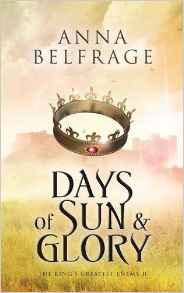
Days of Sun and Glory by Anna Belfrage is the 2nd book Anna’s latest series, The King’s Greatest Enemy. In the Shadow of the Storm saw Adam de Guirande, a trusted officer of Roger Mortimer, marry Kit de Monmouth and navigate the political climate of rising opposition to Edward II’s increasing infatuation with Hugh Despenser, while at the same time being 2 strangers negotiating the early tribulations and insecurities of married life. In Days of Sun and Glory the crisis in England is worsening; Mortimer is free and on the continent, leaving his supporters to face the suspicions and antagonisms of the king and Despenser.

Philip_iv_and_family
Isabella with her father, Philip IV, and brothers.

Days of Sun and Glory is a stunning read; full of action, love and suspense, it has the reader on the edge of their seat from the 1st page – and leaves you there right to the last.  This story will have you laughing, crying and biting your finger nails with anticipation throughout. It is a fascinating read that pulls you into the lives of, not only, the central characters, Kit and Adam, but also of the historical characters; Mortimer, Isabella, King Edward and his heir, the future Edward III.

Although we see new enemies the chief antagonist remains the same: Despenser. Anna Belfrage paints a picture of Despenser that makes you cringe every time he appears on the page. He is charmingly polite and clever; while being, at the same time despicable and slimy. He will stoop to anything to keep his position and influence with the king; using any weapon available – including children . This is one man everyone loves to hate – except the king and his wife.

As luck would have it, they ran into Lord  Despenser on their way back to their allotted chamber. Kit didn’t see him at first, she simply felt the muscles in Adam’s arm tense.

“If it isn’t my favourite traitor,” Despenser said with a smirk, stepping out to block their path. Adam bowed, as did Kit – protocol required that they do so, even if Kit would have preferred to spit Despenser in the face. This was the man who had threatened her and abused her, who had tortured her Adam, leaving him permanently crippled.

“No traitor, my lord,” Adam replied in a calm voice. “Despite your repeated attempts to smear me as such, I remain a loyal servant of my master, Edward of Windsor.”

Despenser’s mouth curled into a sneer….

And fighting against his schemes are Adam and Kit. The central characters have a love story to rival the greats. However, Anna Belfrage has cleverly placed them in their time and history. In stark contrast to the rebellious Queen Isabella, Kit is the obedient, dutiful 14th century wife – most of the time; while Adam is torn between duty to lord and obligation to family, constantly forced to balance his priorities and overcome his personal feelings. Their relationship makes the book – their love has overcome petty jealousies, personal tragedy, family feuds and the threats of the dastardly Despenser.

And behind it all lies Adam’s fears of what would happen if he or his family were to fall into Despenser’s clutches.

“It won’t happen,” she said.

“No,”  he [Adam] agreed in a shaky voice. “I’ll leap off a cliff rather than end up in his hands.”

Kit got down on her knees before him and prised his fingers off his face, cupping it and lifting it so that she could see his eyes. “It won’t,” she repeated. “I won’t let it happen.”

That made him smile. “My protective wife.” Adam stroked her cheek.

Kit had risked her life to save him from Despenser once, and she’d do it again if she had to…

Isabela_Karel_Eda
Edward III, as Duke of Aquitaine, paying homage to Charles IV, supported by his mother Queen Isabella

While Kit and Adam are becoming old-hands at the political balancing-act, thrown into the midst of it all is Adam’s new lord, Edward; son and heir of Edward II the 13-year-old prince is torn between his parents. While Adam and Kit see a desperate child forced to choose between love of his mother and duty to his father, each parent  sees that controlling the son as a means to controlling the future. Young Edward becomes a star of the book; likeable, mischievous and old beyond his years, Anna Belfrage hints at the hero-king to come, while ably depicting the fear and confusion of the child he is. Edward steals practically every scene he is written into.

Anna Belfrage has done her research well. From the historical characters to the marvellous castles and palaces in France and England, Anna brings the 14th century to life in vivid, entertaining and exciting language. The best and worst of human strengths and frailties are characterised within the magnificent castles of Vincennes and Windsor, in the sprawling cities of London and Paris; taking the reader on a wild ride through the French and English countrysides, with spies, poisoners and the possibility of ambush just around the corner.

While the reader may know the history, Anna Belfrage tells the story in a manner that will always leave you wondering what happens next. She gets under the skin of her characters, both historical and fictional. Her sympathetic portrayal of the characters and events takes the reader through a whole range of emotions; fear, anger, humour, awe … and love. Tears and laughter are never far from each other as the lives of Kit and Adam are revealed before us.

Engaging and entertaining, Anna Belfrage has created a masterpiece in Days of Sun and Glory, a book which is impossible to put down, but which you do not – ever – want to end.

*

Anna Belfrage is the author of the extremely popular time-travelling series, The Graham Saga. To find out more about this incredible author and her books, please visit her website.

*

Pictures courtesy of Wikipedia

*

My book, Heroines of the Medieval World,  is now available in hardback in the UK from both Amberley Publishing and Amazon UK and worldwide from Book Depository. It is also available on Kindle in both the UK and USA and will be available in Hardback from Amazon US from 1 May 2018.

Be the first to read new articles by clicking the ‘Follow’ button, liking our Facebook page or joining me on Twitter.

*

©Sharon Bennett Connolly 2016
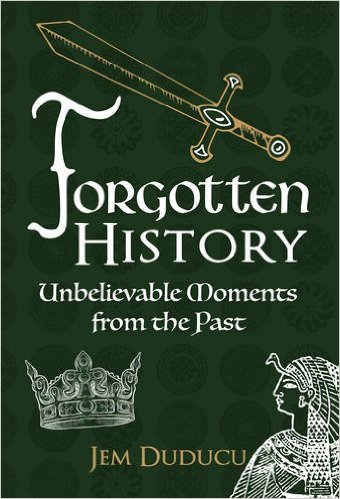
Book Corner: Forgotten History by Jem Duducu

51qGNL5YngL._SX338_BO1,204,203,200_Not all history is recorded in school textbooks or cast into towering monuments that shape city skylines. Quite often the most intriguing (and most bizarre) bits are forgotten and fall away into obscurity. In this fascinating book, Jem Duducu shines light on the almost forgotten, wonderfully strange, and often hilarious moments of history that would otherwise be lost forever.

Covering a wide variety of topics, from the time a Pope put his dead predecessor on trial all the way up to the awkward moment when the US Air Force accidentally dropped nuclear bombs on Spain, take a journey through time and discover the weird and wonderful history that you didn’t learn about in school.

 Forgotten History: Unbelievable Moments From the Past by Jem Duducu is one of those wonderful books that you simply can’t put down. When it arrived through my door I decided ‘I’ll just have a peek’. Two hours later and I was still ‘peeking’. The book takes you on a fascinating journey from Ancient History through all the eras right up to the 20th century. It brings you those little pieces of history that you may have overlooked, or forgotten – or simply didn’t know. From the history of the Rottweiler, to the green children of Woolpit to Sergeant Stubby, the most decorated dog in the First World War….

This book has something for everyone, it tells you the story, giving you the facts and the history of the history, so to speak. It is a fun and entertaining, and one you can read from cover to cover, or pop in and out of.

Well written and incredibly well researched, Jem Duducu has found those stories from history that have fallen through the cracks of most history books. He gives us the facts, events and personalities that you may have thought were just stories, but are, in fact, a part of our history.

For instance, I have loved Alexandre Dumas’ Three Musketeers since I was a child, but did you know the heroic, dashing D’Artagnan was real?

D_A
The real D’Artagnan

Someone Regarded as Legendary but Isn’t

D’Artagnan, or to give him his full name, Charlers Ogier de Batz de Castelmore, Comte d’Artagnan, was pretty much the man you’d hope for. He was the captain of Louis XIV’s elite Musketeer guard, and in this instance the legend isn’t far from the reality of the man’s true character. He lived during the time of Cardinal Richelieu, he was a brave and accomplished warrior, and he fought in many battles. However, the plots of the Musketeer books bear little resemblance to events in his life…

As well as covering the important, but often overlooked, characters from history – such as D’Artagnan and the Lady Aethelflaed of the Mercians – Jem Duducu has found some rather obscure, but fascinating, facts such as the origin of the croissant, the Nazi plot to kidnap the Pope and a statue put on trial for murder….

I could go on all day – which is probably why I spent hours reading the book after only intending to have a quick look!

Forgotten History: Unbelievable Moments From the Past by Jem Duducu has something for everyone, whatever period or genre of history you like, you will find something interesting and new. Packed full of facts and information, it can be used as a learning resource, or simply as a book to read, devour and enjoy. With some wonderful photographs and illustrations to support the text, the book tells the stories in a wonderful, engaging and unique way, which will leave you with a smile on your face – and looking for just one more story before closing the book.

©2016 Sharon Bennett Connolly.

*

My book, Heroines of the Medieval World,  is now available in hardback in the UK from both Amberley Publishing and Amazon UK and worldwide from Book Depository. It is also available on Kindle in both the UK and USA and will be available in Hardback from Amazon US from 1 May 2018.

Be the first to read new articles by clicking the ‘Follow’ button, liking our Facebook page or joining me on Twitter.

*

Picture of D’Artagnan courtesy of Wikipedia

Book Corner: A Year in the Life of Medieval England by Toni Mount

tmThe medieval era is often associated with dynastic struggles, gruesome wars and the formidable influence of the Church. But what about the everyday experience of the royal subjects and common people? Here, alongside the coronations, diplomatic dealings and key battles, can be found the fabric of medieval life as it was really lived, in its folk songs, recipes and local gossip. With a diverse range of entries – one for each day of the year – historian Toni Mount provides an almanac for lovers of all things medieval.

Toni Mount’s latest book, A Year in the Life of Medieval England, is a veritable treasury of miscellaneous snippets of medieval history. A true gem in every sense, it is one of those books that you pick up and flick through ‘just for 5 minutes’ – only to find that when you close the book again you’ve lost the last 2 hours!

Chock full of fascinating information, told in diary format, the book takes us through the year from 1st January to 31st December. Some days have just one entry – the shortest being in June;

25th – Midday Eclipse

A midday eclipse was recorded on 25th June 1191.

While other entries run to several pages, there is at least one entry for each day, and often 2 or 3. The book gives us insights into medieval court life and the great players on the national stage; offering us glimpses into their Christmas traditions, family life and political machinations. We are treated to abdications, usurpations, coronations, births and weddings; all told in a wonderfully friendly, entertaining style.

Jean_Froissart,_Chroniques,_154v,_12148_btv1b8438605hf336,_crop
The Peasants’ Revolt

However, where this book shines is in the entries about ordinary people; drawing from wills, letters and chronicles Toni Mount builds up a picture of daily life, of the trials and labours of the man – or woman – next door. We see how the influences of Church and King dictated their lives; how the extremes of weather could lead to feast or famine and how neighbours looked out for each other.

May

10th – A Village dispute

On this day, at Woodbridge in Suffolk, a dispute arose between William the Piper, aged twenty-four years and more, and John Scanlon of the same [place], and they struck each other with their fists … John Bray, chaplain, and others took John Scanlon by the neck … He resisted and William struck John Scanlon while he was being held … forthwith, John Scanlon took a knife out of the sheath of John Bray without [him] knowing it and struck William feloniously with a wound in the chest nine inches deep and one inch in latitude from which wound William died, languishing for nine days following the dispute … Alice, wife of William was with him in his home when he died.

This book is a treasure trove for any fan of medieval England. Each day holds a wonderful snippet of information; either a story or an event, or an explanation of a tradition or saint’s day. The author has managed to cover a wide range of medieval life and events. With stories taken from the towns and fields of rural England, the law courts of London or the royal court itself, it would be impossible to read this book without learning something new – and fascinating.

400px-RidsdalePanorma
Medieval York

Toni Mount has succeeded in building a picture of medieval life through all levels of society. On the same page we can read about a mercer’s will, and woman accused of witchcraft – and the death of the Black Prince. The entries are, at times, touching – such as a letter from Joan of Arc to her English captors – and at other times amusing, such as a poem about table manners for children. And amongst it all we can find recipes for herb fritters and remedies for gout!

Supported by colourful images of medieval life and court pageantry, this book is a wonderful read; from the medieval scholar to the armchair historian, it has something for everyone. Whether you read it chronologically, or head straight for your birthday (yes I did);

On this day in 1141, a strange phenomenon was recorded in London: the tide in the Thames went out and failed to flow in again for an entire twenty-four hours.

A Year in the Life of Medieval England is a wonderful, fascinating read. From the story of Aethelflaed to the Battle of Bosworth; the challenge for any reader will be putting it down!

*

Pictures taken from Wikipedia.

*

My book, Heroines of the Medieval World,  is now available in hardback in the UK from both Amberley Publishing and Amazon UK and worldwide from Book Depository. It is also available on Kindle in both the UK and USA and will be available in Hardback from Amazon US from 1 May 2018.

Be the first to read new articles by clicking the ‘Follow’ button, liking our Facebook page or joining me on Twitter.

Book Corner: Edward IV Glorious Son of York by Jeffrey James

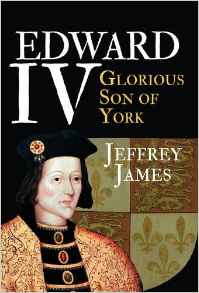
indexFew English monarchs had to fight harder for the right to rule than King Edward IV – Shakespeare’s glorious son of York. Cast in the true Plantagenet mould, over six feet tall, he was a naturally charismatic leader. Edward had the knack of seizing the initiative and winning battles and is free from the unflattering characterisations that plagued his brother, Richard III, having been portrayed as a good-looking and formidable military tactician. Described sometimes as reckless and profligate, all sources remark on his personal bravery. In the eleven years between 1460 and 1471 he fought five major battles in the Wars of the Roses. Three of them – Towton, Barnet and Tewkesbury – rank among the most decisive of the medieval period.

This is a history of Edward IV’s struggle to gain and retain the kingship of England during a period of sustained dynastic turmoil during the Wars of the Roses.

Jeffrey James’ biography of Edward IV is a wonderful introduction to the Wars of the Roses from the Yorkist point of view.  Told in a chronological narrative, it covers the events from the very outset of the Wars, telling the story from Edward’s birth, through the struggles of Richard, Duke of York, and the outbreak of war. It concentrates on Edward’s fight to win – and keep – the throne, covering the various battles, and Edward’s military tactics, in great detail.

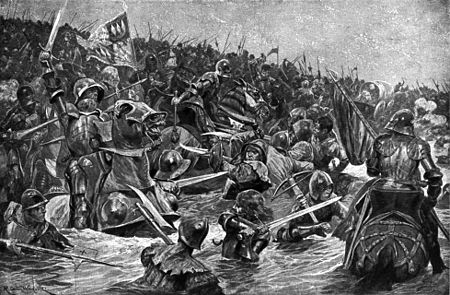
450px-Richard_Caton_Woodville's_The_Battle_of_Towton
The Battle of Towton

With the author’s background in military history, it is no surprise that where this book shines is in the assessment of the military engagements, troop movements and battle plans. It places Edward’s story in the wider context of the Wars of the Roses, while highlighting the individuality and personality of Edward, which made him such a successful warrior and king.

Scattered among the narrative are insights into Edward’s personality:

Normally relaxed and easy-going – a man who disliked unpleasantness for its own sake – Edward nonetheless had a fiery temper, usually vented against those of noble rank who angered or disappointed him. Though more often stressing the king’s good nature contemporaries sometimes touch on this aspect of Edward’s character.

More marked was the king’s man-management skills.

Jeffrey James uses contemporary sources in abundance to back up his arguments and theories. Extensive footnotes and a comprehensive bibliography provide limitless opportunities for further reading. Maps and family trees at the beginning of the book help to provide a basic understanding of the scale of the Wars, and of the personalities involved. The narrative is also supplemented by 40 photographs, portraits and illustrations, providing a further visual aid to the people, locations and battlefields involved in the conflict.

Edward IV, Glorious Son of York is an engaging, accessible narrative which provides thorough analysis of the king’s actions – and the actions of the chief players in the Wars of the Roses. Edward’s relationships with his family, allies and, even, his enemies – foreign and domestic – are discussed and assessed, providing interesting insights into the great personalities of the 15th century.

It provides some fascinating little tidbits of history:

There may have been mercenary pikemen, as well as halberdiers, professional soldiers – forerunners of the famed continental landsknechts – whose habit of slashing their clothing seeded the fashions of Tudor times.

Marriage_Edward_IV_Elizabeth_Woodville_Wavrin_Anciennes_Chroniques_d'Angleterre_Francais_85_f109.jpeg
Marriage of Edward IV and Elizabeth Woodville

Unfortunately it does get a little fanciful in places, claiming that “Leaden images, depicting a man and a woman, found discarded in an orchard nearby, suggest enchantment” when talking about the wedding of Elizabeth Woodville and Edward IV. He also suggests Richard of Gloucester (the future Richard III) hero-worshipped his brother, without any contemporary evidence to back this up.

However, such dubious claims are few and far between and, on the whole, the author’s research is impeccable and supported by contemporary sources and evidence from archaeology. Jeffrey James also acknowledges the work and theories of fellow historians, such as Amy Licence and Charles Ross, analysing their assessments in relation to his own.

In keeping with the author’s background in military history, his Jeffrey James’ analysis of military events and tactics is insightful:

If Warwick was stirring up trouble in the North he was – to use a modern phrase – ‘operating well under the radar’, using proxies in a manner designed to circumvent the activation of any immediate royal redress. Today we might use the term ‘hybrid warfare’ when describing acts like theses: acts designed to surprise, confuse and wear down an opponent.

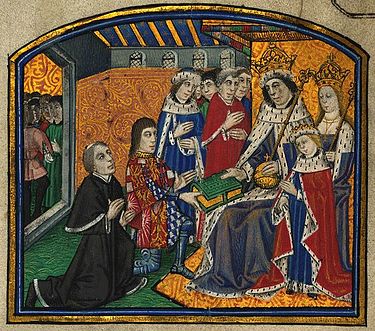
Rivers_&_Caxton_Presenting_book_to_Edward_IV
King Edward IV

Although the book concentrates on Edward’s fight to win and retain the throne, it also looks into Edward’s family life and the implications of his marriage to Elizabeth Woodville; on England, his allies and international politics. It provides and in-depth analysis of where Edward’s relationship with the Earl of Warwick broke down, and of Edward’s various successes and failures. He doesn’t shirk from discussing where Edward made mistakes, nor looking at where he could have done better, or been more – or less – ruthless.

Edward IV, Glorious Son of York is a well-written, entertaining biography of one of England’s most fascinating kings and his fight to win – and keep – the throne.

*

Pictures taken from Wikipedia.

*

My book, Heroines of the Medieval World,  is now available in hardback in the UK from both Amberley Publishing and Amazon UK and worldwide from Book Depository. It is also available on Kindle in both the UK and USA and will be available in Hardback from Amazon US from 1 May 2018.

Be the first to read new articles by clicking the ‘Follow’ button, liking our Facebook page or joining me on Twitter.


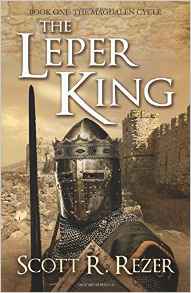
Book Corner: The Leper King by Scott R Rezer

srrKing of Jherusalem and Defender of the Holy Sepulcher, Baldwin walks the sword’s edge between the quarreling barons of his Court and the jihad of Islam. Between the two, however, a sinister presence lurks—a cabal of heretics who will stop at nothing to see its dark designs come to fruition. Baldwin is young, courageous, and a leper. In the midst of mounting political tensions and war, a beautiful woman befriends the lonely sick king—a woman who claims she is an immortal saint.

The Leper King is the 1st in Scott R. Rezer’s The Magdalen Cycle series of novels. Last year I read The Pawns of Sion, the sequel to The Leper King, for The Review, and thoroughly enjoyed it. So, when I was given the opportunity to read the story from the beginning, I jumped at the chance – and was far from disappointed. Luckily both books work well as standalone stories; they have the common theme running through the series, but you certainly do not have to read them in order. They are fantastic stories set around the Crusader Kingdom of the 12th century, combining fabulous adventure, war and intrigue with a wonderful touch of the mystic and magic.

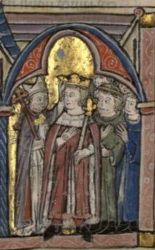
Coronation_Baldwin_IV
Coronation of Baldwin IV

The Leper King has everything; love, betrayal, the Knights Templar, heroes and heroines, Mary Magdalen ….. and the mysterious, dangerous Order of Sion which has its own personal agenda and is determined to bend the Kingdom of Jerusalem to its own will.

The fight for good versus evil is cleverly woven into the historical story of the survival of the western Crusader kingdoms against the Muslim onslaught. The individual stories of love and ambition within the royal family are set against the needs of the kingdom and the machinations of the great nobles. Murder and revenge, love and betrayal, magic and history; all go into making this novel a unique and enthralling story.

William sensed her before he saw her: a prickling of the sense like a cool draft through a chink in the chancellery door….The chapel lay dimly lit. She stood in the midst of it, all in white and gold, bathed in the soft glow of the candlelight.

“When you pray, do not use vain repetitions as the heathen  do: for they think they will be heard for their many words,” she said, throwing the words of the Christ in his face with a sly, wicked smile.

She was often that way with him: taunting and playful, annoyingly forthright. “You told him you were the Magdalen.” he said, ignoring her acerbic remark.

She laughed suddenly, musically. “You make it sound as though I were lying.”

He narrowed his gaze. He was in no mood for her playfulness. “Did you tell him all of it?”

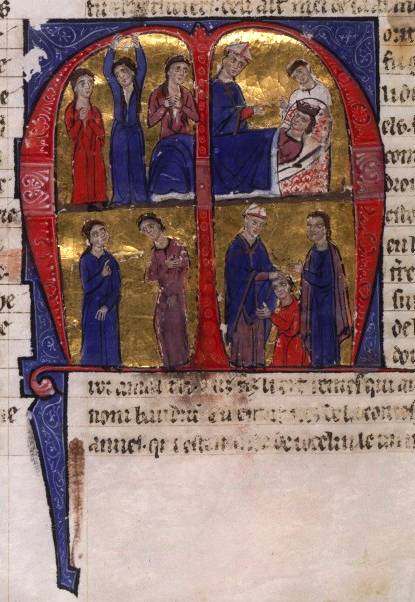
Amaurydeath-BaldwinIVcrowned-full
Death of King Amaury and Coronation of Baldwin

Her levity dissipated like a vapor. In her anger, she was a fearful presence, terrible to behold. Candlelight and shadows were unkind to her unnatural beauty. “He is a boy, even if he is a king,” she said, taking a menacing step towards him. “I will tell him when he can best handle it – when he decides that what I’ve already told him is true.”

The hero of the novel is Baldwin IV, King of Jerusalem; he was only 13 on his accession to the throne and already suffering from the effects of leprosy. Baldwin struggles to keep his lords united while fighting against the mystical forces of evil. His strength of character and determination hold his kingdom together while he is faced with 2 implacable foes; the secret cabal that is the Order of Sion from within and the man who was, arguably, the Muslim’s greatest ever warrior – Salah ad-Din – from without.

Scott R Rezer’s characters are well researched and brought to life in wonderfully vivid; they are exciting, glamorous and mysterious. He demonstrates an understanding of the needs, desires and mentality of the major players in 12th century Outremer. The story of magic, Mary Magdalen and the fight between good and evil slip easily into the great landscape of the Holy Land and serves to highlight that the actions of the individual protagonists come together to make the greater story of the Crusader Kingdoms, and the fight for survival.

the descriptions of Biblical locations, of battles fought and sumptuous, exotic palaces, bring the 12th century Holy Land to life.

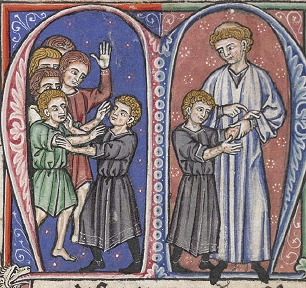
British Library - Yt 12 152v
The discovery of Baldwin’s leprosy

There are some very nice little touches in the book, which help to give it an individuality, such as the use of native names for locations, depending on who is talking. To the Muslims, Jerusalem is known as Urshalim, while to the Crusaders, it is known as Jherusalem. In much the same way as the language, the author looks at the struggle in the Holy Land from both sides, Muslim and Christian, even demonstrating how both rulers, Baldwin and Saladin, are faced with advisers bent on revenge or peace, depending on their personal experiences with their foes.

The many strands of the story are brought together for a thrilling climax of action and magic, that leaves you elated and bereft at the same time. It is a wonderful blend of history and fiction, drawing you into Baldwin’s world and the tensions with which the Holy Land was beset. The dual story of the eternal battle of good versus evil cleverly mirrors the history of the  Crusades themselves and the battle of Christian against Muslim.

The novel keeps you entertained and on the edge of your seat throughout. It is unique, thought-provoking, fascinating and intriguing; evoking a multitude of emotions. In short, it is a great read and I look forward to reading and reviewing Book 3.

*

My book, Heroines of the Medieval World,  is now available in hardback in the UK from both Amberley Publishing and Amazon UK and worldwide from Book Depository. It is also available on Kindle in both the UK and USA and will be available in Hardback from Amazon US from 1 May 2018.

Be the first to read new articles by clicking the ‘Follow’ button, liking our Facebook page or joining me on Twitter.

Book Corner: Interview with Tony Riches

Tony RichesThis week I’m talking to best-selling historical fiction author Tony Riches who lives in Pembrokeshire, one of the most unspoilt areas of the UK. Hi Tony, thanks for agreeing to be a guest interviewee on my blog, History…the Interesting Bits.

Hi Sharon I’d like to start by congratulating you on a great blog – it’s good to see a balance of well researched history and historical fiction.

Thank you Tony, that’s lovely to hear. So, what made you become a writer?

I wrote articles for magazines and journals before tackling my first book just over four years ago. (I self-published a short ebook about how everyone can use the principles of Agile Project Management and was a surprising success.) I went on to write several non-fiction books on subjects as diverse as the story of Scott’s Antarctic ship, the Terra Nova, to Atlantis, about the last flight of the NASA Space shuttle. Now my focus is very much on historical fiction – and I have become something of an expert on the rise of the Tudor dynasty

Who are your major writing influences?

I read widely, so it is hard to single out influences, although some of my favourites are C.J. Sansom (I’ve just finished reading his impressive book Lamentation, about Queen Katherine Parr), as well as Anne O’Brien and Conn Iggulden.

Most novels tend to look at the Wars of the Roses from the Yorkist side, what made you choose to tell the story from the Tudor point of view?

I was born within sight of Pembroke Castle, so feel a special connection with Henry Tudor, who was born there. Everyone knows about King Henry VIII and his daughter, Queen Elizabeth Ist – but I was surprised to discover there were no books about Owen Tudor, the Welsh servant who married a queen and founded the Tudor dynasty. I discovered several accounts of the life of Henry Tudor (who later became King Henry VII) but there were no novels that brought his own story to life.

The idea for the Tudor Trilogy occurred to me when I realised Henry Tudor could be born in book one, ‘come of age’ with the help of Owen’s son, Jasper Tudor, in book two, and rule England in book three, so there would be plenty of scope to explore his life and times.

If someone said they wanted to make a film of your books, who would you pick to play Owen, Edmund and Jasper?

I’m currently in the process of having audiobooks produced of OWEN and JASPER and find it fascinating to hear their voices from over five centuries ago, so can imagine what it must be like to see them made as a film. I’ve always thought Welsh Actor Michael Sheen would be great for Owen – and perhaps Ioan Gruffudd (famous for playing Horatio Hornblower) as Jasper Tudor. Edmund is a bit of a shady character (I’ve never forgiven him for what he did to Margaret Beaufort) although I recently visited Carmarthen Castle where he died and his impressive tomb in St David’s Cathedral. How about another great young Welsh actor, Iwan Rheon, (who you might know as Ramsay Bolton in Game of Thrones.)

How long do you spend researching a novel before you start writing?

I’ve developed a great ‘system’ over the years of spending a year researching, followed by about nine months writing the book while it’s all still fresh in my mind. I have a wonderful collection of books on Wars of The Roses and the fifteenth century, and I particularly enjoy visiting the actual locations I’m writing about. (I’m off to Josselin in Brittany soon, to see the châteaux where Jasper and Henry spent their long exile – and will be positing about it on my writing blog.)

What comes first, your storyline or your research?

I have to decide where to start the storyline, then I start the research notes. For example, in OWEN I decided to begin with his first meeting with Queen Catherine of Valois, as little is really known about his life before then and I could easily work it in later.

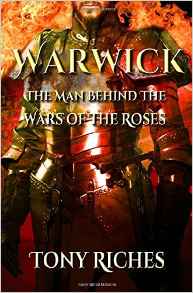
indexYou’ve also written a novel about Warwick, the Kingmaker, so which are you, Yorkist, Lancastrian – or on the fence?

Richard Neville, ‘Warwick the Kingmaker’ was a fascinating character to write about, as I explored his motivation for changing sides. Personally, like Jasper Tudor – and his nephew Henry, I would like nothing more than to reconcile the houses of Lancaster and York. I have great sympathy for Edward of York, and have even tried to give his younger brother Richard the benefit of the doubt.

Owen is told in the first person. It works really well – makes the story more personal for the reader. What made you write it in that way?

I’d already written the first two chapters when I read Wolf Hall, by Hilary Mantel, and was struck by the power of her use of the present-tense. It was a huge risk to re-write it in the first person present-tense but I enjoyed the challenge.

How do you organise your writing day?

I’ve learnt to ‘deal with’ social media early in the morning to prevent it distracting me from writing. My ‘system’ is to aim for twenty-five chapters of about four thousand words, to arrive at a completed first draft for editing of about a hundred thousand. I keep track of my daily word count on a simple Excel spreadsheet, which allows me to see how well I’m doing at a glance.

What do you enjoy most about writing?

There is nothing better than having feedback from a reader who says they’ve really enjoyed one of my books. I’d like to think in some small way I’ve also helped readers understand the rise of the Tudors a little better, and it’s my ambition to present a more balanced view of the often overlooked King Henry VII.

What is the worst thing about writing?

I should know better by now but I must admit that a harsh comment in a review can trouble me for days. One reviewer recently pointed out that I’d failed to explain the reason for the Wars of The Roses!

How long does it take to do a project from start to finish? Do you write one book at a time, or have several on the go at once?

I’m happy to produce one new book a year. I enjoy sailing and kayaking, so I usually begin writing at the end of the season in October and aim to send a first draft to my editor by Easter the following year. The process is so intense I don’t think I could manage to juggle two books at once.

Who are your favourite personalities from history? Is there anyone you would particularly like to write about, but haven’t yet?

It would have to be Jasper Tudor, who put his loyalty to Henry Tudor and Margaret Beaufort before everything else. As for those I haven’t written about yet, there are some fascinating members of the court of Henry VIII I’ve already ‘penciled in’ for potential future novels.

You’ve written about the Wars of the Roses and the Romans, what other historical periods would you like to write about?

I’d like to slowly make my way towards the Elizabethan period, as I was looking at an original portrait of Queen Elizabeth 1st recently and saw the knowing look in her eye. There are plenty of books about Elizabeth but still plenty of scope to explore her life and times.

Do you ever get writer’s block? If so, how do you get around it?

No, I suffer from the opposite, which is waking up with my characters voices telling me so much I can hardly write it all down quickly enough. I keep my laptop by the side of the bed now, and have been known to write a whole chapter before breakfast.

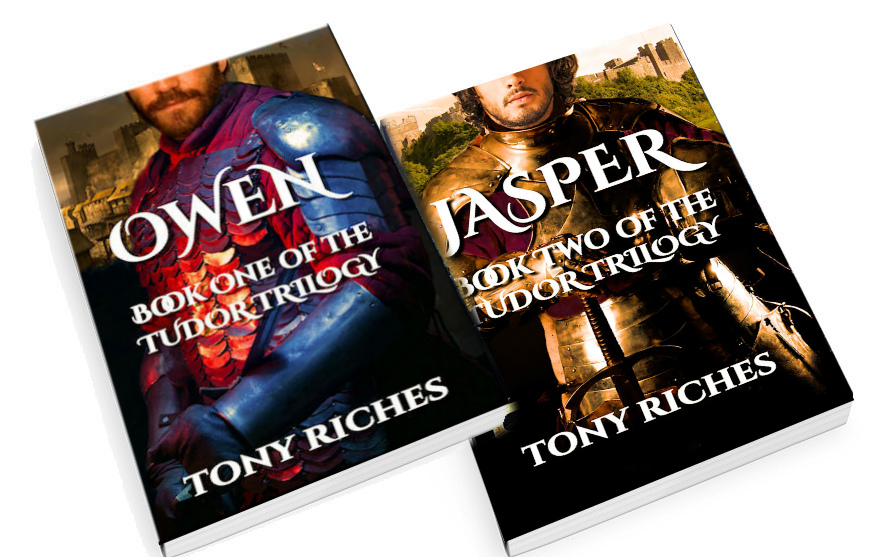
Owen and JasperDo you find social media – such as Facebook and Twitter – a benefit or a hindrance?

Twitter is a great way to build an international readership and has enabled me to have best sellers in the US and Australia – something which earlier writers would only have been able to dream of.  As a consequence, I’ve invested less time in Facebook, although there are some great groups there which I follow and contribute to when I can.

We have had Owen and Jasper, so what will be the last book of the Tudor trilogy?

I’m busy with the research for HENRY – Book Three of the Tudor Trilogy now.  I’ve just read Alison Weir’s excellent new book about Katherine of Aragon and was disappointed to see Henry portrayed as more than a little sinister and insensitive, so it looks like it’s up to me to present an alternative point of view.

What is your next project, once The Tudors is complete?

I’m looking forward to entering the court of Henry Tudor’s tyrannical son – through the eyes of someone who knows him particularly well….

 For more information about Tony’s books please visit his popular blog, The Writing Desk and his WordPress website and find him on Facebook and Twitter @tonyriches.

*

Thank you very much, Tony Riches, for that marvellous insight into the life of a writer. Thoroughly entertaining.

*

My book, Heroines of the Medieval World,  is now available in hardback in the UK from both Amberley Publishing and Amazon UK and worldwide from Book Depository. It is also available on Kindle in both the UK and USA and will be available in Hardback from Amazon US from 1 May 2018.

Be the first to read new articles by clicking the ‘Follow’ button, liking our Facebook page or joining me on Twitter.

Book Corner: The Last Legionnaire by Paul Fraser Collard

indexJack Lark has come a long way since his days as a gin palace pot boy. But can he surrender the thrill of freedom to return home?

London, 1859. After years fighting for Queen and country, Jack walks back into his mother’s East End gin palace a changed man. Haunted by the horrors of battle, and the constant fight for survival, he longs for a life to call his own. But the city – and its people – has altered almost beyond recognition, and Jack cannot see a place for himself there.

A desperate moment leaves him indebted to the Devil – intelligence officer Major John Ballard, who once again leads Jack to the battlefield with a task he can’t refuse. He tried to deny being a soldier once. He won’t make the same mistake again.

Europe is about to go to war. Jack Lark will march with them.

Jack Lark is back!

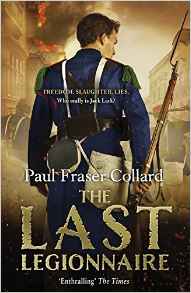
I have spent a wonderful week on the battlefields of Victorian Europe, reading Jack Lark’s latest adventure. The Last Legionnaire is the 5th book in Paul Fraser Collard‘s fabulous series of novels based on the chameleon soldier, Jack Lark – and what a fabulous, eye-catching book cover! Lark is a serial imposter, one day taking on the guise of a rank-and-file soldier, the next sitting comfortably, in a captain’s uniform, the officers mess. This makes for some interesting and uncomfortable situations; it means you can always find Jack where the action is, but also means he’s vulnerable to the demands of intelligence officer, Major Ballard, who knows his secret.

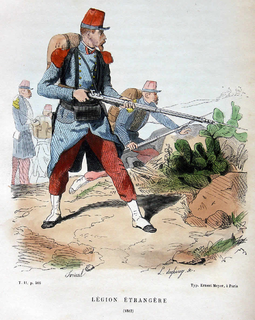
255px-Légion_Étrangère_1852
A French Legionnaire, 1852

The story begins by bringing Jack home the rookeries of Whitechapel, in London, where the poorest a most desperate of Victorian society reside. However, he soon realises it’s no longer home; Jack Lark is one of those men who is most comfortable in the army, among soldiers. It’s what he’s good at. And it doesn’t take long to find his way back to war – with the French army – in search of a man who ran away from home and joined the French Foreign Legion.

There is action in abundance. It is frenetic and vivid. Paul Collard’s battlefield scenes are a masterpiece of descriptive writing. You can almost hear the cacophony of the cannons, see the regiments advancing in column, hear the screams of the wounded and frightened horses.  The author manages to impart not only the action, but also the misery, the fear, the danger – and the lust for battle, the addiction to fighting and the power a man can find in sword, bayonet and rifle. Descriptions of the battlefield hospital, the surgeons at work – as well as the battlefield itself – demonstrate the grim reality of war.

The story is at times touching and often brutal. Jack Lark is a unique character. He serves as an example of how men can find a pleasure, or sense of accomplishment, in battle … and in another battle survived. The Last Legionnaire always has a view to the human element. Jack is aware of is soldiering abilities, even scared of what he is; he knows what he is capable of and tries hard to keep himself under control. But he also has a chivalric nature; he wouldn’t be able to resist helping a damsel in distress, rescuing a child or stopping a regiment, on the verge of panic, from running.

“I’ve seen men like you before.” Palmer broke the silence. “They survive a battle or two, so they start to believe that they’re good at fighting, that they have a talent for it.” He watched Jack pull out the small pot of grease that he used to seal each freshly loaded chamber on his revolver. “Truth is they were just lucky. One day that luck runs out, and they’re just as dead as the poor bastard who died in the first five minutes of his first battle.”

Jack stopped what he was doing and met Palmer’s flat stare. “And you’re different, I suppose?”

Palmer shrugged. “I do what has to be done, nothing more, nothing less. I know that one day  my luck will run out. I don’t see the point in trying to make that day come along any quicker than it needs to.”

Jack’s anger had disappeared. He could not argue against the truth. He returned his attention to his revolver. Only when he had finished loading it did he look at Palmer again. “What about that lucky man? What if his luck holds? What if he goes on surviving?

“Then I pity the poor bastard.”

Paul Collard’s characters are incredibly diverse and full of life. Jack invokes the reader’s sympathy for a man who tries to do the right thing, but sometimes manages to go the wrong way about it. He marches to war with a small entourage, a mismatch of individuals who all want something from him.

450px-Yvon_Bataille_de_Solferino_Compiegne
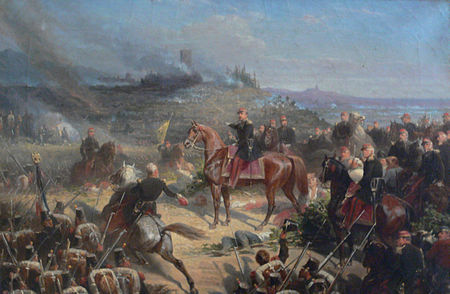
Battle of Solferino, 1859

His sense of chivalry means he has taken under his wing a face from his past; Mary, and her young son Billy, no longer have a home and Jack does his best to protect and support them, despite frequent criticism of his inadequacies. Major Ballard is an intelligence officer; comfortable in using others’ weaknesses in order to achieve his ends. And then there’s Palmer, Ballard’s man, but he has a soft spot for Jack; he sees much of himself in the younger man. The partnership of Jack and Palmer is a strong part of the story. The 2 men grow to like and trust each other; they play to their individual strengths and their banter is enjoyable and entertaining.

Ever since reading Beau Geste as a child, I’ve had a soft spot for French Foreign Legion stories and this one is fabulous. Paul Collard has done his homework and it shines through, his knowledge of the Legion, their history and ethos, is second-to-none.

The author has an incredible sense of adventure, which he manages to get across on every page of his writing; you can tell he grew up reading Cornwell, MacDonald-Fraser and Forrester. Jack Lark is his own unique hero and he is a worthy successor to the great literary soldiers who came before him. I couldn’t help imagining him sat round a table with Sharpe, Flashman and Hornblower; he would certainly be able to hold his own when it came to telling the stories of their adventures!

*

Paul Fraser Collard‘s Jack Lark series of books are available now from Amazon

*

My book, Heroines of the Medieval World,  is now available in hardback in the UK from both Amberley Publishing and Amazon UK and worldwide from Book Depository. It is also available on Kindle in both the UK and USA and will be available in Hardback from Amazon US from 1 May 2018.

Be the first to read new articles by clicking the ‘Follow’ button, liking our Facebook page or joining me on Twitter.

Book Corner: Interview with Paul Fraser Collard

Author ImageJack Lark exploded onto Kindles and bookshelves everywhere in Paul’s 1st novel, The Scarlet Thief, and now, 3 years later, The Last Legionnaire is Jack Lark’s 5th adventure. And what an adventure!

This week, after finishing his latest book, The Last Legionnaire, I was lucky enough to catch up with its author, Paul Fraser Collard and ask him a few questions about his writing and  the hero of his books, Jack Lark.

What made you become a writer? I have always read a lot. For years, I spent my daily commute to work reading anything I could get my hands on. My favourite books were always historical fiction, especially the Sharpe novels by Bernard Cornwell. When I was in my early thirties, I began to wonder if I had it in me to write my own novel. One day, after a tough day at work, I opened up my laptop and made a start.

Who are your major writing influences? Bernard Cornwell stands out. I have read every book he has ever written. For me, he gets the mix of historical detail and plot exactly right. The books never fail to sweep me away into the past whilst still giving me a wonderful education into the period he is covering.

I would also say I have been influenced by the fantastic George McDonald Fraser. His Flashman series is quite magnificent. I could never hope to write anything close to such brilliance, but it did give me the idea of setting each novel in a new setting with a different cast of supporting characters.

index2Jack Lark is quite a unique character, a soldier/officer impostor. How did you come up with him as your character? Is he based on an actual historic person? The idea for Jack was developed from the desire to find a way to move a character around without tying him to a single regiment or a particular military campaign. I knew that is what I wanted to make my series stand out, and so I thought long and hard how to create a character that was unique enough to be able to travel the Victorian world.

The idea for an imposter came from the real story of Percy Toplis, a man made famous by the BBC TV series called The Monocled Mutineer. Percy was a rogue from a mining town in the north of England, yet he managed to pass himself off as a British army officer during the First Word War. Poor Percy met a rather nasty end, but he gave me the proof I felt I needed that a lad from a very humble background could manage to impersonate an officer.

If someone said they wanted to make a film of your books, who would you pick to play Jack Lark? Goodness, I hope this happens! However, I am dreadful at answering this question. I just don’t know of any actor that matches the picture of Jack that I carry in my head. Perhaps readers of this interview can send me their suggestions!

How long do you spend researching a novel before you start writing? I always start any novel with a period of research. This generally begins whilst I am still working on another book. I work full time so everything has to be fitted in 2as and when I can. I would say that on average I spend around three months learning the history of the next novel. Some have been easier than others. The American Civil War or the events of the Indian Mutiny are covered by hundreds of books, whereas the campaign against the Shah of Persia and the battle of Khoosh-Ab barely feature anywhere!

What comes first, your storyline or your research? They both develop together. The history gives me the framework and the plot is the fabric that gets woven around it. I put the two together in a very detailed plan that tends to be around 20-30,000 words. Then all I have to do it flesh it all out.

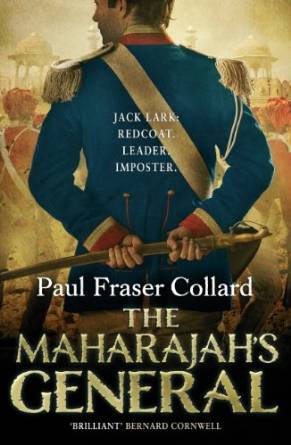
With The Last Legionnaire, Jack becomes embroiled in a war that Britain took no part in; how did you decide where he was going to fight next? I always have a vague idea where Jack is going for the next couple of novels. From there, I cast around to see what events happened in the years following the last novel I have planned. The tricky bit is thinking of how Jack can go from one to the other. I remember a review of The Maharajah’s General that stated that it would be a dull series indeed, if Jack just moved from one convenient identity to another (a Victorian version of Mr Ben, if you like!). So I always think very carefully about the link between the novels. Hopefully they work!

Do you know how the book is going to end when you start it? Pretty much. As I have to cram my writing into short gaps in my day, I need to be able to write fast. This makes planning pretty important and my novel outline is always very detailed. That said, it can and does change. The ending to The Last Legionnaire change dramatically about one week before I had to submit it to my editor. The ending I had planned just didn’t sit well and so it had to be changed.

How do you organise your writing day? My writing time is squeezed into my commute at the start and the end of the day. I have quite a long journey so that gives me just under two hours a day dedicated to writing. I then fit what I can into other times. This means I have to be very disciplined about using what time I have as e3ffectively as I can. I try hard to write at full speed on the train, making sure I cram as much productivity into those two hours as I can. I am not one of those writers who had the luxury of ruminating over the perfect sentence!

What do you enjoy most about writing? Creating the story is the best bit and I love plotting and creating the detailed outline.

What is the worst thing about writing? Finishing the first draft! This gets harder, if I start planning the next novel before I have finished the current one.

How long does it take to do a project from start to finish? So far I am getting a novel done in around ten months. I tend to work on multiple books at the same time. Right now I am polishing book 6, writing a short story whilst also plotting and researching for book 7.

Who are your favourite personalities from history? Is there anyone you would particularly like to write about, or include in Jack’s adventures? I love the idea of working in a reference to Flashman in one of Jack’s stories, but I must say, I have always been much more interested in the ordinary men and women who found themselves caught up in the cataclysm of war than the great and famous personalities. For me, the tale of an ordinary infantryman is more interesting than that of a famous general. Apart from a few exceptions, Jack’s stories will focus on what the battles were like for the poor bloody individuals on the front line.

What other historical periods would you like to write about? I w4ould really enjoy writing about WW2. If anything this period fascinates me even more than the Victorian Empire. I have written a novel set in WW2, but for now it is on the back burner as its needs a re-write that I just don’t have time to do. For the moment at least!

Do you ever get writer’s block? If so, how do you get around it? I have to say that I don’t often get writer’s block. I think this is because I have so little time to actually write. I tend to do my thinking at other times. When I sit down to write, I slip into blast mode and just go for it. If I do get stuck then I jump to something else. I cannot bear to waste time! It is too precious.

Do you find social media – such as Facebook – a benefit or a hindrance? I love it! The publishers are very keen on social media and I was a little daunted at first. But now I think it is the best outlet I have. I have found so many brilliant people on Facebook and on Twitter and I would now count many of them as friends. I love the fact that I can be available to anyone kind enough to read my books and I always enjoy being able to chat about history or anything else that comes up.

What will be your next project? Where is Jack fighting next – and when do we get to read it? Next up is the start of The American Civil War and specifically the First Battle of Bull Run (Jack fights for the Union in this one). If you have finished The Last Leindexgionnaire then you will have an idea of what takes Jack across the Atlantic.

This one should be out early in 2017.

How many more Jack Lark adventures do we have to look forward to? Do you have a number in mind, or will he keep fighting until there are no wars left? I cannot imagine ever letting Jack settle down and I hope he can keep going for many years, and many novels, to come. You will know when I have written the last one as I will make sure the cover image is of him facing the reader for the first time.

*

I would like to extend my thanks to Paul Fraser Collard for his fantastic answers. Look out for my review of The Last Legionnaire, which should go live on Friday 13th May, 2016.

*

My book, Heroines of the Medieval World,  is now available in hardback in the UK from both Amberley Publishing and Amazon UK and worldwide from Book Depository. It is also available on Kindle in both the UK and USA and will be available in Hardback from Amazon US from 1 May 2018.

Be the first to read new articles by clicking the ‘Follow’ button, liking our Facebook page or joining me on Twitter.

©2016 Sharon Bennett Connolly

Book Corner: In the Shadow of the Storm, by Anna Belfrage

51FcCxVcaOL._SX310_BO1,204,203,200_Adam de Guirande owes his lord, Sir Roger Mortimer, much more than loyalty. He owes Sir Roger for his life and all his worldly goods, he owes him for his beautiful wife – even if Kit is not quite the woman Sir Roger thinks she is. So when Sir Roger rises in rebellion against the king, Adam has no choice but to ride with him – no matter what the ultimate cost may be. England in 1321 is a confusing place. Edward II has been forced by his barons to exile his favourite, Hugh Despenser. The barons, led by the powerful Thomas of Lancaster, Roger Mortimer and Humphrey de Bohun, have reasons to believe they have finally tamed the king. But Edward is not about to take things lying down, and fate is a fickle mistress, favouring first one, then the other… The Welsh Marches explode into war, and soon Sir Roger and his men are fighting for their very lives. When hope splutters and dies, when death seems inevitable, it falls to Kit to save her man – if she can….

In the Shadow of the Storm is the first book in Anna Belfrage’s new series, The King’s Greatest Enemy, and what a magnificent introduction to Anna’s new heroes and heroines! Set in one the most tumultuous periods of English history, the book expertly blends the personal lives of its heroic couple, Sir Adam and Kit, his new wife, with the national drama of the disintegrating reign of Edward II.

Seal_of_Edward_II-2
Seal of Edward II

I know it’s a bit of a cliché, but this book is impossible to put down. The action and intrigue are, to put it simply, riveting. In the Shadow of the Storm has a great mix of love story and rebellion, and of heroes and villains and a heavy dose of adventure; it has you in tears one minute and on the edge of your seat with excitement the next.

Kit is my new hero! In a world where women’s rules were very specifically defined, Kit pushes the boundaries in order to achieve what she wants – but she never quite exceeds them. A young woman kidnapped from her sheltered life and thrown into a marriage to a man she has never met, and into the world of her new husband’s lord; where war, intrigue and a secret threatens to destroy the growing love the couple have for each other. However, not only does she manage to avoid sinking, Kit becomes a champion swimmer.

Adam went to the nearby table, sloshed wine into a goblet and drank deeply before passing it to her.

“I hadn’t expected to find you a virgin,” he said, eyes the colour of pewter raking her body up and down.

“What do you mean, my lord?”

“Don’t give me that.” He reclaimed the cup and leaned against one of the bedposts. “Do you think I don’t know about you and Lord Roger?” Not only was he tall, he was big, a thick, fair fuzz covering his chest, the hair darkening closer to his groin.

“Lord who?” Kit’s head ached.

“Mortimer,” he clarified with an edge to his voice. “Our lord and master.”

Adam is a knight sworn to Lord Roger Mortimer, balancing a burgeoning love for his wife and family with his duty to his lord. Kit and Adam are a very real, down-to-earth, young couple; newly married they are still discovering each other. Misunderstandings and insecurities lead to a married life that is anything but smooth. And in the midst of their developing love and trust, they are thrown into the middle of Mortimer’s rebellion against Edward II.

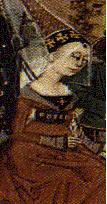
Isabella_of_France
Isabella of France, Edward II’s queen

Ranged against them are enemies aplenty. Adam’s own step-brother, Guy, has eyes on Kit – and on everything Adam possesses – and will go to extraordinarily vicious lengths to achieve his goal. While the most despicable of all is Hugh le Despenser the younger, Edward II’s favourite and a man with a particular hatred for Adam and his lord. Vindictive and cruel, Despenser is determined to destroy Adam; Kit has to use all her courage and skill to thwart him – and to save her husband’s life.

Anna Belfrage manages to weave a wonderful story around the very real history of a desperate time for England and her people. The threats and dangers of living in a divided, unstable realm, with forces polarizing between the king and queen, are vividly depicted, drawing the reader deeper and deeper into the 14th century.

The author’s deep knowledge of the period serves to make the reader believe they are actually there, watching the action, weighing the choices and living the harsh reality of a realm on the brink of civil war. The history is impeccable, with Kit and Adam’s story slipping into the historical timeline so neatly that it is practically impossible to see the line where history ends and fiction begins.

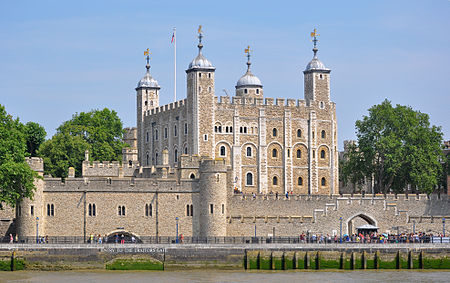
450px-Tower_of_London_viewed_from_the_River_Thames
Tower of London

Anna Belfrage’s depiction of the historical characters is exquisite. Despenser is suitably heinous; he makes your skin crawl when he walks into a scene. Lord Roger Mortimer is determined, charming … and noble. The personalities are diverse and fascinating. The landscapes are so vividly describes as to be dramatic; you could almost imagine yourself riding along the rivers of the Welsh Marches, incarcerated in a dark, cold dungeon, or walking along the main thoroughfare of the ancient town of Shrewsbury.

In the Shadow of the Storm is a wonderfully exciting book; a clever blend of intrigue, romance and action. Anna Belfrage is a master story-teller and has done her homework well – she brings the 14th century to vivid, colourful life. It will be difficult to read anything better this year …. but I can’t wait to see if Book 2 in The King’s Greatest Enemy series, Days of Sun and Glory, proves me wrong……

*

nna Belfrage is the author of the extremely popular time travelling series, The Graham Saga. To find out more about this incredible author and her books, please visit her website.

Pictures of Edward II and Isabella of France are courtesy of Wikipedia.

*

My book, Heroines of the Medieval World,  is now available in hardback in the UK from both Amberley Publishing and Amazon UK and worldwide from Book Depository. It is also available on Kindle in both the UK and USA and will be available in Hardback from Amazon US from 1 May 2018.

Be the first to read new articles by clicking the ‘Follow’ button, liking our Facebook page or joining me on Twitter.

©2016 Sharon BennettConnolly


Book Corner: Hanging Mary by Susan Higginbotham

51lmZWdly4L._SX331_BO1,204,203,200_In 1864 Washington, one has to be careful with talk of secession. Better to speak only when in the company of the trustworthy, like Mrs. Surratt. A widow who runs a small boarding house, Mary Surratt isn’t half as committed to the cause as her son, Johnny. If he s not escorting veiled spies, he s inviting home men like John Wilkes Booth, the actor who is even more charming in person than he is on the stage. But when President Lincoln is killed, the question of what Mary knew becomes more important than anything else. Based on the true history of Mary Surratt, Hanging Mary reveals the untold story of those on the other side of the assassin’s gun.

 Hanging Mary is a wonderfully deep, thought-provoking book which transports you back to 19th century Washington and walks you through the months leading up to the Lincoln Assassination, the assassination itself and, finally, the dreadful aftermath. More than a novel, Hanging Mary allows you to experience the lives of the men and women caught up, however unwittingly, in the conspiracies of John Wilkes Booth.

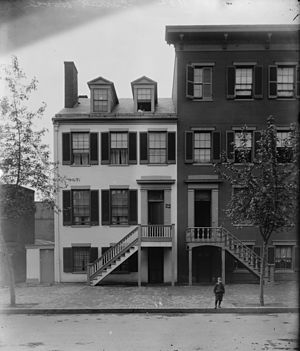
300px-Mary_Surratt_house_-_Brady-Handy
Mary Surratt’s boarding house

As the title suggests, the eponymous heroine, Mary Surratt pays the ultimate price for her southern sympathies. One of the 2 narrators, Mary tells the story of how her respectable boarding house and its residents were caught up in the plot to kill the president.

The other narrator is Mary’s boarder, Nora Fitzpatrick, a young woman who sees Mary as a surrogate mother. A spectator, rather than a conspirator, Nora watches the unravelling of the lives of those in the boarding house. Caught up in the aftermath, but unable to desert her former landlady, she bears witness to the events as they unfold. Between them, Mary and Nora, reveal the story of the plot to kidnap Lincoln, which eventually led to his assassination at Ford’s Theatre. We watch the comings and goings at the boarding house, are introduced to the dashing actor, John Wilkes Booth, and to Mary’s own son, John H Surratt.

As the story develops we experience the fear of not knowing what will happen, of being imprisoned and of not knowing what is happening in the wider world as the tale moves inexorably to its conclusion.

Nora: ….Mr Wilson came to our room. “Collect your things, Miss Fitzpatrick. You’re to be released, and your father is waiting to take you home.”

“What about the others, sir?”

“The orders concern only you, miss”

I embraced Anna. “They’ll free you and your mother soon, I just know it. They’re investigating and realizing that we’re innocent of all this.”

“I hope so.”

Brushing my eyes I left the dejected Anna behind, I followed Mr Wilson to the office where I had been searched. There my father was pacing around. “Nora!” He took me into his arms. “My darling child, I have been frantic with worry.”

“And she’s safe and sound, just as I told you,” Mr Wilson said. “Can we give you a ride in the ambulance? It’s a dreary day, as you know.”

“Thank you, but I prefer to take my daughter home myself,” my father said stiffly.

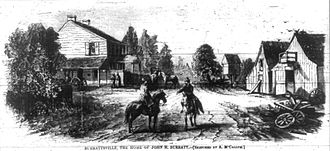
Surrattsville_-_print_-_1867
Surrattsville, where the family owned the local tavern.

You cannot read this book without being touched by Mary’s story. It draws you in, takes hold and refuses to let you go. By the climax of the trial, it was impossible to put the novel down; I read late into the night, feeling that witnessing the end of Mary’s journey was an obligation that had to be seen through. The words paint images in your mind that are vivid, at times horrifying, but which let you know that you are witnessing history and a brutal justice.

The book stays with you for days afterwards, thinking of the dignity of the woman who faced her fate with as much stoicism as she could muster. The novel reminds you of the humanity and compassion of those who stuck by Mary in her time of need; those who supported and helped her and tried to obtain a reprieve, even though they didn’t know her.

Susan Higginbotham has used her extensive research skills to recreate life in 1860s Washington. The book is full of little tidbits of information which will amaze the modern reader; such as that petitioners could walk straight into the White House and ask to see the president (can you imagine that?). The locations are described in vivid detail; down to the graffiti on the prison walls and the crowds outside the White House during the president’s speech. You find yourself immersed, not only in the story, but in the heart of Washington DC itself; in the social life and the politics and in the death throes of the Civil War itself.

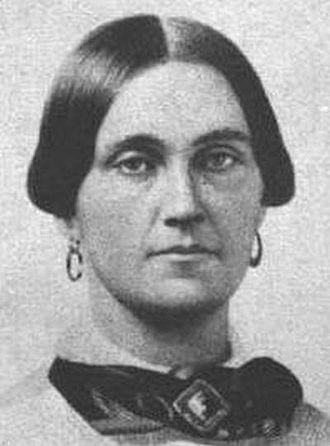
330px-Mary_Surratt
Mary Surratt

The strength of this book, however, is in the characters. Mary Surratt is a sympathetic heroine, trying to make it through life as best she can after her late husband had wasted away most of their money. She is caught between supporting her son, an active sympathiser of the South, and protecting her daughter, Anna. Her all-too-human trait of going with the flow, and her failure to recognise the dangers surrounding the plotters, draws her  into the edges of the conspiracy, but how much she actually knew, and whether she committed treason, is  open to interpretation.

John Wilkes Booth comes across as a smooth-talking, gallant charmer, who tends to know the right thing to say. It’s easy to imagine how his swarthy, confident manner could draw Mary into his conspiracy, to make her believe she is just being helpful, but doing nothing wrong. However, Booth’s refusal to be taken alive meant anyone associated with him was caught up in the web of conspiracy, and left Mary with no one to attest to her level of involvement – or lack thereof.

The author has used the memoirs of those involved, court transcripts and newspaper reports in order to recreate Mary Surratt’s life as faithfully as possible. Telling the human side of the story the book takes you on an emotional rollercoaster, with moving and powerful imagery. But it is well worth the disturbed sleep, to be able to experience such a wonderful, thought-provoking, poignant story.

This is a book not to be missed and a story that needed telling – I can’t recommend it highly enough. The language, history, the personal stories – even the locations – all combine to make this novel a unique piece of literature and an experience in itself.

*

Susan Higginbotham‘s meticulously researched historical fiction brought to life by her heartfelt writing delights readers. Higginbotham runs her own historical fiction/history blog, History Refreshed by Susan Higginbotham, and owns a bulletin board, Historical Fiction Online. She has worked as an editor and an attorney and lives in Apex, North Carolina, with her family.

Available from Amazon in the UK & the US.

*

Pictures are courtesy of Wikipedia.

*

My book, Heroines of the Medieval World,  is now available in hardback in the UK from both Amberley Publishing and Amazon UK and worldwide from Book Depository. It is also available on Kindle in both the UK and USA and will be available in Hardback from Amazon US from 1 May 2018.

Be the first to read new articles by clicking the ‘Follow’ button, liking our Facebook page or joining me on Twitter.

©2016 Sharon Bennett Connolly