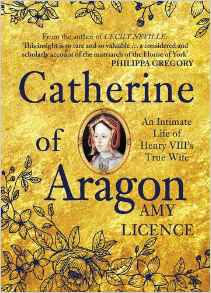
Today, it is my pleasure to welcome Amy Licence on the final leg of her Blog Tour. A few weeks ago, I had the pleasure of reviewing Amy’s latest book, Catherine of Aragon, an Intimate Life of Henry VIII’s TrueWife and today she is back with an extract from this fabulous look into the life and struggles of Henry VIII’s first queen.
This extract is taken from the end of 1529, just before the Reformation parliament meet, illustrating how the marriage was under tension but Catherine was still fighting back.
Catherine was permitted to return for the Christmas season, which was traditionally presided over by the King and Queen together. And Henry was not quite ready to dispense with traditions, either religious or marital; he would need a couple more years for that. Hall related that the season was observed “in great triumph… with great plenty of viands and diverse disguisings and interludes, to the great rejoicing of his people” but it was definitely not a triumph for Catherine. To observers, it seemed that Henry was being pleasant to Catherine, showing his wife “more consideration than was his wont,” and with Anne not making an appearance. However, all was less than harmonious behind the scenes. On Christmas Eve, after her return, Henry had told Catherine that even if the Pope declared their marriage lawful, he still intended to divorce her and he would get his way, as the Church of Canterbury was more important than Rome and he would declare the Pope a heretic. Something must have broken in Catherine to hear this. She had, related Chapuys “lost all hope of bringing him to a sense of right and duty” never could think that her affairs would fall so low as they are at present. She always fancied that the King, after pursuing his course for some time, would turn away, and yielding to his conscience, would change his purpose as he had done at other times, and return to reason.” She had been wrong.
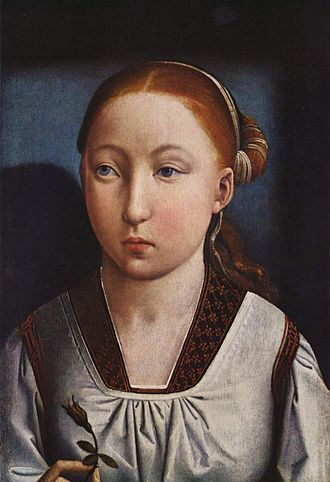
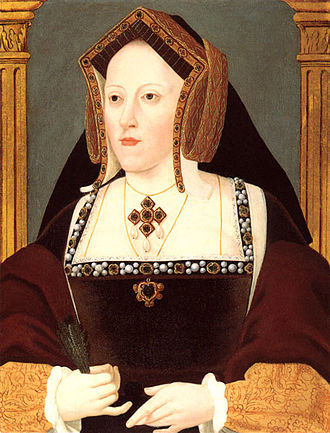
Portrait of Catherine of Aragon by Michel Sittow
Yet the Queen had also been working behind the scenes. She might have been down but Catherine was nothing if not an indefatigable fighter, so she was not yet out. In the knowledge that Henry was hoping for the French and Italian universities to confirm his view of his marriage, Catherine set out to counter his efforts. She was more than a match for him intellectually and in terms of character, but in her present restricted circumstances, there was little she could do, being excluded from the political process as the Reformation Parliament met for the first time. Appealing to the universities was something positive that she hoped might influence the Council. The same Edward Lee, Henry’s almoner, had informed the king that nobody in Spain apart from the Emperor, “cared a straw” whether or not the marriage was dissolved, so Catherine asked Charles to ask the Spanish Universities to write in her defence, along with her niece, Empress Isabella. She hoped that if the Archbishop of Toledo could gather their responses, “her case might be considerably improved.” She also wrote to Margaret of Savoy with the same request, and “wherever else it may be considered expedient” as it was the only thing now she thought might “stop the King in his course.”
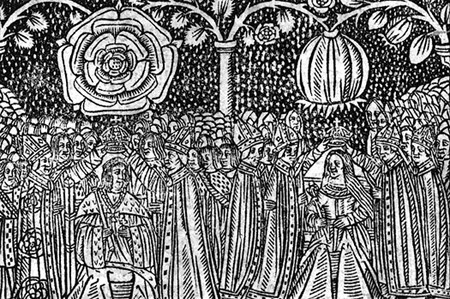
Woodcut of Henry and Catherine’s joint coronation
Catherine feared that her husband was “so blind as passionate in these matters, that it is much to be feared that one of these days he will take steps which may perhaps induce his people and the Commons… to consent to the divorce.” She begged Henry for permission to consult her Council of advisers, and was granted permission for them to attend her at Richmond. However, this kindness may have only been conferred “in order to discover whether she had received a recent dispatch from Rome.” In fact, Henry’s new Parliament would not yet discuss Catherine and her marriage in its coming session, instead they were setting about the process of undermining the ties that bound England to Rome.
I would like to congratulate Amy on a fabulous Blog Tour, and thank her for asking History…the Interesting Bits to be a part of it. You can find out more about Amy Licence on her website, and this amazing, definitive, biography of Catherine of Aragon is available from Amazon.
If you’d like to catch up with the previous stops on Amy’s Blog Tour, simply click on the day: Monday; Tuesday; Wednesday; Thursday.
*
My book, Heroines of the Medieval World, is now available in hardback in the UK from both Amberley Publishing and Amazon UK and worldwide from Book Depository. It is also available on Kindle in both the UK and USA and will be available in Hardback from Amazon US from 1 May 2018.
Be the first to read new articles by clicking the ‘Follow’ button, liking our Facebook page or joining me on Twitter.
My latest book review, of Derek Birks‘ latest novel, Scars From the Past, the first novel of his stunning new series, set 10 years after the conclusion of his fantasticRebels& Brothers series, has gone live over at The Review today!
Scars From the Past is the first novel from Derek Birks’ new series and, I have to say, it is the ultimate page-turner! It is a new direction for the author. While there is just as much action as in the first series, the story is less about national politics and more family orientated, as the Elders fight to survive, and to avoid the family imploding.Where the first series concentrated on duty and feudal loyalty, this new novel examines more personal relationships; love and friendship.
The original Rebels & Brothers series told the story of Ned Elder, a Sharpe-like hero who fought his way through the Wars of the Roses and Edward IV’s battle to win – and hold – the throne of England. The new series, set ten years after the end of the fourth book, The Last Shroud, follows the adventures of the next generation. Ned’s son, John, is a young man finding it difficult to live up to his father’s legend and the reader follows his journey as he realises his own identity and that duty and responsibility are not so easy to run from…..
To read the full review of this fantastic novel – and to enter the prize draw and be in with a chance of winning a hot-off-the-press signed paperback copy in the giveaway, simply visit The Review and leave a comment. Good luck!
*
My book, Heroines of the Medieval World, is now available in hardback in the UK from both Amberley Publishing and Amazon UK and worldwide from Book Depository. It is also available on Kindle in both the UK and USA and will be available in Hardback from Amazon US from 1 May 2018.
Be the first to read new articles by clicking the ‘Follow’ button, liking our Facebook page or joining me on Twitter.
The fact that Cleopatra is better known for her seductions than her statecraft, and that Jezebel is remembered as a painted trollop rather than a faithful wife and religiously devout queen, isn’t a way for historians to keep these interesting women in the public eye, rather it’s a subversion of their power, a re-writing of history to belittle and shame these powerful figures, preventing them from becoming icons of feminine strength and capability. Slut shaming has its roots in our earliest history, but it continues to flourish in our supposedly post-feminist, equal-rights world. It is used to punish women for transgressions against gender norms, threatening the security of their place in society and warning that they’d better be “good girls” and not rock the patriarchal boat, or they, too could end up with people believing they’ve slept with everything from farm animals to relatives. This is The Jezebel Effect
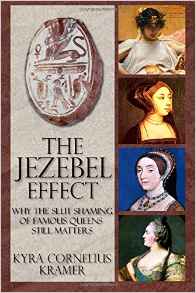
The Jezebel Effect: Why the Slut Shaming of Famous Queens Still Matters by Kyra Cornelius Kramer is a remarkable, thought-provoking analysis of the way queens have been treated and judged, based on their sexuality. The author is passionate about her subject and pulls no punches. Her arguments are well thought out and presented in such an honest, forthright manner that it is as if she is talking to you personally. It is a surprisingly enjoyable book; and I guarantee you will learn something new and find yourself re-appraising your own thoughts and approaches to women in history.
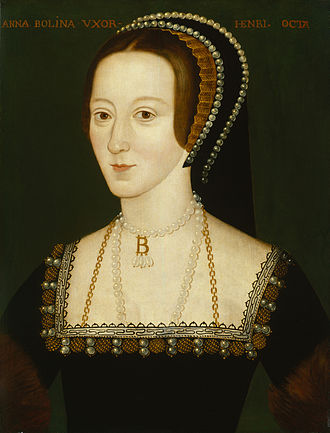
Anne Boleyn
Starting with the biblical queen, Jezebel, and including Cleopatra, Anne Boleyn, Katherine Howard and Catherine the Great, Kyra Kramer uses these queens as case studies demonstrating the way a woman’s reputation can be won, lost or destroyed through her sexual activities. Taking each queen in turn, their lives are analysed in great detail, demonstrating how political and personal slander were used by their enemies to create their bad-girl images.
For the last 500 or so years, the most popular version of Anne’s life has her playing the role of sultry harlot, a woman willing to use her sexuality as the bait to trap a king. At the very least it has been taken for granted that she wanted to be queen and manipulated Henry in order to achieve her goal. She looms in the public mind as “the most popular femme fatale, far outranking Cleopatra or Catherine the Great of Russia”. Inasmuch as Anne has been cast as a sly temptress making a gambit for the throne, here execution seldom engenders pity…
Kyra Kramer uses the queens as examples of how the stories of their lives have been manipulated as a political weapon to discredit and to apportion blame. The author goes on to present modern-day situations and makes an amazing case of showing how the way women were treated and vilified in the past is informing our thoughts and opinions of today, and how the shaming of women due to their sexual practices is continuing, and expanding, especially in the internet age.
This book will make you think again about how you present and represent women in your own life – it made me rethink a portion of my book as I realised I had conceptualised one of my ‘Heroines’ based on the deeply entrenched way women have been viewed for centuries. We see it in everyday life: a woman has an affair with a married man and it is she who is blamed, not the man; a female politician gets threatened with rape because she acts against the norm, Kyra Kramer demonstrates how such concepts have been used and developed throughout the centuries.
The Jezebel Effect: Why the Slut Shaming of Famous Queens Still Matters is a fabulous, fascinating read that will make you think again of how women have been viewed in the past, and are still being viewed today. It’s an enjoyable read that combines the history with the philosophy and politics of the sexual activities of some of the most famous – and infamous – of queens. It is a forthright analysis of women’s history that will leave you not only thinking about its contents for days afterwards, but about your own approach – whether you’re a man or a woman – to how women are seen and appraised every day.
*
My book, Heroines of the Medieval World, is now available in hardback in the UK from both Amberley Publishing and Amazon UK and worldwide from Book Depository. It is also available on Kindle in both the UK and USA and will be available in Hardback from Amazon US from 1 May 2018.
Be the first to read new articles by clicking the ‘Follow’ button, liking our Facebook page or joining me on Twitter.
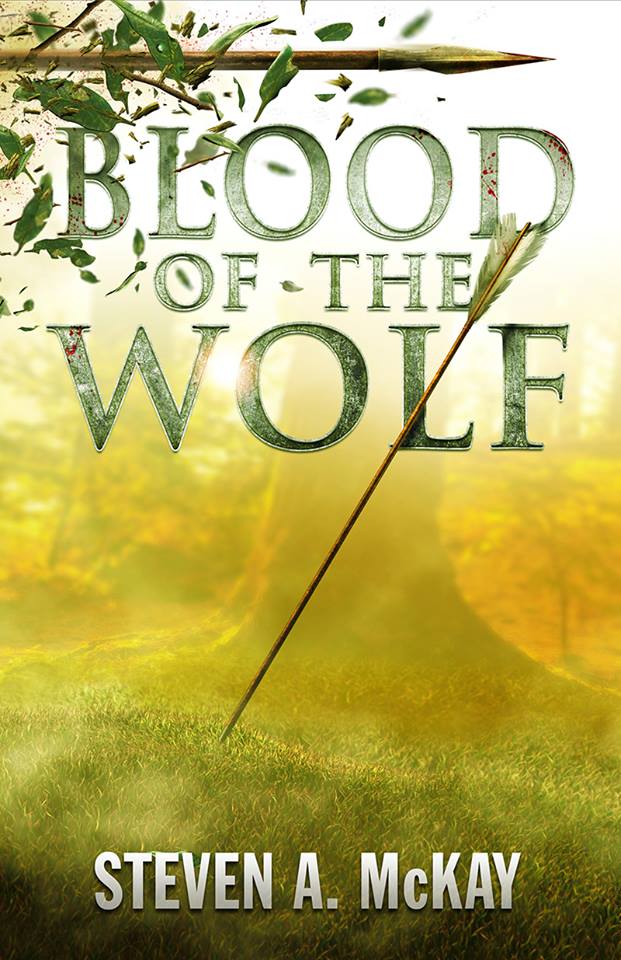
My latest book review, of Steven A. McKay’s latest novel, Blood of the Wolf, the final novel of his stunning Forest Lord series, a wonderful new reworking the legend of Robin Hood has gone live over at The Review today!
With Blood of the Wolf, Steven A McKay has definitely saved the best to last! The fourth and concluding part of his fabulous Forest Lord series sees Robin and his band of Merry Men reunited and embarking on one final adventure together, facing a most formidable foe; a new and particularly vicious band of outlaws. This book has everything: suspense, action and enduring friendships that are tested to their limits. Old and new enemies make the reader eager to see Robin win through, and a few surprises along the way make this a thoroughly entertaining and gripping novel.
It leads you on a desperate chase through the forests, in the halls of the Sheriff’s castles and into the villages of England …
To read the full review of this fantastic novel – and to enter the prize draw and be in with a chance of winning a paperback copy in the giveaway, simply visit The Review and leave a comment. Good luck!
*
My book, Heroines of the Medieval World, is now available in hardback in the UK from both Amberley Publishing and Amazon UK and worldwide from Book Depository. It is also available on Kindle in both the UK and USA and will be available in Hardback from Amazon US from 1 May 2018.
Be the first to read new articles by clicking the ‘Follow’ button, liking our Facebook page or joining me on Twitter.
Catherine of Aragon continues to fascinate readers 500 years after she became Henry VIII’s first queen. Her life was one of passion and determination, of suffering and hope, but ultimately it is a tragic love story, as circumstances conspired against her. Having lost her first husband, Henry’s elder brother Prince Arthur, she endured years of ill health and penury, to make a dazzling second match in Henry VIII. There is no doubt that she was Henry’s true love, compatible with him in every respect and, for years, she presided over a majestic court as the personification of his ideal woman.
However, Catherine’s body failed her in an age when fertility was a prerequisite of political stability. When it became clear that she could no longer bear children, the king’s attention turned elsewhere, and his once chivalric devotion became resentment. Catherine’s final years were spent in lonely isolation but she never gave up her vision: she was devoted to her faith, her husband and to England, to the extent that she was prepared to be martyred for them. Banished and close to death, she wrote a final letter to her ‘most dear lord and husband’. ‘I pardon you everything… mine eyes desire you above all things.’ The fidelity of this remarkable woman never wavered.
Catherine of Aragon, an Intimate Life of Henry VIII’s True Wife by Amy Licence is one of those incredible books that you can’t get away from. Days after you’ve finished it, your mind is still pondering the twists and turns in the incredible story that has unfolded before you. And yet, this is not a gripping novel, it’s a biography … a real-life story of one of England’s most famous queens, told in an expert, accessible fashion by one of today’s most prominent historians of women’s history.
The level of detail in this book is incredible, Amy Licence has looked into every corner of Catherine’s life-story. It paints a wonderful, vivid picture of the life of a Renaissance princess. From even before her earliest years, the author charts Catherine’s life in its entirety, giving us a complete picture of the world that surrounded the young princess from the moment she was born to the moment of her death.
Plans for Catherine’s marriage started early. As far back as the spring of 1489, Ferdinand and Isabella had received a delegation sent by Henry VII of England, seeking her as a bride for his son. That March the royal family were at the castle of Medina del Campo, a blockish red medieval fortress situated on a mound dominating the town, to hear the culmination of a year’s worth of offers and promises, conditions and stipulations, about the futures of two small children. Catherine was then three years old, a small sturdy princess with auburn hair … Her prospective husband was barely out of the cradle. Henry VII’s eldest son Arthur, was the first-born child of a new dynasty, and nine months Catherine’s junior …
Not only does the author retell the events of the life of Catherine of Aragon, chronologically, but she also highlights the influences that affected her decisions and actions throughout that life. From her parents and the reconquest of Spain, through her marriage to Arthur and the lonely years following Arthur’s death, we see the events that influenced and shaped Catherine’s life as Queen of England and wife of Henry VIII.
Catherine of Aragon, an Intimate Life of Henry VIII’s True Wife discusses the personalities and character of those who had a major effect on Catherine’s life, giving us an unprecedented, detailed view of those who surrounded her at various stages in her career as princess and queen. Catherine’s marriage to Prince Arthur is thoroughly examined, giving an insight into the relationship of this young couple, a relationship that would eventually change the course of English history. We see the good and bad of the men who were to decide Catherine’s fate, in her father, Ferdinand, and father-in-law, Henry VII, and learn of Catherine’s struggles to stay positive in the face of the two kings trying to get the best deal for themselves in Catherine’s marriage. And we see an intriguing biography of Henry VIII as he grows from being Catherine’s saviour and a magnificent Renaissance prince, to being her jailer and tormentor.
Amy Licence places Catherine’s life firmly within the Europe of the time, displaying a brilliant understanding of the Reformation, and its progress from central Europe to Henry’s court. Moreover, despite the eventual failure of the marriage, Amy Licence paints a glittering picture of the court of Henry and Catherine at its height, when this young, formidable couple were the superstars of Europe.
The most revealing part of the book is in the character of Catherine herself. The author has researched every aspect of Catherine’s life and personality, providing a portrait of a formidable woman navigating her way through a male-dominated world while trying to hold true to her deeply ingrained Catholic principles. And with this comes the realisation that it must have taken an inordinate amount of personal courage to face down Henry and his demands, and the overriding fear for her own personal safety.
Of course, the latter part of the book focuses on the divorce. I am no great fan of Catherine of Aragon and have often wondered at her stubbornness and why she was so unmovable in the face of Henry’s desperate need for an heir. Amy Licence explains Catherine’s viewpoint with absolute clarity; the reasons she stuck to her guns at the risk of her own safety and that of her daughter. The author’s theories and arguments are well though-out and incisive, giving an unprecedented insight into the mind of this amazing queen and evoking empathy in the least sympathetic of readers, I’m sure.
I have no doubt that Catherine of Aragon, an Intimate Life of Henry VIII’s True Wife will be seen as the definitive biography of Catherine of Aragon. It is an impressive, essential complement to any Tudor library.
*
Amy Licence has been a teacher for over a decade. She has an MA in Medieval and Tudor Studies and has published several scholarly articles on the Tudors. She is an author and historian of women’s lives in the medieval and Tudor period.
Catherine of Aragon, an Intimate Life of Henry VIII’s True Wife is available on Amazon in the UK from 15th October and in the US from 14th March 2017.
My book, Heroines of the Medieval World, is now available in hardback in the UK from both Amberley Publishing and Amazon UK and worldwide from Book Depository. It is also available on Kindle in both the UK and USA and will be available in Hardback from Amazon US from 1 May 2018.
Be the first to read new articles by clicking the ‘Follow’ button, liking our Facebook page or joining me on Twitter.
My latest book review, of Glynn Holloway’s epic novel 1066: What Fates Impose has gone live over at The Review today!
Glynn Holloway’s 1066: What Fates Impose is an experience in itself. It takes you on the epic journey of Harold Godwinson, earl of Wessex, and William, duke of Normandy – Harold’s rival for the throne of England – that ends at Senlac Hill, Hastings on 14th October 1066. It is a riveting tale, weaving together the lives, loves and conflicts of those who held the fate of England in their hands. Impossible to put down, 1066: What Fates Impose,gives the reader a panoramic view the events that would change the course of English history forever….
To read the full review of this fantastic novel – and to enter the prize draw and be in with a chance of winning a paperback copy in the giveaway, simply visit The Review and leave a comment. Good luck!
*
My book, Heroines of the Medieval World, is now available in hardback in the UK from both Amberley Publishing and Amazon UK and worldwide from Book Depository. It is also available on Kindle in both the UK and USA and will be available in Hardback from Amazon US from 1 May 2018.
Be the first to read new articles by clicking the ‘Follow’ button, liking our Facebook page or joining me on Twitter.
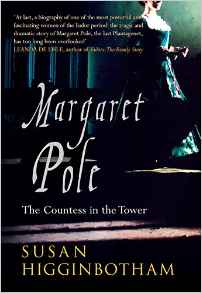
Of the many executions ordered by Henry VIII, surely the most horrifying was that of sixty-seven-year-old Margaret Pole, Countess of Salisbury, hacked to pieces on the scaffold by a blundering headsman.
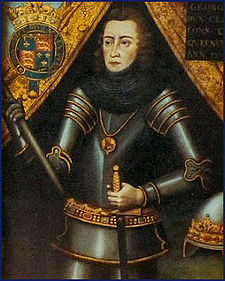
From the start, Margaret’s life had been marred by tragedy and violence: her father, George, Duke of Clarence, had been executed at the order of his own brother, Edward IV, and her naive young brother, Edward, Earl of Warwick, had spent most of his life in the Tower before being executed on the orders of Henry VII.
Yet Margaret, friend to Katherine of Aragon and the beloved governess of her daughter Mary, had seemed destined for a happier fate until religious upheaval and rebellion caused Margaret and her family to fall from grace. From Margaret’s birth as the daughter of a royal duke to her beatification centuries after her death, Margaret Pole: The Countess in the Tower tells the story of one of the fortress’s most unlikely prisoners.
Margaret Pole: the Countess in the Tower tells the story of an amazing woman who navigated two eras of history. Born into the Medieval world, during the reign of her uncle, Edward IV, she survived the change of dynasty and prospered during the reign of Henry VII; marrying and starting a dynasty of her own. During the reign of Henry VIII, she was accorded the title of Countess of Salisbury in her own right, and given the charge of her cousin’s most prized possession; his only daughter and heir, Mary Tudor.
George, Duke of Clarence – Margaret’s father
Susan Higginbotham tells Margaret’s story in great detail. Starting with a childhood marred by her father’s attainder and execution by his own brother – Edward IV – the reader is drawn into Margaret’s life and family. From the highs of being governess to the princess, through the lows of her years of imprisonment in the Tower, and eventual execution at an age – 67 – when she should have been allowed to spend her days in quiet retirement, surrounded by her grandchildren; Susan Higginbotham tells a fascinating story of family tragedy, national politics and religious upheaval.
What Margaret thought of the death of her uncle Richard III we cannot know, but as she rode south on the orders of the new King Henry, she must have done so with some trepidation. Orphaned, with her closest relative a boy younger than herself, she had no powerful male relations to speak up for her, nor could her female ones be of much help. Her paternal grandmother, Cecily Neville, Duchess of York, was the mother of a defeated king; her maternal grandmother, Anne Beauchamp, Countess of Warwick, had been stripped of her lands during Edward IV’s reign….Thus, young Margaret’s future rested largely in the hands of a man neither she nor most other people in England had even met.
Engaging and sympathetically told, Susan Higginbotham’s narrative is a joy to read. It draws you in to Margaret’s life, relating her fears and hopes – and a deep and enduring love for her family.
Cardinal Reginald Pole – Margaret’s most famous son
Susan Higginbotham has undertaken an incredible amount of research for this book, an endeavour which shines through on every page. The author has reconstructed Margaret Pole’s life and death, using every primary source available. Highlighting contradictions and explaining omissions, she takes the countess’s story from her earliest days to her final, dreadful moments… and beyond. Included at the end of the book is an appendix of over 30 pages of written evidence taken in the Exeter Conspiracy; a conspiracy involving at least 2 of her sons, which would see her imprisoned in the Tower for years before she was sent to the executioner’s block. It made for some absorbing reading late into the night.
All the key players in Margaret’s story are discussed, their actions and influence on Margaret’s life analysed and assessed. From Henry VIII to Princess Mary and Margaret’s own children. Susan Higginbotham’s analysis is unrivalled, her words painting vivid portraits of all the main characters who had a part to play Margaret’s life and explaining her relationships in detail.
Moreover, Margaret’s story is firmly placed in the wider context of English and European politics of the time; and in the great upheaval of the Reformation. Where there is contention, the author presents all possible arguments, before giving her own opinion and explaining her reasoning. She makes clear where information is lacking and highlights where she is providing her own theory and opinions.
In my recent interview with her, I asked Susan Higginbotham if she saw Margaret as a victim or a heroine, and she replied:
I would say a heroine, because she had strong beliefs which she maintained in the face of pressure, and she conducted herself with courage and dignity throughout adversity. I don’t think she would like to be remembered as a victim.
Margaret Pole, Countess of Salisbury
This biography of Margaret reinforces Susan Higginbotham’s statement. Margaret is portrayed as a strong, independent woman, who had raised a large family single-handed, following the death of her husband. Margaret had a strong faith and demonstrated great loyalty to the Tudor dynasty. Her courage and strength of purpose shines through on every page – as does her intelligence. Margaret Pole was no meek and feeble woman, she stood up for her beliefs, herself and her family, while always maintaining her loyalty to the crown.
Susan Higginbotham treats Margaret Pole with great compassion and dignity, telling her story – and that of her family – in such an engaging manner that the book is impossible to put down. Knowing how events will eventually play out makes it no less compelling.
It is a fascinating story and – ultimately – a sad one; however, it’s also a story of faith, courage and perseverance. Margaret Pole: the Countess in the Tower is a wonderful read – shining a light on the life of a woman whose story deserves to be told.
*
Pictures courtesy of Wikipedia
*
My book, Heroines of the Medieval World, is now available in hardback in the UK from both Amberley Publishing and Amazon UK and worldwide from Book Depository. It is also available on Kindle in both the UK and USA and will be available in Hardback from Amazon US from 1 May 2018.
Be the first to read new articles by clicking the ‘Follow’ button, liking our Facebook page or joining me on Twitter.
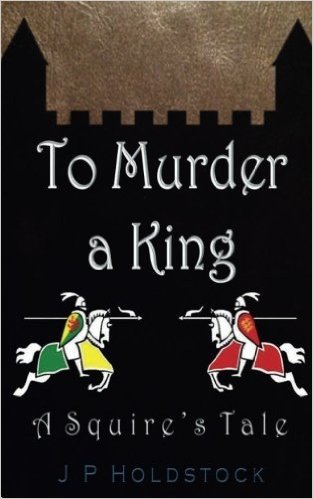
My latest book review, of James Holdstock’s amazing To Murder a King has gone live over at The Review today!
To Murder A Kingis the first book in James Holdstock’s A Squire’s Tale series. While it is aimed at teenage readers it is a fabulous tale for all ages. A story of murder and intrigue with a little bit of the dark arts thrown in it leaves you gripped from the first pages. Of course, it doesn’t hurt that the greatest knight in history, William Marshal, has a leading role!
This novel is a fabulous adventure set in the early days of the reign of King John. Suitable for children from, about 9 and above, it is an enjoyable, entertaining read – even for an adult. It tells the story in such a way that children also learn about medieval life, politics and warfare; and even the prejudices of Normans towards Saxons….
To read the full review of this fantastic novel – and to enter the prize draw and be in with a chance of winning a paperback copy in the giveaway, simply visit The Review and leave a comment. Good luck!
*
My book, Heroines of the Medieval World, is now available in hardback in the UK from both Amberley Publishing and Amazon UK and worldwide from Book Depository. It is also available on Kindle in both the UK and USA and will be available in Hardback from Amazon US from 1 May 2018.
Be the first to read new articles by clicking the ‘Follow’ button, liking our Facebook page or joining me on Twitter.
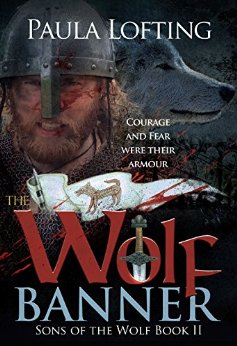
My latest book review, of Paula Lofting’s amazing pre-Conquest novel, The Wolf Banner has gone live over at The Review today!
WAR AND BLOODFEUD
1056…England lurches towards war as the rebellious Lord Alfgar plots against the indolent King Edward. Sussex thegn, Wulfhere, must defy both his lord, Harold Godwinson, and his bitter enemy, Helghi, to protect his beloved daughter.
As the shadow of war stretches across the land, a more personal battle rages at home, and when it follows him into battle, he knows he must keep his wits about him more than ever, and COURAGE AND FEAR MUST BECOME HIS ARMOUR…
The Wolf Banner is the second book in Paula Lofting’s marvellous Sons of the Wolf series which tells the story of Saxon England in the years preceding the Norman Conquest. It follows the trials and tribulations of one family; Wulfhere, his wife and children. A thegn sworn to Harold Godwinson, Wulfhere has responsibilities to his king, his lord and his family, while trying to overcome his own fears, temptations and one big problem; his neighbour and sworn enemy, Helghi. The Wolf Banner builds on the first book, to draw the reader further into Wulfhere’s life, the highs and lows, into battles with swords and words. It is a fabulous adventure, full of family heartache, compromise and love, while never losing sight of the bigger picture; of England and the struggles of Harold Godwinson, Earl of Wessex, both against his enemies and his king….
To read the full review of this fantastic novel – and to enter the prize draw and be in with a chance of winning one of two e-books in the giveaway, plus a copy of the first book in the series, Sons of the Wolf, simply visit The Review and leave a comment. Good luck!
*
My book, Heroines of the Medieval World, is now available in hardback in the UK from both Amberley Publishing and Amazon UK and worldwide from Book Depository. It is also available on Kindle in both the UK and USA and will be available in Hardback from Amazon US from 1 May 2018.
Be the first to read new articles by clicking the ‘Follow’ button, liking our Facebook page or joining me on Twitter.
The Anglo-Saxon age was one of great change and unrest. Lasting from the departure of the Romans in approximately AD 400 until the Norman invasion in AD 1066, this era was defined by the continued spread of Christianity, the constant threat of Viking raids and the first stirrings of a nation that would become known as England.
With its strange customs and unfamiliar names, the Anglo-Saxon era became mysterious and misunderstood, ironically by the descendants of the Anglo-Saxons, the English people themselves. Archaeological discoveries have forced us to re-evaluate these ingenious and skilled people, and to acknowledge the debt we owe to them. Martin Wall seeks to ‘de-mystify’ the period, breaking it down into easy-to-read, bitesize chunks, and to show that the so-called ‘Dark Ages’ were by no means backward or inferior. It was a truly heroic age, whose exemplars, such as King Offa, Alfred the Great, Lady Aethelflaed or Athelstan, stand beside the giants of world history. In 100 excerpts from these turbulent, bloody and exciting centuries, a proud, complex, but ultimately doomed civilisation is revealed.
The Anglo-Saxons in 100 Facts by Martin Wall is one of those fascinating little books which are such fun to read. It’s 192 pages are packed full of stories from the Anglo-Saxon period which help to trace its history and define the era. Starting from the 5th century AD, the book traces the Anglo-Saxon story all the way to the Norman Conquest… and beyond.
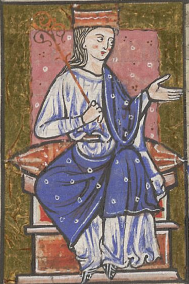
Aethelflaed, Lady of the Mercians
In short, bite-sized chapters, The Anglo-Saxons in 100 Facts, is full of those little bits of history you may have missed, or overlooked. Weaving the stories together to build a beautiful picture of the now-lost Anglo-Saxon world. Not only presenting the great personalities of the era, the book also investigates the influence of the church, literature, politics and the Vikings. It helps to explain the drive behind King Alfred and his desire to unite England as one nation.
The book is written in such an easy-going, conversational manner, you don’t even realise you’re reading – it is as if the author is right there, talking to you.
Welsh malcontents murdered a Mercian abbot, Egbert, who was travelling with his companions in Brycheiniog, a small mountain kingdom in South Wales. Egbert was under the protection of Aethelflaed who was justifiably furious. Within three days she concentrated her army on the Welsh border and invaded the little kingdom, burning and ravaging as she went. Tewdr, the King of Brycheiniog, had no choice but to retreat to his fortified Crannog, a fort on a man-made island in Lake Llasngorse. The indefatigable Mercian queen was not to be denied, however, and the place was stormed and burned and Tewdr’s relatives taken as hostages, including his wife.
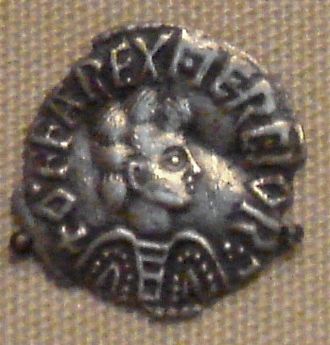
Offa, King of Mercia
The Anglo-Saxons in 100 Facts is a very enjoyable read, full of facts and information, and a little bit of humour. All the main characters of the period are covered – from Offa to Harold II and beyond – and given their place in the larger history of the nation as a whole. Outside threats and influences – such as the church, the Normans and, of course, the dreaded Vikings – are discussed, analysed and assessed.
It’s amazing how much information one writer can pack into less than 200 pages!
The author knows and loves his Anglo-Saxon history and it shines through on every page. Thoroughly and comprehensively researched, it is a fun read for anyone wanting to know ‘a little bit more’ about the time before the Normans, and the build-up to the Conquest from the Saxon point of view.
I just wanted to read the excerpts about Aethelflaed – for my research – and found myself devouring the entire book.
*
Pictures courtesy of Wikipedia
*
My book, Heroines of the Medieval World, is now available in hardback in the UK from both Amberley Publishing and Amazon UK and worldwide from Book Depository. It is also available on Kindle in both the UK and USA and will be available in Hardback from Amazon US from 1 May 2018.
Be the first to read new articles by clicking the ‘Follow’ button, liking our Facebook page or joining me on Twitter.
 Today, it is my pleasure to welcome Amy Licence on the final leg of her Blog Tour. A few weeks ago, I had the pleasure of reviewing Amy’s latest book, Catherine of Aragon, an Intimate Life of Henry VIII’s True Wife and today she is back with an extract from this fabulous look into the life and struggles of Henry VIII’s first queen.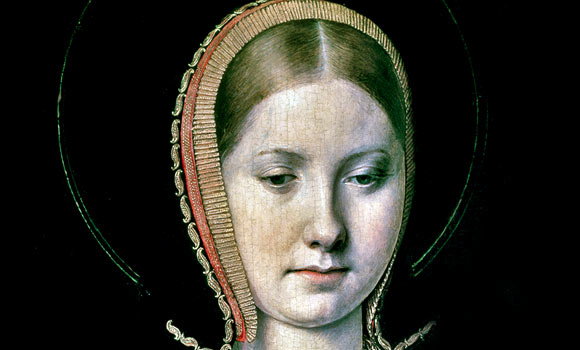


 Amy Licence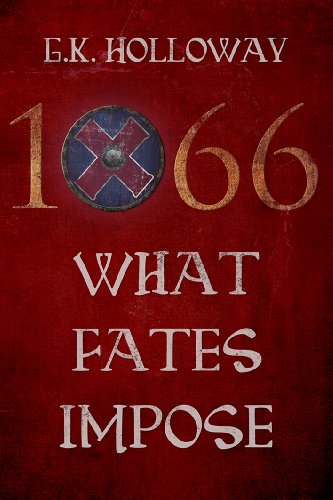



 History... the interesting bits!