Gwenllian was the only child of Llywelyn ab Gruffuddd, also known as Llywelyn the Last, Prince of Wales. Her mother was Eleanor de Montfort, who was the daughter of Eleanor of England, sister of Henry III, and Simon de Montfort, Earl of Leicester. Llywelyn and Eleanor had married in Worcester Cathedral in October 1278, in a lavish ceremony attended by Edward I, King of England, and Alexander III, King of Scots.

Gwenllian, a descendant of both Welsh and English royalty, was born in June 1282 at the palace of Garth Celyn, Abergwyngregyn, near Bangor; her mother died giving birth to her. Shortly after her birth, Edward I concluded his conquest of Wales. Gwenllian’s father, Llywelyn, was killed in an ambush on 11 December 1282 – and just six months after her birth, Gwenllian was an orphan. Her uncle Dafydd, Llywelyn’s younger brother, became the little princess’s legal guardian. After his brother’s death, Dafydd continued the fight for Welsh independence but was betrayed to the English, in June 1283.
Dafydd, his wife, children and little Gwenllian were captured at Bera Mountain in Snowdonia, where they had been in hiding. At just one year old, Gwenllian was taken, by sea, probably to thwart any attempt at rescue, from Wales, the land of her birth. She would never see her homeland again. The baby girl was placed behind the high walls of the Gilbertine priory of Sempringham, in Lincolnshire, just south of the great city of Lincoln. Her female cousins, the seven daughters of Dafydd, were also placed in various nunneries, so it is possible some of her cousins were with her. Dafydd’s legitimate daughter, Gwladus, who was a similar age to Gwenllian, was placed in Sixhills, another Gilbertine priory, in the Lincolnshire Wolds.

Dafydd’s two sons, Llywelyn and Owain, were imprisoned in Bristol Castle; the eldest, Llywelyn, died there in 1287, just four years after his capture. Owain was still living in 1325, every night securely incarcerated in a specially constructed timber cage within Bristol Castle. Dafydd himself suffered the horrendous ‘traitor’s death’; he was hung, drawn and quartered at Shrewsbury.
The Gilbertines were the only wholly-English monastic community. Their founder, St Gilbert, had some form of physical deformity, which prevented him from pursuing a career as a knight. He trained as a clerk in France, studying under Master Anselm at Laon. He eventually entered the household of the Bishop of Lincoln and, in 1129, was appointed Vicar of Sempringham and West Torrington. He established the first priory there in 1131, with seven local women vowing to live a life of chastity, poverty and obedience. Sempringham Priory was a double-house, housing both men and women in segregated quarters.
At its height, the priory housed 200 nuns and forty canons. The order followed strict rules, based on those of the Augustinian and Premonstratensian monasteries. By the time of Gilbert’s death in 1189 there were thirteen priories in England; this number had risen to twenty-five at the time of the Reformation.1
Gwenllian was a prisoner at the Gilbertine Priory of St Mary, at Sempringham, for the rest of her life. A prisoner of three English kings, Edward I, Edward II and Edward III, she was a rallying figure for the subjugated Welsh and too valuable to ever be freed. Edward I wrote to the Prior and Prioress of Sempringham of his decision to place Gwenllian in their custody, on 11 November 1283: ‘… Having the Lord before our eyes, pitying also her sex and her age, that the innocent may not seem to atone for the iniquity and ill-doing of the wicked and contemplating especially the life in your Order’.2
Although Edward wanted Gwenllian to be forgotten, he could not afford to forget about her himself, and four years after she was placed in the convent, Edward ordered Thomas Normanvill to ‘go to the places where the daughters of Llewellyn and of David his brother, who have taken the veil in the Order of Sempringham, are dwelling, and to report upon their state and custody by next Parliament’.3 The extent of Gwenllian’s knowledge of her own history and homeland is far from certain. Having been taken from Wales at six months old, she is said not to have spoken a word of Welsh and may not have even known how to spell her name; she is referred to as ‘Wencillian’, in a document sent to Edward III at the time of her death, although spelling was far from uniform in the 14th century.
Gwenllian was probably well-cared for. Edward III endowed her with a pension of £20 a year, which was paid to the priory for her food and clothing. Whether Gwenllian was treated according to her rank at the priory is unknown. However, she was aware of her importance and her family connections; as David Pilling points out and she does in fact call herself Princess of Wales, daughter of Llywelyn ap Gruffudd in a petition of 1327 to Edward II:
Wentliane, daughter of Lewelyn [Llywelyn], formerly Prince of Wales, prays the King of his grace to remember her and aid her, since the King, his father, promised her when she was put in the house of Sempringham, £100 of land and rent; whereof he told Walter de Langeton, then Treasurer, that he had given her £20 from the Exchequer yearly; and with this she has been provided.4
She is said to have received gifts from her cousin the king, and may have spent time in Edward III’s company, when he visited the priory at Easter-time in 1328; the young king issued a charter from Sempringham on 2 April of that year.5

Gwenllian may also have spent time in the company of Joan Mortimer, the daughter of Roger Mortimer, supposed lover of Isabelle of France, Edward III’s mother, and ruler of England after the deposition of her huusband, Edward II. Joan was held at Sempringham following her father’s downfall in 1330. She was only eighteen at the time, however, so may have had little in common, beyond their joint status as prisoners of the crown, with Gwenllian, who was a woman now in her late forties who had spent her entire life in conventual seclusion. The profound difference between Joan and Gwenllian, of course, is that Joan was released after a short time.
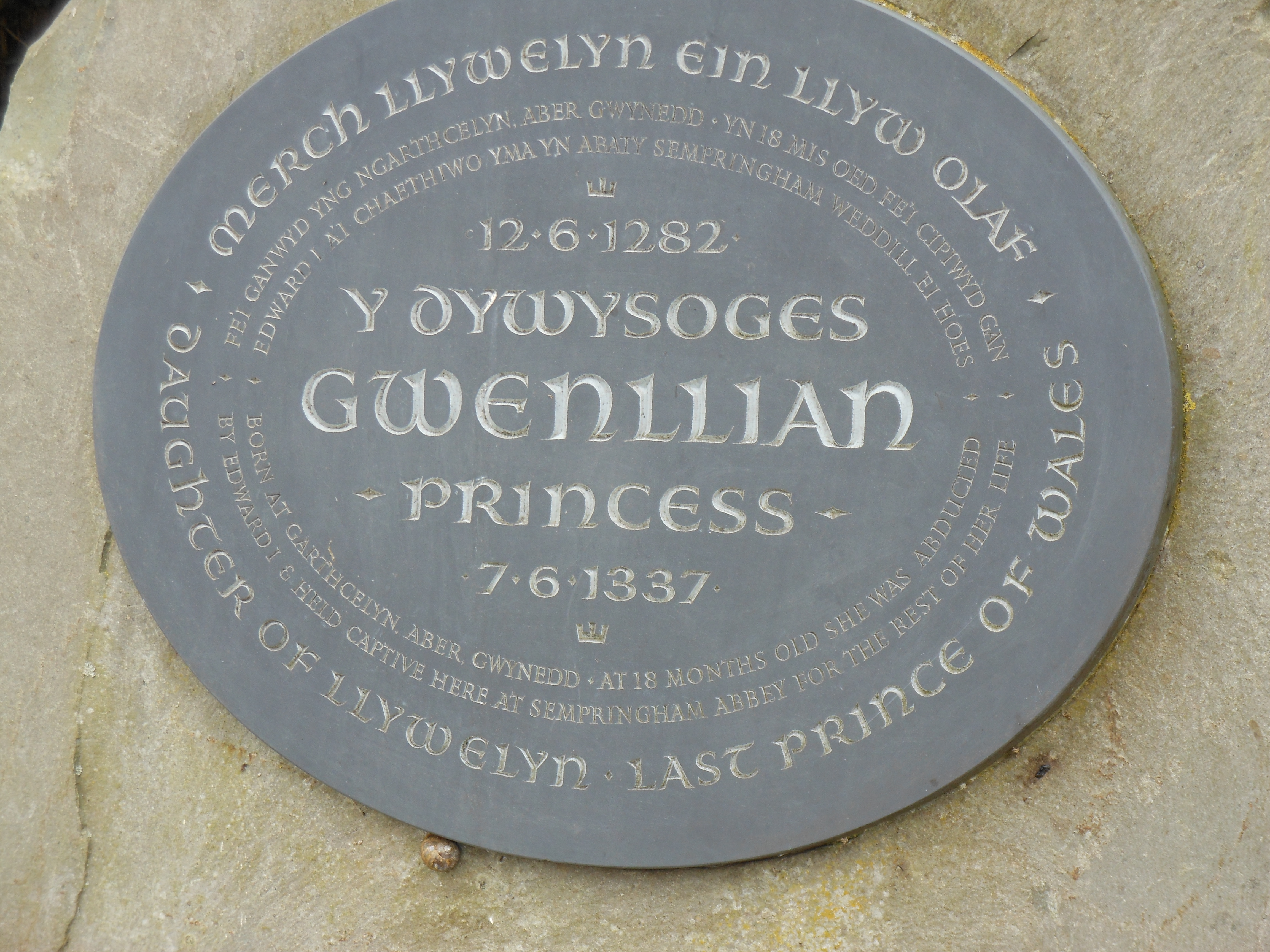
Gwenllian only found her freedom in death. She died on 7 June 1337, the same month as her fifty-fifth birthday. She was buried at the priory where she had spent all but eighteen months of her life. Her grave was lost at the time of the dissolution of the monasteries, in the 16th century. However, a memorial plaque was placed near St Andrew’s Church in Sempringham in 1993, stating:
In memory of Gwenllian, daughter of the last Prince of Wales. Born at Abergwyngregyn 12.06.1282. Died at Sempringham 7.6.1337. Having been held prisoner for 54 years.6
Although she left very few marks on the world, a child whose very future was stolen by Edward I, Gwenllian’s remarkable story has not been forgotten. In 2009 a mountain in Snowdonia in Wales, formerly known as Carnedd Uchaf, was renamed Carnedd Gwenllian in the lost princess’s honour.
*
Gwenllian’s story, and that of her mother and grandmother, is told in my latest book, Ladies of Magna Carta: Women of Influence in Thirteenth Century England.
Footnotes: [1] David Ross, editor, Sempringham Priory, Church and Holy Well, britainexpress.com; [2] englishmonarchs.co.uk; [3] ibid; [4] William Rees, Calendar of Ancient Petitions Relating to Wales [5] Calendar of the Charter Rolls. 1-14, Edward III; [6] The Princess Gwenllian Society, Princessgwenllian.co.uk
Sources: castlewales.com; snowdoniaheritage.info; William Rees, Calendar of Ancient Petitions Relating to Wales; Marc Morris A Great and Terrible King;David Williamson Brewer’s British royalty; Mike Ashley The Mammoth Book of British kings & Queens; Alison Weir Britain’s Royal Families; Roy Strong The Story of Britain; Dan Jones The Plantagenets; the Kings who Made England; Chronicles of the Age of Chivalry Edited by Elizabeth Hallam; The Oxford Companion to British History; The History Today Companion to British History; Derek Wilson The Plantagenets; britainexpress.com; englishmonarchs.co.uk; princessgwenllian.co.uk; Calendar of the Charter Rolls; David Pilling.
Images: Photos of Sempringham Church and memorial ©2019 Sharon Bennett Connolly. Llywelyn the Last courtesy of Wikipedia.
*
My Books
Signed, dedicated copies of all my books are available through my online store.
Out now: Scotland’s Medieval Queens

Scotland’s history is dramatic, violent and bloody. Being England’s northern neighbour has never been easy. Scotland’s queens have had to deal with war, murder, imprisonment, political rivalries and open betrayal. They have loved and lost, raised kings and queens, ruled and died for Scotland. From St Margaret, who became one of the patron saints of Scotland, to Elizabeth de Burgh and the dramatic story of the Scottish Wars of Independence, to the love story and tragedy of Joan Beaufort, to Margaret of Denmark and the dawn of the Renaissance, Scotland’s Medieval Queens have seen it all. This is the story of Scotland through their eyes.
‘Scotland’s Medieval Queens gives a thorough grounding in the history of the women who ruled Scotland at the side of its kings, often in the shadows, but just as interesting in their lives beyond the spotlight. It’s not a subject that has been widely covered, and Sharon is a pioneer in bringing that information into accessible history.’ Elizabeth Chadwick (New York Times bestselling author)
Available now from Amazon and Pen and Sword Books
Also by Sharon Bennett Connolly:
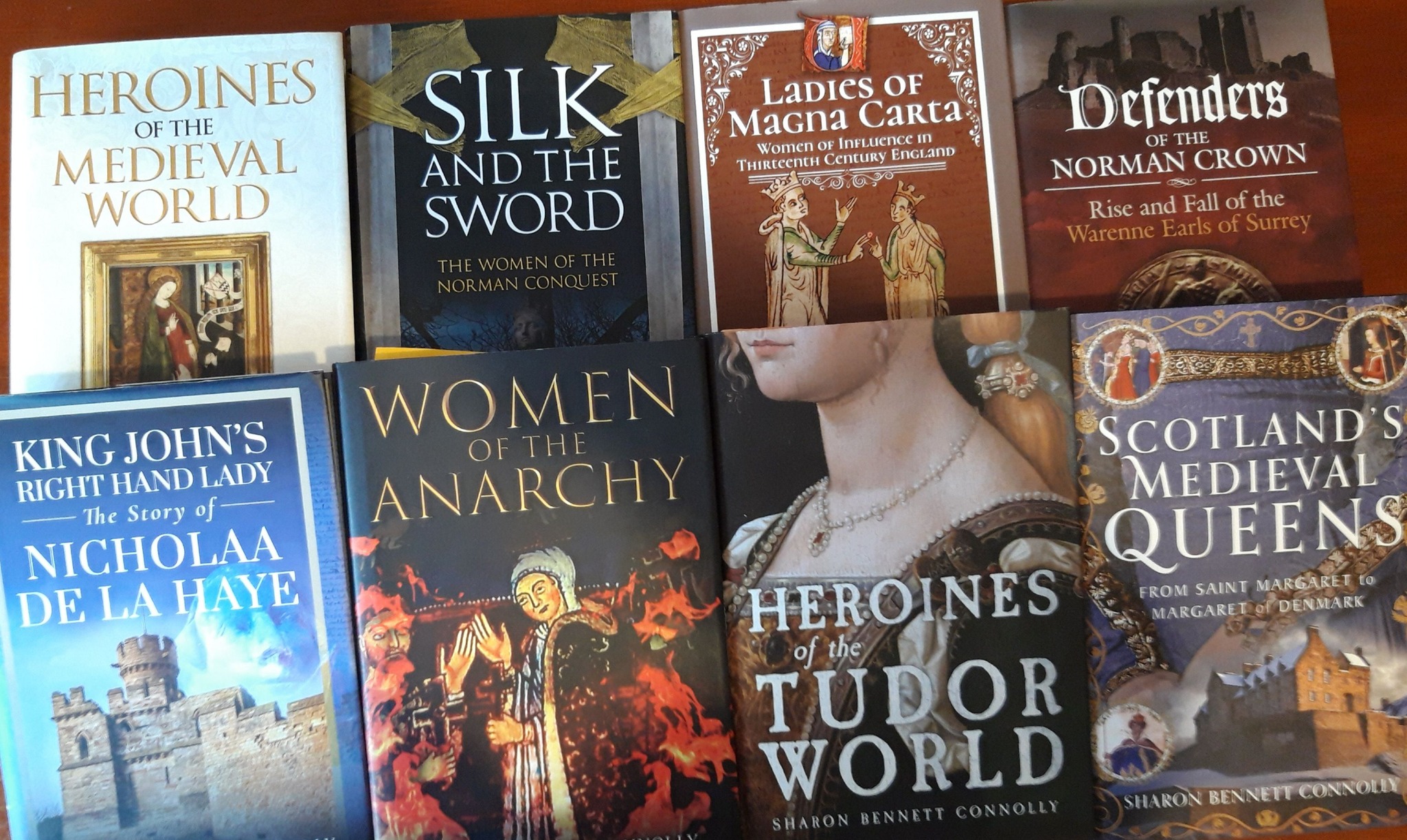
Heroines of the Tudor World tells the stories of the most remarkable women from European history in the time of the Tudor dynasty, 1485-1603. These are the women who ruled, the women who founded dynasties, the women who fought for religious freedom, their families and love. Heroines of the Tudor World is now available from Amberley Publishing and Amazon UK. Women of the Anarchy demonstrates how Empress Matilda and Matilda of Boulogne, unable to wield a sword themselves, were prime movers in this time of conflict and lawlessness. It shows how their strengths, weaknesses, and personal ambitions swung the fortunes of war one way – and then the other. Available from Bookshop.org, Amberley Publishing and Amazon UK. King John’s Right-Hand Lady: The Story of Nicholaa de la Haye is the story of a truly remarkable lady, the hereditary constable of Lincoln Castle and the first woman in England to be appointed sheriff in her own right. Available from all good bookshops Pen & Sword Books, bookshop.org and Amazon.

Defenders of the Norman Crown: The Rise and Fall of the Warenne Earls of Surrey tells the fascinating story of the Warenne dynasty, from its origins in Normandy, through the Conquest, Magna Carta, the wars and marriages that led to its ultimate demise in the reign of Edward III. Available from Pen & Sword Books, Amazon in the UK and US, and Bookshop.org. Ladies of Magna Carta: Women of Influence in Thirteenth Century England looks into the relationships of the various noble families of the 13th century, and how they were affected by the Barons’ Wars, Magna Carta and its aftermath; the bonds that were formed and those that were broken. It is now available in paperback and hardback from Pen & Sword, Amazon, and Bookshop.org. Heroines of the Medieval World tells the stories of some of the most remarkable women from Medieval history, from Eleanor of Aquitaine to Julian of Norwich. Available now from Amberley Publishing and Amazon, and Bookshop.org. Silk and the Sword: The Women of the Norman Conquest traces the fortunes of the women who had a significant role to play in the momentous events of 1066. Available now from Amazon, Amberley Publishing, and Bookshop.org.
Alternate Endings: An anthology of historical fiction short stories including Long Live the King… which is my take what might have happened had King John not died in October 1216. Available in paperback and kindle from Amazon.
Podcast:

Have a listen to the A Slice of Medieval podcast, which I co-host with Historical fiction novelist Derek Birks. Derek and I welcome guests, such as Bernard Cornwell and Michael Jecks, and discuss a wide range of topics in medieval history, from significant events to the personalities involved. Every episode is also now available on YouTube.
*
Don’t forget! Signed and dedicated copies of all my books are available through my online bookshop.
For forthcoming online and in-person talks, please check out my Events Page.
You can be the first to read new articles by clicking the ‘Follow’ button, liking our Facebook page or joining me on Twitter, Threads, Bluesky and Instagram.
©2019 Sharon Bennett Connolly FRHistS
 History... the interesting bits!