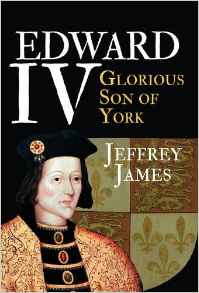
Few English monarchs had to fight harder for the right to rule than King Edward IV – Shakespeare’s glorious son of York. Cast in the true Plantagenet mould, over six feet tall, he was a naturally charismatic leader. Edward had the knack of seizing the initiative and winning battles and is free from the unflattering characterisations that plagued his brother, Richard III, having been portrayed as a good-looking and formidable military tactician. Described sometimes as reckless and profligate, all sources remark on his personal bravery. In the eleven years between 1460 and 1471 he fought five major battles in the Wars of the Roses. Three of them – Towton, Barnet and Tewkesbury – rank among the most decisive of the medieval period.
This is a history of Edward IV’s struggle to gain and retain the kingship of England during a period of sustained dynastic turmoil during the Wars of the Roses.
Jeffrey James’ biography of Edward IV is a wonderful introduction to the Wars of the Roses from the Yorkist point of view. Told in a chronological narrative, it covers the events from the very outset of the Wars, telling the story from Edward’s birth, through the struggles of Richard, Duke of York, and the outbreak of war. It concentrates on Edward’s fight to win – and keep – the throne, covering the various battles, and Edward’s military tactics, in great detail.
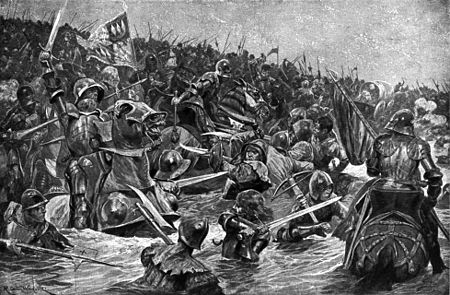
The Battle of Towton
With the author’s background in military history, it is no surprise that where this book shines is in the assessment of the military engagements, troop movements and battle plans. It places Edward’s story in the wider context of the Wars of the Roses, while highlighting the individuality and personality of Edward, which made him such a successful warrior and king.
Scattered among the narrative are insights into Edward’s personality:
Normally relaxed and easy-going – a man who disliked unpleasantness for its own sake – Edward nonetheless had a fiery temper, usually vented against those of noble rank who angered or disappointed him. Though more often stressing the king’s good nature contemporaries sometimes touch on this aspect of Edward’s character.
More marked was the king’s man-management skills.
Jeffrey James uses contemporary sources in abundance to back up his arguments and theories. Extensive footnotes and a comprehensive bibliography provide limitless opportunities for further reading. Maps and family trees at the beginning of the book help to provide a basic understanding of the scale of the Wars, and of the personalities involved. The narrative is also supplemented by 40 photographs, portraits and illustrations, providing a further visual aid to the people, locations and battlefields involved in the conflict.
Edward IV, Glorious Son of York is an engaging, accessible narrative which provides thorough analysis of the king’s actions – and the actions of the chief players in the Wars of the Roses. Edward’s relationships with his family, allies and, even, his enemies – foreign and domestic – are discussed and assessed, providing interesting insights into the great personalities of the 15th century.
It provides some fascinating little tidbits of history:
There may have been mercenary pikemen, as well as halberdiers, professional soldiers – forerunners of the famed continental landsknechts – whose habit of slashing their clothing seeded the fashions of Tudor times.
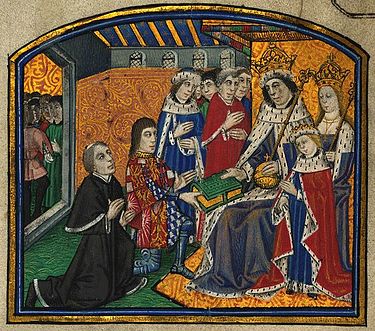
Marriage of Edward IV and Elizabeth Woodville
Unfortunately it does get a little fanciful in places, claiming that “Leaden images, depicting a man and a woman, found discarded in an orchard nearby, suggest enchantment” when talking about the wedding of Elizabeth Woodville and Edward IV. He also suggests Richard of Gloucester (the future Richard III) hero-worshipped his brother, without any contemporary evidence to back this up.
However, such dubious claims are few and far between and, on the whole, the author’s research is impeccable and supported by contemporary sources and evidence from archaeology. Jeffrey James also acknowledges the work and theories of fellow historians, such as Amy Licence and Charles Ross, analysing their assessments in relation to his own.
In keeping with the author’s background in military history, his Jeffrey James’ analysis of military events and tactics is insightful:
If Warwick was stirring up trouble in the North he was – to use a modern phrase – ‘operating well under the radar’, using proxies in a manner designed to circumvent the activation of any immediate royal redress. Today we might use the term ‘hybrid warfare’ when describing acts like theses: acts designed to surprise, confuse and wear down an opponent.
King Edward IV
Although the book concentrates on Edward’s fight to win and retain the throne, it also looks into Edward’s family life and the implications of his marriage to Elizabeth Woodville; on England, his allies and international politics. It provides and in-depth analysis of where Edward’s relationship with the Earl of Warwick broke down, and of Edward’s various successes and failures. He doesn’t shirk from discussing where Edward made mistakes, nor looking at where he could have done better, or been more – or less – ruthless.
Edward IV, Glorious Son of York is a well-written, entertaining biography of one of England’s most fascinating kings and his fight to win – and keep – the throne.
*
Pictures taken from Wikipedia.
*
My book, Heroines of the Medieval World, is now available in hardback in the UK from both Amberley Publishing and Amazon UK and worldwide from Book Depository. It is also available on Kindle in both the UK and USA and will be available in Hardback from Amazon US from 1 May 2018.
Be the first to read new articles by clicking the ‘Follow’ button, liking our Facebook page or joining me on Twitter.
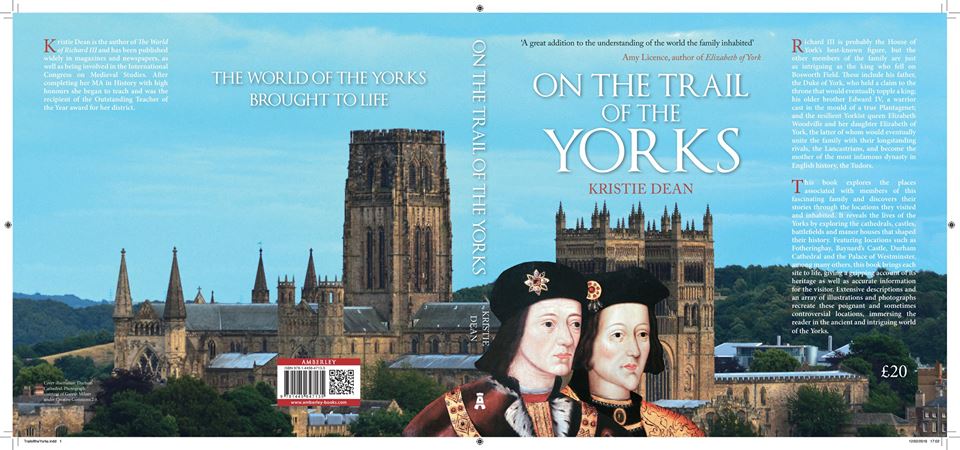
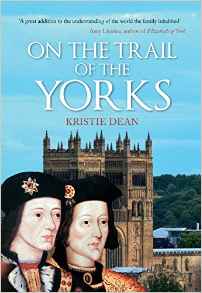
This week I have the great pleasure of starting off Kristie Dean’s Blog Tour, in honour of the launch of her new book, On the Trail of the Yorks.
Just a year ago she published the book, The World of Richard III and on Monday her latest offering, On the Trail of the Yorks goes on sale in the UK. Kristie’s books are a unique and fascinating blend of history and travel writing; they bring to life the castles, palaces and other locations associated with one of the ,most famous kings – and families – in British history.
Here, she talks to me about her love of history and writing.
What made you become a writer?
When I was a little girl I would spend my time creating stories for the other kids. I also wrote and distributed a neighborhood newspaper. I was always writing – poems, short stories, and even reports. I wrote a research paper for my 7th grade teacher and she later talked to my parents, telling them I was pushing myself too hard. It wasn’t that; I just couldn’t stand a blank page, and so I was always looking for new ways of writing.
With a career as a teacher, how do you discipline yourself to write?
When I am working on a book, writing consumes my life. I come home from work and write for three or four hours plus I write all day Saturday and most of Sunday. If I have a school event or my husband convinces me to go out, I take that evening off. I take a week off every May to take my students to Washington DC, although I do take research materials to read on the bus. I also am a mentor teacher at my school, so that takes a chunk of time. But, just like writing and teaching, it is worthwhile and enjoyable.
How do you organise your writing day?
At 5 p.m., I get home and write until at least 8 p.m. On weekends, I am researching/writing by 9 a.m. and usually going until 5 p.m. If I am writing about a certain location and I am in a ‘zone’ I will often continue until I am done.
Kristie Dean
How many projects do you have going at once, or do you concentrate on one at a time?
With my time constraints, I usually have one or two in the back of my mind, but I only work on one at a time. I would love to be able to work on two or three projects at a time. Authors who are able to do this amaze me.
Your books are quite unique, a combination of history and historical locations, what made you decide to write them this way?
I traveled to Europe several times and always ended up frustrated with my guidebooks. I ended up making my own guides to each location for myself and fellow travelers to reach deeper in the history. Since I was particularly fascinated with the Plantagenets (especially Richard III) and Anne Boleyn, I was frustrated there weren’t any guides to places associated with them. Then a member of a history group I am in wrote an excellent guide for Anne Boleyn. This helped me to realize that I wasn’t the only one who wanted to explore the history of a location, so I decided to start with the historical figure I was most interested in, which was Richard III.
How long do you spend researching your book before you start writing?
This is a tough one to answer since it varies. I already had a great deal of information on Richard III and the Wars of the Roses, so much of my research involved the locations associated with him. However, I have been researching for a fiction book for years. Whether it ever sees the light of day is a different story.
What do you enjoy most about writing?
I love getting to delve into the lives of historic figures and locations. I also like visiting each place to get a feel for it. I enjoy trying to make history come alive for my readers.
What is the worst thing about writing?
The long hours of solitude. It can get lonely, and when I am up against a deadline I do not have time to go out with friends.
How long does it take to do a project from start to finish?
About a year. It depends on the book and how much research I’ve done prior. It also depends on where the research takes me. I became interested in Margaret of York while writing my latest book and spent several hours researching information that I did not even need for the book.
Have you ever considered writing a novel? What would it be about?
(Laughs) Oh yes, I have. It would be a thriller, I think. I love reading those types of novels. I might eventually do an historic fiction novel, too.
Who are your favourite personalities from history?
Oh my. It would be easier to answer who doesn’t interest me, but I will give it a try. Richard III, obviously. Anne Boleyn, All the Plantagenet queens, St Margaret, Margaret of York, Cecily Neville, Anne Neville, Llywelyn Fawr, and several lesser known women from history. From a more modern time, Winston Churchill intrigues me.
What are your favourite places from history?
All of England, Scotland, and Wales. I feel like the area is a second home for me. I love traveling and exploring each region. Middleham Castle is one of my favourites, as well as Llanrhychwyn Church, which is believed to be the oldest church in Wales. This little church is a gem, said to have been built by Llywelyn Fawr for his wife, Joan. I had a difficult time finding it, but Sharon Kay Penman helped me by putting me in touch with someone who lived in the area. Pam took me straight there, and I was immediately enchanted.
Your last book was The World of Richard III and the new one is On the Trail of the Yorks, what is it that fascinates you about Richard III and the House of York?
I have been fascinated by that time period for a long time. It’s a time of turbulence, a time of changing allies and enemies, and a time of controversy. It just pulls me in. Originally, I was interested in the controversy surrounding Richard III, but now I am captivated by the entire period.
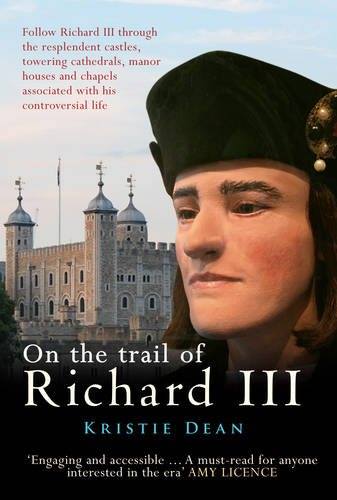
On another note, The World of Richard III is going to undergo a title change to On the Trail of Richard III for the paperback version. This will keep the two books aligned.
Would you ever consider doing a book about the House of Lancaster and the locations associated with it?
I would, but I think many of the locations would be the same. Of course, the difference would be what the Lancastrians would be doing at each location. It is certainly an interesting idea.
Do you ever get writer’s block? If so, how do you get around it?
Not often. When I do it is a sign that I need a break. So, I get up, play with my three dogs and two cats or take a walk outside. Or I clean the bathroom. I am always excited to get back to writing after that.
Do you find social media – such as Facebook – a benefit or a hindrance?
It’s a benefit, but I confess to not being the best at it. I don’t get around to the various groups as often as I want, so sometimes I am out of the loop. I do have several wonderful Facebook friends who help me admin my groups and keep me up to date on what’s happening in the other history groups.
What is be your next project?
I have a book about locations associated with some of history’s forgotten women brewing in my head, but it has a serious contender in Margaret, Mary and Arthur Tudor. I am not sure which will win out in the end. I am taking a much-needed break right now to collaborate with some friends on a joint project. I will spend two weeks in East Anglia this summer with them doing research.
I would like to extend a huge ‘thank you’ to Kristie Dean for her wonderful answers and wish her the every success with her latest book. And look out for my review of On the Trail of the Yorks next week!
*
Kristie Dean has an MA in History and now enjoys teaching the subject, following a successful career in public relations. Her particular historic interest is the medieval era, specifically the Plantagenets, the Wars of the Roses and the Tudors. When not traveling for research, you can find Kristie at home in Tennessee with her husband, three dogs, and two cats. On the Trail of the Yorks is available from Amazon UK from 15th March 2016 and from Amazon US in May. And On the Trail of Richard III is due for release in paperback in May.
*
My book, Heroines of the Medieval World, is now available in hardback in the UK from both Amberley Publishing and Amazon UK and worldwide from Book Depository. It is also available on Kindle in both the UK and USA and will be available in Hardback from Amazon US from 1 May 2018.
Be the first to read new articles by clicking the ‘Follow’ button, liking our Facebook page or joining me on Twitter.
Derek Birks‘ ‘Rebels & Brothers’ series of 4 novels is a tour de force in Wars of the Roses fiction.
Many books claim to be ‘in the best tradition of Bernard Cornwell’ or ‘a worthy successor to Cornwell’. But very few live up to such promise. however, when I read Derek Birks’ debut novel I thought that, just maybe, I had found one that lived up to such high praise. By the 2nd book I knew the praise was well-deserved.
The Rebels & Brothers series grabs you on the 1st page and keeps you hooked until the very end. And yet they leave you bereft once you have finished, as you know you are not going to read another book as good anytime soon.
The books interweave the personal stories of the Elder family with the wider political and martial drama of the Wars of the Roses. We follow the 3 Elder siblings, Ned, Eleanor and Emma, as they try to negotiate a safe passage through the war, whilst battling a family feud and making enemies at the highest levels of society.
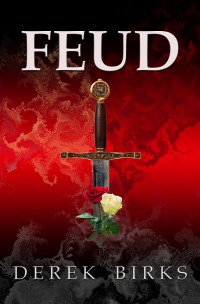
Feud: In 1459, as England stands on the brink of the Wars of the Roses, Ned Elder, a Yorkshire knight, finds himself caught up in the wars when his family is brutally attacked by a local rival, Lord Radcliffe. Ned’s sisters, Emma and Eleanor, are abducted and he must find a way to rescue them. With only a few loyal companions, Ned is hounded across the land by the Radcliffes. Ned and his sisters fight back, but they are young and they make mistakes – and new enemies – along the way. All will be decided on the snowy battlefield of Towton – for Ned and for England.
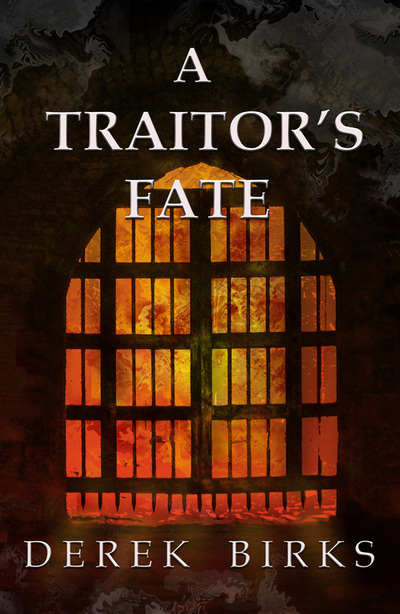
A Traitor’s Fate opens in 1464. The feud with the Radcliffes is over and the Elder siblings have won a hard-fought peace. But one man can’t accept the outcome and finds a new ally to help him achieve his revenge.
Ned is sent to confront a Lancastrian revolt by the new king, Edward of York, he finds his enemies are on his own side, as well as that of the rebels. Branded a traitor by his own commander, the Earl of Warwick, Ned is soon a wanted man in hostile territory and the price on his head only rises when he stumbles upon a royal secret.
Meanwhile, Eleanor and Emma watch over Ned’s pregnant wife, Amelie, with only a small garrison of old men and boys to protect them.
A condemned man, Ned fights to escape his pursuers before his whole family suffers destruction.
Having read Feud I was expecting great things from the 2nd book – and it did not disappoint. The story is told in great detail, the action is fast-paced and the characters elicit a great deal of sympathy and empathy. A Traitor’s Fate is one of those increasingly rare stories which are impossible to put down – and yet, at the same time as you can’t wait to get to the end, you don’t want it to finish.
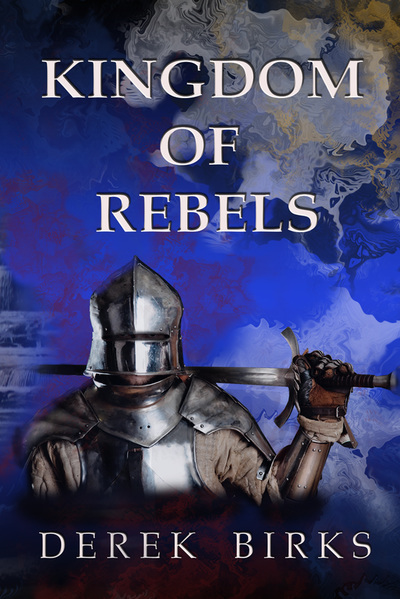
Book 3 of the series, Kingdom of Rebels, takes you on a journey through one of the most turbulent periods of the reign of Edward IV, through the eyes of this one Yorkshire family trying to survive the feuds and battles of the Wars of the Roses, whilst simultaneously trying not to destroy each other. It is impossible not to feel invested in the characters – they are flawed and damaged, but trying their best to survive and you find yourself willing them on.
The story sees Ned Elder exiled to Burgundy by the Earl of Warwick, but for his enemies this is still not enough. At the same time, but far away on the Scottish border, Ned’s sister Eleanor defends the small, beleaguered fortress of Crag Tower; with only a handful of men, she desperately awaits Ned’s return.
Set against the backdrop of a nervous kingdom, where its 2 most powerful men – Edward IV and the Earl of Warwick – are at loggerheads, Ned must fight – yet again – to save his family.
One by one Ned’s family and friends are caught up in Warwick’s web of treason. The fate of the Elders and those who serve them lies once more in the balance as all are drawn back to Yorkshire where they face old enemies once more.
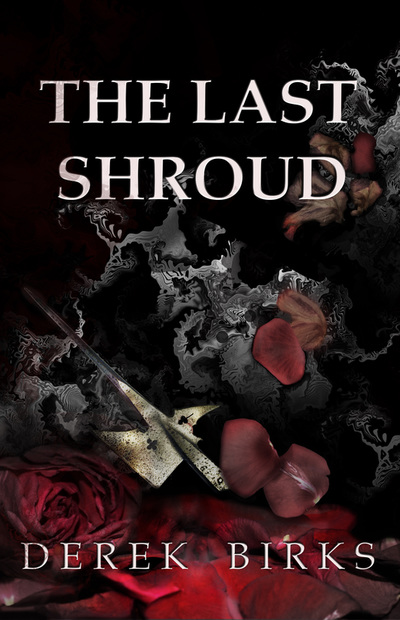
TheLast Shroud sees Ned Elder caught in the middle of Warwick’s rebellion against Edward IV. The king has enemies on all sides and flees to the Low Countries, leaving his few loyal retainers to keep their heads down until his return; when they must take up their swords for one last campaign…
But is Ned the warrior he once was? As the kingdom spirals into civil war, divisions between Ned and his sisters, Emma and Eleanor, threaten the family’s very survival. Out of the turmoil of rebellion steps an old enemy who offers to help, but can he be trusted?
Will the Elder family stand together when it matters most? They must, if they are to survive.
With The Last Shroud, the Elder family story comes to an end – and what an ending!
It has been a rollercoaster ride through the Kingdoms & Brothers series and this book is no exception. Following Ned and the rest of the Elders through the Warwick Rebellion against Edward IV and culminating with the Battle of Tewkesbury, the family fights to survive, mending some – but not all – bridges along the way, and still making new enemies.
As ever, the story telling is fast-paced and masterful, and the finale frenetic. A worthy final chapter to what has been a magnificent series.
There are several themes running through all 4 books.
The Elders face many enemies, and some change from book to book. But one enemy stays the same: the powerful Earl of Warwick. Offended by a young Ned at the Battle of St Albans, Warwick takes every opportunity to try to bring Ned down – and ruin his family. Using the feud with the Radcliffes he encourages and aids Ned’s numerous enemies in their endeavours.
Set in one of the most turbulent periods of Medieval history, the battle scenes are vivid, hectic and alive with action. The family doesn’t survive unscathed and it is the losses and hardships they suffer, and how they react to them, that makes them such sympathetic and likeable characters.
A great feature of the stories are the strong, independent women. They don’t just sit at home, sewing in the solar and waiting for their men to come home. They are not victims, nor powerless. They are fighters, women who take what life throws at them and battle on. But they find romance too, and face the trials and tribulations of love just as stoically as they do their enemies.
Derek Birks follows the historical story of the Wars of the Roses with great accuracy, dropping Ned and his family into the well-known events wherever they can cause the most drama, or see the most action. The Elders are present at all the key events, from the opening shots at the 1st Battle of St Albans, to the Yorkist victory at Tewkesbury.
To put it succinctly, this series is edge-of-your-seat action from start to end, leaving you breathless in your armchair. Believe me, you don’t want to miss a moment.
*
My book, Heroines of the Medieval World, is now available in hardback in the UK from both Amberley Publishing and Amazon UK and worldwide from Book Depository. It is also available on Kindle in both the UK and USA and will be available in Hardback from Amazon US from 1 May 2018.
You can be the first to read new articles by clicking the ‘Follow’ button, liking our Facebook page or joining me on Twitter.
Last year I took my 9-year-old son and 40-something husband to visit their first battlefield. We were holidaying in Derbyshire and decided to drive down to Leicestershire and visit Bosworth. With all the hype around the discovery and re-burial of Richard III, it seemed a great way to show a 9-year-old the story of a battle.
He, of course, knows a little of the Richard III story. He can identify the king’s portrait and knows he was involved in the Wars of the Roses, but we don’t linger on the Princes in the Tower too much. I don’t think he is as familiar with Henry VII, but he can tell you all of Henry VIII’s queens, in order, and tell you their fate. So taking my son to the battlefield was a way of giving him a place and time where he could visualise the events and the people.
It worked.
However, what I found surprising was the effect it had on my husband. Hubby is a bit of a computer geek and into all the mod cons. He never had an interest in history before he met me, and even now I can see his eyes glossing over if I talk too much about the past – 15 minutes a day is usually all he can take!
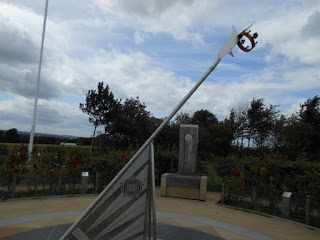
The Sundial on Ambion Hill
I have visited battlefields before; Waterloo, Stamford Bridge, Hastings and a few others. The calm serenity always amazes me. I expect to hear the echoes of battle, the cries of the wounded, clashes of arms and the shouted orders of the battle’s commanders – and the thunder of the horses hooves during the cavalry charge. At Bosworth, if you close your eyes tight, and listen intently, you can almost hear it…..
The Battle of Bosworth Trail
The Battlefield trail is a wonderful leisurely walk. It’s not the actual battlefield; they found that a short distance away a few years ago, but it is Ambion Hill. And standing at the memorial you have a panoramic view of the area; you can imagine the 2 sides facing each other, troops in the thick of it and those waiting to engage. My son listened in awe as I described the death of Norfolk and the final, desperate charge of Richard III; and Percy’s men standing, watching and waiting – possibly very close to where we were stood at that moment.
View from Ambion Hill
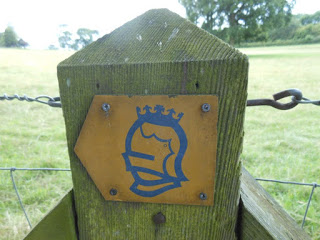
As you walk round the hill and through the woods, there are markers, pointing the way; and viewpoints and information posts telling the story of the battle and explaining the technology and tactics used. One marker explains the use of the longbow, how it dealt death from afar. The marker explained where the archers were positioned during the fighting; you almost expected to look to your right and see them raising their bows to the air.
My son was fascinated by the idea that children as young as he was had already started their knightly training, that there were only about 1,000 knights in the whole of England. And I was amazed to discover that many who could be knights chose not to, in order to avoid the duty and responsibility that came with knighthood; these men were simply called esquires or gentlemen.
Information post explaining the use of cannons in the battle
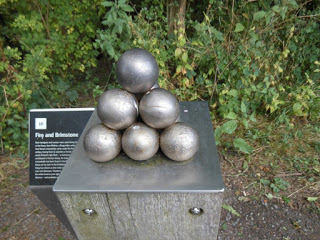
It amazed my husband to discover that cannon and handguns were in use in the battle. 1485 seems to be too long ago for men to have used gunpowder. The handguns were large and cumbersome weapons, too large for one hand to use; guns were still very much in their infancy. However, it was a scattering of cannon balls and other small metal objects (such heraldic badges, spur rowels and coins), found by metal detectors, which finally meant the location of the battlefield could be confidently identified.
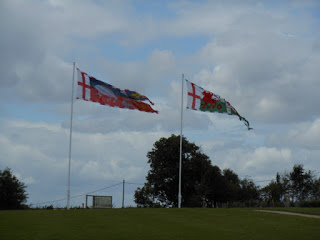
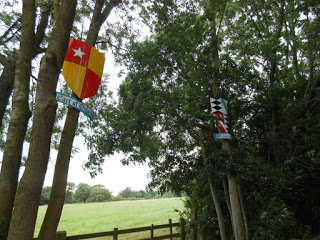
Battle standards in Ambion Wood
Although the general battlefield has now been identified, we still don’t know where individual parts of the action took place. We can’t say for certain where the action between Norfolk and Oxford took place, nor where Norfolk fell. We can’t tell where Stanley and his men were standing, watching for that turn in the battle that made him decide to join Henry Tudor’s forces.
But the specifics don’t matter as much as I expected they would. The battlefield provides its own story. And the fact you can’t say exactly where each part of the action happened serves to highlight the confusion of a battle. When you’re on the ground, in the thick of it, fighting for your life and your king, you wouldn’t be looking round to see where on the field you were. You would be looking to your own survival, fighting the man in front of you while watching your back.
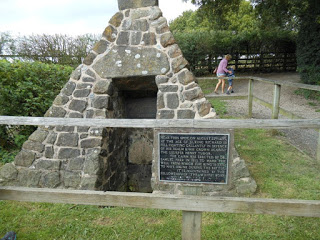
King Richard’s Well, cairn built close to where it is thought the king fell
So the locations of events are vague, but that they are remembered and commemorated is what matters. Whether the marker is where Richard fell matters less than that there is a marker to the fallen king.
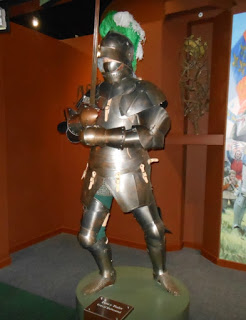
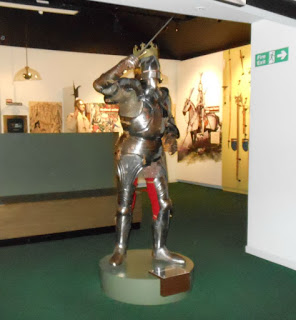
And once you have walked the Battlefield Trail, there is the Heritage Centre to visit. The Centre offers wonderful background to the battle, told through the voices of those involved: a serving girl at a local inn, a mercenary’s wife, an archer. The 2 armoured kings stand watch over you as you view artefacts found on the field of battle and study maps and videos explaining the battle and the troop movements.
Henry VII
The Heritage Centre is very hands-on; children can try on the armour and test out the helmets. You can test your ability to draw a longbow; it’s not as easy as you think. By far the most dramatic display is the little corner dedicated to the Barber-Surgeons. The tools of his trade are displayed and a skeleton depicting the wounds of one soldier from the battlefield. Given the recent discovery of Richard III, and the detailed descriptions of his wounds, this seemed a particularly poignant display.
Richard III
Walking the battlefield is a humbling experience. So little is known about the men who fought and died in these fields on 22nd August 1485. And, yet, the date marks so much change in English history: the end of one the Plantagenet dynasty and the start of Tudor rule; the end of the Middle Ages and the beginnings of the Renaissance. Just around the corner were the marital problems of Henry VIII and the English Reformation and the subsequent, glorious reign of Elizabeth I. But the men who fought that day would know nothing of the significance of the battle beyond that moment.
Richard of Conisbrough seems to have been a very controversial figure throughout his life, from questions of his paternity, through his secret marriage, to his untimely death for his involvement in a particularly ill-thought-out plot.
He and I were born within 3 miles (and, of course, 6 centuries) of each other. As a student, I even gave guided tours at the Castle in which he was born. And the man is a completely fascinating, and yet such a shadowy, figure. The grandfather of both Edward IV and Richard III, he seems to have been a mediocre diplomat and soldier, and his eventual treason barely registers in the history books.
Richard’s birth is obscured by time. Although sources seem undecided, the most likely date of his birth appears to be 1386 (although some place it as early as 1375). He was a grandson of Edward III through his father, Edmund of Langley, 1st Duke of York; and his mother, Isabella of Castile (sister of John of Gaunt’s wife, Constance), was described by chronicler Thomas of Walsingham as having ‘loose morals’. She and Edmund appear to have been an ill-matched pair from the beginning.
Isabel of Castile
Edmund and Isabella married in 1372, two children soon followed; Edward of Norwich in c.1373 and Constance in c.1374. It seems the couple’s relationship cooled soon after, as no other children were forthcoming for over 10 years. As a result, the arrival of Richard of Conisbrough in 1386 appears to have raised some eyebrows and most people – even of the time – suspected that he was the son of Isabella’s lover, rather than the Duke of York.
Isabel’s relationship with John Holland, Duke of Exeter and half-brother of the king, Richard II, was probably an open secret. The fact that his father and brother, both, left him out of their wills has fuelled this theory. However, leaving a son out of your will was not entirely unusual – Edmund of Langley was, in fact, left out of his own father’s will (that of Edward III) – and, my research suggests that Richard of Conisbrough was already dead by the time his brother, Edward, made his will.
Edmund of Langley, 1st Duke of York
Isabella died on 23rd December 1392. Her will made Richard II her heir, but specifically asked him to provide an annual pension of 500 marks for her youngest son. Richard’s allowance was paid regularly until 1399, but following the deposition of Richard II and accession of Henry IV, payments were made only sporadically and Richard of Conisbrough became the Royal Family’s ‘poor relation’.
Richard of Conisbrough’s father, Edmund of Langley, died in 1402 and the dukedom of York passed to Richard’s older brother, Edward.
Although his regular pension petered out under Henry IV, Richard’s career was largely unremarkable. In 1403/4 he was given command of a small force to defend Herefordshire against the last native prince of Wales, Owain Glyndwr. Richard was able to make several connections in the area; most notably with the Mortimer family. The Mortimers were cousins of Richard’s through the marriage of Lionel, Duke of Clarence’s daughter Philippa (Edward III’s granddaughter) to Edmund Mortimer, 3rd Earl of March.
Edmund of Langley and the King of Portugal
Richard of Conisbrough secretly married Anne Mortimer (Philippa’s granddaughter) sometime in 1406. The couple had married without parental consent, or the papal dispensation required due to their being 2nd and 4th cousins. The dispensation was finally obtained in 1408.
Probably a love-match – Anne seems to have been as destitute as her husband. Born in December 1390 Anne’s family were close to Richard II; her father, Roger Mortimer, being seen as his possible heir until his death in 1398. Seen as rivals claimants by the new King, Henry IV, Anne’s fortunes changed in 1399 and she was described as ‘destitute’ after her mother’s death in 1405.
The marriage of Anne and Richard produced 2 children; Isabella was born in 1409 and Richard, later Duke of York, was born in 1411. Not yet 21 years old, Anne herself died in September 1411, probably due to complications following the birth of her son. She was buried at Kings Langley, alongside Edmund of Langley and Isabella of Castile.
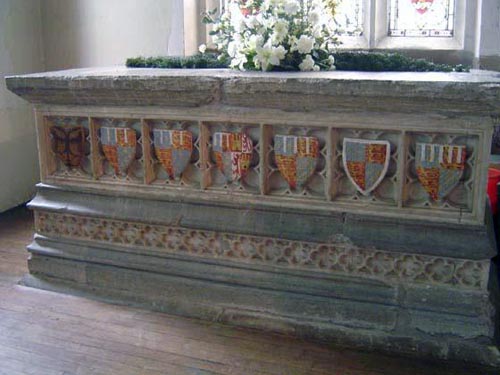
Tomb of Edmund of Langley
Richard would marry as his 2nd wife, sometime between 1411 and 1415, Maud daughter of Thomas, 6th Baron Clifford and divorced wife of John Neville, 6th Baron Latimer. Following his death, Maud continued to live at Richard’s birthplace of Conisbrough Castle, dying there in 1446.
Richard was knighted by Henry IV in 1406, probably with a view to his escorting Henry’s daughter, Philippa, to Denmark, for her marriage to King Erik. Richard’s stay in Denmark was short and unremarkable; he was back in England 2 months after witnessing the wedding.
Little more is heard of Richard until he was created Earl of Cambridge in the reign of Henry V, in 1414. The earldom did not improve his prospects, as it came without the usual grants of land or revenue to support the title; Richard was thought the poorest of England’s Earls.
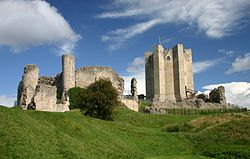
Conisbrough Castle
Fuelled by resentment Richard of Conisbrough, Earl of Cambridge, began plotting with Sir Thomas Grey and Henry 3rd Baron Scrope. Their scheme was to murder Henry V and his 3 brothers at Southampton, before their embarkation for the invasion of France, and replace him with Richard’s brother-in-law, Edmund Mortimer, 5th Earl of March.
However, it seems unclear whether March himself was in on the plot as it was the Earl who revealed it to the king on the 31st July 1415.
Cambridge and his co-conspirators were quickly rounded up. Arrested as the ringleader and at just 30 years old, Cambridge’s honours and estates were declared forfeit. Despite pleas for mercy he was beheaded for treason at Southampton Green on 5th August 1415. He was buried in the Chapel of God’s House, Southampton.
Richard Plantagenet, 3rd Duke of York
Although his honours were forfeit, Richard of Conisbrough was not attainted and his son remained his heir and was therefore able to inherit the dukedom of York, from his uncle Edward, following his death at Agincourt just 2 months later, in October 1415.
The 4-year-old Richard, Duke of York, was made a royal ward. He was raised by the Nevilles, a powerful northern family, and would marry Cecily Neville, youngest daughter of Ralph, 1st Earl of Westmorland, and his second wife, Joan Beaufort. The combination of his York and Mortimer inheritances not only made the Duke of York the wealthiest of English landowners, but also gave him a strong claim to the English throne. As a result, during the ineffectual reign of his cousin, Henry VI, Richard of York made a play for the crown.
His defeat and death at the Battle of Wakefield on 30 December 1460 meant he never became king, but his eldest son Edward took up the mantle and was proclaimed king on 4 March 1461, following this up with his overwhelming victory over the Lancastrians at the Battle of Towton on 29 March 1461.
With just a short interlude of 6 months in 1470/71, the Readeption of Henry VI, the Yorkist dynasty would rule for the next 24 years.
*
Photos: taken from Wikipedia, except that of the tomb of Edmund of Langley which is taken from findagrave.com
*
Sources: TheHistory Today Companion to British History, edited by Juliet Gardiner & Neil Wenborn; Brewer’s British Royalty by David Williamson; Britain’s Royal Families, the Complete Genealogy by Alison Weir; The Wars of the Roses by John Gillingham; The Wordsworth Dictionary of British History by J.P. Kenyon; The Oxford Companion to British History, edited by John Cannon; The Reign of Edward III by WM Ormrod; The Wars of the Roses by Martin J Dougherty; englishmonarchs.co.uk; womenshistory.about.com; findagrave.com; conisbroughcastle.org.uk; hrionline.ac.uk.
Signed, dedicated copies of all my books are available through my online bookshop.
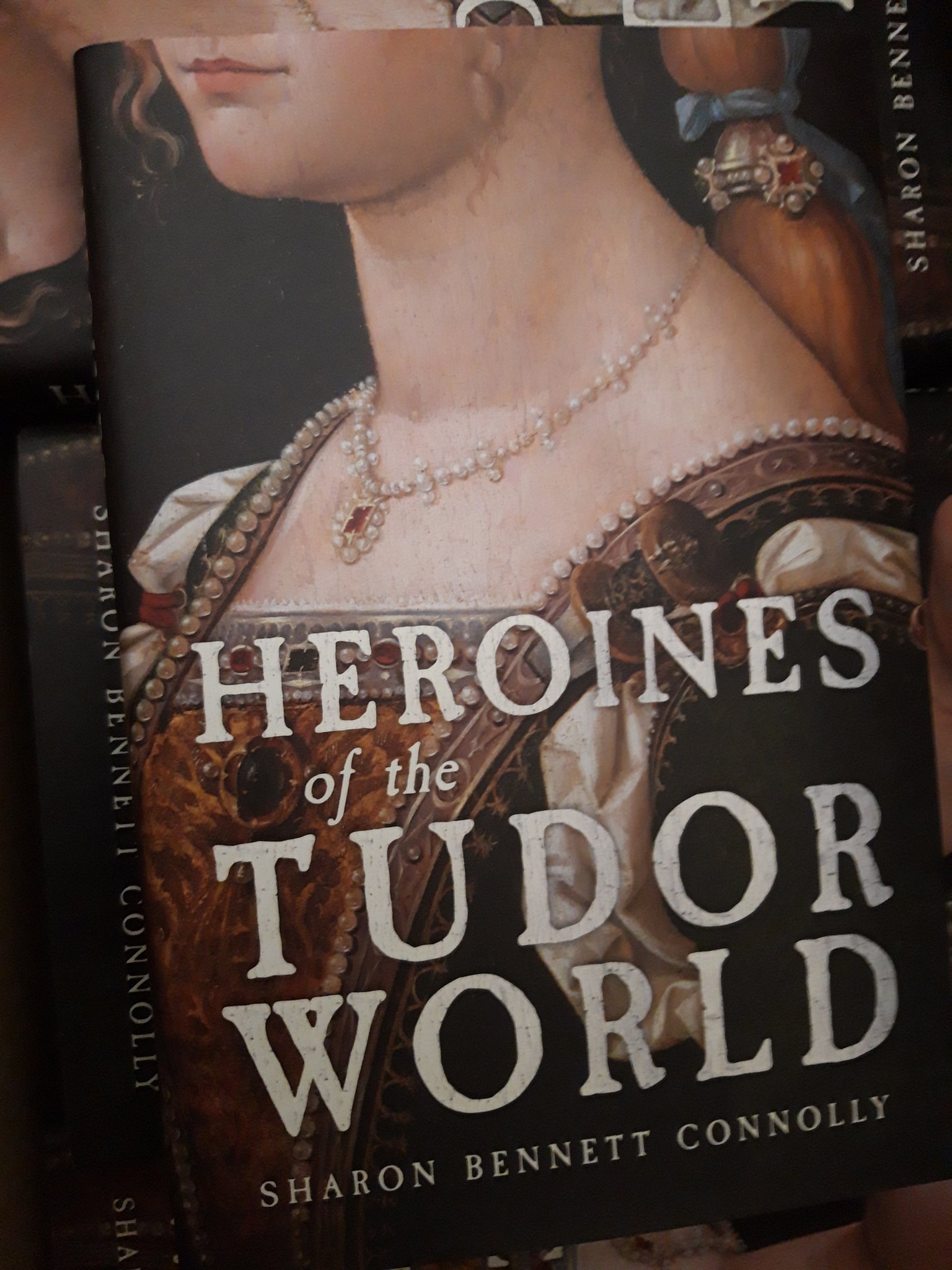
OUT NOW! Heroines of the Tudor World
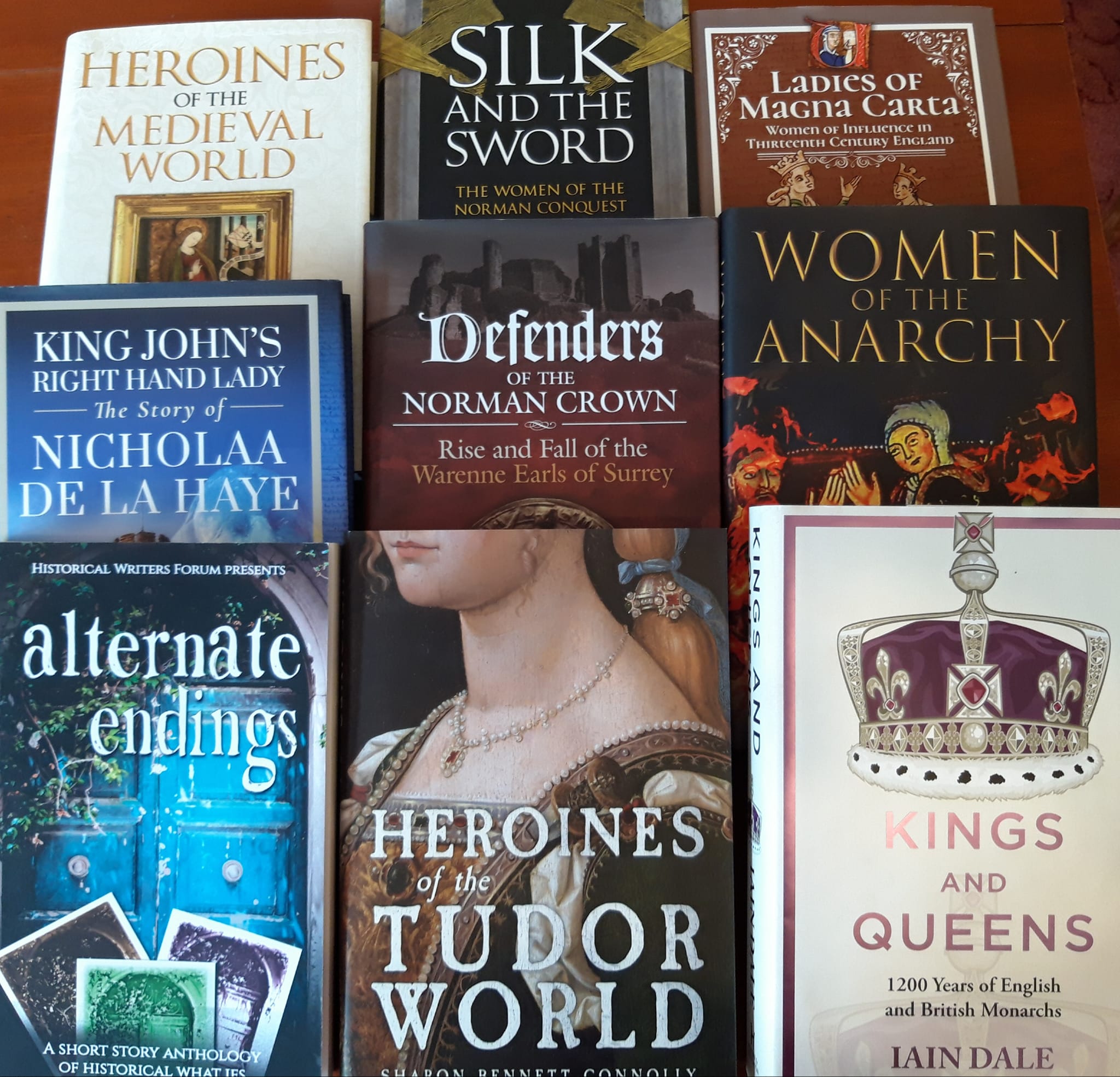
Heroines of the Tudor World tells the stories of the most remarkable women from European history in the time of the Tudor dynasty, 1485-1603. These are the women who ruled, the women who founded dynasties, the women who fought for religious freedom, their families and love. These are the women who made a difference, who influenced countries, kings and the Reformation. In the era dominated by the Renaissance and Reformation, Heroines of the Tudor World examines the threats and challenges faced by the women of the era, and how they overcame them. From writers to regents, from nuns to queens, Heroines of the Tudor World shines the spotlight on the women helped to shape Early Modern Europe.
Alternate Endings: An anthology of historical fiction short stories including Long Live the King… which is my take what might have happened had King John not died in October 1216. Available in paperback and kindle from Amazon.
Podcast:
Have a listen to theA Slice of Medieval podcast, which I co-host with Historical fiction novelist Derek Birks. Derek and I welcome guests, such as Bernard Cornwell, and discuss a wide range of topics in medieval history, from significant events to the personalities involved.
*
Signed and dedicated copies of all my books are available through my online store.
For forthcoming online and in-person talks, please check out my Events Page.
You can be the first to read new articles by clicking the ‘Follow’ button, liking our Facebook page or joining me on Twitterand Instagram.
As the third daughter of Peter (or Pedro) the Cruel of Castile and his long-term mistress (and sometime wife) Maria of Padilla, Isabella of Castile‘s childhood was marred by her father’s battles to hold on to his throne and almost constant warfare with Aragon.
Peter was known in some areas as Peter the Cruel and in others as Peter the Just, depending which side of the conflict people were on. He received support from Edward III of England’s eldest son and heir Edward, the Black Prince, but Peter’s failure to pay the costs of the prince’s campaign, his faithlessness, and the failing health of the Black Prince, meant the king of Castile was left to his own devices by 1367. Adding to Peter’s woes, his own nobles backed the king’s illegitimate brother, Henry of Tastamara, as an alternative candidate. Henry eventually defeated and killed Peter in March 1369.
Peter had been married, in June 1353, to the unfortunate French princess, Blanche de Bourbon, though some historians believe he had already married Maria de Padilla sometime before this. Whatever the case, Peter abandoned Blanche for Maria just 3 days after the wedding. Blanche was imprisoned in various castles, far away from the French border to prevent her rescue. Repeated calls from the French, for her to be released, went unheeded and the pope refused to excommunicate Peter for his actions. Blanche died at Medina Sidonia in 1361, though whether her death was by natural causes or assassination on Peter’s orders is disputed. One source claims Peter’s crossbowman was sent to kill Blanche. Another claims she was poisoned. While another suggests natural causes. With Peter and his brother Henry vying for the crown, misinformation his hard to filter.
Isabella was born sometime around 1355. Her mother died in 1361 and her 3-year-old brother, Alfonso, in 1362. In 1362, Peter had persuaded the Cortes to recognise his relationship with Maria as a legitimate marriage, and thus legitimise his 3 daughters, Beatrix, Constance and Isabella, making Beatrix his heir. However, Beatrix died in 1367 and son, on Peter’s death in 1369, it was Constance who inherited their father’s claim to the crown of Castile. The situation in Castile was precarious, to say the least and Constance was unable to pursue her claim. Her father had taken Constance and her sister to the English territory of Guyenne in 1366, where they had remained whilst Peter had tried to reclaim his crown from Henry. They remained in Bayonne as hostages against the repayment of the financial costs of the expedition. Following Peter’s death, the English took the princesses in and soon after, in September 1371, Constance was married to John of Gaunt, the third surviving son of Edward III, at Roquefort. John of Gaunt had become duke of Lancaster on marrying his first wife, Blanche of Lancaster, who had died in 1368; he saw this second marriage as an opportunity to gain a kingdom of his own. When the newly married couple returned to London, they brought Constance’s younger sister, Isabella, with them.
Following Constance’s official entry into London, 16-year-old Isabella probably stayed with her sister and new brother-in-law at Gaunt’s house on the Thames, the Savoy. A year later, Edward III arranged for Isabella to marry Gaunt’s younger brother, Edmund of Langley. Edmund was the fifth son, fourth surviving of Edward III and Philippa of Hainault. Born in 1341, Edmund was 14 years older than his bride. They were married on 4 July 1372, at Wallingford. John of Gaunt gave the bride a wedding gift of plate bought from leading London goldsmiths. The marriage was a continuation of the of the English policy of the time, to reinforce the dynastic link between England and Castile and thus ensuring that both heirs of Peter of Castile were married into the English royal line. Should Constance die without an heir, Isabella would inherit her claim to the Castilian throne.
On her marriage to Edmund, Isabella became Countess of Cambridge, and would become the first ever Duchess of York when Edmund was created Duke of York by his nephew, King Richard II, on 6 August 1385. She was appointed a Lady of the Garter in 1379. In 1381, Isabella accompanied her husband, taking along their 8-year-old son Edward to Lisbon, on John of Gaunt’s ill-fated expedition to claim the Castilian throne for his wife. The Portuguese chronicler, Ferñao Lopes, noted how the Portuguese king, Ferdinand, supported the countess on his arm on the walk up the steep slope from the Tagus to the cathedral, and led her mount by the rein to the monastery where they were lodged. Little Edward was briefly betrothed to King Ferdinand’s only legitimate child, Beatriz, who would go on to marry John I of Castle, the son of Henry of Trastamara.
The couple’s first son, Edward was born in 1373 – he would become the second Duke of York, and be killed at Agincourt in 1415. A daughter, Constance, was born in 1374. A second son, Richard of Conisbrough, grandfather of both Edward IV and Richard III, was born at Conisbrough Castle in Yorkshire, sometime between 1375 and 1386. He was executed for his involvement in the Southampton Plot, against Henry V, in 1415.
It is hard to discern the truth of the relationship between Isabella and Edmund. Froissart remarked on Edmund’s indolent character and together they were described as an ill-matched pair. Thomas of Walsingham, in particular, commented on Isabella’s ‘loose morals.’ And 40 years after her death, John Shirley, spicing up poems he was transcribing with gossip, referred to a love affair ‘my lady of York doughter to the king of Spaygne and my lord of Huntyngdone.’ The affair was said to have started as early as 1374 and has cast doubt on the legitimacy of Edmund and Isabella’s third and youngest child, Richard of Conisbrough. Recent studies, however, have cast doubt on the affair, their argument supported by Duke Edmund’s will, giving the lie to a rocky relationship by requesting to be buried ‘near his beloved Isabel, formerly his companion.’
Conisbrough Castle, Yorkshire
Isabella died on 23 December 1392, aged about 37, and was buried at the church of the Dominicans, in King’s Langley, on 14 January 1393. In her will, drawn up a week before her death, and with her husband’s consent, she made Richard II her heir and asked that he provide a pension for her youngest son and Richard II’s godson, Richard of Conisbrough. Richard was given an allowance of £500 by the king, but this was only paid sporadically following Richard II’s deposition by Henry IV. Richard was not even mentioned in the wills of his father and brother and G.L. Harriss, of the Oxford Dictionary of National Biography, has speculated this could be proof that Richard was not the son of the Duke of York. Although it could simply be because his mother had already made provision for their youngest son. At the time of Isabella’s death, Duke Edmund was still in debt due to the failed Castilian expedition, and so Isabella’s will gave provision for her younger son whilst protecting the incomes of her husband and older son.
Jenny Stratford’s recent essay on Isabella of Castile from the Oxford Dictionary of National Biography has an extensive study of Isabella’s will and argues against the supposed affair with John Holland, rooting out the sources of the rumours and and demonstrating how they took flight. Isabella’s will demonstrates her pride in her heritage and affection for her husband and children, as well as a conventional piety. She left personal bequests to Richard II and his queen, Anne of Bohemia, in addition to books, jewels, plate, horses and robes to her husband, children and friends, with monetary bequests for various other members of the York household, including servants and the musicians of the household chapel. Isabella also left a bequest of robes, furs and jewels, to the first lady of her household, Marie St Hilaire, who was the mother of Gaunt’s illegitimate daughter, Blanche, born about 1359.
Edmund married again, to his cousin Joan Holland, niece of his first wife’s supposed lover, John Holland. In another bizarre family twist, it was Joan’s brother, Edmund Holland, 4th Earl of Kent, who had an affair – and an illegitimate daughter – with Constance of York, the daughter of Edmund and Isabella.
*
Sources: Ian Mortimer, Edward III The Perfect King; englishmonarchs.co.uk; womenshistory.about.com; WM Ormrod, The Reign of Edward III; Conisbrough Castle, South Yorkshire; Oxforddnb.com; TheHistory Today Companion to British History, edited by Juliet Gardiner & Neil Wenborn; Brewer’s British Royalty by David Williamson; Britain’s Royal Families, the Complete Genealogy by Alison Weir; The Wars of the Roses by John Gillingham; The Wordsworth Dictionary of British History by J.P. Kenyon; The Oxford Companion to British History, edited by John Cannon; The Reign of Edward III by WM Ormrod; The Wars of the Roses by Martin J Dougherty; englishmonarchs.co.uk; womenshistory.about.com; findagrave.com; conisbroughcastle.org.uk; hrionline.ac.uk.
Signed, dedicated copies of all my books are available through my online bookshop.
Coming on 15 June 2024: Heroines of the Tudor World
Heroines of the Tudor World tells the stories of the most remarkable women from European history in the time of the Tudor dynasty, 1485-1603. These are the women who ruled, the women who founded dynasties, the women who fought for religious freedom, their families and love. These are the women who made a difference, who influenced countries, kings and the Reformation. In the era dominated by the Renaissance and Reformation, Heroines of the Tudor World examines the threats and challenges faced by the women of the era, and how they overcame them. From writers to regents, from nuns to queens, Heroines of the Tudor World shines the spotlight on the women helped to shape Early Modern Europe.
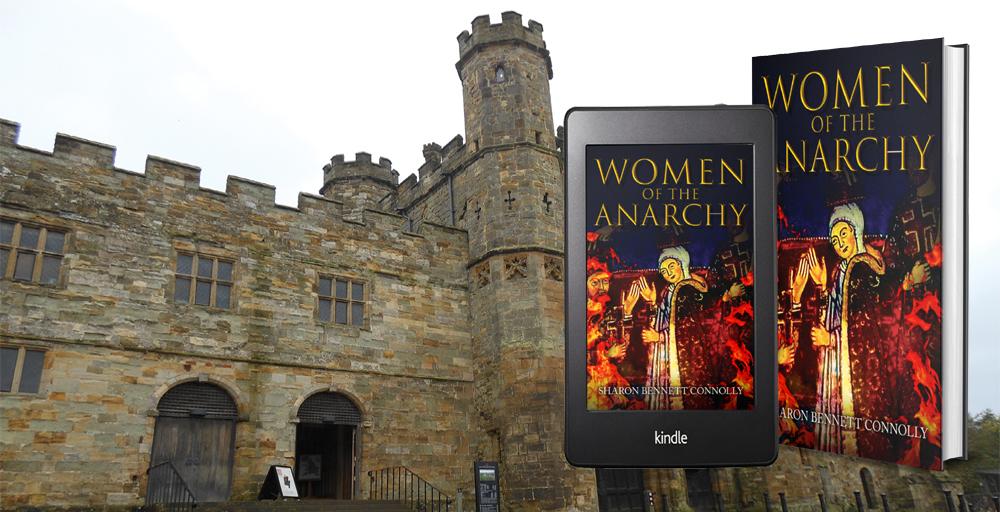
Two cousins. On the one side is Empress Matilda, or Maud. The sole surviving legitimate child of Henry I, she is fighting for her birthright and that of her children. On the other side is her cousin, Queen Matilda, supporting her husband, King Stephen, and fighting to see her own son inherit the English crown. Women of the Anarchy demonstrates how these women, unable to wield a sword, were prime movers in this time of conflict and lawlessness. It show how their strengths, weaknesses, and personal ambitions swung the fortunes of war one way – and then the other.
King John’s Right-Hand Lady: The Story of Nicholaa de la Haye is the story of a truly remarkable lady, the hereditary constable of Lincoln Castle and the first woman in England to be appointed sheriff in her own right. It is is available from King John’s Right-Hand Lady: The Story of Nicholaa de la Haye is the story of a truly remarkable lady, the hereditary constable of Lincoln Castle and the first woman in England to be appointed sheriff in her own right. Available from all good bookshops or direct from Pen & Sword Books, bookshop.org and Amazon. Defenders of the Norman Crown: The Rise and Fall of the Warenne Earls of Surrey tells the fascinating story of the Warenne dynasty, from its origins in Normandy, through the Conquest, Magna Carta, the wars and marriages that led to its ultimate demise in the reign of Edward III. Available from Pen & Sword Books, Amazon in the UK and US, and Bookshop.org.
Alternate Endings: An anthology of historical fiction short stories including Long Live the King… which is my take what might have happened had King John not died in October 1216. Available in paperback and kindle from Amazon.
Podcast:
Have a listen to theA Slice of Medieval podcast, which I co-host with Historical fiction novelist Derek Birks. Derek and I welcome guests, such as Bernard Cornwell and discuss a wide range of topics in medieval history, from significant events to the personalities involved.
*
Don’t forget!Signed and dedicated copies of all my books are available through my online bookshop.
For forthcoming online and in-person talks, please check out my Events Page.
You can be the first to read new articles by clicking the ‘Follow’ button, liking our Facebook page or joining me on Twitterand Instagram.
Few English monarchs had to fight harder for the right to rule than King Edward IV – Shakespeare’s glorious son of York. Cast in the true Plantagenet mould, over six feet tall, he was a naturally charismatic leader. Edward had the knack of seizing the initiative and winning battles and is free from the unflattering characterisations that plagued his brother, Richard III, having been portrayed as a good-looking and formidable military tactician. Described sometimes as reckless and profligate, all sources remark on his personal bravery. In the eleven years between 1460 and 1471 he fought five major battles in the Wars of the Roses. Three of them – Towton, Barnet and Tewkesbury – rank among the most decisive of the medieval period.









 History... the interesting bits!