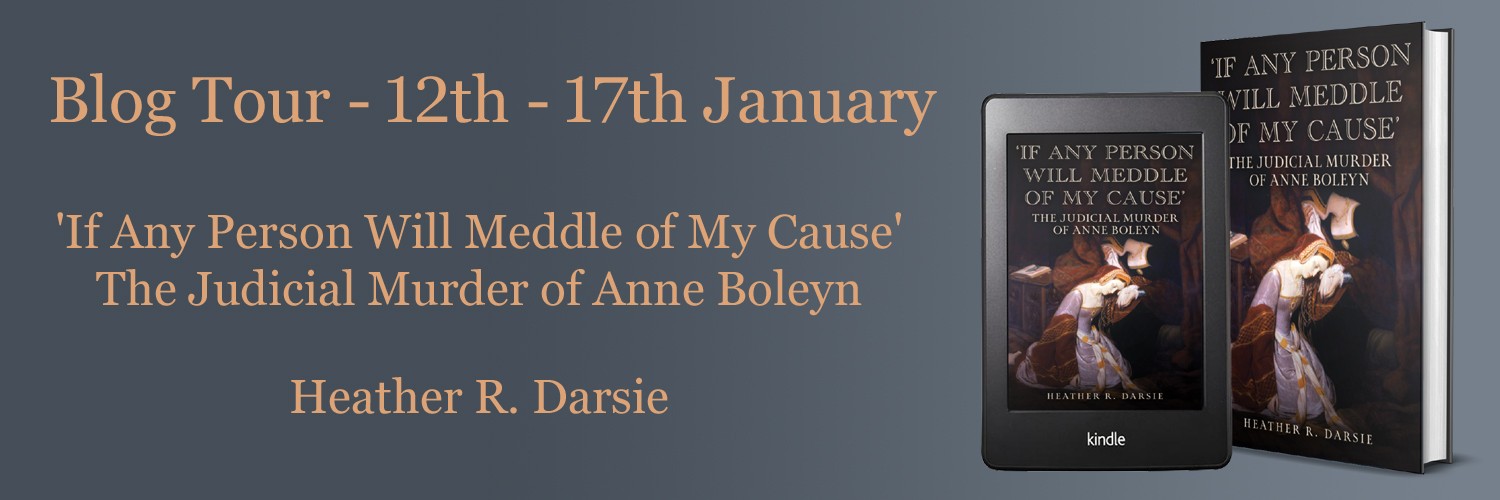
Guest Post: Anne Boleyn Forces Legal Reform by Heather R. Darsie

History ... the Interesting Bits

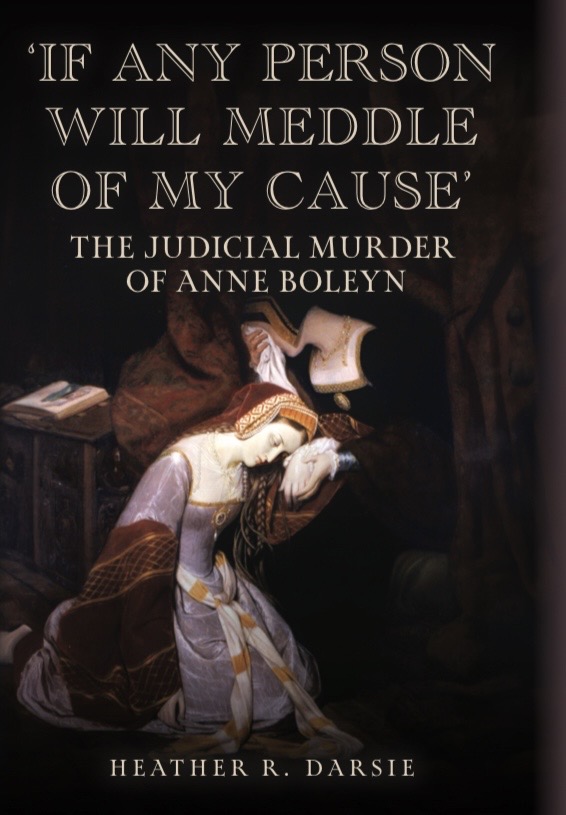
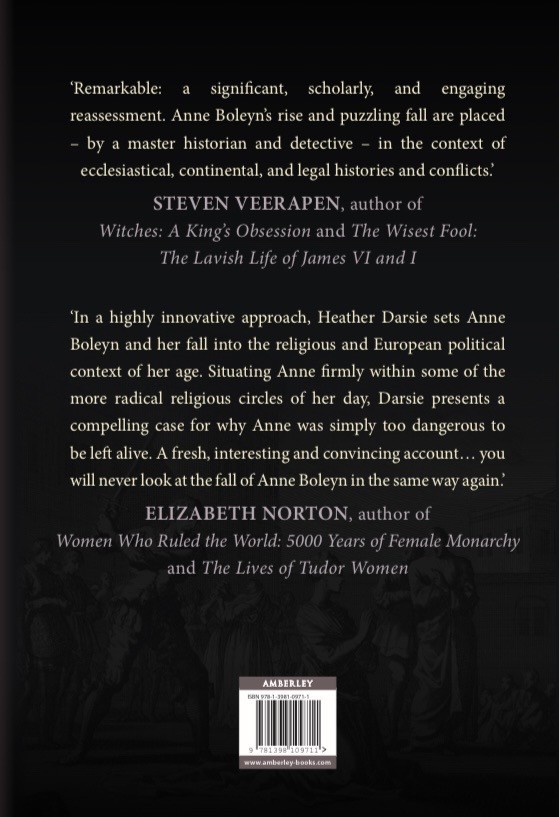
Anne Boleyn is one of the great enigmas of English history. Credited – or blamed – for Henry VIII’s break with Rome and the English Reformation, she is also the mother of one of England’s greatest monarchs, Queen Elizabeth I. Moreover, Anne Boleyn holds the tragic distinction of being the first queen of England to ever be executed. Historian Heather R. Darsie‘s new book, If Any Person Will Meddle of My Cause: The Judicial Murder of Anne Boleyn, looks into Anne’s queenship and execution – and how the law made her death possible.

And today we have a treat! An extract from the book, to give you a taste of what’s in store….

Welcome Heather!

Anne Boleyn Forces Legal Reform

By Heather R. Darsie, J. D.
History ... the Interesting Bits

Anne Boleyn is famously seen as the reason for Henry VIII breaking from the Catholic church. Her interest in at least reforming religion in England, if not going more toward the way of Martin Luther, made her a figurehead in some ways for underground efforts. In reality, Henry was finishing the work of his forbears from centuries before. He also quickly learned that he needed to pull away from Rome so that he could have full control of legal matters within his kingdom, without outside meddling or dawdling,

“Although Henry had grown frustrated over the confounding dithering of Clement VII and ineptitude of Cardinal Thomas Wolsey in the handling of his Great Matter, the issue of Henry VIII’s annulment from Katharine of Aragon was not the biggest problem. The biggest problem was, Henry rapidly learned, that he had no control over his legal system in very important arenas when he needed it most. Aside from not having legal control, the lag time in communications being sent from London to Rome and back again contributed to the delay in Henry’s annulment proceedings, too.

Once Henry was set on his path inspired by Anne Boleyn, he learned just how much money was being kept out his coffers. Cardinal Wolsey started the process before his death, but Thomas Cromwell and Anne spurred Henry to continue shutting down religious institutions in an effort to redistribute the nation’s wealth in favour of crown and kingdom. None of these ideas were novel….

Loosening the church’s powers with England began at the very tail end of the High Middle Ages with Edward I of England. At the beginning of the thirteenth century with the enaction of Magna Carta, the passing of land to a corporation, like a church, without royal consent was forbidden. …Edward I enacted the Statutum de Viris Religiosis, or Statute of Religious Men, in 1279…It forbade the passage of any lands in mortmain [meaning “deadhand”] to any religious man. If anyone did pass their lands to a religious man, then those lands were forfeited…The goals of the Mortmain statutes were not achieved until Henry VIII’s Parliament passed several statutes in 1529 and one directly addressing mortmain in 1531. Henry then began dissolving the monasteries in the 1530s, something he arguably would not have done without being encouraged by his fixation on and love for Anne Boleyn…

Henry VIII was not the first king of England to challenge the pope’s authority. He was the fourth, although the laws of the first two kings were more or less forgotten by the time Henry started taking action. Edward III passed the first, overtly aggressive statutes against papal power, with his successor Richard II taking even stronger action…The laws fell by the wayside during the fifteenth century, not to be fully revived until Henry VIII needed to assert stronger control….
History ... the Interesting Bits

[Edward III] enacted the Statute of Praemunire Facias, or simply the Statute of Praemunire, in 1353. This statute severely curtailed the influence and outright meddling of papal authority and other foreign powers within England… The punishments for the Statute of Praemunire were…severe. Anyone who effectively requested foreign interference with any legal matter, temporal or ecclesiastical, that rightly was under the purview of the king of England’s courts, was at risk of imprisonment, being outlawed and forfeiting all their property, goods, lands, and chattel. These were extremely serious penalties.

Being outlawed meant that the person had no rights or legal protection. Effectively, they were stripped of personhood and did not exist. If the person were robbed and killed after being outlawed, no crime was committed because the person existed outside of the law. Being outlawed was a desperate state of living and reserved for only the worst criminals, as in some ways it was a fate worse than death. The only positive element of being outlawed was that a person, if they survived their term of outlawry, they could be allowed back into society. Once recognised as a legal person again, they were usually at a diminished station, but at least they were alive and had rights… [Updates] were made to the Statute of Praemunire in 1365, curtailing the ability of the papal court to act as a court of first impression or a court of appeal for matters arising in England…

Roughly twenty-five years later, Richard II continued his grandfather Edward III’s work… The 1393 Statute of Praemunire Facias, enhancing the law passed in 1353, did not allow the papal curia to hear any non-spiritual matters that were prejudicial to the king, or went against the customs and laws of England. Spiritual matters could still be heard in Rome, such as divorces and annulments. Anyone who violated the 1393 statute risked punishment by forfeiting all that they owned and being outlawed. The same punishment applied to anyone who aided and abetted them. This was where Henry VIII suffered from the decisions of his great-great-great-granduncle Richard II in Henry’s Great Matter with Katharine of Aragon. This is why Henry’s annulment proceeding simply had to be heard by the pope in Rome, unless Cardinal Wolsey could figure out a solution.…”

History ... the Interesting Bits

Henry VIII’s need for Anne Boleyn opened his eyes to the restrictions of his legal control within England. Their passion inspired Henry to complete the work that was begun hundreds of years before anyone conjured the name of ‘Anne Boleyn’.

For more, pick up a copy of If Any Person Will Meddle of My Cause: The Judicial Murder of Anne Boleyn, available via hardback and Kindle in the UK, or via Kindle internationally. Hardbacks are available for international pre-order, with release on 21 April 2026.

About the book:

Many people know about the dramatic rise and fall of Anne Boleyn, Henry VIII’s controversial second wife, but this is the first book to look at her life from a Continental perspective. Her role models for queenship came from the Low Countries and France, and this contributed to her tragic end. Heather R. Darsie reviews the political missteps and implications of Anne Boleyn’s queenship, delving into the threat she posed to Henry, and why legal changes made during the early years of the English Reformation allowed the English king to judicially murder his inconvenient queen.

Historically, certain things have been overlooked about Anne’s execution: she wore colours usually associated with martyrdom, announced that she did not come to preach, was killed by beheading instead of burning, and had a very crude burial in an unmarked grave. Anne tried to portray herself as a martyr, and Henry did everything he could to prevent her from reaching that status. If Any Person Will Meddle of My Cause is about Anne Boleyn, but not the Anne Boleyn you know.

About the Author:

History ... the Interesting Bits

Heather R. Darsie is an independent researcher in the US specializing in early modern history. She focuses on researching the Holy Roman Empire and England in the early 16th century. She is the author of ‘Anna, Duchess of Cleves‘, ‘Children of the House of Cleves‘ and ‘Katharine of Aragon, Spanish Princess‘. Her primary career is as an attorney. She runs the website MaidensAndManuscripts.com.

*

My Books

Signed, dedicated copies of all my books are available through my online bookshop. or by contacting me.

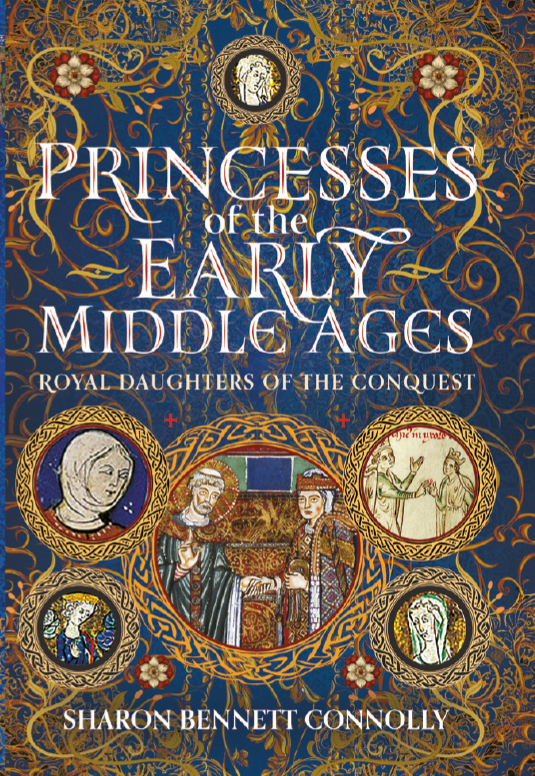
Coming 30 March: Princesses of the Early Middle Ages
Books by Sharon Bennett Connolly

Daughters of kings were often used to seal treaty alliances and forge peace with England’s enemies. Princesses of the Early Middle Ages: Royal Daughters of the Conquest explores the lives of these young women, how they followed the stereotype, and how they sometimes managed to escape it. It will look at the world they lived in, and how their lives and marriages were affected by political necessity and the events of the time. Princesses of the Early Middle Ages will also examine how these girls, who were often political pawns, were able to control their own lives and fates. Whilst they were expected to obey their parents in their marriage choices, several princesses were able to exert their own influence on these choices, with some outright refusing the husbands offered to them.

Their stories are touching, inspiring and, at times, heartbreaking.

Princesses of the Early Middle Ages: Royal Daughters of the Conquest is now available for pre-order from Pen & Sword and Amazon.

Also by Sharon Bennett Connolly:

Books by Sharon Bennett Connolly

Scotland’s history is dramatic, violent and bloody and Scotland’s Medieval Queens have seen it all. This is the story of Scotland through their eyes. Available now from Amazon and Pen and Sword BooksHeroines of the Tudor World tells the stories of the most remarkable women from European history in the time of the Tudor dynasty, 1485-1603. These are the women who ruled, the women who founded dynasties, the women who fought for religious freedom, their families and love. Heroines of the Tudor World is now available from Amberley Publishing and Amazon UK. Women of the Anarchy demonstrates how Empress Matilda and Matilda of Boulogne, unable to wield a sword themselves, were prime movers in this time of conflict and lawlessness. It shows how their strengths, weaknesses, and personal ambitions swung the fortunes of war one way – and then the other. Available from Bookshop.orgAmberley Publishing and Amazon UKKing John’s Right-Hand Lady: The Story of Nicholaa de la Haye is the story of a truly remarkable lady, the hereditary constable of Lincoln Castle and the first woman in England to be appointed sheriff in her own right. Available from all good bookshops Pen & Sword Booksbookshop.org and Amazon

Royal Historical Society

Defenders of the Norman Crown: The Rise and Fall of the Warenne Earls of Surrey tells the fascinating story of the Warenne dynasty, from its origins in Normandy, through the Conquest, Magna Carta, the wars and marriages that led to its ultimate demise in the reign of Edward III. Available from Pen & Sword BooksAmazon in the UK and US, and Bookshop.orgLadies of Magna Carta: Women of Influence in Thirteenth Century England looks into the relationships of the various noble families of the 13th century, and how they were affected by the Barons’ Wars, Magna Carta and its aftermath; the bonds that were formed and those that were broken. It is now available in paperback and hardback from Pen & SwordAmazon, and Bookshop.orgHeroines of the Medieval World tells the stories of some of the most remarkable women from Medieval history, from Eleanor of Aquitaine to Julian of Norwich. Available now from Amberley Publishing and Amazon, and Bookshop.orgSilk and the Sword: The Women of the Norman Conquest traces the fortunes of the women who had a significant role to play in the momentous events of 1066. Available now from Amazon,  Amberley Publishing, and Bookshop.org.

Alternate Endings: An anthology of historical fiction short stories including Long Live the King… which is my take what might have happened had King John not died in October 1216. Available in paperback and kindle from Amazon.

Podcast:
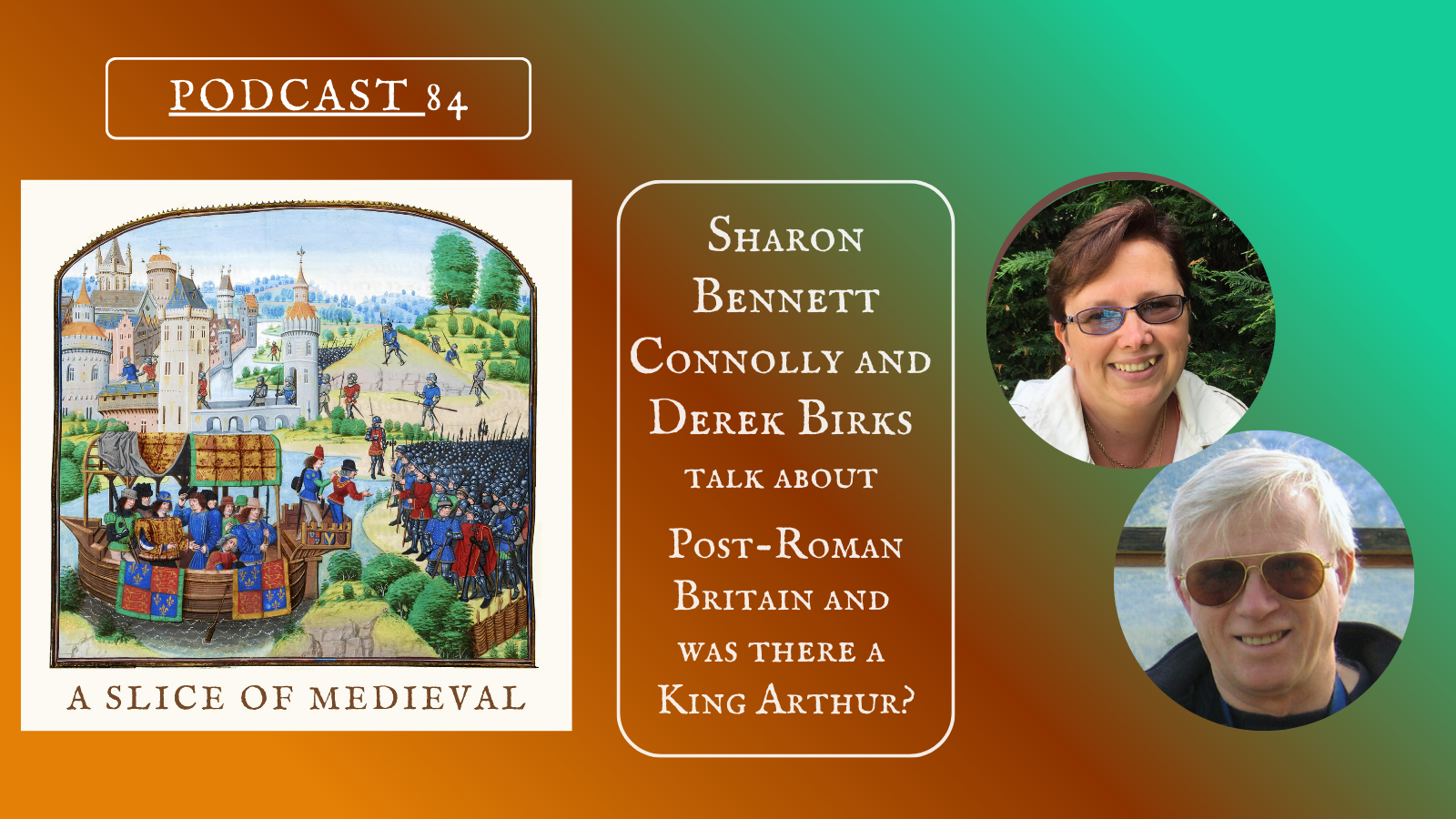
Have a listen to the A Slice of Medieval podcast, which I co-host with Historical fiction novelist Derek Birks. Derek and I welcome guests, such as Ian Mortimer, Bernard Cornwell, Elizabeth Chadwick and Scott Mariani, and discuss a wide range of topics in medieval history, from significant events to the personalities involved. 

Every episode is also now available on YouTube.

*

Don’t forget! Signed and dedicated copies of all my books are available through my online bookshop.

For forthcoming online and in-person talks, please check out my Events Page.

You can be the first to read new articles by clicking the ‘Follow’ button, liking our Facebook page or joining me on TwitterThreadsBluesky and Instagram.

*

©2026 Sharon Bennett Connolly FRHistS and Heather R. Darsie
Wordly Women: Heather R. Darsie

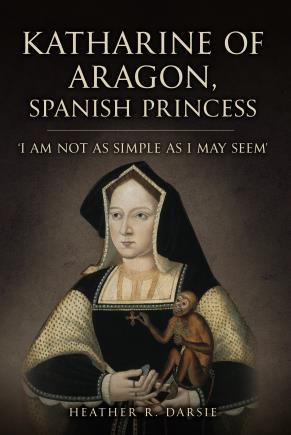
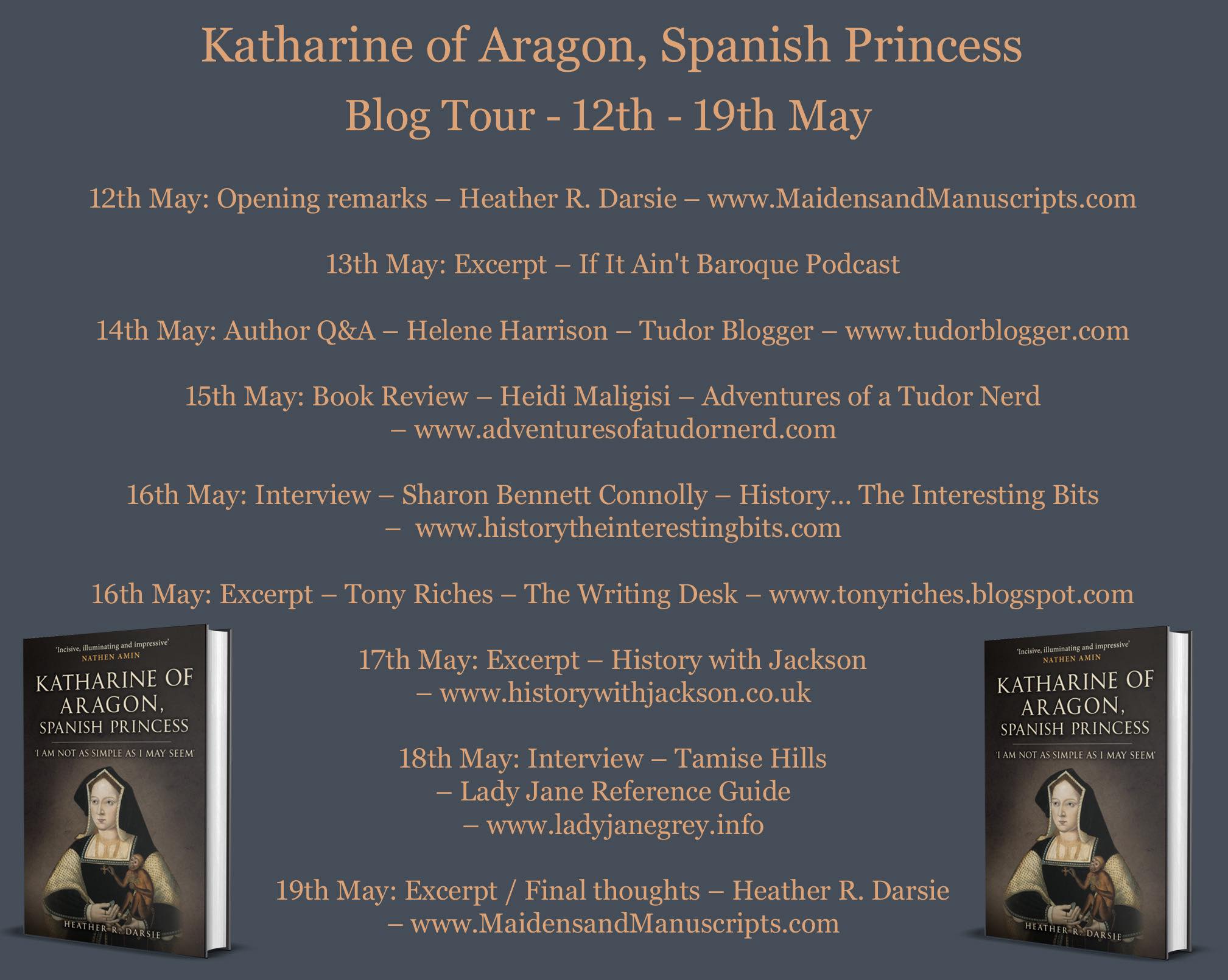
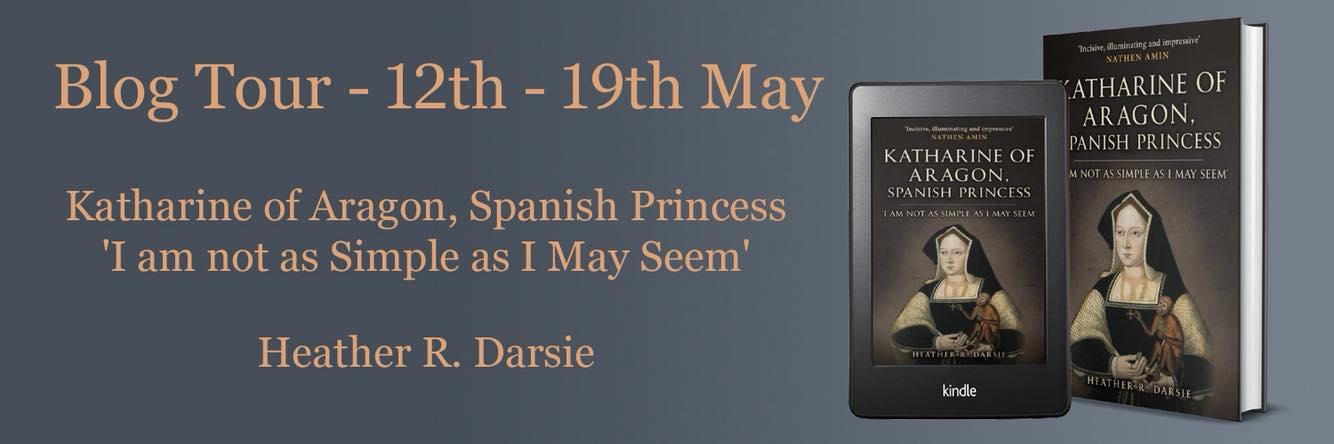
In a special episode of my Wordly Women interview series, Heather R. Darsie drops by on her blog tour celebrating the publication of her new book, Katharine of Aragon, Spanish Princess: ‘I am Not as Simple as I May Seem’. Do have a look at the other stops on the tour to geta taste of this wonderful new biography.

So, Heather, What got you into writing?

Heather: As silly as this sounds, I can’t remember originally. My dad had an electric typewriter that he let me use to write stories beginning when I was probably eight years old. I continued writing stories and poems through high school (14 to 18 years old in the USA), which culminated in a play based off Edgar Allen Poe’s “Annabel Lee” when I was in my final year of high school. My play was called Annalise, wherein the wife was dying of amyotrophic lateral sclerosis of which my paternal grandfather passed away. The husband slowly went mad, to the point where the wife’s had to intervene. The theme of the play was tragedy. My high school put on the play, I was in the local newspaper, and invited to host a workshop at the statewide high school theatre festival.

After graduating from high school, I went to university and majored in German Languages and Literature, then pursued my Juris Doctorate in American Jurisprudence. Along the way, I studied abroad in Costa Rica and France, learning Spanish and French, too. I have had numerous opportunities to travel to France, Spain, Germany, and various countries in Central America, which have all contributed to keeping my language skills sharp.

I became heavily interested in Tudor history in around 2010. By early 2015, I grew tired of reading the same-old, same-old about Anna of Cleves, a German woman. I asked Claire Ridgeway of the Anne Boleyn Files if I could contribute a post on Anna to her website, to which Claire kindly agreed. Thereafter encouraged and emboldened, I sent a letter in my very best German to the mayor of the current City of Cleves, and my research took off from there. The combination of a life-long interest in writing, linguistic education, research and analytical skills from my juris doctorate, combined with the history community’s encouragement is how I arrived here, ten years on.

Sharon: Tell us about your books.

Heather: I view myself as a Tudor-adjacent historian. The persons and events I choose to focus on should be recognizable am most interested in the Holy Roman Empire of the German Nation, which began recognizing itself that way in the early 16th century. Specifically, anyone or anything connected to the von der Marks, which is Anna of Cleves’ family (she was “of Cleves” much like Princess Mary Tudor would be “Mary of England” in another country) or the Habsburgs. My first two nonfiction books, Anna, Duchess of Cleves: The King’s Beloved Sister and Children of the House of Cleves: Anna and Her Siblings are effectively German history books. My third nonfiction book, Stuart Spouses: A Compendium of Consorts from James I of Scotland to Queen Anne of Great Britain looks at just that, the husbands and wives of the Scottish-to-English Stuart dynasty. The dynastic intermingling with continental European families is fascinating. I wrote a novella during the pandemic, Diary of a Plague Doctor’s Wife, set during the last outbreak of the Black Death in 1720s Marseille. The parallels to our own experiences 300 years later with Covid-19 were eerie to me at the time of writing.

Sharon: What attracts you to the Catherine of Aragon?

Heather: Like Anna of Cleves, I felt there was more to her than the end of her marriage with Henry VIII. Specifically, I wanted to know more about Katharine’s family dynasty and Katharine’s early time in England, and share that with readers.

Sharon: Who is your favourite Tudor and why?

Heather: For queens, I am drawn to Catherine Parr. She seemed the most savvy when it came to navigating Henry VIII and the dangerous politics of the Tudor court. I am very intrigued by Thomas Cromwell in his position as a lawyer. He was very clever; I hope to write about him someday.

Sharon: Who is your least favourite Tudor and why?

Heather: I do not have a least favorite, but I do think the most tragic was Anne Boleyn, who was foisted by her own petard. I am finding that more and more as I work on my next book, If any Person will Meddle with My Cause: The Judicial Murder of Anne Boleyn.

Sharon: How do you approach researching your topic, especially when most of the sources are Spanish?

Heather: I start with finding articles on JSTOR, then checking the footnotes for sources. From there, I go to Google Play, Archive.org, the Spanish library websites, etc. for old manuscripts. Like many English books, several of the old, out-of-copyright ones are available for free. The Spanish language is not a barrier for me, since I hear or read it most days a week at work.

Sharon: Tell us your ‘favourite’ Catherine of Aragon story you have come across in your research.

Heather: I really enjoyed reading about all of the pageants she viewed during her formal entry into London. It must have been quite the time for her.

Sharon: Tell us your least ‘favourite’ Catherine of Aragon story you have come across in your research.

Heather: Katharine was having a difficult time with Spanish grammar in her letters toward the very late 1520s and early 1530s. This could be indicative of the extreme stress that she was under during that time, or the isolation she was experiencing and being unable to speak Spanish with anyone, or both. I found it tragic and poignant. I don’t believe I remarked on that in my book.

Sharon: Are there any other eras you would like to write about?

Heather: I am interested in doing a little more on the late 16th to early 17th century. Otherwise, I am fairly happy with the time frame that I work in now, but exploring more individuals and courts.

Sharon: What are you working on now?

Heather: I am finishing up the aforementioned book, If any Person will Meddle with My Cause: The Judicial Murder of Anne Boleyn. I am completing an epic as well, which I will self publish likely later this year, that has heavy Greek mythology themes. Our heroes go on a quest to bring back the Olympians and restore justice to the human world. The epic is clocking in at about 3, 600 lines right now. I suppose it makes me a poet along with an author.

Sharon: And finally, what is the best thing about being a writer?

Heather: Sharing knowledge.

About the book:

Katharine of Aragon is more in the public consciousness now due to the TV show ‘Spanish Princess’. Katharine has of course been an interesting historical figure for quite some time because she is the first wife of the infamous Henry VIII. This book provides a new perspective on Katharine because it includes far more background on her Spanish upbringing, Spanish culture, and how that continued to define her in England during her first fifteen years in the country. Additionally, Heather uses rich primary sources, such as ‘The Receyt of Ladie Kateryne’, which have either not been sourced or infrequently referred to in other biographies about Katharine. In this, Heather’s multilingual abilities – especially her fluent Spanish – are put to good use. No one, for example, has considered he rippling impact of terminating Katharine’s marriage on the Trastamara and Habsburg dynasties in Europe. Katherine was as important abroad as she was in England.

Buy Katharine of Aragon, Spanish Princess: ‘I am Not as Simple as I May Seem’

About the author:

Heather R. Darsie, J. D. is an independent researcher specializing in early modern history. She describes herself as a “Tudor-adjacent” historian, focusing on the Holy Roman Empire and England in the early 16th century. She is the author of four nonfiction books: Anna, Duchess of Cleves: The King’s Beloved Sister, Children of the House of Cleves: Anna and Her Siblings, Stuart Spouses: A Compendium of Consorts from James I of Scotland to Queen Anne of Great Britain, and Katharine of Aragon, Spanish Princess: I am not as Simple as I May Seem. She self-published the novella Diary of a Plague Doctor’s Wife. Her primary career is as an attorney. Heather lives in Illinois with her loving husband, wonderful stepchildren, and three raucous parrots.

Where to find Heather:

Website: MaidensAndManuscripts.com; Instagram: @hdarsiehistory; X: @hrdarsiehistory; Threads: hdarsiehistory; Facebook: Heather R. Darsie, Historian; BlueSky: @hrdarsiehistory.bsky.social

*

My books

Signed, dedicated copies of all my books are available through my online store.

Out now: Scotland’s Medieval Queens

Scotland’s history is dramatic, violent and bloody. Being England’s northern neighbour has never been easy. Scotland’s queens have had to deal with war, murder, imprisonment, political rivalries and open betrayal. They have loved and lost, raised kings and queens, ruled and died for Scotland. From St Margaret, who became one of the patron saints of Scotland, to Elizabeth de Burgh and the dramatic story of the Scottish Wars of Independence, to the love story and tragedy of Joan Beaufort, to Margaret of Denmark and the dawn of the Renaissance, Scotland’s Medieval Queens have seen it all. This is the story of Scotland through their eyes.

Scotland’s Medieval Queens gives a thorough grounding in the history of the women who ruled Scotland at the side of its kings, often in the shadows, but just as interesting in their lives beyond the spotlight. It’s not a subject that has been widely covered, and Sharon is a pioneer in bringing that information into accessible history.’ Elizabeth Chadwick (New York Times bestselling author)

Available now from Amazon and Pen and Sword Books

Also by Sharon Bennett Connolly:

Heroines of the Tudor World tells the stories of the most remarkable women from European history in the time of the Tudor dynasty, 1485-1603. These are the women who ruled, the women who founded dynasties, the women who fought for religious freedom, their families and love. Heroines of the Tudor World is now available from Amberley Publishing and Amazon UK. Women of the Anarchy demonstrates how Empress Matilda and Matilda of Boulogne, unable to wield a sword themselves, were prime movers in this time of conflict and lawlessness. It shows how their strengths, weaknesses, and personal ambitions swung the fortunes of war one way – and then the other. Available from Bookshop.orgAmberley Publishing and Amazon UKKing John’s Right-Hand Lady: The Story of Nicholaa de la Haye is the story of a truly remarkable lady, the hereditary constable of Lincoln Castle and the first woman in England to be appointed sheriff in her own right. Available from all good bookshops Pen & Sword Booksbookshop.org and Amazon

Defenders of the Norman Crown: The Rise and Fall of the Warenne Earls of Surrey tells the fascinating story of the Warenne dynasty, from its origins in Normandy, through the Conquest, Magna Carta, the wars and marriages that led to its ultimate demise in the reign of Edward III. Available from Pen & Sword BooksAmazon in the UK and US, and Bookshop.orgLadies of Magna Carta: Women of Influence in Thirteenth Century England looks into the relationships of the various noble families of the 13th century, and how they were affected by the Barons’ Wars, Magna Carta and its aftermath; the bonds that were formed and those that were broken. It is now available in paperback and hardback from Pen & SwordAmazon, and Bookshop.orgHeroines of the Medieval World tells the stories of some of the most remarkable women from Medieval history, from Eleanor of Aquitaine to Julian of Norwich. Available now from Amberley Publishing and Amazon, and Bookshop.orgSilk and the Sword: The Women of the Norman Conquest traces the fortunes of the women who had a significant role to play in the momentous events of 1066. Available now from Amazon,  Amberley Publishing, and Bookshop.org.

Alternate Endings: An anthology of historical fiction short stories including Long Live the King… which is my take what might have happened had King John not died in October 1216. Available in paperback and kindle from Amazon.

Podcast:

Have a listen to the A Slice of Medieval podcast, which I co-host with Historical fiction novelist Derek Birks. Derek and I welcome guests, such as Bernard Cornwell and Michael Jecks, and discuss a wide range of topics in medieval history, from significant events to the personalities involved. Every episode is also now available on YouTube.

*

Don’t forget! Signed and dedicated copies of all my books are available through my online store.

For forthcoming online and in-person talks, please check out my Events Page.

You can be the first to read new articles by clicking the ‘Follow’ button, liking our Facebook page or joining me on TwitterThreadsBluesky and Instagram.

*

©2025 Sharon Bennett Connolly, FRHistS and Heather R. Darsie
Guest Post: Children of the House of Cleves by Heather R Darsie

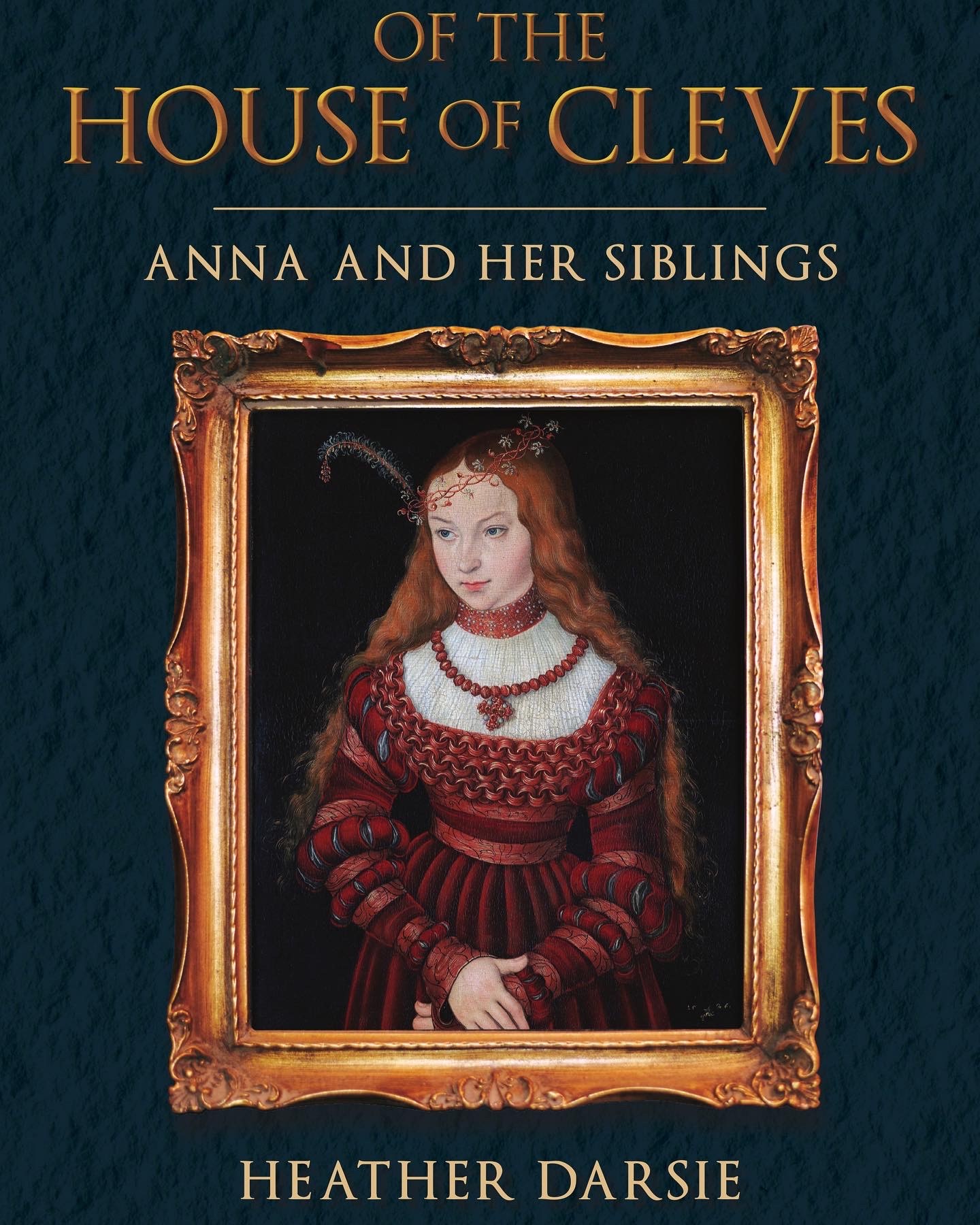
Today it is an honour and pleasure to open the blog tour for Heather R. Darsie’s latest book, Children of the House of Cleves: Anna and Her Siblings. You may remember that Heather wrote a fabulous biography of Anna of Cleves, Henry VIII’s fourth wife, a few years back. She has now followed that up with a look into Anna’s family.

Mental Illness in the House of Cleves

By Heather R. Darsie, J.D.

The von der Mark family, particularly once it came to the mental health of Anna of Cleves’ fraternal nephew Johann Wilhelm, was marred with mental health issues. Unfortunately, it is impossible to diagnose individuals from hundreds of years ago with afflictions that the modern person would recognize. To that end, terms from the time are rather simplistic.

Anna of Cleves’ family did not appear to have any serious mental health concerns on her father Johann III’s side, although Johann was regarded as being simple-minded. Madness featured on the maternal, Jülich-Berg side of Anna’s family. Her mother Maria of Jülich-Berg’s paternal grandfather, Gerhard of Jülich-Berg. He, “fell in and out of madness, beginning when William was still an infant…” That eventually led to William’s regency on the late 15th century, until Gerhard died.

William’s daughter Maria, mother of Anna and her siblings, was said to have died in a fit of rage. She was recognized as an intelligent, capable woman in her lifetime. Beyond her heartbroken rage at the end of her life, there is nothing to hint that Gerhard’s mental instability was passed down to Maria.

Anna’s brother Wilhelm is difficult to discern. After a series of strokes in his forties and fifties, Wilhelm occasionally suffered from a mental stupor. Whether it was from the strokes or a mental disorder is hard to sort. However, whatever his post-stroke limitations, a regency was never necessary during Wilhelm’s long reign as Duke of Jülich-Cleves-Berg.

Anna’s second sister-in-law through Wilhelm, Maria von Habsburg, was prone to fits of melancholy. Sometimes, the fits, or what the modern person might suspect to be depression, could be quite intense. She was one of Juana the Mad’s granddaughters, after all.

With the exception of perhaps Gerhard of Jülich-Berg, no one in the family was quite as mad as Anna’s nephew, Johann Wilhelm of Jülich-Cleves-Berg. Johann Wilhelm’s peculiar disposition began presenting itself in his youth, although it was easy enough to put him away in a religious establishment. Unfortunately, by the time he became a young man, there was no hiding his infirmity.

Again, there are really only glimpses of what ailed Johann Wilhelm. At times, he seemed to have entered an almost catatonic state. At other times, he seemed perfectly lucid, but was highly paranoid.

As the decades rolled on and Anna’s brother Wilhelm sought method after method of treating Johann Wilhelm, nothing worked. Multiple doctors saw him, including a known quack. Even witches were consulted in hopes of curing Johann Wilhelm, but nothing worked. On top of Johann Wilhelm’s mental illness, he failed to conceive any children.

Likely motivated by her own desperation for a child, Johann Wilhelm’s wife arranged an exorcism for him,

“The exorcism, which began around 5 September 1599, was violent, but started off harmlessly enough. Johann Wilhelm and members of his court were at Hambach Castle [near the city of Jülich], then being used by the duke as a hunting lodge. Foreign priests … and their religious retinue awaited Johann Wilhelm and his company as they returned from a hunting excursion. The priests gathered in Hambach Castle’s galleries to greet Johann Wilhelm, who was immediately apprehensive when he saw them. According to the report, Johann Wilhelm behaved strangely toward them because, “he was able to think or suspect without a doubt that the priests or monks are not being called for in vain, but are called to the place for the sake of the cause” of exorcising him.

Aside from dispossessing Johann Wilhelm of whatever demon was harassing him, the monks and priests wished to remove any impediment to Johann Wilhelm’s marriage bed…. The hope was that God would make them fruitful. Johann Wilhelm was keenly aware that the United Duchies needed an heir, especially since his first marriage was childless.”

What follows is a curious description of the efforts to which the priests went in cleansing Johann Wilhelm of the demon or demons whom they believed were vexing him. It was a shameful event.

If this excerpt piqued your interest, consider reading Children of the House of Cleves: Anna and Her Siblings, set for release in the UK on 15 June 2023 and in the US/Internationally on 12 September 2023. Can’t wait until September? The US Kindle version is released on 15 June, too! You might also like to read Heather R. Darsie’s biography on Anna of Cleves, the first researched and written from the German perspective, Anna, Duchess of Cleves: The King’s Beloved Sister.

Children of the House of Cleves: Anna and Her Siblings is available from Amberley Publishing and Amazon in the UK and US

About the Author:

Heather R. Darsie is an independent researcher in the US specializing in early modern history. She focuses on researching the Holy Roman Empire and England in the early 16th century. She is the author of ‘Anna, Duchess of Cleves’ and ‘Catherine of Aragon – Spanish Princess’. Her primary career is as an attorney. She runs the website MaidensAndManuscripts.com.

Sources & Suggested Reading

1. Darsie, Heather R. Children of the House of Cleves: Anna and Her Siblings. Stroud: Amberley (2023).

2. Darsie, Heather R. Anna, Duchess of Cleves: The King’s Beloved Sister. Stroud: Amberley (2019).

*

My Books:

Signed, dedicated copies of all my books are available, please get in touch by completing the contact me form.

Out Now!

King John’s Right-Hand Lady: The Story of Nicholaa de la Haye is now available for pre-order from Pen & Sword Booksbookshop.org and Amazon UK. (I will hopefully have a US release date shortly)

In a time when men fought and women stayed home, Nicholaa de la Haye held Lincoln Castle against all-comers. Not once, but three times, earning herself the ironic praise that she acted ‘manfully.’ Nicholaa gained prominence in the First Baron’s War, the civil war that followed the sealing of Magna Carta in 1215.

A truly remarkable lady, Nicholaa was the first woman to be appointed sheriff in her own right. Her strength and tenacity saved England at one of the lowest points in its history. Nicholaa de la Haye is one woman in English history whose story needs to be told…

Coming 15 January 2024: Women of the Anarchy

On the one side is Empress Matilda, or Maud. The sole surviving legitimate child of Henry I, she is fighting for her birthright and that of her children. On the other side is her cousin, Queen Matilda, supporting her husband, King Stephen, and fighting to see her own son inherit the English crown. Both women are granddaughters of St Margaret, Queen of Scotland and descendants of Alfred the Great of Wessex. Women of the Anarchy demonstrates how these women, unable to wield a sword, were prime movers in this time of conflict and lawlessness. It show how their strengths, weaknesses, and personal ambitions swung the fortunes of war one way – and then the other.

Available for pre-order from Amberley Publishing and Amazon UK.

Also by me:

Defenders of the Norman Crown: The Rise and Fall of the Warenne Earls of Surrey tells the fascinating story of the Warenne dynasty, of the successes and failures of one of the most powerful families in England, from its origins in Normandy, through the Conquest, Magna Carta, the wars and marriages that led to its ultimate demise in the reign of Edward III. Defenders of the Norman Crown: Rise and Fall of the Warenne Earls of Surrey is now available from Pen & Sword BooksAmazon in the UK and US, and  Bookshop.org.

Ladies of Magna Carta: Women of Influence in Thirteenth Century England looks into the relationships of the various noble families of the 13th century, and how they were affected by the Barons’ Wars, Magna Carta and its aftermath; the bonds that were formed and those that were broken. It is now available in paperback and hardback from Pen & Sword,  Amazon, and Bookshop.org.

Heroines of the Medieval World tells the stories of some of the most remarkable women from Medieval history, from Eleanor of Aquitaine to Julian of Norwich. Available now from Amberley Publishing and Amazon, and Bookshop.org.

Silk and the Sword: The Women of the Norman Conquest traces the fortunes of the women who had a significant role to play in the momentous events of 1066. Available now from Amazon,  Amberley Publishing, and Bookshop.org.

Alternate Endings: An anthology of historical fiction short stories including Long Live the King… which is my take what might have happened had King John not died in October 1216. Available in paperback and kindle from Amazon.

*

Podcast:

Have a listen to my A Slice of Medieval podcast:

For forthcoming online and in-person talks, please check out my Events Page.

You can be the first to read new articles by clicking the ‘Follow’ button, liking our Facebook page or joining me on Twitter and Instagram.

*

©2023 Heather R. Darsie and Sharon Bennett Connolly FRHistS

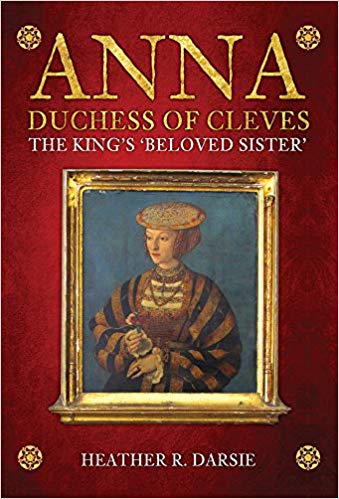
Guest Post: Anna Duchess of Cleves by Heather R. Darsie

Today it is a pleasure to welcome historian Heather R. Darsie to History… the Interesting Bits with an article about Anne of Cleves, Henry VIII’s fourth wife. Heather’s new book, Anna Duchess of Cleves; the king’s Beloved Sister is out now.

The First Hint of Trouble: An Early Spat Between the Johann II of Cleves and Elector Frederick of Saxony

By Heather R. Darsie

Throughout the late 15th and early 16th century, various disputes over territory sprung up across the German-speaking portions of the Holy Roman Empire. In 1517, a new facet of rebellion against the Empire was introduced in Saxony when Martin Luther’s 95 Theses became known. Maximilian I was still the Holy Roman Emperor in 1517. He could not know what the changing attitudes toward the Catholic church would do to the fabric of the Empire. Maximilian passed away on 12 January 1519, making his grandson Charles the next Holy Roman Emperor. Charles’ first coronation, in Germany, took place in 1520.

Twenty-year-old Charles V was crowned in October 1520 as the King of the Romans-Germans at a grand ceremony in Aachen. By being crowned King of the Romans-Germans, Charles V was the Holy Roman Emperor Elect. Pope Leo X gave Charles V permission to style himself as the Holy Roman Emperor until Charles’ 1530 coronation at Bologna by Pope Clement VII.

In 1520 when Charles V’s massive train of at least two thousand horse. The various electors, including Elector Fredrick of Saxony, made up part of Charles V’s company. Though the details are unclear, it is recorded in an account of Charles V’s coronation printed circa 1520 that the Elector of Saxony and “Duke of Gülch” – an archaic spelling of “Jülich” – squabbled for a long time over who took which precedence during the procession to Aachen Cathedral.

Frederick of Saxony believed that Johann III of Cleves should have been included with the Saxon contingent rather than Johann being independent of Saxony. Saxony was ruled by an Elector, with only eleven electors in all of the Germanic areas. By comparison, Johann III was only a duke, and there were hundreds of duchies in all of the Germanic areas. In the end, Anna’s father Johann III entered the city before Elector Frederick of Saxony. Elector Frederick likely took exception to this snub.

Elector Frederick, famous for having sheltered Martin Luther from Charles V, passed away. Because Frederick was childless, his younger brother John became Elector of Saxony in 1525. Frederick was Catholic throughout his life. There is some debate over whether Frederick converted to Lutheranism on his deathbed. In February 1527, Elector John’s son Johann Friedrich married Johann III’s eldest daughter, Sybylla of Cleves.  The debate over Lutheran reforms was in full swing, and Charles V tried his best to quell the rising tides of religious change.

The marital alliance between Anna of Cleves’ elder sister Sybylla and Johann Friedrich did not have the immediate benefits for which Elector John hoped. Elector John was a Lutheran even before he became the Elector of Saxony. Sybylla and Johann Friedrich welcomed their first son, also named Johann Friedrich, in January 1529. The next year, the first Diet of Augsburg took place. It was at this Diet that Emperor Charles V tried to soothe tensions over Protestantism, and also when he introduced his comprehensive criminal code. The Augsburg Confession was produced because of this Diet, too. After the Diet of Augsburg, the issue of religion and thus, allegiance to the Emperor became more divided.

Anna’s and Sybylla’s parents were Catholic, their mother Maria particularly so. Jülich-Cleves-Berg was understood to be predominantly Catholic under the reign of Johann III, but tolerant of Lutheranism. By the late 1520s, two political and religious ideas dominated Germany: pro-Imperial and pro-Catholic, or anti-Imperial and pro-Lutheran. This put Jülich-Cleves-Berg and Saxony on different ends of the political spectrum.

Sybylla herself converted to Lutheranism, as did Anna’s and Sybylla’s little sister Amalia. At the begin of his reign in 1539 as Duke Wilhelm V, Johann Friedrich sent Philipus Melanchthon to learn whether Wilhelm was pro-Lutheran or pro-Catholic. Johann Friedrich became Elector of Saxony in 1532 after the death of his father, and needed to know which way Wilhelm leaned.

If you’re curious to know more about religion in Cleves during Anna of Cleves’ lifetime, check out my new biography, “Anna, Duchess of Cleves: The King’s ‘Beloved Sister.’

Sources & Suggested Reading

  1. Römischer Künigklicher Maiestat Krönung zü Ach Geschehen. Author unknown. Circa Held by the Newberry Library, Chicago, Illinois.
  2. Rosenthal, Earl E. “The Invention of the Columnar Device of Emperor Charles V at the Court of Burgundy in Flanders in 1516.” Journal of the Warburg and Courtauld Institutes36 (1973): 198-230.
  3. Darsie, Heather. Anna, Duchess of Cleves: The King’s ‘Beloved Sister.’ Stroud: Amberley (2019).

Anna Duchess of Cleves; the king’s Beloved Sister

Anna was the ‘last woman standing’ of Henry VIII’s wives – and the only one buried in Westminster Abbey. How did she manage it?

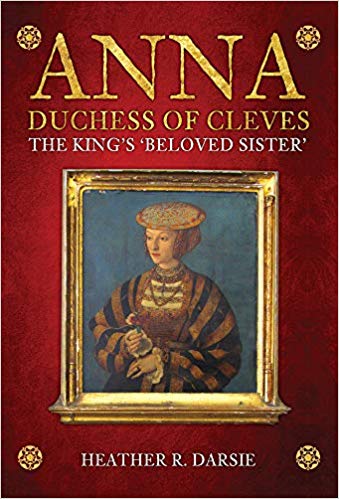
Anna, Duchess of Cleves: The King’s ‘Beloved Sister’ looks at Anna from a new perspective, as a woman from the Holy Roman Empire and not as a woman living almost by accident in England. Starting with what Anna’s life as a child and young woman was like, the author describes the climate of the Cleves court, and the achievements of Anna’s siblings. It looks at the political issues on the Continent that transformed Anna’s native land of Cleves – notably the court of Anna’s brother-in-law, and its influence on Lutheranism – and Anna’s blighted marriage. Finally, Heather Darsie explores ways in which Anna influenced her step-daughters Elizabeth and Mary, and the evidence of their good relationships with her.

Was the Duchess Anna in fact a political refugee, supported by Henry VIII? Was she a role model for Elizabeth I? Why was the marriage doomed from the outset? By returning to the primary sources and visiting archives and museums all over Europe (the author is fluent in German, and proficient in French and Spanish) a very different figure emerges to the ‘Flanders Mare’.

Anna Duchess of Cleves; the king’s Beloved Sister is available now from Amberley Publishing and Amazon in the UK and from Book Depository worldwide.

About the author:

Heather Darsie works as an attorney in the US. Along with her Juris Doctorate she has a BA in German, which was of great value in her research in the archives of Germany, Switzerland and the Netherlands for this book. She is currently studying for her Master’s in Early Modern History through Northern Illinois University. She runs the website MaidensAndManuscripts.com and regularly contributes to QueenAnneBoleyn.com and TudorsDynasty.com. She has been researching this work for several years.

*

My books

Tracing the fortunes of the women who had a significant role to play in the momentous events of 1066, Silk and the Sword: the Women of the Norman Conquest is available from Amazon UK,  Amberley Publishing, Book Depository and Amazon US.

Also by Sharon Bennett Connolly:

Telling the stories of some of the most incredible women from Medieval history, Heroines of the Medieval World,  is now available in hardback in the UK from Amazon UK, and in the US from Amazon US. It is available now in paperback in the UK from from both Amberley Publishing and Amazon and worldwide from Book Depository.

*

You can be the first to read new articles by clicking the ‘Follow’ button, liking our Facebook page or joining me on Twitter.

©2019 Sharon Bennett Connolly and Heather R. Darsie