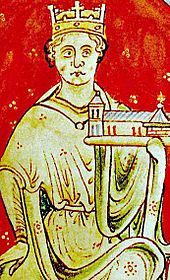
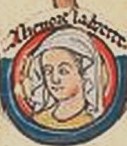
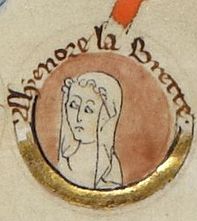
Isabella of Gloucester is a shadow in the pages of history. I could find no pictures of her. Until recently, no one even seemed certain of her name; in the history books she has been called Isabel, Isabella, Hawise, Avice – probably due to different language interpretations, translations and misunderstandings. However, Rich Price, who has done extensive research on primary sources from King John‘s reign has clarified that The Close Rolls definitely name her as ‘comitissa Isabella’ and ‘Isabella filia Willielmi comitis’ (Isabella, daughter of Count William), so we’ll stick with Isabella.
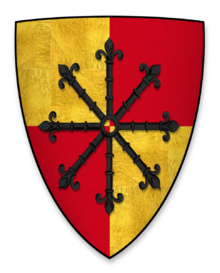
Isabella was the youngest daughter, and co-heiress, of William, 2nd Earl of Gloucester and his wife, Hawise, daughter of Robert de Beaumont, 2nd Earl of Leicester; Isabella was therefore a great-granddaughter of Isabel de Vermandois (and a distant cousin of the Warennes). Through her father, Isabella was a descendant of Robert of Gloucester, the illegitimate half-brother of Empress Matilda who was his sister’s leading general during the civil war known as The Anarchy. We know very little of Isabella’s childhood, although, considering her social status, as the daughter of one of England’s wealthiest earls, it is likely that she was given the education expected of a high-ranking noblewoman and taught to run a large household, as well as the social graces of singing, dancing and needlework. Her parents’ marriage appears to have been a successful one. Isabella’s mother, Countess Hawise, was a regular witness to her husband’s charters and was mentioned in several of them, especially in the pro amina clauses of grants made to religious houses that sought spiritual benefits for those named.
Although her date of birth has been lost to history – most sources say between 1173 and 1176, though she may have been born in the 1160s – she was betrothed in 1176, possibly whilst still in her cradle, to Prince John. The youngest son of Henry II and Eleanor of Aquitaine, John was 9 years old at the time of the betrothal. Under the terms of the marriage agreement, Earl William recognised John as heir to the earldom of Gloucester, effectively disinheriting Isabella’s two elder sisters. The marriage was to be a way for Henry II to provide for his youngest son. After the Earl of Gloucester’s death in 1183, his entire estate was passed to Isabella, who had been made a ward of the king. However the wedding did not take place until 1189, when John was 21.
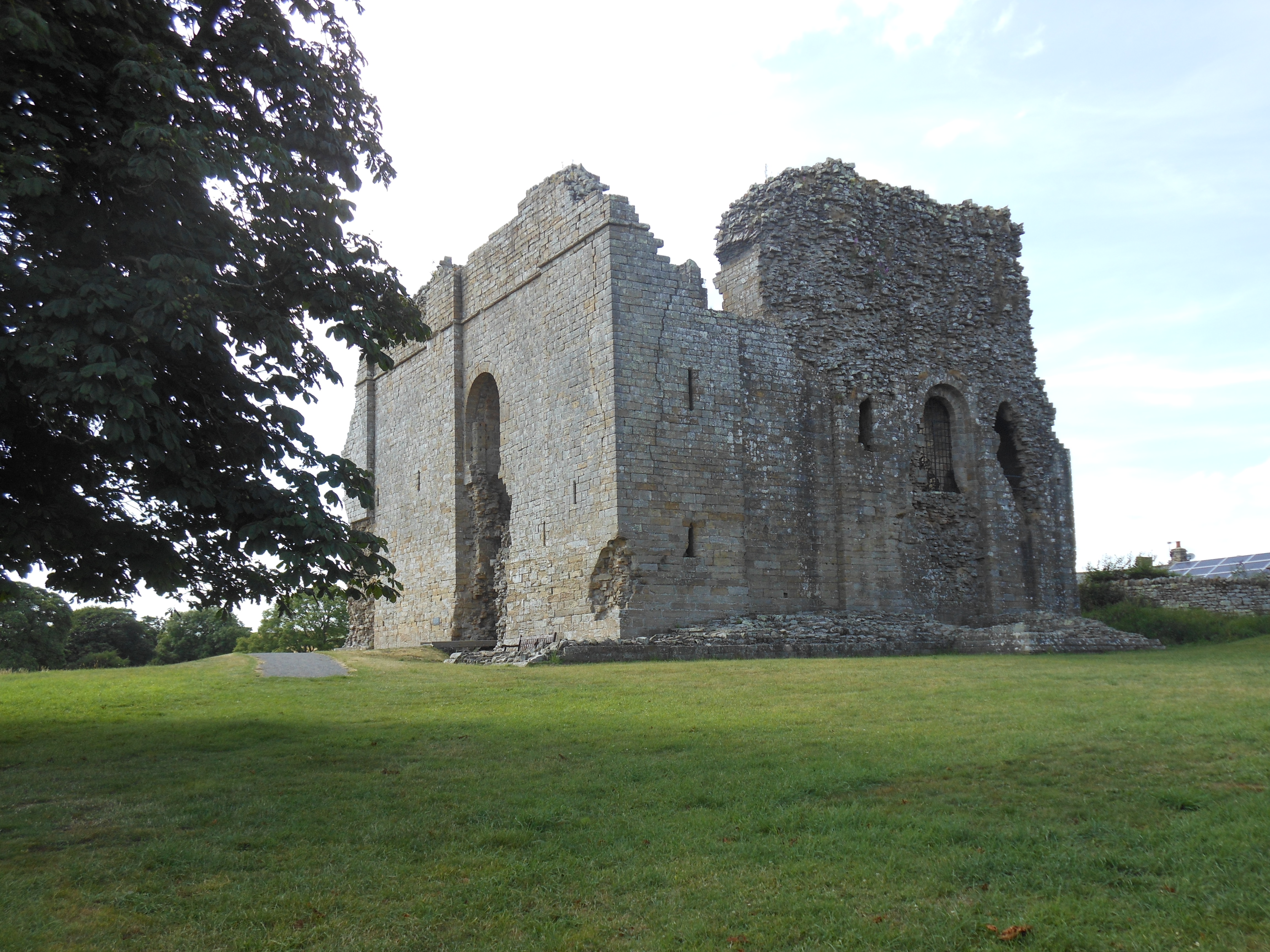
Baldwin, the Archbishop of Canterbury at the time, opposed the marriage as the couple were related within the prohibited degrees, both being a great-grandchild of Henry I, and ordered that they should not live together as husband and wife. John promised to seek a papal dispensation, in order to overcome Baldwin’s objections – although it appears this was never obtained. Nevertheless, John and Isabella were married on 29 August, 1189, at Marlborough Castle, Wiltshire. Although Isabella and John were married for ten years, their marriage was neither happy nor successful. They spent some time together in the first years of their marriage and issued joint charters during a visit to Normandy around 1190–91. However, they appear to have spent less and less time in each others’ company as the years went on. They never had any children and it is during this time in his life that John’s illegitimate children, including Richard of Chilham and Joan Lady of Wales, were probably born. In 1193, as part of his plotting with Philip Augustus, John promised to marry the French king’s half-sister, Alys, who had previously been betrothed to John’s own brother, Richard. Nothing eventually came of the marriage proposal, but it was an implicit rejection of Isabella as his wife.
John succeeded to the throne on the death of his older brother Richard I – the Lionheart – on 6 April 1199. He was crowned king on 27 May 1199; the fact that Isabella was not crowned alongside him, suggests that John was already looking for a way out of the marriage. Isabella would never be styled Queen of England.
Within months of his succession, possibly as early as 30 August 1199 (the day after their 10th wedding anniversary), but certainly by 1200, John had obtained a divorce on the grounds of consanguinity; the bishops of Lisieux, Bayeux and Avranches, sitting in Normandy, provided the required judgement.
However, in order to keep his hold on the substantial Gloucester lands, John imposed a royal wardship on Isabella for the next 14 years. When John remarried, to Isabelle d’Angouleme, his new, young wife (she was no more than 12 on her wedding day and possibly a year or two younger) was lodged with Isabella of Gloucester at Winchester, the countess’s allowance was raised from £50 to £80 to cover the extra expenditure that comes with housing a queen. John’s wife and ex-wife were housed together until a few weeks before the birth of Isabelle’s first child by John, the future King Henry III, who was born in 1207.
The king eventually arranged a new marriage for Isabella, to a man who was over 16 years her junior. In 1214, although possibly past child-bearing age – certainly safe child-bearing age – she was married to Geoffrey de Mandeville, Earl of Essex, who had paid the considerable sum of 20,000 marks to become her second husband and Earl of Gloucester ‘jure uxoris‘ (by right of his wife), a huge sum which he could never hope to repay. Indeed, he soon defaulted on his payments. Just 2 years later, in 1216, de Mandeville died from wounds he had received in a tournament in London.
One of the Magna Carta sureties, de Mandeville was in a state of rebellion against the king when he died; as a result, all his lands and titles – including the earldom of Gloucester – were forfeit to the crown. Isabella’s feelings towards John may well be seen in the fact that, even after de Mandeville’s death, she continued to support the rebels. Isabella was now a widow and although virtually penniless appears to have reveled in her first taste of freedom, styling herself on one charter ‘Countess of Gloucester and Essex in my free widowhood’. It was not until 17th September 1217, almost a year after the death of King John, that Isabella’s lands were returned to her.
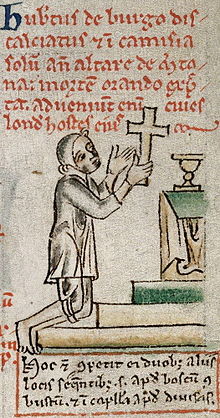
At about the same time – or shortly after – Isabella was married for a third and final time, to Hubert de Burgh. Hubert De Burgh had become Chief Justiciar of England in 1215 and would rise to be Regent during the minority of Henry III. It was only several years after Isabella’s death that he would be created Earl of Kent.
On 13 October 1217 the sheriffs of nine counties were ordered to relinquish custody of Isabella’s lands to de Burgh. This final marriage was, sadly, very short-lived and Isabella was dead within only a few weeks of her wedding day and almost exactly a year after the death of her first husband, King John.
Isabella died on 14 October 1217, probably at Keynsham Abbey near Bristol, and was buried at the cathedral of Christ Church, Canterbury. Shortly before her death, Isabella made a grant to the monks of Canterbury, of £10 of land in her manor of Petersfield, Hampshire, which was witnessed by Hubert de Burgh and other members of his household.
In spite of her three marriages, Isabella never had children and was succeeded to the earldom of Gloucester by her nephew, Gilbert de Clare.
She was laid to rest in Canterbury Cathedral, Kent.
*
Isabella of Gloucester’s story appears in greater detail in my book, Ladies of Magna Carta: Women of Influence in Thirteenth Century England.
Further Reading: Robert Bartlett England Under the Norman and Angevin Kings 1075-1225; Dan Jones The Plantagenets; the Kings who Made England; The Plantagenet Chronicle Edited by Elizabeth Hallam; Maurice Ashley The Life and Times of King John; Roy Strong The Story of Britain; Oxford Companion to British History; Mike Ashley British Kings & Queens; David Williamson Brewer’s British Royalty; Rich Price King John’s Letters Facebook page; finerollshenry3.org.uk; Oxforddnb.com; magnacarta800th.com; Church, Stephen, King John: England, Magna Carta and the Making of a Tyrant; Danziger, Danny and John Gillingham, 1215: The Year of Magna Carta.
Pictures courtesy of Wikipedia.
*
My Books
Signed, dedicated copies of all my books are available through my online bookshop.
Out now: Scotland’s Medieval Queens

Scotland’s history is dramatic, violent and bloody. Being England’s northern neighbour has never been easy. Scotland’s queens have had to deal with war, murder, imprisonment, political rivalries and open betrayal. They have loved and lost, raised kings and queens, ruled and died for Scotland. From St Margaret, who became one of the patron saints of Scotland, to Elizabeth de Burgh and the dramatic story of the Scottish Wars of Independence, to the love story and tragedy of Joan Beaufort, to Margaret of Denmark and the dawn of the Renaissance, Scotland’s Medieval Queens have seen it all. This is the story of Scotland through their eyes.
‘Scotland’s Medieval Queens gives a thorough grounding in the history of the women who ruled Scotland at the side of its kings, often in the shadows, but just as interesting in their lives beyond the spotlight. It’s not a subject that has been widely covered, and Sharon is a pioneer in bringing that information into accessible history.’ Elizabeth Chadwick (New York Times bestselling author)
Available now from Amazon and Pen and Sword Books
Also by Sharon Bennett Connolly:

Heroines of the Tudor World tells the stories of the most remarkable women from European history in the time of the Tudor dynasty, 1485-1603. These are the women who ruled, the women who founded dynasties, the women who fought for religious freedom, their families and love. Heroines of the Tudor World is now available for pre-order from Amberley Publishing and Amazon UK. Women of the Anarchy demonstrates how Empress Matilda and Matilda of Boulogne, unable to wield a sword themselves, were prime movers in this time of conflict and lawlessness. It shows how their strengths, weaknesses, and personal ambitions swung the fortunes of war one way – and then the other. Available from Bookshop.org, Amberley Publishing and Amazon UK. King John’s Right-Hand Lady: The Story of Nicholaa de la Haye is the story of a truly remarkable lady, the hereditary constable of Lincoln Castle and the first woman in England to be appointed sheriff in her own right. Available from all good bookshops Pen & Sword Books, bookshop.org and Amazon.
Defenders of the Norman Crown: The Rise and Fall of the Warenne Earls of Surrey tells the fascinating story of the Warenne dynasty, from its origins in Normandy, through the Conquest, Magna Carta, the wars and marriages that led to its ultimate demise in the reign of Edward III. Available from Pen & Sword Books, Amazon in the UK and US, and Bookshop.org. Ladies of Magna Carta: Women of Influence in Thirteenth Century England looks into the relationships of the various noble families of the 13th century, and how they were affected by the Barons’ Wars, Magna Carta and its aftermath; the bonds that were formed and those that were broken. It is now available in paperback and hardback from Pen & Sword, Amazon, and Bookshop.org. Heroines of the Medieval World tells the stories of some of the most remarkable women from Medieval history, from Eleanor of Aquitaine to Julian of Norwich. Available now from Amberley Publishing and Amazon, and Bookshop.org. Silk and the Sword: The Women of the Norman Conquest traces the fortunes of the women who had a significant role to play in the momentous events of 1066. Available now from Amazon, Amberley Publishing, and Bookshop.org.
Alternate Endings: An anthology of historical fiction short stories including Long Live the King… which is my take what might have happened had King John not died in October 1216. Available in paperback and kindle from Amazon.
Podcast:

Have a listen to the A Slice of Medieval podcast, which I co-host with Historical fiction novelist Derek Birks. Derek and I welcome guests, such as Bernard Cornwell and Elizabeth Chadwick, and discuss a wide range of topics in medieval history, from significant events to the personalities involved.
Every episode is also now available on YouTube.
*
Signed and dedicated copies of all my books are available through my online store.
For forthcoming online and in-person talks, please check out my Events Page.
You can be the first to read new articles by clicking the ‘Follow’ button, liking our Facebook page or joining me on Twitter, Threads, Bluesky and Instagram.
©2015 Sharon Bennett Connolly FRHistS


 History... the interesting bits!