Elizabeth Mure, Robert II and a Question of Legitimacy

Books by Sharon Bennett Connolly
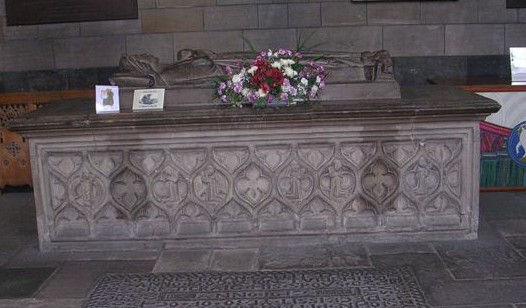
Tomb of Marjorie Bruce, Paisley Abbey

Robert II, King of Scots, had been born on 2 March 1316, as the grandson and heir of Robert the Bruce. His mother. Marjorie Bruce, had died at the time of his birth, or shortly after. He had been supplanted as his grandfather’s heir when Bruce’s queen, Elizabeth de Burgh, gave birth to a son, David Bruce, in 1324. David was crowned as King David II on his father’s death in 1329. Although only 5-years-old, David was already a married ‘man’, having wed Edward III’s 7-year-old sister, Joan of the Tower, in July 1328.

Edward III saw an opportunity in Scotland having a child-king and, notwithstanding the headache he was causing his own sister, he decided to support the claims, to the Scottish crown, of Edward Balliol, son of the deposed king, John Balliol, and his wife, Isabella de Warenne. Edward III invaded Scotland. King David and his young wife were sent to France for their safety, while the Scots fought for the kingdom. One of those leading the fight was Robert Stewart, David’s nephew – Robert the Bruce’s grandson. He had become High Steward of Scotland on his father’s death in 1327. He was made guardian of Scotland whilst still in his late teens and fought in the defeat of the Scots at Halidon Hill in July 1333, when he was still only 17.

Robert was David II’s heir – until the latter produced a son and heir of his own, at least. Uncle and nephew had a fractious relationship, even after David returned from French exile. David may have resented the reputation Robert had gained in fighting for Scottish independence, and he was certainly wary of Robert’s powerful position, as High Steward, guardian and – of course – as heir presumptive to the crown.
Books by Sharon Bennett Connolly
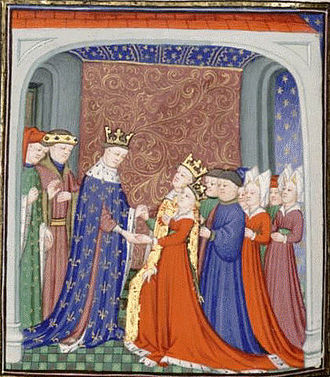
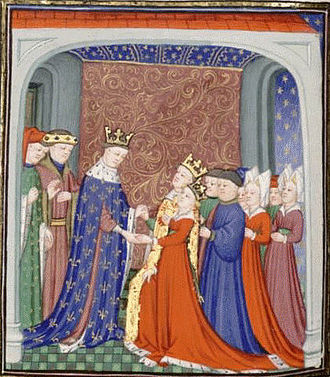
David II and Joan being greeted by Philip VI of France

Robert’s strength, however, lay not only in his proximity to the throne, but also in the fact he had managed to do what David had not, produce an heir. Six, in fact. Robert’s rather unusual marital situation, and perhaps the growing awareness, as the years went on, that there was less and less likelihood of David producing an heir, saw him apply for a papal dispensation to marry Elizabeth Mure, which was supported by King David, King Philip VI of France, the seven Scottish bishops and parliament. It was granted on 22 November 1347, at least ten years after the start of their relationship. The dispensation allowed for the retrospective legitimisation of their children:

This Robert took to his bed one of the daughters of Adam More, knight; and of her he begat sons and daughters, out of wedlock. But he afterwards – in the year 1349, to wit – bespoke and got the dispensation of the Apostolic See, and espoused her regularly, according to the forms of the Church.1

An earlier dispensation, issued in 1345, had annulled Elizabeth’s betrothal to Hugh Giffard. Elizabeth was the daughter of Adam Mure of Rowallon, Ayrshire. Though whether her mother was his first wife, Joan Cunnigham, or his second wife, Janet, is undetermined. The unusual nature of their relationship and marital situation has given rise to questions over the legitimacy of their children. According to John Riddell, the facts of the relationship are that:

Robert II, when related to Elizabeth Mure, in the third and fourth forbidden degrees of affinity, and the fourth forbidden degree of consanguinity, lived for a long space in concubinage with her, during which ‘prolis utriusque sexus multitudinem procrearunf’ – during that unhallowed, and in law, incestuous connection; till at last, resolving to marry, but discovering the double relationship between them, which was a bar to their marriage at common (Ecclesiastical) law, they then obtained a dispensation from Clement VI, in 1347, for the purpose, in ordinary form. After which it is in proof, that they did marry under authority of the dispensation, – Robert founding in 1364, in compliance with an injunction there, a Chaplainry, in expiation of his former offence, which was, by received doctrine at the time, deemed an aggravated one.2
Books by Sharon Bennett Connolly
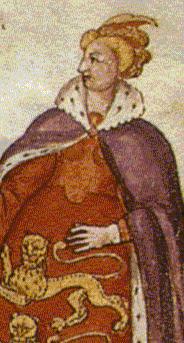
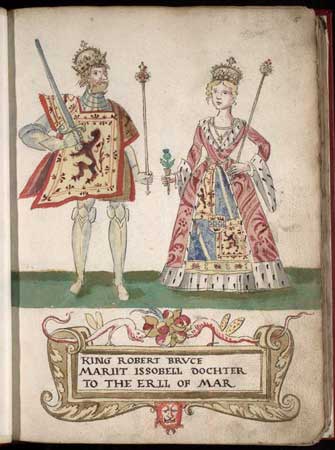
Robert II’s maternal grandparents, Robert the Bruce and his first wife, Isabella of Mar

It has been argued that the children of Robert and Elizabeth were not only born outside of marriage, but also that their parents were related within the limited degrees, and therefore the relationship was incestuous without a papal dispensation. This, however, ignores the possibility that Robert and Elizabeth did go through a form of marriage in the 1330s, when Scotland was deeply involved in its war with England and, with David II sent to France for his safety and Robert was the senior representative of the Bruce family in Scotland. Moreover, it may have been thought prudent that Robert should marry sooner, rather than later, for dynastic considerations. With Edward Balliol unmarried and with no heir, the fact that the king’s heir was married with children was significant, a sign that the Bruce–Stewart dynasty was secure, at least.

That the marriage was not regularised until the war was over could be excused by the fact there were more urgent matters to attend to and the financial and legal obligations of obtaining a dispensation could wait. This would certainly explain the papacy’s willingness to regulate the marriage by issuing a retroactive dispensation. Alternatively, they may have only recently discovered a familial relationship within the prohibited degrees, and therefore applied for a dispensation. Elizabeth and Robert then underwent a second, formal, marriage ceremony in 1349.

Their first child, John, had been born in about 1337 and was created Earl of Carrick in 1369, the title held by his great-grandfather, Robert the Bruce, before he became king. He would ascend the throne as Robert III on his father’s death in 1390. Although the birth order could be slightly different, it seems likely that John was followed by a sister, Margaret, who was married to John MacDonald, Lord of the Isles, as his second wife, for which a papal dispensation was issued on 14 June 1350. The couple were granted the island of Colowsay by Margaret’s father in a charter dated to July 1376. Three more sons followed, Walter, Robert and Alexander. Walter was married to Isabel, Countess of Fife, in April 1360 or 1361. He died sometime after 14 August 1362 but before the end of the year, as his widow married again, to Thomas Bisset of Upsetlington on 10 January 1363. She resigned the earldom of Fife to Walter’s brother, Robert Stewart, Earl of Menteith, on 30 March 1371.

Robert Stewart is identified as the ‘second born of the king’ in the Liber Pluscardensis. Robert was Earl of Menteith by right of his wife, Margaret Graham, a title she herself had inherited from her mother, Mary. Margaret had been married three times before; her first husband, Sir John Moray, was the son of Christian Bruce, King Robert I’s sister, by her last husband, Sir Andrew Murray. Robert was later created Duke of Albany and acted as regent during his brother’s reign.
Books by Sharon Bennett Connolly
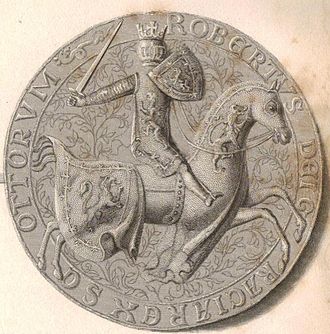
The reverse side of Robert II’s Great Seal

The third son, Alexander, has a significant reputation as a cruel and rapacious character, earning him the nickname, the Wolf of Badenoch. He married Euphemia, Countess of Ross and was Earl of Ross in her name. Euphemia resigned her share of Buchan to the king, who regranted it to Alexander and Euphemia, in July 1382, so that they were Earl and Countess of Ross and Buchan. The marriage had its difficulties and Alexander left his wife, for ‘Mariota’s daughter Athyn’ but was ordered to return to her, in a charter dated 2 November 1389, by the Bishop of Moray and Ross. Apparently, the breach was irretrievable, as Pope Clement VII ‘issued a commission to dissolve her marriage’ on 9 June 1392, and in December 1392 Euphemia was granted a divorce ‘from bed and board’.3 Although Alexander had seven illegitimate children, he and Euphemia had remained childless.

Robert II and Elizabeth Mure also had four more daughters, although their order of birth is unknown. Marjory married John Dunbar, the son of Patrick Dunbar and Isabel Randolph of Moray. He was created Earl of Moray by his father-in-law in March 1372. Marjory’s second husband was Alexander Keith of Grandown.

Jean, or Joan, Stewart was married three times, firstly to John Keith, son of William de Keith, the Marischal, in January 1374. John died just fourteen months later. A year after that, in either June or October 1376, Jean married Sir John Lyon of Glamis. On 4 October 1376, King Robert II granted land, the thanedom of Tannadyce in Forfar, possibly a wedding gift, ‘to his dearest son John Lyon and Johanna his wife, the King’s beloved daughter’.4 The marriage was initially kept secret and only publicly acknowledged on 10 May 1378 when the king, with the consent of his surviving sons, ‘granted to the spouses letters of acknowledgement and remission for any clandestine marriage formerly contracted by them, in regard a marriage had been solemnly celebrated between them in face of the Church, in presence of the King and his sons and other friends and relatives.’5 Further grants followed, but Sir John was killed, apparently murdered by Sir James Lindsay on 4 November 1382. According to the Liber Pluscardensis, the deed was done at night when the ‘victim was in bed and unsuspecting’.6 Their only child was John’s son and successor, also called John Lyon. On 20 November 1384, Jean married for a third and final time, to Sir James Sandilands of Calder. Ahead of the marriage, Sir James was granted the baronies of Dalzell, Motherwell and Wiston, to be held by Sir James and Jean, the king’s daughter, ‘whom God willing he is about to take to wife’.7 The princess is last mentioned in 1404, as ‘Lady Johanna of Glammys’. She was buried beside her second husband, Sir John Lyon, at Scone Abbey.

Another daughter, Elizabeth Stewart, married Thomas Hay, Baron of Erroll and Constable of Scotland. A charter issued by King Robert II granted an annuity to ‘Thomas Hay and Elizabeth the king’s daughter, and the children born and to be born of them’ dated 7 September 1372, the day of their marriage.8

Isabel Stewart was married twice, firstly to James Douglas, son of William Douglas, Earl of Douglas, and his wife, Margaret, Countess of Mar. A papal dispensation was issued for the marriage in September 1371 and James succeeded his father as Earl Douglas in 1384. Sir James died in 1388 and sometime in the next two years, Isabel married John Edmonstone of Duntreath. Isabel most likely died before 22 July 1410, when accounts record payments to ‘John Edmonstone … for the reason that he was once married to the Countess of Douglas’.9

Through the marriages of his sons and daughters, Robert Stewart created a familial network that extended his influence over the greater part of central, western and north-eastern Scotland. He formed unions with eight of the country’s fifteen existing earldoms as well as gaining other lordships, royal castles and offices north of the Forth-Clyde line. However, the unusual nature of the marriage of Robert and Elizabeth would always leave a question mark hanging over the legitimacy of their children, an uncertainty that the children of Robert’s second marriage would highlight and try to exploit.
Books by Sharon Bennett Connolly
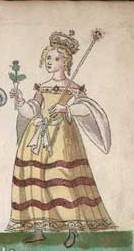
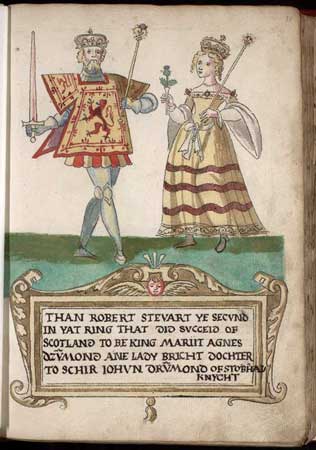
Robert III and his queen, Annabella Drummond

But it was Elizabeth’s eldest son, John, Earl of Carrick, who would succeed his father as King Robert III. Elizabeth herself, though married to David II’s heir, was never to become queen. She died sometime before 1355, possibly in childbirth as she would have been no more than in her late 30s, or perhaps from complications arising from having borne at least nine children, and possibly as many as thirteen. We have so little information about her that her place of burial is also unknown, though Paisley Abbey or Scone Abbey are possibilities. We only know that poor Elizabeth was dead by 1355 because 2 May of that year is the date of the papal dispensation for Robert Stewart’s second marriage, to Euphemia Ross.

Whatever the nature of their marriage, and the reason for the dispensation, it was not an arranged marriage for dynastic purposes. Robert and Elizabeth appear to have chosen each other. The number of children born, even during times of war, suggests that Robert and Elizabeth had a close and loving relationship. This did not, however, preclude Robert from marrying again, possibly only a short time after Elizabeth’s death. Walter Bower suggests that, although Robert’s relationship with Elizabeth Mure was earlier, the marriage only occurred after Queen Euphemia’s death:

It is noteworthy that the said King Robert fathered three sons by the Lady Elizabeth daughter of Sir Adam More, namely John who was later king, and Robert duke of Albany, and the said Alexander earl of Buchan, who was commonly called ‘The Wolf of Badenoch’. Later he married the Lady Euphemia daughter of Hugh earl of Ross, by whom he fathered Walter earl of Athol and lord of Brechin, and David earl of Strathearn. But on the death of Queen Euphemia he married the said Lady Elizabeth, and so by virtue of subsequent marriage, a second marriage ceremony, the said brothers John, Robert and Alexander were legitimated, for according to canon law a subsequent marriage legitimates sons born before the marriage.10
Books by Sharon Bennett Connolly
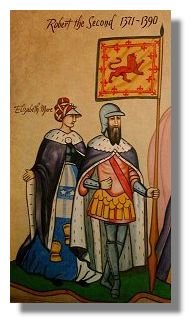
Robert II and Elizabeth Mure

This timeline, of course, does not work, as the papal dispensation, legitimising the children, was issued in 1347 and there is every indication that Elizabeth was dead before 1355.

King Robert II died at Dundonald Castle on 19 April 1390 and was buried at Scone Abbey. He had spent almost his entire life as heir presumptive to the Scottish throne, always waiting on the sidelines. It is a sad fact of history that we have very little insight into the personalities and appearances of Robert’s wives. We do not know, for instance, what either wife thought of his various mistresses, nor his illegitimate children. They cannot have been happy about his philandering but may have accepted it, reluctantly. It was certainly not an unusual trait in the men of the family, as both Robert the Bruce and David II had had a string of mistresses.

Robert’s first wife, Elizabeth Mure, never got to wear the crown, though her influence, through her children, would set the tone for the Scottish royal house of Stewart into the next century.

We shall leave the story Robert’s second wife, Queen Euphemia, for another day.

*

Images: courtesy of Wikipedia

Notes:

1. John of Fordun’s Chronicle of the Scottish Nation; 2. John Riddell, Stewartiana, containing the case of Robert II and Elizabeth Mure; 3. Sir James Balfour Paul, editor, The Scots Peerage, Vol. VII; 4. ibid, Vol VIII; 5. ibid; 6. ibid; 7. ibid; 8. Burnett (1880) Exchequer Rolls, Vol. IV; 9. ibid; 10. Bower, Scotichronicon, V 7.

Sources:

John of Fordun’s Chronicle of the Scottish Nation, edited by W. F. Skene; Walter Bower, Scotichronicon; John Riddell, Stewartiana, containing the case of Robert II and Elizabeth Mure; Sir James Balfour Paul, editor, The Scots Peerage; fmg.ac/Projects/MedLands/SCOTLAND; Susan Abernethy, The Two Wives of Robert II, King of Scots – Elizabeth Mure and Euphemia Ross; G. Barrow, G. (1978), The Aftermath of War: Scotland and England in the late Thirteenth and early Fourteenth Centuries; Rosalind K. Marshall, Scottish Queens 1034–1714; Nigel Tranter, The Story of Scotland; Richard Oram, editor, The Kings and Queens of Scotland; David Ross, Scotland, History of a NationLiber pluscardensis, edited by Felix James Henry Skene.

*

My Books

Signed, dedicated copies of all my books are available through my online bookshop.

Out now: Scotland’s Medieval Queens

Books by Sharon Bennett Connolly

Scotland’s history is dramatic, violent and bloody. Being England’s northern neighbour has never been easy. Scotland’s queens have had to deal with war, murder, imprisonment, political rivalries and open betrayal. They have loved and lost, raised kings and queens, ruled and died for Scotland. From St Margaret, who became one of the patron saints of Scotland, to Elizabeth de Burgh and the dramatic story of the Scottish Wars of Independence, to the love story and tragedy of Joan Beaufort, to Margaret of Denmark and the dawn of the Renaissance, Scotland’s Medieval Queens have seen it all. This is the story of Scotland through their eyes.

Scotland’s Medieval Queens gives a thorough grounding in the history of the women who ruled Scotland at the side of its kings, often in the shadows, but just as interesting in their lives beyond the spotlight. It’s not a subject that has been widely covered, and Sharon is a pioneer in bringing that information into accessible history.’ Elizabeth Chadwick (New York Times bestselling author)

Available now from Amazon and Pen and Sword Books

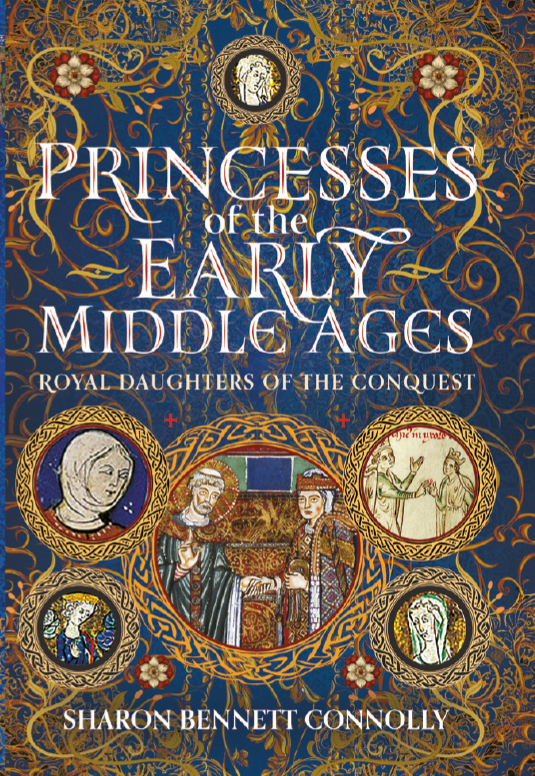
Coming 30 March 2026: Princesses of the Early Middle Ages
Books by Sharon Bennett Connolly

Daughters of kings were often used to seal treaty alliances and forge peace with England’s enemies. Princesses of the Early Middle Ages: Royal Daughters of the Conquest explores the lives of these young women, how they followed the stereotype, and how they sometimes managed to escape it. It will look at the world they lived in, and how their lives and marriages were affected by political necessity and the events of the time. Princesses of the Early Middle Ages will also examine how these girls, who were often political pawns, were able to control their own lives and fates. Whilst they were expected to obey their parents in their marriage choices, several princesses were able to exert their own influence on these choices, with some outright refusing the husbands offered to them.

Their stories are touching, inspiring and, at times, heartbreaking.

Princesses of the Early Middle Ages: Royal Daughters of the Conquest is now available for pre-order.

Also by Sharon Bennett Connolly:

Books by Sharon Bennett Connolly

Heroines of the Tudor World tells the stories of the most remarkable women from European history in the time of the Tudor dynasty, 1485-1603. These are the women who ruled, the women who founded dynasties, the women who fought for religious freedom, their families and love. Heroines of the Tudor World is now available from Amberley Publishing and Amazon UK. Women of the Anarchy demonstrates how Empress Matilda and Matilda of Boulogne, unable to wield a sword themselves, were prime movers in this time of conflict and lawlessness. It shows how their strengths, weaknesses, and personal ambitions swung the fortunes of war one way – and then the other. Available from Bookshop.orgAmberley Publishing and Amazon UKKing John’s Right-Hand Lady: The Story of Nicholaa de la Haye is the story of a truly remarkable lady, the hereditary constable of Lincoln Castle and the first woman in England to be appointed sheriff in her own right. Available from all good bookshops Pen & Sword Booksbookshop.org and Amazon

Royal Historical Society

Defenders of the Norman Crown: The Rise and Fall of the Warenne Earls of Surrey tells the fascinating story of the Warenne dynasty, from its origins in Normandy, through the Conquest, Magna Carta, the wars and marriages that led to its ultimate demise in the reign of Edward III. Available from Pen & Sword BooksAmazon in the UK and US, and Bookshop.orgLadies of Magna Carta: Women of Influence in Thirteenth Century England looks into the relationships of the various noble families of the 13th century, and how they were affected by the Barons’ Wars, Magna Carta and its aftermath; the bonds that were formed and those that were broken. It is now available in paperback and hardback from Pen & SwordAmazon, and Bookshop.orgHeroines of the Medieval World tells the stories of some of the most remarkable women from Medieval history, from Eleanor of Aquitaine to Julian of Norwich. Available now from Amberley Publishing and Amazon, and Bookshop.orgSilk and the Sword: The Women of the Norman Conquest traces the fortunes of the women who had a significant role to play in the momentous events of 1066. Available now from Amazon,  Amberley Publishing, and Bookshop.org.

Alternate Endings: An anthology of historical fiction short stories including Long Live the King… which is my take what might have happened had King John not died in October 1216. Available in paperback and kindle from Amazon.

Podcast:

A Slice of Medieval

Have a listen to the A Slice of Medieval podcast, which I co-host with Historical fiction novelist Derek Birks. Derek and I welcome guests, such as Ian Mortimer, Bernard Cornwell, Elizabeth Chadwick and Scott Mariani, and discuss a wide range of topics in medieval history, from significant events to the personalities involved. 

There are now over 80 episodes to listen to!

Every episode is also now available on YouTube.

*

Don’t forget! Signed and dedicated copies of all my books are available through my online bookshop.

For forthcoming online and in-person talks, please check out my Events Page.

You can be the first to read new articles by clicking the ‘Follow’ button, liking our Facebook page or joining me on TwitterThreadsBluesky and Instagram.

*

©2025 Sharon Bennett Connolly FRHistS

Black Agnes

History ... the Interesting Bits
Agnes of Dunbar (from a children’s book)

You may have noticed that I love the stories of women from medieval times who do the remarkable, who will defy a tyrant or hold a castle while under siege. Women like Nicholaa de la Haye. And yet, Nicholaa was not the only medieval woman to hold tenaciously to a castle under siege. It was more common than one might think. Matilda de Braose (or Briouze), the Lady of Hay, was another such, who held her castle against the besieging Welsh; as was Agnes of Dunbar, known to history as Black Agnes and a woman who was a blight on English forces in Scotland. Agnes was a bold lady whose acts of defiance against the English would surely have impressed Nicholaa, nationalities aside, of course.

Agnes was the eldest daughter of Thomas Randolph, 1st Earl of Moray, and his wife Isabel, a daughter of Sir John Stewart of Bunkle. Thomas Randolph was a favoured nephew of Robert the Bruce, King of Scots, and one of his most stalwart supporters. Randolph was rewarded with the earldom of Moray and the appointment as guardian during the minority of King Robert’s son and successor, David II, in 1329.

There is very little known of the early life of Agnes, until about 1320, when she was married to Patrick, Earl of Dunbar. We can imagine that Agnes envisioned a life as a typical laird’s lady, raising children, looking after the land and tenants while her husband was away fighting. Unfortunately, Agnes and Patrick would remain childless, so the countess was not preoccupied with raising children. Agnes’s younger sister, Isabel, was married to Sir Patrick Dunbar, Earl Patrick’s cousin, and it would be their son, George, who would be made heir to Earl Patrick and Agnes.

From the timing of the marriage, we can surmise that Agnes was probably born just after the turn of the century, into a country struggling to gain independence from its aggressive neighbour, England. It would, therefore, not be unreasonable to assume that she saw little of her father during her early years as he was frequently away fighting; even after the Scottish victory at Bannockburn in 1314, Randolph continued in active service for the Scottish crown, fighting with Robert the Bruce in Ireland in 1317, and in the borders with England in 1318 and 1319.

Scotland’s troubles continued long into the reign of David II, with the English backing David’s rival, Edward Balliol, son of Scotland’s former king, John Balliol. This despite David II being married to Edward III’s sister, Joan of the Tower. The throne would pass back and forth between the two claimants for several years. When Agnes’s father died in 1332, he was succeeded by her brother Thomas, who was killed just weeks later, at the Battle of Dupplin Moor, fighting those who had been disinherited during the Wars of Independence. Thomas, in turn, was succeeded by another brother, John, who was killed fighting the English at the Battle of Neville’s Cross in 1346.

History ... the Interesting Bits
Arms of Patrick, Earl of March

On John’s death, the earldom of Moray would pass to Agnes’s husband in right of his wife. Agnes and Patrick were cousins within the prohibited degree of consanguinity and a dispensation had been needed for them to marry. According to the chronicler, Pitscottie, she gained her name of Black Agnes ‘be ressone she was blak skynnit’, suggesting Agnes had a dark complexion; her black hair, dark eyes and olive skin more common among Mediterranean countries than the northern fastness of Scotland.1 The English attributed a different reason to her name, to them, Black Agnes was the most evil Scotswoman who ever lived. Pitscottie went on to say of Agnes that she was ‘of greater spirit than it became a woman to be’, which, given her actions in the face of the enemy, is a fair appraisal of an incredible woman.2

Agnes was not the only woman to become heavily involved in the Scottish Wars of Independence, which had been a different kind of war from the very beginning. Robert the Bruce’s wife, daughter and sisters had been imprisoned for eight years by Edward I; his sister Christian would herself become involved in the fighting during her nephew David’s reign, defending the castle of Kildrummy against the supporters of Edward Balliol, in 1335.

Most of Agnes Randolph’s life is shrouded in mystery; there is very little mention of her existence until the English army appeared before her castle of Dunbar in January 1338. With the resumption of hostilities between England and Scotland in the 1330s, the castle of Dunbar became strategically important for both sides.

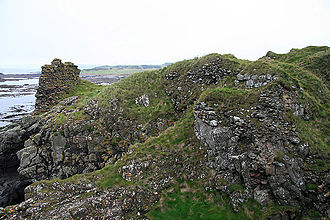
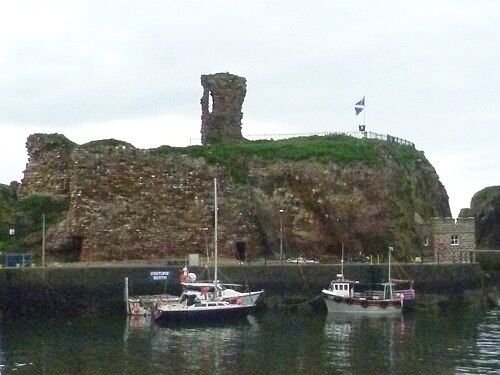
The stronghold had been rebuilt, at the expense of Edward III, in 1333, but by 1337 it was standing against England’s king. English affairs in the north lay in the hands of Richard (II) FitzAlan, Earl of Arundel, and William Montague, Earl of Salisbury, and it was these two experienced military leaders who decided to launch an English offensive by attacking Dunbar. An impressive stronghold, the castle was all but impregnable; it was built at the mouth of the Dunbar harbour, on separate rocks, with interlinking bridges and corridors.

History ... the Interesting Bits
The castle of Dunbar

Strategically, the castle’s position made it impossible for the English to march past it and leave it behind them, intact, able to harry the invaders and cut their lines of communication with England. Earl Patrick was away from home at the time, however, Scottish writer Nigel Tranter suggests that Agnes deliberately allowed herself to be besieged to give the Scottish forces time to rally and organise a resistance to the English invasion. Even so, it must have been a terrifying sight for the countess to look out from the battlements and see an army approaching; and the English earls must surely have been confident that they could beat the countess and her reduced garrison.

In January 1338, the English laid siege to Dunbar, surrounding it as best they could. The army had brought a legion of engineers with it, thus ensuring that a vast number of siege engines could be constructed and the castle’s inhabitants would face an almost constant barrage from missiles. When Salisbury demanded that Agnes surrender, she is said to have responded,

Of Scotland’s King I haud my House,
He pays me meat and fee,
And I will keep my gude and house,
While my house will keep me.3

The siege didn’t go exactly as the English planned. Agnes mocked them at every opportunity, appearing on the battlements even during bombardments. She is said to have had her maids dusting the battlements where they had been struck by missiles. When a siege engine known as a sow (a battering ram) was brought to face the castle, Agnes is said to have taunted the English by shouting ‘Beware, Montagow, for fallow shall they sow.’ The Scots would use the displaced rocks, caused by the barrages, and the missiles that had been fired at them, and rain them back down on their enemies. As the sow was destroyed and the English took cover, Agnes is said to have shouted ‘Behold the litter of English pigs.’4 Attack after attack was repulsed by Agnes and her men; a ballad, said to have been written by Salisbury himself, demonstrates Agnes’ steadfast attitude:

History ... the Interesting Bits
William Montague, from the Salisbury Roll

She makes a stir in tower and trench,
That brawling, boisterous, Scottish wench;
Came I early, came I late,
I found Agnes at the gate!5

The English even tried subterfuge to win the castle, bribing one of the castle’s guards to raise the gate and allow entry to the English attackers. However, the guard, having taken the money, went straight to Agnes:

Believing that they were going to be entering the castle, the Earl and his soldiers arrived at the gate. The guards, thinking Salisbury would be first to enter, dropped the gate after the first soldier stepped into the castle. Fortunately for Salisbury, one of his men had passed him on the approach. The thwarted earl retreated back to his camp with Agnes yelling at him from the castle walls: ‘Fare thee well Montague, I meant that you should have supped with us and support us in upholding the castle from the English!’5

At one point, the English used Agnes’s brother John Randolph in an attempt to persuade her to submit. One of the regents of Scotland during David II’s minority, John had been ambushed and captured in 1335. He was brought before Dunbar Castle, where Salisbury threatened to hang him in full view of his sister. Unperturbed, Agnes responded that John’s death could only be to her own benefit; although she could not inherit John’s titles, she was, alongside her sister, co-heir to his lands. John was given a reprieve and sent to imprisonment in England. Ironically, he would be freed in 1341 as part of a prisoner exchange; for the earl of Salisbury, of all people!

The problem for the English lay in the fact that they could not entirely surround the castle. Although they could besiege it from the land, the castle was still accessible by sea. An English fleet was guarding the harbour, but Sir Alexander Ramsay of Dalhousie managed to replenish the castle’s dwindling supplies by using a fleet of fishing boats, approaching in the early dawn from the cover of the Bass Rock. He managed to sneak through the enemy lines, making a dash for the harbour before the larger English vessels could get underway. Ramsay managed to land vital supplies and reinforcements for the garrison through a partially submerged entrance.

Agnes even sent the Earl of Salisbury some fresh-baked food when she knew the English supplies were running low, taunting the poor earl. Eventually, Agnes’s resistance proved too much for the English army, and, after nineteen weeks, on 10 June 1338, they lifted the siege, claiming their men and resources were needed for the king’s campaigns overseas. It had cost over £6,000, prompting one English chronicler to record that the siege had been ‘wasteful, and neither honourable nor secure, but useful and advantageous to the Scots’.6

History ... the Interesting Bits
David II, King of Scots, and Edward III, King of England

The struggle against the English continued for several more years, but David II and his queen, Joan of the Tower, the daughter of Edward II and sister of Edward III, returned to Scotland amid great rejoicing in 1341; only for David to become a captive of Edward III following the Battle of Neville’s Cross in 1346. Scotland’s king spent eleven years in English captivity, while Scotland was ruled by his nephew and heir, Robert the Steward.

David returned in 1357, the same year that Patrick, Earl of Dunbar, participated in the raid that saw Berwick returned to Scottish sovereignty, for a short time at least. Earl Patrick continued to witness royal charters until July 1368 and remained active in Scottish affairs until his death in 1369. When Agnes also died in 1369, aged about 57, her father’s earldom and that of her husband passed to her nephew, George Dunbar.

Agnes of Dunbar was a women of status, raised to command households, if not men, who stepped up to the mark when the occasion demanded it. Although she was not educated in military techniques and tactics, she had lived within a world that was constantly on a war footing and when faced with a fight, she rose to the challenge. With her death, Black Agnes passed into legend, her tenacity and stalwart defence of Dunbar Castle a shining example of what a mere woman can be capable of achieving.

Images:

Courtesy of Wikipedia

Notes:

1. The historie and cronicles of Scotland … by Robert Lindesay of Pitscottie, ed. A. J. G. Mackay, 3 vols, Scottish Text Society, 42–3, 60 (1899–1911); 2. ibid; 3. Kyra Cornelius Kramer, Black Agnes and Psychological Warfare, kyrackramer.com; 4. Nigel Tranter, The Story of Scotland; 5. Kramer, Black Agnes and Psychological Warfare; 6. Historia Anglicana

Sources:

The historie and cronicles of Scotland … by Robert Lindesay of Pitscottie, ed. A. J. G. Mackay, 3 vols, Scottish Text Society, 42–3, 60 (1899–1911); Kyra Cornelius Kramer, Black Agnes and Psychological Warfare, kyrackramer.com; Nigel Tranter, The Story of Scotland; oxforddnb.com; Brewer’s British Royalty by David Williamson; Kings & Queens of Britain by Joyce Marlow; Mammoth Book of British Kings & Queens by Mike Ashley; Oxford Companion to British History Edited by John Cannon; Britain’s Royal Families by Alison Weir; educationscotland.gov.uk/scotlandhistory; englishmonarchs.co.uk; The Perfect King by Ian Mortimer; Scotland, History of a Nation by David Ross; The Life & Times of Edward III by Paul Johnson; The Reign of Edward III by W.M. Ormrod

*

My Books

Signed, dedicated copies of all my books are available through my online bookshop.

Out now: Scotland’s Medieval Queens

Books by Sharon Bennett Connolly

Scotland’s history is dramatic, violent and bloody. Being England’s northern neighbour has never been easy. Scotland’s queens have had to deal with war, murder, imprisonment, political rivalries and open betrayal. They have loved and lost, raised kings and queens, ruled and died for Scotland. From St Margaret, who became one of the patron saints of Scotland, to Elizabeth de Burgh and the dramatic story of the Scottish Wars of Independence, to the love story and tragedy of Joan Beaufort, to Margaret of Denmark and the dawn of the Renaissance, Scotland’s Medieval Queens have seen it all. This is the story of Scotland through their eyes.

Scotland’s Medieval Queens gives a thorough grounding in the history of the women who ruled Scotland at the side of its kings, often in the shadows, but just as interesting in their lives beyond the spotlight. It’s not a subject that has been widely covered, and Sharon is a pioneer in bringing that information into accessible history.’ Elizabeth Chadwick (New York Times bestselling author)

Available now from Amazon and Pen and Sword Books

Coming 30 March 2026: Princesses of the Early Middle Ages

Books by Sharon Bennett Connolly

Daughters of kings were often used to seal treaty alliances and forge peace with England’s enemies. Princesses of the Early Middle Ages: Royal Daughters of the Conquest explores the lives of these young women, how they followed the stereotype, and how they sometimes managed to escape it. It will look at the world they lived in, and how their lives and marriages were affected by political necessity and the events of the time. Princesses of the Early Middle Ages will also examine how these girls, who were often political pawns, were able to control their own lives and fates. Whilst they were expected to obey their parents in their marriage choices, several princesses were able to exert their own influence on these choices, with some outright refusing the husbands offered to them.

Their stories are touching, inspiring and, at times, heartbreaking.

Princesses of the Early Middle Ages: Royal Daughters of the Conquest is now available for pre-order.

Also by Sharon Bennett Connolly:

Books by Sharon Bennett Connolly

Heroines of the Tudor World tells the stories of the most remarkable women from European history in the time of the Tudor dynasty, 1485-1603. These are the women who ruled, the women who founded dynasties, the women who fought for religious freedom, their families and love. Heroines of the Tudor World is now available from Amberley Publishing and Amazon UK. Women of the Anarchy demonstrates how Empress Matilda and Matilda of Boulogne, unable to wield a sword themselves, were prime movers in this time of conflict and lawlessness. It shows how their strengths, weaknesses, and personal ambitions swung the fortunes of war one way – and then the other. Available from Bookshop.orgAmberley Publishing and Amazon UKKing John’s Right-Hand Lady: The Story of Nicholaa de la Haye is the story of a truly remarkable lady, the hereditary constable of Lincoln Castle and the first woman in England to be appointed sheriff in her own right. Available from all good bookshops Pen & Sword Booksbookshop.org and Amazon

Royal Historical Society

Defenders of the Norman Crown: The Rise and Fall of the Warenne Earls of Surrey tells the fascinating story of the Warenne dynasty, from its origins in Normandy, through the Conquest, Magna Carta, the wars and marriages that led to its ultimate demise in the reign of Edward III. Available from Pen & Sword BooksAmazon in the UK and US, and Bookshop.orgLadies of Magna Carta: Women of Influence in Thirteenth Century England looks into the relationships of the various noble families of the 13th century, and how they were affected by the Barons’ Wars, Magna Carta and its aftermath; the bonds that were formed and those that were broken. It is now available in paperback and hardback from Pen & SwordAmazon, and Bookshop.orgHeroines of the Medieval World tells the stories of some of the most remarkable women from Medieval history, from Eleanor of Aquitaine to Julian of Norwich. Available now from Amberley Publishing and Amazon, and Bookshop.orgSilk and the Sword: The Women of the Norman Conquest traces the fortunes of the women who had a significant role to play in the momentous events of 1066. Available now from Amazon,  Amberley Publishing, and Bookshop.org.

Alternate Endings: An anthology of historical fiction short stories including Long Live the King… which is my take what might have happened had King John not died in October 1216. Available in paperback and kindle from Amazon.

Podcast:

A Slice of Medieval

Have a listen to the A Slice of Medieval podcast, which I co-host with Historical fiction novelist Derek Birks. Derek and I welcome guests, such as Bernard Cornwell, Elizabeth Chadwick and Scott Mariani, and discuss a wide range of topics in medieval history, from significant events to the personalities involved. 

There are now over 80 episodes to listen to!

Every episode is also now available on YouTube.

*

Don’t forget! Signed and dedicated copies of all my books are available through my online bookshop.

For forthcoming online and in-person talks, please check out my Events Page.

You can be the first to read new articles by clicking the ‘Follow’ button, liking our Facebook page or joining me on TwitterThreadsBluesky and Instagram.

*

©2025 Sharon Bennett Connolly FRHistS

‘Margaret of Logie, of high and noble birth’

Joan of the Tower, Queen of Scotland

When she died in September 1362, Joan of the Tower (also known as Joan Makepeace) had been Queen of Scots for thirty-three years. She had never borne a child, nor is there any mention of her ever having become pregnant. So, on her death, David II was still without a son and heir. The heir to the Scottish throne was Robert Stewart, the nephew he despised, who had six legitimate sons by 1362.

Following the murder of his lover, Katherine Mortimer, in 1360, and before Joan’s death, King David had fallen in love with Margaret Drummond. The first reference to Margaret and David’s relationship is in a charter of 20 January 1363, to the Friars Preacher, for the souls of David himself and of ‘our beloved’ Margaret Logie. Margaret was the daughter of a lowly Scottish knight, Sir Malcolm Drummond. She had been married to Sir John Logie of Logie and had at least one son, also called John.

The relationship with Margaret further alienated David’s heir, Robert Stewart, who was involved in a violent feud with Margaret’s brothers, John and Maurice Drummond. It also threatened to disinherit Robert, should Margaret give birth to a son. This could explain Robert’s involvement in a rebellion early in 1363, in which a petition was presented to the king, demanding that he set aside Margaret and dismiss his current advisers.

Despite the opposition to the relationship, ‘in the year 1363, the aforesaid lord David, king of Scotland, took to wife, at Inchmurdach, a great lady, named Margaret of Logie, of high and noble birth, and born in his kingdom; and he endowed her with many lands and possessions, and raised her to reign in honour with him, with the royal diadem.’1 They were married at Inchmurdoch, in the Fife manor house of the Bishop of St Andrews, though ‘Thai ware togiddyr bot schort quhile.’2

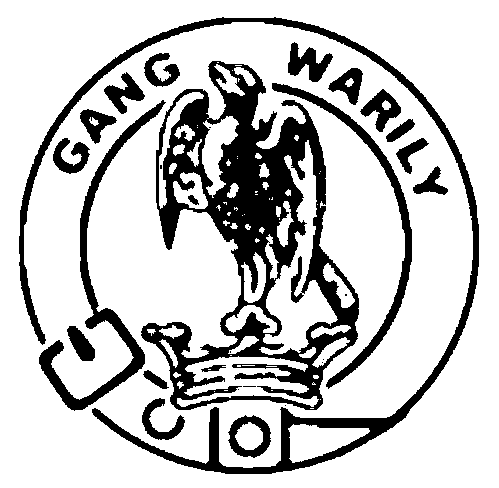
Crest badge of the Clan Drummond

According to the chroniclers, Margaret was very beautiful, but her character left much to be desired, ‘With the aim therefore of providing for the succession to the kingdom from the fruit of her womb (if God granted it), King David chose a most beautiful lady, Margaret Logie, the widow of John Logie, perhaps not so much for the excellence of her character as a woman as for the pleasure he took in her desirable appearance.’3 Once married, David gave preferential treatment to Margaret’s family, granting them lands and prestigious marriages. One such marriage, possibly inspired by Margaret herself, was between her niece, Annabella Drummond, and John, the eldest son and heir of Robert Stewart.

If Margaret herself did not produce a son and heir for Scotland, her niece might one day become queen. This must have angered Robert Stewart, who was still embroiled in the feud with Margaret’s brothers. Demonstrating her own influence over King David, in the winter of 1368, the queen went as far as to persuade her husband to order the arrest and imprisonment of Robert and some of his sons. The continued lack of an heir, however, may have begun to rankle with King David, who released his nephew after a short time. David also favoured his stepson. On 6 December 1363, John Logie, ‘the son of the Queen of Scotland’, was among the ‘divers lords and others, who came to England in the retinue of the K. of Scotland about a treaty of peace between the Kings’ and was gifted ‘a parcelgilt cup, weight 75s., value 6l. 5s. 4d’.4 He received further gifts such as that on 16 December 1365, when the king ‘of Scotland, Sir Archibald, and other lords of Scotland came to Annandale, and gave seisin of it to one John de Logy son of the Queen of Scotland’.5

Annabella Drummond, Margaret’s niece

The Liber Pluscardensis suggests that the queen, knowing David was tiring of her, faked a pregnancy in order to maintain her influence over her husband, and save her marriage. It did not work. Margaret is always portrayed as an ‘arrogant, demanding wife’, and it may be that she was, though I cannot help but wonder that harsh words are used to describe her because she was lowly born, the daughter of a mere knight, rather than a princess. She was seen as unworthy for the high office to which David had elevated her. It cannot have been easy for her, being reminded constantly of her low social position in respect of the others who surrounded the king. It would go some way to explain her haughty attitude; she was trying to live up to her queenship. David had also started an affair with Agnes Dunbar, sister of George, Earl of March.

Whether it was for the lack of an heir, the demanding nature of his wife, or a desire to marry a new love, the result was the same: ‘he lived with her for a short time, [but following animosity that arose between them,] he divorced her about the beginning of Lent 1369.’6 King David applied for a divorce, which was granted, relegating Margaret to the position of ‘Lady Margaret Logie, onetime Queen’. Margaret, however, was not going to go quietly and live in retirement on the pension of £100 a year the king had awarded her. Margaret decided to appeal to a higher power and

On this account she secretly boarded a ship in the Firth of Forth [well supplied with money] and made for the papal court. She arrived at Avignon where the pope was then to be found. By making an appeal she transferred her case there, and disturbed the whole kingdom by her legal action. And so once the king’s proctors had travelled to the apostolic see, the case was bitterly disputed, and the pleading between the advocates of the contending parties was so prolonged that a book compiled from that source and certified by notarial marks is longer [in] wordage (in my judgment, for I who have written this have seen this pleading) than the contents of the text of four Psalters. For her case was many times committed for hearing by auditors and cardinals, so that if she had lived, she would have subjected the kingdom to an interdict; but she died on a pilgrimage to Rome.7

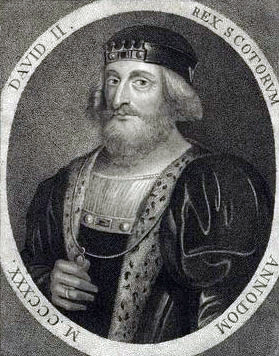
David II, King of Scots


King David II Bruce died, childless, at Edinburgh Castle on 22 February 1371, having reigned for forty-two of his forty-seven years. The king’s death did not stop Margaret from continuing with her lawsuit against him for some years, despite how much it was costing the former queen. There was a

Notarial instrument dated 23d June 1372, attesting obligation of same date by the Lady Margaret Queen of Scotland, widow of the late David Bruys K. of Scotland, acknowledging a loan of 500 marks from Adam Franceys and two other London merchants, made to her at Avignon, repayable at Caleys at Pentecost following. Done in the house of the said Queen Margaret at Avignon ut supra.8

Scotland was under the threat of a papal interdict as a result. Reprieve only came with Margaret’s death, during a pilgrimage to Rome in early 1375. The rule of the house of Bruce had lasted just sixty-five years and had been punctuated by the country’s fight for Scotland’s sovereignty. Eventually, however, it was not England that ensured the downfall of the House of Bruce. It was the failure of King David to have an heir.

David II (left) and Edward III

There is always a tendency to blame the woman when a king dies childless, but the fact that David was married twice and had a number of mistresses, but never became a father, even of an illegitimate child, would suggest that the problem lay with David. Though the point is moot.

In the end, David’s heir was his nephew, as he had been from the moment David ascended the throne. David was succeeded by the first of the Stewart kings, Robert II, son of Robert the Bruce’s eldest daughter, Marjorie and her husband, Walter Stewart. The royal House of Stewart would rule Scotland until 1714 and England from 1603 until 1714.

Notes:

1. John of Fordun’s Chronicle of the Scottish Nation; 2. ‘They were together but a short while’, Wyntoun, The orygynale cronykil of Scotland; 3. Bower, Scotichronicon, V 7; 4. Calendar of documents relating to Scotland, Vol. 4, no. 93; 5. ibid.; 6. Bower, Scotichronicon, V 7; 7. ibid,; 8. Calendar of documents relating to Scotland, Vol. 4, no. 197

Bibliography:

John of Fordun’s Chronicle of the Scottish Nation; Walter Bower, Scotichronicon; Andrew Wyntoun, The orygynale cronykil of Scotland; Calendar of documents relating to Scotland preserved in Her Majesty’s Public Record Office; Richard Oram, editor, The Kings and Queens of Scotland; Rosalind K. Marshall, Scottish Queens 1034–1714; Ian Mortimer, The Perfect King: The Life of Edward III, Father of the English Nation; Dr Callum Watson, ‘Ane Lady Bricht’: A Life of Annabella Drummond, Queen of Scots, c. 1350–1401; Bruce Webster, Margaret [née Margaret Drummond], Oxforddnb.com; Nigel Tranter, The Story of Scotland; B. Webster, ‘David II and the Government of Fourteenth-Century Scotland’ (article); David Ross Scotland, History of a Nation; Phil Carradice, Robert the Bruce: Scotland’s True Braveheart; G. Barrow ‘The Aftermath of War: Scotland and England in the late Thirteenth and early Fourteenth Centuries’ (article); Colm MacNamee, Robert Bruce: Our Most Valiant Prince and Lord; Stephen Spinks, Robert the Bruce: Champion of a Nation; Fiona J. Warson, Robert the Bruce; Bruce Webster, ‘David II’, Oxforddnb.com

*

My Books

Signed, dedicated copies of all my books are available through my online bookshop.

Out now: Scotland’s Medieval Queens

Scotland’s history is dramatic, violent and bloody. Being England’s northern neighbour has never been easy. Scotland’s queens have had to deal with war, murder, imprisonment, political rivalries and open betrayal. They have loved and lost, raised kings and queens, ruled and died for Scotland. From St Margaret, who became one of the patron saints of Scotland, to Elizabeth de Burgh and the dramatic story of the Scottish Wars of Independence, to the love story and tragedy of Joan Beaufort, to Margaret of Denmark and the dawn of the Renaissance, Scotland’s Medieval Queens have seen it all. This is the story of Scotland through their eyes.

Available now from Amazon and Pen and Sword Books

Also by Sharon Bennett Connolly:

Heroines of the Tudor World tells the stories of the most remarkable women from European history in the time of the Tudor dynasty, 1485-1603. These are the women who ruled, the women who founded dynasties, the women who fought for religious freedom, their families and love. Heroines of the Tudor World is now available for pre-order from Amberley Publishing and Amazon UK. Women of the Anarchy demonstrates how Empress Matilda and Matilda of Boulogne, unable to wield a sword themselves, were prime movers in this time of conflict and lawlessness. It shows how their strengths, weaknesses, and personal ambitions swung the fortunes of war one way – and then the other. Available from Bookshop.orgAmberley Publishing and Amazon UKKing John’s Right-Hand Lady: The Story of Nicholaa de la Haye is the story of a truly remarkable lady, the hereditary constable of Lincoln Castle and the first woman in England to be appointed sheriff in her own right. Available from all good bookshops Pen & Sword Booksbookshop.org and Amazon

Defenders of the Norman Crown: The Rise and Fall of the Warenne Earls of Surrey tells the fascinating story of the Warenne dynasty, from its origins in Normandy, through the Conquest, Magna Carta, the wars and marriages that led to its ultimate demise in the reign of Edward III. Available from Pen & Sword BooksAmazon in the UK and US, and Bookshop.orgLadies of Magna Carta: Women of Influence in Thirteenth Century England looks into the relationships of the various noble families of the 13th century, and how they were affected by the Barons’ Wars, Magna Carta and its aftermath; the bonds that were formed and those that were broken. It is now available in paperback and hardback from Pen & SwordAmazon, and Bookshop.orgHeroines of the Medieval World tells the stories of some of the most remarkable women from Medieval history, from Eleanor of Aquitaine to Julian of Norwich. Available now from Amberley Publishing and Amazon, and Bookshop.orgSilk and the Sword: The Women of the Norman Conquest traces the fortunes of the women who had a significant role to play in the momentous events of 1066. Available now from Amazon,  Amberley Publishing, and Bookshop.org.

Alternate Endings: An anthology of historical fiction short stories including Long Live the King… which is my take what might have happened had King John not died in October 1216. Available in paperback and kindle from Amazon.

Podcast:

Have a listen to the A Slice of Medieval podcast, which I co-host with Historical fiction novelist Derek Birks. Derek and I welcome guests, such as Bernard Cornwell and discuss a wide range of topics in medieval history, from significant events to the personalities involved. Every episode is also now available on YouTube.

*

Don’t forget! Signed and dedicated copies of all my books are available through my online bookshop.

For forthcoming online and in-person talks, please check out my Events Page.

You can be the first to read new articles by clicking the ‘Follow’ button, liking our Facebook page or joining me on Twitter and Instagram.

©2025 Sharon Bennett Connolly FRHistS
Joan Makepeace, Scotland’s Lonely Queen

joan_queen_of_scotland1
Joan of the Tower, Queen of Scotland

In my research I frequently discover instances of happy medieval marriages – and even if a marriage was not based on love, it did not mean that it would not be successful. Indeed, in many such instances the young woman concerned found her own way of succeeding, whether it was through her children or the management of estates – or the fact that a lasting peace was achieved between her 2 countries.

Unfortunately for Joan of the Tower, later to be known as Joan Makepeace, her marriage achieved none of these things.

Joan was born in the Tower of London on 5 July, 1321; hence her rather dramatic name. She was the youngest of the 4 children of Edward II and his queen, Isabella of France, and had 2 older brothers and 1 sister. Her eldest brother, Edward, who was 9 years older than Joan, succeed his father as King Edward III in 1327, following Edward II’s deposition. While her 2nd brother, John of Eltham, was born in 1316 and died shortly after his 20th birthday, while campaigning against the Scots. Joan’s only sister, Eleanor of Woodstock, born in 1318, was only 3 years older than her baby sister and would go on to marry Reginald II, Count of Guelders.

Joan also had an illegitimate brother, Adam FitzRoy, a son of Edward II by an unknown woman. He was born in the early 1300s, but died whilst campaigning in Scotland with his father, in 1322.

Little Joan was named after her maternal grandmother, Queen Joan I of Navarre, wife of Philip IV of France. The king, also in London at the time of Joan’s birth, but not at the  Tower, granted an £80 respite on a £180 loan to Robert Staunton, the man who brought him news of the birth.¹ By 8th July Edward was visiting his wife and baby daughter at the Tower of London and stayed with them for several days.

Joan’s father, Edward II

As the last of the children of Edward II and Isabella, it seems likely that the royal couple’s relationship changed shortly after her birth, their marriage heading for an irretrievable breakdown that would see the king deposed in favour of his son. Edward II was well known for having favourites; the first, Sir Piers Gaveston, met a sticky end in 1312, when he was murdered by barons angry at the influence he held over the king. Isabella’s estrangement with her husband followed the rise of a new favourite, Sir Hugh le Despenser, and, by the time of Joan’s birth, his influence on the king was gaining strength and alienating powerful barons at court. In March 1322 those barons were defeated at the Battle of Boroughbridge, Yorkshire, with many prominent barons killed, including the king’s erstwhile brother-in-law Humphrey de Bohun, earl of Hereford. The leader of the insurrection, the king’s cousin Thomas, earl of Lancaster, was executed 6 days later at Pontefract Castle.

Joan was, therefore, growing up amid a period of great turmoil, not only within England, but within her own family. It is doubtful that, as she grew, she was unaware of the atmosphere, but  Isabella and Edward were both loving parents and probably tried to shield their children as much as they could, ensuring stability in their everyday lives. Joan was soon placed  in the household of her older siblings, and put into the care of Matilda Pyrie,  who had once been nurse to her older brother, John of Eltham.

Sometime before February 1325, Joan and her sister were established in their own household, under the supervision of Isabel, Lady Hastings and her husband, Ralph Monthermer. Isabel was the younger sister of Edward II’s close companion, Hugh Despenser the Younger, and this act has often been seen by historians as the king removing the children from the queen’s custody. Although it could have been a malicious act it must be remembered, however, that Ralph Monthermer was the girls’ uncle-by-marriage through his first wife, Joan of Acre, Edward II’s sister, and it was a custom of the time that aristocratic children were fostered among the wider family.

Joan’s brother Edward III

Joan and her elder sister, Eleanor, remained with Isabel even after Ralph’s death in the summer of 1325; however, the following year, they were given into the custody of Joan Jermy, sister-in-law of the king’s younger half-brother Thomas, Earl of Norfolk. Joan was the sister of Thomas’s wife, Alice Hales, and took charge of the girls’ household in January 1326, living alternately at Pleshey in Essex and Marlborough in Wiltshire.

As with all her siblings, Joan played a part in her father’s diplomatic plans; an attempt to form an alliance against France, Edward sought marriages in Spain for 3 of his 4 children. While Eleanor was to marry Alfonso XI of Castile, little Joan was proposed as the bride for the grandson of Jaime II of Aragon – the future Pedro IV – but this would come to nought.

By this time their mother, Isabella, was living at the French court, along with her eldest son, Edward, refusing to return to her husband whilst he still welcomed Hugh Despenser at his court. Within months Isabella and her companion (possibly her lover), Roger Mortimer, were to invade England and drive Edward II from his throne, putting an end to the proposed Spanish marriages. He was captured and imprisoned in Berkley Castle, forced to abdicate in favour of his eldest son, who was proclaimed King Edward III in 1327.

With her father exiled or murdered (his fate remains a bone of contention to this day), Joan became the central part of another plan – that of peace with Scotland. Isabella and her chief ally, Roger Mortimer, were now effectively ruling the kingdom for the young Edward III – still only in  his mid-teens. With the kingdom in disarray Isabella sought to end the interminable wars with Scotland, much to the young king’s disgust. Joan was offered as a bride for David, Robert the Bruce’s only son and heir, by his second wife, Elizabeth de Burgh.

David II

The 1328 Treaty of Northampton was seen as a major humiliation by Edward III – and the 16-year-old king made sure his displeasure was known. However, he was forced to sign it, agreeing to Scotland’s recognition as an independent kingdom, the return of both the Ragman Roll (a document showing the individual acts of homage by the Scottish nobility) and the Stone of Scone (the traditional stone on which Scotland’s kings were crowned and which had sat in Westminster Abbey since being brought south by Edward I) and the marriage of Bruce’s 4-year-old son, David, to his 7-year-old sister, Joan.

Although the Stone of Scone and Ragman Roll were never returned to Scotland, the marriage between Joan and David did go ahead, although with a proviso that, should the marriage not be completed within 2 months of David reaching his 14th birthday, the treaty would be declared invalid. With neither king present – with Edward III refusing to attend, Robert the Bruce did likewise, claiming illness – the children were married at Berwick-on-Tweed on 17 July 1328, in the presence of Queen Isabella. The wedding was a lavish occasion, costing the Scots king over £2500.²

Following the wedding, and nicknamed Joan Makepeace by the Scots, Joan remained in Scotland with her child-groom. With Robert the Bruce’s death the following year, and David’s accession to the throne as David II, Joan and David attained the dubious record of being the youngest married monarchs in British history. They were crowned, jointly, at Scone Abbey in Perthshire, on 24th November 1331. It was the 1st time a Scottish Queen Consort was crowned.

Virtually nothing is known of Joan’s early years in Scotland. We can, I’m sure, assume she continued her education and maybe spent some time getting to know her husband. Scotland, however, was in turmoil and Edward III was not about to let his sister’s marriage get in the way of his own ambitions for the country. Unfortunately for Joan, Edward Balliol, son of the erstwhile king, John Balliol, and Isabella de Warenne, had a strong claim to the crown and was, as opposed to her young husband, a grown man with the backing of Edward III. What followed was a tug-of-war for Scotland’s crown, lasting many years.

David II and Joan being greeted by Philip VI of France

David’s supporters suffered a heavy defeat at Halidon Hill in July 1333 and shortly after Joan, who was residing at Dumbarton at the time, and David were sent to France for their safety, where they spent the next 7 years. An ally of Scotland and first cousin of Joan’s mother, Philip VI of France gave the king and queen, and their Scottish attendants, accommodation in the famous Château Gaillard in Normandy.

Their return to Scotland, on 2nd June 1341, was greeted with widespread rejoicing that proved to be short-lived. When the French asked for help in their conflict with the English, David led his forces south. He fought valiantly in the disastrous battle at Neville’s Cross on 17th October 1346, but was captured by the English; he was escorted to a captivity in England that would last for the next 11 years, save for a short return to Scotland in 1351-52.

Joan and David’s marriage had proved to be an unhappy, loveless and childless union and, while a safe conduct was issued for Joan to visit her husband at Windsor for the St George’s Day celebrations of 1348, there is no evidence she took advantage of it. Although we know little of Joan’s movements, it seems she remained in Scotland at least some of the time, possibly held as a hostage to David’s safety by his Scottish allies. She may also have visited David in his captivity, taking it as an opportunity to visit with her own family, including her mother; Queen Isabella is said to have supported Joan financially while her husband was imprisoned, feeding and clothing her. Joan does not appear to have taken an active role in negotiations for David’s release, despite her close familial ties to the English court.

When David returned to Scotland he brought his lover, Katherine Mortimer, with him. They had met in England and it was said “The king loved her more than all other women, and on her account his queen was entirely neglected while he embraced his mistress.”³ Katherine met a grisly fate and was stabbed to death by the Earl of Atholl.

At Christmas 1357 Joan was issued with a safe conduct from Edward III “on business touching us and David” and again in May 1358 “by our licence for certain causes”.² Although the licences are understandably vague on the matter, Joan had, in fact, left David and Scotland.

All that remains of Joan’s burial place

Joan spent the rest of her life in England, living on a pension of £200 a year provided by her brother, Edward III. She renewed family connections and was able to visit her mother before Isabella’s death in August 1358. As Queen of Scotland, she occasionally acted on her husband’s behalf. In February 1359 David acknowledge her assistance in the respite of ransom payments granted by Edward III saying it was “at the great and diligent request and instance of our dear companion the Lady Joan his sister.”²

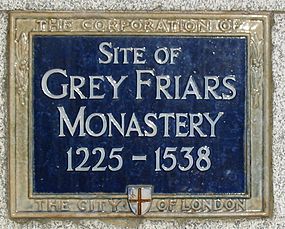
Little is known of Joan’s appearance or personality. Several years after her death she was described as “sweet, debonair, courteous, homely, pleasant and fair” by the chronicler Andrew of Wyntoun.² Having led an adventurous life, through no choice of her own, if unhappy in love, Joan of the Tower, Queen of Scotland, died at the age of 41 on 7th September 1362, and was buried in the Church of the Greyfriars, Newgate, in London, where her mother had been laid to rest just 4 years earlier.

Following his wife’s death David II married his lover, Margaret Drummond, the widow of Sir John Logie, but divorced her on 20th March 1370. He died, childless, at Edinburgh Castle in February 1371, aged 47, and was succeeded by the first of the Stewart kings, his nephew, Robert II, son of Robert the Bruce’s eldest daughter, Marjorie.

*

Footnotes: ¹Isabella of France: The Rebel Queen by Kathryn Warner; ² Oxforddnb.com; ³Walter Bower quoted in Oxforddnb.com

Sources: The Story of Scotland by Nigel Tranter; Brewer’s British Royalty by David Williamson; Kings & Queens of Britain by Joyce Marlow; Mammoth Book of British Kings & Queens by Mike Ashley; Oxford Companion to British History Edited by John Cannon; Britain’s Royal Families by Alison Weir; educationscotland.gov.uk/scotlandhistory; englishmonarchs.co.uk; berkshirehistory.com; thefreelancehistorywriter.com; The Perfect King by Ian Mortimer; Scotland, History of a Nation by David Ross; The Life & Times of Edward III by Paul Johnson; The Reign of Edward III by W.M. Ormrod; Isabella of France: The Rebel Queen by Kathryn Warner; Isabella and the Strange Death of Edward II by Paul Doherty; Edward II: The Unconventional King by Kathryn Warner; Oxforddnb.com.

*

My Books

Signed, dedicated copies of all my books are available through my online bookshop.

Out now: Scotland’s Medieval Queens

Scotland’s history is dramatic, violent and bloody. Being England’s northern neighbour has never been easy. Scotland’s queens have had to deal with war, murder, imprisonment, political rivalries and open betrayal. They have loved and lost, raised kings and queens, ruled and died for Scotland. From St Margaret, who became one of the patron saints of Scotland, to Elizabeth de Burgh and the dramatic story of the Scottish Wars of Independence, to the love story and tragedy of Joan Beaufort, to Margaret of Denmark and the dawn of the Renaissance, Scotland’s Medieval Queens have seen it all. This is the story of Scotland through their eyes.

Available now from Amazon and Pen and Sword Books

Also by Sharon Bennett Connolly:

Heroines of the Tudor World tells the stories of the most remarkable women from European history in the time of the Tudor dynasty, 1485-1603. These are the women who ruled, the women who founded dynasties, the women who fought for religious freedom, their families and love. Heroines of the Tudor World is now available for pre-order from Amberley Publishing and Amazon UK. Women of the Anarchy demonstrates how Empress Matilda and Matilda of Boulogne, unable to wield a sword themselves, were prime movers in this time of conflict and lawlessness. It shows how their strengths, weaknesses, and personal ambitions swung the fortunes of war one way – and then the other. Available from Bookshop.orgAmberley Publishing and Amazon UKKing John’s Right-Hand Lady: The Story of Nicholaa de la Haye is the story of a truly remarkable lady, the hereditary constable of Lincoln Castle and the first woman in England to be appointed sheriff in her own right. Available from all good bookshops Pen & Sword Booksbookshop.org and Amazon

Defenders of the Norman Crown: The Rise and Fall of the Warenne Earls of Surrey tells the fascinating story of the Warenne dynasty, from its origins in Normandy, through the Conquest, Magna Carta, the wars and marriages that led to its ultimate demise in the reign of Edward III. Available from Pen & Sword BooksAmazon in the UK and US, and Bookshop.orgLadies of Magna Carta: Women of Influence in Thirteenth Century England looks into the relationships of the various noble families of the 13th century, and how they were affected by the Barons’ Wars, Magna Carta and its aftermath; the bonds that were formed and those that were broken. It is now available in paperback and hardback from Pen & SwordAmazon, and Bookshop.orgHeroines of the Medieval World tells the stories of some of the most remarkable women from Medieval history, from Eleanor of Aquitaine to Julian of Norwich. Available now from Amberley Publishing and Amazon, and Bookshop.orgSilk and the Sword: The Women of the Norman Conquest traces the fortunes of the women who had a significant role to play in the momentous events of 1066. Available now from Amazon,  Amberley Publishing, and Bookshop.org.

Alternate Endings: An anthology of historical fiction short stories including Long Live the King… which is my take what might have happened had King John not died in October 1216. Available in paperback and kindle from Amazon.

Podcast:

Have a listen to the A Slice of Medieval podcast, which I co-host with Historical fiction novelist Derek Birks. Derek and I welcome guests, such as Bernard Cornwell and discuss a wide range of topics in medieval history, from significant events to the personalities involved. Every episode is also now available on YouTube.

*

Don’t forget! Signed and dedicated copies of all my books are available through my online bookshop.

For forthcoming online and in-person talks, please check out my Events Page.

You can be the first to read new articles by clicking the ‘Follow’ button, liking our Facebook page or joining me on Twitter and Instagram.

©2017 Sharon Bennett Connolly FRHistS
An Uncommon Sister – Christian Bruce

330px-Turnberry_Castle
Turnberry Castle

Christian Bruce was one of the many children of Sir Robert le Brus, Lord of Annandale, and his wife Marjorie, Countess of Carrick in her own right. Christian was one of 11 children, with 5 boys and 5 girls surviving infancy. Unfortunately we don’t know when she was born, nor whether or not she was an older or younger sibling.

Christian was probably born at her father’s castle of Turnberry sometime in the 1270s or early 1280s.

Christian’s grandfather was another Robert le Brus, one of the 13 Competitors for the throne of Scotland following the death of Margaret, the Maid of Norway; when the vacancy of the Scottish throne was resolved by Edward I of England in favour of John Balliol. And when Balliol’s kingship failed it was Christian’s brother, Robert the Bruce, who became one of the leading candidates for the Scottish throne.

There are some question marks over Christian’s marital history. Some sources claim she married Gartnait, Earl of Mar in the 1290s, and was the mother of Donald of Mar. However, this has recently been disputed. Christian never seems to have been addressed, or described, as the Countess of Mar, and there seems to have been little communication between Christian and her supposed son, Donald, even though they were both held prisoner in England simultaneously.

RobertBruceAndElizabethDeBurgh (280X280)_tcm4-562387
Robert the Bruce and Elizabeth de Burgh

The main argument against the marriage appears to be that Abbot Walter Bower had stated that Gartnait had been married to the ‘eldest Bruce daughter’, a description never applied to Christian. However, if the elder daughters were already married, Christian may well have been the eldest ‘unmarried’ Bruce daughter.

By 1305, however, Gartanit was dead and Christian had married Sir Christopher Seton (c. 1278-1306). Sir Christopher was a knight with lands in Annandale and northern England. He was a stalwart supporter of Robert the Bruce, his family having had a long tradition of serving the Bruce family. We know little to nothing about Christian’s short marriage to Sir Christopher; their relationship had to take a back seat to the national events of the time.

Sir Christopher was with Christian’s brother on the fateful day in the Greyfriars Church in Dumfries, when one of Robert the Bruce’s men fatally stabbed John Comyn, his rival to  the Scottish throne. Robert then made the dash for Scone, hoping to achieve his coronation before the Christian world erupted in uproar over his sacrilege. An excommunicate could not be crowned. Christian accompanied her brother, his wife Elizabeth and daughter Marjorie and her sister Mary to Scone Abbey. The Stone of Scone was the traditional coronation seat of the Kings of Scotland and, although the stone had been stolen by the English and spirited away to London, holding the coronation at the Abbey sent a message of defiance to the English.

330px-Stone_of_Scone_replica
Scone Abbey with a replica of the Stone of Scone in the forefront.

On 25th March 1306 Christian, alongside her husband, saw her brother crowned King Robert I by Isabella MacDuff, Countess of Buchan, who claimed her family’s hereditary right to crown Scotland’s kings (despite her being married to a Comyn), just 6 weeks after John Comyn’s death. The next day saw the ceremony repeated following the late arrival of William Lamberton, Bishop of St Andrews,

Robert’s coronation was the start of the most desperate period of his life – and that of his supporters. Edward I of England was never a one to casually acquiesce when he saw his will flouted. He sent his army into Scotland to hunt down the new king and his adherents. After his defeat by the English at Methven in 1306, Robert went into hiding in the Highlands. He sent his wife and daughter north to what he hoped would be safety. Christian, her sister Mary and the Countess of Buchan accompanied them, escorted by  the Earl of Atholl and Christian’s brother, Sir Neil Bruce.

It is thought that the Bruce women were heading north to Orkney in order to take a boat to Norway, where Robert’s sister, Isabel, was queen consort to King Erik II. Unfortunately they would never make it. The English caught up with them at Kildrummy Castle and laid siege to it. The defenders were betrayed by someone in their own garrison, a blacksmith who set fire to the barns, making the castle indefensible. The women managed to escape with the Earl of Atholl, but Neil Bruce remained with the garrison to mount a desperate defence in order give the queen, his niece and sisters enough time to escape.

Following their capitulation the entire garrison was executed. Sir Neil Bruce was given a traitor’s death; he was hung, drawn and quartered at Berwick in September 1306.

330px-Doon_castle_(2266044734)
Doon Castle

Christian and her companions did not escape for long; they made for Tain, in Easter Ross, possibly in the hope of finding a boat to take them onwards. They were hiding in the sanctuary of St Duthac when they were captured by the Earl of Ross (a former adherent of the deposed King John Balliol), who handed them over to the English. They were sent south, to Edward I at Lanercost Priory in Cumbria.

Following the coronation Christian’s husband, Sir Christopher Seton, had been sent to hold Loch Doon Castle against the English. Following a siege the castle was surrendered by its Governor, Sir Gilbert de Carrick. Seton was executed on the orders of Edward I; the poor man was hanged.

Christian’s sister Mary and Isabella, Countess of Buchan, were treated particularly harshly by Edward I. The English king had special cages built for them and for centuries it has been thought they were suspended from the walls of the keeps at Roxburgh and Berwick Castles, exposed to the elements and the derision of the English garrisons and populace, and a taunt to the Scots just over the border. However, the cages were in fact indoors, within rooms in the castles’ keeps. In contrast, Christian was sent into captivity to a Gilbertine convent at Sixhills in Lincolnshire; she was probably told of her husband’s death – and the manner of it – some time during the journey south. On 15 March 1307, financial provision was made fro Christian’s keep by an order sent to the sheriff of Lincoln to provide ‘3d. a day for her expenses, from the morrow of All Souls last year, when she came there; and a mark yearly for her dress.’ (Calendar of documents relating to Scotland, no. 1910, p. 508)

The convent at Sixhills was also custodian to the daughter of Dafydd ap Gruffydd, the last Welsh prince of Wales. Gwladys had been sent there following their father’s capture in 1283. She died at Sixhills in 1336. Gwladys’s cousin, Gwenllian, was sent to Sixhills’ sister priory at Sempringham. Dafydd himself was hanged, drawn and quartered; his two sons were imprisoned in Bristol Castle, Llywelyn died there a few years later, whilst the younger son, Owain lived until at least 1325, imprisoned nightly in a cage to prevent escape.

Christian languished at Sixhills for 8 years, until shortly after her brother’s remarkable victory over the English at Bannockburn, in 1314. During the battle, King Robert the Bruce had managed to captured several notable English prisoners, including Humphrey de Bohun, 4th Earl of Hereford and Essex, which put the King of Scots in a strong bargaining position. King Robert was able to arrange the exchange of his English captives for the members of his family still incarcerated in England, and Isabella Buchan.

Once home in Scotland Christian joined her brother’s court. In no hurry to remarry, she accompanied the king and his family on a short progress around Tyndale, an area of Northumberland which was officially in Scottish hands. Some time after her return to Scotland, Christian had also been granted the Bruce lands of Garioch in Aberdeenshire.

David_II_of_Scotland_by_Sylvester_Harding_1797
David II, Robert the Bruce’s son and successor

The Scottish Wars of Independence took a heavy toll on Christian’s family. Having lost her brother and husband in 1306, she lost her 2 younger brothers on the same day in 1307. Thomas and Alexander Bruce had been leading a force into Galloway when they were overwhelmed by the forces of Dungal MacDouall, a supporter of the Comyn faction. The brothers, both in their early 20s, were handed over to the English and were beheaded at Carlisle on 9th February 1307. Robert and Christian’s surviving brother, Edward, was killed in battle in Ireland in 1318.

The sad losses must have seemed endless to Christian. In 1316 King Robert had lost his daughter, Marjorie, in childbirth. She was just 19. Her son, Robert Stewart, survived and would be the king’s heir until the birth of his only son, David, in 1324. Marjorie’s son would eventually succeed as King Robert II following his uncle David II’s death in 1371. And in 1323 Christian’s sister Mary died; Mary had survived 4 years imprisoned in an iron cage at Roxburgh Castle before being transferred to a more comfortable imprisonment in 1310. It wouldn’t be surprising if her inhumane incarceration had contributed to Mary’s death in her early 40s.

Christian remained unmarried for many years. Although their marriage had been a short one, Christian kept her husband’s memory alive for many years to come; in 1324 she founded a chapel in Dumfries in his honour. There is a possibility  she was the Bruce sister mooted as a bride for Sir Andrew Harclay, earl of Carlisle, as part of a peace treaty with Scotland in 1323. However, negotiations broke down and the marriage never took place.

330px-Bothwell_Castle_20080505_-_south-east_tower
Bothwell Castle

Christian eventually married in 1326, to a man who was probably about 20 years her junior. Her 2nd husband was Sir Andrew Murray of Bothwell, posthumous son of the Sir Andrew Murray who had fought beside Sir William Wallace in the victory at Stirling Bridge.

Christian and Andrew were to have 2 children, sons. Their eldest, John, married Margaret Graham, Countess of Mentieth, sometime after 21st November 1348. John died in 1352 and Margaret would go on to marry Robert Duke of Albany, brother of Robert III and a great-grandson of King Robert the Bruce. A 2nd son, Thomas, would marry Joan, a daughter of Maurice Moray, Earl of Strathearn, and died in 1361.

On the death of Christian’s surviving brother, Robert the Bruce, in 1329, Scotland was once again thrown into turmoil. His 5-year-old son, David, was proclaimed king, with regents set to rule for him. As a member of the royal family Christian took part in David’s coronation in 1331. She shared a room in Scone Palace with her nieces, the new king’s sisters.

The English, however, saw the Bruce’s death as an opportunity and backed Edward Balliol‘s invasion of Scotland. Edward was crowned king in 1332, but could not consolidate his position. In the same year Murray was chosen as Guardian of Scotland and spent the next 5 years fighting the English and repulsing their attempts to return Balliol to the throne. Again, Christian found herself in the thick of the fighting when Sir Andrew installed her as keeper of Kildrummy Castle. In 1335 she was besieged by one of Balliol’s commanders, David Strathbogie, earl of Atholl. Her husband marched to her aid with a force of over a thousand men; he was able to surprise Atholl and defeated him at Culblean.

Kildrummy_castle_2
Kildrummy Castle

Christian remained in possession of Kildrummy Castle even after Sir Andrew’s death; her husband had died at Avoch Castle in Ross in 1338, having retired from national politics the year before. Christian is known to have entertained her nephew’s wife, Queen Joan, at Kildrummy Castle in 1342. David II was generous to his aunt, providing her with an income from a number of sources, including the customs of Aberdeen.

It is believed that Christian died sometime in 1356, the last time she was mention in the exchequer rolls. She must have been well into her 70s, a great age for the time. I couldn’t find any source to confirm where she was buried; however, her husband was initially buried in the chapel at Rossmarkie, but later reinterred in Dunfermline Abbey, suggesting that this is also Christian’s resting place. It would be appropriate if it was, as so many of her ancestors and family are buried there; including her husband, brother, Robert, and niece, Marjorie.

*

Pictures courtesy of Wikipedia

*

Sources: The Story of Scotland by Nigel Tranter; Brewer’s British Royalty by David Williamson; Kings & Queens of Britain by Joyce Marlow; educationscotland.gov.uk/scotlandhistory Mammoth Book of British Kings & Queens by Mike Ashley; Oxford Companion to British History Edited by John Cannon; Edward I A Great and Terrible King by Marc Morris; Britain’s Royal Families by Alison Weir; oxforddnb.com; thefreelancehistorywriter.com; englishmonarchs.co.uk; The Kings & Queens of Scotland edited by Richard Oram; Scotland: History of a Nation by David Ross.

*

My Books

Signed, dedicated copies of all my books are available through my online bookshop.

Coming 15 January 2024: Women of the Anarchy

On the one side is Empress Matilda, or Maud. The sole surviving legitimate child of Henry I, she is fighting for her birthright and that of her children. On the other side is her cousin, Queen Matilda, supporting her husband, King Stephen, and fighting to see her own son inherit the English crown. Both women are granddaughters of St Margaret, Queen of Scotland and descendants of Alfred the Great of Wessex. Women of the Anarchy demonstrates how these women, unable to wield a sword, were prime movers in this time of conflict and lawlessness. It show how their strengths, weaknesses, and personal ambitions swung the fortunes of war one way – and then the other.

Available for pre-order from Amberley Publishing and Amazon UK.

Coming on 15 June 2024: Heroines of the Tudor World

Heroines of the Tudor World tells the stories of the most remarkable women from European history in the time of the Tudor dynasty, 1485-1603. These are the women who ruled, the women who founded dynasties, the women who fought for religious freedom, their families and love. These are the women who made a difference, who influenced countries, kings and the Reformation. In the era dominated by the Renaissance and Reformation, Heroines of the Tudor World examines the threats and challenges faced by the women of the era, and how they overcame them. Some famous, some infamous, some less well known, including Anne Boleyn, Elizabeth Barton, Catherine de Medici, Bess of Hardwick and Elizabeth I. From writers to regents, from nuns to queens, Heroines of the Tudor World shines the spotlight on the women helped to shape Early Modern Europe.

Heroines of the Tudor World is now available for pre-order from Amberley Publishing and Amazon UK.

Also by Sharon Bennett Connolly:

King John’s Right-Hand Lady: The Story of Nicholaa de la Haye is the story of a truly remarkable lady, who was the hereditary constable of Lincoln Castle and the first woman in England to be appointed sheriff in her own right. Her strength and tenacity saved England at one of the lowest points in its history. King John’s Right-Hand Lady: The Story of Nicholaa de la Haye is now available from Pen & Sword Booksbookshop.org and Amazon.

Defenders of the Norman Crown: The Rise and Fall of the Warenne Earls of Surrey tells the fascinating story of the Warenne dynasty, of the successes and failures of one of the most powerful families in England, from its origins in Normandy, to its ultimate demise in the reign of Edward III. Defenders of the Norman Crown: Rise and Fall of the Warenne Earls of Surrey is now available from Pen & Sword BooksAmazon in the UK and US, and Bookshop.org.

Ladies of Magna Carta: Women of Influence in Thirteenth Century England looks into the relationships of the various noble families of the 13th century, and how they were affected by the Barons’ Wars, Magna Carta and its aftermath; the bonds that were formed and those that were broken. It is now available in paperback and hardback from Pen & Sword,  Amazon, and Bookshop.org.

Heroines of the Medieval World tells the stories of some of the most remarkable women from Medieval history, from Eleanor of Aquitaine to Julian of Norwich. Available now from Amberley Publishing and Amazon, and Bookshop.org.

Silk and the Sword: The Women of the Norman Conquest traces the fortunes of the women who had a significant role to play in the momentous events of 1066. Available now from Amazon,  Amberley Publishing, and Bookshop.org.

Alternate Endings: An anthology of historical fiction short stories including Long Live the King… which is my take what might have happened had King John not died in October 1216. Available in paperback and kindle from Amazon.

Podcast:

Have a listen to the A Slice of Medieval podcast, which I co-host with Historical fiction novelist Derek Birks. Derek and I welcome guests, such as Bernard Cornwell and Elizabeth Chadwick, and discuss a wide range of topics in medieval history, from significant events to the personalities involved.

*

Don’t forget! Signed and dedicated copies of all my books are available through my online bookshop.

For forthcoming online and in-person talks, please check out my Events Page.

You can be the first to read new articles by clicking the ‘Follow’ button, liking our Facebook page or joining me on Twitter and Instagram.

©2016 Sharon Bennett Connolly FRHistS