Thora, Harald Hardrada’s Other Wife

Books by Sharon Bennett Connolly
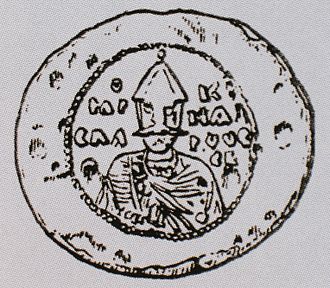
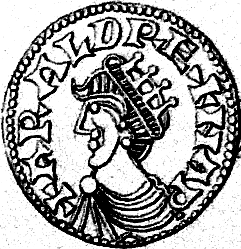
Coin of Harald Hardrada

The legend of Harald Hardrada, King Harald III of Norway, is one of my favourite stories of the 11th century. It is the tale of a warrior king, probably the best fighter of his generation, a poet and a lover. Harald’s marriage to his first wife, Elisiv of Kyiv, is the stuff legends are made of; a landless prince making his fortune in Byzantium before returning to claim his bride and winning a crown. And they lived happily ever after …. or not!

Elisiv gave Harald 2 daughters, Ingegerd and Maria, but no sons. It may, therefore, have been a desire for sons that led Harald to take a second wife, although without setting aside his first. According to Snorri Sturluson, in the ‘winter after King Magnus the Good died, King Harald took Thora, daughter of Thorberg Arnason, and they had two sons; the oldest called Magnus, and the other Olaf.’ [1]

Thora (or Tora) was the daughter of Thorberg Arnason and Ragnhild Erlingsdottir and was born around 1025; her kinsman, Fin Arnason, was a good friend of Harald’s and was married to Bergliot, the daughter of Halfdan, a brother of Harald Hardrada and Saint Olaf.  The marriage also provided the desired son and heir, which his first marriage had failed to do; both of Thora’s sons would later become kings of Norway. Magnus succeeded his father in 1066, and was in 1069 succeeded by his brother, Olaf III, who had ruled alongside Magnus since 1067.
Books by Sharon Bennett Connolly
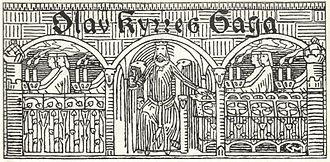
Gerhard Munthe: illustration for Olav Kyrres saga in Heimskringla (1899)

Harald probably went through some form of marriage ceremony, more likely a handfasting than a Christian marriage, with Thora in 1048. The marriage appears to have been a political arrangement, in order to garner the support of the powerful Giskeӕtten family, the chiefs of which played a significant role in power politics.

Of Harald’s two sons, Magnus, who succeeded his father in 1066, appears to have been as warlike as Harald. In 1058, aged no more than ten or eleven, he led a fleet to England in support of Earl Ӕlfgar of Mercia, after the earl had been outlawed only a year after he had succeeded to his father’s earldom. Magnus was probably little more than a figurehead for the expedition and unlikely to have been expected to make crucial military decisions, but it would have been good experience for the young prince, and a taste of what the future held for him. By the time he was sixteen, Magnus was a successful warrior and is said to have clashed with his father; the two almost coming to blows until the king was restrained by friends.
Books by Sharon Bennett Connolly
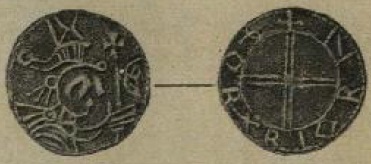
Coin dating to the reign of King Olaf Kyrre

It has been suggested that the marriage may have come following the death of Elisiv, or that Elisiv never even left Kyiv, but given that her daughters were born once Harald was back in Scandinavia, this seems improbable. Harald’s daughters are not likely to have been the daughters of Thora, as Maria was engaged to Thora’s brother, Eystein Orre; who would have been Maria’s uncle, had she been Thora’s daughter. Harald having two wives, simultaneously, seems the most likely explanation. As demonstrated by King Cnut and King Harold II of England, two wives and, therefore, two families, were not uncommon in Scandinavian culture; although in these two other cases an earlier wife was put aside for the sake of a more prestigious marriage, whereas Harald Hardrada’s first marriage was by far the more prestigious, while the second was politically expedient.

Thora was the kinswoman of Harald’s one-time friend, Fin Arnason, who was captured fighting for the Danes against Harald. When Fin refused Harald’s offer of quarter (life), Harald made a further offer:

‘“Wilt thou accept thy life, then, from thy she-relation Thorer [Thora]?”

The earl: “Is she here?”

“She is here, ” said the king.

Then Earl Fin broke out with the ugly expressions which since have been preserved, as a proof that he was so mad with rage that he could not govern his tongue: —

“No wonder thou hast bit so strongly, if the mare was with thee.”

Earl Fin got life and quarter and the king kept him a while about him…’

Heimskringla. The Chronicle of the Kings of Norway, by Snorre Sturluson.
Books by Sharon Bennett Connolly
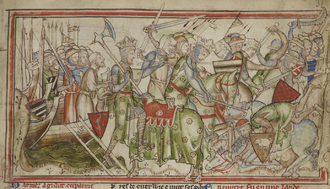
Harald landing near York, 1066 (Matthew Paris)

At the beginning of September, 1066, Harald sailed his fleet of over 200 ships to Shetland and then to Orkney, where he gathered reinforcements and left his wife and daughters to await news of events. There is some confusion as to which wife was left on Orkney, some sources say Elisiv, who, as Harald’s wife and queen would have expected to become queen of England, had he been successful. Some historians argue that as Thora was a relative of the Earl of Orkney she would have been more likely to travel with Harald than Elisiv.

We know from Thora’s joining one of Harald’s expeditions to Denmark, that he was not averse to taking his wives with him to war. However, given that young Magnus was left behind to rule Norway, aged only sixteen, it seems likely that his mother was also left behind, to advise him. According to Snorri;

‘Thora, the daughter of Thorberg, also remained behind; but he took with him Queen Ellisif [Elisiv] and her two daughters, Maria and Ingegerd. Olaf, King Harald’s son, also accompanied his father abroad.’

Heimskringla. The Chronicle of the Kings of Norway, by Snorre Sturluson.

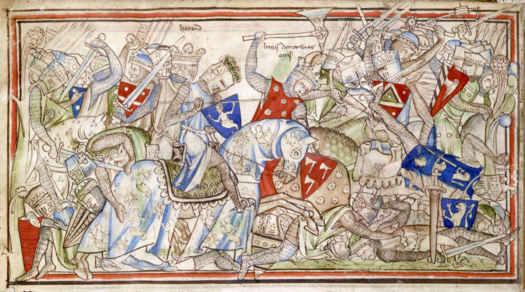
Harald fought two battles outside York. The first, the Battle of Fulford, on 20 September, against the brothers, Edwin, Earl of Mercia, and Morcar, Earl of Northumberland, ended in victory for Harald Hardrada and his ally, Tostig, the former earl of Northumberland and brother of the new King of England, Harold II. However, a second battle at Stamford Bridge, five days later, saw victory go to the English. Harold II had marched his men the 200 miles from the south coast to York, in less than 4 days, and confronted his brother and the Norwegian king on 25 September. At the end of the day, Harald Hardrada and Tostig both lay dead on the field.
Books by Sharon Bennett Connolly
Battle of Stamford Bridge, 1066 (Matthew Paris)

Harald and Elisiv’s daughter, Maria, is said to have died suddenly on 25 September 1066, the same day as the Battle of Stamford Bridge, on hearing of her father’s death. She had been betrothed to Eystein Orre, the brother of Harald’s second wife, Thora; Eystein was also among the dead at Stamford Bridge. Maria’s sister, Ingegerd, returned to Norway with her mother and half-brother. Olaf had traveled with the Norwegian army, but had not taken part in the battle, having been left to guard the ships at Riccal, near York. After the English victory, he was allowed to claim his father’s body and take the survivors home.

After Harald’s death, Norway was ruled successively by Harald’s sons Magnus II and Olaf III. Olaf III ruled until his death in 1093 and was succeeded by Magnus III, his acknowledged but illegitimate son.

Of Thora’s fate, little is certain. She may have remarried, although there is some confusion. According to Adam of Bremen, she married either King Swein of Denmark or an unknown Swedish king. [2] As with much of her life, the year of Thora’s death remains unknown.

Footnotes:

[1] Heimskringla. The Chronicle of the Kings of Norway, by Snorre Sturluson; [2] Fulford: The Forgotten Battle of 1066 by Charles Jones.

Pictures:

Courtesy of Wikipedia

Sources:

The English and the Norman Conquest by Dr Ann Williams; Brewer’s British Royalty by David Williamson; Britain’s Royal Families, the Complete Genealogy by Alison Weir; The Wordsworth Dictionary of British History by JP Kenyon; The Norman Conquestby Marc Morris; Harold, the King Who Fell at Hastings by Peter Rex; The Anglo-Saxons in 100 Facts by Martin Wall; The Anglo-Saxon Age by Martin Wall; Kings, Queens, Bones and Bastards by David Hilliam; The Mammoth Book of British kings & Queens by Mike Ashley; The Oxford Companion to British History Edited by John Cannon; The Anglo-Saxon Chronicles translated and edited by Michael Swaton; The Anglo-Saxon Chronicle translated by James Ingram; Queen Emma and the Vikings by Harriett O’Brien; The Bayeux Tapestry by Carola Hicks; On the Spindle Side: the Kinswomen of Earl Godwin of Wessex by Ann Williams; oxforddnb.com.

*

My Books

Signed, dedicated copies of all my books are available through my online bookshop.

Out now: Scotland’s Medieval Queens

Books by Sharon Bennett Connolly

Scotland’s history is dramatic, violent and bloody. Being England’s northern neighbour has never been easy. Scotland’s queens have had to deal with war, murder, imprisonment, political rivalries and open betrayal. They have loved and lost, raised kings and queens, ruled and died for Scotland. From St Margaret, who became one of the patron saints of Scotland, to Elizabeth de Burgh and the dramatic story of the Scottish Wars of Independence, to the love story and tragedy of Joan Beaufort, to Margaret of Denmark and the dawn of the Renaissance, Scotland’s Medieval Queens have seen it all. This is the story of Scotland through their eyes.

Scotland’s Medieval Queens gives a thorough grounding in the history of the women who ruled Scotland at the side of its kings, often in the shadows, but just as interesting in their lives beyond the spotlight. It’s not a subject that has been widely covered, and Sharon is a pioneer in bringing that information into accessible history.’ Elizabeth Chadwick (New York Times bestselling author)

Available now from Amazon and Pen and Sword Books

Also by Sharon Bennett Connolly:

Books by Sharon Bennett Connolly

Heroines of the Tudor World tells the stories of the most remarkable women from European history in the time of the Tudor dynasty, 1485-1603. These are the women who ruled, the women who founded dynasties, the women who fought for religious freedom, their families and love. Heroines of the Tudor World is now available for pre-order from Amberley Publishing and Amazon UK. Women of the Anarchy demonstrates how Empress Matilda and Matilda of Boulogne, unable to wield a sword themselves, were prime movers in this time of conflict and lawlessness. It shows how their strengths, weaknesses, and personal ambitions swung the fortunes of war one way – and then the other. Available from Bookshop.orgAmberley Publishing and Amazon UKKing John’s Right-Hand Lady: The Story of Nicholaa de la Haye is the story of a truly remarkable lady, the hereditary constable of Lincoln Castle and the first woman in England to be appointed sheriff in her own right. Available from all good bookshops Pen & Sword Booksbookshop.org and Amazon

Defenders of the Norman Crown: The Rise and Fall of the Warenne Earls of Surrey tells the fascinating story of the Warenne dynasty, from its origins in Normandy, through the Conquest, Magna Carta, the wars and marriages that led to its ultimate demise in the reign of Edward III. Available from Pen & Sword BooksAmazon in the UK and US, and Bookshop.orgLadies of Magna Carta: Women of Influence in Thirteenth Century England looks into the relationships of the various noble families of the 13th century, and how they were affected by the Barons’ Wars, Magna Carta and its aftermath; the bonds that were formed and those that were broken. It is now available in paperback and hardback from Pen & SwordAmazon, and Bookshop.orgHeroines of the Medieval World tells the stories of some of the most remarkable women from Medieval history, from Eleanor of Aquitaine to Julian of Norwich. Available now from Amberley Publishing and Amazon, and Bookshop.orgSilk and the Sword: The Women of the Norman Conquest traces the fortunes of the women who had a significant role to play in the momentous events of 1066. Available now from Amazon,  Amberley Publishing, and Bookshop.org.

Alternate Endings: An anthology of historical fiction short stories including Long Live the King… which is my take what might have happened had King John not died in October 1216. Available in paperback and kindle from Amazon.

Podcast:

Have a listen to the A Slice of Medieval podcast, which I co-host with Historical fiction novelist Derek Birks. Derek and I welcome guests, such as Bernard Cornwell and Elizabeth Chadwick, and discuss a wide range of topics in medieval history, from significant events to the personalities involved.

Every episode is also now available on YouTube.

*

Don’t forget! Signed and dedicated copies of all my books are available through my online bookshop.

For forthcoming online and in-person talks, please check out my Events Page.

You can be the first to read new articles by clicking the ‘Follow’ button, liking our Facebook page or joining me on TwitterThreadsBluesky and Instagram.

©2020 Sharon Bennett Connolly FRHistS
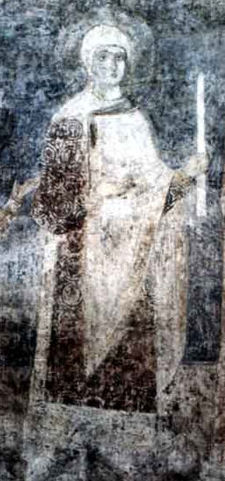
Harald Hardrada and Elisiv of Kyiv

Books by Sharon Bennett Connolly
Elisiv of Kyiv

One of my favourite characters of the 1066 story is the Norwegian king Harald Hardrada. Harald led a fascinating life, even before his ill-fated attempt on the English throne; exiled in Kyiv at 15, while seeking his fortune in the east he became captain of the famous Varangian Guard before returning to his native Norway to become king.

When I started writing Silk and the Sword: The Women of the Norman Conquest I discovered that there were several Kyivan links to the story of 1066. The baby sons of England’s short-lived king, Edmund II Ironside, who reigned and died in 1016, were given sanctuary and protection in Kyiv, saving them from the clutches of Edmund’s successor, King Cnut. And after the Conquest, Harold II Godwinson’s own daughter, Gytha, would make her life in Kyiv as the wife of Vladimir II Monomakh; she was the mother of Mstislav the Great, the last ruler of a united Kyivan Rus. Vladimir was the nephew of Harald Hardrada’s first wife, the Russian princess, Elisiv.

Harald Hardrada’s story had been one of almost-constant conflict since he was a teenager. At the age of 15 he had fought alongside his half-brother, King Óláf, at the Battle of Stiklestad, in an unsuccessful attempt by Óláf to regain the throne. The Anglo-Saxon Chronicle recorded: ‘This year returned King Óláf into Norway; but the people gathered together against him, and fought against him; and he was there slain, in Norway, by his own people, and was afterwards canonized.’ [1]

Following Olaf’s death, Harald Hardrada first fled to Sweden before moving on to Kyivan Rus. Harald spent 3 or 4 years at the court of Yaroslav I (the Wise), Prince of Kyiv. Yaroslav was the husband of Óláf’s sister-in-law, Ingergerd (sister of Óláf’s wife, Queen Astrid). At only 15, Harald’s military skills were already impressive and Yaroslav made him a captain in his army; the young Norwegian fought alongside the Kyivan prince on his campaigns against the Poles in 1031.

Books by Sharon Bennett Connolly
Coin of Harald

Having gained a reputation that spread throughout eastern Europe, in 1034 or 1035, Harald and his force of 500 men moved on to Constantinople, where he joined the ranks of the Varangian Guard, in the service of the Byzantine emperor, Michael IV (reigned 1034–1041). A formidable warrior and commander, Harald eventually became leader of the whole Varangian guard, seeing action against Arab pirates, and the towns of Asia Minor that supported them. Throughout his adventures in Byzantium, Harald sent his plunder back to Prince Yaroslav in Kyiv; treasure which, given the number of towns he had taken, must have been quite considerable.

On the death of Michael IV Constantinople proved a less friendly place for the Scandinavian and after a brief imprisonment and daring escape from his cell, Hardrada decided that it was time to return home. It is said that the new empress, Zoe, refused him permission to leave, but the Norwegian managed to escape Constantinople with two ships and his most loyal supporters. One of the ships was destroyed by the iron chains which blocked the seagoing entrance and exit to Constantinople, but the other made it through by shifting the weight in the ship so acted like a seesaw and it effectively jumped over the chain.

Harald returned to his friend Yaroslav I in Kyiv, to whom he had sent his vast amounts of plunder. In 1044, whilst still at Yaroslav’s court, Harald married the Kyivan prince’s daughter, Elisiv (also known as Elisiff, Elizabeth or Elizaveta). Elisiv was born around 1025 and would probably have met Harald when he first appeared at her father’s court, in 1034-5; when she was 9 or 10 years old and he a 15-year-old fugitive from Cnut’s conquest of Norway. Elisiv was probably the oldest daughter of Yaroslav’s eleven children with his wife, Ingegerd. Through her mother, Elisiv was the granddaughter of Sweden’s king, Olof Skötkonung. Her father, Grand Prince Yaroslav, was responsible for the rise in power and influence of Kyiv in the 11th century; his court was considered modern and cultured.

Yaroslav’s children were well-educated and able to read and write, including the girls; Elisiv’s sister, Anna, who married King Henry I of France, demonstrated her superior level of education when she signed her marriage contract with her full name, in her own hand; King Henry, her new husband, could only manage to write a cross. Although we have no description of Elisiv, we know that Anna was renowned for her ‘exquisite beauty, literacy and wisdom’ and we can assume that Elisiv, having shared in her sister’s upbringing, was no less accomplished. [2]

It is possible that marriage between Harald and Elisiv had been discussed during the Norwegian’s first visit to Kyiv in 1035. However, given that she would have only been nine or ten years of age when Harald left for Constantinople, it seems hard to believe the claims that Elisiv had refused him on the grounds that he was not wealthy enough to marry her; her father, on the other hand, may well have done so. This may also explain Harald sending his plunder back to Kyiv for safekeeping, as proof of his increasing wealth and eligibility as a husband for Elisiv, even if he still held no princely title and was exiled from his homeland. In 1044, therefore, there was no financial objection to Harald and Elisiv marrying and there is evidence that Harald was genuinely in love with his Kyivan bride. Harald wrote poetry to his princess:

Past Sicily’s wide plains we flew,
A dauntless, never-wearied crew;
Our Viking steed rushed through the sea,
As Viking-like fast, fast sailed we.
Never, I think, along this shore
Did Norsemen ever sail before;
Yet to the Kyivan queen, I fear,
My gold-adorned, I am not dear. [3]

Books by Sharon Bennett Connolly
Contemporary image of Yaroslav the Wise, from his seal

With the treasure Harald amassed during his sojourn in Constantinople and Elisiv’s dowry, Harald now had the means to return home. He initially made for Sweden, arriving there in 1046. By the end of the year, he was co-king in Norway, under Magnus the Good, who left Harald to rule Norway while he concentrated on Denmark; the two kings had kept separate courts. Harald’s court in Norway was presided over by his queen, Elisiv. Within a few of years of arriving in Norway, the couple had two daughters, Ingegerd and Maria Haraldsdóttir. Ingergerd was probably born in 1046, with Maria arriving a year of two after.

Married life, however, was about to get more complicated, when Harald took a second wife, without setting aside Elisiv. According to Snorri Sturluson, in the ‘winter after King Magnus the Good died, King Harald took Thora, daughter of Thorberg Arnason, and they had two sons; the oldest called Magnus, and the other Olaf.’ [4] 

It has been suggested that the marriage may have come following the death of Elisiv, or that Elisiv never even left Kyiv, but given that her daughters are believed to have been born once Harald was back in Scandinavia, this seems improbable. Harald’s daughters are not likely to have been the daughters of Thora, as Maria was engaged to Eystein Orre, who would have been her uncle had she been Thora’s daughter. Harald having two wives, simultaneously, seems the most likely explanation. As demonstrated by King Cnut and King Harold II of England, two wives and, therefore, two families, were not uncommon in Scandinavian culture; although in these two other cases an earlier wife was put aside for the sake of a more prestigious marriage, whereas Harald Hardrada’s first marriage was the most prestigious, while the second was politically expedient. And it was this second marriage which gave Harald his sons; Magnus and Olaf, both later kings of Norway.

Books by Sharon Bennett Connolly
Battle of Fulford, 1066, taken from ‘The Life of Edward the Confessor’

At the beginning of September, 1066, Harald sailed his fleet of over 200 ships to Shetland and then to Orkney, where he gathered reinforcements and left his wife and daughters to await news of events. There is some confusion as to which wife was left on Orkney, some sources say it was Elisiv, who, as Harald’s wife and queen would have expected to become queen of England, had he been successful. Some historians argue that as Thora was a relative of the Earl of Orkney she would have been more likely to travel with Harald than Elisiv.

We know from Thora’s joining one of Harald’s expeditions to Denmark, that he was not averse to taking his wives with him to war. However, given that young Magnus was left behind to rule Norway, aged only sixteen, it seems likely that his mother was also left behind, to advise him. According to Snorri; ‘Thora, the daughter of Thorberg, also remained behind; but he took with him Queen Ellisif [Elisiv] and her two daughters, Maria and Ingegerd. Olaf, King Harald’s son, also accompanied his father abroad.’ [5]

Books by Sharon Bennett Connolly
Battle of Stamford Bridge, 1066, taken from ‘The Life of Edward the Confessor’

Harald and Elisiv’s daughter, Maria, is said to have died suddenly on 25 September 1066, the same day as the Battle of Stamford Bridge, on hearing of her father’s death. Though this does not make sense, unless Maria had travelled to Riccal, where Harald moored his ships before marching to York, with the army and awaited the outcome of the battle with the ships; or the timing of her death has been altered for dramatic effect. Maria had been betrothed to Eystein Orre, the brother of Harald’s second wife, Thora; Eystein was also among the dead at Stamford Bridge. Maria’s sister, Ingegerd, returned to Norway with her mother and half-brother. She was first married to Olaf I, King of Denmark who died in 1095, with whom she had a daughter, Ulvhild. Following Olaf’s death, Ingegerd married Philip, King of Sweden. She was widowed again in 1118 and died around 1120, having been consecutively queen of Denmark and Sweden.

Of Harald’s queen, Elisiv, little is known after King Harald’s death, not even the year of her own death. This Kyivan princess, who captured the heart of one of the greatest Viking warriors of all time, just disappears into the mists of history.

Footnotes:

[1] The Anglo-Saxon Chronicle translated by James Ingram; [2] Prominent Russians: Anna Yaroslavna (article), russiapedia.rt.com; [3] Quoted in Fulford: The Forgotten Battle of 1066 by Charles Jones; [4] Heimskringla. The Chronicle of the Kings of Norway, by Snorre Sturluson; [5] ibid.

Pictures:

Courtesy of Wikipedia

Sources:

The English and the Norman Conquest by Dr Ann Williams; Brewer’s British Royalty by David Williamson; Britain’s Royal Families, the Complete Genealogy by Alison Weir; The Wordsworth Dictionary of British History by JP Kenyon; The Norman Conquest by Marc Morris; Harold, the King Who Fell at Hastings by Peter Rex; The Anglo-Saxons in 100 Facts by Martin Wall; The Anglo-Saxon Age by Martin Wall; Kings, Queens, Bones and Bastards by David Hilliam; The Mammoth Book of British kings & Queens by Mike Ashley; The Oxford Companion to British History Edited by John Cannon; The Anglo-Saxon Chronicles translated and edited by Michael Swanton; The Anglo-Saxon Chronicle translated by James Ingram; Queen Emma and the Vikings by Harriett O’Brien; The Bayeux Tapestry by Carola Hicks; On the Spindle Side: the Kinswomen of Earl Godwin of Wessex by Ann Williams; oxforddnb.com.

*

My Books

Signed, dedicated copies of all my books are available through my online bookshop.

Out now: Scotland’s Medieval Queens

Books by Sharon Bennett Connolly

Scotland’s history is dramatic, violent and bloody. Being England’s northern neighbour has never been easy. Scotland’s queens have had to deal with war, murder, imprisonment, political rivalries and open betrayal. They have loved and lost, raised kings and queens, ruled and died for Scotland. From St Margaret, who became one of the patron saints of Scotland, to Elizabeth de Burgh and the dramatic story of the Scottish Wars of Independence, to the love story and tragedy of Joan Beaufort, to Margaret of Denmark and the dawn of the Renaissance, Scotland’s Medieval Queens have seen it all. This is the story of Scotland through their eyes.

Scotland’s Medieval Queens gives a thorough grounding in the history of the women who ruled Scotland at the side of its kings, often in the shadows, but just as interesting in their lives beyond the spotlight. It’s not a subject that has been widely covered, and Sharon is a pioneer in bringing that information into accessible history.’ Elizabeth Chadwick (New York Times bestselling author)

Available now from Amazon and Pen and Sword Books

Also by Sharon Bennett Connolly:

Books by Sharon Bennett Connolly

Heroines of the Tudor World tells the stories of the most remarkable women from European history in the time of the Tudor dynasty, 1485-1603. These are the women who ruled, the women who founded dynasties, the women who fought for religious freedom, their families and love. Heroines of the Tudor World is now available for pre-order from Amberley Publishing and Amazon UK. Women of the Anarchy demonstrates how Empress Matilda and Matilda of Boulogne, unable to wield a sword themselves, were prime movers in this time of conflict and lawlessness. It shows how their strengths, weaknesses, and personal ambitions swung the fortunes of war one way – and then the other. Available from Bookshop.orgAmberley Publishing and Amazon UKKing John’s Right-Hand Lady: The Story of Nicholaa de la Haye is the story of a truly remarkable lady, the hereditary constable of Lincoln Castle and the first woman in England to be appointed sheriff in her own right. Available from all good bookshops Pen & Sword Booksbookshop.org and Amazon

Royal Historical Society

Defenders of the Norman Crown: The Rise and Fall of the Warenne Earls of Surrey tells the fascinating story of the Warenne dynasty, from its origins in Normandy, through the Conquest, Magna Carta, the wars and marriages that led to its ultimate demise in the reign of Edward III. Available from Pen & Sword BooksAmazon in the UK and US, and Bookshop.orgLadies of Magna Carta: Women of Influence in Thirteenth Century England looks into the relationships of the various noble families of the 13th century, and how they were affected by the Barons’ Wars, Magna Carta and its aftermath; the bonds that were formed and those that were broken. It is now available in paperback and hardback from Pen & SwordAmazon, and Bookshop.orgHeroines of the Medieval World tells the stories of some of the most remarkable women from Medieval history, from Eleanor of Aquitaine to Julian of Norwich. Available now from Amberley Publishing and Amazon, and Bookshop.orgSilk and the Sword: The Women of the Norman Conquest traces the fortunes of the women who had a significant role to play in the momentous events of 1066. Available now from Amazon,  Amberley Publishing, and Bookshop.org.

Alternate Endings: An anthology of historical fiction short stories including Long Live the King… which is my take what might have happened had King John not died in October 1216. Available in paperback and kindle from Amazon.

Podcast:

A Slice of Medieval

Have a listen to the A Slice of Medieval podcast, which I co-host with Historical fiction novelist Derek Birks. Derek and I welcome guests, such as Elizabeth Chadwick, Helen Castor, Ian Mortimer, Scott Mariani and Bernard Cornwell and discuss a wide range of topics in medieval history, from significant events to the personalities involved.

Every episode is also now available on YouTube.

*

Don’t forget! Signed and dedicated copies of all my books are available through my online bookshop.

For forthcoming online and in-person talks, please check out my Events Page.

You can be the first to read new articles by clicking the ‘Follow’ button, liking our Facebook page or joining me on TwitterThreadsBluesky and Instagram.

©2020 Sharon Bennett Connolly FRHistS
Judith of Flanders, Countess of Northumberland

History...the Interesting Bits
Judith of Flanders

Judith of Flanders was born sometime in the early 1030s. Her father was Baldwin IV, Count of Flanders; he died in 1035, when Judith was, at most, five years old and possibly still only a baby.

Baldwin had been count since the age of seven, from 987. His first wife was Orgive of Luxembourg, the mother of Baldwin’s son and heir, Baldwin V, who was born in 1012. Orgive died in 1030. Their son, Baldwin V, married Adele of France, the second daughter of Robert II (the Pious), King of France, and they had at least three children together, including Baldwin VI, Count of Flanders, and Matilda of Flanders, Duchess of Normandy and Queen of England as the wife of William the Conqueror. After Orgive’s death, Baldwin IV married again. In about 1031 he wed Eleanor of Normandy, the daughter of Baldwin’s neighbour, Richard II, Duke of Normandy, and his wife, Judith of Brittany. Eleanor’s brother was Robert I, Duke of Normandy, the father of William the Conqueror, who became Duke of Normandy and King of England. Eleanor’s daughter and only child Judith, therefore, was a first cousin of William the Conqueror, the future King of England, as well as aunt of his wife, Matilda.

When her father died in 1035, Judith’s older brother, who was about twenty years her senior, succeeded as Count Baldwin V; it would be he who decided on Judith’s future when the time came for her to marry. We know nothing of Judith’s childhood or level of education. As the daughter of a count, expected to make a good marriage into another ruling or noble family, she would have been taught how to run a large household, dancing, embroidery and possibly some languages, such as Latin. It is unlikely, however, that she was taught to read and write, skills usually reserved for members of the Church. It is possible she was raised alongside her niece, Matilda, who was of a similar age to Judith.

History...the Interesting Bits
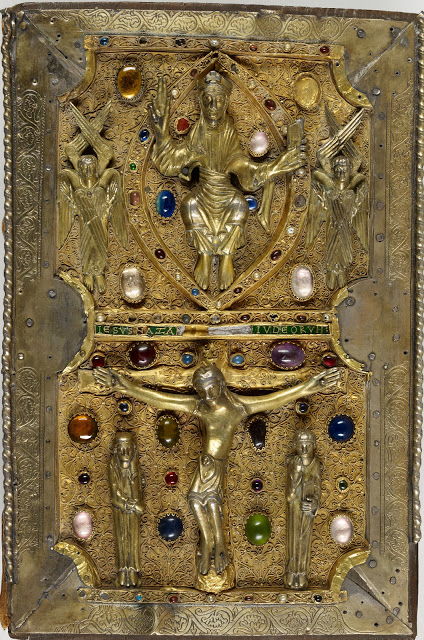
Cover of one of the four gospels commissioned by Judith of Flanders

In the late summer or autumn of 1051, Judith was married to Tostig, a son of the powerful Earl Godwin of Wessex and his wife, Gytha. And when the family fell foul of King Edward the Confessor, Judith accompanied them into exile; back to her homeland of Flanders. Tostig was probably the third eldest son of Godwin and Gytha of Wessex, one of his older brothers being the future King Harold II of England. He would have been in his early twenties at the time of his marriage and the family’s subsequent exile; Judith was no more than six years younger than him, which would suggest she was at least fifteen years old at the time of her marriage.

Judith would have returned to her new homeland of England when Tostig and his family forced their return from exile in 1052. After some vigorous negotiations in London, an uneasy peace was restored between Earl Godwin and the king. Judith and Tostig would have finally been able to settle down to married life, following months of uncertainty and upheaval. Although it is impossible to say for certain, they were probably given one of Godwin’s many comital estates, somewhere in Wessex, in which to set up their household. Their marriage appears to have been a successful one, with no rumours of infidelity recorded by the various chroniclers of the time. They are thought to have had two sons together, Skuli Tostisson Kongsfostre and Ketil Tostisson, born in 1052 and 1054, respectively.

Tostig was created earl of Northumbria in 1055 and spent the next few years sparring with Malcolm III, King of Scots. However, with peace restored Tostig left on pilgrimage to Rome in 1061, taking Judith with him. They were accompanied by several English bishops, including Ealdred, bishop of Worcester, who had just been made archbishop of York by King Edward, and was travelling to Rome to receive his pallium.

Their party reached Rome in the spring of 1061, where they were received honourably by Pope Nicholas; Tostig given the honour of attending a synod, possibly that held on 15 April at Easter 1061, at which Tostig is said to have sat next to the pope. Shortly after departing Rome for their homeward journey, Tostig’s party were caught up in a local dispute between the papacy and the Tuscan nobility; they were ambushed while travelling along the Via Cassia, by the Count of Galeria. Tostig was able to escape by the ruse of one of his own thegns pretending to be the earl. Judith and a large portion of the party had gone on ahead and were unaware for some time of what had befallen Tostig. She must have been relieved to hear of the failure of the attack when Tostig eventually caught up with her.

History...the Interesting Bits
Memorial to the Battle of Stamford Bridge, York

Judith appears to have been a very pious individual, although some stories have come down to us of disagreements between the Earl and his countess, and the Church. One story from Symeon of Durham tells of Judith’s attempts to circumvent the rules of the community of St Cuthbert. Despite there being a specific injunction forbidding women to enter the precincts of the church in which lay the shrine of St Cuthbert, Judith was determined to get around this. She sent one of her own maidservants to attempt entry, but the poor girl fell ill as soon as she crossed the boundary and died shortly afterwards, clearly demonstrating the power of St Cuthbert’s will. We can assume that Judith gave up trying to enter the shrine after that! Judith sent gifts to the cathedral – including a crucifix, church ornaments and images of the Virgin Mary and St John the Evangelist, decorated in gold and silver – to make amends for her disastrous attempt to break the rules.

Despite this, the relationship between the couple and the Church at Durham was generally cordial and mutually appreciated. The earl and countess were notable for almsgiving in Northumbria, and for their generosity towards the community of St Cuthbert. In return Æthelwine, Bishop of Durham, was generous enough to give Judith a relic containing some of St Oswine’s hair. As a consequence, Tostig and Judith are both commemorated in the Durham Liber Vitae.

In 1065, rebellion in Northumbria, and the lack of support from his fellow nobles – including his brother Harold – saw Tostig and his family banished from England; he and Judith, their children and their entire household, crossed the English Channel on 1 November 1065. They made their way to Flanders, to seek refuge with Judith’s brother, Count Baldwin, where they were warmly welcomed just a few days before Christmas.

History...the Interesting Bits
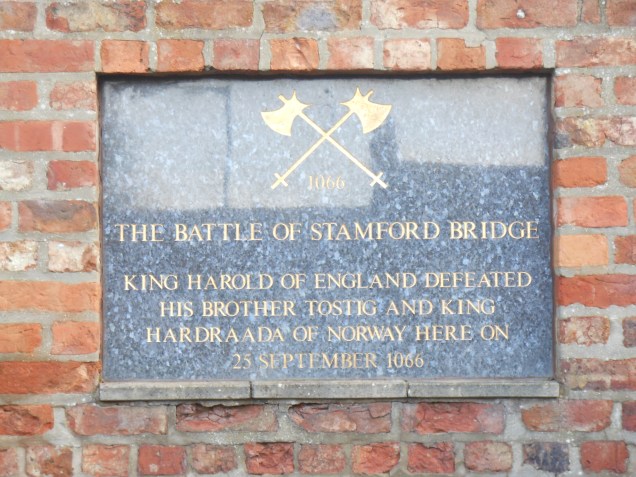
Memorial Plaque, Stamford Bridge, York

However, everything changed in January 1066, with the death of Edward the Confessor and the accession of Tostig’s brother, Harold, to the English throne. Not one to miss an opportunity, Tostig started raiding English shores, before invading from Scotland with his ally Harald Hardrada, King of Norway. They defeated the Northumbrians at the Battle of Fulford, near York, on 20 September, before facing Tostig’s brother, King Harold II, across the battlefield of Stamford Bridge 5 days later. King Harold proved victorious and Tostig and his ally, Harald Hardrada, were both killed in the fighting.

Judith’s whereabouts during Tostig’s invasion are not mentioned. It is possible that she stayed safe in Flanders with her family and two young sons, the oldest of whom was about fourteen by 1066. However, she may have travelled with her husband; there is a suggestion that at least one of her sons fought at Stamford Bridge and travelled to Norway with the survivors. Following Tostig’s defeat at Stamford Bridge, and Harold’s subsequent death at the Battle of Hastings, Judith’s two sons by Tostig eventually sought refuge with King Olaf ‘the Peaceable’ of Norway, Harald Hardrada’s son who had been allowed to return home following his father’s defeat and death at Stamford Bridge. Little is known of their movements after that, other than that the oldest, Skuli Tostisson Kongsfostre, must have married and had children as he was the ancestor of King Inge II of Norway.

History...the Interesting Bits
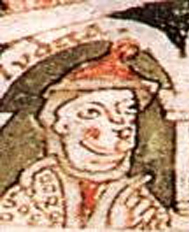
Wedding of Judith of Flanders and Welf IV, Duke of Bavaria

For a time, Judith remained in Flanders from where her older, half-brother, Count Baldwin V, arranged a second marriage for her in about 1070, to Welf IV, the newly created Duke of Bavaria. The couple were to have two sons and a daughter; Welf, who succeeded his father as Duke of Bavaria and died in 1119, Henry and Kunizza, who married Count Frederick of Diessen and died in 1120. Henry succeeded his brother as Duke of Bavaria and died in 1126; he had at least seven children by his wife, Wulfhilde of Saxony.

A patron of the arts, Judith is renowned for the commissioning of four gospel books, luxurious creations produced in England, probably at Winchester. When Judith left England, she took these gospels, with other manuscripts and relics in her private collection, with her to Flanders. After she remarried, they accompanied her to southern Germany.

On 12 March 1094, with the approval of her husband and sons, Judith drew up a list of bequests. She bequeathed the four gospels and other treasures, to the monastery at Weingarten, a foundation of her husband’s family, thus helping to disseminate Anglo-Saxon art throughout southern Europe. Among the bequests was also a relic of Christ’s blood, given to her by her father. She died a year later, on 5 March 1095, and was buried at the Abbey of Weingarten. Judith is remembered at Weingarten as a widowed queen of England, perhaps a testimony to how close her first husband got to the English throne.

*

This article, Judith of Flanders, Countess of Northumberland, first appeared on Mary Anne Yarde’s wonderful blog Myths, Legends, Book and Coffee Pots.

*

Images:

Courtesy of Wikipedia, except Stamford Bridge memorials ©2018 Sharon Bennett Connolly and Judith’s gospel courtesy of the British Library.

Sources:

The English and the Norman Conquest by Dr Ann Williams; Brewer’s British Royalty by David Williamson; Britain’s Royal Families, the Complete Genealogy by Alison Weir; The Wordsworth Dictionary of British History by JP Kenyon; The Norman Conquest by Marc Morris; Harold, the King Who Fell at Hastings by Peter Rex; The Anglo-Saxons in 100 Facts by Martin Wall; The Anglo-Saxon Age by Martin Wall; Kings, Queens, Bones and Bastards by David Hilliam; The Mammoth Book of British kings & Queens by Mike Ashley; The Oxford Companion to British History Edited by John Cannon; The Anglo-Saxon Chronicles translated and edited by Michael Swaton; The Anglo-Saxon Chronicle translated by James Ingram; Queen Emma and the Vikings by Harriett O’Brien; The Bayeux Tapestry by Carola Hicks; On the Spindle Side: the Kinswomen of Earl Godwin of Wessex by Ann Williams; oxforddnb.com.

*

My Books

Signed, dedicated copies of all my books are available through my online store.

OUT NOW! Scotland’s Medieval Queens

Books by Sharon Bennett Connolly

Scotland’s history is dramatic, violent and bloody. Being England’s northern neighbour has never been easy. Scotland’s queens have had to deal with war, murder, imprisonment, political rivalries and open betrayal. They have loved and lost, raised kings and queens, ruled and died for Scotland. From St Margaret, who became one of the patron saints of Scotland, to Elizabeth de Burgh and the dramatic story of the Scottish Wars of Independence, to the love story and tragedy of Joan Beaufort, to Margaret of Denmark and the dawn of the Renaissance, Scotland’s Medieval Queens have seen it all. This is the story of Scotland through their eyes.

Scotland’s Medieval Queens gives a thorough grounding in the history of the women who ruled Scotland at the side of its kings, often in the shadows, but just as interesting in their lives beyond the spotlight. It’s not a subject that has been widely covered, and Sharon is a pioneer in bringing that information into accessible history.’ Elizabeth Chadwick (New York Times bestselling author)

Available now from Amazon and Pen and Sword Books

Also by Sharon Bennett Connolly:

Books by Sharon Bennett Connolly

Heroines of the Tudor World tells the stories of the most remarkable women from European history in the time of the Tudor dynasty, 1485-1603. These are the women who ruled, the women who founded dynasties, the women who fought for religious freedom, their families and love. Heroines of the Tudor World is now available for pre-order from Amberley Publishing and Amazon UK. Women of the Anarchy demonstrates how Empress Matilda and Matilda of Boulogne, unable to wield a sword themselves, were prime movers in this time of conflict and lawlessness. It shows how their strengths, weaknesses, and personal ambitions swung the fortunes of war one way – and then the other. Available from Bookshop.orgAmberley Publishing and Amazon UKKing John’s Right-Hand Lady: The Story of Nicholaa de la Haye is the story of a truly remarkable lady, the hereditary constable of Lincoln Castle and the first woman in England to be appointed sheriff in her own right. Available from all good bookshops Pen & Sword Booksbookshop.org and Amazon

Historical Novel Society

Defenders of the Norman Crown: The Rise and Fall of the Warenne Earls of Surrey tells the fascinating story of the Warenne dynasty, from its origins in Normandy, through the Conquest, Magna Carta, the wars and marriages that led to its ultimate demise in the reign of Edward III. Available from Pen & Sword BooksAmazon in the UK and US, and Bookshop.orgLadies of Magna Carta: Women of Influence in Thirteenth Century England looks into the relationships of the various noble families of the 13th century, and how they were affected by the Barons’ Wars, Magna Carta and its aftermath; the bonds that were formed and those that were broken. It is now available in paperback and hardback from Pen & SwordAmazon, and Bookshop.orgHeroines of the Medieval World tells the stories of some of the most remarkable women from Medieval history, from Eleanor of Aquitaine to Julian of Norwich. Available now from Amberley Publishing and Amazon, and Bookshop.orgSilk and the Sword: The Women of the Norman Conquest traces the fortunes of the women who had a significant role to play in the momentous events of 1066. Available now from Amazon,  Amberley Publishing, and Bookshop.org.

Alternate Endings: An anthology of historical fiction short stories including Long Live the King… which is my take what might have happened had King John not died in October 1216. Available in paperback and kindle from Amazon.

Podcast:

A Slice of Medieval

Have a listen to the A Slice of Medieval podcast, which I co-host with Historical fiction novelist Derek Birks. Derek and I welcome guests, such as Bernard Cornwell, and discuss a wide range of topics in medieval history, from significant events to the personalities involved. A recent episode saw Derek and I looking at the years before the Norman Conquest in A Triumvirate of Earls.

Every episode is also now available on YouTube.

*

Don’t forget! Signed and dedicated copies of all my books are available through my online store.

For forthcoming online and in-person talks, please check out my Events Page.

You can be the first to read new articles by clicking the ‘Follow’ button, liking our Facebook page or joining me on TwitterThreads and Instagram.

©2019 Sharon Bennett Connolly FRHistS