Guest Post: In the Footsteps of Royalty: Exploring the Plantagenets on Our First Historic Adventure by Maxine Sommer

Today, it is a pleasure to welcome my friend Maxine Sommer back to History…the Interesting Bits. This summer, Maxine led a tour group of History fans through France in search of the Plantagenets, stopping at some iconic landmarks associated with Henry II, Eleanor of Aquitaine and the rest of the most famous – and at times, infamous – medieval royal family.

Over to Maxine….

In the Footsteps of Royalty: Exploring the Plantagenets on Our First Historic Adventure

“Journeying Through Medieval Masterpieces and Iconic Landmarks”

Château Gaillard: A Castle of Triumph and Tragedy
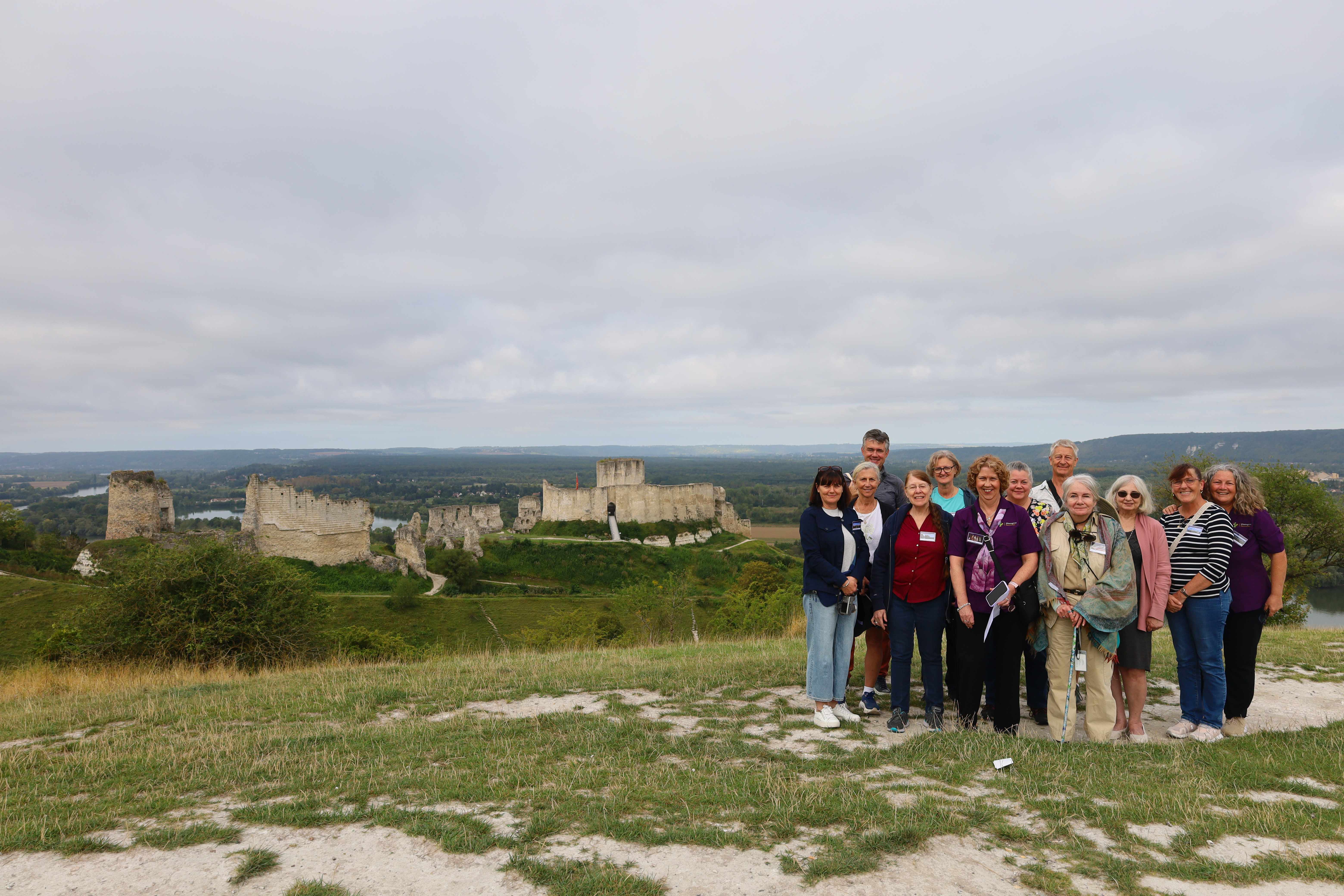
Château Gaillard

From day one, we dove into history headfirst with a visit to the imposing ruins of Château Gaillard. Though often hailed as Richard the Lionheart’s crowning achievement, this fortress holds layers of much more history than that. In 1314, it became the prison of two daughters-in-law of King Philip IV, key figures in the infamous Tour de Nesle Affair, a scandal that rocked the French court. A couple of decades later, the castle played host to Scotland’s child king, David II, and his bride, offering a royal respite before his return to reclaim his kingdom.

With the help of our brilliant guide Ange, we traced the rise and fall of Chateau Gaillard, from its hasty construction under Richard I to its swift capture by King Philip Augustus of France after John’s ill-fated reign. Standing among the weathered stone walls, it was easy to imagine its days of glory and power, but also to understand how quickly a once-unstoppable fortress could be toppled under weaker leadership. Chateau Gaillard’s story is not just one of medieval might but also a reminder of the delicate balance of power that shaped the Plantagenet era.

The Magnificent Bayeux Tapestry: A Stitch in Time

Though the Bayeux Tapestry predates the Plantagenets by nearly a century, it remains an essential highlight for anyone captivated by the medieval period. No amount of reading can prepare you for the sheer grandeur of this stunning masterpiece, meticulously crafted by hand to narrate the dramatic lead-up to the Norman invasion of England. The vibrant details leap to life, showcasing a vivid display that is nothing short of extraordinary.

One moment that particularly struck me was a scene depicting King Harold’s hasty departure for Normandy—his men, so rushed, they left without their shoes, splashing barefoot through the water as they headed to their ships. It’s these small yet poignant details that bring the narrative to life, showcasing the dedication of the women who painstakingly wove this epic tale.

Beyond the tapestry itself, the adjoining museum is a treasure trove of information, shedding light not just on this remarkable artifact but also on the broader historical context of the era. Visiting the Bayeux Tapestry is an unforgettable experience that will truly immerse you in the rich history of Normandy.

Mont Saint-Michel: A Dreamlike Retreat

Mont St Michel

This tidal island certainly lives up to its UNESCO World Heritage status, sadly though, as with most sites like this, the allure of their fame can bring overwhelming crowds, making it challenging to fully appreciate their beauty. To create an unforgettable experience for my group, I arranged for us to stay overnight on the island—a decision that transformed our visit into something truly magical. As the day’s tourists departed, we found ourselves wandering the winding paths of Mont Saint-Michel in peaceful solitude. The island’s enchanting atmosphere became even more pronounced as twilight descended, allowing us to immerse ourselves in its rich history without the jostle of crowds.

The journey across the causeway to Mont Saint-Michel feels like a step back in time, as the abbey loomed larger, the closer we got to the gate. Approaching the island in this way adds to the otherworldly feeling, transporting you to a different realm entirely.

One of my guests, Dianne, perfectly captured the essence of our experience in her review: “The highlight for me was staying overnight on the island of Mont Saint-Michel. I will never forget watching the sun come up and the light making the abbey glow.” Her words echo the indescribable wonder we all felt, creating memories that will last a lifetime.

Fontevraud Abbey: Where History, Serenity, and Culinary Splendour Meet
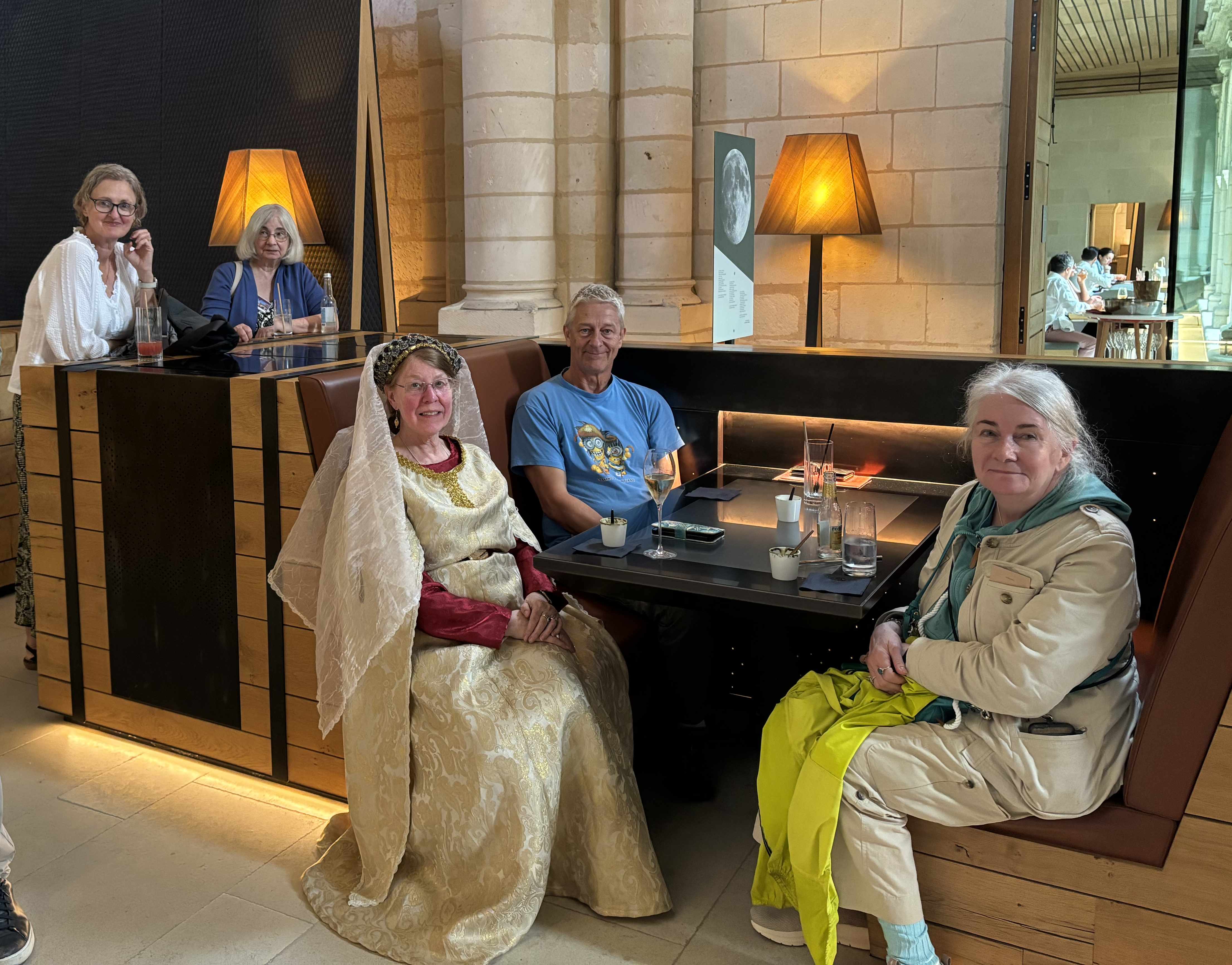
Queen Eleanor at the Abbey

For anyone captivated by the Plantagenets, a visit to Fontevraud Abbey—final resting place of the indomitable Eleanor of Aquitaine—is often a dream come true. Several of my group members had long wished to stand before her effigy, so it was clear that this site would be a highlight of our tour. Yet, what awaited us at Fontevraud far exceeded expectations.

Our stay at Fontevraud l’Hôtel, situated within the abbey grounds, offered the unique luxury of exploring the abbey well into the night, with its tranquil beauty only deepening as the moonlight bathed its ancient stones. But what truly made this visit unforgettable was the dining experience. I selected the abbey’s famed “lunar menu,” a modern interpretation of the simple yet refined meals once enjoyed by the monks and nuns who lived here centuries ago. What followed was a culinary journey that transcended time—an extraordinary feast of countless, artfully prepared courses that delighted the senses.

To top it all off, we were treated to a special visit from “Queen Eleanor” herself, brought to life by our talented group member Donna in costume, creating an enchanting atmosphere that perfectly rounded out our unforgettable night at the Abbey.

Guédelon: A Medieval Masterpiece in the Making
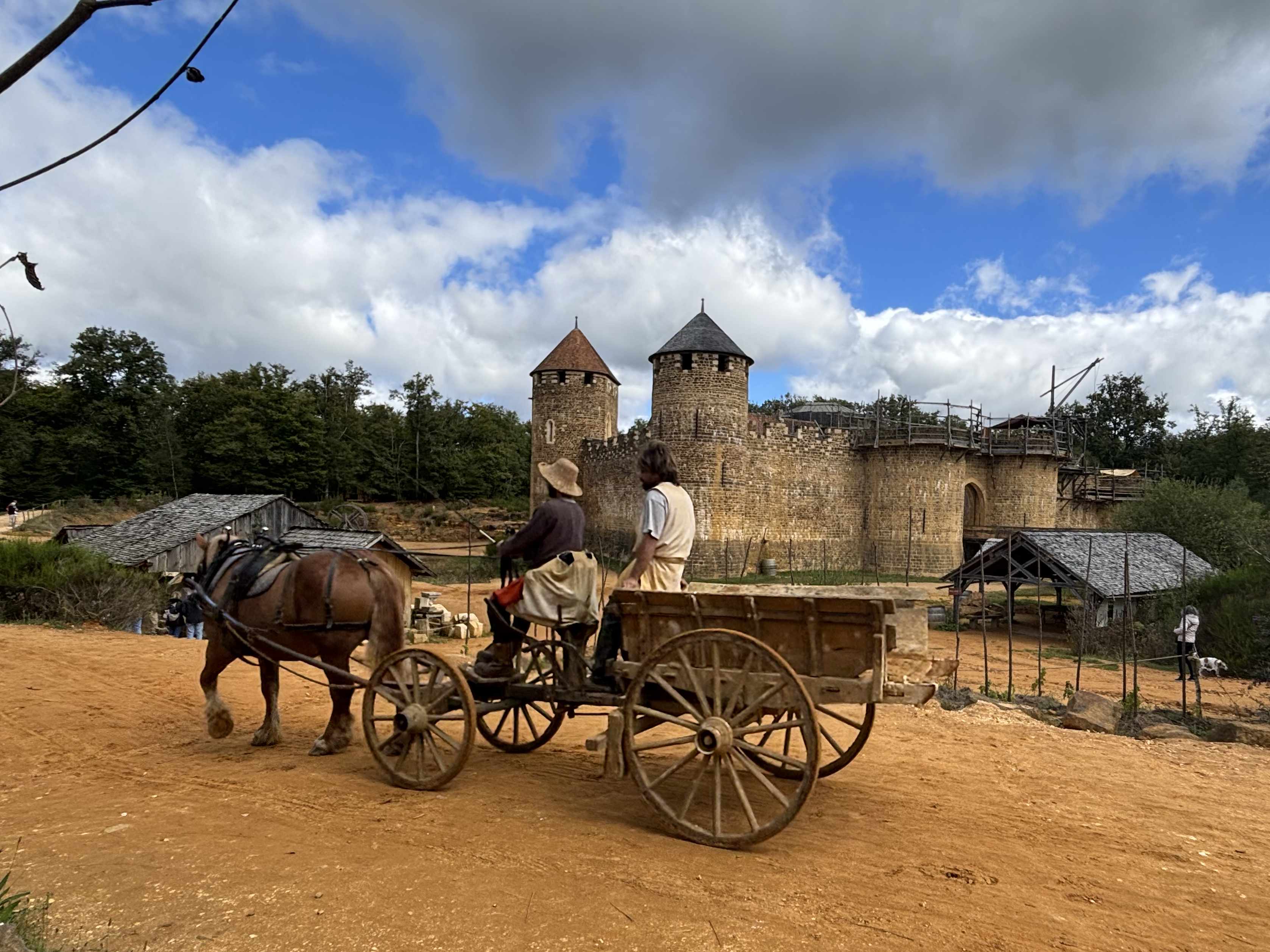
Guedelon Medieval Site

Though its connection to the Plantagenets lies only in the era, Guédelon captivated us with its sheer ambition and authenticity. This extraordinary project, set within an unused quarry, is an ongoing attempt to build a 13th-century castle using only the materials and techniques of the medieval period. It was like stepping back in time—without the school excursion chaos! We had the chance to speak with the craftsmen, each dedicated to recreating history one stone at a time. It’s mind-boggling to witness the painstaking effort that goes into building each section of the castle by hand, giving us a new appreciation for the scale of historical construction.

As we walked through Guédelon, I couldn’t help but reflect on Château Gaillard, which we visited earlier in the tour—a fortress that Richard the Lionheart had built in just two years. While Richard’s team had far more manpower in 1196, the ongoing construction of Guédelon, which began in 1997, has taken 27 years and is still far from complete.

Adding to the authenticity, the village that houses the volunteers lives strictly by 13th-century standards. They grow their own food, dress in period-appropriate clothing, and cook using medieval techniques. It’s a living glimpse into the past and an absolute must-visit for history enthusiasts.

“Unraveling the Tales of an Intriguing Plantagenet Legacy”

Richard I, the Lionheart
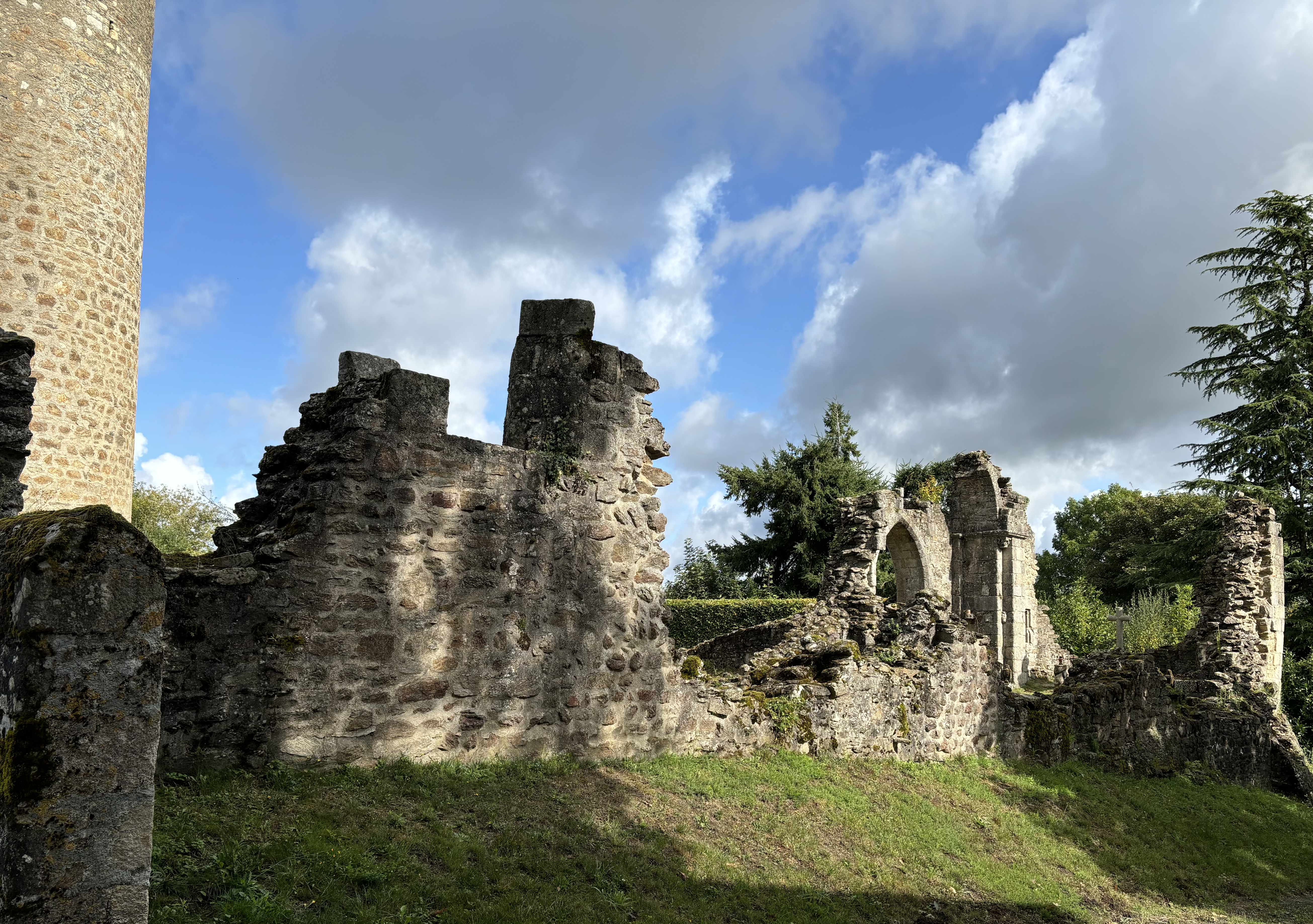
Château Châlus-Chabrol

A Plantagenet-themed tour through France wouldn’t be complete without constant references to the Angevins. Unsurprisingly, Richard the Lionheart was a recurring figure throughout our journey, from the stunning ruins of Château Gaillard—Richard’s pride and joy—to his embalmed heart at Rouen Cathedral, and finally to Château Châlus-Chabrol, where he met his end after receiving a fatal crossbow wound. Along the way, there were lively debates about his merits as a king and husband, discussions that seemed to spill over into several coach rides and castle visits!

But the most amusing conversation of all came after our visit to Château Châlus-Chabrol. According to local legend, Richard’s entrails were buried in the chapel of the castle where he died, the very castle he had been besieging when he was fatally wounded. As we travelled on, our group began to ponder this curious story—if Richard was the enemy, how likely was it that the castle’s defenders would have invited him into their chapel to die comfortably by the fire? Surely, the reality was less cozy than that! This debate sparked plenty of laughs and camaraderie, as we cheerfully unraveled the mystery of Richard’s final days. It was moments like this that truly made the tour so memorable, blending history with humour and shared insights.

Henry II
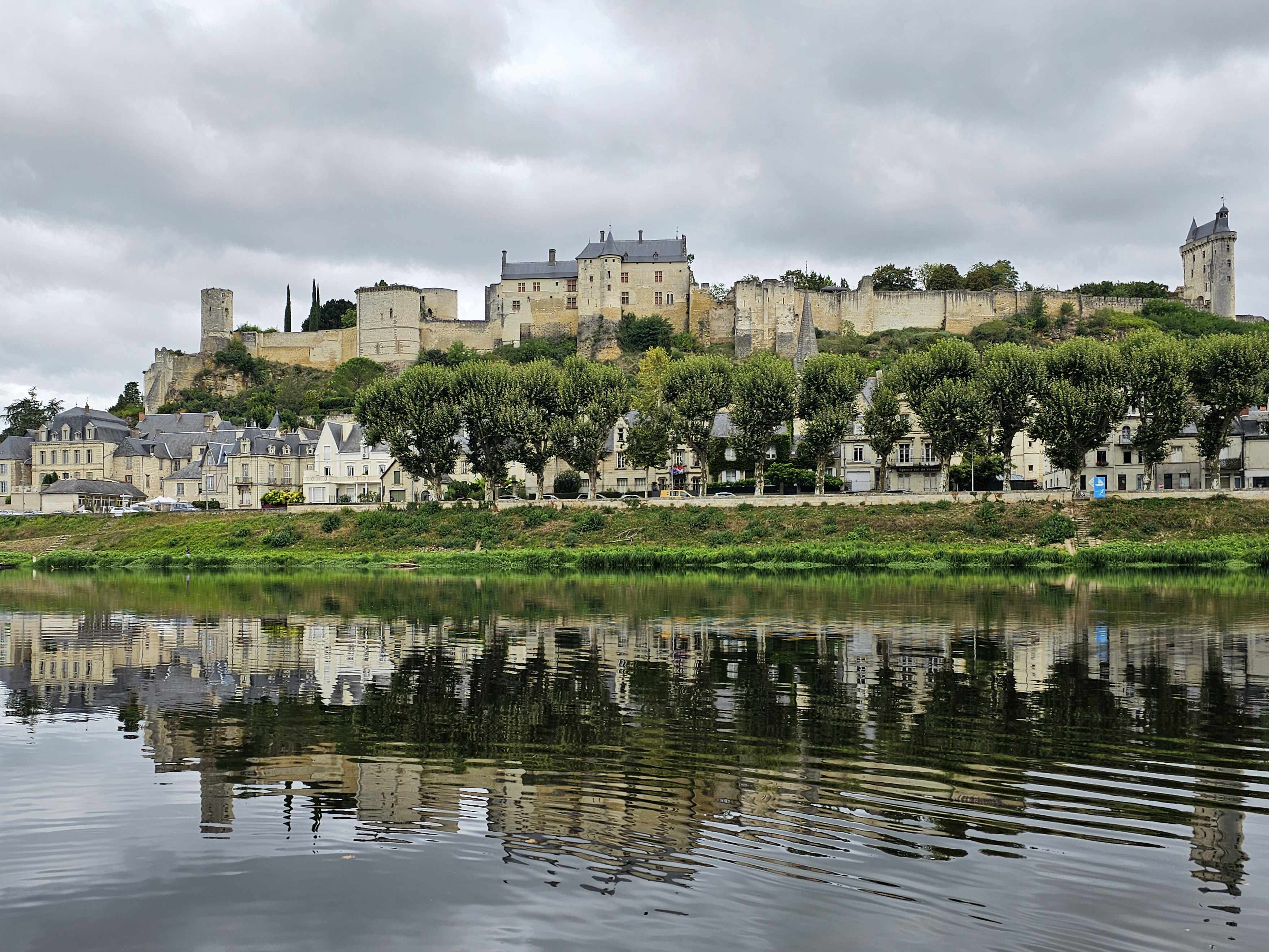
Chinon Castle

On the evening of Day 4, just outside Poitiers, I arranged a lively group discussion before dinner, with the spotlight on none other than Henry II. The topic was particularly fitting after our earlier visit to the impressive Chinon Castle, a stronghold that played a key role in his reign. Over a glass or two of wine, our conversation quickly sparked debates about the enigmatic first Plantagenet king.

For many, Henry II is synonymous with the infamous murder of Thomas Becket in December 1170—a crime that shocked Europe, with Becket killed on the very floor of Canterbury Cathedral. Henry’s tumultuous relationships with his sons, often called the ‘Devil’s Brood,’ and the long imprisonment of his formidable wife, Eleanor of Aquitaine, have painted a rather dark image of him in the pages of history. And yet, I have a dear friend who defends Henry passionately, believing history has judged him too harshly. This made me eager to hear the views of my group.

I was not disappointed. What followed was a fascinating and animated discussion about Henry’s complexity, revealing both his flaws and strengths. Like many moments on our journey, everyone felt welcome to share their opinions, creating a warm and open exchange that deepened our collective understanding of this remarkable, yet often misunderstood, king.

The Hundred Years’ War
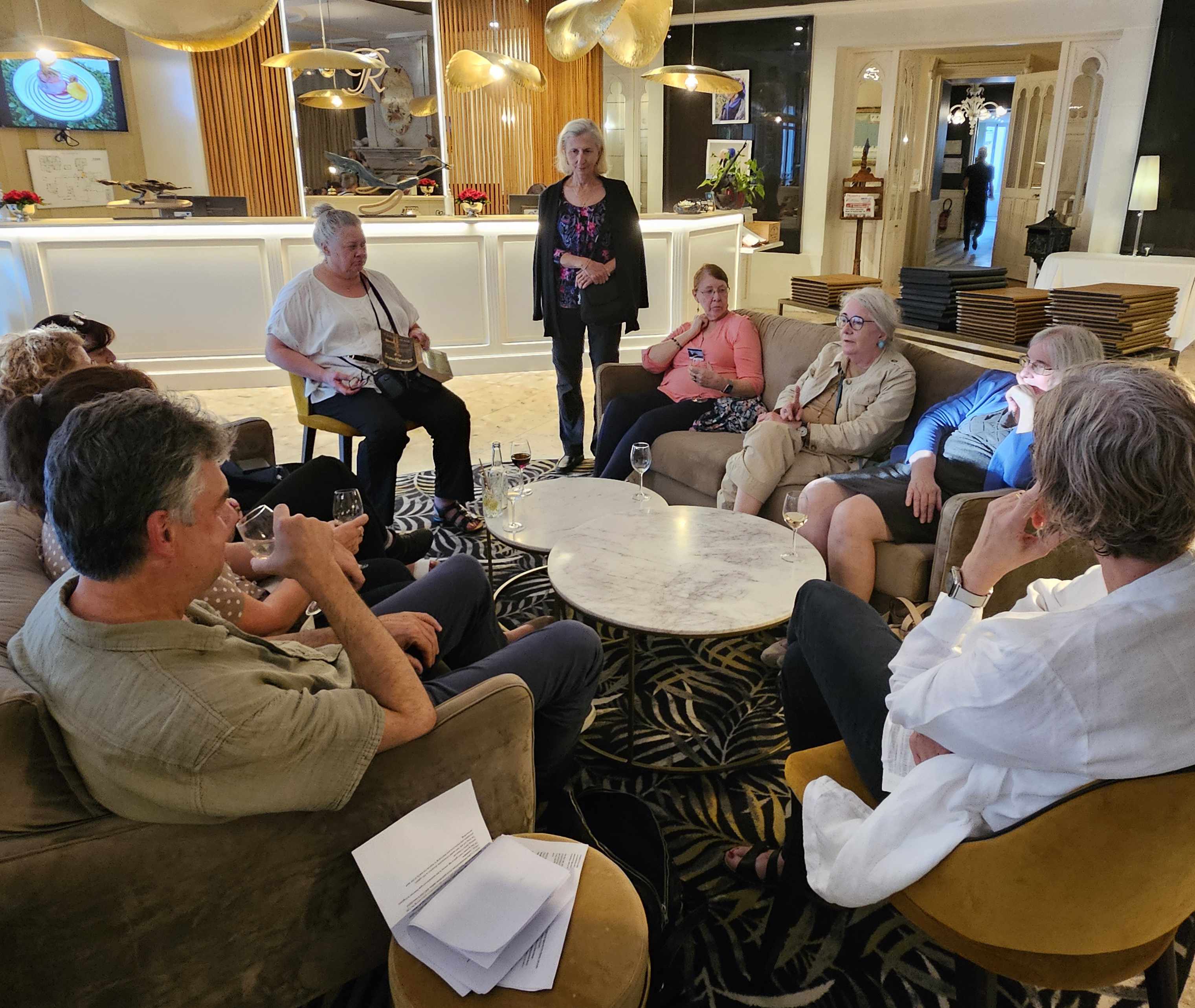
Group discussion: Hundred Years’ War

Beyond the Angevins, one of the most pivotal topics of our journey through France was the prolonged struggle for the French crown between the Plantagenet kings of England and the Valois kings of France, famously known as The Hundred Years’ War. This conflict defined a significant part of Plantagenet history in France, so I was especially excited to organize another pre-dinner group discussion on Day 8.

I am sure most of the group had read accounts of this struggle from an English perspective, however I was curious to explore its impact on the French people. Now, what better way to do that, than by hearing the insights of our

exceptional guide, Ange, a native Frenchman, who provided a fresh and compelling view of the war from the French side. His perspective gave us a different and not unbalanced understanding of this conflict.

It’s not often us history ‘nerds’ can engage in such thoughtful debates over a glass of wine, and this particular evening felt like another one of those perfect moments of camaraderie and learning that made our journey so incredible.

Eleanor of Aquitaine
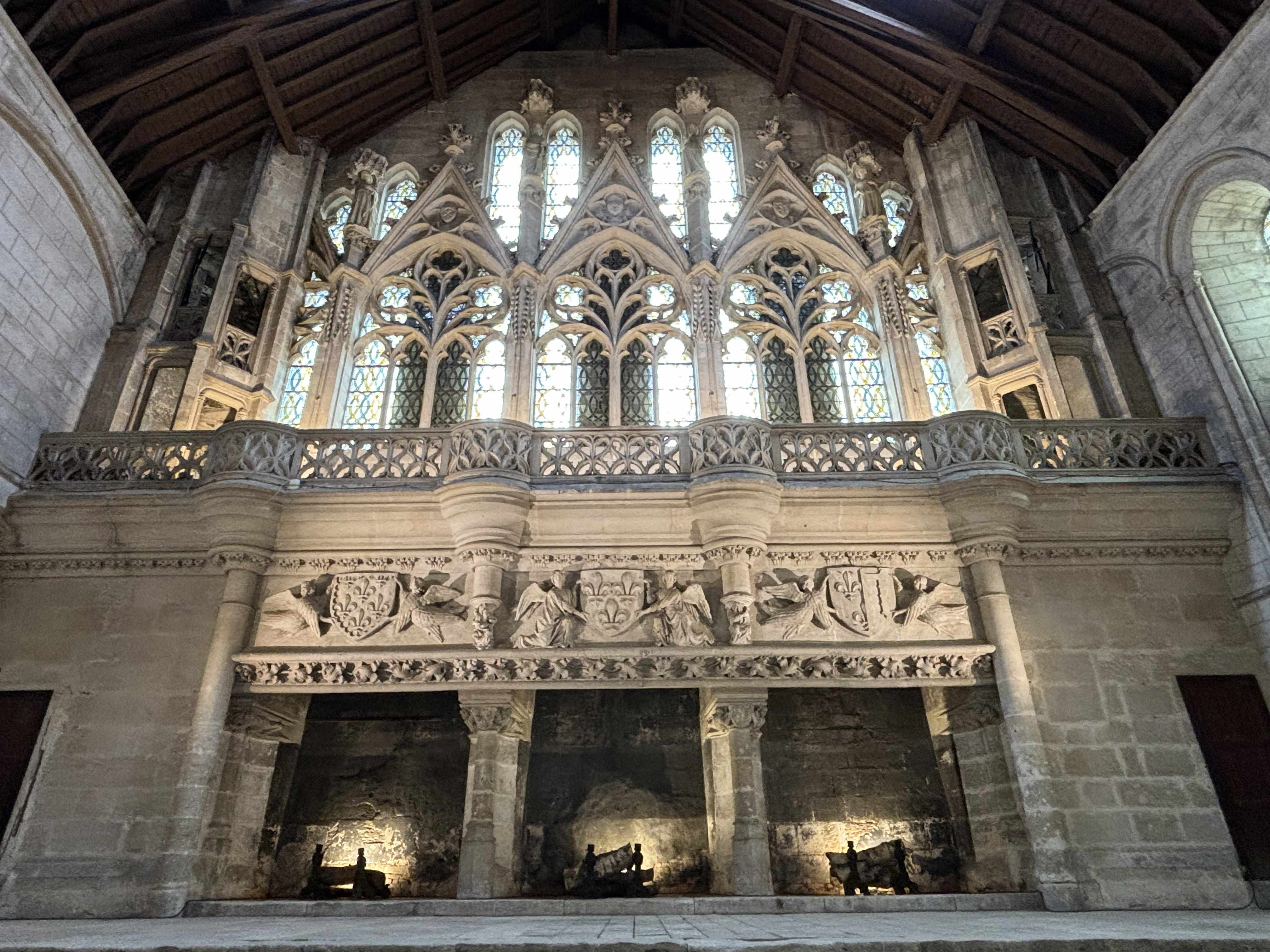
Great Hall at Poitiers

No 10-night Plantagenet-themed tour through France would be complete without a deep dive into the life of the most remarkable queen of them all, Eleanor of Aquitaine. Our journey took us to some of the most significant places in her life, from the serene beauty of Fontevraud Abbey, where we had the privilege of visiting her effigy and reflecting on her final days, to the lively city of Poitiers, where she held court with unmatched influence for so many years.

We also ventured to Bordeaux, a region now synonymous with world-class wine, a commodity that owes much of its early prominence to Eleanor’s marriage to Henry, Duke of Normandy—later Henry II of England. Despite the challenges and turbulence of their union, the marriage of these two dynamic figures laid the foundation for a dynasty that ruled for 331 years.

Our discussions about Eleanor were as vibrant as her extraordinary life. From her imprisonment at the hands of her own husband to her daring voyages to the Holy Land—one of which took place when she was nearly 70 years old—we marveled at her resilience and power. And finally, we reflected on the peace she found at Fontevraud, where she spent her final days in quiet reflection at the abbey she so loved.

I hope you’ve enjoyed this glimpse into our amazing journey. For more stories and discoveries from my first tour, visit my blog and uncover all the memorable experiences we shared beyond just mere history: plantagenetdiscoveries.com.

We’re gearing up for the next adventure in July, and you won’t want to miss it! Mention this article when you reach out http://www.plantagenetdiscoveries.com/contact for an exclusive discount—I’d love to welcome you on board for our next historical journey.

*

My Books:

Signed, dedicated copies of all my books are available through my online store.

OUT NOW! Heroines of the Tudor World
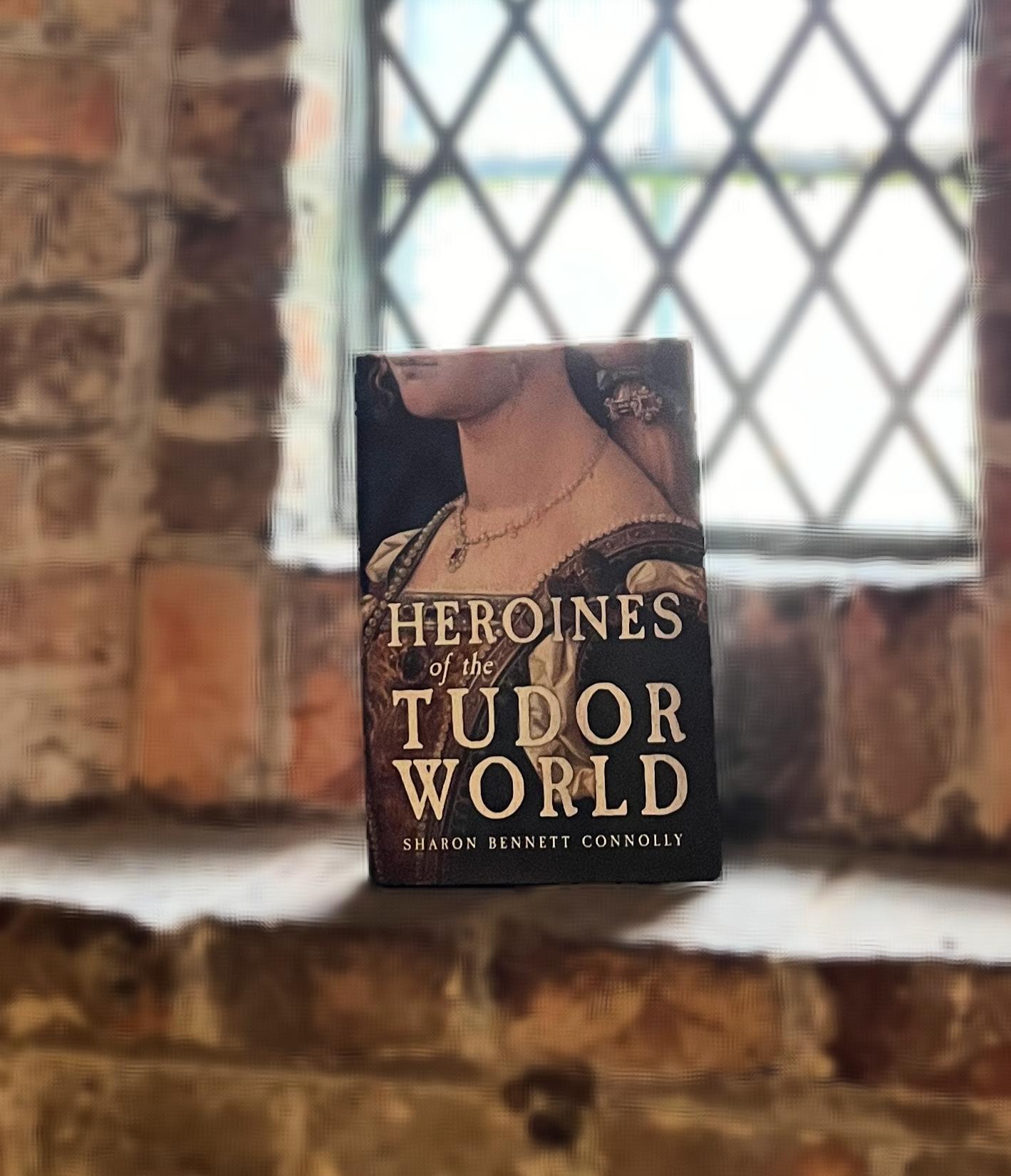
Heroines of the Tudor World tells the stories of the most remarkable women from European history in the time of the Tudor dynasty, 1485-1603. These are the women who ruled, the women who founded dynasties, the women who fought for religious freedom, their families and love. These are the women who made a difference, who influenced countries, kings and the Reformation. In the era dominated by the Renaissance and Reformation, Heroines of the Tudor World examines the threats and challenges faced by the women of the era, and how they overcame them. From writers to regents, from nuns to queens, Heroines of the Tudor World shines the spotlight on the women helped to shape Early Modern Europe.

Heroines of the Tudor World is now available for pre-order from Amberley Publishing and Amazon UK.

Coming 30 January 2025: Scotland’s Medieval Queens
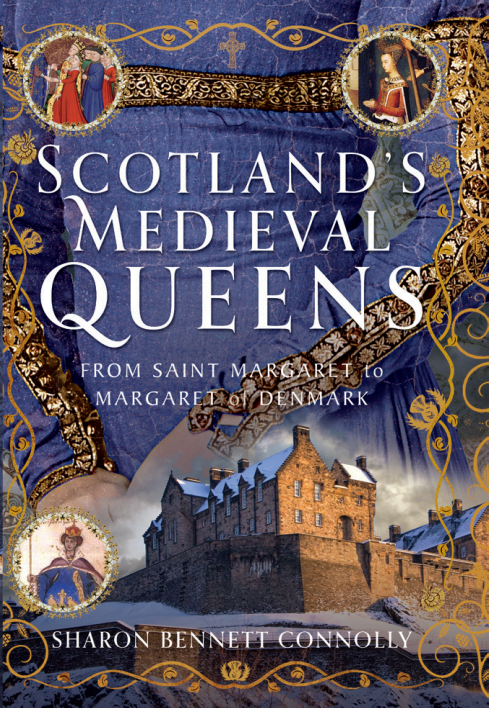
Scotland’s history is dramatic, violent and bloody. Being England’s northern neighbour has never been easy. Scotland’s queens have had to deal with war, murder, imprisonment, political rivalries and open betrayal. They have loved and lost, raised kings and queens, ruled and died for Scotland. From St Margaret, who became one of the patron saints of Scotland, to Elizabeth de Burgh and the dramatic story of the Scottish Wars of Independence, to the love story and tragedy of Joan Beaufort, to Margaret of Denmark and the dawn of the Renaissance, Scotland’s Medieval Queens have seen it all. This is the story of Scotland through their eyes.

Available for pre-order now.

Also by Sharon Bennett Connolly:
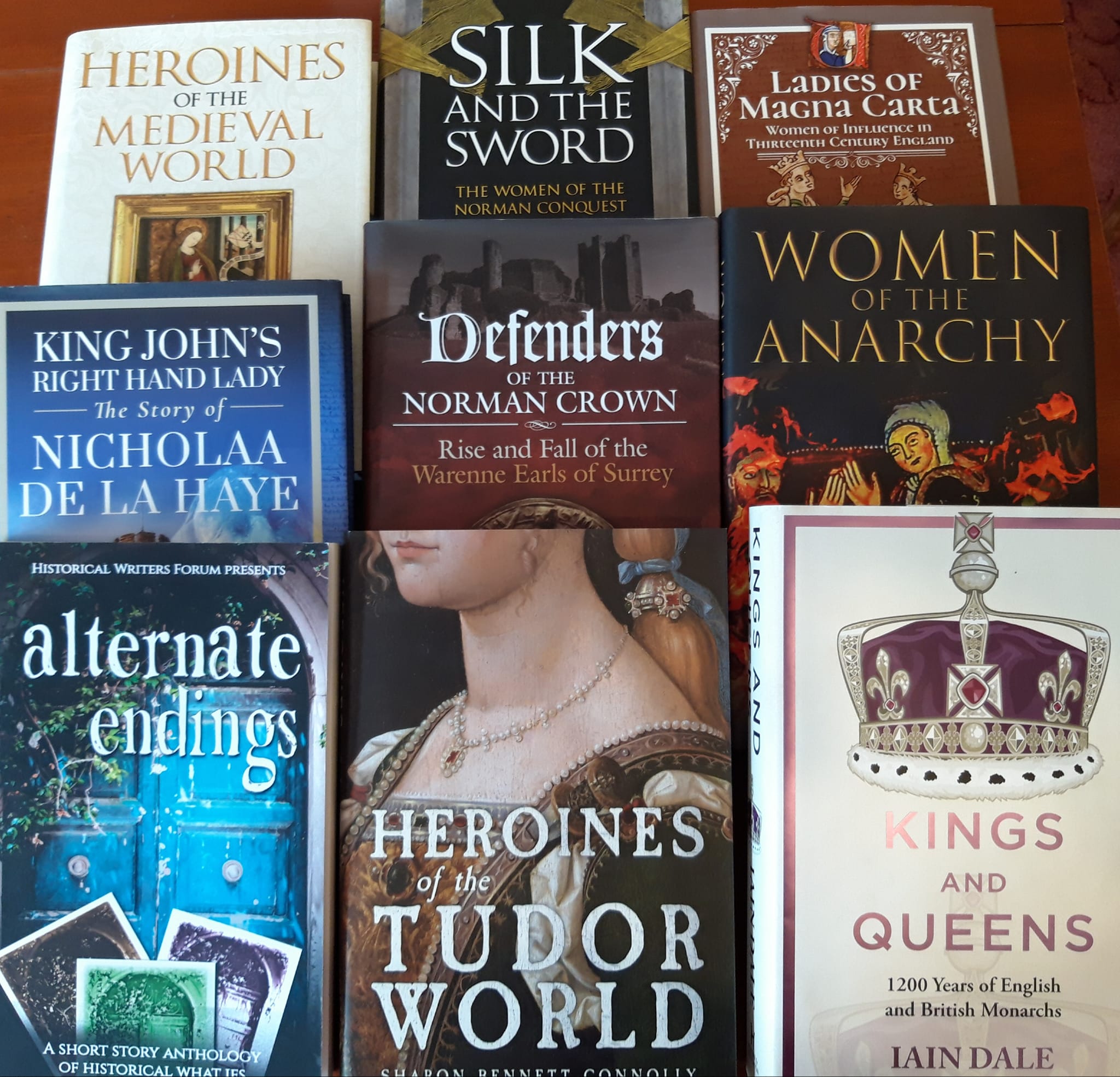
Women of the Anarchy demonstrates how Empress Matilda and Matilda of Boulogne, unable to wield a sword themselves, were prime movers in this time of conflict and lawlessness. It shows how their strengths, weaknesses, and personal ambitions swung the fortunes of war one way – and then the other. Available from Bookshop.orgAmberley Publishing and Amazon UKKing John’s Right-Hand Lady: The Story of Nicholaa de la Haye is the story of a truly remarkable lady, the hereditary constable of Lincoln Castle and the first woman in England to be appointed sheriff in her own right. Available from all good bookshops Pen & Sword Booksbookshop.org and AmazonDefenders of the Norman Crown: The Rise and Fall of the Warenne Earls of Surrey tells the fascinating story of the Warenne dynasty, from its origins in Normandy, through the Conquest, Magna Carta, the wars and marriages that led to its ultimate demise in the reign of Edward III. Available from Pen & Sword BooksAmazon in the UK and US, and Bookshop.org

Ladies of Magna Carta: Women of Influence in Thirteenth Century England looks into the relationships of the various noble families of the 13th century, and how they were affected by the Barons’ Wars, Magna Carta and its aftermath; the bonds that were formed and those that were broken. It is now available in paperback and hardback from Pen & SwordAmazon, and Bookshop.orgHeroines of the Medieval World tells the stories of some of the most remarkable women from Medieval history, from Eleanor of Aquitaine to Julian of Norwich. Available now from Amberley Publishing and Amazon, and Bookshop.orgSilk and the Sword: The Women of the Norman Conquest traces the fortunes of the women who had a significant role to play in the momentous events of 1066. Available now from Amazon,  Amberley Publishing, and Bookshop.org.

Alternate Endings: An anthology of historical fiction short stories including Long Live the King… which is my take what might have happened had King John not died in October 1216. Available in paperback and kindle from Amazon.

Podcast:

Have a listen to the A Slice of Medieval podcast, which I co-host with Historical fiction novelist Derek Birks. Derek and I welcome guests, such as Bernard Cornwell, and discuss a wide range of topics in medieval history, from significant events to the personalities involved.

*

Don’t forget! Signed and dedicated copies of all my books are available through my online store.

For forthcoming online and in-person talks, please check out my Events Page.

You can be the first to read new articles by clicking the ‘Follow’ button, liking our Facebook page or joining me on TwitterThreads and Instagram.

*

©2024 Sharon Bennett Connolly FRHistS and Maxine Sommer

Guest Post: Empresses, Saints and Female-Kings: The Four Great-Granddaughters of King Ladislaus the Elbow-High by Katarzyna Ogrodnik-Fujcik

Today it is a pleasure to welcome my good friend, Kasia Ogrodnik to History…the Interesting Bits with a little bit of Polish history for us. I have been wanting to tell the story of King Jadwiga since writing about her in Heroines of the Medieval World. But Kasia is far better qualified to write about her compatriot, Poland’s famous female king and saint, and Jadwiga’s influential female relatives.

So, over to Kasia…

Empresses, Saints and Female-Kings: The Four Great-Granddaughters of King Ladislaus the Elbow-High

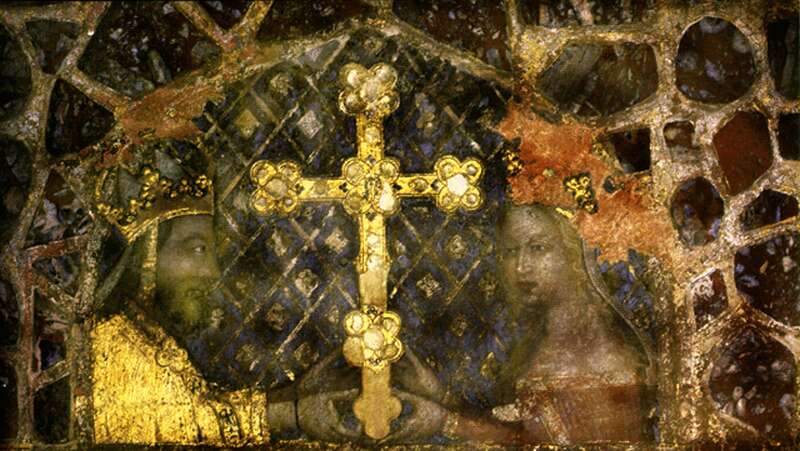
Charles IV, King of Bohemia and Holy Roman Emperor and Anna of Schweidnitz [Anna Świdnicka], c. 1357, Chapel of St. Katherine, Karlstejn

The night of 19 May 1365 saw a young girl leaving Pisa on horseback. With her hair loose, clad only in her nightgown she was galloping to safety after fire broke out in Palazzo degli Anziani. Judging by her looks no one would have guessed this girl was in fact Holy Roman Empress and Queen of Bohemia. 

Anna of Schweidnitz, Silesia (today Poland), was the only child of Duke Henry II, the grandson of King Ladislaus the Elbow-High of Cracow (Poland). Upon her father’s death she was placed under the care of his elder brother, her uncle, Bolko II the Small. The ruler of the small, but politically important duchy, Bolko was the last independent Silesian Piast. Since Charles IV of Luxembourg intended to annex the entirety of Silesia to the Kingdom of Bohemia, Bolko’s duchy, being the only missing part, was crucial to his plans. To secure the Schweidnitz inheritance Charles married Anna and this is how her journey began. Of course, she was not the only great-granddaughter of King Ladislaus to make an illustrious career. His three other great-granddaughters were to leave their marks on the world, too, and indelible ones. Two of them were to be crowned ”kings” and one proclaimed  saint. 

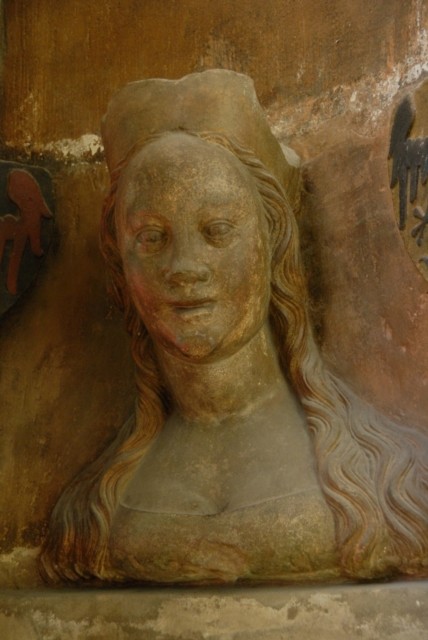
Anna of Schweidnitz [Anna Świdnicka], bust in St Vitus Cathedral, Prague, c. 1370

Anna of Schweidnitz (b.1339), Queen of Bohemia and Holy Roman Empress, was Charles IV of Luxembourg’s third wife. Initially she was betrothed to his son, Wenceslaus, but the boy died while still very young. His mother, Charles’s second wife died too shortly afterwards. To secure the Schweidnitz succession Charles decided to marry his late son’s fiancee himself. Anna was raised and educated at the splendid court of Queen Elizabeth of Poland (her late father’s aunt) at Buda, where she was sent by her uncle and official guardian, Duke Bolko II the Small. It was there where she and Charles were married in the closing days of  May 1353. Shortly afterwards the newlyweds returned to Prague and paid a visit to Schweidnitz, where the succession treaty was signed according to which the duchy was to be inherited by Anna and her children by Charles upon the death of her uncle Bolko and his wife Agnes of Habsburg. On 28 July 1353, Anna was crowned Queen of Bohemia and the following year, on 9 February 1354, Queen of Germany. The year 1355 saw the royal couple in Italy, where on Easter Sunday (5 April 1355) they were crowned Holy Roman Emperor and Holy Roman Empress in a splendid ceremony in the Basilica of Saint Peter, Rome.

Anna and Charles’s first child, a daughter, Elizabeth, was born in 1358. Charles was overjoyed, but Anna felt she failed her husband (which we know thanks to her surviving correspondence with Petrarch). A much awaited son and heir arrived three years later, named Wenceslaus, traditional name of the rulers of Bohemia. He was to become Charles’ beloved and favoured child. Anna died on 11 July 1362, in childbirth, aged 23. The child did not survive, either, and they were buried together in St Vitus Cathedral, Prague. Anna was remembered for her personal charm and sweet nature. Not only did she receive a bluestocking education, but she was also considered one of the style icons of her time, her reputation as a great beauty resting on the surviving images created during her lifetime and shortly after her untimely death. Tradition has it that of Charles’ four wives it was Anna he loved most. Stricken with grief upon her passing, he did not remarry until a political situation forced him to. His fourth wife was Anna’s kin, Elizabeth of Pomerania, also great-granddaughter of King Ladislaus the Elbow-High. 

Elizabeth of Pomerania (Eliška Pomořanská, Elżbieta Pomorska)

 
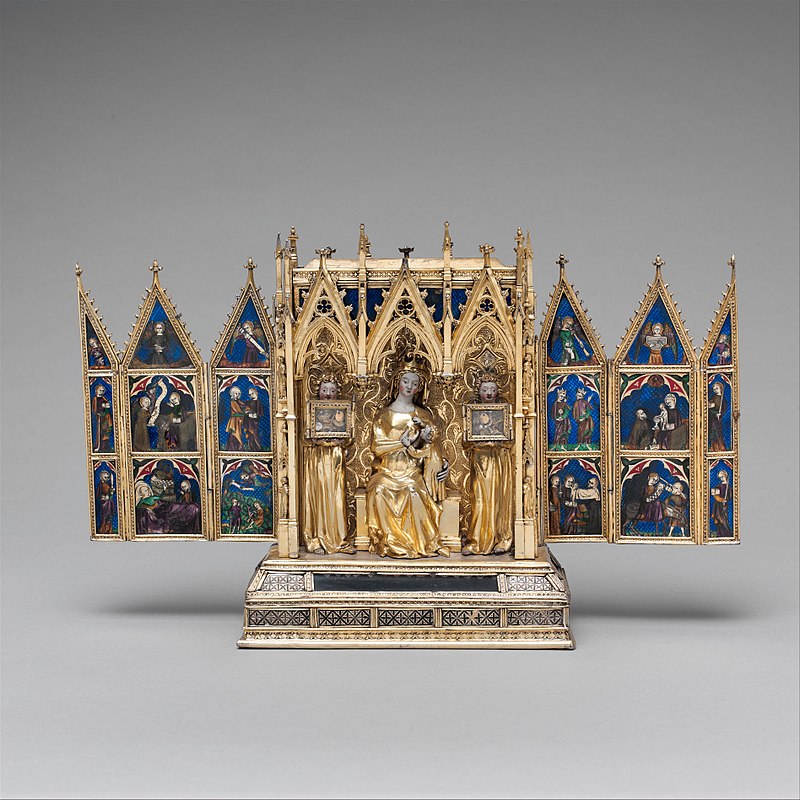
Reliquary Shrine of Elizabeth of Poland, Queen of Hungary, Maria and Jadwiga’s paternal grandmother, attributed to Jean de Touyl, ca. 1350 . Metropolitan Museum of Art, New York

Elizabeth was a daughter of Duke Bogusław the Great of Pomerania and Princess Elżbieta of Poland. In 1362 her maternal grandfather, King Casimir the Great of Poland together with his nephew, Louis the Great of Hungary, dukes of Austria and Bavaria formed a coalition against Charles IV of Luxembourg. The opposing parties found themselves on the verge of war, which did not break out, however, perhaps due to Anne of Schweidnitz’s untimely death. The rulers came to terms instead and a marriage was forged to consolidate their agreement. Charles was to marry Elizabeth. He was thrice her age, shorter than her and not very attractive. She was described as beautiful, full of life, and as fit as a fiddle. Stories had it that she could break horseshoes with her own hands. She was an avid horse rider and hunter. 

The wedding ceremony was celebrated in Kraków on 21 May 1363. Afterwards the couple travelled together to Prague where Elizabeth was crowned Queen of Bohemia. Five years later her imperial coronation at Rome followed. Despite the age difference she and Charles got along well, being married for fifteen years. Their union produced six children, four of whom were to reach adulthood. Charles and Elizabeth’s eldest child, a daughter Anne, was to marry Richard II and become Queen Consort of England. Their son, Sigismund was to be crowned King of Bohemia, Hungary and Holy Roman Emperor. Charles IV died in 1378. Elizabeth herself was to outlive her husband for fifteen years. She died in 1393 and like his three wives before her, she was buried in St Vitus Cathedral, Prague.

Mária [Mary] of Anjou, King of Hungary

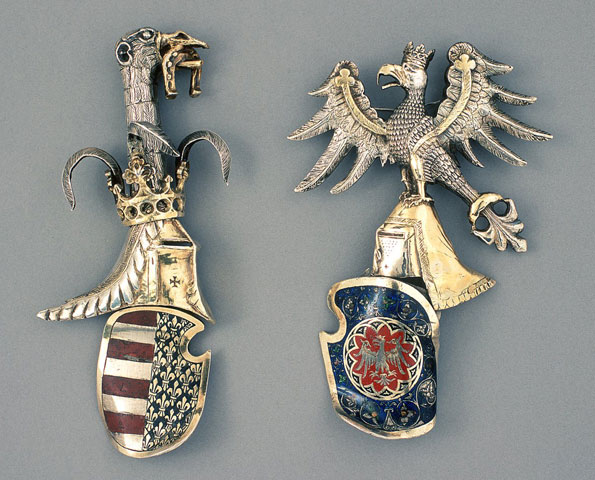
The coats of arms of Hungary and Poland, c. 1340. Treasury of Aachen Cathedral, Germany

Mary was one of the three daughters of Louis the Great of Hungary and his second wife, Elizabeth of Bosnia. In 1379, Mary’s elder sister Catherine died, leaving her and her sister Jadwiga Louis’s sole surviving children. The matter of Polish succession had been on the agenda long before Mary was born. Upon King Casimir the Great’s death in 1370 his nephew, Mary’s father, Louis was crowned king of Poland. Initially it was Mary, who was to succeed him as the king of Poland, but the events took a different turn, and in the end she was replaced by her younger sister, Jadwiga [Hedwig]. 

Mary was crowned “king” of Hungary on 17 September 1382, seven days after her father’s death. However, the idea of a female monarch was not popular among the Hungarian nobility. Many nobles considered Charles III of Naples, Mary’s distant cousin, the lawful heir. 

Charles landed in Dalmatia in September 1385. In October Mary was married to Sigismund of Luxembourg, however, this  could not prevent Charles from entering the capital.  Mary was forced to renounce the throne and Charles’s coronation took place on 31 December 1385. He did not rule for long. Two months later, in February 1386, he was murdered, most probably at the instigation of Mary’s mother. Mary was restored, but in July she and her mother were captured by the dead king’s supporters. Famed for her beauty, but not for her political decisions, Mary’s mother met a violent end. After imprisonment by her opponents in Novigrad castle, she was found guilty of the murder of Charles III of Naples and strangled to death before her daughter’s own eyes, her body put on display, hanging on a rope from the castle walls. Mary survived and was rescued by her husband, Sigismund, who was crowned king of Hungary afterwards. Mary officially remained his co-ruler, but had no real influence on the government. She died on 17 May 1395 after falling from a horse during a hunting accident. She was pregnant at the time. Her prematurely born son did not survive either. 

Jadwiga [Hedwig] of Anjou, king and patron saint of Poland

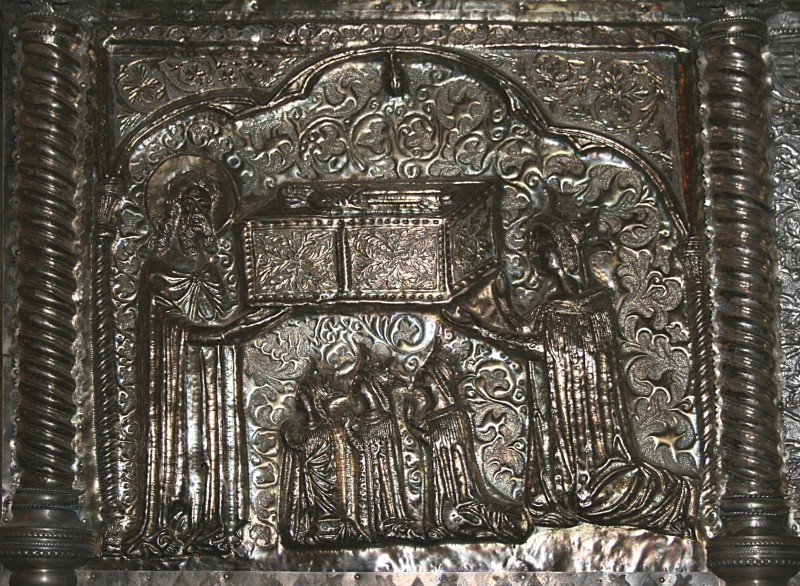
Jadwiga and Maria, their mother and their sister Catherine as depicted on the St Simeon’s casket, Zadar, Croatia

Mary’s younger sister, Hedwig was born on 18 February 1374, being the youngest of the three daughters of Louis the Great of Hungary and Elizabeth of Bosnia. 

Both Mary and Jadwiga received a bluestocking education, Jadwiga both at the cultivated court of Hungary and in Vienna, at the court of her future father-in-law. Not only could Jadwiga read and write, but she also spoke fluent Latin and German. As the king of Poland she owned a big library and always  showed an active and generous support of scholars and learning institutions.

Since Polish nobles did not like the idea of Mary’s consort, Sigismund of Bohemia, becoming de facto their king, they appealed to Elizabeth of Bosnia, the dowager queen, who had assumed regency, asking to send the younger of her two surviving daughters to Kraków. Elizabeth agreed and absolved the Polish nobles from the oath of loyalty they had pledged to Mary. 

Jadwiga’s coronation took place on 16 October 1384 in Wawel Cathedral, Kraków, where she was crowned ”king” of Poland. On 18 January 1385 the Lithuanian delegation came to the capital and a meeting was held with the representatives of the Polish nobility. Jadwiga was to marry the ruler of pagan Lithuania, Jogaila. In the opening days of 1386, Jadwiga publicly called off her engagement to Wilhelm Habsburg and married newly baptised Jogaila, who was to come down in history under his new name, Władysław Jagiełło [Ladislaus Jagiellon]. At the time of their wedding she was twelve, he was thirty-five. Władyslaw was crowned king on 4 March 1386. 

Despite her young age Jadwiga continued to play an active role in the administration and politics of her realm. She conducted the negotiations with the knights of the Teutonic Order, but also on the Hungarian front. Jadwiga conferred with her sister Mary on numerous occasions. Their meetings were held both in Hungary and in Lesser Poland. She also intervened in Lithuania, where she peacefully resolved dynastic disputes between the ruling fractions.

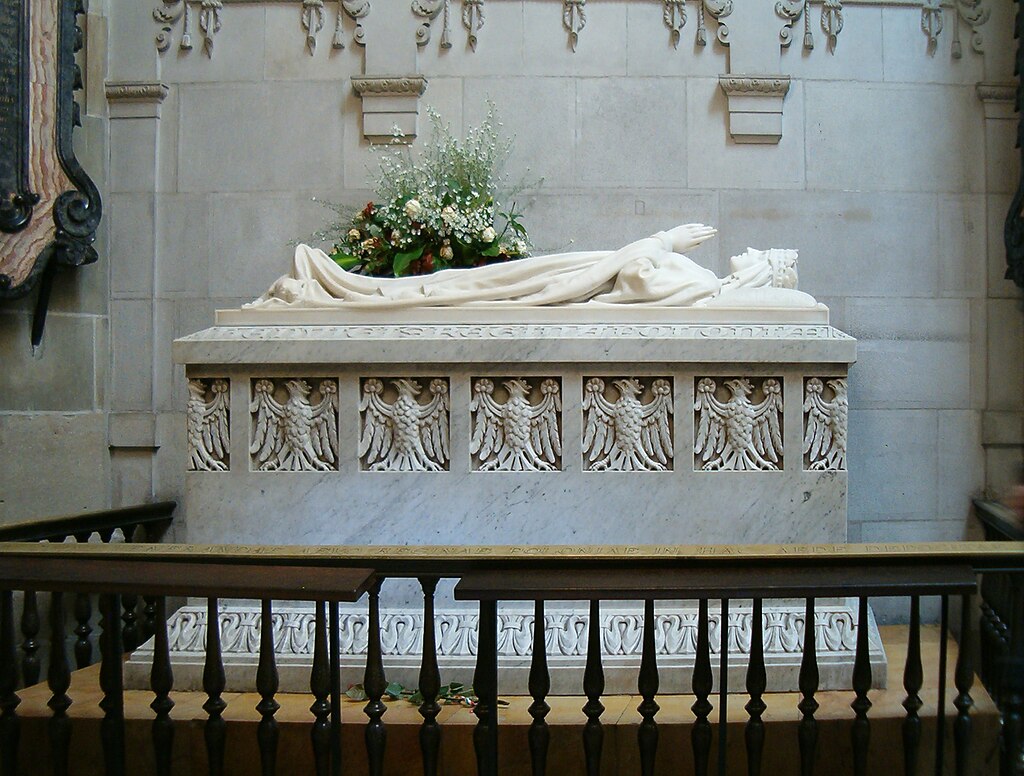
Jadwiga’s tomb effigy from 1902 by Antoni Madeyski, Wawel Cathedral, Kraków, Poland. The queen’s earthly remains were transferred here from her original resting place at the high altar in 1949 and stayed here till 1987. Then they were transferred to the altar with the Black Crucifix

She was famed for her charity and showing great care to the poor and the ill. Her active and generous support of scholars and learning institutions did not waver over the years. In her last will she donated all her jewelry, her rich dresses and other valuable objects to the Kraków Academy (the first Polish university founded by Kazimierz Wielki), now the Jagiellonian University. Additionally, she founded a dormitory for Polish students at the University of Prague. 

Jadwiga died from complications in childbirth on 17 July 1399. She was twenty-five at the time. Her daughter did not survive, either. Almost immediately after her death, Jadwiga’s tomb became the focus of miracles and the destination of pilgrimages. Her cult flourished, with her canonization first mentioned during the funeral ceremony. However, it was to take seven centuries before she was actually canonised by Pope John Paul II. Ever since she has been recognised as patron saint of Poland and considered Polish national hero. 

About the author:

Katarzyna Ogrodnik-Fujcik specializes in British literature and history, her area of expertise being the first Plantagenets (the Angevins). She lives in Poland. She writes for different magazines and websites on Polish and European Middle Ages. She runs a blog dedicated to Henry the Young King. She consulted a BBC documentary on William Marshal.

*

My Books:

Signed, dedicated copies of all my books are available through my online store.

OUT NOW! Heroines of the Tudor World

Heroines of the Tudor World tells the stories of the most remarkable women from European history in the time of the Tudor dynasty, 1485-1603. These are the women who ruled, the women who founded dynasties, the women who fought for religious freedom, their families and love. These are the women who made a difference, who influenced countries, kings and the Reformation. In the era dominated by the Renaissance and Reformation, Heroines of the Tudor World examines the threats and challenges faced by the women of the era, and how they overcame them. From writers to regents, from nuns to queens, Heroines of the Tudor World shines the spotlight on the women helped to shape Early Modern Europe.

Heroines of the Tudor World is now available for pre-order from Amberley Publishing and Amazon UK.

Coming 30 January 2025: Scotland’s Medieval Queens

Scotland’s history is dramatic, violent and bloody. Being England’s northern neighbour has never been easy. Scotland’s queens have had to deal with war, murder, imprisonment, political rivalries and open betrayal. They have loved and lost, raised kings and queens, ruled and died for Scotland. From St Margaret, who became one of the patron saints of Scotland, to Elizabeth de Burgh and the dramatic story of the Scottish Wars of Independence, to the love story and tragedy of Joan Beaufort, to Margaret of Denmark and the dawn of the Renaissance, Scotland’s Medieval Queens have seen it all. This is the story of Scotland through their eyes.

Available for pre-order now.

Also by Sharon Bennett Connolly:

Women of the Anarchy demonstrates how Empress Matilda and Matilda of Boulogne, unable to wield a sword themselves, were prime movers in this time of conflict and lawlessness. It shows how their strengths, weaknesses, and personal ambitions swung the fortunes of war one way – and then the other. Available from Bookshop.orgAmberley Publishing and Amazon UKKing John’s Right-Hand Lady: The Story of Nicholaa de la Haye is the story of a truly remarkable lady, the hereditary constable of Lincoln Castle and the first woman in England to be appointed sheriff in her own right. Available from all good bookshops Pen & Sword Booksbookshop.org and AmazonDefenders of the Norman Crown: The Rise and Fall of the Warenne Earls of Surrey tells the fascinating story of the Warenne dynasty, from its origins in Normandy, through the Conquest, Magna Carta, the wars and marriages that led to its ultimate demise in the reign of Edward III. Available from Pen & Sword BooksAmazon in the UK and US, and Bookshop.org

Ladies of Magna Carta: Women of Influence in Thirteenth Century England looks into the relationships of the various noble families of the 13th century, and how they were affected by the Barons’ Wars, Magna Carta and its aftermath; the bonds that were formed and those that were broken. It is now available in paperback and hardback from Pen & SwordAmazon, and Bookshop.orgHeroines of the Medieval World tells the stories of some of the most remarkable women from Medieval history, from Eleanor of Aquitaine to Julian of Norwich. Available now from Amberley Publishing and Amazon, and Bookshop.orgSilk and the Sword: The Women of the Norman Conquest traces the fortunes of the women who had a significant role to play in the momentous events of 1066. Available now from Amazon,  Amberley Publishing, and Bookshop.org.

Alternate Endings: An anthology of historical fiction short stories including Long Live the King… which is my take what might have happened had King John not died in October 1216. Available in paperback and kindle from Amazon.

Podcast:

Have a listen to the A Slice of Medieval podcast, which I co-host with Historical fiction novelist Derek Birks. Derek and I welcome guests, such as Bernard Cornwell, and discuss a wide range of topics in medieval history, from significant events to the personalities involved.

*

Don’t forget! Signed and dedicated copies of all my books are available through my online store.

For forthcoming online and in-person talks, please check out my Events Page.

You can be the first to read new articles by clicking the ‘Follow’ button, liking our Facebook page or joining me on TwitterThreads and Instagram.

*

©2024 Sharon Bennett Connolly FRHistS and Katarzyna Ogrodnik-Fujcik

Book Corner: The Vengeance of Merlin by Steven A McKay

A heinous crime is perpetrated against the druids of Britain and a grief-stricken Bellicus suddenly finds his world changing in ways he never expected. Before he can begin to make sense of things the terrible news that the Picts have allied with the Saxons and now march on Dun Breatann together spurs the warrior-druid into action, and soon he and his companions are racing homewards. Horsa, fearsome leader of the sea-wolves, promises to use any tactic – including torture and dark magic – against Bellicus’s terrified Damnonii people who are being slaughtered and dragged from their burnt out villages to please the Saxons’ brutal gods.
Bellicus, his friend Duro, and the great war-dog Cai will need all their bravery, experience, and cunning to stand against the insane cruelty of the raiders which even shocks their own allies in the Pictish army.
Many will fall as the fighting rages, but can bonds of loyalty, friendship, and family be enough to save Queen Narina and the people of Dun Breatann from the grim fate their enemies have planned for them?
This new Warrior Druid of Britain adventure is sure to delight lovers of fast-paced historical fiction, especially readers of Peter Gibbons, Griff Hosker, and Bernard Cornwell.

Saxons and Picts come together to conquer Northern Britain, but when the war is over they must face the vengeance of Merlin!

The best Bellicus adventure yet!

Another thrilling adventure!

Vengeance of Merlin by Steven A. McKay is the 6th book in his excellent Warrior Druid of Britain series. The books follow the adventures of Bellicus the druid and his friend Duro, a former Roman soldier. King Arthur, Merlin and Lancelot are all supporting actors. Together they face the Saxon onslaught, headed by the infamous brothers Hengist and Horsa.

While Bellicus is distracted by the Moot – a meeting of all the druids in Britain which comes with its own drama – Hengist joins forces with Dun Breatann’s enemy, Drest, to launch an attack on the stronghold. The uneasy alliance between Drest and Hengist is stretched thin by the unsavoury methods of the Saxon forces. The tension is further exacerbated by the fact Dun Breatann is virtually impregnable and resisting.

With murder, sacrifice and intrigue aplenty, The Vengeance of Merlin has all the ingredients for a fantastic story.

“What’s wrong with these people?” Duro demanded as silence followed them along the town’s main thoroughfare. “Have they never seen a druid before?”

“Be fair,” Bellicus laughed. “Nemias, Qunavo, Ria, Lugotorix – none of them look anything like I do.”

“You’ve got the eagle-topped staff,” Duro groused, throwing a fierce look at a man who scurried off as they went by. “Isn’t that enough?”

“Maybe, on my own,” Bellicus said, still laughing at his friend’s bemusement. “But with you at my side? No wonder the people here think trouble must be brewing. They probably think you’re the ghost of some legionary that was part of the garrison here.”

The centurion opened his mouth to make an angry retort, then he realised he was being made fun off and broke off, shaking his head and sharing in the druid’s amusement.

“Look,” Bellicus said, pointing at an old tombstone that was just lying on the ground, abandoned. “See what I mean?”

The stone had been carved to show a Roman optio, with the inscription beneath naming him as Caecilius Avitus of the Twentieth Legion Valeria Victrix.

Duro paused, reading, and then grunted. “Fifteen years service. Died when he was thirty-four. Mithras protect him.”

A stocky, middle-aged man with sunbrowned skin appeared on the road before them then, and he did not appear frightened by their presence, although he did peer warily at Cai.

“You a druid?” he asked, pointing at Bellicus’s staff, his eyes moving smoothly across Duro and the mastiff before returning to the shaven-headed giant atop the great black horse.

“I am. Bellicus of Dun Breatann. You must be the headman.”

The fellow nodded, his stance and demeanour telling of a history as a soldier, either in the local militia or perhaps even, like Duro, as a legionary.

“Your friends are at the old shrine of Minerva,” the headman informed them, gesturing along the road. “It’s not far along this way. Just keep following the road and you’ll see it to the south, across the bridge.” He paused and it seemed he wanted to ask them more about their business in Caer Legion, but respect for the druid’s office kept him silent and the riders moved on, saluting him and receiving the same gesture in return.

“He looked like he was expecting trouble,” Duro muttered when they were some distance away from the headman, who still stood watching them ride on.

Bellicus snorted with laughter. “Duro,” he said, “you have the exact same look about you. You always do. It’s just something old soldiers have.”

The characters make The Vengeance of Merlin. Princess Catia is maturing into a brave, adventurous leader, though with still that childish curiosity. Aife is divided by her loyalties between her father, her friends and what is right- and knowing that doing the right thing means going against her father. Even Bellicus has a big career decision to make; one that will affect his love life. Every character has their own challenges and issues, struggles they must overcome and decisions that need to be taken.

Steven A. McKay takes the reader back to the time when the Romans had left Britain and the Saxons were just arriving. The vivid landscape, the attitudes of the people and the meeting of history and legend, together with the mystery that surrounds the druids, all serve to transport the reader back to a time when the veil between magic and reality was not so thick and distinct as it is today.

Steven is setting us up for a great war against the Saxons. Hopefully, that means we will not only get to see more of Bellicus and Duro, but also more of Arthur!

The twists and turns in the story makes The Vengeance of Merlin a tense but addictive read. The gripping storyline keeps the reader enthralled to the very last page – even if it does take you until 1 in the morning to get there!

I loved it!

To Buy the book:

Vengeance of Merlin is available in paperback and ebook from Amazon

About the author:

Steven A McKay was born in Scotland in 1977 and always enjoyed studying history. He decided to write his Forest Lord novels after seeing a house called “Sherwood” when out at work one day. Since then he’s started a new series, the Warrior Druid of Britain Chronicles, and just completed a trilogy about Alfred the Great.

Steven used to be in a heavy metal band although he tend to just play guitar in his study these days. He did use those guitars to write the theme song for the podcast he co-hosts, Rock, Paper, Swords! with Matthew Harffy, though. Give it a listen, they’ve interviewed great guests like Diana Gabaldon, Simon Scarrow, Bernard Cornwell, Dan Jones and more.

My Books:

Signed, dedicated copies of all my books are available through my online store.

OUT NOW! Heroines of the Tudor World

Heroines of the Tudor World tells the stories of the most remarkable women from European history in the time of the Tudor dynasty, 1485-1603. These are the women who ruled, the women who founded dynasties, the women who fought for religious freedom, their families and love. These are the women who made a difference, who influenced countries, kings and the Reformation. In the era dominated by the Renaissance and Reformation, Heroines of the Tudor World examines the threats and challenges faced by the women of the era, and how they overcame them. From writers to regents, from nuns to queens, Heroines of the Tudor World shines the spotlight on the women helped to shape Early Modern Europe.

Heroines of the Tudor World is now available for pre-order from Amberley Publishing and Amazon UK.

Coming 30 January 2025: Scotland’s Medieval Queens

Scotland’s history is dramatic, violent and bloody. Being England’s northern neighbour has never been easy. Scotland’s queens have had to deal with war, murder, imprisonment, political rivalries and open betrayal. They have loved and lost, raised kings and queens, ruled and died for Scotland. From St Margaret, who became one of the patron saints of Scotland, to Elizabeth de Burgh and the dramatic story of the Scottish Wars of Independence, to the love story and tragedy of Joan Beaufort, to Margaret of Denmark and the dawn of the Renaissance, Scotland’s Medieval Queens have seen it all. This is the story of Scotland through their eyes.

Available for pre-order now.

Also by Sharon Bennett Connolly:

Women of the Anarchy demonstrates how Empress Matilda and Matilda of Boulogne, unable to wield a sword themselves, were prime movers in this time of conflict and lawlessness. It shows how their strengths, weaknesses, and personal ambitions swung the fortunes of war one way – and then the other. Available from Bookshop.orgAmberley Publishing and Amazon UKKing John’s Right-Hand Lady: The Story of Nicholaa de la Haye is the story of a truly remarkable lady, the hereditary constable of Lincoln Castle and the first woman in England to be appointed sheriff in her own right. Available from all good bookshops Pen & Sword Booksbookshop.org and AmazonDefenders of the Norman Crown: The Rise and Fall of the Warenne Earls of Surrey tells the fascinating story of the Warenne dynasty, from its origins in Normandy, through the Conquest, Magna Carta, the wars and marriages that led to its ultimate demise in the reign of Edward III. Available from Pen & Sword BooksAmazon in the UK and US, and Bookshop.org

Ladies of Magna Carta: Women of Influence in Thirteenth Century England looks into the relationships of the various noble families of the 13th century, and how they were affected by the Barons’ Wars, Magna Carta and its aftermath; the bonds that were formed and those that were broken. It is now available in paperback and hardback from Pen & Sword,  Amazon, and Bookshop.orgHeroines of the Medieval World tells the stories of some of the most remarkable women from Medieval history, from Eleanor of Aquitaine to Julian of Norwich. Available now from Amberley Publishing and Amazon, and Bookshop.orgSilk and the Sword: The Women of the Norman Conquest traces the fortunes of the women who had a significant role to play in the momentous events of 1066. Available now from Amazon,  Amberley Publishing, and Bookshop.org.

Alternate Endings: An anthology of historical fiction short stories including Long Live the King… which is my take what might have happened had King John not died in October 1216. Available in paperback and kindle from Amazon.

Podcast:

Have a listen to the A Slice of Medieval podcast, which I co-host with Historical fiction novelist Derek Birks. Derek and I welcome guests, such as Bernard Cornwell, and discuss a wide range of topics in medieval history, from significant events to the personalities involved.

*

Don’t forget! Signed and dedicated copies of all my books are available through my online store.

For forthcoming online and in-person talks, please check out my Events Page.

You can be the first to read new articles by clicking the ‘Follow’ button, liking our Facebook page or joining me on TwitterThreads and Instagram.

*

©2024 Sharon Bennett Connolly FRHistS.

The Battle of the Standard

History ... the Interesting Bits
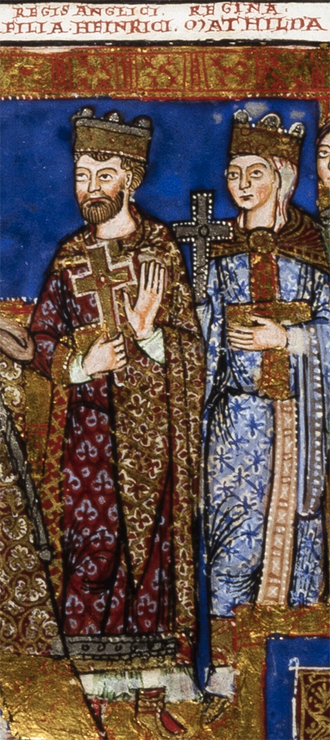
King Stephen

22 August is a famous date in history. The Battle of Bosworth, on 22 August 1485 is often seen as the end of one era and the beginning of another: the end of the medieval age and the beginning of the early modern. It was the end of the royal line of the Plantagenets, begun under Henry II in 1154 and ended with the death of Richard III on that fateful August day. It was the advent of, arguably, the most famous royal house in history: the house of Tudor, which ruled England from 1485 to 1603.

But Bosworth was not the only battle fought on English soil on 22 August. 347 years before, during the period known to history as the Anarchy, when King Stephen stole the English throne from his cousin Empress Matilda. At Northallerton in North Yorkshire, an English army faced a Scots army in what would come to be known as the Battle of the Standard; between the forces of King Stephen and those of his wife’s uncle – and also the uncle of Empress Matilda – David I, King of Scots.

On his marriage to Matilda de Senlis, arranged by his brother-in-law King Henry, David acquired lands in Northampton, Bedford, Cambridge and Huntingdon, as well as lands stretching from South Yorkshire to Middlesbrough, which would become known as the ‘honour of Huntingdon’. By the first Treaty of Durham, agreed in February 1136, at which David had refused to do homage to Stephen but allowed his son to do so, young Henry was given Doncaster and the lordship of Carlisle. He also received his mother’s inheritance, the honour and earldom of Huntingdon, paying homage for these lands to King Stephen at York. At Stephen’s Easter court that same year, Henry sat at the king’s right hand, his royal birth giving him precedence ahead of the English earls. This infuriated Earl Ranulf of Chester, who had wanted Carlisle for himself, and Simon (II) de Senlis, Henry’s older half-brother, who maintained a rival claim to the Huntingdon lands.

History ... the Interesting Bits
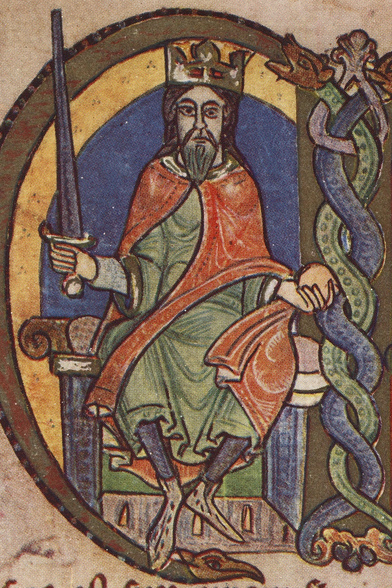
David I King of Scots

The two barons withdrew from the court in disgust. As the grandson of Earl Waltheof, Henry also demanded the earldom of Northumberland. When Stephen refused to relinquish it, Scottish raids into Northumberland were renewed. David was ostensibly arguing that he was supporting his niece, Empress Matilda, in her struggle with Stephen over the English crown, though his actual motives were far from selfless. The Gesta Stephani was generous in assessing the Scots king’s dilemma:

In Scotland, which borders on England, with a river fixing the boundary between the two kingdoms, there was a king of a gentle heart, born of religious parents and equal to them in his just way of living. Since he had in the presence of King Henry, together with the other magnates of the kingdom, or rather first of all of them, bound himself with an oath that on King Henry’s death he would recognise no-one as his successor except his daughter or her heir, he was greatly vexed that Stephen had come to take the tiller of the kingdom of the English. But because it had been planned and carried out by the barons themselves without consulting him he wisely pondered the ultimate result and waited quietly for some time to see what end the enterprise would come.1

In the early months of 1138, David had exploited Stephen’s preoccupation with the siege of Bedford Castle to lead a foray into Northumberland. The Scots king was apparently spurred on by a letter from Empress Matilda ‘stating that she had been disinherited and deprived of the kingdom promised to her on oath, that the laws had been made of no account, justice trampled under foot, the fealty of the barons of England and the compact to which they had sworn broken and utterly disregarded, and therefore she humbly and mournfully besought him to aid her as a relation, since she was abandoned, and assist her as one bound to her by oath, since she was in distress’.2

History ... the Interesting Bits
Empress Matilda depicted in an image from the Gospels of Henry the Lion.

Whether acting in response to his niece’s pleas or to pursue his own interests, David had moved south in January 1138. He had besieged Wark Castle and led a chevauchée further south. However, he had retreated into the Scottish borders when Stephen brought a substantial force against him. From Roxburgh, David awaited the departure of the English army before renewing his campaign. The Scots ventured across the border, once again, on 8 April, this time targeting the coastal regions of Northumberland and County Durham in a campaign of plunder and waste. Stephen was now tied up in the south in campaigns against various rebel barons, including William Fitz Alan, who was married to a niece of Robert, Earl of Gloucester, and Arnulf of Hesdin, who held Shrewsbury Castle against the king.

Robert of Gloucester, Empress Matilda’s illegitimate half-brother, had finally made a move in favour of his sister, issuing Stephen with a diffidatio, a chivalric device which was a formal statement of renunciation of allegiance and homage. According to William of Malmesbury, Robert ‘sent representatives and abandoned friendship and faith with the king in the traditional way, also renouncing homage, giving as the reason that his action was just, because the king had both unlawfully claimed the throne and disregarded, not to say betrayed, all the faith he had sworn to him’.3

David took advantage of these distractions and again crossed the River Tees with a Scottish army in July. He sent two Scottish barons to lay siege to Wark Castle while he headed further south. Eustace fitz John, deprived of Bamburgh Castle by King Stephen but still in control of Alnwick, chose to add his own forces to those of King David. The army marched past Bamburgh until the garrison, believing themselves impregnable, taunted the Scots from the safety of the castle’s formidable walls. The Scots promptly attacked, breaking down the barricades and killing everyone in the castle. Bernard de Baliol was then sent north by King Stephen and he and Robert de Bruce were tasked with discussing terms with the Scots. The proposal was that if the Scots went home, Prince Henry would be given the earldom of Northumberland. David rejected the offer.

Stephen, it seems, was beset on all sides, with invaders on his northern borders, rebellion within his kingdom and trouble across the Channel in Normandy. He employed all his senior commanders in putting out the fires – including his wife, Queen Matilda. In the late summer of 1138, following the capitulation of Shrewsbury, Stephen had hanged that town’s entire garrison, learning from his leniency at Exeter. He then ‘besieged Dover with a strong force on the landward side, and sent word to [Queen Matilda’s] friends and kinsmen and dependents in Boulogne to blockade the force by sea. The people of Boulogne proved obedient, gladly carried out their lady’s commands and, with a great fleet of ships, closed the narrow strait to prevent the garrison receiving any supplies.’4 This military pressure, combined with the persuasive power of Robert de Ferrers, father-in-law of the rebel garrison’s commander, Walchelin Maminot, caused Walchelin to surrender to the queen, in late August or early September. The retribution meted out to the Shrewsbury garrison was probably another persuasive argument to the recalcitrant defenders.

History ... the Interesting Bits
Coin of Prince Henry of Scotland

David had overplayed his hand by allowing his troops from Galloway to plunder the countryside, thus uniting the northern barons in their determination to put an end to these all-too-frequent Scottish forays into England. With Stephen, his loyal generals and his wife occupied with rebels in the south of England, the defence of the north fell to Thurstan, Archbishop of York since 1115 and nearing his seventieth year. Placing the archbishop in command was a move which would prevent baronial squabbling over seniority. Thurstan called for a crusade against the Scots and mustered his army at York. The Scots refused all offers of negotiations, so the archbishop marched his force to Northallerton in Yorkshire, just 30 miles north-west of York. Calling upon holy favour, the army was preceded by the banners of St Peter, St John of Beverly and St Wilfrid of Ripon, flying on a mast which itself was mounted on a carriage.

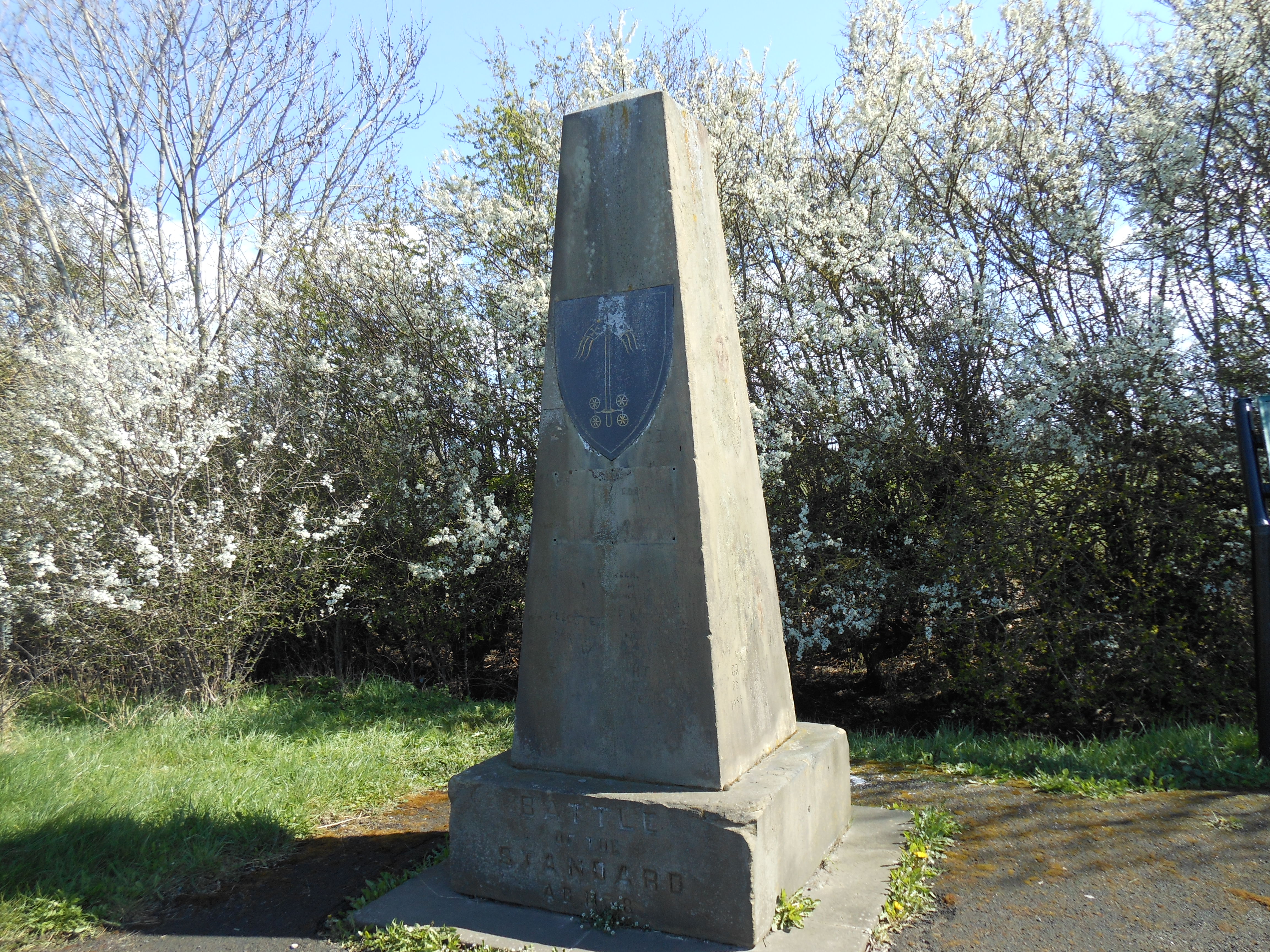
On 22 August 1138, with the carriage supporting the standards placed on the summit of the southernmost of two hillocks next to the Darlington road, the troops were arrayed to the front of their standards. Above the emblems of the saints a banner read, ‘Body of the Lord, to be their standard-bearer and the leader of their battle.’5 It is from this pious display that the ensuing clash, the Battle of the Standard, would get its name. The English forces were formed in three groups, with dismounted men-at-arms in the front rank, a body of knights around the standards and the shire levies deployed at the rear and on both flanks. The Scots were drawn up on the northern hillock, with men-at-arms and archers in the front and the poorly equipped men from Galloway and the Highlanders in the rear. The unarmoured men from Galloway complained bitterly about being placed in the rear and demanded the rightful place of honour in the front of the battleline, to the extent that King David, against his better judgement, granted them their wish to spearhead the attack. Prince Henry took command of the right flank, comprising the troops from Strathclyde and the eastern Lowlands and a body of mounted knights. The left was formed of men from the western Highlands. The king led the small reserve, made up of the men from Moray and the eastern Highlands.

The presence of the apostle and two Yorkshire saints in their force, arrayed against a foe containing a contingent of Picts, led to a sense among the English that they were on a noble crusade. According to Henry of Huntingdon, the Bishop of Durham then gave a stirring speech before the bishops and priests retreated from the field:

History ... the Interesting Bits
Memorial to the Battle of the Standard, Northallerton

… Rouse yourselves, then, gallant soldiers, and bear down on an accursed enemy with the courage of your race and in the presence of God. Let not their impetuosity shake you, since the many tokens of our valour do not deter them. They do not cover themselves with armour in war; you are in the constant practice of arms in time of peace, that you may be at no loss in the chances at the day of battle. Your head is covered with the helmet, your breast with a coat of mail, your legs with greaves and your whole body with shield. Where can the enemy strike you when he finds you sheathed in steel … It is not so much the multitude of a host, as the valour of a few which is decisive. Numbers, without discipline, are a hindrance to success in the attack and to retreat in defeat. Your ancestors were often victorious when they were but a few against many…6

As the English soldiers shouted out ‘Amen! Amen!’ in response to the bishop’s speech, the Scottish army advanced with their own battle cry of ‘Alban! Alban!’ on their lips. The men of Galloway launched the initial attack and ‘bore down on the English mailed knights with a cloud of darts and their long spears’.7 The unclothed Galwegians had no protection against the hail of arrows and English swords, though their sheer ferocity saw them temporarily breach the English front rank. Even so, they could get no further: ‘The whole army of English and Normans stood fast around the Standard in one solid body.’8 It was a stalemate that Prince Henry attempted to break by leading a mounted charge against the English forces. Although he sustained heavy losses, the prince broke through the English ranks and continued towards the enemy’s rear, reaching the horse lines. The English closed ranks before the Scots foot soldiers could take advantage of the gap created by the prince’s charge.

Henry of Huntingdon reserves praise for the prince: ‘[David’s] brave son, heedless of what his countrymen were doing, and inspired only by his ardour for the fight and for glory, made a fierce attack, with the remnant of the fugitives on the enemy’s ranks … But this body of cavalry could by no means make any impression against men sheathed in armour, and fighting on foot in a close column; so that they were compelled to retire with wounded horses and shattered lances, after a brilliant but unsuccessful attack.’9 Finding himself marooned behind enemy lines, the prince ordered his men to discard any identifying badges and mingle with the English forces until they could escape. The ruse worked and the prince was able to make his way back to Carlisle.

According to Huntingdon, the men of Galloway were put to flight when their chief fell, pierced by an arrow. Fighting along the line, and having seen what befell the Galwegians, the remainder of the Scots army began to falter. Seeing that the battle was lost, men began to flee. It began as a trickle, but soon the greater part of the army was in retreat. King David had chosen the greatest of the Scottish knights as his personal guard, and they remained steadfast almost to the last. Once they saw the battle was lost, they persuaded the king to call for his horse and retreat rather than risk death or capture. Henry of Huntingdon reports 11,000 Scottish dead against few English casualties, with Gilbert de Lacy’s brother the only English knight to fall on the field of battle.

The English, however, failed to pursue the fleeing Scots. David was therefore able to march his surviving army north to join the forces that had been besieging Wark Castle since June. Satisfied that they had seen off the Scottish threat, the English had withdrawn, leaving only a small contingent in the field to reduce Eustace fitz John’s castle at Malton. Negotiations for peace could then begin:

History ... the Interesting Bits
Durham Cathedral

After the war between the two kings had lasted for a long time, created terrible disorder, and brought widespread calamity, a peace mission was sent out by God’s will; travelling to and fro between the two kings, who were exhausted by the slaughter, destruction, ceaseless anxieties, and hardships, the envoys succeeded in restoring harmony between them.10

A truce was arranged at Carlisle at the end of September 1138 and negotiations for a lasting peace began in earnest. On 9 April 1139, the Treaty of Durham was concluded between King Stephen and David of Scotland. As part of the treaty, Henry of Scotland would marry Ada de Warenne, daughter of William de Warenne, 2nd Earl of Warenne and Surrey. Not that peace would prevent King David from continuing to aid his niece, Empress Matilda, in her struggles against King Stephen, but that is another story.

Notes:

1. K. R. Potter (trans.), Gesta Stephani; 2. ibid; 3. William of Malmesbury quoted in Matthew Lewis, Stephen and Matilda’s Civil War: Cousins of Anarchy; 4. John of Worcester quoted in Patricia A. Dark, The Career of Matilda of Boulogne as Countess and Queen in England, 1135-1152; 5. Matthew Lewis, Stephen and Matilda’s Civil War; 6. Thomas Forester (trans. and ed.), The Chronicle of Henry of Huntingdon. Comprising the history of England, from the invasion of Julius Caesar to the accession of Henry II. Also,the Acts of Stephen, King of England and Duke of Normandy; 7. ibid; 8. ibid; 9. ibid; 10. Ordericus Vitalis, The Ecclesiastical History of Orderic Vitalis, 1075-1143, book XIII.

Images:

King David, King Stephen, Empress Matilda and the coin of Prince Henry of Scotland are courtesy of Wikipedia. All photos are ©2024 Sharon Bennett Connolly FRHistS

Sources:

Potter, K. R. (trans.), Gesta Stephani; Matthew Lewis, Stephen and Matilda’s Civil War: Cousins of Anarchy; Patricia A. Dark, The Career of Matilda of Boulogne as Countess and Queen in England, 1135-1152; Thomas Forester (trans. and ed.), The Chronicle of Henry of Huntingdon. Comprising the history of England, from the invasion of Julius Caesar to the accession of Henry II. Also, the Acts of Stephen, King of England and Duke of Normandy; David Smurthwaite, The Complete Guide to the Battlefields of Britain; David Crouch, The Reign of King Stephen; Keith Stringer, ‘Henry, Earl of Northumberland (c. 1115-1152)’, Oxforddnb.com; G.W.S. Barrow, ‘David I (c. 1185-1153)’, Oxforddnb.com; Keith Stringer, ‘Ada [née Ada de Warenne], countess of Northumberland (c. 1123-1178)’, Oxforddnb.com; Victoria Chandler, ‘Ada de Warenne, Queen Mother of Scotland (c. 1123-1178)’, The Scottish Historical Review, Vol. 60, no. 170; Farrer, W. and C. T. Clay (eds), Early Yorkshire Charters, Volume 8: The Honour of Warenne; Henry of Huntingdon, The History of the English People 1000–1154; Catherine Hanley, Matilda: Empress, Queen, Warrior; Marjorie Chibnall, The Empress Matilda: Queen Consort, Queen Mother and Lady of the English; Edmund King, King Stephen.

*

My Books

Signed, dedicated copies of all my books are available through my online store.

Out now: Scotland’s Medieval Queens

Books by Sharon Bennett Connolly

Scotland’s history is dramatic, violent and bloody. Being England’s northern neighbour has never been easy. Scotland’s queens have had to deal with war, murder, imprisonment, political rivalries and open betrayal. They have loved and lost, raised kings and queens, ruled and died for Scotland. From St Margaret, who became one of the patron saints of Scotland, to Elizabeth de Burgh and the dramatic story of the Scottish Wars of Independence, to the love story and tragedy of Joan Beaufort, to Margaret of Denmark and the dawn of the Renaissance, Scotland’s Medieval Queens have seen it all. This is the story of Scotland through their eyes.

Scotland’s Medieval Queens gives a thorough grounding in the history of the women who ruled Scotland at the side of its kings, often in the shadows, but just as interesting in their lives beyond the spotlight. It’s not a subject that has been widely covered, and Sharon is a pioneer in bringing that information into accessible history.’ Elizabeth Chadwick (New York Times bestselling author)

Available now from Amazon and Pen and Sword Books

Also by Sharon Bennett Connolly:

Books by Sharon Bennett Connolly

Heroines of the Tudor World tells the stories of the most remarkable women from European history in the time of the Tudor dynasty, 1485-1603. These are the women who ruled, the women who founded dynasties, the women who fought for religious freedom, their families and love. Heroines of the Tudor World is now available from Amberley Publishing and Amazon UK. Women of the Anarchy demonstrates how Empress Matilda and Matilda of Boulogne, unable to wield a sword themselves, were prime movers in this time of conflict and lawlessness. It shows how their strengths, weaknesses, and personal ambitions swung the fortunes of war one way – and then the other. Available from Bookshop.orgAmberley Publishing and Amazon UKKing John’s Right-Hand Lady: The Story of Nicholaa de la Haye is the story of a truly remarkable lady, the hereditary constable of Lincoln Castle and the first woman in England to be appointed sheriff in her own right. Available from all good bookshops Pen & Sword Booksbookshop.org and Amazon

Defenders of the Norman Crown: The Rise and Fall of the Warenne Earls of Surrey tells the fascinating story of the Warenne dynasty, from its origins in Normandy, through the Conquest, Magna Carta, the wars and marriages that led to its ultimate demise in the reign of Edward III. Available from Pen & Sword BooksAmazon in the UK and US, and Bookshop.orgLadies of Magna Carta: Women of Influence in Thirteenth Century England looks into the relationships of the various noble families of the 13th century, and how they were affected by the Barons’ Wars, Magna Carta and its aftermath; the bonds that were formed and those that were broken. It is now available in paperback and hardback from Pen & SwordAmazon, and Bookshop.orgHeroines of the Medieval World tells the stories of some of the most remarkable women from Medieval history, from Eleanor of Aquitaine to Julian of Norwich. Available now from Amberley Publishing and Amazon, and Bookshop.orgSilk and the Sword: The Women of the Norman Conquest traces the fortunes of the women who had a significant role to play in the momentous events of 1066. Available now from Amazon,  Amberley Publishing, and Bookshop.org.

Alternate Endings: An anthology of historical fiction short stories including Long Live the King… which is my take what might have happened had King John not died in October 1216. Available in paperback and kindle from Amazon.

Podcast:

Have a listen to the A Slice of Medieval podcast, which I co-host with Historical fiction novelist Derek Birks. Derek and I welcome guests, such as Bernard Cornwell and discuss a wide range of topics in medieval history, from significant events to the personalities involved. There are now over 70 episodes to listen to!

Every episode is also now available on YouTube.

*

Don’t forget! Signed and dedicated copies of all my books are available through my online bookshop.

For forthcoming online and in-person talks, please check out my Events Page.

You can be the first to read new articles by clicking the ‘Follow’ button, liking our Facebook page or joining me on TwitterThreadsLinkedIn, Bluesky and Instagram.

©2024 Sharon Bennett Connolly FRHistS

The Remarkable Courage of Anne Askew

Portrait of Henry VIII after Hans Holbein the Younger

When Henry VIII decided to break with Rome, he was making that decision not just for himself but for his entire nation. But Henry was still a conservative Catholic and while others embraced the Reformation and the tenets of Calvinism or Lutheranism, Henry remained Catholic to his dying day, just not Roman Catholic. His break with Rome led to the Dissolution of the Monasteries, where monastic institutions and communities were broken up and sold off.

This, in turn led to the Pilgrimage of Grace, a popular revolt in Yorkshire in October 1536, led by Robert Aske, which spread to other parts of northern England. The rebellion was inspired by the failed Lincolnshire Rising, which had started on 1 October 1536 and it was said 22,000 people followed a monk and shoemaker, the vicar of Louth and Nicholas Melton (known as Captain Cobbler) to protest against the closing of the monasteries and the seizure of church land and plate. The figure was probably much smaller, perhaps some 3,000 rebels. However, by the time they marched on Lincoln and occupied Lincoln Cathedral, some 40,000 rebels were demanding the right to worship as Roman Catholics and protection for the treasures of Lincolnshire’s churches. The Rising was all but over by 4 October, when Henry sent word that the protesters should disperse or face retribution at the hands of Charles Brandon, Duke of Suffolk, who had mobilised his troops to put down the revolt.

By 14 October, most of the host had returned home. The two ringleaders were hanged at Tyburn, while other leading rebels were executed in the following days. It was against this background and the fear that the Rising must have invoked throughout Lincolnshire, that Anne Askew came to the fore. Anne Askew, also spelt Ayscough or Ainscough, was born around 1521, probably at the family home at Stallingborough, near Grimsby in Lincolnshire. She was the daughter of Sir William Askew and his first wife, Elizabeth Wrottesley.

Portrait of Anne Askew by Hans Eworth

Anne was the second oldest of five children, with an older sister Martha, a younger sister Jane, and two younger brothers, Francis and Edward. Her father, a landowner in Lincolnshire and Nottinghamshire, was knighted in 1513. He attended the king at the Field of the Cloth of Gold in France in 1520 and in 1521 he was appointed High Sheriff of Lincolnshire. From 1529, he was a member of Parliament for Grimsby. After the death of Anne’s mother, he married twice more. He married the daughter of a Struxley or Streichley of Nottinghamshire, whose name is sadly now lost to history and married again in 1522 to Elizabeth, the daughter of John Hutton of Tudhoe, Co. Durham and the widow of Sir William Hansard of South Kelsey, Lincolnshire, with whom he had two more sons, Christopher and Thomas.

By about 1523, the family had moved to South Kelsey, just 20 miles from Lincoln. Anne was well educated, possibly by tutors, though we do not know the specifics of her education. Anne’s writings were published posthumously by reformist scholar John Bale, and it is from these that we get most of her story.

Anne’s future was decided following the tragic early death of her older sister, Martha. Sir William had arranged for Martha to marry Thomas Kyme of Friskney, the son and heir of a neighbouring landowner. Sadly, Martha died before the wedding could take place. Rather than suffer a financial loss with the failure of the arrangement, Sir William offered 15-year-old Anne as a replacement bride, ‘so that in the ende she was compelled against her will or fre consent to marrye with hym,’ and, as John Bale put it, Anne ‘demeaned her selfe lyke a Christen wife’.1 Anne and Thomas had two children together.

It was about the time that Anne was preparing for her wedding, in 1536, that the Lincolnshire Rising erupted, starting in Louth and making its way towards Lincoln. Her father Sir William was one of the commissioners for the king’s tax subsidy who were due to sit in Caistor as the rebels arrived in the town. Sir William attempted to ride for home, ahead of the rebellious host. He was soon captured, aware that his own servants who were accompanying him supported the rebels. Anne’s brothers were also arrested by the rebels and their house watched. Sir William was then forced to write to the king to inform him of what had happened, with the complaint that ‘the common voice and fame was that all jewels and goods of the churches of the country should be taken from them and brought to Your Grace’s Council, and also that your said loving and faithful subjects should be put off new enhancements and other importunate charges.’2

With the failure of the rebellion, Sir William and his sons returned home. One wonders if the treatment of her menfolk, at the hands of those who were defending Roman Catholicism, was not a factor in Anne turning to the reformed faith. However the transformation came about, and in spite of her husband’s devout Catholicism, Anne did become a committed Protestant. She acquired a copy of an English Bible and began reading aloud from it, though her husband and brother had both forbidden her to do so. Anne explained that ‘in processe of tyme by oft reading of the sacred Bible, she fell clerelye from all olde superstycyons of papystrye, to a perfyght believe in Jhesus Christ.’3

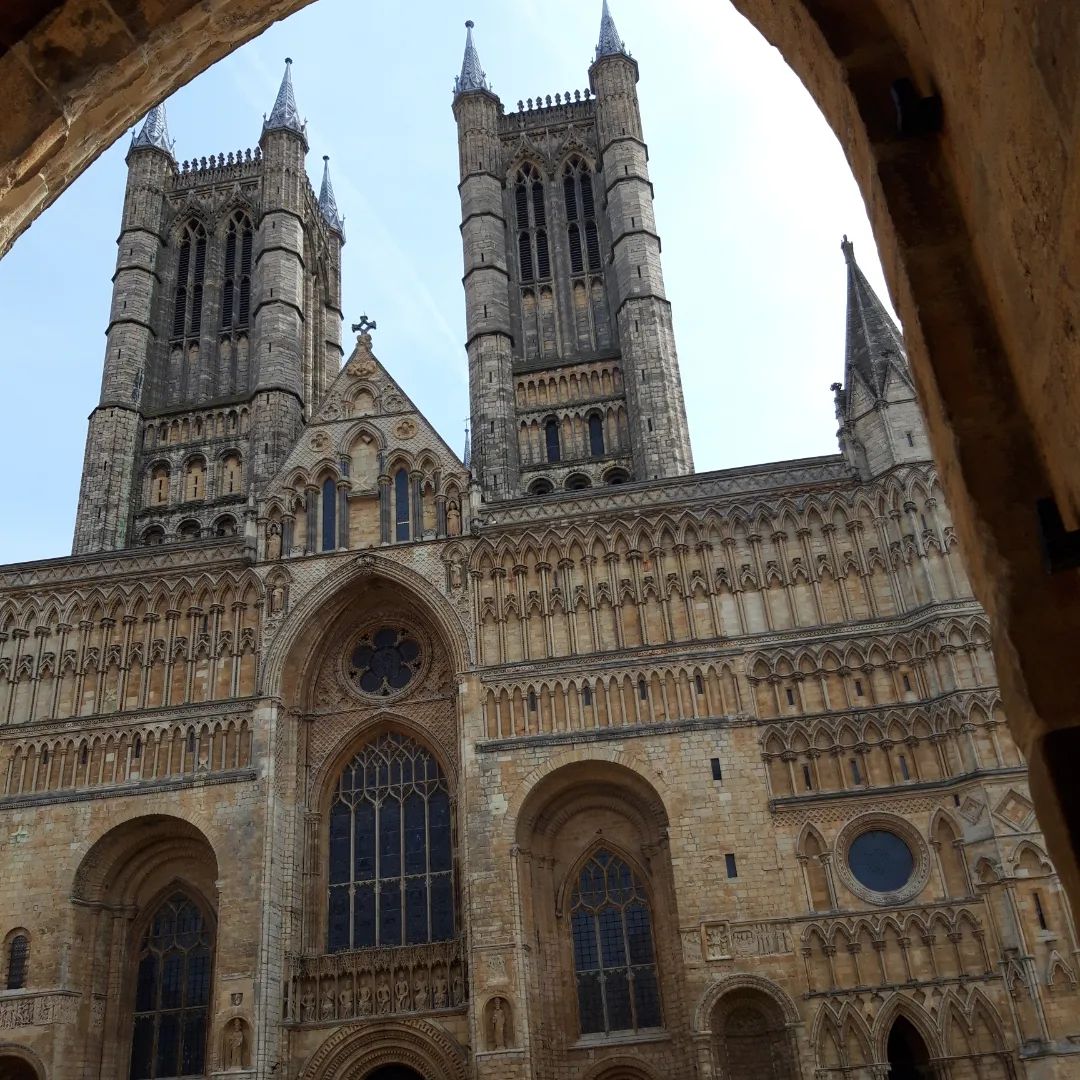
Lincoln Cathedral

In May 1543, the Act for the Advancement of True Religion was passed, forbidding any woman below the rank of noblewoman or gentlewoman from reading the Bible; and forbidding any woman, of any rank, from reading the Bible aloud. Anne was a gentlewoman and therefore still permitted to read the Bible, but only in private. She wanted to travel to Lincoln to see the cathedral’s Bible, but Kyme forbade it. Anne had been apprised of the hostility this would engender: ‘For my fryndes told me, if I ded come to Lyncolne, the prestes wolde assault me and put me to great trouble, as thereof they had made their boast.’4 Anne did travel to Lincoln and stayed there for about six days, reading her Bible in the cathedral. She said that one man confronted her, but he had said so little of significance that she could not recall his words.

This incident, and the fact that Anne continued to read aloud to whoever would listen, to such an extent that the local priest complained to her husband, infuriated Thomas Kyme. Angry and embarrassed at his wife’s actions, Kyme drove her from the house, with some violence. Driven from hearth and home – and from her children, Anne resumed her maiden name and sought a divorce. In late 1544 she travelled to London, accompanied by only a maid, in order to obtain a legal separation in the court of chancery. Two of her brothers were already in London. Edward, who had previously been in the service of Archbishop Thomas Cranmer, was cup-bearer to Henry VIII and her half-brother, Christopher, who died around this time, was a Gentleman of the Privy Chamber.

Her cousin, Christopher Brittayn, was a lawyer at the Temple and Anne’s sister Jane was married to George St Poll, a lawyer in the service of the duke and duchess of Suffolk. Anne lodged in a house close to the Temple, London’s legal centre, and soon met others with like-minded religious views, many with connections. Several gentlewomen gave Anne money, including the countess of Hertford and the wife of Sir Anthony Denny. They both sent messengers to Anne with money.

Queen Kateryn Parr

Anne found herself moving in exalted circles, these ladies were close friends of Henry VIII’s new queen, Kateryn Parr, though whether the queen and Anne ever met is uncertain. Anne made other connections in the city, including her religious advisor John Lascels and the chronicler Edward Hall. She was also close to the Kentish Anabaptist Joan Bocher, who would be executed in 1550.

After preaching publicly in the streets of the capital, Anne came to the attention of the authorities. According to Anne’s nephew, writing after her death, she was arrested following the interception of a letter she was trying to send, while attempting to communicate with the queen. She was detained on 10 March 1545, under the Six Articles Act, which made deviation from the official tenets of the English church a civil offence. Anne was brought before Sir Martin Bowes, Lord Mayor of London, and the bishop of London’s chancellor, and interrogated as to her beliefs. She was told that St Paul forbade women from talking of the word of God, but Anne countered that St Paul only barred women from instructing a congregation.

Still only 24 years of age, Anne was confident, fearless and bold in dealing with the great men of the city of London. Women were not meant to behave in such a way, they were supposed to be contrite and accept the superior intellect and authority of the men in charge. As a consequence, the Lord Mayor ordered her imprisonment. She spent 12 days in prison, visited daily by a priest sent by Edmund Bonner, Bishop of London. Her cousin, Brittayn, failed in his petition to have her released on bail, but succeeded in having her examined before the bishop himself, on 25 March. She was accused of subscribing to reformist beliefs concerning transubstantiation and the other sacraments and the dominion of the priesthood and asked to sign a declaration of orthodox faith.

Anne took the paper and wrote ‘I, Anne Askewe do beleve all maner thynges contayned in the faythe of the Catholyck churche.’5 Bishop Bonner flew into a fury, but her cousin, Brittayn, persuaded him that she acted from her ‘weak woman’s wit’ and with the added voices of her friends, Hall, Hugh Weston and Francis Spilman, Anne was returned to prison for one more night before being freed on bail the next day. Whether or not Anne abjured is open to interpretation; the authorities say she did, Anne denied it.

The torture of Anne Askew

Once freed, Anne continued to pursue her divorce from Thomas Kyme. The Privy Council became involved and ordered both Anne and Thomas to appear before them within ten days. Anne and Kyme were brought before the Council at Greenwich and were questioned about their relationship. The questioning, under the direction of Stephen Gardiner, Bishop of Winchester, turned to the matter of Anne’s views in the sacrament and after an exchange of words whereby Anne evaded Gardiner’s questions, she was again committed to prison for the night, this time to Newgate, a harrowing place. Kyme returned home. Anne was brought before the Council the next day and questioned further by Bishop Gardiner, who declared that she should be burnt.

According to Anne herself, they charged her ‘upon my obedience to show them if I knew any man or woman of my sect. Answered that I knew none. Then they asked me of my lady of Suffolk, my lady of Sussex, my lady of Hertford, my lady Denny and my lady Fitzwilliam.’6 These women were close associates of the queen, Kateryn Parr. The queen’s chambers were searched for heretical texts, though none were found.

On 28 June 1546, Anne Askew was arraigned for heresy at the Guildhall in London, alongside Nicholas Shaxton, former Bishop of Salisbury, and two other men. Shaxton abjured but Anne was condemned ‘without any triall of a jurie’.7

The next day, Anne was sent to the Tower and subjected to further questioning. It was hoped that this would force Anne to reveal her associates at court and, by extension, their husbands. When she refused to name anyone, her interrogators, Thomas Wriothesley and Richard Rich, took the exceptional step of having her undress to her shift and fastened to the rack. In Anne’s own words:

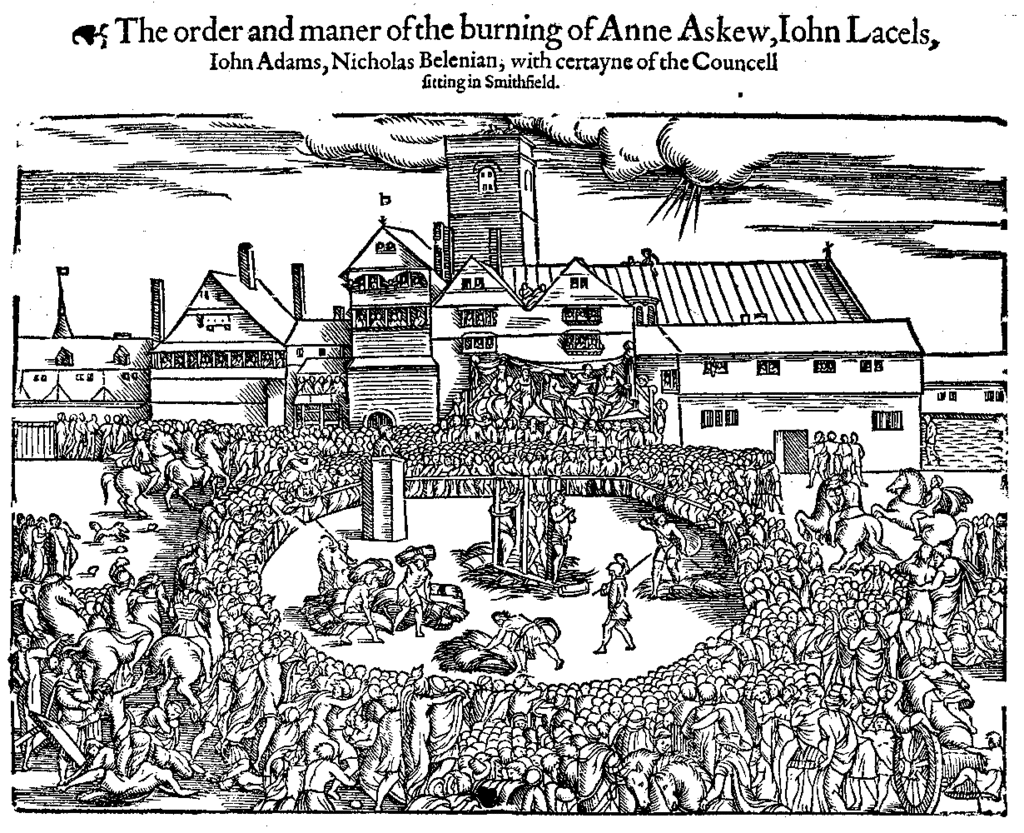
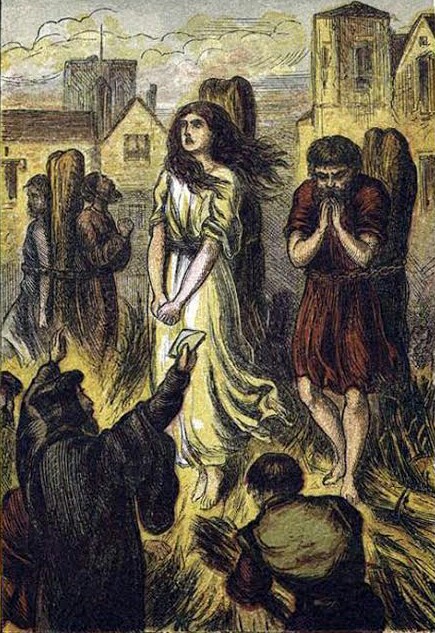
Woodcut of the burning of Anne Askew

Then they put me on the rack because I confessed no ladies or gentlewomen to be of my opinion; and there they kept me a long time, and because I lay still and did not cry, my lord chancellor and Master Rich took pains to rack me with their own hands till I was nigh dead. Then the lieutenant (of the Tower) caused me to be loosed from the rack. Immediately, I swooned away, and then they recovered me again. After that I sat two long hours reasoning with my lord chancellor upon the bare floor.8

As a woman, gently born and already condemned, Anne should have been exempt from such treatment. Anne was so severely tortured that by the end of it her body was broken, all four limbs were dislocated and she was unable to stand. She was eventually returned to Newgate from where, on 16 July 1546, Anne was carried to the site of her execution at Smithfield, sat on a chair in a cart, every movement causing her more pain. She was tied to another chair at the stake, where she was given one more chance to recant and receive a pardon.

She refused.

She died alongside three other Protestants, John Lascels, John Hadlam, who was a tailor, and John Hemley, formerly an Observant friar.

The Martyrdom of Anne Askew

Anne Askew holds the terrible distinction of being one of only two women to have ever been tortured in the Tower of London, the other being Margaret Cheyne, who had been involved in the Pilgrimage of Grace and was also burnt for heresy. Anne died bravely, never revealing her connections at court, thus, perhaps, saving a queen of England from the same fate. She was 25 years old.

On a national level, her death was a consequence of the growing fear that accompanied Henry’s failing health. On a personal level, although Anne’s journey to London had arisen from her marriage troubles, these troubles were always entwined within her own spiritual journey. Anne’s supreme confidence in her faith and her courage under torture deservedly earned her a place in the Protestant martyrology. Her own, first-hand account of her story was edited and published by John Bale and reprinted in John Foxe’s Book of Martyrs, ensuring her legacy would pass down through the generations.

*

Notes:

1. The examinations of Anne Askew, edited by E. V. Beilin, quoted in Diane Watt, ‘Askew [married name Kyme], Anne’, Oxforddnb.com; 2. & P, Vol XI, p. 534, quoted in Elizabeth Norton, The Lives of Tudor Women; 3. The examinations of Anne Askew, edited by E. V. Beilin, quoted in Diane Watt, ‘Askew [married name Kyme], Anne’; 4. ibid; 5. ibid; 6. The examinations of Anne Askew, quoted in Amy Licence, The Sixteenth Century in 100 Women; 7. Thomas Wriothesley quoted in Diane Watt, ‘Askew [married name Kyme], Anne’; 8. Mickey Mayhew, House of Tudor: A Grisly History

Sources:

Diane Watt, ‘Askew [married name Kyme], Anne’, Oxforddnb.com; Amy Licence, The Sixteenth Century in 100 Women; The examinations of Anne Askew, edited by E. V. Beilin; Elizabeth Norton, The Lives of Tudor Women; Don Matzat, Katherine Parr: Opportunist, Queen, Reformer; Mickey Mayhew, House of Tudor: A Grisly History; J.D. Mackie, The Earlier Tudors 1485-1558; Arthur D. Innes, A History of England Under the Tudors; Sarah Bryson, The Brandon Men: In the Shadow of Kings; Steven Gunn, Charles Brandon: Henry VIII’s Closest Friend; Sarah Bryson, La Reine Blanche: Mary Tudor, A Life in Letters; John Paul Davis, A Hidden History of the Tower of London: England’s Most; Robert Lacey, The Life and Times of Henry VIII; David Loades, editor, Chronicles of the Tudor Kings: The Tudor Dynasty from 1485 to 1553: Henry VII, Henry VIII and Edward VI in the Words of their Contemporaries.

Images:

Courtesy of Wikipedia except Lincoln Cathedral which is ©2024 Sharon Bennett Connolly FRHistS

*

My Books

Signed, dedicated copies of all my books are available through my online bookshop.

Out now: Scotland’s Medieval Queens

Books by Sharon Bennett Connolly

Scotland’s history is dramatic, violent and bloody. Being England’s northern neighbour has never been easy. Scotland’s queens have had to deal with war, murder, imprisonment, political rivalries and open betrayal. They have loved and lost, raised kings and queens, ruled and died for Scotland. From St Margaret, who became one of the patron saints of Scotland, to Elizabeth de Burgh and the dramatic story of the Scottish Wars of Independence, to the love story and tragedy of Joan Beaufort, to Margaret of Denmark and the dawn of the Renaissance, Scotland’s Medieval Queens have seen it all. This is the story of Scotland through their eyes.

Scotland’s Medieval Queens gives a thorough grounding in the history of the women who ruled Scotland at the side of its kings, often in the shadows, but just as interesting in their lives beyond the spotlight. It’s not a subject that has been widely covered, and Sharon is a pioneer in bringing that information into accessible history.’ Elizabeth Chadwick (New York Times bestselling author)

Available now from Amazon and Pen and Sword Books

Also by Sharon Bennett Connolly:

Books by Sharon Bennett Connolly

Heroines of the Tudor World tells the stories of the most remarkable women from European history in the time of the Tudor dynasty, 1485-1603. These are the women who ruled, the women who founded dynasties, the women who fought for religious freedom, their families and love. Heroines of the Tudor World is now available for pre-order from Amberley Publishing and Amazon UK. Women of the Anarchy demonstrates how Empress Matilda and Matilda of Boulogne, unable to wield a sword themselves, were prime movers in this time of conflict and lawlessness. It shows how their strengths, weaknesses, and personal ambitions swung the fortunes of war one way – and then the other. Available from Bookshop.orgAmberley Publishing and Amazon UKKing John’s Right-Hand Lady: The Story of Nicholaa de la Haye is the story of a truly remarkable lady, the hereditary constable of Lincoln Castle and the first woman in England to be appointed sheriff in her own right. Available from all good bookshops Pen & Sword Booksbookshop.org and Amazon

Defenders of the Norman Crown: The Rise and Fall of the Warenne Earls of Surrey tells the fascinating story of the Warenne dynasty, from its origins in Normandy, through the Conquest, Magna Carta, the wars and marriages that led to its ultimate demise in the reign of Edward III. Available from Pen & Sword BooksAmazon in the UK and US, and Bookshop.orgLadies of Magna Carta: Women of Influence in Thirteenth Century England looks into the relationships of the various noble families of the 13th century, and how they were affected by the Barons’ Wars, Magna Carta and its aftermath; the bonds that were formed and those that were broken. It is now available in paperback and hardback from Pen & SwordAmazon, and Bookshop.orgHeroines of the Medieval World tells the stories of some of the most remarkable women from Medieval history, from Eleanor of Aquitaine to Julian of Norwich. Available now from Amberley Publishing and Amazon, and Bookshop.orgSilk and the Sword: The Women of the Norman Conquest traces the fortunes of the women who had a significant role to play in the momentous events of 1066. Available now from Amazon,  Amberley Publishing, and Bookshop.org.

Alternate Endings: An anthology of historical fiction short stories including Long Live the King… which is my take what might have happened had King John not died in October 1216. Available in paperback and kindle from Amazon.

Podcast:

Have a listen to the A Slice of Medieval podcast, which I co-host with Historical fiction novelist Derek Birks. Derek and I welcome guests, such as Bernard Cornwell and Elizabeth Chadwick, and discuss a wide range of topics in medieval history, from significant events to the personalities involved.

There are now over 70 episodes to listen to!

Every episode is also now available on YouTube.

*

Don’t forget! Signed and dedicated copies of all my books are available through my online bookshop.

For forthcoming online and in-person talks, please check out my Events Page.

You can be the first to read new articles by clicking the ‘Follow’ button, liking our Facebook page or joining me on TwitterThreadsBluesky and Instagram.

©2024 Sharon Bennett Connolly FRHistS


Book Corner: The Lost Queen by Carol McGrath

1191 and the Third Crusade is underway . . .

It is 1191 and King Richard the Lionheart is on crusade to pitch battle against Saladin and liberate the city of Jerusalem and her lands. His mother, the formidable Eleanor of Aquitaine and his promised bride, Princess Berengaria of Navarre, make a perilous journey over the Alps in midwinter. They are to rendezvous with Richard in the Sicilian port of Messina.

There are hazards along the way – vicious assassins, marauding pirates, violent storms and a shipwreck. Berengaria is as feisty as her foes and, surviving it all, she and Richard marry in Cyprus and continue to the Holy Land. England needs an heir. But first, Richard and his Queen must return home . . .

The Lost Queen is a thrilling medieval story of high adventure, survival, friendship and the enduring love of a Queen for her King.

At last! Attention is being paid to Berengaria of Navarre, wife and queen of King Richard I (the Lionheart. There is an excellent new biography out, by my good friend Dr Gabrielle Story, entitled Berengaria of Navarre: Queen of England and Lord of Le Mans. And now there is a wonderful novel, The Lost Queen by Carol McGrath.

Carol expertly weaves fact and fiction together to bring us am engaging, entertaining and informative story on the life of the one queen of England who is said to have never set foot in the country (actually, it seems that she did, but only after Richard’s death).

The Lost Queen follows Berengaria from the moment she is collected by her future mother-in-law, Eleanor of Aquitaine, on her journey through the Alps and Italy, to her first meeting with her husband Richard I. She is then drawn into the grand enterprise that was the Third Crusade, with the conquest of Cyprus along the way.

Food tasters sampled every dish before offering Queen Eleanor the best of everything, placing small morsels on her plate when she inclined her head in assent. Don Sancho never took any chances in case a dish was spoiled – or worse, might contain poison. Only once the Dowager and Don Sancho were served was Berengaria able to make selections for her own plate. As she ate, carefully making sure not to appear greedy, she noticed that Queen Eleanor had a hearty appetite, sampling everything and complimenting Don Sancho on his well-presented feast. Lifting a goblet to her mouth and sipping daintily, she praised the Gascon wine served in her honour.

Over custard tarts, a speciality of the palace pastry cooks, the Dowager broached plans for their journey. She tapped the table with an impatient gesture. ‘Don Sancho, may I assume Berengaria will be ready by this week’s end with her baggage mules packed? She will need suitable clothing for travel to Sicily, along with her confessor and her ladies.’

‘Indeed. We shall provide a well-armed guard under Sancho’s command for the first part of the journey,’ Don Sancho said. ‘Berengaria and her ladies will ride. They are all of them fine horsewomen.’

‘We will need stout covered wagons and apothecaries in case of illness, though I expect none,’ the Dowager responded. Berengaria wondered if Queen Eleanor had ever been in need of apothecaries in her whole life, other than for childbirth. Suddenly she grew nervous at the thought that the arrangements thay had made for her wedding in Sicily might not be good enough.

Don Sancho nodded in assent, then added, ‘All is ready, including priests and two bishops who will travel with your train as far as Rome.’ He gave Eleanor a broad smile.

Berengaria looked at her father with a confidence she did not feel. ‘So my brother and his knights will escort us through French territories?’ she asked.

‘Not France, but the county of Toulouse. And indeed, my daughter, Sancho will ride with you as far as Les Baux. Arrangements have been made. travel passes have been granted.’

Her brother nodded. ‘My dear sister, I have business in Aragon, but I intend guarding you to the very borders of the German Empire.’

Berengaria loved her bear-like brother. ‘I am glad of your escort, dear Sancho.’

She looked over to see Eleanor’s reaction, but the Dowager simply thanked Sancho for his care of them. Her expression remained composed as she added, ‘We hope to have Philip of Flanders as our escort through the Alps and on to Sicily. The Count is intent on joining the Crusade.’

Carol McGrath recreates the world of the late 12th century, from medieval England to the Holy Land – you can almost feel that sand between your toes and the burning sun on your face. Neither does the author shy away from the more unpleasant episodes of the Crusades. Richard I’s execution of 3,000 prisoners is depicted through Berengaria’s eyes, and with the understanding of the constraints and political wranglings of the time. I love the depiction of Richard I’s relationship with his mother, Eleanor of Aquitaine, and Carol McGrath’s exploration of how this may have affected Richard and Berengaria’s marriage.

My favourite part of the book is Berengaria’s relationship with her sister-in-law, Joanna, dowager queen of Sicily and sister of Richard the Lionheart. Joanna is, as any regular reader will know, one of my favourite medieval women. And I love how Carol McGrath portrays the developing friendship between the two women, thrown together by necessity, but appreciating each other’s strengths and character.

Whilst the attention of the book is very firmly on Berengaria of Navarre, a more intimate, fictional story, of a young lady named Avelina, travelling to the Holy Land in search of her husband, offers the reader a more intimate experience of the non-royal crusaders and the lives of them and their families. As well as the dangers inherent in women travelling to far-off places. Carol McGrath uses Avelina’s story, and the stories of those around her, to demonstrate the different people and events – and personal tragedies – associated with the Crusades. It also serves to remind the modern-day reader that news travelled slowly in medieval times and that letters that were lost or waylaid could have a huge impact on people’s lives.

The characters portrayed in The Lost Queen by Carol McGrath are rich and vivid. They come to life on the page.

This is a must-read book for anyone interested in the Plantagenets!

To Buy The Lost Queen

About the Author:

Following a first degree in English and History, Carol McGrath completed an MA in Creative Writing from The Seamus Heaney Centre, Queens University Belfast, followed by an MPhil in English from University of London.The Handfasted Wife, first in a trilogy about the royal women of1066 was shortlisted for the RoNAS in 2014.The Swan-Daughter and The Betrothed Sister complete this highly acclaimed trilogy.Mistress Cromwell, a best-selling historical novel about Elizabeth Cromwell, wife of Henry VIII’s statesman, Thomas Cromwell, was republished by Headline in 2020.The Silken Rose,first in a medieval She-Wolf Queens Trilogy, featuring Ailenor of Provence, saw publication in April 2020. This was followed by The Damask Rose.The Stone Rose was published April2022. Carol is writing Historical non-fiction as well as fiction.Sex and Sexuality in Tudor England waspublished in February 2022.The Stolen Crown2023 and The Lost Queen will be published 18thJuly2024. Carol lives in Oxfordshire, England and in Greece.Find Carol on her website:www.carolcmcgrath.co.uk.

Follow Carol on:

Amazon: @CarolMcGrath, Facebook: https://www.facebook.com/CarolMcGrathAuthor1, Pinterest: http://www.pinterest.co.uk/carol0275/the-handfasted-wife/ Twitter: twitter.com/carolmcgrath, website: scribbling-inthemargins.blogspot.com/ LinkedIn: https://www.linkedin.com/in/carol-mcgrath-906723a

*

My Books

Signed, dedicated copies of all my books are available through my online bookshop.

OUT NOW! Heroines of the Tudor World

Heroines of the Tudor World tells the stories of the most remarkable women from European history in the time of the Tudor dynasty, 1485-1603. These are the women who ruled, the women who founded dynasties, the women who fought for religious freedom, their families and love. These are the women who made a difference, who influenced countries, kings and the Reformation. In the era dominated by the Renaissance and Reformation, Heroines of the Tudor World examines the threats and challenges faced by the women of the era, and how they overcame them. From writers to regents, from nuns to queens, Heroines of the Tudor World shines the spotlight on the women helped to shape Early Modern Europe.

Heroines of the Tudor World is now available for pre-order from Amberley Publishing and Amazon UK.

Also by Sharon Bennett Connolly:

Women of the Anarchy demonstrates how Empress Matilda and Matilda of Boulogne, unable to wield a sword themselves, were prime movers in this time of conflict and lawlessness. It shows how their strengths, weaknesses, and personal ambitions swung the fortunes of war one way – and then the other. Available from Bookshop.orgAmberley Publishing and Amazon UKKing John’s Right-Hand Lady: The Story of Nicholaa de la Haye is the story of a truly remarkable lady, the hereditary constable of Lincoln Castle and the first woman in England to be appointed sheriff in her own right. Available from all good bookshops Pen & Sword Booksbookshop.org and AmazonDefenders of the Norman Crown: The Rise and Fall of the Warenne Earls of Surrey tells the fascinating story of the Warenne dynasty, from its origins in Normandy, through the Conquest, Magna Carta, the wars and marriages that led to its ultimate demise in the reign of Edward III. Available from Pen & Sword BooksAmazon in the UK and US, and Bookshop.org

Ladies of Magna Carta: Women of Influence in Thirteenth Century England looks into the relationships of the various noble families of the 13th century, and how they were affected by the Barons’ Wars, Magna Carta and its aftermath; the bonds that were formed and those that were broken. It is now available in paperback and hardback from Pen & Sword,  Amazon, and Bookshop.orgHeroines of the Medieval World tells the stories of some of the most remarkable women from Medieval history, from Eleanor of Aquitaine to Julian of Norwich. Available now from Amberley Publishing and Amazon, and Bookshop.orgSilk and the Sword: The Women of the Norman Conquest traces the fortunes of the women who had a significant role to play in the momentous events of 1066. Available now from Amazon,  Amberley Publishing, and Bookshop.org.

Alternate Endings: An anthology of historical fiction short stories including Long Live the King… which is my take what might have happened had King John not died in October 1216. Available in paperback and kindle from Amazon.

Podcast:

Have a listen the A Slice of Medieval podcast, which I co-host with Historical fiction novelist Derek Birks. Derek and I welcome guests, such as Bernard Cornwell and discuss a wide range of topics in medieval history, from significant events to the personalities involved. In episode #43, Derek and I chat with Carol about Berengaria of Navarre and The Lost Queen.

*

Don’t forget! Signed and dedicated copies of all my books are available through my online bookshop.

For forthcoming online and in-person talks, please check out my Events Page.

You can be the first to read new articles by clicking the ‘Follow’ button, liking our Facebook page or joining me on Twitter and Instagram.

©2024 Sharon Bennett Connolly FRHistS

Lady Jane: The 9 Days’ Queen

The Streatham Portrait of Jane Grey

Frances and Henry Grey were married in 1533, at her parent’s residence of Suffolk Place in Southwark. As the eldest surviving child of Mary Tudor, dowager Queen of France and Duchess of Suffolk, Frances was fourth in line to the throne after the children of Henry VIII, Edward, Mary and Elizabeth. When settling the succession, the king had instructed that his younger sister Mary’s line should be preferred over that of his older sister, Margaret. As a consequence, Frances was frequently at court.

The couple’s first child, a son, died young. They had three surviving daughters. The eldest, Jane, was born in October 1537, about the same time as her cousin Edward, the future King Edward VI; with the birth of the longed-for heir to the throne, Jane’s own birth went almost unnoticed. Jane would have been named after Henry VIII’s tragic queen, Jane Seymour, who died within two weeks of Edward’s birth.

Jane Grey would be known to history as the Nine Days’ Queen.

 She was raised at the family home of Bradgate Park, near Leicester. Frances and Henry Grey are said to have been very strict parents who were not prone to expressions of love and affection; the children were used to sarcasm, cuffs and criticism. In her teenage years, Jane herself is said to have complained to the visiting scholar Roger Ascham:

‘When I am in the presence either of father or mother, whether I speak, keep silence, sit, stand or go, eat, drink, be merry or sad, be sewing, playing, dancing, or doing anything else, I must do it as it were in such weight, measure and number, even so perfectly as God made the world; or else I am so sharply taunted, so cruelly threatened, yea presently sometimes with pinches, nips and bobs and other ways (which I will not name for the honour I bear them) … that I think myself in hell.’1

Mary Tudor and Charles Brandon, Jane’s maternal grandparents

Jane enjoyed study and excelled in all fields, including Greek and philosophy. She was afforded a first-class education and from 1545 her tutor was John Aylmer. Aylmer had been sponsored through his studies at Cambridge by Jane’s father, the Marquess of Dorset, and was a brilliant academic. As a future courtier, Jane was given lessons in dance and music; probably including the popular instruments, the lute, spinet and virginal. In religion, Jane and her sisters were raised as ‘evangelicals’, the common word in the first half of the sixteenth century for Protestants. From the age of nine, Jane’s mother would have taken her to court from time to time, to familiarise her daughter with the court and her future duties as a Maid of Honour. Frances was at the time serving as a Lady of the Privy Chamber to the king’s sixth wife, Kateryn Parr, Henry VIII’s 6th and final wife.

In January 1547, King Henry VIII died and was succeeded by his 9-year-old son, Edward VI. Jane and Edward were first cousins, once removed,and it is entirely possible – even likely – that Frances and Henry harboured hopes that Jane would marry the young king. It was Henry VIII’s will that shaped and dominated Jane’s future. More than ten years before his death, Parliament had granted Henry the right to bequeath the crown where he desired, rather than by strict primogeniture. In his final will, dated 26 December 1546, Henry excluded the Stuart line of his elder sister Margaret and settled the succession, should his children die without heirs, on the descendants of his younger sister, Mary, Duchess of Suffolk. Should Edward, Mary and Elizabeth all die without producing a child of their own, Jane would be queen; although Henry probably still held out hope that Frances would produce a son who could inherit ahead of the sisters.

Henry Grey, Marquess of Dorset

The government of England was now in the hands of the boy-king’s uncle Edward Seymour, Earl of Somerset – soon to become duke of Somerset. Somerset and Henry Grey did not get along well and Grey, though he was the only marquess in England he was not appointed to the new king’s privy council. The younger brother of Somerset, Thomas Seymour, the Lord High Admiral of England and first Baron Seymour of Sudeley, having recently – and rather scandalously – married the king’s widow, proposed that he take on the wardship of Lady Jane. Henry Grey was reluctant, given the scandal attached to the hasty marriage of Queen Kateryn and Seymour just four months after the king’s death. However, Princess Elizabeth had already joined the dowager queen’s household and Seymour hinted at arranging a marriage between Jane and the young king when they were old enough, sweetening the deal with the offer of a payment of £2,000 for Jane’s wardship.

Joining the household of the dowager queen was a great opportunity for Jane, which would provide her with connections that would benefit herself and her family. And so, at ten years-old, Jane was given into the custody of Thomas Seymour and from then on was frequently in the household of Kateryn Parr, at Chelsea and later at Sudeley Castle. This was one of the happiest periods of Jane’s short life.

During her time in the dowager queen’s household, Jane got to know her cousin, Princess Elizabeth, better, though they never grew close. At thirteen, Elizabeth was too old to pay much attention to ten-year-old Jane. And despite her tender years, Elizabeth was rather self-contained and distant; she had already experienced the highs and lows of royal life, from being lauded as her father’s heir to being declared a bastard and knowing her mother was executed as a traitor. The princess had learned not to trust easily and to keep her own counsel. That Jane was, technically, Elizabeth’s heir, must have made the relationship more fractious in a world where one’s inheritance could be erased by an act of parliament.

Frances Brandon, Duchess of Suffolk

Jane must have enjoyed living in a household of well educated, inquisitive women. One wonders, though, if she was aware of other goings-on in the household, as Thomas Seymour paid excessive attention to Princess Elizabeth. This caused tensions within the household, especially after the queen fell pregnant and began to fear that Seymour saw Elizabeth as a suitable replacement should she die in childbirth. Fearful for the princess’s reputation – and of her husband’s intentions – Elizabeth was sent away by Kateryn. Jane was now the most senior lady in the queen dowager’s household. And when Kateryn died a week after giving birth to her only child, Lady Mary Seymour, it was 11-year-old Jane who acted as chief mourner at her funeral, walking behind the queen’s coffin from the house to the chapel at Sudeley.

After the funeral, the queen’s household was broken up and Jane sent home to her parents. Within a few weeks, however, Thomas Seymour, now over the first stages of grief at losing his wife, given the blow to his finances and status the queen’s death had caused, realised that he could yet regain some standing if he resumed his guardianship of Jane. It took some persuading, but Seymour assured Henry and Frances that Jane would be well cared for and under the supervision of his mother. Although the late dowager queen’s women were still in Seymour’s household, the atmosphere had changed; and as Seymour’s ambitions came under suspicion from the Privy Council, it must have been an uncomfortable place for Jane to be. Amid rumours that Thomas Seymour was intending to marry Princess Elizabeth, he was arrested, as were Elizabeth’s servants. Elizabeth herself continued to insist that she would never agree to marry anyone without the Council’s permission.

Seymour was condemned for high treason by Act of Attainder and executed on 20 March 1549. On Seymour’s arrest, Jane had returned to Dorset House, her family’s London residence. Henry Grey may have seen his own hopes of advancement and Jane’s marriage to Edward VI disappear at Seymour’s arrest, but he must have been relieved that at least he had survived the affair with his head still on his shoulders. Besides, the wheel of fortune was about to turn his way. People were becoming increasingly disenchanted with Somerset’s rule and in the wake of Kett’s Rebellion in Norfolk, by 14 October it was Edward Seymour, Duke of Somerset, who was lodged in the Tower under arrest. John Dudley, Earl of Warwick and future Duke of Northumberland, took the reins of government. Henry Grey was finally appointed to the Privy Council and received numerous rewards of office and grants of lands and lordships.

King Edward VI

Jane’s marriage was never far from the minds of those in power. Edward Seymour, Duke of Somerset had wanted to marry Jane to his oldest son and heir, the earl of Hertford, also called Edward. Nothing had come of this plan by the time of Somerset’s fall. Before that, as early as 1541, the French Ambassador had proposed that she marry Charles, Duke of Orléans, third son of King Francis I, but the boy died in 1545. John Dudley initially favoured a marriage between Jane and the king. The children born of such a marriage would secure the succession and guarantee the continuance of the new religion within England’s borders. It would also resolve the problems associated with the succession of Mary or Elizabeth. Jane and Edward were good friends and corresponded regularly, but neither Jane nor Edward appeared enthusiastic about the suggestion and the idea was dropped, for the time being.

By February of 1553, the point was moot.

The young king was ill again, and it was becoming apparent that he was dying. Those around him started looking to the problem of the succession. The next in line was Princess Mary, a committed Catholic who would undo all the work Edward had done in advancing the Reformation. Edward could not pass over Mary’s claim to the crown in favour of Elizabeth, so chose to exclude all females from the succession and his ‘Device’ would leave the crown to ‘the Lady Jane’s heirs male’. As his health failed him, in June King Edward changed the wording of the Device to ‘The Lady Jane and her heirs male.’ Further arguments for excluding Mary and Elizabeth centred on their legitimacy – open to question after Henry VIII had, at various times, declared them both illegitimate – and the fear that they would marry outside of England.

Jane, on the other hand, was married to Lord Guildford Dudley, the fifteen-year-old son of John Dudley, now Duke of Northumberland and Lord President of the Council. Their parents saw the young couple as an alternative, Protestant king and queen to the Catholic Mary. The wedding had taken place in May 1553 in Dudley’s London home, Durham House. The young couple had been reluctant to marry and were bullied into it by their parents.

Edward VI’s ‘Devise for the Succession’

Aged just fifteen, King Edward VI died at Greenwich Palace on 6 July 1553. He was unmarried and left no heir. As the king lay dying Mary was summoned to the council, but instead rode to Kenninghall in Norfolk, with Robert Dudley despatched to intercept her with orders to take the princess to a place of safety. On 8 July, Mary heard the news of the king’s death and the following day proclaimed herself queen, despatching a letter to the Privy Council, ordering them to endorse her claim. She then moved to the formidable fortress of Framlingham Castle, where thousands flocked to her standard. Princess Elizabeth initially stayed away, pleading illness, watching and waiting to see how events played out. On 9 July the Privy Council summoned Lady Jane, recuperating from an illness at Chelsea, to appear before them. Dudley’s daughter, Mary Sidney, was sent to escort Jane by barge to Syon House, where she was greeted by two nobles who knelt before her, kissed her and informed her that Edward had nominated her as his successor. John Dudley, Duke of Northumberland and now father-in-law of the new queen, gave a lengthy speech, informing all present that King Edward’s wish had been for Jane to succeed him. Jane was left trembling and speechless before she fell to the ground, crying and declaring

I am insufficient to fill the role.2

Jane’s reaction to the proclamation of her accession to the throne suggests that she was not aware of the plans of Edward, Dudley and her father to make her queen. Though she was a clever girl and may well have suspected what was afoot. The next morning, dressed in the green and white of the Tudors and accompanied by her husband Guildford dressed equally splendidly in white and gold, Jane was escorted to the Tower in a procession of barges. There were no flags being waved, and no crowds lining the river to get a glimpse of their new queen. London was only just learning of the king’s death. Jane was greeted at the Tower by the Marquess of Winchester and Sir John Bridges, Lieutenant of the Tower, and various other civilian and military officials. Winchester knelt before the young queen and presented the keys to the fortress. John Dudley stepped forward and took them. Jane then made her ceremonial entrance into the White Tower and, with flags flying, a fanfare of trumpets and guns firing in salute, was seated under the canopy of state. The crown was brought to her, but she initially refused to wear it, only putting it on when Winchester persuaded her that he wished to see how it suited her.

Mary I

On one matter, Jane was adamant. She refused to make Guildford king: ‘If the crown belongs to me, I would be content to make my husband a duke. But I will never consent to make him king.’3 Royal blood flowed through Jane’s veins, not her husband’s. Apparently, Guildford fled the room in tears, but his parents were hopeful that Jane could be persuaded to change her mind. After all, they lived in a patriarchal society and no one expected that a woman could actually rule in her own right.

The Privy Council and leading judges declared Jane the new Queen of England.

That Sunday, at St Paul’s Cross, Bishop Ridley preached that as bastards, Mary and Elizabeth were unfit for the crown and that Mary’s Catholicism was a particular threat to the country, exposing it to foreign influence. A devout Protestant, Jane was seen as the symbol of continuity for the Protestant faith, untainted by any previous declarations of illegitimacy. However, there was no rejoicing and only the herald could be heard to shout ‘Long live the Queen!’

For 9 days, Jane was England’s first female monarch.

By 12 July, Mary and her supporters had gathered at Framlingham, Suffolk. Within days, the duke of Northumberland rode out of London with 3,000 men, promising to capture or kill Mary. Jane ordered the gates to the Tower be locked and the keys given to her. On 18 July, Jane began raising troops to be led against rebels in Buckinghamshire. But as Northumberland left London, everything began to fall apart. Rumours circulated that Mary had a force of 30,000. Londoners refused to rally to the duke’s army.

Northumberland’s coup collapsed.

On 19 July, Henry Grey, Duke of Suffolk, declared in favour of Mary. He entered his daughter’s chamber, where she sat at dinner under a canopy of state, and dramatically tore down the hangings. The next day, the Privy Council proclaimed Mary as Queen of England. And Jane went from being queen to a prisoner in the Tower of London; she was taken from the royal apartments to the Gentleman Gaoler’s lodgings. Her mother and ladies-in-waiting were allowed to return home, which they did without delay.

Mary was crowned on 1 October 1533, and Jane’s younger sisters Katherine and Mary became maids of honour to the new queen. Frances, too, was welcomed at court. John Dudley, Duke of Northumberland, Jane’s father-in-law, had been tried and convicted of high treason and executed on 22 August 1553. After just a few days in the Tower, Henry Grey, Duke of Suffolk, was pardoned and allowed to go home to his wife.

As for Jane, in November, she, her husband and two of his brothers were tried and convicted of high treason. Mary was willing to be merciful and spared their lives, for the moment. Jane was kept in comfortable confinement and may have hoped that she would eventually be released, had her father not involved himself in yet another plot…

Princess Elizabeth, the future Queen Elizabeth I

Opposed to Mary’s proposed marriage to Philip of Spain, the Wyatt rebellion, led by Sir Thomas Wyatt, the son of the poet who was an admirer of Anne Boleyn, aimed to overthrow Mary. The intent was to marry Princess Elizabeth to Edward Courtney, Earl of Devon and a descendant of Edward IV, and put Elizabeth on the throne. As Wyatt raised an army in Kent, Grey was raising forces in the Midlands. However, Wyatt’s forces were overwhelmed as London closed its gates to them and Grey was arrested at his manor of Astley. He was taken prisoner, arraigned for his treason, condemned, and executed at the Tower on 23 February 1554, less than a month after his brief rebellion began.

Though she was in no way implicated in the rebellion, her father’s actions had already sealed Jane’s fate; her very existence as a possible figurehead for Protestant discontent made her an unacceptable danger to the state. The queen could no longer afford to be merciful, and Mary signed the death warrant for Jane and Guildford; the sentence for Jane was commuted from burning to beheading. She received a few days’ stay of execution while Mary sent the dean of St Paul’s, John Feckenham, to her to try and persuade Jane to accept the Catholic faith. But Jane remained steadfast, writing ‘Lord, thou God and father of my life, hear me poor and desolute woman, arm me, I beseech thee, with thy armour, that I may stand fast.’4

The night before her execution, aware that her father, by now also imprisoned in the Tower, was in great distress over her fate, Jane wrote a final letter to him:

‘Father, although it pleases God to hasten my death by one by whom my life should rather have been lengthened; yet can I so patiently take it, that I yield God more hearty thanks for shortening my woeful days, than if all the world had been given into my possession, with life lengthened at my own will. And albeit I am assured for your impatient dolours redoubled manifold ways, both in bewailing your own woe, and especially, as I hear, my unfortunate state; yet, dear father (if I may without offence rejoice in my own mishaps), herein I may account myself blessed, that washing my hands with the innocence of my fact, my guiltless blood may cry before the Lord, ‘Mercy to the innocent!’5

The Execution of Lady Jane Grey by Paul Delaroche

At ten the next morning Guildford Dudley was taken from the Tower and escorted to Tower Hill for his execution. Jane watched him leave from her window. As Jane walked to her own execution, Guildford’s body was carried into the Tower’s chapel, St Peter Ad Vincula, for burial. Dressed in black, Jane mounted the scaffold by the White Tower. Speaking to the assembled crowd, she performed the traditional admission of guilt, saying that she had acted against the queen’s highness, though qualified it with:

‘Touching the procurement and desire thereof by me or on my behalf, I do wash my hands thereof in innocence.’6

Having said her piece, and her prayers, Jane gave her gloves and handkerchief to Elizabeth Tilney and her prayer book to Thomas Bridges, the brother of the Lieutenant of the Tower. Jane then removed her gown, headdress and neckerchief as the executioner knelt to ask her forgiveness, which Jane gave willingly.

Jane knelt and, with her handkerchief tied over her eyes, she had to feel for the block and cried out ‘What shall I do? Where is it?’ when she couldn’t find it.7 One of those close by guided her to the block.

Her final words were ‘Lord, into thy hands I commend my spirit!’8

She was despatched with one stroke of the axe.

Notes:

1 .Lady jane Grey quoted in Jill Armitage, Four Queens and a Countess: Mary Queen of Scots, Elizabeth I, Mary I, Lady Jane Grey and Bess of Hardwick, p. 54; 2. Jill Armitage, Four Queens and a Countess: Mary Queen of Scots, Elizabeth I, Mary I, Lady Jane Grey and Bess of Hardwick, p. 68; 3. ibid; 4. Leanda de Lisle, The Sisters Who Would Be Queen, p. 146; 5. ibid, p. 148; 6. ibid, p. 150; 7. ibid, p. 151; 8. ibid, p. 152

Images:

Courtesy of Wikipedia

Sources:

Jill Armitage, Four Queens and a Countess: Mary Queen of Scots, Elizabeth I, Mary I, Lady Jane Grey and Bess of Hardwick; Leanda de Lisle, The Sisters Who Would Be Queen; Amy Licence, Tudor Roses; Amy Licence, The Sixteenth Century in 100 Women; Haynes (ed.), State papers, Vol. VI; Amy Licence, In Bed with the Tudors; Erin Lawless, Forgotten Royal Women: The King and I; David Loades, editor, Chronicles of the Tudor Kings: The Tudor Dynasty from 1485 to 1553: Henry VII, Henry VIII and Edward VI in the Words of their Contemporaries;  ODNB.com; Tracy Borman, The Private Lives of the Tudors; Sarah Gristwood, The Tudors in Love: The Courtly Code Behind the Last Medieval Dynasty; John Cannon, editor, The Oxford Companion to British History; Arthur D. Innes, A History of England Under the Tudors; J.D. Mackie, The Earlier Tudors 1485-1558

*

My Books

Signed, dedicated copies of all my books are available through my online bookshop.

OUT NOW! Heroines of the Tudor World

Heroines of the Tudor World tells the stories of the most remarkable women from European history in the time of the Tudor dynasty, 1485-1603. These are the women who ruled, the women who founded dynasties, the women who fought for religious freedom, their families and love. These are the women who made a difference, who influenced countries, kings and the Reformation. In the era dominated by the Renaissance and Reformation, Heroines of the Tudor World examines the threats and challenges faced by the women of the era, and how they overcame them. From writers to regents, from nuns to queens, Heroines of the Tudor World shines the spotlight on the women helped to shape Early Modern Europe.

Heroines of the Tudor World is now available for pre-order from Amberley Publishing and Amazon UK.

Women of the Anarchy

Two cousins. On the one side is Empress Matilda, or Maud. The sole surviving legitimate child of Henry I, she is fighting for her birthright and that of her children. On the other side is her cousin, Queen Matilda, supporting her husband, King Stephen, and fighting to see her own son inherit the English crown. Women of the Anarchy demonstrates how these women, unable to wield a sword, were prime movers in this time of conflict and lawlessness. It show how their strengths, weaknesses, and personal ambitions swung the fortunes of war one way – and then the other.

Available from Bookshop.orgAmberley Publishing and Amazon UK.

Also by Sharon Bennett Connolly:

King John’s Right-Hand Lady: The Story of Nicholaa de la Haye is the story of a truly remarkable lady, the hereditary constable of Lincoln Castle and the first woman in England to be appointed sheriff in her own right. Available from all good bookshops Pen & Sword Booksbookshop.org and AmazonDefenders of the Norman Crown: The Rise and Fall of the Warenne Earls of Surrey tells the fascinating story of the Warenne dynasty, from its origins in Normandy, through the Conquest, Magna Carta, the wars and marriages that led to its ultimate demise in the reign of Edward III. Available from Pen & Sword BooksAmazon in the UK and US, and Bookshop.org

Ladies of Magna Carta: Women of Influence in Thirteenth Century England looks into the relationships of the various noble families of the 13th century, and how they were affected by the Barons’ Wars, Magna Carta and its aftermath; the bonds that were formed and those that were broken. It is now available in paperback and hardback from Pen & Sword,  Amazon, and Bookshop.orgHeroines of the Medieval World tells the stories of some of the most remarkable women from Medieval history, from Eleanor of Aquitaine to Julian of Norwich. Available now from Amberley Publishing and Amazon, and Bookshop.orgSilk and the Sword: The Women of the Norman Conquest traces the fortunes of the women who had a significant role to play in the momentous events of 1066. Available now from Amazon,  Amberley Publishing, and Bookshop.org.

Alternate Endings: An anthology of historical fiction short stories including Long Live the King… which is my take what might have happened had King John not died in October 1216. Available in paperback and kindle from Amazon.

Podcast:

Have a listen to the A Slice of Medieval podcast, which I co-host with Historical fiction novelist Derek Birks. Derek and I welcome guests, such as Bernard Cornwell – and Tony Riches. We discuss a wide range of topics in medieval history, from significant events to the personalities involved.

*

Don’t forget! Signed and dedicated copies of all my books are available through my online bookshop.

For forthcoming online and in-person talks, please check out my Events Page.

You can be the first to read new articles by clicking the ‘Follow’ button, liking our Facebook page or joining me on Twitter and Instagram.

*

©2024 Sharon Bennett Connolly FRHistS 

Lady Katherine Gordon, “Duchess of York”

The Two Princes Edward and Richard in the Tower, 1483 by Sir John Everett Millais

I don’t usually start my articles with a disclaimer, but with this one, I think I will. The Princes in the Tower is always a hot topic, after all. So, I will warn you. Here, I am going to look into the life of Lady Katherine Gordon, rather than the veracity of the claim of her husband, Perkin Warbeck/Prince Richard, to being the younger of the two lost Princes. I am giving you the information and evidence that Katherine would have been presented with at the time, and not making any actual judgements. I will leave that to others who have spent much more time on the study of the Princes than I.

Lady Katherine Gordon was, by all accounts, a beautiful woman, with connections, though distant, to the Scottish royal family. She was the daughter of George Gordon, second Earl of Huntly, and his third wife, Elizabeth Hay. George Gordon had previously been married to Annabella Stewart, a great-aunt of James IV, meaning that Katherine was distantly related to the king by marriage.

Katherine first came to prominence in 1496, when she was given as a bride to Richard, Duke of York, the younger son of Edward IV and one of the Princes in the Tower. ‘Richard’ had recently emerged from hiding to claim the English throne, and after having spent some years on the Continent had been welcomed at the Scottish court in the autumn of 1495, probably simply to antagonise the English king, Henry VII, rather than in a genuine belief in his claim to be one of the lost princes. It would later be revealed that Richard was actually an impostor named Perkin Warbeck, from the Flemish city of Tournai. But that was by no means clear when he was residing at the Scottish court and several Continental royals, including the lost prince’s aunt Margaret of York, Duchess of Burgundy, had supported his claim to be Richard, Duke of York.

King James IV was probably hedging his bets as to Richard’s real identity when he offered Katherine Gordon in marriage. Katherine had just enough royal credentials to be a suitable bride for an English prince but was not too royal that King James would be embarrassed should Richard prove to be an impostor. And if Richard was successful in overthrowing Henry VII and claiming the English throne, James would have a friend as his neighbour in England. For James, it was worth the gamble and for Richard, it meant that he could count on Scottish support. The Scots king welcomed Richard to court with all honours due to an English prince. He treated Richard like an honoured royal guest, dressed him like a king, gave him a pension and took him on a progress through the kingdom. There is a letter purportedly written by Prince Richard to Lady Katherine in December 1495, just weeks before their wedding, which suggests he is highly enthusiastic about the match:

King Edward V and the Duke of York in the Tower of London by Paul Delaroche.

Most noble lady, it is not without reason that all turn their eyes to you; that all admire, love, and obey you. For they see your two-fold virtues by which you are so much distinguished above all other morals. Whilst, on the one hand, they admire your riches and immutable prosperity, which secure to you the nobility of your lineage and the loftiness of your rank, they are, on the other hand, struck by your rather divine than human beauty, and believe that you are not born in our days, but descended from Heaven.

All look at your face, so bright and serene that it gives splendour to the cloudy sky; all look at your eyes as brilliant as stars, which makes all pain to be forgotten, and turn despair into delight; all look at your neck, which outshines pearls; all look at your fine forehead, your purple light of youth, your fair hair; in one word, at the splendid perfection of your person; and looking at, they cannot choose but admire you; admiring, they cannot choose but love you; loving, they cannot choose but obey you.

I shall, perhaps, be the happiest of all your admirers, and the happiest man on earth, since I have reason to hope you will think me worthy of your love. If I represent to my mind all your perfections, I am not only compelled to love, to adore, and to worship you, but love makes me your slave. Whether waking or sleeping, I cannot find rest or happiness except in your affection. All my hopes rest in you, and in you alone.

Most noble lady, my soul, look mercifully down upon me your slave, who has ever been devoted to you from the first hour he saw you. Love is not an earthly thing, it is heaven born. Do not think it below yourself to obey love’s dictates. Not only kings, but also gods and goddesses have bent their necks beneath its yoke.

I beseech you, most noble lady, to accept for ever one who in all things will cheerfully do your will as long as his days shall last. Farewell, my soul and my consolation. You, the brightest ornament of Scotland, farewell, farewell.1

James IV, copy by Daniël Mijtens of a lost contemporary portrait

The marriage between the man claiming to be Richard of York and Katherine Gordon was celebrated on 13 January 1496. Richard was given a white damask ‘spousing’ gown for the occasion. Other gifts included a purple damask-covered suit of armour, six servants, two trumpeters and a French armourer. Richard was also awarded an annual pension of £1, 344.2 The ceremony was followed by a series of jousts in which the king of Scots himself participated, though there is no evidence that Prince Richard did; he probably watched the jousts in the company of his bride. Katherine was now referred to as duchess of York. The newlyweds then travelled with the king to the palace at Falkland in Fife to wait out the winter in anticipation of the campaigning season and Richard’s invasion of England to claim the throne.

James, too, was intent on invading England, despite pressure from both the Spanish and French monarchs. James insisted that the English had started the conflict by destroying his ships and cattle. In September 1496, James invaded Northumberland but returned to Scotland after only three days – no one in England had risen in support of Richard, Duke of York. As the year 1496 ended, Richard was no closer to invading England and was spending less time with King James, instead staying with his wife Katherine at Falkland Palace. In the meantime, King Henry VII’s spies had been at work on the Continent, discovering the true identity of Prince Richard.

King James IV’s priorities now changed. He was seeking peace with Henry VII, and a bride. In July 1497, James was negotiating with Henry to marry the English king’s eldest daughter, Margaret, though she was only eight years old at the time. Henry VII made one of the conditions of the peace that James ‘delyvere unto us Perkyn Werbek’.3 Although the Scots king was amenable to the suggestion, Warbeck was not available to be handed over to the English.

On 6 July, he and his wife set sail from Ayr after 19 months in Scotland. He left behind a brown horse, to be used to settle any debts that may still be outstanding. The ship, a French merchant vessel known as the Cukow, carried Warbeck, Katherine and 30 of Warbeck’s followers. Its hold was stocked with provisions including wine, bread, salt beef, mutton, cheese and fish. Although the king had not been present to bid them farewell, he had provided Katherine with some cloth to make a gown suitable for wearing aboard ship. What had spurred Warbeck to leave Scotland at this particular time is unclear. It may have been the burgeoning peace between James IV and Henry VII, or it may have been news of the Cornish uprising, which had erupted after King Henry had implemented a tax to raise funds for war against Scotland. It may be that Warbeck thought to join this rebellion.

Henry VII painted by an unknown artist

Katherine and her pretender-prince sailed first for Ireland, arriving in Cork on 25 July 1497. After spending a month in Ireland trying to raise troops to their cause, they sailed for Cornwall, making landfall at Whitesand Bay on 7 September with a small flotilla with just a hundred or so people on board. Warbeck’s first action after landing was to make his way to the parish of St Buryan, four miles inland, where he left Katherine to await news of his military campaign. He then headed further into Cornwall, recruiting along the way. It is estimated that by the time he reached Bodmin, Warbeck had an army of between three and five thousand men. After failing to take Exeter from the earl of Devon, Warbeck and his forces marched towards Taunton. The earl of Devon then set off in pursuit and cut off his line of retreat back into Cornwall.

Another royal army moved down from Oxfordshire into Somerset, reaching Glastonbury on 19 September, the same day Warbeck had reached Taunton – just twenty miles away. Warbeck was cornered and, losing his nerve, attempted to flee in the dead of night. With only sixty men, Warbeck sought sanctuary at Beaulieu Abbey in Hampshire on 22 September. Where most religious houses that offered sanctuary could only provide it for a limited period of forty days, Beaulieu was one of those with an exemption, which meant those seeking it could remain in sanctuary there for the remainder of their lives. By early October, Warbeck had been persuaded to surrender and under strong guard was taken to face the king, who was now at Taunton.

16th-century copy by Jacques Le Boucq of the only known contemporary portrait of Warbeck, Library of Arras

The king and his prisoner then proceeded to Exeter where Perkin Warbeck was reunited with his wife. Katherine had been retrieved from St Buryan’s by a force sent by King Henry. When she was found, she was dressed in robes of mourning, which may suggest that she had already been apprised of her husband’s failure, or that she had recently lost a child. We do not know. As the young woman was presented to Henry VII, she was ‘ashamed and tearful’.4 The chronicler Polydore Vergil described the meeting: ‘When the king saw the woman’s beauty he promptly judged her worthy to be among the captive hostages of a general rather than a common soldier.’5 The king perceived Katherine’s nobility and resolved to afford her a more honourable status than he had previously planned. This meant, inevitably, that she would be separated from Warbeck.

Warbeck had been promised his life, but in the same interview the king insisted that Perkin Warbeck publicly admit, in front of his wife, the extent of his deception; that he was not, in fact, the duke of York, and that he was an impostor from Tournai. It may well be that Katherine was not wholly surprised by the confession. She must have heard the stories and accusations, but to hear the confession from her husband’s lips must have been hard to take. She was not duchess of York, she was Mrs Perkin Warbeck. The revelation put their very marriage in doubt. He had married her under a false identity, as Richard, Duke of York. Katherine put herself into the hands of the king.

Henry VII treated Katherine kindly, though he would not send her back home to Scotland. Instead, she was sent to London to serve in the household of Queen Elizabeth. The king purchased horses and saddles for her journey and presented Katherine with new clothes, including a satin gown and a black velvet bonnet. Katherine arrived at Sheen on 21 October and was presented to the queen, the woman she had believed to be her sister-in-law until Warbeck had made his confession. Katherine was given a position in the queen’s household and a pension, not as the wife of the pretender, but in her own right as a high-ranking Scottish noblewoman. When the king returned to London, bringing Warbeck with him, the two lived separately within the royal household. They were well treated but not permitted to sleep together. Katherine also resumed her maiden name.

Tower of London

In June 1498, in spite of the lenient treatment he had received from the king, Perkin Warbeck chose to abscond from Westminster Palace. He was recaptured within a couple of days, having only reached the Carthusian priory at Sheen, just seven miles from Westminster. Although he still escaped the executioner’s axe, the king was no longer minded to be so lenient and sent Warbeck, after a spell in the stocks, to close confinement within the Tower of London.

Katherine’s own situation does not appear to have been threatened by Warbeck’s recklessness and in June 1499 she accompanied the king and queen to Calais for a meeting with Archduke Philip and his wife Juana of Castile, the sister of their future daughter-in-law Catherine of Aragon. Later in the same year Perkin Warbeck, having tried to escape with fellow prisoner Edward, Earl of Warwick, was accused of conspiring against the king. And this time he was not going to get away with it. As it had been established that he was not noble, Warbeck was executed by hanging, not beheading, at Tyburn on 23 November 1499. Warwick was beheaded on Tower Hill five days later.

Katherine’s marital status had been ambiguous since the discovery of Warbeck’s deception, but she was now definitively free to remarry. We know not whether she was saddened or relieved at the execution of Warbeck. She may have felt nostalgic for the short time they had been together, or grateful that the man who betrayed her was no longer able to cast a shadow over her life and future; or both. We will never know. Katherine remained at court and as one of the queen’s ladies was present at the betrothal ceremony of James IV and Margaret Tudor, held at Richmond in January 1502. When the queen, Elizabeth of York, died in February 1503 Katherine was one of the chief mourners at her funeral, accompanying the procession from the Tower of London to Westminster Abbey behind the queen’s sisters. And at the Abbey, she laid her pall on the coffin, again, after the queen’s sisters. After the queen’s death, Katherine remained at court, keeping the king company: she played cards with him, acquired medicines for him when he was ill and painted cloths and religious scenes to be held before him as he lay dying.

Fyfield Manor, Berkshire, Katherine’s home with her last husband

After Warbeck’s fall, Katherine Gordon had been taken prisoner, but her noble status had allowed her to be accepted at court as one of the queen’s ladies. Katherine never remarried in the lifetime of either Elizabeth of York or Henry VII. She was no longer a prisoner, but still not entirely free. Shortly before Henry VII’s death, Katherine was granted land in Berkshire, on the condition that she would not leave England. Following Henry VII’s death, sometime between 1510 and 1512 Katherine married James Strangeways, a Gentleman Usher of the King’s Chamber, but he died in 1516, leaving all his property to Katherine. The following year, Katherine married Matthew Craddock, a Welsh knight from Glamorganshire, obtaining permission to live with him in Wales; her promise to never leave England making such a request necessary. From 1525 to 1530, Katherine was employed in the household of Henry VIII’s daughter Mary as Chief Lady of the Privy Chamber. Katherine was widowed once again in 1531, with Craddock making her executor of his will and leaving her income from some of his Welsh properties in addition to 500 marks. Sometime before 1536 Katherine married for a fourth and final time. Her husband, Christopher Ashton, was a Gentleman Usher of the Privy Chamber. Katherine spent the last years of her life on her lands in Berkshire, at Fyfield Manor.

St Nicholas Church, Fyfield, where Katherine was buried

Survived by her last husband, she died on 14 October 1537, forty years almost to the day after Perkin Warbeck had been captured at Beaulieu Abbey. In her will she refers to all of her husbands, save Warbeck. She leaves bequests to Margaret Kyme, the daughter of Elizabeth of York’s sister, Cecily, to her servant, Philippa Hulls and to Alice Smyth, whom Katherine refers to as her sister.6 Perhaps she was a sister of one of Katherine’s husbands. There is no mention of any children and although there has been speculation that Katherine and Warbeck had a child, there is no evidence of this beyond a report by the Venetian ambassador Adrian Trevisano from September 1497,in which he says Warbeck had arrived in Cornwall ‘leaving behind his wife and children’.7 This may well have been a misunderstanding as there is no further mention of children from Trevisano or any other sources. Katherine was buried in the chancel of the church of St Nicholas at Fyfield. A tomb there, missing its brasses, is still referred to as Lady Gordon’s Monument.

Lady Katherine Gordon had survived the fallout from her first husband’s rebellions and conspiracies and made a life for herself at the English court. She appears to have been considered a dupe to Warbeck’s plotting, rather than a co-conspirator. Her position as the daughter of a Scottish earl and a distant relative of the king of Scots afforded her the chance to make a new life for herself as one of the queen of England’s ladies and she grabbed the opportunity in both hands. She went from being a royal captive to a trusted and loved member of the English court. Not all female prisoners would be so fortunate.

Notes:

1. ‘December 1494’ in CSPM pp. 72-79 quoted in Nathen Amin, Henry VII and the Tudor Pretenders, p. 219; Nathen Amin, Henry VII and the Tudor Pretenders, p. 220; 3. ibid; 4. Bernard André quoted in ibid, p. 269; Polydore Vergil quoted in ibid, p. 269; 6. Susan Abernethy, ‘The Life of Lady Katherine Gordon’; 7. Nathen Amin, Henry VII and the Tudor Pretenders, p. 327

Images:

Courtesy of Wikipedia except the Tower of London which is  © 2024 Sharon Bennett Connolly FRHistS

Further Reading:

Nathen Amin, Henry VII and the Tudor Pretenders; Susan Abernethy, ‘The Life of Lady Katherine Gordon’; Amy Licence, The Sixteenth Century in 100 Women; Amy Licence, In Bed with the Tudors; Erin Lawless, Forgotten Royal Women: The King and I; David Loades, editor, Chronicles of the Tudor Kings: The Tudor Dynasty from 1485 to 1553: Henry VII, Henry VIII and Edward VI in the Words of their Contemporaries; David Ross, Scotland: History of a Nation; ODNB.com; Tracy Borman, The Private Lives of the Tudors; Sarah Gristwood, The Tudors in Love: The Courtly Code Behind the Last Medieval Dynasty; John Cannon, editor, The Oxford Companion to British History; Arthur D. Innes, A History of England Under the Tudors; J.D. Mackie, The Earlier Tudors 1485-1558.

*

My Books

Signed, dedicated copies of all my books are available through my online bookshop.

OUT NOW! Heroines of the Tudor World

Heroines of the Tudor World tells the stories of the most remarkable women from European history in the time of the Tudor dynasty, 1485-1603. These are the women who ruled, the women who founded dynasties, the women who fought for religious freedom, their families and love. These are the women who made a difference, who influenced countries, kings and the Reformation. In the era dominated by the Renaissance and Reformation, Heroines of the Tudor World examines the threats and challenges faced by the women of the era, and how they overcame them. From writers to regents, from nuns to queens, Heroines of the Tudor World shines the spotlight on the women helped to shape Early Modern Europe.

Heroines of the Tudor World is now available for pre-order from Amberley Publishing and Amazon UK.

Women of the Anarchy

Two cousins. On the one side is Empress Matilda, or Maud. The sole surviving legitimate child of Henry I, she is fighting for her birthright and that of her children. On the other side is her cousin, Queen Matilda, supporting her husband, King Stephen, and fighting to see her own son inherit the English crown. Women of the Anarchy demonstrates how these women, unable to wield a sword, were prime movers in this time of conflict and lawlessness. It show how their strengths, weaknesses, and personal ambitions swung the fortunes of war one way – and then the other.

Available from Bookshop.orgAmberley Publishing and Amazon UK.

Also by Sharon Bennett Connolly:

King John’s Right-Hand Lady: The Story of Nicholaa de la Haye is the story of a truly remarkable lady, the hereditary constable of Lincoln Castle and the first woman in England to be appointed sheriff in her own right. Available from all good bookshops Pen & Sword Booksbookshop.org and AmazonDefenders of the Norman Crown: The Rise and Fall of the Warenne Earls of Surrey tells the fascinating story of the Warenne dynasty, from its origins in Normandy, through the Conquest, Magna Carta, the wars and marriages that led to its ultimate demise in the reign of Edward III. Available from Pen & Sword BooksAmazon in the UK and US, and Bookshop.org

Ladies of Magna Carta: Women of Influence in Thirteenth Century England looks into the relationships of the various noble families of the 13th century, and how they were affected by the Barons’ Wars, Magna Carta and its aftermath; the bonds that were formed and those that were broken. It is now available in paperback and hardback from Pen & Sword,  Amazon, and Bookshop.orgHeroines of the Medieval World tells the stories of some of the most remarkable women from Medieval history, from Eleanor of Aquitaine to Julian of Norwich. Available now from Amberley Publishing and Amazon, and Bookshop.orgSilk and the Sword: The Women of the Norman Conquest traces the fortunes of the women who had a significant role to play in the momentous events of 1066. Available now from Amazon,  Amberley Publishing, and Bookshop.org.

Alternate Endings: An anthology of historical fiction short stories including Long Live the King… which is my take what might have happened had King John not died in October 1216. Available in paperback and kindle from Amazon.

Podcast:

Have a listen to the A Slice of Medieval podcast, which I co-host with Historical fiction novelist Derek Birks. Derek and I welcome guests, such as Bernard Cornwell – and Tony Riches. We discuss a wide range of topics in medieval history, from significant events to the personalities involved.

*

Don’t forget! Signed and dedicated copies of all my books are available through my online bookshop.

For forthcoming online and in-person talks, please check out my Events Page.

You can be the first to read new articles by clicking the ‘Follow’ button, liking our Facebook page or joining me on Twitter and Instagram.

*

©2024 Sharon Bennett Connolly FRHistS 

Publication Day: Heroines of the Tudor World

In 2017, when I published Heroines of the Medieval World, it was a dream come true – to actually write and publish a book! I never imagined, then, that I would still be writing books 7 years later, nor that I would get the opportunity to write a sequel!

But here it is!

Continue reading for a chance to win a signed copy of Heroines of the Tudor World in my Publication Day GIVEAWAY!

Heroines of the Tudor World tells the stories of the most remarkable women from European history in the time of the Tudor dynasty, 1485-1603.

These are the women who ruled, the women who founded dynasties, the women who fought for religious freedom, their families and love.

These are the women who made a difference, who influenced countries, kings and the Reformation. In the era dominated by the Renaissance and Reformation, Heroines of the Tudor World examines the threats and challenges faced by the women of the era, and how they overcame them. Some famous, some infamous, some less well known, including Anne Boleyn, Elizabeth Barton, Catherine de Medici, Bess of Hardwick and Elizabeth I.

From writers to regents, from nuns to queens, Heroines of the Tudor World shines the spotlight on the women helped to shape Early Modern Europe.

I am so excited to be able to announce that Heroines of the Tudor World is now available from – everywhere! Including Amberley Publishing, Bookshop.org and Amazon UK.

Publication Day GIVEAWAY!

For the chance to win a signed copy of Heroines of the Tudor World simply leave a comment below.

The draw fro the winner will be made at noon Friday 21 June 2024.

Competition Closed: and the winner is Andria van Buskirk!

Book Launch

Do join me for the Heroines of the Tudor World book launch, including a talk and book signing will be held at the gorgeous historic venue, The Lincoln County Assembly Rooms, Monday 24 June, 2024, at 7pm.

Tickets in-store or online from £7 – ticket with book deals available.

To reserve your ticket, call in at Lindum Books on Bailgate, Lincoln, or click here!

Reviews:

And the first reviews are in – and amazing!

Tony Riches was the first to give his views: ⭐️⭐️⭐️⭐️⭐️

Heroines of the Tudor World is “is perfect for ‘dipping in’ at a random page or section – where you can be sure of discovering something interesting. I also liked the way some Tudor women pop up in several categories, highlighting the complexity of their lives.  As with her medieval heroines, some of the categories are thought provoking, such as the idea of heroic mistresses and scandalous heroines, but this makes for a lively and engaging read.” Read the whole 5* review over at The Writing Desk.

And Medieval Madame, on Instagram, also gave Heroines of the Tudor World 5 stars: ⭐️⭐️⭐️⭐️⭐️

“Automatically, when we think of the Tudor woman we tend to think of King Henry VIII’s wives, ladies in waiting or mistresses like Lady Jane Parker and Mary Boleyn. Yet so many women played a vital role, and they are lesser known but those who are more widely known don’t get enough recognition. Women, the weaker, frailer, gentler sex who should have a purpose: ‘stay at home, do embroidery, bear children – hope to survive!’ Not forgetting obey your Husband!

This book centres around women who, either by chance or decision, step out of the mould society cast upon them, even if it meant death. Remember, the Tudor World was one of the most vicious times in English history.

In this 12 chapter book, Sharon Bennett Connolly looks at many women from different backgrounds, and placed into chapters that’s what made their names live on. Take for example chapter 11 we see, “Literary Heroines,” here you can read about Margaret Roper, daughter of Sir Thomas More. Religious reformist, published, Queen Katherine Parr. Then French royalty who could well handle a quill!

Other heroines include: Caterina Sforza, Elizabeth Barton, Katherine Willoughby, Mary Queen of Scots, Anne de Vere and so many more – the list is vast! That is what makes an interesting read. Whether by religion, royalty, nobility or scandal.

Sharon has achieved another piece of thought provoking literature by shining a light on this enjoyable and contemporary read. As a sequel to her “Heroines of the Medieval World,” this certainly does not disappoint, and I enjoyed it equally.

For an in-depth view on many resilient, defiant and warrior women, who could very well be the first step to what we know in modern times as feminism. This is it! This is an excellent read, most certainly in the top three reads of the year. Sharon has crafted her creative writing once more for our educational enjoyment.

[Gifted] To Be Released 15 June 2024″

All About History ⭐️⭐️⭐️⭐️

All About History magazine gave Heroines of the Tudor World 4 stars, highlighting that the book ‘reminds readers that the lot of women in this era was not an easy one, but in these fascinating stories she reminds us too that there have always been women who dared to challenge the status quo. Whether standing up for country, crown, family or love, the women who spring to life in these pages are richly deserving of their place in history.’

The first review on Amazon was ⭐️⭐️⭐️⭐️⭐️ from Helen Musson. It was short but oh so very, very sweet:

Brilliant!

And what an incredible review of Heroines of the Tudor World from Heidi Malagisi at Adventures of a Tudor Nerd:

“Connolly gave her readers a thrilling look into the 16th century….my only complaint is that it was not a longer book…”If you have enjoyed Sharon Bennett Connolly’s previous books and you are a Tudor nerd, I highly suggest you read, ‘Heroines of the Tudor World.'”

Interviews, podcasts and YouTube

You can find me talking about my choice of Heroines of the Tudor World on some of the best Tudor podcasts:

On Tudors Dynasty I may have mentioned to Rebecca Larsen that I don’t think much of Henry VIII. And I had a fabulous time, chatting with Natalie Grueninger over at On the Tudor Trail.

And I am on Books & Brews, over on You Tube, talking about my favourite Heroines of the Past. You can even watch the outtakes!

To Buy Heroines of the Tudor World

You can order signed, dedicated copies of Women of the Anarchy through my online bookshop. Heroines of the Tudor World is now available from – everywhere! Including Amberley Publishing, Bookshop.org and Amazon UK.

*

Also by Sharon Bennett Connolly:

Women of the Anarchy demonstrates how Empress Matilda and Matilda of Boulogne, unable to wield a sword, were prime movers in this time of conflict and lawlessness. It show how their strengths, weaknesses, and personal ambitions swung the fortunes of war one way – and then the other. Available from Bookshop.orgAmberley Publishing and Amazon UK. King John’s Right-Hand Lady: The Story of Nicholaa de la Haye is the story of a truly remarkable lady, the hereditary constable of Lincoln Castle and the first woman in England to be appointed sheriff in her own right. It is is available from Pen & Sword Booksbookshop.org and AmazonDefenders of the Norman Crown: The Rise and Fall of the Warenne Earls of Surrey tells the fascinating story of the Warenne dynasty, from its origins in Normandy, through the Conquest, Magna Carta, the wars and marriages that led to its ultimate demise in the reign of Edward III. Available from Pen & Sword BooksAmazon in the UK and US, and Bookshop.org.

Ladies of Magna Carta: Women of Influence in Thirteenth Century England looks into the relationships of the various noble families of the 13th century, and how they were affected by the Barons’ Wars, Magna Carta and its aftermath; the bonds that were formed and those that were broken. It is now available in paperback and hardback from Pen & Sword,  Amazon, and Bookshop.orgHeroines of the Medieval World tells the stories of some of the most remarkable women from Medieval history, from Eleanor of Aquitaine to Julian of Norwich. Available now from Amberley Publishing and Amazon, and Bookshop.orgSilk and the Sword: The Women of the Norman Conquest traces the fortunes of the women who had a significant role to play in the momentous events of 1066. Available now from Amazon,  Amberley Publishing, and Bookshop.org.

Alternate Endings: An anthology of historical fiction short stories including Long Live the King… which is my take what might have happened had King John not died in October 1216. Available in paperback and kindle from Amazon.

Podcast:
Have a listen to the A Slice of Medieval podcast, which I co-host with Historical fiction novelist Derek Birks. Derek and I welcome guests, such as Bernard Cornwell and discuss a wide range of topics in medieval history, from significant events to the personalities involved.

*

Don’t forget! Signed and dedicated copies of all my books are available through my online bookshop.

For forthcoming online and in-person talks, please check out my Events Page.

*You can be the first to read new articles by clicking the ‘Follow’ button, liking our Facebook page or joining me on Twitter and Instagram.
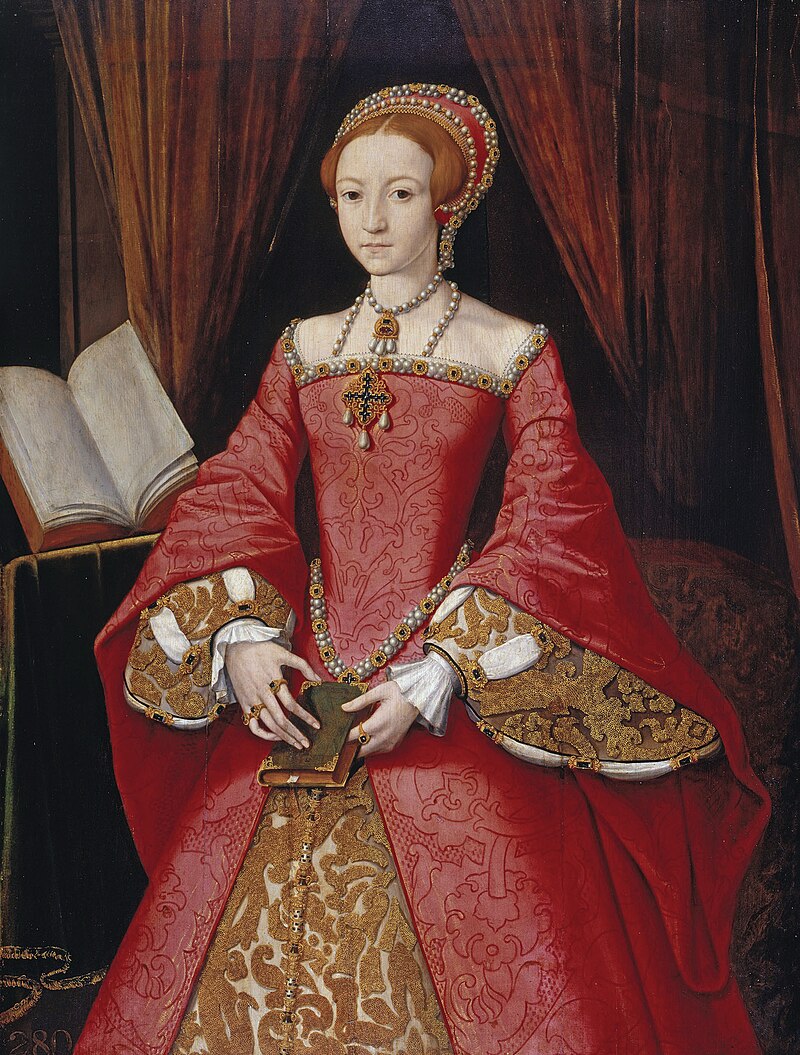
*

Article: 2024 © Sharon Bennett Connolly FRHistS

Guest Post: Frances – Tudor Countess: The History Behind the Book, by Tony Riches
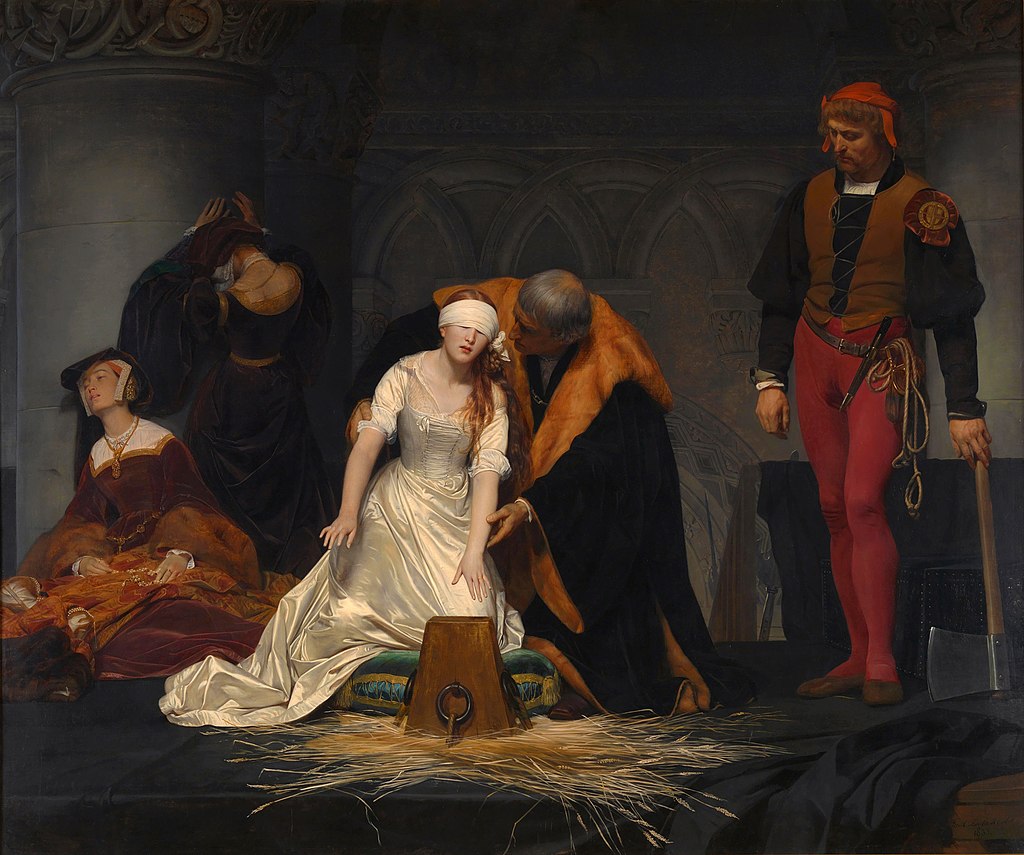
Today, it is a pleasure to welcome Tony Riches back to History…the Interesting Bits, with an article about the story behind his new novel, Frances: Tudor Countess. Frances Walsingham was the daughter of Queen Elizabeth’s spymaster, Francis Walsingham who married three times, including the soldier-poet, Sir Philip Sidney and, later, Robert Devereux, Earl of Essex

So, over to Tony…

Frances – Tudor Countess: The History Behind the Book

The origins of my latest book can be traced to my birth in Pembroke, Wales, close to the medieval castle where Henry Tudor was born. I couldn’t find any books which brought his story to life, and was inspired to write the Tudor Trilogy, where Henry is born in the first book, comes of age in the second, and becomes King of England in the third.

The success of the Tudor Trilogy led to the idea of following the dynasty in a continuous thread to the end, with the death of Queen Elizabeth I. I enjoy studying the real history to understand the social, political and economic context, and like to offer readers an historically authentic ‘immersive’ experience.

Over the past ten years I’ve built an extensive reference collection of books on everything Tudor and Elizabethan, from medicine to recipes, childbirth to government, as well as numerous biographies of key players in the story of the Tudors. All this research provides the backdrop within which the real lives and relationships of my chosen subjects develop and evolve.

For my second trilogy I decided to write about the reign of Henry VIII as the ‘Brandon Trilogy’, from the perspective of his youngest sister, Mary, his best friend, Charles Brandon, and the woman who some say could have become his seventh wife, Katherine Willoughby.

This took me to the Elizabethan era, and the decision to explore the enigmatic queen through three of her favourite men, Drake, Essex and Raleigh. Each saw her very differently, as Drake was in awe of her, Essex was like the son she never had, and Raleigh became captain of her guard.

I found that most of what I thought I knew about these men was wrong or missing vital details. I discovered Drake strived to understand and help liberate enslaved people. The heroic failure of the Essex rebellion was more about his lack of emotional intelligence than political ambition, and Raleigh’s colonisation of the New World was conducted from the comfort of his home through the courageous sacrifices of others.

I also realised I would need to make the Elizabethan books a series of six, rather than a trilogy, and explore the complexity of Queen Elizabeth through the eyes of three of her ladies. I had plenty to choose from, but found the most interesting were Penelope, eldest daughter of the queen’s nemesis, Lady Lettice Knollys, Frances, the only surviving child of the queen’s spymaster, Walsingham, and one of her ‘Gentlewomen’, Bess Raleigh.

One of my favourite historical sources for the Elizabethan series is “The Elizabethan Court Day by Day” by Marion E. Colthorpe. A rich and varied collection of research, this is where I discovered such details as the queen’s chambers being infested with fleas, which accumulated at the windows, the lists of participants in Accession Day jousts, and actual menus for royal banquets. Most importantly, this resource enabled me to cross-check events on any day at the Elizabethan court with other sources to ensure historical accuracy.

Of the many biographies I’ve studied, an unexpected source I found useful was Daphne du Maurier’s work on Francis and Anthony Bacon, who became important advisors to Frances in her struggle to understand and influence events at court. I also collected the works of the late Professor David Loades, particularly on the lives of William and Robert Cecil, who provide a connection between the books of the Elizabethan series.

To anyone looking for a deeper understanding of the Elizabethan world, I also recommend Liza Picard’s Elizabeth’s London: Everyday Life in Elizabethan London and The Time Traveller’s Guide to Elizabethan England by Ian Mortimer. There are plenty of well-researched books about the great events of the period, such as the Spanish Armada, but I was keen to develop a sense of how my subjects lived from day to day, what they wore, what they ate, and most importantly, how they thought about their world.

When I set out on this ‘journey’ to tell the story of the Tudors I had no idea how much I would learn about fascinating women such as Frances Walsingham, who witnessed the key events of the Elizabethan era first-hand, yet is so little known – until now.

To Buy the book:

Frances – Tudor Countess is new from Amazon in the United Kingdom and United States in eBook and Paperback, and an audiobook edition will be produced this year:

About the Author:

Tony Riches is a full-time UK author of best-selling Tudor historical fiction. He lives in Pembrokeshire, West Wales and is a specialist in the history of the Wars of the Roses and the lives of the Tudors. For more information about Tony’s books please visit his website tonyriches.com and his blog, The Writing Desk and find him on Facebook, Twitter @tonyriches and Bluesky: https://bsky.app/profile/tonyriches.bsky.social. You can find out more about his research on his popular podcast series, ‘Stories of the Tudors’

Media Links:

Website: https://www.tonyriches.com/ Twitter: https://twitter.com/tonyriches Bluesky: https://bsky.app/profile/tonyriches.bsky.social Facebook: https://www.facebook.com/tonyriches.author/ LinkedIn: https://www.linkedin.com/in/tonyriches/ Instagram: https://www.instagram.com/tonyriches.author/ Amazon Author Page: https://www.amazon.com/Tony-Riches/e/B006UZWOXA Goodreads: https://www.goodreads.com/author/show/5604088.Tony_Riches

*

My Books

Signed, dedicated copies of all my books are available through my online bookshop.

Coming on 15 June 2024: Heroines of the Tudor World

Heroines of the Tudor World tells the stories of the most remarkable women from European history in the time of the Tudor dynasty, 1485-1603. These are the women who ruled, the women who founded dynasties, the women who fought for religious freedom, their families and love. These are the women who made a difference, who influenced countries, kings and the Reformation. In the era dominated by the Renaissance and Reformation, Heroines of the Tudor World examines the threats and challenges faced by the women of the era, and how they overcame them. From writers to regents, from nuns to queens, Heroines of the Tudor World shines the spotlight on the women helped to shape Early Modern Europe.

Heroines of the Tudor World is now available for pre-order from Amberley Publishing and Amazon UK.

Out Now! Women of the Anarchy

Two cousins. On the one side is Empress Matilda, or Maud. The sole surviving legitimate child of Henry I, she is fighting for her birthright and that of her children. On the other side is her cousin, Queen Matilda, supporting her husband, King Stephen, and fighting to see her own son inherit the English crown. Women of the Anarchy demonstrates how these women, unable to wield a sword, were prime movers in this time of conflict and lawlessness. It show how their strengths, weaknesses, and personal ambitions swung the fortunes of war one way – and then the other.

Available from Bookshop.orgAmberley Publishing and Amazon UK.

Also by Sharon Bennett Connolly:

King John’s Right-Hand Lady: The Story of Nicholaa de la Haye is the story of a truly remarkable lady, the hereditary constable of Lincoln Castle and the first woman in England to be appointed sheriff in her own right. Available from all good bookshops or direct from Pen & Sword Booksbookshop.org and AmazonDefenders of the Norman Crown: The Rise and Fall of the Warenne Earls of Surrey tells the fascinating story of the Warenne dynasty, from its origins in Normandy, through the Conquest, Magna Carta, the wars and marriages that led to its ultimate demise in the reign of Edward III. Available from Pen & Sword BooksAmazon in the UK and US, and Bookshop.org

Ladies of Magna Carta: Women of Influence in Thirteenth Century England looks into the relationships of the various noble families of the 13th century, and how they were affected by the Barons’ Wars, Magna Carta and its aftermath; the bonds that were formed and those that were broken. It is now available in paperback and hardback from Pen & Sword,  Amazon, and Bookshop.orgHeroines of the Medieval World tells the stories of some of the most remarkable women from Medieval history, from Eleanor of Aquitaine to Julian of Norwich. Available now from Amberley Publishing and Amazon, and Bookshop.orgSilk and the Sword: The Women of the Norman Conquest traces the fortunes of the women who had a significant role to play in the momentous events of 1066. Available now from Amazon,  Amberley Publishing, and Bookshop.org.

Alternate Endings: An anthology of historical fiction short stories including Long Live the King… which is my take what might have happened had King John not died in October 1216. Available in paperback and kindle from Amazon.

Podcast:

Have a listen to the A Slice of Medieval podcast, which I co-host with Historical fiction novelist Derek Birks. Derek and I welcome guests, such as Bernard Cornwell – and Tony Riches. We discuss a wide range of topics in medieval history, from significant events to the personalities involved.

*

Don’t forget! Signed and dedicated copies of all my books are available through my online bookshop.

For forthcoming online and in-person talks, please check out my Events Page.

You can be the first to read new articles by clicking the ‘Follow’ button, liking our Facebook page or joining me on Twitter and Instagram.

*

©2024 Sharon Bennett Connolly FRHistS and Tony Riches