Book Corner: The Knight’s Pledge by Scott Mariani

History... the Interesting Bits

1191.

Will Bowman, now fully entangled in Richard Lionheart’s crusade, has reached the Holy Land. However, just as he and his crew are about to touch down in Acre, they are drawn into an intense battle at sea, where they are faced with the dreaded Byzantine weapon: Greek Fire.

Barely escaping with his life, Will gains the trust of Richard Lionheart, moving into his service. But as the siege of Acre continues, and Richard’s campaign grows ever more brutal and barbaric, Will begins to wonder just how safe his new position is.

And when the King sends him on a seemingly doomed mission, Will must ask himself: who exactly is he fighting for?

Well, Scott Mariani has taken to historical fiction like a duck to water. He has a flare for it. But then, he did draw me in with his Ben Hope novels, all of which had a historical mystery at the heart of the the story. With his second full, historical fiction, The Knight’s Pledge, he draws the reader into the action from the very first pages as his hero, Will Bowman, arrives at Acre to take part in the Third Crusade.

And an added bonus is that a quote from my review of the first book, The Pilgrim’s Revenge, is among the endorsements on the first pages!

And what an adventure we are treated to. Scott Mariani expertly blends fact with fiction and tells a story that will keep you hooked.

The story is gripping and full of suspense – you are never quite sure whether the heroes are going to succeed – or even make it out alive!

History... the Interesting Bits

Will had personally come face to face with King Richard only once, and then for only a few brief moments. But he had seen his monarch flying fearlessly into the thick of battle enough times to know how he would respond.

Sure enough, almost within a heartbeat the flagship had diverted course and was steering straight at the enemy vessel, all oars manned and powering as hard as they could go. The captain of Will’s ship instantly followed suit, with a clamour of shouted orders and the frenzied activity of the sailors all around them. Every crewman aboard knew his duty as well as he knew his own name, and they needed little encouragement as they rushed to their stations and flung themselves behind the oars. Amid the rapid pounding of the drum and hoarse cries of ‘Heave ho, boys,’ and ‘We’ll have at those bastards,’ the ship picked up pace and curved sharply around. As they leaned hard into the turn, the deck sloped like a pitched roof and the bows threw up a white wave that smothered the nearside rail with foam.

One by one, every other ship of the fleet was veering off their course to engage this new enemy. Will sprinted back across the sloping deck to where he and his companions had been sitting earlier and snatched up the weapons that he kept stowed next to his habitual sleeping place. With hands trembling in anticipation of the fight that would very soon be on them he buckled up his sword belt, then quickly tensioned and strung his bow stave, an action that was second nature to him. He had been an expert with the bow for such a large part of his life that it had become the name he was known by. His leather quiver contained a sheaf of arrows carefully fashioned by his own hand, made to fly straight and true and each fitted with an iron-pointed bodkin head capable of piercing a coat of chain mail like the one he was wearing under his leather jerkin.

Gabriel came running hot on his heels, and disregarding his precious chessmen that were strewn and rolling all about the deck he grabbed the curved falchion sword he favoured over the more conventional straight-bladed variety. Samson’s preference was for his short-handled war axe, a gift to him from Will, which had hammered and split the heads of many a foe in the battles they had fought en route.

But this new enemy was like no other they had faced before. As the deck levelled itself after their steep turn, Will glanced forward and saw the Saracen ship suddenly much closer, partly wreathed behind the curtain of roiling black smoke that was pouring from the burning galley. ‘Godspeed,’ he yelled at Gabriel and Samson, then ran for the laddered companionway that led up to the elevated section of the forecastle. It was already teeming with his fellow archers, mostly equipped with crossbows and only a minority who used the more old-fashioned but further-shooting and more accurate – when properly handled – longbow.

History... the Interesting Bits

Scott Mariani’s meticulous research and attention to detail helps to recreate the Holy Land of 1191. The sights, the smells, the spiders! Oh, and the insults! I have a new favourite insult; ‘scobberlotcher’.

Will Bowman proves how fearless and brave he can be. Though he is still young and has a naivety about him which I think will be increasingly challenged as his war goes on. It is fascinating to watch the evolution of this young man, from grieving farmer to warrior. And expert archer, he’s strong, courageous and loyal. He is quick-witted, intelligent, even, a natural leader of men, but still in possession of a sense of chivalry that will get him into trouble.

In the first half of the story, we follow the experiences of the army during the Siege of Acre, and its aftermath. Ever a writer with a sense of adventure, Scott Mariani then sends our hero on a near-suicidal mission in search of lost treasure. While it may not be in the historical record, the quest is certainly plausible – as is the outcome! (but no spoilers!)

All in all, The Knight’s Pledge is an absolute joy to read – or, rather, devour. Scott Mariani has lost none of his legendary storytelling skills in his transition from the thriller genre to historical fiction. And I like to think I can see a little of Ben Hope in this new hero, Will Bowman. I think Ben would certainly have approved of Will.

At least I know what I’m getting my dad for Christmas – he’s gonna love The Knight’s Pledge!

Buy the Book: The Knight’s Pledge

About the author:

History... the Interesting Bits

Scott Mariani is the No.1 Sunday Times bestselling author of the multi-million-selling Ben Hope thrillers. From 2025 he is launching into a new historical adventure series featuring medieval English hero Will Bowman, who is forced from his home to join King Richard ‘the Lionheart’ on the Third Crusade and rises up to become a knight. Book 1,THE PILGRIM’S REVENGE, is available from April 2025 and is published by Hodder & Stoughton.

Scott lives and writes in west Wales, UK. You can find out more about his work by visiting his official website.

*

My Books:

Signed, dedicated copies of all my books are available, please get in touch by completing the contact me form or through my online bookshop.

Out now: Scotland’s Medieval Queens

Books by Sharon Bennett Connolly

Scotland’s history is dramatic, violent and bloody. Being England’s northern neighbour has never been easy. Scotland’s queens have had to deal with war, murder, imprisonment, political rivalries and open betrayal. They have loved and lost, raised kings and queens, ruled and died for Scotland. From St Margaret, who became one of the patron saints of Scotland, to Elizabeth de Burgh and the dramatic story of the Scottish Wars of Independence, to the love story and tragedy of Joan Beaufort, to Margaret of Denmark and the dawn of the Renaissance, Scotland’s Medieval Queens have seen it all. This is the story of Scotland through their eyes.

Scotland’s Medieval Queens gives a thorough grounding in the history of the women who ruled Scotland at the side of its kings, often in the shadows, but just as interesting in their lives beyond the spotlight. It’s not a subject that has been widely covered, and Sharon is a pioneer in bringing that information into accessible history.’ Elizabeth Chadwick (New York Times bestselling author)

Available now from Amazon and Pen and Sword Books

Coming in 2026!
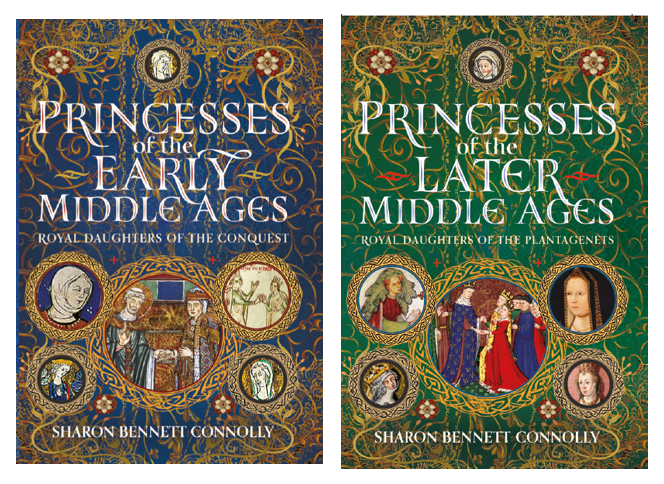
Daughters of kings were often used to seal treaty alliances and forge peace with England’s enemies. Princesses of the Early Middle Ages: Royal Daughters from the Conquest and Princesses of the Later Middle Ages: Royal Daughters of the Plantagenets will explore the lives of these young women, demonstrating how they followed the stereotype, and how they sometimes managed to escape it. It will look at the world they lived in, and how their lives and marriages were affected by political necessity and the events of the time.

Were they political pawns? Or, were they able to control their own lives and fates? What impact did they have on the world in which they lived?

Their stories are touching, inspiring and, at times, heartbreaking.

Princesses of the Early Middle Ages: Royal Daughters from the Conquest is now available for pre-order from Amazon and bookshop.org.

Also by me:

Books by Sharon Bennett Connolly

Heroines of the Tudor World tells the stories of the most remarkable women from European history in the time of the Tudor dynasty, 1485-1603. These are the women who ruled, the women who founded dynasties, the women who fought for religious freedom, their families and love. Heroines of the Tudor World is now available for pre-order from Amberley Publishing and Amazon UK. Women of the Anarchy demonstrates how Empress Matilda and Matilda of Boulogne, unable to wield a sword themselves, were prime movers in this time of conflict and lawlessness. It shows how their strengths, weaknesses, and personal ambitions swung the fortunes of war one way – and then the other. Available from Bookshop.orgAmberley Publishing and Amazon UKKing John’s Right-Hand Lady: The Story of Nicholaa de la Haye is the story of a truly remarkable lady, the hereditary constable of Lincoln Castle and the first woman in England to be appointed sheriff in her own right. Available from all good bookshops Pen & Sword Booksbookshop.org and Amazon

Royal Historical Society

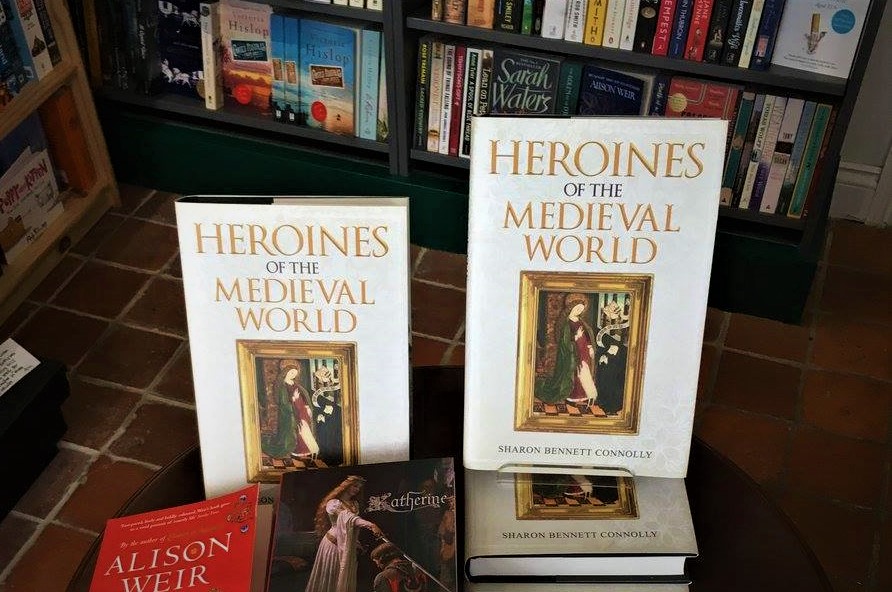
Defenders of the Norman Crown: The Rise and Fall of the Warenne Earls of Surrey tells the fascinating story of the Warenne dynasty, from its origins in Normandy, through the Conquest, Magna Carta, the wars and marriages that led to its ultimate demise in the reign of Edward III. Available from Pen & Sword BooksAmazon in the UK and US, and Bookshop.orgLadies of Magna Carta: Women of Influence in Thirteenth Century England looks into the relationships of the various noble families of the 13th century, and how they were affected by the Barons’ Wars, Magna Carta and its aftermath; the bonds that were formed and those that were broken. It is now available in paperback and hardback from Pen & SwordAmazon, and Bookshop.orgHeroines of the Medieval World tells the stories of some of the most remarkable women from Medieval history, from Eleanor of Aquitaine to Julian of Norwich. Available now from Amberley Publishing and Amazon, and Bookshop.orgSilk and the Sword: The Women of the Norman Conquest traces the fortunes of the women who had a significant role to play in the momentous events of 1066. Available now from Amazon,  Amberley Publishing, and Bookshop.org.

Alternate Endings: An anthology of historical fiction short stories including Long Live the King… which is my take what might have happened had King John not died in October 1216. Available in paperback and kindle from Amazon.

*

Podcast:
History... the Interesting Bits

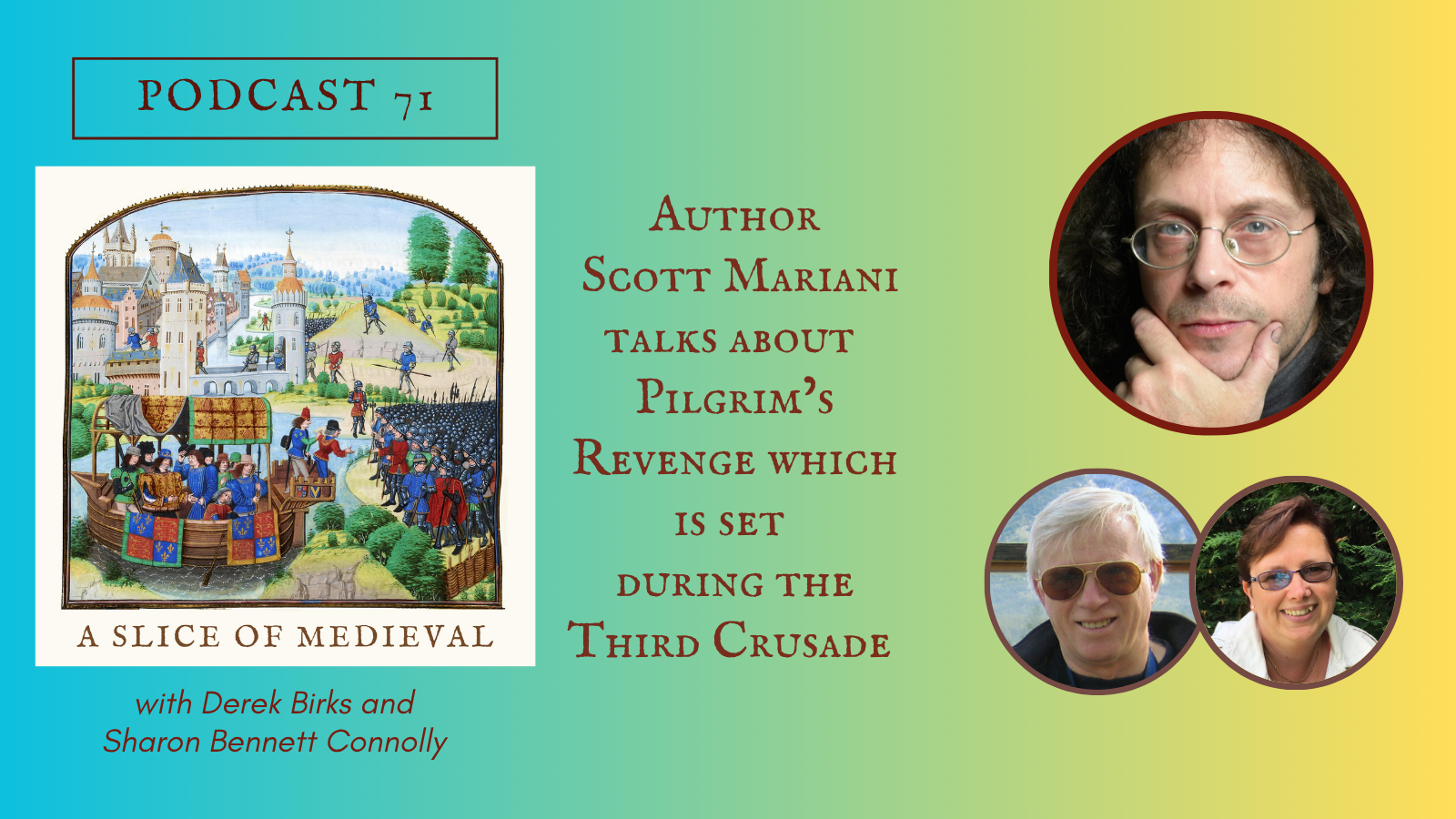
Have a listen to the A Slice of Medieval podcast, which I co-host with Historical fiction novelist Derek Birks. Derek and I welcome guests, such as Bernard Cornwell and Elizabeth Chadwick, and discuss a wide range of topics in medieval history, from significant events to the personalities involved. 

In episode 71, Derek Birks and I chat with Scott Mariani about his new hero, Will Bowman and the journey to the Third Crusade.

There are now over 80 episodes to listen to!

Every episode is also available on YouTube.

*

Don’t forget! Signed and dedicated copies of all my books are available through my online bookshop.

For forthcoming online and in-person talks, please check out my Events Page.

You can be the first to read new articles by clicking the ‘Follow’ button, liking our Facebook page or joining me on TwitterThreadsBluesky and Instagram.

*

©2025 Sharon Bennett Connolly FRHistS

Book Corner: Templar Traitor by Angus Donald

Angus Donald

“Do not lie to me, Templar, or it will be the last thing you do.”

July 1241. Western Europe cowers in terror before the threat of a Mongol invasion. The swift cavalry columns of Genghis Khan have smashed the steel-clad warriors of Russia, Poland and Hungary – and now Austria lies directly in their path.

At a skirmish outside the walls of Vienna, German knights capture a squad of Mongol scouts and are astonished to discover one of their number is an Englishman – a former Templar – who has been riding with these Devil’s horsemen for more than twenty years.

Interrogator Father Ivo of Narbonne is summoned to draw the truth from the prisoner before his impending trial, to find out why he abandoned his faith, his Brethren and his homeland to become… a traitor to Christendom.

Based on a true story, this is the first novel in a new blockbuster trilogy from ‘master of the genre’ Angus Donald.

My first thought when I heard about Templar Traitor by Angus Donald was “ooh, Templars – love anything Templar related. And by Angus Donald, too! Must read.” My second was “a Templar fighting with the Mongols? Yeah, right!” And with those conflicting thoughts in mind, I decided to give it a go. Angus Donald is a great writer, so even if it is more fantasy than reality, he may be able to pull it off. How surprised was I to discover, from the very first pages, that this wasn’t a fantasy, nor a King & Conqueror-esque rewriting of History. (Forgive me for mentioning King & Conqueror, but when someone butchers History like that, the pain is real!)

This was a true story!

A clever, original plot is the more remarkable for the fact it derives from the true story of a Templar knight fighting with the Mongol horde, in the army of Genghis Khan, no less!

Templar Traitor gives a unique angle on the Templars, the Crusades and the Mongols. It also gives an insight into events we rarely hear about and rebuffs the Euro-centric view of the Middle Ages. In Templar Traitor Angus Donald expertly portrays the contrast and melding of the different civilisations of the European Christian and the Mongol. The clash of cultures adds an intensity top the story, beyond the warmongering and empire-building. The human toll of ambition and deceit is evident.

It seemed to Robert a desperate last throw of the dice for the Latin kingdoms. If this attempt on Damietta failed, the Christians would likely be swept into the Mediiterranean.

Yet, despite the importance of this expedition, Robert was concerned for his brother, who, he knew, would soon be hurled into the fury of battle. Gilly was not a weakling, but there was an air of fragility about him that inspired protectiveness in Robert. It had been like this since childhood.

‘I have just written to Father,’ continued Gilbert, ‘and told him about your predicament. And that I am to be dispatched to Egypt with the first of our knights. I only pray that the old man lives long enough to receive the letter. You knew that Henry had taken to his bed before I left England? I do not think he will ever walk or ride again.’

‘You told me, Gilly. Our earthly father will soon be with our Heavenly one.’

‘What will they do with you, Rob? said Gilbert. ‘Will they show mercy?’

‘God chose me as his servant, Gilly – He will not abandon me. And I have served the Order faithfully these past ten years. That must count for something.’

‘I shall pray for you,’ said Gilbert. ‘I shall pray for you every night, Rob.’

‘And I you. I want you to promise me something, Gilly. You are not to court danger unnecessarily in Damietta. They will call for volunteers, they will ask you to risk your life for the cause. Do not do this again. If you love me, brother, remain silent when the call goes out for brave knights to undertake some fresh perilous mission.’

‘Would you do that, brother?’ asked Gilbert. ‘The Robert of Hadlow I know prizes risk and danger more highly than anything else. Would he duck a challenge? No. The knight who won the First Lance badge for skill at arms three years in a row? A feat no other Templar has ever achieved. Would he shirk his duty? I think not.’

‘It is not shirking. You already serve God by serving the Order. And to serve God is to serve mankind. There is no need to risk your life further. Others also seek glory. Let them step forward.

‘There is a whiff of hypocrisy in your words, brother. I know that you would never dodge a chance to strike a blow for Christ. How can you ask that of me?’

‘This is not about me. This is about you, your life. Father will soon be gone to his reward and I … Well, look at me, in this cell, awaiting trial for my foolishness. Learn from my example. Do not seek out unnecessary risk in Egypt – that is all I ask.’

‘I shall do as I think fit. As you would do. But I shall pray for God’s guidance.’

I cannot imagine the amount of research that must have gone into recreating the lands the Mongols conquered. Legendary cities such as Samarkand are rebuilt and brought to life. The Nomadic lifestyle of the Mongols means the marauding army takes its own sheep, goats and herds of horses campaigning with it. The women accompany the army, making a home in the encampment wherever they stop.

Angus Donald sheds light on the knight’s story, fleshing out the gaps in the known history to create a remarkable adventure that will leave the reader eager for more. The Templar knight, Robert of Hadlow, has his own secrets, motives and family concerns. Add to this a private feud with a priest, the need to rescue his baby brother and forbidden love, and Robert’s story has all the ingredients for a magnificent adventure.

Robert of Hadlow is a likeable character, even if the reader feels they cannot wholly trust him. The author implants that niggling doubt in the reader’s subconscious and I’m not quite sure how and when he did it!

All in all, Templar Traitor is definitely in my Top 10 of Books of 2025. The originality of the story is refreshing. The attention to detail and the layers of plot make it a gripping, fascinating read. Oh, and there’s enough single combat and vivid battle scenes to satisfy anyone who likes a jolly good battle! From the first page, the story is intriguing. I enjoyed the fact that I didn’t know what the endgame was. This is far from formulaic historical fiction where the hero knight saves the day. There is mystery and deceit throughout – on both sides – with ulterior motives and hidden agendas.

Templar Traitor is probably the best book Angus Donald has written, possibly even better than his Holcroft Blood series – and that was excellent! I cannot recommend it highly enough.

Look out for Angus chatting with Derek and I about Templar Traitor and the Mongols on A Slice of Medieval soon.

Buy the book:

Templar Traitor by Angus Donald is out now.

About the author:

Angus Donald is the author of the bestselling Outlaw Chronicles, a series of ten novels set in the 12th/13th centuries and featuring a gangster-ish Robin Hood. Angus has also published the Holcroft Blood trilogy about a mildly autistic 17th-century English artillery officer, son of notorious Crown Jewels thief Colonel Thomas Blood. Before becoming an author, Angus worked as a fruit-picker in Greece, a waiter in New York City and as an anthropologist studying magic and witchcraft in Indonesia. For fifteen years he was a journalist working in Hong Kong, India, Afghanistan and London. He now writes full time from a medieval farmhouse in Kent. http://www.angusdonaldbooks.com.

*

My Books

Signed, dedicated copies of all my books are available through my online bookshop.

Out now: Scotland’s Medieval Queens

Books by Sharon Bennett Connolly

Scotland’s history is dramatic, violent and bloody. Being England’s northern neighbour has never been easy. Scotland’s queens have had to deal with war, murder, imprisonment, political rivalries and open betrayal. They have loved and lost, raised kings and queens, ruled and died for Scotland. From St Margaret, who became one of the patron saints of Scotland, to Elizabeth de Burgh and the dramatic story of the Scottish Wars of Independence, to the love story and tragedy of Joan Beaufort, to Margaret of Denmark and the dawn of the Renaissance, Scotland’s Medieval Queens have seen it all. This is the story of Scotland through their eyes.

Scotland’s Medieval Queens gives a thorough grounding in the history of the women who ruled Scotland at the side of its kings, often in the shadows, but just as interesting in their lives beyond the spotlight. It’s not a subject that has been widely covered, and Sharon is a pioneer in bringing that information into accessible history.’ Elizabeth Chadwick (New York Times bestselling author)

Available now from Amazon and Pen and Sword Books

Also by Sharon Bennett Connolly:

Books by Sharon Bennett Connolly

Heroines of the Tudor World tells the stories of the most remarkable women from European history in the time of the Tudor dynasty, 1485-1603. These are the women who ruled, the women who founded dynasties, the women who fought for religious freedom, their families and love. Heroines of the Tudor World is now available for pre-order from Amberley Publishing and Amazon UK. Women of the Anarchy demonstrates how Empress Matilda and Matilda of Boulogne, unable to wield a sword themselves, were prime movers in this time of conflict and lawlessness. It shows how their strengths, weaknesses, and personal ambitions swung the fortunes of war one way – and then the other. Available from Bookshop.orgAmberley Publishing and Amazon UKKing John’s Right-Hand Lady: The Story of Nicholaa de la Haye is the story of a truly remarkable lady, the hereditary constable of Lincoln Castle and the first woman in England to be appointed sheriff in her own right. Available from all good bookshops Pen & Sword Booksbookshop.org and Amazon

Royal Historical Society

Defenders of the Norman Crown: The Rise and Fall of the Warenne Earls of Surrey tells the fascinating story of the Warenne dynasty, from its origins in Normandy, through the Conquest, Magna Carta, the wars and marriages that led to its ultimate demise in the reign of Edward III. Available from Pen & Sword BooksAmazon in the UK and US, and Bookshop.orgLadies of Magna Carta: Women of Influence in Thirteenth Century England looks into the relationships of the various noble families of the 13th century, and how they were affected by the Barons’ Wars, Magna Carta and its aftermath; the bonds that were formed and those that were broken. It is now available in paperback and hardback from Pen & SwordAmazon, and Bookshop.orgHeroines of the Medieval World tells the stories of some of the most remarkable women from Medieval history, from Eleanor of Aquitaine to Julian of Norwich. Available now from Amberley Publishing and Amazon, and Bookshop.orgSilk and the Sword: The Women of the Norman Conquest traces the fortunes of the women who had a significant role to play in the momentous events of 1066. Available now from Amazon,  Amberley Publishing, and Bookshop.org.

Alternate Endings: An anthology of historical fiction short stories including Long Live the King… which is my take what might have happened had King John not died in October 1216. Available in paperback and kindle from Amazon.

Podcast:

A Slice of Medieval

Have a listen to the A Slice of Medieval podcast, which I co-host with Historical fiction novelist Derek Birks. Derek and I welcome guests, such as Elizabeth Chadwick, Helen Castor, Ian Mortimer, Scott Mariani and Bernard Cornwell and discuss a wide range of topics in medieval history, from significant events to the personalities involved. Look out for Angus chatting with Derek and I about Templar Traitor and the Mongols on A Slice of Medieval soon.

Every episode is also now available on YouTube.

*

Don’t forget! Signed and dedicated copies of all my books are available through my online bookshop.

For forthcoming online and in-person talks, please check out my Events Page.

You can be the first to read new articles by clicking the ‘Follow’ button, liking our Facebook page or joining me on TwitterThreadsBluesky and Instagram.

*

©2025 Sharon Bennett Connolly FRHistS


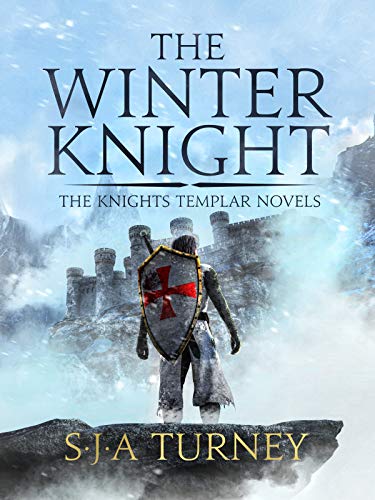
Book Corner: The Winter Knight by SJA Turney

A murder in a far off castle. A deadly struggle to survive… An intense and gripping Medieval thriller.

In the depths of winter at an ancient German castle, high up in the mountains, a noble is found dead under mysterious circumstances.

Back at Rourell, Arnau is taking on the responsibilities of a full Templar Knight. But when he is tasked with returning Brother Lütolf’s papers to settle a legal dispute between his family and the Order, Arnau is unexpectedly drawn into the killing at the castle. Here he enters a dark game of knives and double-crosses.

Trapped in the ice-bound fortress, mastery of the sword is no longer enough. This is a different kind of war: one of shadows and whispered threats. Arnau must use all the guile he possesses, or risk succumbing to an icy tomb.

The Winter Knight is the fourth adventure of Arnaud Vallbona in SJA Turney‘s wonderful Knights Templar series. Each story in this series is unique and focuses on the experiences or life of the individual brothers of the preceptory at Rourell in Spain. The first book, Daughter of War, dealt with the very survival of the preceptory itself and its indomitable ruler, Ermengarde; a female preceptrix of the Knights Templar. And while the second book, The Last Emir, saw Arnaud hunting for relics, the third sent him east, to Byzantium and the Fourth Crusade.

The Winter Knight once more sends Arnaud on his travels, this time to the home of his former mentor, Brother Lutolf, in Germany. And to an altogether different adventure. Rather than a tale of war and destruction, The Winter Knight is a totally gripping murder mystery set among the chilly atmosphere of a German castle, or schloss, in the depths of winter.

‘”But if thou doest evil, dread thou; for not without cause he beareth the sword, for he is the minister of God, venger into wrath to him that doeth evil.” Romans thirteen. The Lord reminds us that the ministers of God are the agents of his vengeance, bringing the sword to evildoers.’

Felipe frowned. ‘You don’t mean …’

Arnau sighed. ‘It is, in one very important way, none of our business. But as warriors of His Church, it is in another way our business above all others. The word of the Book should always take precedence over temporal matters, Felipe.’

‘Interference might not be popular, Brother Arnau. I do not think they like us.’

‘They do not have to like us. Just to respect our authority within the Church. It might be a matter of duty that we apprehend the evildoer and visit divine judgement upon him.’

Felipe joined in the shivers now. ‘Be careful, Brother Arnau.’ He tapped his precious book of the Rule. ‘”Every brother of the Temple should be believed to the benefit of the Temple and our house, and the brother should be careful what he takes upon himself, for if the thing is not as he says, he should be judged to have committed a fault.” Rule 150.’

Arnau turned back to the window. Beneath that canopy and the ever-present snow, the dark circle of the well seemed to be taunting him, sneering that it had eaten the young lord who was the very reason for their visit. He clenched his teeth. ‘I can live with committing a fault, but whoever cut an innocent man’s throat and attempted to hide the body in such a despicable way? He deserves the vengeance of the Lord.’

His eyes rose to the apartments opposite, just in time to see a hooded figure in one of the windows looking straight across the courtyard at him, then disappearing within and slamming the shutters tight.

SJA Turney fills each page with an atmosphere of suspense and intrigue that is hard to escape, even after the book is finished. The clever plot, beautiful and desolate snowy countryside and wonderful, diverse characters have the reader intrigued from the very first page – the opening scenes being the grisly murder itself!

As I have come to expect with SJA Turney, the research is impeccable. From the Templar Rule, through the German weather and the bleak and imposing castle, down to the language and customs of the time, the author has recreated medieval Germany in great detail, even down to the German mindset, their distrust of foreign military orders and the political machinations of the time.

Arnau de Vallbona is a wonderful lead character, and it has been a pleasure to watch him grow and mature over the 4 books, from an immature novice to a full-fledged knight of the Order, having grown in confidence and ability. However, he is no knightly paragon and it is fascinating to watch his struggles with his Order’s rules, with a little flirtation with Brother Lutolf’s sister, and his responsibilities, in searching for the murderer, supervising his squire and looking after Templar interests in the face of a grieving family.

As a murder mystery, The Winter Knight is impressive. Even looking at it with a critical eye, the plot is cleverly woven into the story, drawing on legend, human emotions and the worst of humanity to leave the reader guessing at the identity of the murder until the full extent of his crimes is revealed to the reader.

Despite being the fourth book in a series, The Winter Knight has a unique quality in that it is entirely readable and entertaining as a standalone. At no point does the reader feel that they are missing a part of the story as a result of not having read the previous 3 books. Although, as someone who has read and devoured them all, I highly recommend the entire series.

With The Winter Knight, SJA Turney has again shown his versatility as a writer in this thoroughly absorbing and entertaining novel. I can’t wait for the next instalment!

About the Author:

Simon lives with his wife, children and dogs in rural North Yorkshire. Having spent much of his childhood visiting historic sites with his grandfather, a local photographer, Simon fell in love with the Roman heritage of the region, beginning with the world famous Hadrian’s Wall. His fascination with the ancient world snowballed from there with great interest in Egypt, Greece and Byzantium, though his focus has always been Rome. A born and bred Yorkshireman with a love of country, history and architecture, Simon spends most of his rare free time travelling the world visiting historic sites, writing, researching the ancient world and reading voraciously.

Simon’s early career meandered along an arcane and eclectic path of everything from the Ministry of Agriculture to computer network management before finally settling back into the ancient world. During those varied years, Simon returned to university study to complete an honours degree in classical history through the Open University. With what spare time he had available and a rekindled love of all things Roman, he set off on an epic journey to turn Caesar’s Gallic War diaries into a novel accessible to all. The first volume of Marius’ Mules was completed in 2003 and has garnered international success, bestseller status and rave reviews, spawning numerous sequels. Marius’ Mules is still one of Simon’s core series and although Roman fiction features highly he now has Byzantine, Fantasy and Medieval series, too, as well as several collaborations and short stories in other genres.

Now, with in excess of 25 novels available and 5 awaiting release, Simon is a prolific writer, spanning genres and eras and releasing novels both independently and through renowned publishers including Canelo and Orion. Simon writes full time and is represented by MMB Creative literary agents.

Look out for Roman military novels featuring Caesar’s Gallic Wars in the form of the bestselling Marius’ Mules series, Roman thrillers in the Praetorian series, set during the troubled reign of Commodus, adventures around the 15th century Mediterranean world in the Ottoman Cycle, and a series of Historical Fantasy novels with a Roman flavour called the Tales of the Empire.

*

My Books

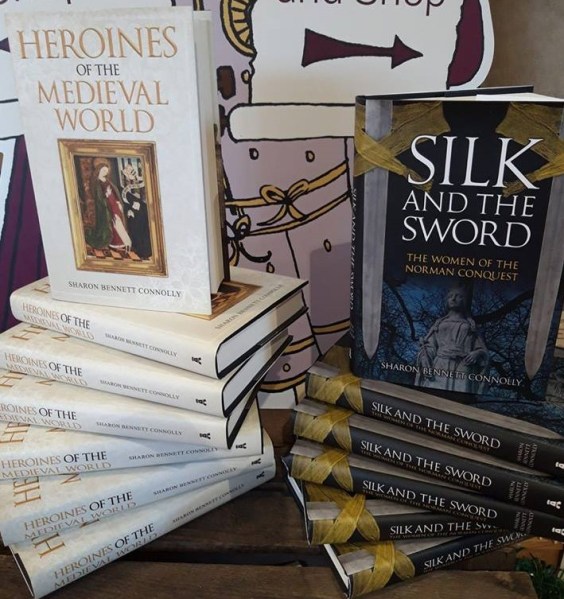
Silk and the Sword: The Women of the Norman Conquest

From Emma of Normandy, wife of both King Cnut and Æthelred II to Saint Margaret, a descendant of Alfred the Great himself, Silk and the Sword: the Women of the Norman Conquest traces the fortunes of the women who had a significant role to play in the momentous events of 1066.  Available now from Amazon UK,  Amberley Publishing, Book Depository and Amazon US.

Heroines of the Medieval World

Telling the stories of some of the most remarkable women from Medieval history, from Eleanor of Aquitaine to Julian of Norwich, Heroines of the Medieval World,  is available now on kindle and in paperback in the UK from from both Amberley Publishing and Amazon, in the US from Amazon and worldwide from Book Depository.

*

You can be the first to read new articles by clicking the ‘Follow’ button, liking our Facebook page or joining me on Twitter and Instagram.

©2019 Sharon Bennett Connolly

Guest Post: Busting Mediaeval Building Myths: Part Two

Tattershall Castle, Lincolnshire

I think after the wonderful insights of last week’s Guest Post: Busting Mediaeval Building Myths: Part One, we have all been eagerly awaiting Part Two of James Wright‘s brilliant article – I know I have!

So, without further ado. Here it is:

Busting Mediaeval Building Myths: Part Two

James Wright, Buildings Archaeologist, Triskele Heritage

In my last guest blog for History the Interesting Bits, we discussed five common myths about mediaeval buildings. These tall tales included stories of secret passages, yarns about the twist of spiral staircases relating to right-handed defenders and anecdotes that lepers were provided special windows in churches to watch the mass through.

As a buildings archaeologist I often meet folk who are eager to tell me all about their properties and their enthusiasm is genuinely infectious. I’m a great lover of historic architecture and believe that we can learn so much of value about a society by what it builds. However, romanticised and elaborated stories often grow up around certain mysterious features in mediaeval buildings – and it is surprising how often these get repeated all across the country in so many different structures.

In the second part of this series, I will discuss five more common misconceptions, attempt to explain how they come about and what the underlying truth behind each myth is. Hopefully this will help to give a broader and deeper understanding of historic buildings that will bring us that little bit closer to their former occupants.

  • Ship Timbers
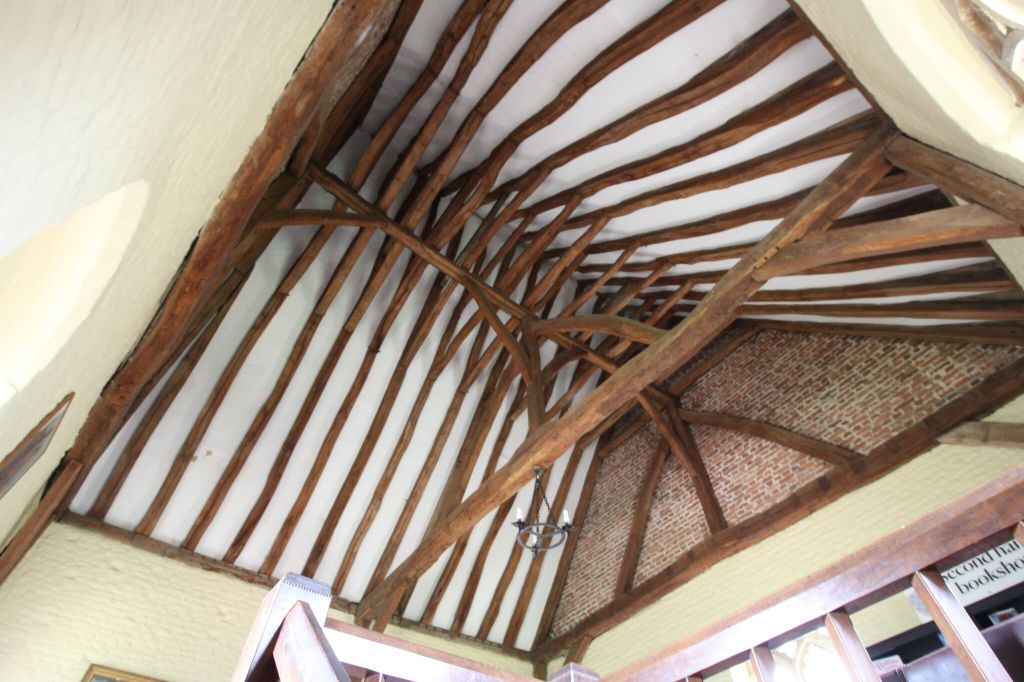
Ship timbers, Tattershall

Perhaps the most tenacious and persistent mediaeval building myth is that lots of timber-framed buildings were constructed from salvaged ship timbers. There is even a house in Hertfordshire that is actually called Ships Timbers! Given that traditional British boozers have a reputation as hotbeds of rumour and intrigue, it will come as no shock that many pubs have the reused ship timbers story associated with them – often linked to a famous battle such as Trafalgar. Is there any truth in these tales?

On extremely rare occasions, it can be demonstrated that specific pieces of timber may have genuinely originated from a ship. I cannot stress just how rare this is and that documentary evidence is often lacking. My former colleague, Damian Goodburn, Historic Timber Specialist at MOLA, has pointed out that ship timbers rarely lend themselves to reuse in terrestrial buildings due to extreme weathering, their shaping designed for aquatic settings and the overall unworkability of seasoned oak. Instead, timbers from ship-breaking yards tend to be reused in marine or inter-tidal architecture, such as the Bermondsey foreshore of the River Thames in London. Alternatively, ship timbers may occasionally be found in the foundations of structures located very close to waterways, such as the three pieces recorded in the foundations of the Rose Playhouse, Bankside, London.

The vast majority of timber-framed buildings were constructed from newly felled trees and/or reused terrestrial structures such as barns, granaries and houses. The reuse of buildings is widely documented – for example the building accounts for Tattershall Castle, Lincolnshire, refer to the removal of timber from nearby Revesby Abbey in 1434-5. Reused timber will often be placed in a different part of the new building to the original structure leaving rectangular holes, known as mortises, visible and it is probably this which gives us the origin of the romantic story of timbers salvaged from wrecked ships.

  • Arrow-sharpening Grooves
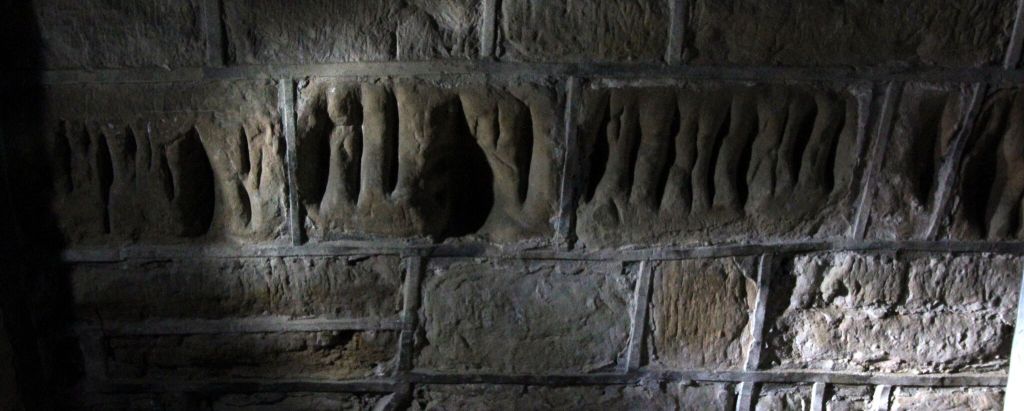
Arrow grooves, Lambley

Worn into the hard stonework of the interior of many a church porch can be found clusters of strange vertical grooves which visitors are commonly told were created by archers sharpening their arrows, such as those at Holy Trinity, Lambley, Nottinghamshire. Given Edward III’s law of 1363, that all able-bodied men aged between 16 and 60 must practice their archery on Sundays and holy days, plus the location of many archery butts close to the parish church, the arrow-sharpening story has become received wisdom wherever the grooves are found.

There is neither any documentary evidence to suggest that archers sharpened their arrows on the stones of church porches, neither would this be a practical solution to the problem of dulled arrowheads. As churchyards were consecrated ground, archery butts were located elsewhere in the manor, creating a laborious trek to the porch. Instead, the sixteenth century archery expert, Roger Ascham tells us that bowmen would sharpen their arrows using hand-held files and whetstones. Equally, the majority of the grooves are orientated vertically and are located relatively low-down in the porches which render them as impractical for drawing a metre long arrow shaft across. Finally, these grooves are often found on soft limestones entirely useless for honing an edge.

The swashbuckling tales of English victories at Crécy and Azincourt have led to nationalistic myths of an epic proportion. Not only have accounts of the battles become rather knotted, but the desire to connect local history to the heroic archers has led to a misreading of the evidence. Folk traditions from pre-modern Germany and France, collected in the nineteenth century by Charles Rau, refer to parishioners scraping powder from church stonework to use in rituals. The stone was seen as a powerful holy material which was ingested as cures for fever or impotence. It is likely that similar ritualistic practises associated with holy buildings were also once common in Britain and the grooves in church porches relates to this folk ritual.

  • Murder Holes
Murder holes, Berry Pomeroy, Devon

Look up whilst you are visiting castles and you will often see voids in the overhead masonry associated with the defence of the building. These can take the form of slots overhanging the walls, known as machicolations (for example at Berry Pomeroy, Devon), or holes in the gate passage, known as murder holes (such as those at Caernarfon, Gwynedd). The popular story is that they were built so that the defenders could pour boiling oil down upon attackers.

Although it is not a myth that these holes were created to potentially hurl items into the spaces below them, including projectiles, stones and caustic lime, their uses were even more complicated. They could act as safe observation points from which the wall foot or passageway could be seen. If fires were started, either accidentally or deliberately, during a siege the slots could also be used to douse the flames with cold water.

Boiling oil was rarely used – it was prohibitively expensive, not often available in large enough quantities to be effective, would have been difficult to heat (it has a boiling point at 2040C), problematic to transport around the parapets and could have been a fire risk in itself. There are a very small number of scattered references to the use of hot oil, including at the siege of Orléans in 1428. For the most part, castles were rarely laid siege to and murder holes were mostly left untested. In fact many of them were intended to be nothing more than symbols of architectural prestige: the machicolations at Tattershall would have directly overlooked the roofs of the castle’s Inner Ward – not the best place to drop offensive weapons or scalding materials!

  • Templar Graffiti
Templar graffiti, Worksop

Type “Templar graffiti” into a search engine and you will find a mind-boggling number of links to hundreds of castles and churches, from the dungeons of Warwick Castle to the porch of Worksop Priory, Nottinghamshire. The websites invariably refer to cross-shaped graffiti left behind by the enigmatic Order of the Knights Templar (founded 1199 and dissolved 1312) and their crusading brethren. The legend that he Templars harboured the Holy Grail is all-consuming and many believe that the location of the cup of Christ can be found by decoding intriguing symbols and carvings at sites such as Royston Cave, Hertfordshire.

One of the principle problems with these romanticised notions is that they have more akin to conspiracy theories and Dan Brown novels than to historical research. In particular, it can be demonstrated that the “dungeon” at Warwick Castle was actually the storage basement of Caesar’s Tower, built over 30 years after the Templars were dissolved. Similarly, the carvings at Royston Cave, have been identified, by archaeologist Matthew Champion, as dating to the late fourteenth and fifteenth centuries. Again, this falls outside of the Templar period and the religious character of the carvings is entirely consistent with those in a wide variety of other sites of the period.

Ultimately, crosses are a very common discovery in mediaeval graffiti surveys. They may be related to devotional activities such as prayer, but, as large numbers – around 80% – are found in church porches (as at Worksop) it is also likely that they relate to more secular behaviour. In particular, there is good evidence for mediaeval porches being used as sheltered meeting rooms, places where manorial courts were held, locations for reading wills and a site for parish notices to be read or fixed. As such the graffiti crosses may have been left as contractual memorials akin to swearing on the Bible or signing a document.

  • Devil’s Door
Devil’s door, Warkworth

Many churches, such as St Lawrence, Warkworth, Northumberland, have their north aisle doors blocked up – a phenomena which has been increasingly referred to as the Devil’s Door. Tradition states that this door, nearest to the font, was left open during baptisms so that demons could escape from the new-born child upon command of the priest. The north side of the church was thought of as being connected with the devil and after the Reformation these doors were blocked up as they were considered to relate to superstitions incompatible with the Protestant faith.

Francis Young has written eloquently on the subject of baptismal folklore and suggests that the sacrament was never considered to be a true exorcism, thus we might not be expecting demons to come flying out of the north door. Furthermore, Nicholas Groves has pointed out that the part of the baptism when the devil was commanded to leave the body of the infant, actually took place outside of the south porch in the churchyard. Equally, the belief that the north side of the church was particularly feared also does not stand up. Many churches have their principle entrance to the north, including Southwell Minster, Nottinghamshire, they face the principle access route from the settlement. It is also the case that large numbers of churches retained both their north and south porches, as at Kelham, Nottinghamshire.

Although it is acknowledged that north aisle doors may have been left open during baptisms, this was never part of the established liturgy. However, a number of formal church processions, including that on Palm Sunday, required the north porch as an exit point prior to walking, clockwise, around the east end of the church and back in through the south porch. Following the Reformation, these processions no longer took place making the door and porch essentially redundant. Churchwardens eventually decommissioned many of them as an expensive maintenance liability.

—————————-

I hope that you enjoyed this blog and that it will prove useful in trying to fully understand mediaeval buildings on your own visits. Should you wish for more information on this subject, please feel free to tweet me on @jpwarchaeology or email on james@triskeleheritage.com

All images courtesy of James Wright.

*

I would like to say a HUGE THANK YOU to James Wright for taking the time to write two incredibly fascinating post. I owe you one, James.

*

My Books

Silk and the Sword: The Women of the Norman Conquest

From Emma of Normandy, wife of both King Cnut and Æthelred II to Saint Margaret, a descendant of Alfred the Great himself, Silk and the Sword: the Women of the Norman Conquest traces the fortunes of the women who had a significant role to play in the momentous events of 1066.  Available now from Amazon UK,  Amberley Publishing, Book Depository and Amazon US.

Heroines of the Medieval World

Telling the stories of some of the most remarkable women from Medieval history, from Eleanor of Aquitaine to Julian of Norwich, Heroines of the Medieval World,  is available now on kindle and in paperback in the UK from from both Amberley Publishing and Amazon, in the US from Amazon and worldwide from Book Depository.

*

You can be the first to read new articles by clicking the ‘Follow’ button, liking our Facebook page or joining me on Twitter and Instagram.

©2019 Sharon Bennett Connolly and James Wright

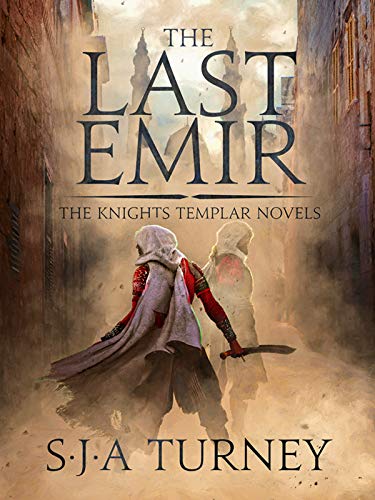
Book Corner: The Last Emir by SJA Turney

51oYQKZfjYLRisk everything; fight to the last: a taut and intense historical thriller from master author S.J.A. Turney
The relics of Christendom have been plundered during the long Moorish conquest of the Iberian peninsula. Newly minted Templar Sergeant Arnau de Vallbona must recover one of the most elusive to save his priory at Rourell in Spain.

Travelling to Majorca on a stealth mission to retrieve the bones of St Stephen, Arnau soon discovers the raid is more complex than it first appears: the mighty Almohad dynasty has laid claim to the island, and will fight them every step of the way.

Along with his companion, the aged warrior Balthesar, Arnau is in desperate straits. Surrounded on all sides by hostile forces, it will take all their cunning and strength to escape with their prize – and their lives….

A thrilling and unexplored account of the Knights Templar, grounded in extraordinary research, The Last Emir is perfect for fans of Bernard Cornwell, K.M. Ashman and C.F. Iggulden.

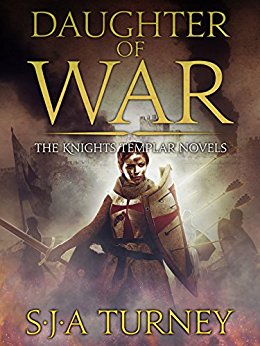
The Last Emir is the second book in S.J.A. Turney’s fabulous series recounting the exploits of the Knights Templars in Spain during the Moorish Conquest of the country. The first book in the series, Daughter of War was a gripping drama which followed the struggles of Titborga and Arnau as the found sanctuary and a purpose in the Templar preceptory at Rourell, run by the incredible preceptrix, Ermengarda, as they battled an unscrupulous Spanish nobleman intent on getting his hands on Titborga’s lands – at any cost. It was a wonderful, gritty story with every page filled to the brim with action.

And The Last Emir is no less immersive. The second book takes Arnau on a quest to Majorca, in search of a Holy relic, but finding only trouble and a dispute between rival Moorish factions. The story is skillfully told, weaving a tale of intrigue and betrayal, and blurring the lines between the rival factions. S.J.A. Turney paints a wonderful image of the island of medieval Majorca, taking the reader on a journey across the island, re imagining the amazing landscape, the loud, busy markets and the sumptuous palaces with such precision that you can almost see, hear and smell the bazaar, the preserved manuscripts in the library … and the blood and passion of battle.

‘I’m sorry.’

Balthesar threw him a withering  look that made his cheeks burn hotter. ‘Later,’ was all the older man said.

Peril, though, was following them that day, for as Arnau began to feel that perhaps they were almost safe, two mounted figures in black and white emerged from a side street ahead of them.

‘What now?’ gasped Arnau.

‘We have no choice. We’re trapped. Go back and we’re entering the noose you created for us. We have to cross the bridge, even if we have to kill those horsemen to do it. With luck the guards at the bridge have not heard about us yet.’

It appeared that kill the horsemen was precisely what they would have to do. the Two Almohad warriors spotted their quarry and, realising that they had ensnared them, roared victorious-sounding cries, then ripped their blades free of their scabbards and put heel to flank, charging towards the two Templars.

Arnau had time, as he drew his own sword, to register the shock of the two local guards at the bridge. They were arguing urgently and dithering, perhaps unsure whether to intervene or to remain at their assigned place by the bridge.

Beside Arnau, Balthesar also drew his blade. ‘Keep your mouth shut,’ he commanded, ‘if we are to get out of Al-Bulãnsa alive.’

51h0jv1U4aL._SY346_

The only downside of this book is that not all the characters we met in Daughter of War appear in this story. Arnau and Balthesar are far away from their familiar surroundings, having to rely on their wits and their own abilities in order to survive and win their way back home. Arnau, in particular, is on a journey of discovery, of his own strengths and weaknesses, the differences between Islam and Christianity and of his companion in arms. Through his own trials, he has to learn that not everything is black-and-white, lines blur and whether a person is good or evil is not necessarily defined by their religion. He has already learned the brutality of war, but in The Last Emir, he also has to learn about the subtleties of war.

This is a fabulous novel, which takes a reader away from the preconceptions and mysticism of the Knights Templar and presents the Templars as they were, and as they were created; warrior monks fighting for Christianity and what is right.

Well researched, not only in the customs of medieval Spain, both Christian and Moor, but also in the rich history of the country, and of individual events of the time, S.J.A. turney’s attention to the historic detail infuses the story with anthenticity. The author has created a marvellous, gripping story. The narrative is wonderfully written with every page pleasure to read – long into the night. Arnau and his Templar colleagues are the best kind of heroes – those the readers can invest themselves in and always want to read more.

Waiting for Book 3 is already proving a challenge…


About the Author:

Sja

Simon lives with his wife, children and dogs in rural North Yorkshire. Having spent much of his childhood visiting historic sites with his grandfather, a local photographer, Simon fell in love with the Roman heritage of the region, beginning with the world famous Hadrian’s Wall. His fascination with the ancient world snowballed from there with great interest in Egypt, Greece and Byzantium, though his focus has always been Rome. A born and bred Yorkshireman with a love of country, history and architecture, Simon spends most of his rare free time travelling the world visiting historic sites, writing, researching the ancient world and reading voraciously.

Simon’s early career meandered along an arcane and eclectic path of everything from the Ministry of Agriculture to computer network management before finally settling back into the ancient world. During those varied years, Simon returned to university study to complete an honours degree in classical history through the Open University. With what spare time he had available and a rekindled love of all things Roman, he set off on an epic journey to turn Caesar’s Gallic War diaries into a novel accessible to all. The first volume of Marius’ Mules was completed in 2003 and has garnered international success, bestseller status and rave reviews, spawning numerous sequels. Marius’ Mules is still one of Simon’s core series and although Roman fiction features highly he now has Byzantine, Fantasy and Medieval series, too, as well as several collaborations and short stories in other genres.

Now, with in excess of 25 novels available and 5 awaiting release, Simon is a prolific writer, spanning genres and eras and releasing novels both independently and through renowned publishers including Canelo and Orion. Simon writes full time and is represented by MMB Creative literary agents.

Look out for Roman military novels featuring Caesar’s Gallic Wars in the form of the bestselling Marius’ Mules series, Roman thrillers in the Praetorian series, set during the troubled reign of Commodus, adventures around the 15th century Mediterranean world in the Ottoman Cycle, and a series of Historical Fantasy novels with a Roman flavour called the Tales of the Empire.

*

Out Now!

Tracing the fortunes of the women who had a significant role to play in the momentous events of 1066, Silk and the Sword: the Women of the Norman Conquest is available from Amazon UK,  Amberley Publishing and Book Depository. It is scheduled for release in the US on 1 March 2019 and is available for pre-order from Amazon US.

fave

Also by Sharon Bennett Connolly:

Telling the stories of some of the most incredible women from Medieval history, Heroines of the Medieval World,  is now available in hardback in the UK from both Amberley Publishing and Amazon UK, in the US from Amazon US  and worldwide from Book Depository. It will be released in paperback in the UK from 15 March 2019 and is available for pre-order on Amazon.

*

Be the first to read new articles by clicking the ‘Follow’ button, liking our Facebookpage or joining me on Twitter.

*

©2018 Sharon Bennett Connolly

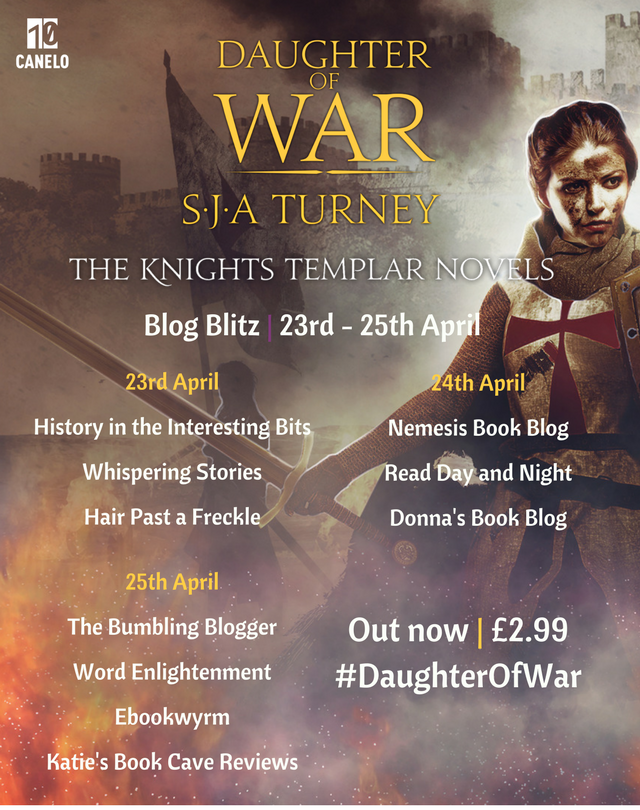
Book Corner: Daughter of War by S.J.A. Turney

Today it is my pleasure to be a part of S.J.A. Turney’s Blog Blitz  with a review of his latest novel, Daughter of War.

An extraordinary story of the Knights Templar, seen from the bloody inside

Europe is aflame. On the Iberian Peninsula the wars of the Reconquista rage across Aragon and Castile. Once again, the Moors are gaining the upper hand. Christendom is divided.
Amidst the chaos comes a young knight: Arnau of Valbona. After his Lord is killed in an act of treachery, Arnau pledges to look after his daughter, whose life is now at risk. But in protecting her Arnau will face terrible challenges, and enter a world of Templars, steely knights and visceral combat he could never have imagined.
She in turn will find a new destiny with the Knights as a daughter of war… Can she survive? And can Arnau find his destiny?
An explosive novel of greed and lust, God and blood, Daughter of War marks the beginning of an epic new series from bestseller S.J.A. Turney. Perfect for fans of Bernard Cornwell, Conn Iggulden and Matthew Harffy.
I had been looking forward to reading Daughter of War by S.J.A. Turney ever since i heard about the book. And I was not disappointed. Daughter of War is like no other Templar story I have read. The story is set in Spain, rather than the Holy Land, during the Reconquista. And has none of the mysticism that many Templar novels revolve around.
Rather than making the book unreadable, however, this makes the story all-the-more fascinating. the author concentrates on the fighting, monastic and community elements of the Templar order and, as a result, has managed to create a story that is both unique and refreshing. This is a must-read for any fan of the real Knights Templar.
What did I love about this book? Everything. The story revolves around a small Templar preceptory in rural Spain, which has attracted the attention and ire of an unscrupulous and greedy Spanish noble. The preceptory is run by Ermengarda d’Oluja – a woman – but a formidable, commanding woman who has become one of my favourite characters. If ever I write a Heroines of the Medieval World 2, Ermengarda will be in there! And that’s the amazing thing, Ermengarda is a real historical character who did run a Templar preceptory – I didn’t even know they had women in the Templars.
 
But if you think that because there is a female Templar, that this book would be any less gritty or warlike than any other Templar story, you’d be mistaken. Ermengarda is a woman of steel and an incredible character. S.J.A. Turney, however, has made sure to keep her within the male-orientated realm in which she lived. She extends the limits of female convention if the twelfth century, but never quite breaks them.
The story also deals with the powerlessness of women in the medieval era and the fact that they did not have the right to decide their own fate when it came to marriage. That they could be forced to marry wherever their family and betters decided. And this is what causes the conflict in Daughter of War.
… There, in an antechamber of ancient stone, beneath an elegantly vaulted ceiling, stood Titborga Cervelló de Santa Coloma in her mourning dress of pure white. The sound of loud conversation emerged from the great hall beyond the thick, heavy wooden doors and, though the details of the discussion could not quite be made out, they sounded purposeful and combative.
Arnau dropped to a knee and bowed his head in respect.
‘My lady.’
‘Rise, Señor de Vallbona,’ she said in an odd, worried tone.
‘How may I be of service?’ he asked, climbing to his feet once more and adjusting his grey bliaut swiftly.
Something about the way the lady’s eyes scoured the dim surroundings put him on edge, and when she spoke, her voice was quiet and suspicious. ‘You are one of Santa Coloma’a most trusted men, Arnau de Vallbona.’
‘I have striven in my time to serve your father appropriately,’ he replied, brow creased more than ever.
‘My father spoke of you often, and well. I have seen you with him. He held you in esteem, perhaps more than one might expect for your somewhat minor rank.’
Arnau stifled the disappointment and irritation he felt at the rather blunt remark. Keeping his expression carefully neutral, he nodded. ‘Your father was a great man. I looked up to him. Even at the end, I -‘
‘I need your help. Your oath, Señor de Vallbona.’
Now Arnau felt alarm. These were careful words spoken in a dangerous tone. What was happening? …
Arnau and Titborga are wonderful characters, each joining the Templar order for their own reasons, and each looking for their own purpose in life. Each character – indeed, every character in the book – is unique, with their own hopes and dreams – and challenges. The book takes care not to stereotype the Templars into over zealous religious fanatics, but gives each their individual stories.
Care is taken to enthuse the book with historical accuracy, be it of the region in which the story is based, of the Templar order in general and of the preceptory in particular. The level of research that has gone into this book is astounding and impressive and has helped to create the world of 12th century Spain, torn between Christian and Muslim inhabitants.
As a story, the pace is incredible and barely gives the reader any time to stop and think as the Templars deal with the growing crisis. The attention to detail of S.J.A. Turney means that the fight scenes, in particular, are incredible scenes that draw the reader in, until they’re cowering behind their sofa to hide from the swinging swords and flying crossbow bolts. The author is a true wordsmith and recreates the medieval world and people with a skill level that is rarely achieved and maintained.
Daughter of War has an air of authenticity that is rarely achieved by an author, you can feel the heat of medieval Spain, the desperation of people in a fight they are not sure they can win, and the determination of those who know they are in the right. However, above all, Daughter of War is one thing; it is a fabulously entertaining story, and I cannot recommend it highly enough.
About the author:
S.J.A. Turney is an author of Roman and medieval historical fiction, gritty historical fantasy and rollicking Roman children’s books. He lives with his family and extended menagerie of pets in rural North Yorkshire.
To buy Daughter of War by S.J.A. Turney:

Amazon (UK); Kobo (UK);  Google Books (UK); Apple Books (UK)

Author Social Media Links

Twitter: @SJATurney

*

My book

Heroines of the Medieval World,  is now available in hardback in the UK from both Amberley Publishing and Amazon UK and worldwide from Book Depository. It is also available on Kindle in both the UK and USA and will be available in Hardback from Amazon US from 1 May 2018.

You can be the first to read new articles by clicking the ‘Follow’ button, liking our Facebook page or joining me on Twitter.

*

©2018 Sharon Bennett Connolly