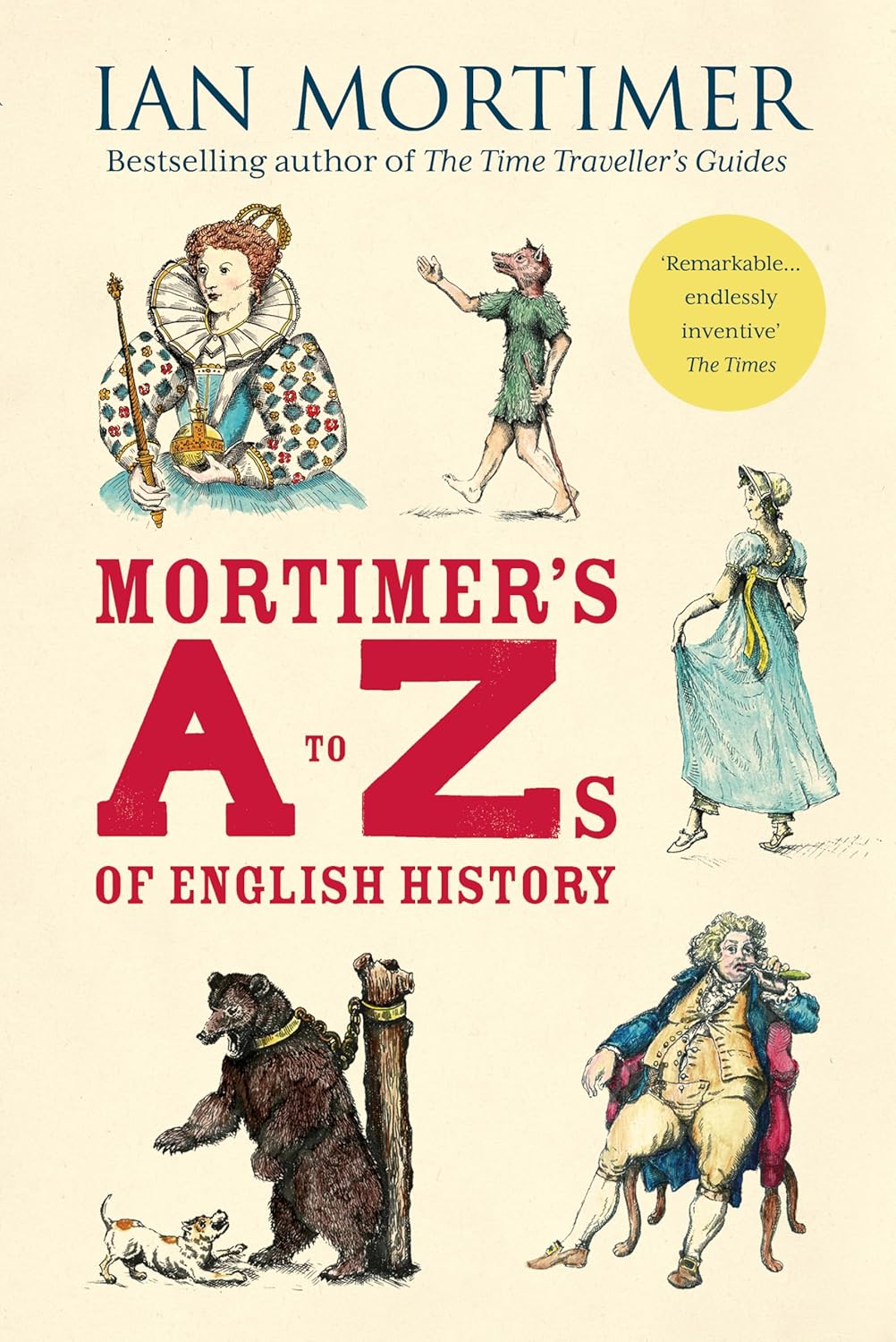
Book Corner: Mortimer’s A to Zs of English History by Ian Mortimer

From the bestselling author of the Time Traveller’s Guides

In these sparkling A to Zs, time-travelling historian Ian Mortimer visits four classic periods of English history: the fourteenth century, the Elizabethan age, the Restoration and the Regency.

As he ranges from the Great Plague to the Great Freeze, from Armada to Austen, and from tobacco to toenails, he shines a light into corners of history we never knew were so fascinating — or so revealing of the whole.

How did the button change life in the Middle Ages? If you found yourself at a smart Elizabethan party, should you kiss your hostess on the lips? Why were pistols safer than swords in a duel? And how come Regency Londoners quaffed so much port?

This is Mortimer at his accessible and witty best. As ever, his aim is not only to bring the past to life but also to illuminate our own times.
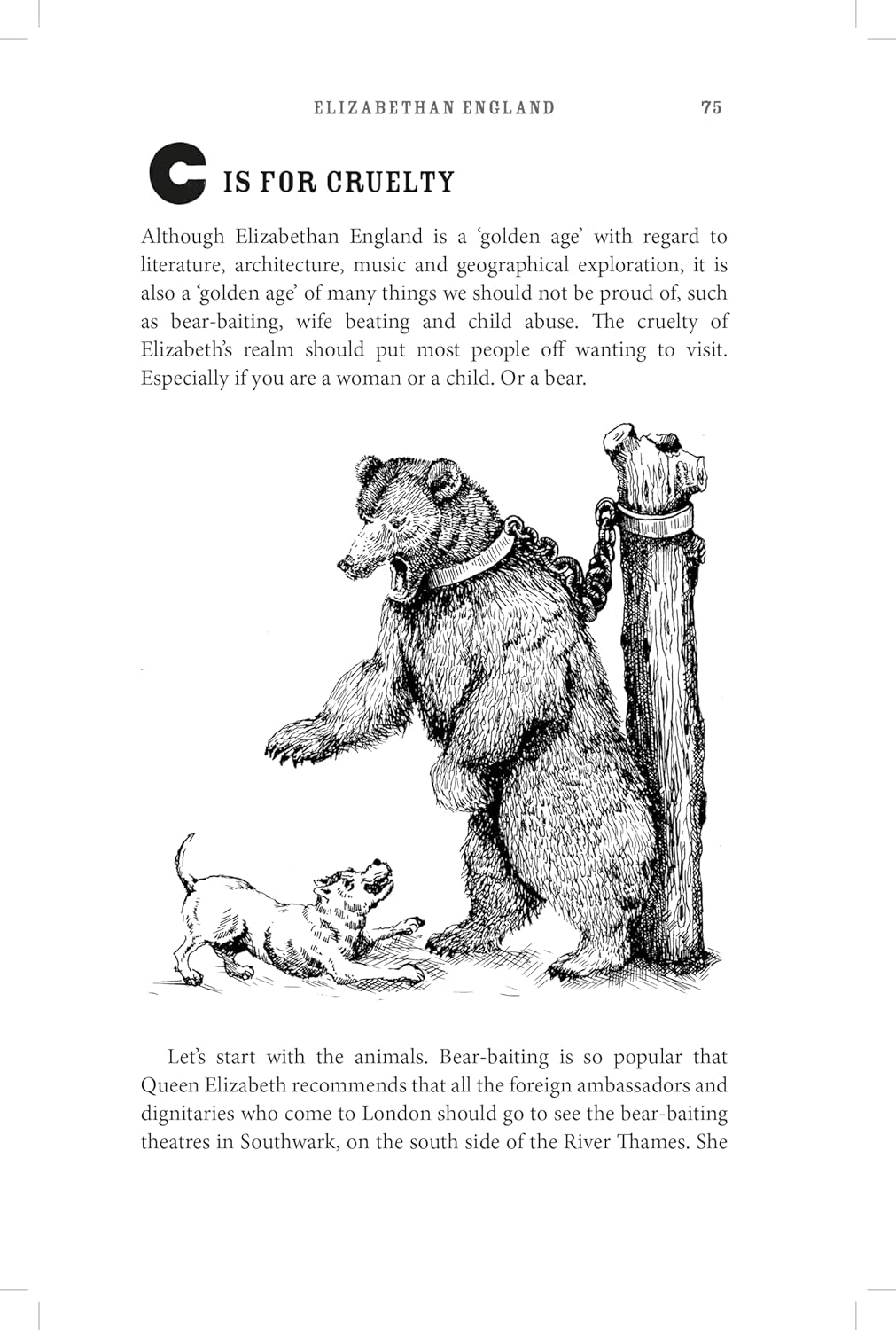
A couple of weeks ago, Derek Birks and I had the pleasure of chatting with Ian Mortimer on our podcast, A Slice of Medieval, and we talked about THIS book. You can listen to the episode when it goes live on New Years’ Eve. And if this review doesn’t persuade you to have a read, Ian’s interview certainly will. Ian Mortimer has a refreshing outlook on History – he not only wants to make it accessible to everyone, he wants to make it enjoyable. And he wants you to look at History from different angles, even sideways. Because then, you see things differently.

Mortimer’s A to Zs of English History is split into 5 sections and focuses on 4 main periods; 14th century, Elizabeth, Restoration and Regency, with a 5th section, the envoi, an A to Z of reflections on those themes history that cross periods. This is a stunning book and a thoroughly enjoyable read.

Many History fans look down on general History books, saying they already know the basics. But this isn’t basic. It is not as much about the facts as it is about changing the way you look at the facts. It is about making you think and making you look differently at the facts, at what we know and how we know it. It makes you wonder how inventions came about, how innovations developed. It makes you consider how diet, environment, opportunities – and the weather – affected society and drove change.

And the envoi of Mortimer’s A to Zs of English History highlights what doesn’t change, considering the values, good and bad, that transect eras and generations. Xenophobia, for instance, rears its ugly head in every generation. Speed, also, is a consideration throughout the eras; the speed of travel, of communication and of progress.
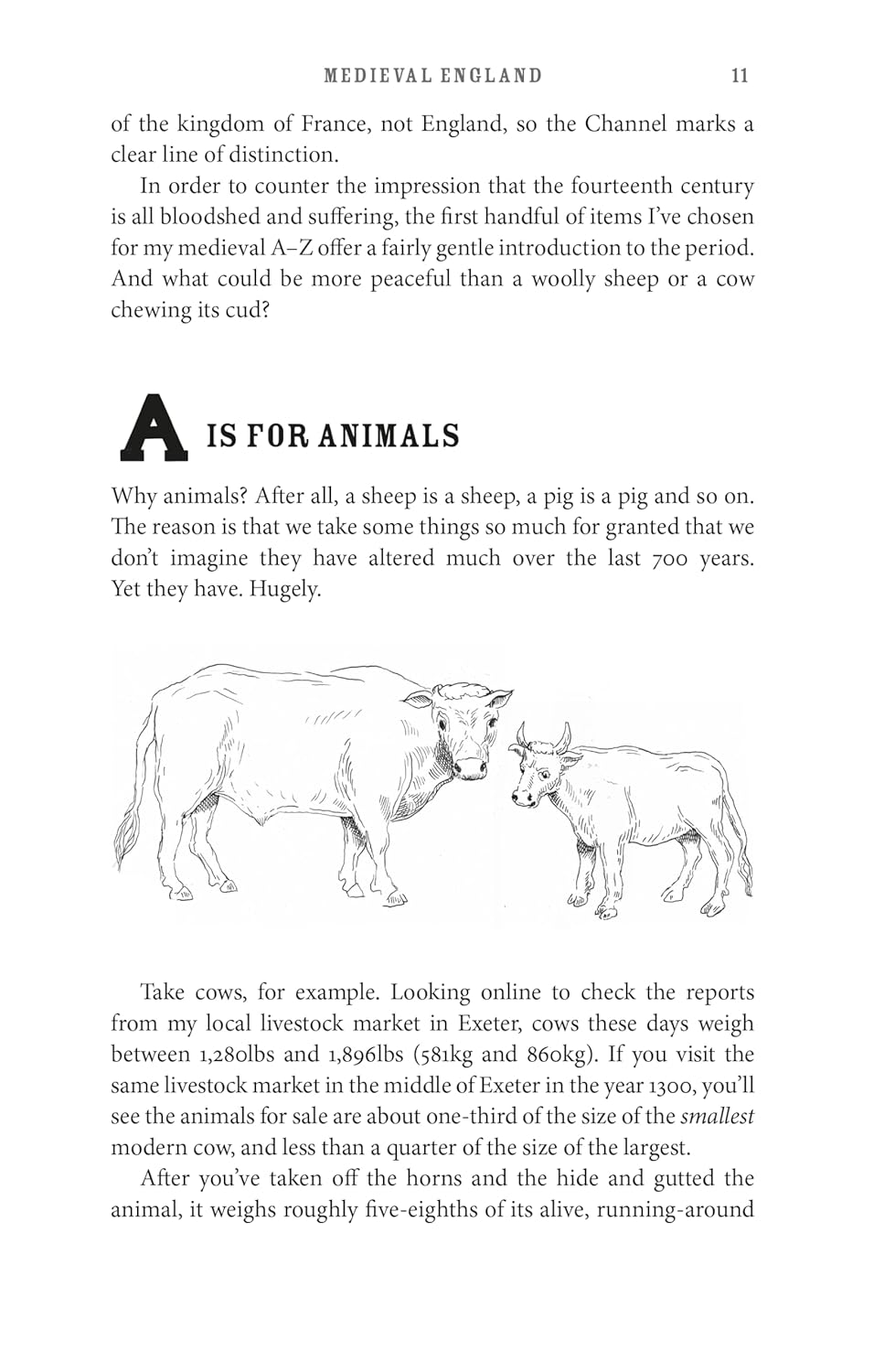
Q is for Queenship

What are medieval queens for? Obviously, they are the partners of kings and their primary duty is to produce the next generation of the royal family. In medieval times it is essential to have a line of succession: political stability depends on it. But it is worth asking what queens are for other than childbirth. After all, they are not like other aristocratic women. When Lord So-and-so goes off to court, he leaves Lady So-and-so behind to look after the household in his absence, with staff to carry out her instructions, just as in countless other private households in the country. But when the king travels, the court goes with him. His queen might remain in one of the palaces or castles or she might accompany him, but even if she remains, her role is limited. Officials are left in charge of the royal residences. Childcare is normally passed over to other women – wetnurses and guardians. When a fourteenth-century king goes abroad, he entrusts the guardianship of the realm to his heir or a near male relative, not his queen. (In this respect, the fourteenth-century is more sexist than earlier ones.) So it is fair to ask, what other purpose do queens serve?

There are several interesting ways to answer this question. For a start, no fourteenth-century English king marries an Englishwoman. Edward I marries Eleanor of Castile and then Margaret of France. Edward II marries Isabella of France. Edward III marries Philippa of Hainault. Richard II first marries Anne of Bohemia and later Isabella of France. Henry IV is married to an Englishwoman, Mary de Bohun, before becoming king but she dies five years before his accession. The same pattern applies to the previous century: King John annuls his marriage to Isabella of Gloucester almost immediately on becoming king and marries a French heiress, Isabella of Angoulême, very shortly afterwards. Queens are a diplomatic link with other kings and kingdoms. They bring with them foreign attendants and a large number of foreign relations – this is an age when third and fourth cousins are an important source of trust, information and support. Edward II’s queen, Isabella of France, is given the task of negotiating a peace treaty with her brother, Charles IV of France, on her husband’s behalf. Queens thus tie England into an international diplomatic network.
Mortimer’s A to Zs of English History will make you think, question – and want to know more. It is a fabulous resource of facts that you didn’t even know you didn’t know – and didn’t know you needed to know.

Who would have thought of buttons as causing a revolution in fashion? Did you know cows and sheep were smaller in medieval times? Ian Mortimer takes a look at the History we do not always consider: the everyday, the quirky, the mundane. He’s insightful; how much more would we have known about medieval women if they had been taught to write, allowed to tell their own stories?

If you have a History fan in your family, you should get them Mortimer’s A to Zs of English History for Christmas.

It is educational.

It is entertaining.

It is amusing.

It is revelatory.

It is a ‘must read’.

You will not look at History in the same way ever again. Get it. Read it. Devour it. And gift a copy to a friend. It is a fabulous resource for anyone with a love of History – and an amazing introduction for anyone you want to get hooked on History.

Buy Mortimer’s A to Zs of English History

About the author:
Ian Mortimer is the bestselling author of the Time Traveller’s Guides series, as well as Medieval Horizons: Why the Middle Ages Matter and four critically acclaimed biographies. He was elected a Fellow of the Royal Historical Society in 1998 and a Fellow of the Society of Antiquaries in 2015. His work on the social history of medicine won the Alexander Prize in 2004 and was published by the Royal Historical Society in 2009. He lives with his wife on the edge of Dartmoor.

*

My Books

Signed, dedicated copies of all my books are available through my online bookshop.

Out now: Scotland’s Medieval Queens

Books by Sharon Bennett Connolly

Scotland’s history is dramatic, violent and bloody. Being England’s northern neighbour has never been easy. Scotland’s queens have had to deal with war, murder, imprisonment, political rivalries and open betrayal. They have loved and lost, raised kings and queens, ruled and died for Scotland. From St Margaret, who became one of the patron saints of Scotland, to Elizabeth de Burgh and the dramatic story of the Scottish Wars of Independence, to the love story and tragedy of Joan Beaufort, to Margaret of Denmark and the dawn of the Renaissance, Scotland’s Medieval Queens have seen it all. This is the story of Scotland through their eyes.

Scotland’s Medieval Queens gives a thorough grounding in the history of the women who ruled Scotland at the side of its kings, often in the shadows, but just as interesting in their lives beyond the spotlight. It’s not a subject that has been widely covered, and Sharon is a pioneer in bringing that information into accessible history.’ Elizabeth Chadwick (New York Times bestselling author)

Available now from Amazon and Pen and Sword Books

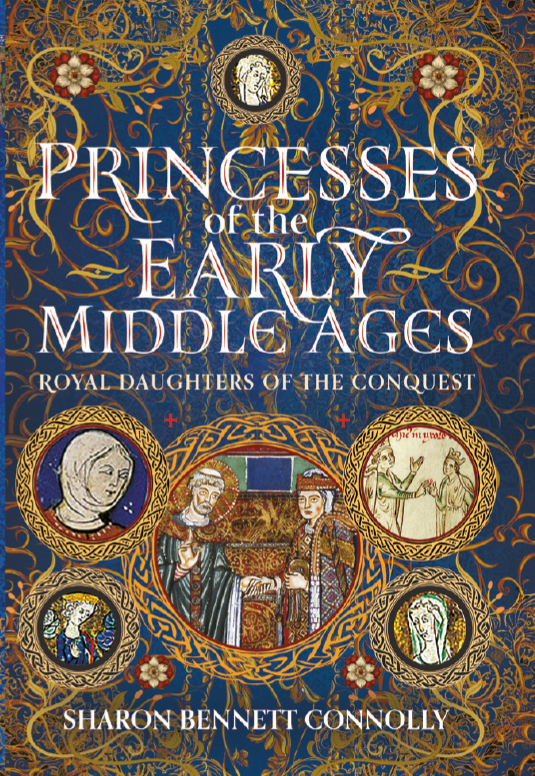
Coming 30 March 2026: Princesses of the Early Middle Ages
Books by Sharon Bennett Connolly

Daughters of kings were often used to seal treaty alliances and forge peace with England’s enemies. Princesses of the Early Middle Ages: Royal Daughters of the Conquest explores the lives of these young women, how they followed the stereotype, and how they sometimes managed to escape it. It will look at the world they lived in, and how their lives and marriages were affected by political necessity and the events of the time. Princesses of the Early Middle Ages will also examine how these girls, who were often political pawns, were able to control their own lives and fates. Whilst they were expected to obey their parents in their marriage choices, several princesses were able to exert their own influence on these choices, with some outright refusing the husbands offered to them.

Their stories are touching, inspiring and, at times, heartbreaking.

Princesses of the Early Middle Ages: Royal Daughters of the Conquest is now available for pre-order.

Also by Sharon Bennett Connolly:

Books by Sharon Bennett Connolly

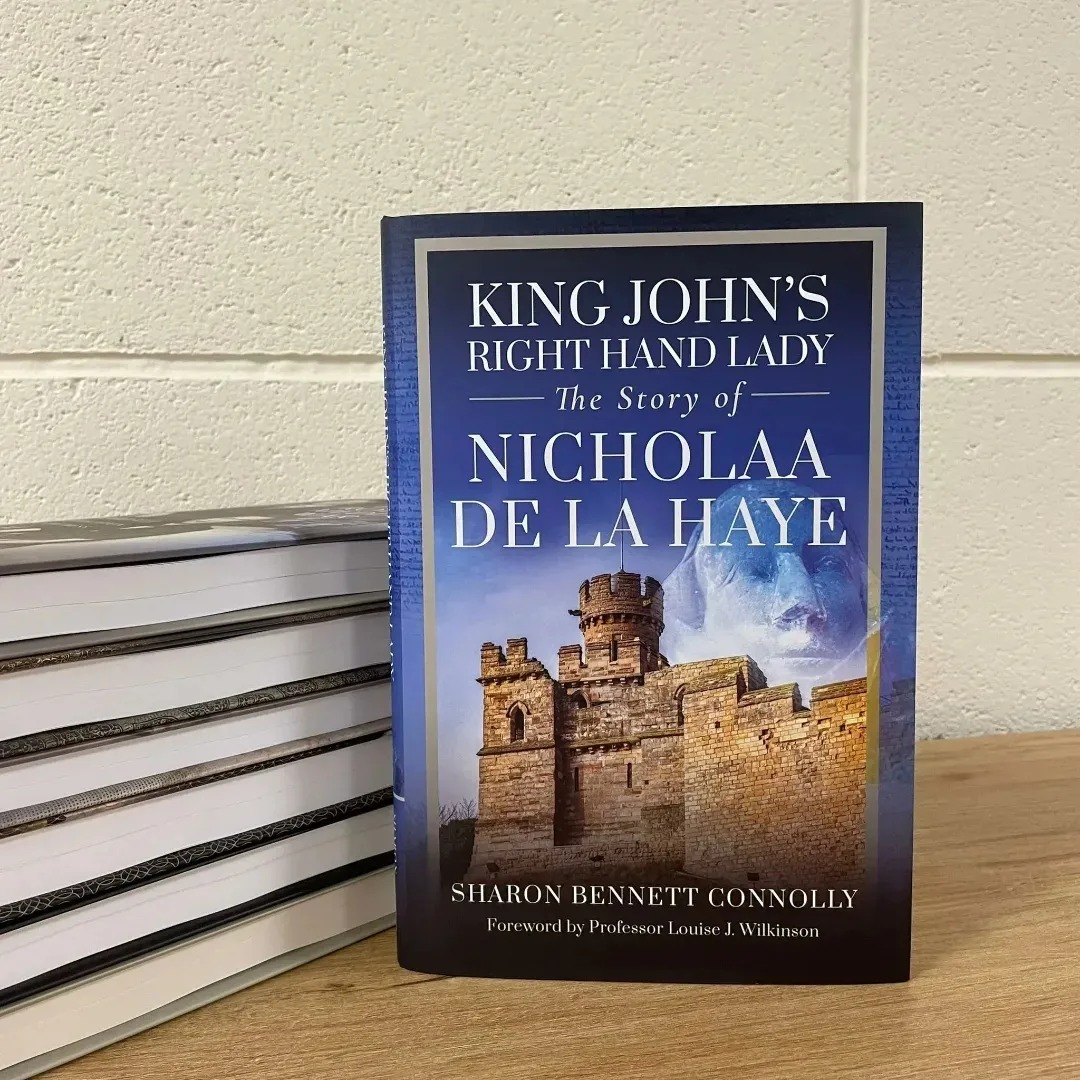
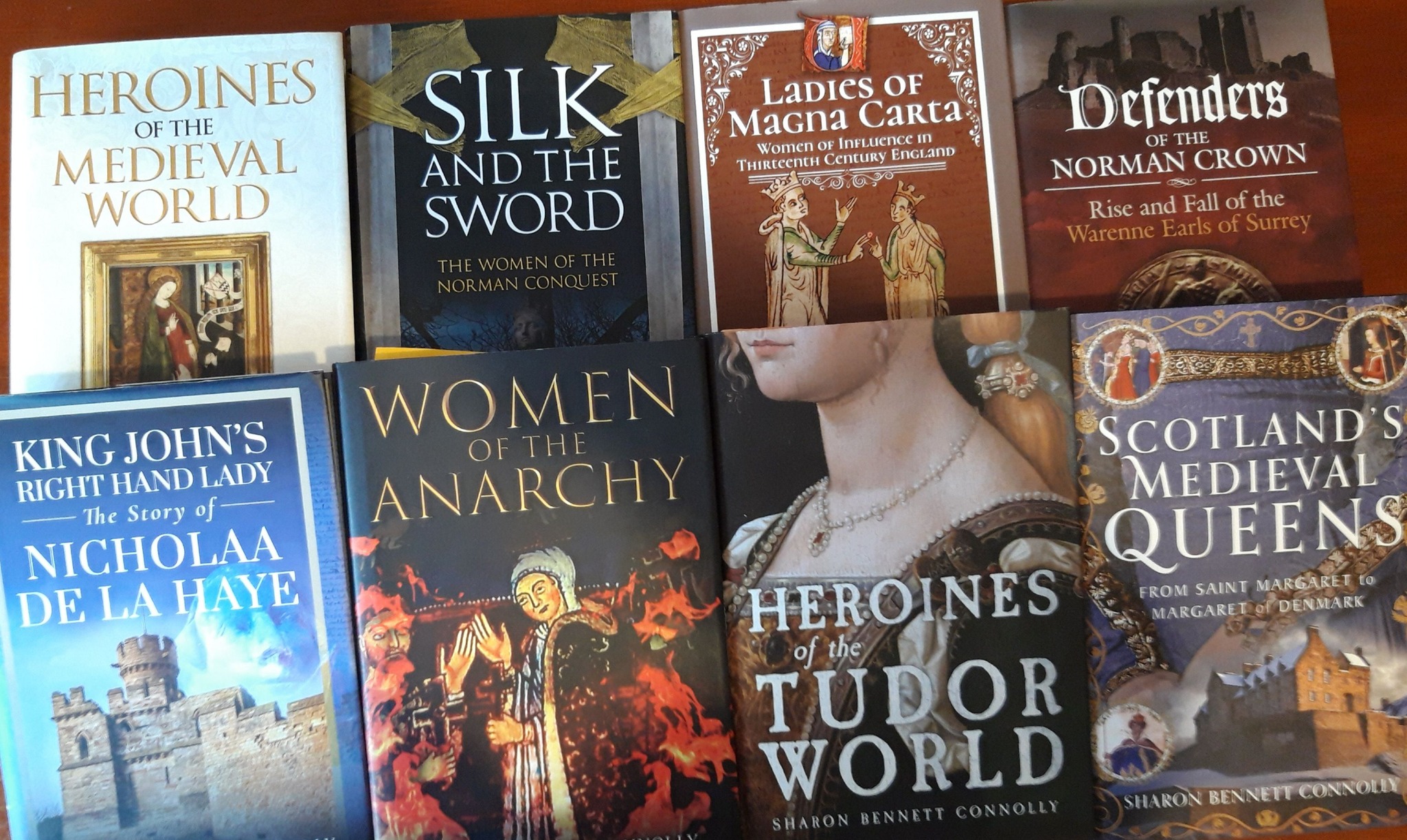
Heroines of the Tudor World tells the stories of the most remarkable women from European history in the time of the Tudor dynasty, 1485-1603. These are the women who ruled, the women who founded dynasties, the women who fought for religious freedom, their families and love. Heroines of the Tudor World is now available from Amberley Publishing and Amazon UK. Women of the Anarchy demonstrates how Empress Matilda and Matilda of Boulogne, unable to wield a sword themselves, were prime movers in this time of conflict and lawlessness. It shows how their strengths, weaknesses, and personal ambitions swung the fortunes of war one way – and then the other. Available from Bookshop.orgAmberley Publishing and Amazon UKKing John’s Right-Hand Lady: The Story of Nicholaa de la Haye is the story of a truly remarkable lady, the hereditary constable of Lincoln Castle and the first woman in England to be appointed sheriff in her own right. Available from all good bookshops Pen & Sword Booksbookshop.org and Amazon

Royal Historical Society

Defenders of the Norman Crown: The Rise and Fall of the Warenne Earls of Surrey tells the fascinating story of the Warenne dynasty, from its origins in Normandy, through the Conquest, Magna Carta, the wars and marriages that led to its ultimate demise in the reign of Edward III. Available from Pen & Sword BooksAmazon in the UK and US, and Bookshop.orgLadies of Magna Carta: Women of Influence in Thirteenth Century England looks into the relationships of the various noble families of the 13th century, and how they were affected by the Barons’ Wars, Magna Carta and its aftermath; the bonds that were formed and those that were broken. It is now available in paperback and hardback from Pen & SwordAmazon, and Bookshop.orgHeroines of the Medieval World tells the stories of some of the most remarkable women from Medieval history, from Eleanor of Aquitaine to Julian of Norwich. Available now from Amberley Publishing and Amazon, and Bookshop.orgSilk and the Sword: The Women of the Norman Conquest traces the fortunes of the women who had a significant role to play in the momentous events of 1066. Available now from Amazon,  Amberley Publishing, and Bookshop.org.

Alternate Endings: An anthology of historical fiction short stories including Long Live the King… which is my take what might have happened had King John not died in October 1216. Available in paperback and kindle from Amazon.

Podcast:
A Slice of Medieval

Have a listen to the A Slice of Medieval podcast, which I co-host with Historical fiction novelist Derek Birks. Derek and I welcome guests, such as Ian Mortimer, Bernard Cornwell, Elizabeth Chadwick and Scott Mariani, and discuss a wide range of topics in medieval history, from significant events to the personalities involved. 

There are now over 80 episodes to listen to!

Every episode is also now available on YouTube.

*

Don’t forget! Signed and dedicated copies of all my books are available through my online bookshop.

For forthcoming online and in-person talks, please check out my Events Page.

You can be the first to read new articles by clicking the ‘Follow’ button, liking our Facebook page or joining me on TwitterThreadsBluesky and Instagram.

*

©2025 Sharon Bennett Connolly FRHistS

Guest Post: Announcing Gothic Precarity by Tim Rideout

History ... the Interesting Bits

Today, it is a pleasure to welcome to History…the Interesting Bits, Dr Tim Rideout. I have known Tim since 2017, when Heroines of the Tudor World came out. He is the ‘go to’ person if you need an interviewer for your literary festival and chaired a panel, which included me, at the Newark Book Festival a few years ago. His first book, ‘Gothic Precarity: Fear and Anxiety in Twenty-First-Century Fiction’ comes out next month.

So, Tim dropped by to tell me a little bit about it.

Announcing Gothic Precarity by Tim Rideout

I’m thrilled to announce the upcoming publication of my new book, ‘Gothic Precarity: Fear and Anxiety in Twenty-First-Century Fiction’, which will be released on 15th September by the University of Wales Press as part of their excellent Gothic Literary Studies series.

This book emerges from a sustained engagement with contemporary fiction that situates the Gothic not simply as a mode of terror or horror, but as a rich cultural register through which the anxieties of our time—social, economic, ecological, and psychological—are exposed and decoded. Over the past two decades, the Gothic has flourished in fiction as a form uniquely attuned to chronic unease, existential threat, and the slow violence of neoliberalism, climate crisis, and systemic collapse.

Why ‘Gothic Precarity’?

The term precarity has become a central keyword in contemporary critical theory, capturing the conditions of instability and insecurity that define life in the early twenty-first century. In my book, I argue that the Gothic offers a distinctive aesthetic and affective vocabulary for exploring those conditions—particularly the entanglement of fear, anxiety, and dread as they permeate everyday life.

Drawing on a wide range of works from authors such as Yiyun Li, Ahmed Saadawi, Silvia Moreno-Garcia, Viet Thanh Nguyen, Diane Cook, and others, Gothic Precarity considers how fiction engages with themes such as economic precarity, racialised violence, climate trauma, and ontological uncertainty. These texts do more than simply represent fear—they perform it, immersing readers in atmospheres of claustrophobia, dread, and instability that mirror our own precarious moments.

Gothic Forms for Precarious Times

Rather than treating the Gothic as a genre of the past, the book rethinks it as a living, evolving mode of cultural critique. It shows how contemporary authors adapt and reconfigure Gothic conventions—hauntings, uncanny spaces, spectral figures, disrupted chronologies—to address the deep unease that defines much of the twenty-first-century experience.

At its heart, Gothic Precarity is a study of how fiction helps us feel, name, and navigate the crises of our time. It’s a book about fear—but also about how fear can become a means of political and ethical awareness, a platform for counter-narratives.

About the book:

Ours is an age of precarity, as fear and anxiety have come to define the twenty-first century. Politically, economically and socially, the neoliberal orthodoxy has become globally dominant and, as a direct result, traditional frameworks of protection have been dismantled, while existential insecurity is increasingly passed from nations and institutions to individuals. In the meantime, the Gothic mode of fiction is experiencing a new ascendancy, strengthening the argument that the Gothic represents the best literary mode with which to decode this age of precarity. In this context, the present study offers a groundbreaking examination of the Gothic mode’s conceptual affinity with notions of neoliberal precarity. Exploring twenty-first-century Gothic fiction’s engagement with the most pressing issues of our age, it considers the oppression and existential entrapment experienced by marginalised populations in the provincial China of the late 1970s, and observes a modern-day Frankenstein’s creature occasion violence and destruction across Baghdad post the 2003 Iraq War. The reader will also discover vampires (representatives of a voracious, toxic economic model) in an alternate Mexico City, encounter a nomadic group traversing the only remaining wilderness in a near-future North America devastated as a result of the climate crisis, and be haunted by a spectral migrant who died in their efforts to flee political oppression in Vietnam.

Pre-Order and More

History ... the Interesting Bits

‘Gothic Precarity: Fear and Anxiety in Twenty-First-Century Fiction’ will be available from the 15th September via the University of Wales Press, Amazon, Waterstones and major retailers. I’ll be sharing more updates, events, and discussions around the book in the coming weeks.

For academics, students, and readers interested in contemporary literature, the Gothic, affect theory, or cultural responses to crisis, I hope this book offers both insight and provocation.

Thank you for reading—and stay tuned for more!

About the author:

Dr Timothy Rideout is a doctoral graduate of the University of Lincoln. He has had a long and successful career in health services leadership.

*

My Books:

Signed, dedicated copies of all my books are available through my online store.

Out now: Scotland’s Medieval Queens

Books by Sharon Bennett Connolly

Scotland’s history is dramatic, violent and bloody. Being England’s northern neighbour has never been easy. Scotland’s queens have had to deal with war, murder, imprisonment, political rivalries and open betrayal. They have loved and lost, raised kings and queens, ruled and died for Scotland. From St Margaret, who became one of the patron saints of Scotland, to Elizabeth de Burgh and the dramatic story of the Scottish Wars of Independence, to the love story and tragedy of Joan Beaufort, to Margaret of Denmark and the dawn of the Renaissance, Scotland’s Medieval Queens have seen it all. This is the story of Scotland through their eyes.

Scotland’s Medieval Queens gives a thorough grounding in the history of the women who ruled Scotland at the side of its kings, often in the shadows, but just as interesting in their lives beyond the spotlight. It’s not a subject that has been widely covered, and Sharon is a pioneer in bringing that information into accessible history.’ Elizabeth Chadwick (New York Times bestselling author)

Available now from Amazon and Pen and Sword Books

Also by Sharon Bennett Connolly:

Books by Sharon Bennett Connolly

Heroines of the Tudor World tells the stories of the most remarkable women from European history in the time of the Tudor dynasty, 1485-1603. These are the women who ruled, the women who founded dynasties, the women who fought for religious freedom, their families and love. Heroines of the Tudor World is now available from Amberley Publishing and Amazon UK. Women of the Anarchy demonstrates how Empress Matilda and Matilda of Boulogne, unable to wield a sword themselves, were prime movers in this time of conflict and lawlessness. It shows how their strengths, weaknesses, and personal ambitions swung the fortunes of war one way – and then the other. Available from Bookshop.orgAmberley Publishing and Amazon UKKing John’s Right-Hand Lady: The Story of Nicholaa de la Haye is the story of a truly remarkable lady, the hereditary constable of Lincoln Castle and the first woman in England to be appointed sheriff in her own right. Available from all good bookshops Pen & Sword Booksbookshop.org and Amazon

Royal Historical Society

Defenders of the Norman Crown: The Rise and Fall of the Warenne Earls of Surrey tells the fascinating story of the Warenne dynasty, from its origins in Normandy, through the Conquest, Magna Carta, the wars and marriages that led to its ultimate demise in the reign of Edward III. Available from Pen & Sword BooksAmazon in the UK and US, and Bookshop.orgLadies of Magna Carta: Women of Influence in Thirteenth Century England looks into the relationships of the various noble families of the 13th century, and how they were affected by the Barons’ Wars, Magna Carta and its aftermath; the bonds that were formed and those that were broken. It is now available in paperback and hardback from Pen & SwordAmazon, and Bookshop.orgHeroines of the Medieval World tells the stories of some of the most remarkable women from Medieval history, from Eleanor of Aquitaine to Julian of Norwich. Available now from Amberley Publishing and Amazon, and Bookshop.orgSilk and the Sword: The Women of the Norman Conquest traces the fortunes of the women who had a significant role to play in the momentous events of 1066. Available now from Amazon,  Amberley Publishing, and Bookshop.org.

Alternate Endings: An anthology of historical fiction short stories including Long Live the King… which is my take what might have happened had King John not died in October 1216. Available in paperback and kindle from Amazon.

Podcast:

A Slice of Medieval

Have a listen to the A Slice of Medieval podcast, which I co-host with Historical fiction novelist Derek Birks. Derek and I welcome guests, such as Bernard Cornwell and Michael Jecks, and discuss a wide range of topics in medieval history, from significant events to the personalities involved. 

Every episode is also now available on YouTube.

*

Don’t forget! Signed and dedicated copies of all my books are available through my online store.

For forthcoming online and in-person talks, please check out my Events Page.

You can be the first to read new articles by clicking the ‘Follow’ button, liking our Facebook page or joining me on TwitterThreadsBluesky and Instagram.

*

©2025 Sharon Bennett Connolly FRHistS and Dr Tim Rideout

Wordly Women: Samantha Wilcoxson

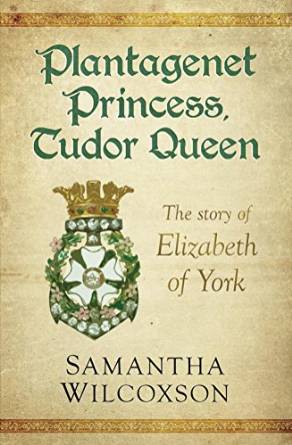
Today we are hopping across the pond for the next chat in my Wordly Women series. Joining me is Samantha Wilcoxson. Author of fiction novels mainly based in the late medieval and Tudor eras and and non-fiction books on the American Revolution, Samantha’s books – literally – span the Atlantic divide. Samantha has a knack for getting into the heads of the people she is writing about. Her book, Plantagenet Princess, Tudor Queen, about Elizabeth of York, is still one of the most insightful novels I have ever read.

Sharon: What got you into writing?

Samantha: What got you into writing? I have always loved reading and used to write dozens of book reviews every year. Many of those books were historical fiction and nonfiction. When I was considering ways to earn money while a stay-at-home mom, my husband suggested I write a book. I had never considered taking this step, so the first obstacle was deciding what I would want to write about. It didn’t take me long to settle on Elizabeth of York, and I quickly became passionate about the project. That novel turned into a series, and I’ve ventured into other historical eras since then.

Sharon: Tell us about your books.

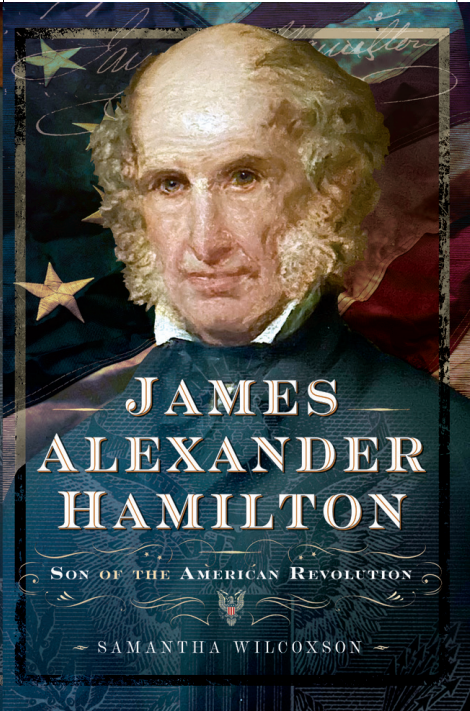
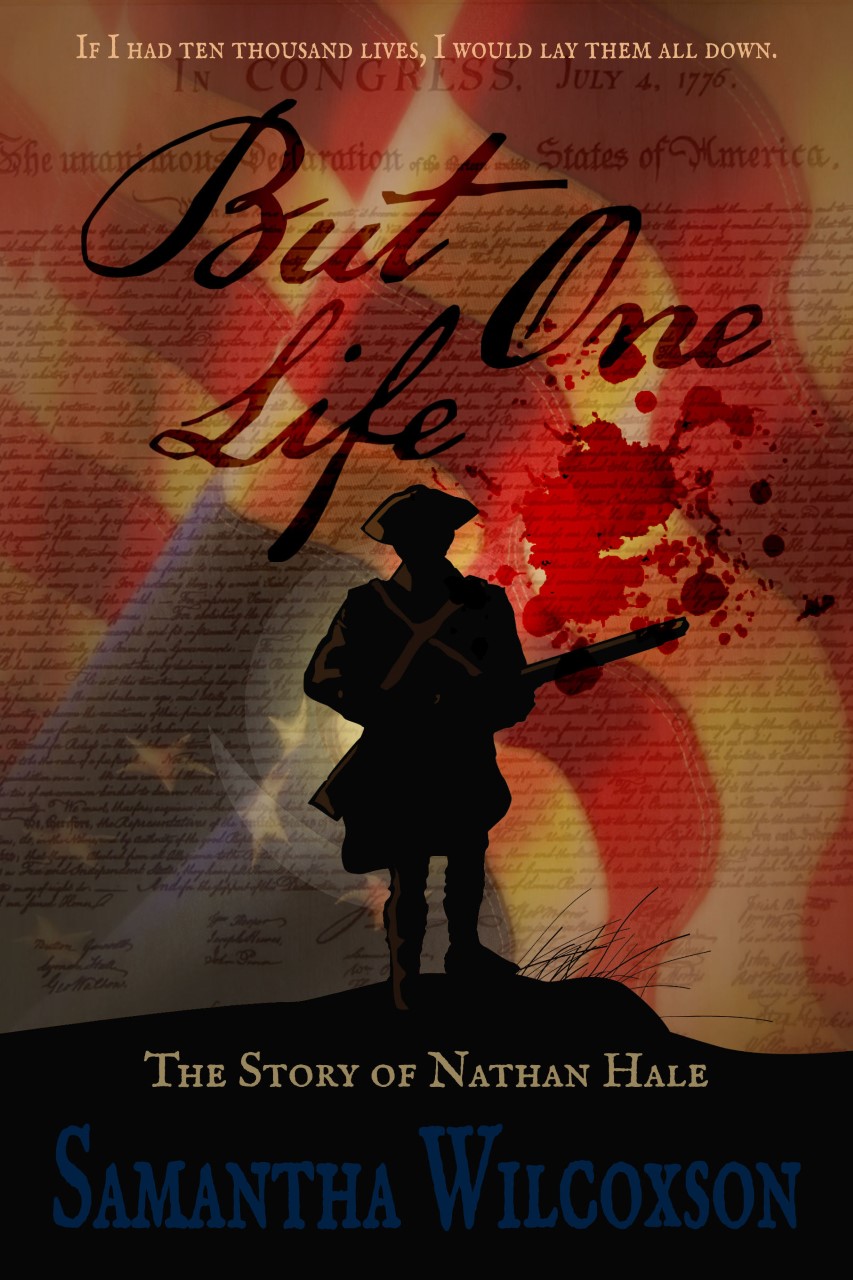
Samantha: Each of my novels explores the life of a real historical figure in a way that helps readers connect with them on a personal level. My Plantagenet Embers series includes three novels featuring Elizabeth of York, Margaret Pole, and Mary I. It also has three novellas that offer new points of view of the same events by focusing on Margaret Beaufort, Elizabeth Woodville, and Reginald Pole. Then I moved into US history with my next two novels. Luminous is biographical fiction of real life radium girl Catherine Wolfe Donohue, and But One Life explores the life of American Revolution soldier Nathan Hale. My nonfiction books are Women of the American Revolution and a newly released biography of James Alexander Hamilton.

Sharon: What attracted you to the Tudors?

Samantha: When I started writing the series that ended up covering the early Tudor era, I was actually obsessed with the Wars of the Roses. I thought Elizabeth of York was an unsung heroine, so I started with her with no real intention of writing about the Tudors! This is actually a great insight into my writing. I never know what is coming next.

Sharon: So, what is coming next?

Samantha: I am currently writing a trilogy set during the Wars of the Roses for Sapere Books. It includes multiple women’s points of view. For example, book one has chapters featuring Marguerite of Anjou, Cecily Neville, and Anne Beauchamp. That one is in editing, and I’m working on book two, which will add the perspective of Elizabeth Woodville and others.

Sharon: How do you approach researching your topic?

Samantha: This depends a lot on whether I’m writing fiction or nonfiction. For novels, I largely depend on biographies already written, but for nonfiction I look for more primary resources like personal letters and diaries. For either, I like to visit locations important to the people I’m writing about so that I can include details about the places they experienced.

Sharon: You also write US history non-fiction.

Samantha: Tell us your ‘favourite’ story you have come across in your research? My research into James Alexander Hamilton uncovered loads of interesting discoveries, partly because nobody else has really written about him. I held letters written between James and Andrew Jackson, Martin Van Buren, John Quincy Adams, and so many others. (Gotta admit, it was tempting to try sneak that JQA letter into my bag!) I think the most fun story I came across, besides John Quincy writing about being too old to stay up all night at a lively Hamilton party, was learning that James was part of the crew of the schooner America for which the America’s Cup is named.

Sharon: Tell us your least ‘favourite’ US history story you have come across in your research?

Samantha: I don’t know if I would call it a least favorite, but I decided to write a novel about Nathan Hale because I often came across quotes attributed to him such as, “I only regret that I have but one life to give for my country” but very little else about who Hale was. What happened in this young man’s life to create such bravery and patriotism? Few references to him offered much, so I decided to dig in and reveal the story of Nathan Hale before his famous execution during the American Revolution.

Sharon: Are there any other eras you would like to write about?

Samantha: I always have a few ideas brewing but am committed to the next couple of books on the Wars of the Roses right now. I have started a bit of research into a historical event that occurred near my home in Michigan in 1847 that I would like to consider for a future project. I’m not one of those writers who has the next five years planned out and I tend to impetuously strike out in new directions, so we’ll see what happens.

Sharon: And finally, what is the best thing about being a writer?

Samantha: Besides spending my day reading, writing, and learning about history, I love the flexibility of being a writer. I began as a stay-at-home mom, and I still appreciate the ability to easily set my work aside for a few days if one of my adult children needs anything. I’ve also made many friends in the writing community who make me feel less alone as a history nerd and have provided amazing support and encouragement for each of my book projects.

About the Author:

Samantha Wilcoxson is an author of emotive biographical fiction and nonfiction featuring history’s unsung heroes. Her novel Luminous has been named Book of the Year by Ruins & Reading and Yarde Book Reviews. Samantha’s most recent work is the first biography of James Alexander Hamilton, published by Pen & Sword History. She is currently writing a Wars of the Roses trilogy for Sapere Books. When not reading or writing, Samantha loves sharing trips to historic places with her family and spending time by the lake with a glass of wine.

Where to find Samantha Wilcoxson:

Website; Instagram; Amazon Author Page; Newsletter Signup; Goodreads; Pinterest; Twitter; Shop Direct; Audible

*

My books

Signed, dedicated copies of all my books are available through my online store.

Out now: Scotland’s Medieval Queens

Scotland’s history is dramatic, violent and bloody. Being England’s northern neighbour has never been easy. Scotland’s queens have had to deal with war, murder, imprisonment, political rivalries and open betrayal. They have loved and lost, raised kings and queens, ruled and died for Scotland. From St Margaret, who became one of the patron saints of Scotland, to Elizabeth de Burgh and the dramatic story of the Scottish Wars of Independence, to the love story and tragedy of Joan Beaufort, to Margaret of Denmark and the dawn of the Renaissance, Scotland’s Medieval Queens have seen it all. This is the story of Scotland through their eyes.

Scotland’s Medieval Queens gives a thorough grounding in the history of the women who ruled Scotland at the side of its kings, often in the shadows, but just as interesting in their lives beyond the spotlight. It’s not a subject that has been widely covered, and Sharon is a pioneer in bringing that information into accessible history.’ Elizabeth Chadwick (New York Times bestselling author)

Available now from Amazon and Pen and Sword Books

Also by Sharon Bennett Connolly:

Heroines of the Tudor World tells the stories of the most remarkable women from European history in the time of the Tudor dynasty, 1485-1603. These are the women who ruled, the women who founded dynasties, the women who fought for religious freedom, their families and love. Heroines of the Tudor World is now available from Amberley Publishing and Amazon UK. Women of the Anarchy demonstrates how Empress Matilda and Matilda of Boulogne, unable to wield a sword themselves, were prime movers in this time of conflict and lawlessness. It shows how their strengths, weaknesses, and personal ambitions swung the fortunes of war one way – and then the other. Available from Bookshop.orgAmberley Publishing and Amazon UKKing John’s Right-Hand Lady: The Story of Nicholaa de la Haye is the story of a truly remarkable lady, the hereditary constable of Lincoln Castle and the first woman in England to be appointed sheriff in her own right. Available from all good bookshops Pen & Sword Booksbookshop.org and Amazon

Defenders of the Norman Crown: The Rise and Fall of the Warenne Earls of Surrey tells the fascinating story of the Warenne dynasty, from its origins in Normandy, through the Conquest, Magna Carta, the wars and marriages that led to its ultimate demise in the reign of Edward III. Available from Pen & Sword BooksAmazon in the UK and US, and Bookshop.orgLadies of Magna Carta: Women of Influence in Thirteenth Century England looks into the relationships of the various noble families of the 13th century, and how they were affected by the Barons’ Wars, Magna Carta and its aftermath; the bonds that were formed and those that were broken. It is now available in paperback and hardback from Pen & SwordAmazon, and Bookshop.orgHeroines of the Medieval World tells the stories of some of the most remarkable women from Medieval history, from Eleanor of Aquitaine to Julian of Norwich. Available now from Amberley Publishing and Amazon, and Bookshop.orgSilk and the Sword: The Women of the Norman Conquest traces the fortunes of the women who had a significant role to play in the momentous events of 1066. Available now from Amazon,  Amberley Publishing, and Bookshop.org.

Alternate Endings: An anthology of historical fiction short stories including Long Live the King… which is my take what might have happened had King John not died in October 1216. Available in paperback and kindle from Amazon.

Podcast:

Have a listen to the A Slice of Medieval podcast, which I co-host with Historical fiction novelist Derek Birks. Derek and I welcome guests, such as Bernard Cornwell and Michael Jecks, and discuss a wide range of topics in medieval history, from significant events to the personalities involved. Every episode is also now available on YouTube.

*

Don’t forget! Signed and dedicated copies of all my books are available through my online store.

For forthcoming online and in-person talks, please check out my Events Page.

You can be the first to read new articles by clicking the ‘Follow’ button, liking our Facebook page or joining me on TwitterThreadsBluesky and Instagram.

*

©2025 Sharon Bennett Connolly, FRHistS and Samantha Wilcoxson

Guest Post: James A. Hamilton and the Americas Cup by Samantha Wilcoxson

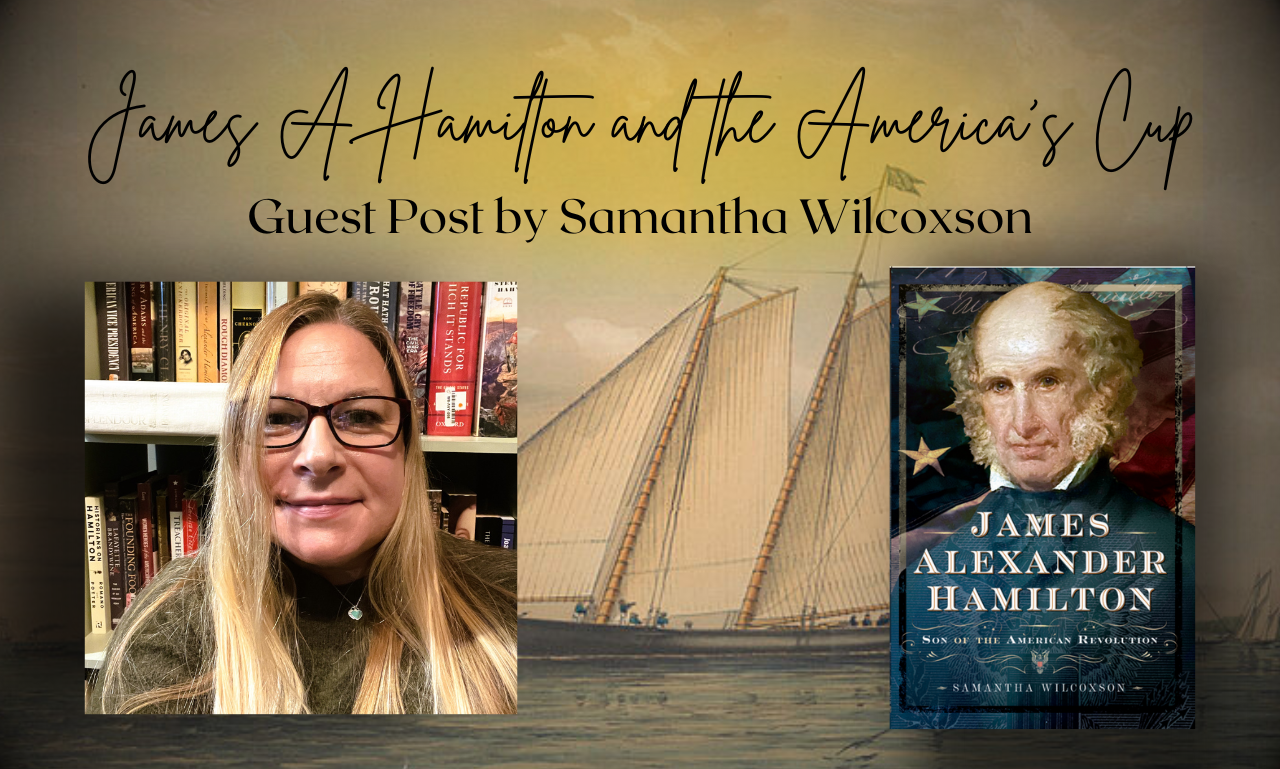
Today, it is a pleasure to welcome Samantha Wilcoxson to History…the Interesting Bits with an article on James A. Hamilton. Samantha’s biography of Hamilton, James Alexander Hamilton: Son of the American Revolution.

James A. Hamilton and the Americas Cup

The America’s Cup has not always been called by that name. In 1851, an invitation came to the New York Yacht Club, the only yacht club in the United States at that time, from the Royal Yacht Squadron “to test the relative merits of the ships.” The British challengers did not anticipate any real contest from the Americans, given their relative inexperience in an arena long dominated by England’s seamen.

It was the same year as England’s Great Exhibition with its Crystal Palace, and national pride was running high. The New York Yacht Club decided to send a schooner named America. One of the ship’s owners was George Lee Schuyler, son-in-law to James Alexander Hamilton.

Schuyler was confident of the schooner’s capabilities and looked forward to seeing it compete against the British ships. Unfortunately, personal issues kept him at home, and he asked his father-in-law to join the crew of the America in his place.

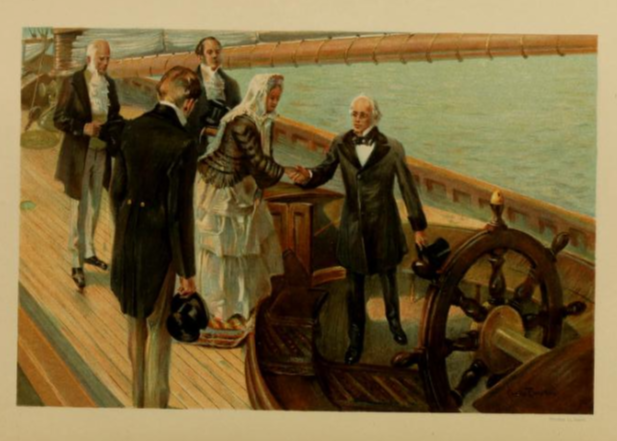
The crew greeting Queen Victoria and Prince Albert, James is the man on the far left

James was the third son of Alexander Hamilton, who had served as the first US treasury secretary and created the national bank. When traveling in Europe, James would often have official letters of introduction from presidents or cabinet members, but he recorded that he rarely used them. “My father’s name alone was my best passport to society.” In this case, it was his son-in-law’s boat that put him in the middle of historic events.

Among a field of sixteen ships, the America took off in a light wind on 22 August 1851. James compared them to race-horses breaking away from the starting line. Shockingly, the America quickly jumped into the lead. When Queen Victoria was informed that the US schooner was in the lead, she asked which was second. The response? “Your Majesty, there is no second.” The America had left all competition far behind.

The American schooner yacht

Following the victory, the Queen and Prince Albert boarded the America to offer their congratulations and were greeted by four crew members, including James A Hamilton. The Royal Yacht Squadron Cup, which the US team was awarded, became known as the America’s Cup, as did the annual regatta.

Read more about the 1851 America’s Cup and other James Alexander Hamilton adventures in my new biography, available through Pen & Sword and your favorite bookstore!

About the book:

Born in the year of the Constitutional Convention, James Alexander Hamilton was uniquely positioned to observe the early republic era and the formation of the experimental United States government. His father, Alexander Hamilton, had been the first US Treasury Secretary, an outspoken and controversial character who was killed in a duel when James was a teenager. With a lifelong devotion to his father’s memory, James advised men from Andrew Jackson and Martin Van Buren to Abraham Lincoln and Salmon P Chase on banking and constitutional matters.

Through his own talents and with the advantage of his father’s name, James served as temporary Secretary of State and District Attorney of New York. James enjoyed a close-knit family life with his wife, Mary Morris, at his Hudson River home named Nevis for his father’s birthplace. He was part of the crew of the yacht America, for which the America’s Cup is named, and on the committee for New York’s Crystal Palace in 1853. More importantly, he served his country through the War of 1812, Western Expansion, and the bloody Civil War. His first-hand account of these transformative events gives readers a priceless look at America’s past. James supported the abolition of slavery and wrote a draft of the Emancipation Proclamation before settling down to write his own Reminiscences that cover the first seventy-five years of US history. 

This biography makes James A Hamilton’s life and observations accessible to the modern reader and will leave you with a new appreciation for the Founders’ heirs who inherited the difficult work of building a nation.

To Buy the book:

James Alexander Hamilton: Son of the American Revolution.   

About the author:

Samantha Wilcoxson is an author of emotive biographical fiction and nonfiction featuring history’s unsung heroes. She loves sharing trips to historic places with her family and spending time by the lake with a glass of wine. Her most recent work is a biography of James Alexander Hamilton published by Pen & Sword History. Samantha is currently writing a Wars of the Roses trilogy for Sapere Books.

Social media:

Websitehttps://samanthawilcoxson.com
Instagramhttps://www.instagram.com/samantha_wilcoxson
Facebookhttps://www.facebook.com/PlantagenetEmbers/
Amazon Author Pagehttps://amazon.com/author/samanthawilcoxson
Newsletter Signuphttps://dashboard.mailerlite.com/forms/668153/107384163504489521/share

*

My Books

Signed, dedicated copies of all my books are available through my online store.

Out now: Scotland’s Medieval Queens

Scotland’s history is dramatic, violent and bloody. Being England’s northern neighbour has never been easy. Scotland’s queens have had to deal with war, murder, imprisonment, political rivalries and open betrayal. They have loved and lost, raised kings and queens, ruled and died for Scotland. From St Margaret, who became one of the patron saints of Scotland, to Elizabeth de Burgh and the dramatic story of the Scottish Wars of Independence, to the love story and tragedy of Joan Beaufort, to Margaret of Denmark and the dawn of the Renaissance, Scotland’s Medieval Queens have seen it all. This is the story of Scotland through their eyes.

Available now from Amazon and Pen and Sword Books

Also by Sharon Bennett Connolly:

Heroines of the Tudor World tells the stories of the most remarkable women from European history in the time of the Tudor dynasty, 1485-1603. These are the women who ruled, the women who founded dynasties, the women who fought for religious freedom, their families and love. Heroines of the Tudor World is now available for pre-order from Amberley Publishing and Amazon UK. Women of the Anarchy demonstrates how Empress Matilda and Matilda of Boulogne, unable to wield a sword themselves, were prime movers in this time of conflict and lawlessness. It shows how their strengths, weaknesses, and personal ambitions swung the fortunes of war one way – and then the other. Available from Bookshop.orgAmberley Publishing and Amazon UKKing John’s Right-Hand Lady: The Story of Nicholaa de la Haye is the story of a truly remarkable lady, the hereditary constable of Lincoln Castle and the first woman in England to be appointed sheriff in her own right. Available from all good bookshops Pen & Sword Booksbookshop.org and Amazon

Defenders of the Norman Crown: The Rise and Fall of the Warenne Earls of Surrey tells the fascinating story of the Warenne dynasty, from its origins in Normandy, through the Conquest, Magna Carta, the wars and marriages that led to its ultimate demise in the reign of Edward III. Available from Pen & Sword BooksAmazon in the UK and US, and Bookshop.orgLadies of Magna Carta: Women of Influence in Thirteenth Century England looks into the relationships of the various noble families of the 13th century, and how they were affected by the Barons’ Wars, Magna Carta and its aftermath; the bonds that were formed and those that were broken. It is now available in paperback and hardback from Pen & SwordAmazon, and Bookshop.orgHeroines of the Medieval World tells the stories of some of the most remarkable women from Medieval history, from Eleanor of Aquitaine to Julian of Norwich. Available now from Amberley Publishing and Amazon, and Bookshop.orgSilk and the Sword: The Women of the Norman Conquest traces the fortunes of the women who had a significant role to play in the momentous events of 1066. Available now from Amazon,  Amberley Publishing, and Bookshop.org.

Alternate Endings: An anthology of historical fiction short stories including Long Live the King… which is my take what might have happened had King John not died in October 1216. Available in paperback and kindle from Amazon.

Podcast:

Have a listen to the A Slice of Medieval podcast, which I co-host with Historical fiction novelist Derek Birks. Derek and I welcome guests, such as Bernard Cornwell and Michael Jecks, and discuss a wide range of topics in medieval history, from significant events to the personalities involved. Every episode is also now available on YouTube.

*

Don’t forget! Signed and dedicated copies of all my books are available through my online store.

For forthcoming online and in-person talks, please check out my Events Page.

You can be the first to read new articles by clicking the ‘Follow’ button, liking our Facebook page or joining me on TwitterThreadsBluesky and Instagram.

*

©2025 Sharon Bennett Connolly FRHistS and Samantha Wilcoxson


Guest Post: The Ambassadress by Ronan Beckman

The Historical Writers Forum have released a new Anthology of short stories. You may remember that last year’s Anthology, Alternate Endings, included a short story about the final days of King John, by me! This year’s Anthology, Masterworks: Historical Fiction Inspired by Works of Art, will make you look at some famous artworks a little differently…

Today, I am joined by one of the contributors, Ronan Beckman, whose story is inspired by Emma Hamilton. Over to Ronan…

Do you remember what got you hooked onto a specific time period or aspect of history? I had just finished reading Amanda Foreman’s excellent biography Georgiana, The Duchess of Devonshire , which resulted in my addiction to everything about the Georgian-era but especially to women’s history in that time. Often relegated to the sidelines of history, Georgian times allowed women to begin to step into the spotlight – albeit in very slow, tiny steps. I began to voraciously read biographies of prominent ladies of that time. And one story that truly stood out for me was the life of a blacksmith’s daughter from Cheshire born as Amy Lyon. But the world knows her better as Emma, Lady Hamilton; lover of Admiral Nelson. Flora Fraser’s Beloved Emma laid out the incredible story of the amazing transformation of this pretty young woman into one of the most talked about celebrities of her age.

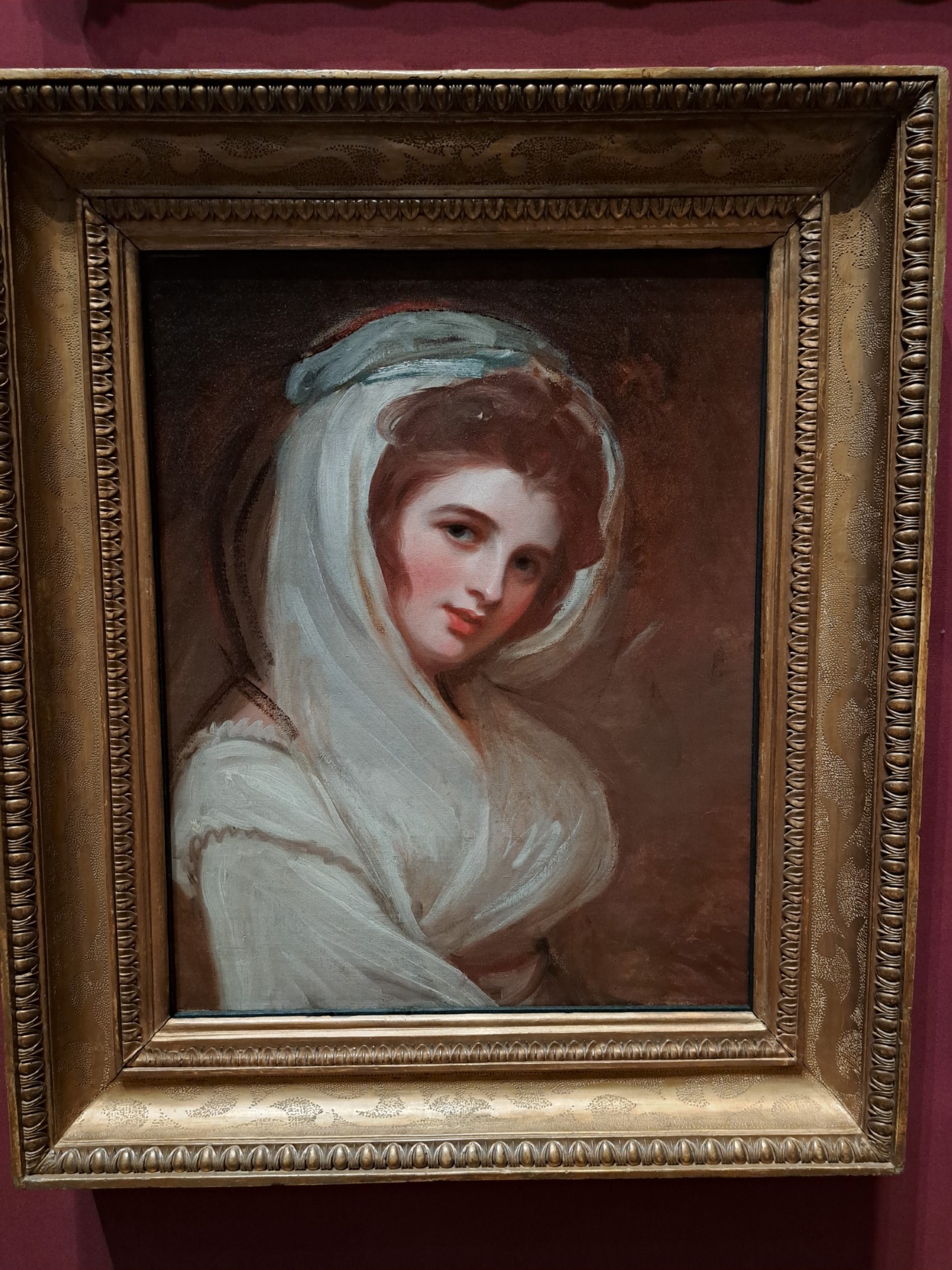
Portrait of Emma Hamilton by George Romney

Several years later, The National Maritime Museum in London put together a fabulous exhibition entitled Seduction & Celebrity that explored Emma Hamilton’s rise and fall, from beginning to end. One of the most noticeable aspects of the show was that there was ample material to display, primarily from one particular artist. George Romney was one of the most prominent society portrait painters of the late Georgian period. Although his talent was comparable to his well-respected contemporaries, such as Joshua Reynolds, Thomas Gainsborough and John Hoppner; he refused to participate in the antics associated with the Royal Academy of Arts and their annual exhibitions. Artists would become fiercely competitive as they all vied for the most prominent places within the show, hoping that their works would stand out from the rest. Romney wanted no part of this circus, and relied on his talent and reputation to gain custom amongst his wealthy clients. This worked out well for him, and he had no shortage of sitters. However, the tedium of producing staid portraiture of the elite classes began to prove tiresome.

How fortunate for Romney then that a customer, Sir Charles Greville, brought in a secret mistress that he had ensconced away in a humble, rural cottage in nearby Edgeware. The 16 year-old Amy Lyon had already experienced several tragedies in her young life; having found herself pregnant by another aristocratic man, Sir Henry Fetherstonhaugh, who promptly abandoned her. Greville came to the rescue, but on the proviso that she gave her baby away, living a life of thrift and economy whilst being at his beck and call. She had no room to negotiate and was grateful for this second chance. Greville sought to have her beauty be captured and admired on canvas, for him to be able to display to his friends. In effect, he wanted to boast “This heavenly goddess is mine, and you cannot even see her in the flesh. Don’t you envy me?”

Emma Hart by Romney

Romney was immediately enchanted by the charisma and stunning beauty of the newly renamed Emma Hart. Her presence reinvigorated his artwork. They embarked on a creative partnership that resulted in Romney’s finest and most creative output. In return, Emma was portrayed in various guises for posterity. She had to reinvent herself for each sitting, becoming a mythological creature or some historic character from long ago. Emma sat for dozens of paintings by Romney. She was his muse, allowing him to explore his craft beyond the confines of standard portraiture. Greville was happy to loan her modelling services to Romney, for it was increasing the value of his ‘ward’ that he had saved from a certain life of penury. Engravings had been made of some of Romney’s paintings, affording a glimpse of her allure to a wider audience. As her image was circulated, there was an increasing curiosity aroused throughout the capital city. Who was this charming being?

The drip-feed of artistic content provided opportunities for both Romney and Emma. Romney’s reputation and name was further advanced as well as inspiring his art to reach new levels of creativity. Emma became what may well be the very first Supermodel – a celebrity whose fame and notoriety was constantly on an upward trajectory. It seems apparent that Romney became infatuated with Emma. And perhaps Emma appreciated the advice and friendship of a man outside of the realm of the Ton, but who knew of the inner workings and mindset of the Upper Class who made up his clientele.

But this fame and notoriety was not appealing to Sir Charles Greville, who was seeking a wealthy heiress to supplement his dwindling finances. Being saddled with an infamous beauty as a mistress would not make him very appealing as a suitor to the respectable ladies that he wanted to pursue. Therefore, he duped Emma into travelling to Naples, to visit his uncle who was the serving British ambassador there. He had offered her to his uncle as a mistress, without her consent or knowledge. This separation severed the symbiotic artistic relationship between Emma and Romney for several years. Romney, who was prone to depression, was affected by her absence deeply. Although furious with Greville for abandoning her, Emma did make the best of her situation – enjoying her time in the royal court of Naples and eventually becoming quite fond of her ambassador.

In the summer of 1791, Emma returned to England to marry Sir William Hamilton and return to Naples as a respectable wife of the ambassador. During these brief few weeks, Emma reunited with her favourite artist, kick-starting a frenetic pace of artistic output as the painter and his muse were working together again. This brief slice in time intrigued me and I wanted to explore it further. I am fortunate enough to have seen many examples of Romney’s work with Emma as the model. You can feel the creative frisson embedded in these artworks. Romney’s paintings of Emma are seared with an energy that simply does not exist in his other portraits. There was something electric between these two individuals. Was it romantic? There is a feeling of magnetic attraction when one looks through Romney’s gaze in his portraits of Emma. I must say that even though Emma modelled for other great artists (Joshua Reynolds, Thomas Lawrence, Élisabeth Louise Vigée Le Brun, among many others), that spark of something special and extraordinary is just not there.

Romney self-portrait

The last painting that Romney painted of Emma was actually painted on her wedding day. Entitled The Ambassadress, the viewer is a witness to the complete transformation of Emma Hart into Lady Hamilton. As Vesuvius erupts in the dark background, one can imagine the well of emotions bursting forth from Romney’s paintbrush – being well aware that this was the last time that he would lay eyes upon the divine Emma he so cherished. Emma looks back at him, slightly pensive but very refined as she knows she is about to embark on a life of newfound respectability. There is so much wistful emotion silently conveyed in this moving portrait. What were those last moments like in Romney’s studio, as they parted ways for the final time?

The Ambassadress was the inspiration for my short story of the same name. It is one of eleven short stories in the Historical Writer Forum’s anthology entitled Masterworks. Eleven authors have written stories that have been influenced by a particular work of art. The result is a series of stories that takes the reader through time and place, from ancient Sumerian kingdoms to present day London. Available now through Amazon.

About the author:

Ronan Beckman is an American educator who has lived in the UK for over 30 years. His interest in history and genealogy helped to spark an interest in further developing the stories of some of the family he researched – resulting in his debut novel ‘An Actress of Repute’. Subsequently, he has become a bit obsessed with all things Georgian and Regency related. Further adventures are in the works for the character of Elizabeth Searle and her fellow actor friends. His latest project has been editing a transcript of a rare, out-of-print book by a Lancashire coal miner who became secretary of the TUC and a Member of Parliament. The new annotated version of Samuel Woods’ ‘Visions of the Mine’ contains biographical notes and historical images. Visit his blog at http://www.ronanbeckman.com.

*

My Books

Christmas is coming!

Signed, dedicated copies of all my books are available through my online bookshop.

Coming 15 January 2024: Women of the Anarchy

On the one side is Empress Matilda, or Maud. The sole surviving legitimate child of Henry I, she is fighting for her birthright and that of her children. On the other side is her cousin, Queen Matilda, supporting her husband, King Stephen, and fighting to see her own son inherit the English crown. Both women are granddaughters of St Margaret, Queen of Scotland and descendants of Alfred the Great of Wessex. Women of the Anarchy demonstrates how these women, unable to wield a sword, were prime movers in this time of conflict and lawlessness. It show how their strengths, weaknesses, and personal ambitions swung the fortunes of war one way – and then the other.

Available for pre-order from Amberley Publishing and Amazon UK.

Also by Sharon Bennett Connolly:

Out nowKing John’s Right-Hand Lady: The Story of Nicholaa de la Haye is the story of a truly remarkable lady. Nicholaa de la Haye was the hereditary constable of Lincoln Castle and the first woman in England to be appointed sheriff in her own right. Her strength and tenacity saved England at one of the lowest points in its history. Nicholaa de la Haye is one woman in English history whose story needs to be told…

King John’s Right-Hand Lady: The Story of Nicholaa de la Haye is now available from Pen & Sword Booksbookshop.org and Amazon.

Defenders of the Norman Crown: The Rise and Fall of the Warenne Earls of Surrey tells the fascinating story of the Warenne dynasty, of the successes and failures of one of the most powerful families in England, from its origins in Normandy, through the Conquest, Magna Carta, the wars and marriages that led to its ultimate demise in the reign of Edward III. Defenders of the Norman Crown: Rise and Fall of the Warenne Earls of Surrey is now available from Pen & Sword BooksAmazon in the UK and US, and Bookshop.org.

Ladies of Magna Carta: Women of Influence in Thirteenth Century England looks into the relationships of the various noble families of the 13th century, and how they were affected by the Barons’ Wars, Magna Carta and its aftermath; the bonds that were formed and those that were broken. It is now available in paperback and hardback from Pen & Sword,  Amazon, and Bookshop.org.

Heroines of the Medieval World tells the stories of some of the most remarkable women from Medieval history, from Eleanor of Aquitaine to Julian of Norwich. Available now from Amberley Publishing and Amazon, and Bookshop.org.

Silk and the Sword: The Women of the Norman Conquest traces the fortunes of the women who had a significant role to play in the momentous events of 1066. Available now from Amazon,  Amberley Publishing, and Bookshop.org.

Alternate Endings: An anthology of historical fiction short stories including Long Live the King… which is my take what might have happened had King John not died in October 1216. Available in paperback and kindle from Amazon.

Podcast:

Have a listen to the A Slice of Medieval podcast, which I co-host with Historical fiction novelist Derek Birks. Derek and I welcome guests, such as Bernard Cornwell, and discuss a wide range of topics in medieval history, from significant events to the personalities involved.

*

Don’t forget! Signed and dedicated copies of all my books are available through my online bookshop.

For forthcoming online and in-person talks, please check out my Events Page.

You can be the first to read new articles by clicking the ‘Follow’ button, liking our Facebook page or joining me on Twitter and Instagram.

*

©2023 Ronan Beckman and Sharon Bennett Connolly FRHistS

Guest Post: Childbirth and the Victorian Workhouse by Jessica Cox

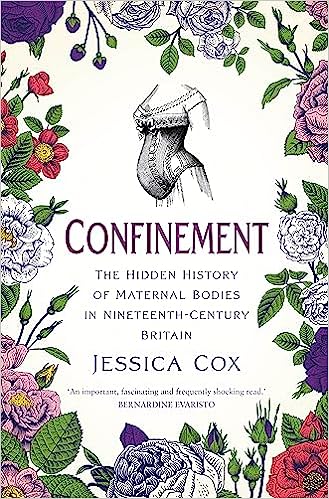
Today it is an absolute pleasure to welcome Jessica Cox to History…the Interesting Bits with a guest article offering insight into her newly released book, Confinement: The Hidden History of Maternal Bodies in Nineteenth-Century Britain

Childbirth and the Victorian Workhouse

by Jessica Cox

‘The patient […] stretched out her hand towards the child. The surgeon deposited it in her arms. She imprinted her cold white lips passionately on its forehead; passed her hands over her face; gazed wildly round; shuddered; fell back – and died’

So ends the life of the eponymous hero’s mother in the opening of Charles Dickens’s Oliver Twist (1838). Her infant son initially appears likely to follow in her footsteps:

For some time he lay gasping on a little flock mattress, rather unequally poised between this world and the next: the balance being decidedly in favour of the latter. Now, if, during this brief period, Oliver had been surrounded by careful grandmothers, anxious aunts, experienced nurses, and doctors of profound wisdom, he would most inevitably and indubitably have been killed in no time. There being nobody by, however, but a pauper old woman, who was rendered rather misty by an unwonted allowance of beer; and a parish surgeon who did such matters by contract; Oliver and Nature fought out the point between them.

Though fictional, the circumstances of Oliver’s birth reflect those of many thousands of babies born in the workhouses of Victorian Britain. Between 1861 and 1865 in London alone, almost twelve thousand women gave birth in workhouses. Giving birth in the workhouse was risky, with an average maternal mortality rate of 0.8 per cent. Overall, maternal mortality rates remained relatively steady throughout the Victorian period, with approximately one in two hundred births (0.5 per cent) resulting in the death of the mother, but this varied according to circumstances and locale. As these figures suggest, the maternal mortality risk in workhouses was somewhat higher than average, and in some of these institutions, it was higher still: in Islington workhouse in 1865, for instance, it was over five per cent.

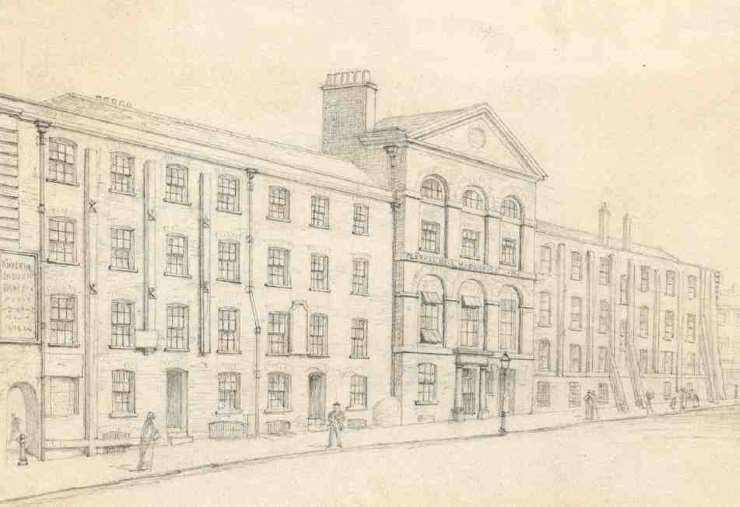
Clerkenwell Workhouse 1882

As Dickens’s description suggests, Oliver’s survival was against the odds. Infant mortality was high throughout the Victorian period – averaging around twenty per cent, but as high as fifty per cent in some areas. Amongst infants born in the workhouse whose mothers died in childbirth, it was even higher. If mother and baby did survive, they might be relocated to the workhouse nursery, and, as with the lying-in wards, these places were often far from sanitary, and unlikely to contribute to the recovery of mothers or the healthy development of infants. The Medical Officer at the Strand Workhouse in London included a description of the nursery there when testifying to a House of Commons select committee looking at conditions in the workhouse in 1861:

[The nursery] was a wretchedly damp and miserable room, nearly always overcrowded with young mothers and their infant children. That death relieved these young women of their illegitimate offspring was only what was to be expected, and that frequently the mothers followed in the same direction was only too true. I used to dread to go into this ward, it was so depressing. Scores and scores of distinctly preventable deaths of both mothers and children took place during my continuance in office through their being located in this horrible den.

The care which Oliver and his mother received also parallels the reality for many birthing women who ended up in one of Britain’s many workhouses. Such places, as the above description suggests, were often unsanitary, and medical assistance could not be guaranteed, though of course medical aid was no guarantee of a successful outcome anyway – especially in lying-in wards such as those found in the workhouses, where infections could be easily spread between patients. Whilst all workhouses were required to employ a medical officer, he was not necessarily summonsed to births, and in some instances, women were attended in childbirth only by fellow paupers. Whilst Dickens is guilty of perpetuating the stereotype of the drunken, incompetent midwife in his fiction (Martin Chuzzlewit’s Mrs Gamp being the most notable example), it was nonetheless the case that many of the women who gave birth in the Victorian workhouse received inadequate – and sometimes no – medical attention.

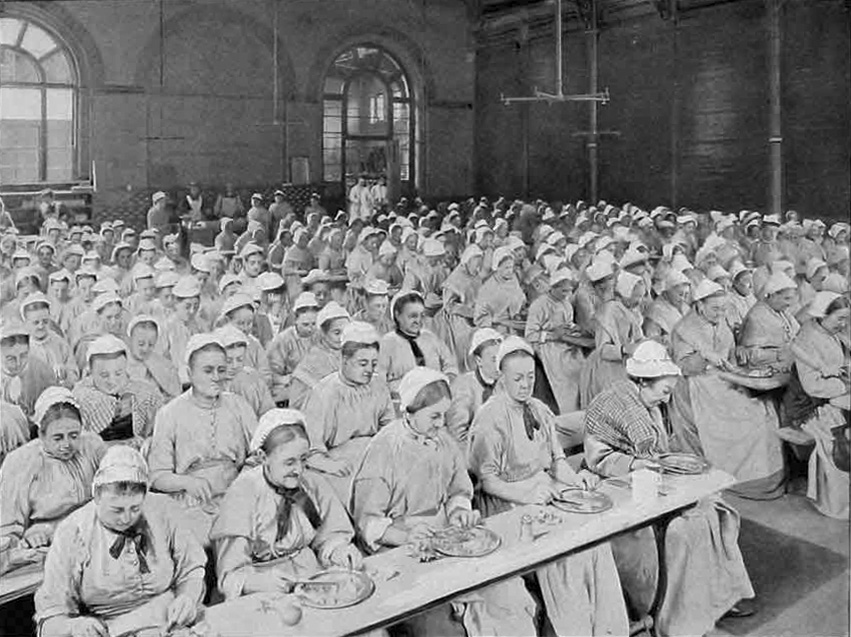
Dinnertime at St Pancras Workhouse, London, 1911

Like many of those born in the workhouse, Oliver Twist is illegitimate. The various lying-in hospitals in Victorian Britain, which provided support for poorer women in childbirth, typically offered aid only to married women, so poor unmarried mothers often had no choice but to attend the workhouse. By and large, these were far from welcoming institutions: concerns were raised about women taking advantage of the care provided and entering the workhouse too early. This resulted in some women being turned away. In one tragic case in 1857, an eighteen-year old woman was turned away from Bradford Workhouse after the matron decided the birth was not imminent. Shortly afterwards, she collapsed in the street, where she gave birth to a stillborn child without any medical assistance. In addition, some workhouses participated in the widespread moral condemnation of unmarried mothers, by forcing them to wear particular colours or items of clothing as a marker of their ‘disgrace’.

Despite the harsh conditions and attitudes associated with giving birth in the workhouse, it did at least – assuming the mother survived – allow for rest after childbirth: women were generally permitted to stay in the lying-in ward for one month following delivery. Whilst there is no doubt that the workhouse was not a particularly desirable option, all things considered, the alternative for poorer women was often to return to hard labour – domestic or paid – soon after giving birth. Prior to the establishment of the National Health Service, the workhouse represented one of the only means of state support for poorer citizens. Today, women who once would have had little choice but to give birth in the workhouse, risking their own and their babies’ lives, have undisputed rights to hospital and medical care. The last workhouses in Britain closed their doors in 1948 – the same year the NHS was formed.

Jessica Cox’s book Confinement: The Hidden History of Maternal Bodies in Nineteenth-Century Britain is published by The History Press and is available now.

About the book:

Covering a fascinating period of population growth, high infant mortality and deep social inequality, rapid medical advances and pseudoscientific quackery, Confinement is the untold history of pregnancy and childbirth in Victorian Britain.

During the nineteenth century, having children was frequently viewed as a woman’s central function and destiny – and yet the pregnant and postnatal body, as well as the birthing room, are almost entirely absent from the public conversation and written histories of the period. Confinement corrects this omission by exploring stories of pregnancy and motherhood across this period. Drawing on a range of contemporary sources, Jessica Cox charts the maternal experiences of women, examining fertility, pregnancy, miscarriage, childbirth, maternal mortality, unwanted pregnancies, infant loss, breastfeeding, and postnatal bodies and minds.

From the royal family to inhabitants of the workhouse, this absorbing history reveals what motherhood was truly like for the women of nineteenth-century Britain.

About the author:

Jessica Cox is a Reader in English Literature at Brunel University, London. She specialises in maternal histories, Victorian sensation fiction, the Brontes, and neo-Victorianism.

*

My Books

Signed, dedicated copies of all my books are available, please get in touch by completing the contact me form.

Out now: King John’s Right-Hand Lady: The Story of Nicholaa de la Haye

In a time when men fought and women stayed home, Nicholaa de la Haye held Lincoln Castle against all-comers, gaining prominence in the First Baron’s War, the civil war that followed the sealing of Magna Carta in 1215. A truly remarkable lady, Nicholaa was the first woman to be appointed sheriff in her own right. Her strength and tenacity saved England at one of the lowest points in its history. Nicholaa de la Haye is one woman in English history whose story needs to be told…

King John’s Right-Hand Lady: The Story of Nicholaa de la Haye is now available from Pen & Sword Booksbookshop.org and Amazon.

Coming 15 January 2024: Women of the Anarchy

On the one side is Empress Matilda, or Maud. The sole surviving legitimate child of Henry I, she is fighting for her birthright and that of her children. On the other side is her cousin, Queen Matilda, supporting her husband, King Stephen, and fighting to see her own son inherit the English crown. Both women are granddaughters of St Margaret, Queen of Scotland and descendants of Alfred the Great of Wessex. Women of the Anarchy demonstrates how these women, unable to wield a sword, were prime movers in this time of conflict and lawlessness. It show how their strengths, weaknesses, and personal ambitions swung the fortunes of war one way – and then the other.

Available for pre-order from Amberley Publishing and Amazon UK.

Also by Sharon Bennett Connolly:

Defenders of the Norman Crown: The Rise and Fall of the Warenne Earls of Surrey tells the fascinating story of the Warenne dynasty, of the successes and failures of one of the most powerful families in England, from its origins in Normandy, through the Conquest, Magna Carta, the wars and marriages that led to its ultimate demise in the reign of Edward III. Defenders of the Norman Crown: Rise and Fall of the Warenne Earls of Surrey is now available from Pen & Sword BooksAmazon in the UK and US, and  Bookshop.org.

Ladies of Magna Carta: Women of Influence in Thirteenth Century England looks into the relationships of the various noble families of the 13th century, and how they were affected by the Barons’ Wars, Magna Carta and its aftermath; the bonds that were formed and those that were broken. It is now available in paperback and hardback from Pen & Sword,  Amazon, and Bookshop.org.

Heroines of the Medieval World tells the stories of some of the most remarkable women from Medieval history, from Eleanor of Aquitaine to Julian of Norwich. Available now from Amberley Publishing and Amazon, and Bookshop.org.

Silk and the Sword: The Women of the Norman Conquest traces the fortunes of the women who had a significant role to play in the momentous events of 1066. Available now from Amazon,  Amberley Publishing, and Bookshop.org.

Alternate Endings: An anthology of historical fiction short stories including Long Live the King… which is my take what might have happened had King John not died in October 1216. Available in paperback and kindle from Amazon.

Podcast:

Have a listen to the A Slice of Medieval podcast, which I co-host with Historical fiction novelist Derek Birks. Derek and I welcome guests, such as Bernard Cornwell and discuss a wide range of topics in medieval history, from significant events to the personalities involved.

*

For forthcoming online and in-person talks, please check out my Events Page.

You can be the first to read new articles by clicking the ‘Follow’ button, liking our Facebook page or joining me on Twitter and Instagram.

©2023 Jessica Cox and Sharon Bennett Connolly FRHistS
Book Corner: Diamond Hunter by Paul Fraser Collard

South Africa, 1871. Jack Lark no longer walks alone. With the worldly Anna Baker by his side, he travels to the Cape Colony diamond fields determined to seek their fortune – and an adventurous new life together.

The journey north soon turns violent as tensions erupt between other hopeful diggers and a gang of Boer men. Everyone has their eye on the same elusive prize – and some will stop at nothing to get it.

For Jack and Anna, unearthing a diamond is only half the battle. Getting out of the mines alive will prove far more difficult – and dangerous. And when the worst happens, Jack finds himself tested as no enemy, no man and no war has ever before.

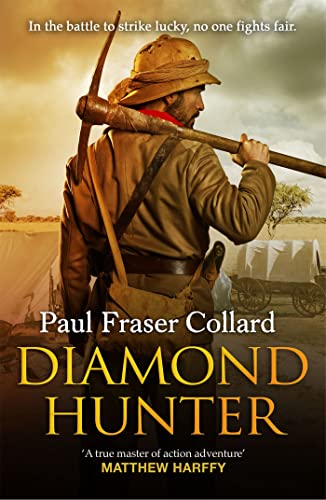
Diamond Hunter by Paul Fraser Collard is the 11th book in the fabulous Jack Lark series. Jack Lark has made a career of being an imposter, finding his home and employment in the various wars of the 19th century. But what do you do when the guns fall silent? In the last book, Commander, Jack had followed the many adventurers of his era and joined an expedition to explore the River Nile. In Diamond Hunter he stays in Africa, but turns his hand to entirely different profession, though one that can be just as brutal and cut-throat as war.

In the opening pages of Diamond Hunter, we find Jack Lark content, with a woman who is his equal in every way, and with enough money to help him on to his next adventure. However, his constant search of adventure is still bubbling beneath the surface and he is now in southern Africa, ready to stake everything in the search for fortune, or at least a diamond big enough to see him comfortable, for now.

However, for Jack Lark, nothing is ever easy. The journey is always fraught with danger and trouble does seem to find him out! And I do wonder what Jack ever did for Paul Fraser Collard to give him such a hard time? Poor bloke. He really goes through it this time.

‘Shit.’ Jack gently moved Anna’s arm away, pushing himself to his feet with a groan as the action set off the pain in his spine, the persistent backache so much worse after hours of walking and periods riding in the jarring wagon. but it was not enough to stop him straightening up, then offering a hand to Anna to help her up too. It never occurred to him to leave her behind.

‘They’ve been drinking.’ She brushed down the seat of her trousers.

‘Probably. Ready?’ He gave her a moment to prepare.

She sucked down a deep breath. ‘Ready.’

Jack did not wait for more. The voices were getting louder. Whoever had been angered was making one hell of a fuss.

It took them no more than a dozen paces to round the wagon and see what was going on. The four Boers were squared up, facing three of the Cape colonists. The fourth was lying on his back, blood smothering his face like a mask.

‘What the hell is happening?’ Jack shouted as he came closer. It was not his fight, but it was his future that would be thrown into jeopardy if something happened to force JW to turn around. He would not allow that to happen.

‘Keep out of it.’ One of the colonists turned to snap at him.

It did not deter him, and he came closer, Anna just behind him. He could see Clarke and Goodfellow lurking on the far side of the wagon, watching what was going on while making sure they kept a safe distance from the fracas. JW and Fred were standing by as if readying themselves to pick up the pieces of whatever occurred, while JW’s wife was sitting at a campfire a good dozen yards away, her face set in a cherubic smile as she stared at the flames, seemingly blithely unaware of what was going on.

As Jack approached, the colonist who had been knocked to the ground slowly got to his feet, his hand lifting to smear the blood from his face.

Paul Fraser Collard is a fabulous storyteller. He transports not only his characters, but also his readers, to the most exotic and dangerous parts of the world of the nineteenth century. In Diamond Hunter he recrates the gritty, muddy and miserable landscape of the South African diamond fields. Honestly, you can practically taste the dust in your mouth!

Jack Lark is one of the best character developments in modern literature. In Diamond Hunter, he is finally comfortable in his own skin. Though that doesn’t mean his problems are over. He accepts who and what he is, but for Jack Lark, that will always mean facing trouble head on – it is one of his most endearing qualities! Jack is more affected by people and events than he likes to believe. He can’t help but help, which always leads him into trouble.

Diamond Hunter is gritty, harsh and sometimes hard to read. It also enjoyable, engrossing and absolutely fabulous. Diamond Hunter is a book you will not want to put down. A totally immersive and absorbing adventure, it leaves the reader as physically and emotionally drained as it does Jack Lark. I think it may be the best adventure yet.

To Buy the book:

Diamond Hunter by Paul Fraser Collard is now available from Amazon.

About the author:

Paul’s love of military history started at an early age. A childhood spent watching films like Waterloo and Zulu whilst reading Sharpe, Flashman and the occasional Commando comic, gave him a desire to know more of the men who fought in the great wars of the Nineteenth and Twentieth Centuries. This fascination led to a desire to write and his series of novels featuring the brutally courageous Victorian rogue and imposter Jack Lark burst into life in 2013. Since then Paul has continued to write, developing the Jack Lark series to great acclaim. To find out more about Paul and his novels visit http://www.paulfrasercollard.com or find him on twitter @pfcollard

*

My Books:

Signed, dedicated copies of all my books are available, please get in touch by completing the contact me form.

Defenders of the Norman Crown: The Rise and Fall of the Warenne Earls of Surrey tells the fascinating story of the Warenne dynasty, of the successes and failures of one of the most powerful families in England, from its origins in Normandy, through the Conquest, Magna Carta, the wars and marriages that led to its ultimate demise in the reign of Edward III. Defenders of the Norman Crown: Rise and Fall of the Warenne Earls of Surrey is now available from Pen & Sword BooksAmazon in the UK and US, Bookshop.org and Book Depository.

1 family. 8 earls. 300 years of English history!

Also by Sharon Bennett Connolly:

Ladies of Magna Carta: Women of Influence in Thirteenth Century England looks into the relationships of the various noble families of the 13th century, and how they were affected by the Barons’ Wars, Magna Carta and its aftermath; the bonds that were formed and those that were broken. It is now available in paperback and hardback from Pen & Sword,  AmazonBookshop.org and from Book Depository worldwide.

Heroines of the Medieval World tells the stories of some of the most remarkable women from Medieval history, from Eleanor of Aquitaine to Julian of Norwich. Available now from Amberley Publishing and Amazon, Bookshop.org and Book Depository.

Silk and the Sword: The Women of the Norman Conquest traces the fortunes of the women who had a significant role to play in the momentous events of 1066.  Available now from Amazon,  Amberley Publishing, Bookshop.org and Book Depository.

*

You can be the first to read new articles by clicking the ‘Follow’ button, liking our Facebook page or joining me on Twitter and Instagram.

*

©2022 Sharon Bennett Connolly FRHistS.

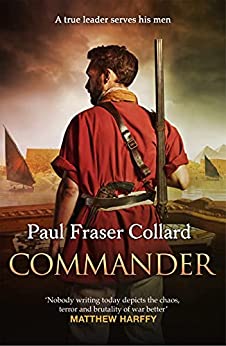
Book Corner: Commander by Paul Fraser Collard

A true leader serves his men.

The Jack Lark series is historical military fiction at its finest, for fans of Bernard Cornwell’s Sharpe series, Matthew Harffy and Patrick O’Brian. This is the tenth adventure featuring Jack Lark: soldier, leader, imposter.

Egypt, 1869. Jack Lark has reinvented himself once more. Working as an unofficial agent for the Consul-General, he moves among the most powerful men in Cairo. But when the opportunity arises to join legendary explorer Sir Samuel White Baker on his expedition into the Sudan, Jack can’t resist a new adventure.

Jack assumes command of an elite cadre to protect the fleet of vessels. But, as they move down the Nile, Jack and his men soon find themselves in a land where the rule of law means nothing, and those who wield power will do anything to keep it. And when a new friend seeks Jack’s help, Jack must decide where his loyalties truly lie . . .

Paul Fraser Collard‘s Commander is the 10th instalment of the exploits of Jack Lark. Jack first made his appearance in the Crimean War and seem to have gone around the world, looking for a fight ever since. I always wondered what would happen to him when the wars finally ended and Commander answers that question; he’d keep fighting, sort of.

Commander is set in 1869 at a time of colonial expansion for the British, which saw a rise in exploration of the more remote regions of Africa. Jack Lark joins one such expedition, that aims to go deep into central Africa, into the Sudan. Jack’s military expertise is called upon to train and lead the company of soldiers that will protect the expedition. Despite still leading a military contingent, he is definitely out of his comfort zone and facing challenges from various quarters, from the environment, the expedition leaders and those out to exploit Africa itself, slavers and big game hunters alike.

As ever, Paul Collard weaves a gripping story as Lark’s adventure into the unknown, both in his career and his personal life, takes a twisting, turning path. Commander confronts the ideas of slavery and the ivory trade within the context of the time, as he does the concept of colonial expansion; this is counterweighted with the sense of adventure and discovery that motivate such vast expeditions. The chance to go where no on has gone before.

Dozens of servants flowed around the room carrying silver platters covered with black velvet cloths embroidered with emeralds and pearls. Every platter bore a large number of drinking vessels no bigger than an egg cup, each one containing a liquid so dark that it was an inky black.

‘Coffee, Lark?’ Stanton reached for a cup from a passing waiter, his free hand held ready to take one for Jack.

‘No, thank you.’ Jack had no taste for the bitter liquid.

‘You are probably wise. I prefer tea myself, but there is no way in hell we can expect the frog to know how to serve it properly, so I suspect we are better off being spared the attempt.’

‘Indeed.’ Jack straightened his back. It always ached by this hour of the day. It was time to make an excuse and head for the buffet. He had delivered the notebook to his master. Nothing else was keeping him there.

‘You look like a hound waiting to be let off the leash.’ Stanton raised his eyebrows over the rim of the tiny coffee cup, which looked incongruous in his large hands. ‘You want to be off, I’ll wager.’

‘Something like that.’

‘Well, you can’t. I hate these bloody things as much as you plainly do, and now you’re here, you can damned well keep me company.’

Jack did his best to keep his expression neutral. The pit of his spine was beginning to hurt with a vengeance, and he wanted nothing more than to return to the cool quiet of his hotel suite and enjoy some peace. It appeared that ambition was to be denied, at least until he could shake off Stanton’s attention and slip away, something he would do at the earliest opportunity. ‘I’d be delighted,’ he lied smoothly.

‘No, you wouldn’t, but I pay your wages so you will just have to endure, as must I.’ Stanton snorted. ‘Sometimes I wish I’d stayed in the army. What about you Lark?’

Paul Fraser Collard’s Jack Lark has one of the best character developments that I have ever read. He is flawed, damaged and does not always make the right decision. But that is what makes him fascinating. He is a fabulous, colourful character, full of life! He is not your typical everyday hero, which makes him unpredictable, which makes the story’s outcome unpredictable. The many twists in the book leave the reader on the edge of their seat throughout, eager to discover the outcome of the converging threads.

In Commander Jack Lark is not only up against an enemy, a former French soldier who he quite likes, who is exploiting the treasures of Africa – it’s animals and people – for his own personal gain. In another life, he may have been Jack’s friend, but in this life, their ideals are diametrically opposed. Jack is also fighting against nature; the unrelenting landscape of Africa, where their boats are hampered by the weeds choking the River Nile and the relentless heat makes work, drill and marching harder.

Commander by Paul Fraser Collard is a triumph in storytelling, taking the reader back to colonial Africa, on an amazing adventure. It recreates the landscape of an Africa untouched by modern development, contrasted with the hustle and bustle of Cairo and the ancient, established, cities of Egypt. It is a pleasure to read – a journey of discovery for reader and character alike. A must read.

I do hope we get to see more of his adventures!

Commander by Paul Fraser Collard is now available from Amazon.

About the author:

Paul’s love of military history started at an early age. A childhood spent watching films like Waterloo and Zulu whilst reading Sharpe, Flashman and the occasional Commando comic, gave him a desire to know more of the men who fought in the great wars of the Nineteenth and Twentieth Centuries. At school, Paul was determined to become an officer in the British army and he succeeded in winning an Army Scholarship. However, Paul chose to give up his boyhood ambition and instead went into the finance industry. Paul stills works in the City, and lives with his wife and three children in Kent. 

*

My Books

Signed, dedicated copies of all my books are available, please get in touch by completing the contact me form.

Defenders of the Norman Crown: The Rise and Fall of the Warenne Earls of Surrey tells the fascinating story of the Warenne dynasty, of the successes and failures of one of the most powerful families in England, from its origins in Normandy, through the Conquest, Magna Carta, the wars and marriages that led to its ultimate demise in the reign of Edward III. Defenders of the Norman Crown: Rise and Fall of the Warenne Earls of Surrey is now available from Pen & Sword BooksAmazon in the UK and US, Bookshop.org and Book Depository.

1 family. 8 earls. 300 years of English history!

Also by Sharon Bennett Connolly:

Ladies of Magna Carta: Women of Influence in Thirteenth Century England looks into the relationships of the various noble families of the 13th century, and how they were affected by the Barons’ Wars, Magna Carta and its aftermath; the bonds that were formed and those that were broken. It is now available in paperback and hardback from Pen & Sword,  AmazonBookshop.org and from Book Depository worldwide.

Heroines of the Medieval World tells the stories of some of the most remarkable women from Medieval history, from Eleanor of Aquitaine to Julian of Norwich. Available now from Amberley Publishing and Amazon, Bookshop.org and Book Depository.

Silk and the Sword: The Women of the Norman Conquest traces the fortunes of the women who had a significant role to play in the momentous events of 1066.  Available now from Amazon,  Amberley Publishing, Bookshop.org and Book Depository.

*

You can be the first to read new articles by clicking the ‘Follow’ button, liking our Facebook page or joining me on Twitter and Instagram.

©2021 Sharon Bennett Connolly

Book Corner: Inspiration for Hauntings by Samantha Wilcoxson

Inspiration for Among the Lost

By Samantha Wilcoxson

My family and I took a trip to Traverse City, Michigan last autumn. While this trip had nothing to do with anything I was writing, my youngest son would be quick to tell you that I always find some sort of historic site to visit anywhere we go. In Traverse City, that place ended up being the former Northern Michigan Asylum, now reinvented as The Village at Grand Traverse Commons.

The Northern Michigan Asylum was built in 1883-1885, including Building 50, the main structure which is almost a quarter of a mile long. More buildings were added over the years to serve patients that were sent from around the state of Michigan. Men, women, and children were segregated in addition to patients being separated according to condition. ‘Beauty is therapy’ was a famous slogan, referring to founding Medical Superintendent Dr James Munson’s belief that the gorgeous natural surroundings of the area would help the patients heal.

Traverse City is gorgeous with the beautiful blue waters of the bay in the summer and an extraordinary kaleidoscope of trees in the autumn. Certainly, some did find healing in the natural surroundings. The buildings of the asylum were carefully crafted with high ceilings, transom windows, and rounded corners to create a bright, safe atmosphere. The grounds include a grove of trees where no two are alike. The variety was collected by Dr James Munson during his travels. One can envision what the place was like when it was new and filled with hopeful nurses and their charges.

However, as we toured the abandoned, dilapidated structures, it was just as easy to imagine that darker things had taken place as well. Old lead paint is peeling from the walls, and the lack of electricity forced us to light our way with flashlights. Shattered windows and graffiti brought to mind broken souls and nefarious deeds that might have taken place within those walls.

I had not planned on writing anything about the asylum, but when the suggestion of an anthology of historical ghost stories was put forward, I knew just where mine would take place. The mysterious steam tunnels and creamy stone structures topped by red spires suddenly seemed the perfect setting for a young nurse to encounter strange happenings. A ghost may not be the worst being she discovers.

Hauntings

FEAR IS AS OLD AS TIME ITSELF
Chilling Tales that will take you through a labyrinth of historical horror.
You will encounter a tormented Roman general.
A Norse woman who must confront her terrifying destiny.
Meet a troubled Saxon brother, searching for his twin’s murderer.
A young nurse tries to solve the mysteries of an asylum for the insane.Down the passages of time, Henry VIII and Anne Boleyn wander through a haunted garden and elsewhere,
a lost slave girl is the soul survivor of a mass slaughter.

These are just a few of the eerie tales which ensure that Hauntings is not for the faint-hearted.

Hauntings is an anthology of stories that span 2,000 years of history. Featuring short stories by S.J.A. Turney, D. Apple, Judith Arnopp, K.S. Barton, Lynn Bryant, Paula Lofting, Stephanie Churchill, Samantha Wilcoxson, Jennifer C. Wilson and Kate Jewell, and with a foreword by yours truly!

now available as an ebook from Amazon in the UK and the US and will be available in paperback shortly.

Hauntings Launch Party!

And we’re having a launch party over Zoom.

Meet the authors and hear the stories behind the stories. It’s free. Come and join us!

It’s on Saturday 23 October at 7pm (UK time) – 2 pm if you’re in New York! Book here!

My Books

Signed, dedicated copies of all my books are available, please get in touch by completing the contact me form.

Defenders of the Norman Crown: The Rise and Fall of the Warenne Earls of Surrey tells the fascinating story of the Warenne dynasty, of the successes and failures of one of the most powerful families in England, from its origins in Normandy, through the Conquest, Magna Carta, the wars and marriages that led to its ultimate demise in the reign of Edward III. Defenders of the Norman Crown: Rise and Fall of the Warenne Earls of Surrey is now available from Pen & Sword BooksAmazon in the UK and US and Book Depository.

1 family. 8 earls. 300 years of English history!

Also by Sharon Bennett Connolly:

Ladies of Magna Carta: Women of Influence in Thirteenth Century England looks into the relationships of the various noble families of the 13th century, and how they were affected by the Barons’ Wars, Magna Carta and its aftermath; the bonds that were formed and those that were broken. It is now available in paperback and hardback from Pen & Sword,  Amazon and from Book Depository worldwide.

Heroines of the Medieval World tells the stories of some of the most remarkable women from Medieval history, from Eleanor of Aquitaine to Julian of Norwich. Available now from Amberley Publishing and Amazon and Book Depository.

Silk and the Sword: The Women of the Norman Conquest traces the fortunes of the women who had a significant role to play in the momentous events of 1066.  Available now from Amazon,  Amberley Publishing, Book Depository.

*

You can be the first to read new articles by clicking the ‘Follow’ button, liking our Facebook page or joining me on Twitter and Instagram.

©2021 Sharon Bennett Connolly

Guest Post: Life in Miniature: A History of Dolls’ Houses by Nicola Lisle

It is a pleasure to welcome to History … the Interesting Bits today, Nicola Lisle, author of Life in Miniature: A History of Dolls’ Houses as part of her Blog Tour with Pen & Sword. A history of dolls’ houses is a little different to my usual type of post, but reading Life in Miniature brought back some very happy childhood memories of my sister and I playing with our dolls’ house in our grandparents’ attic. So I was very interested in finding out more of their history and origins. Nicola very kindly answered a few of my most pressing questions.

Dolls’ house at Charles Dickens’ House, Doughty Street, London

Hi Nicola, congratulations on the release of Life in Miniature and thank you for stopping by to chat.

1. When I heard about your book, I immediately thought of the dolls’ house my sister and I had as children – we used to play with it for hours. How long have you had a fascination for dolls’ houses? Did you have one as a child?

I did have a dolls’ house as a child, and my sister and I played with it a lot. It was apparently made for us by a distant relative, who also made wooden furniture for it. It’s all quite basic, but I love it because it’s unique and it was part of my childhood. We used to have some tiny dolls for it, and we also used to decorate it at Christmas. We had a Christmas tree and had to cut away a square of carpet to fit it in! Sadly, the dolls and Christmas decorations have been lost, but the original furniture and other bits and pieces are still there. As we grew up we lost interest in the dolls’ house and it was in my parents’ loft for many years gathering dust! It wasn’t until I started writing that I became interested in dolls’ houses again, and it was quite by chance. I subscribed to Writing Magazine and Writers’ News – and still do! – and in one issue there was a piece about Dolls House and Miniature Scene magazine, which was open to submissions from freelance writers. It caught my attention, and I got in touch with some ideas. My first piece for the magazine was about the Museum of Childhood at Sudbury Hall in Derbyshire, and it was published in 2004. I carried on writing for the magazine for many years, and it ignited a real passion in me for dolls’ houses. Eventually I rescued my childhood dolls’ house from my mum’s house, and I’m hoping at some point to find the time to give it a bit of TLC! It’s not in bad condition, but it could definitely do with a bit of a makeover!

2. The thing with dolls’ houses is that they are not just for children, are they? My mum has one!

Dolls’ house at Tolsey Museum, Burford

Dolls’ houses are definitely not just for children. I think a lot of adults who had them as children still treasure them, and collecting vintage and antique dolls’ houses is also popular. For children, they are great for stimulating the imagination, but for adults I think it’s more about appreciating the sheer delight of miniatures and the craftsmanship that went into creating them.

3. I think the most famous dolls’ house has to be Queen Mary’s in Windsor Castle, isn’t it? What is so special about it?

Reproduction of miniature of Conan Doyle’s ‘How Watson Learned the Trick’, written for Queen Mary’s Dolls’ House

Yes, I think Queen Mary’s dolls’ house is probably the most famous. It’s special because it captures a slice of 1920s England in such exquisite detail, from the furniture and soft furnishings right down to the food and drink that were popular at the time. It attracted international interest when it first appeared, and it was a showcase to the world, a display of some of the very finest British talent. I think it also restored some pride and optimism in the country during the immediate post-war years. The house and garden were designed by Sir Edwin Lutyens and Gertrude Jekyll, and among its highlights are miniature books, music scores and paintings by popular writers, composers and artists of the day. Many of the books contained original stories written exclusively for the dolls’ house. Two of these, Fougasse’s J. Smith and Conan Doyle’s How Watson Learned the Trick, have been reproduced as miniature replicas with booklets containing the stories in full-size print. Another, Vita Sackville-West’s A Note of Explanation – a story about a mischievous spirit who inhabits the dolls’ house – was also reproduced in full size. I treated myself to all three when I was researching my book, and they are now treasured items on my bookshelves!

4. How long have dolls’ houses been around, Nicola? I always associate them with the Victorians, but were they around earlier? Are dolls’ houses an English creation, or did they come from the continent?

Nicola’s childhood dolls’ house

Dolls’ houses have been around since at least the 16th century and originated in Germany, where they were known as baby houses. The first known dolls’ house was made for the Duke of Bavaria in 1557, and it was a miniature version of his ducal palace. By the 17th century, baby houses had become popular in Germany, particularly in Nuremberg. The idea caught on in Holland towards the end of the 17th century, but instead of baby houses the

Dutch favoured cabinet houses, which were grand, elaborately-carved cabinets containing exquisitely furnished miniature rooms. The earliest dolls’ houses in England appeared in the late 17th century and were similar to the Dutch cabinet houses. By the early 18th century they were beginning to look more like houses than cabinets, and they were often modelled on the great country houses and created by estate carpenters. It wasn’t until the Victorian era that they became regarded as toys for children, and mass production towards the end of the 19th century made them much more widely accessible.

5. And what was their original purpose, were they always aimed at children.

The earliest baby houses, cabinet houses and dolls’ houses were primarily display pieces, and they were very much the preserve of royalty and the aristocracy – each one was a statement of the owner’s wealth and social status. They also had an educational role, often being used to instruct young ladies and servants in efficient household management and domestic skills.

6. I am fascinated by dolls’ houses and have to admit that the first thing I did on getting your book was look at the pictures. The houses are beautiful and the furniture inside is so detailed and intricate, do you have a favourite?

Reproduction of miniature of J. Smith by Fougasse, written for Queen Mary’s Dolls’ House

I saw so many gorgeous dolls’ houses while writing and researching my book that it’s almost impossible to pick a favourite. I think all dolls’ houses have their own particular charm, from the grand, ornate ones to the very simplest, and often it’s the stories behind them that make them special. For this reason, I think the dolls’ house at Uppark in West Sussex is one of my favourites, partly because it’s one of the earliest surviving dolls’ houses from the early 18th century, reflecting the Palladian-style architecture that was popular at the time, and partly because it has a connection with H.G. Wells, and I always love literary connections! Wells’s mother was the housekeeper at Uppark during the late 19th century, and he drew on his childhood memories of Uppark in his novel Tono-Bungay, in which he refers to the “great dolls’ house on the nursery landing”.

Another with a literary connection is the dolls’ house at Charles Dickens’ House at Doughty Street in London. The house doesn’t actually have a connection with Dickens himself, but it was modelled on the Doughty Street house by dolls’ house maker Christopher Cole for his book Make Your Own Dolls’ House, which was published in 1976. It is a simplified version of the real thing, rather than an exact replica, but it is very similar, especially the outside, and it was one I particularly enjoyed going to see! It’s not on public display, but it can be viewed by appointment.

I also have special fondness for the dolls’ house at Overbeck’s in Devon. It was created during the 1980s by a lady called Mabel Hill, a very talented, self-taught craftswoman who used scraps of leftover material and other household odds and ends to make the furniture and soft furnishings. What’s particularly lovely is that Overbeck’s was used as a convalescent home for wounded soldiers during the First World War, and one of the activities they were encouraged to do as therapy was to make dolls’ house furniture. Although there’s no direct link between that and Mabel Hill’s house, it does feel as though there is a spiritual connection.

Others closer to home, in Oxfordshire, include the Regency-style dolls’ house at the Tolsey Museum in Burford, which was created during the 1930s by members of the local community and reflects the town’s rural industries (another fascination of mine!), and the Palladian-style house at Greys Court, near Henley, which was created by a local lady, Patricia Mackenzie, during the 1970s. Like Mabel Hill, she used old materials and household objects to create the house and its contents. She was inspired by the Carlisle Collection of Miniature Rooms, which she used to visit when it was displayed at Greys Court during the 1970s. The collection is now housed at Nunnington Hall in Yorkshire, and is another favourite of mine, with a fascinating history – as I said, there are so many favourites!

7. I am guessing that some of these dolls’ houses have fascinating histories – is there one that has a story that particularly caught your attention?

Interior of Dolls’ house at Charles Dickens’ House

Something I became fascinated with while researching the book was finding out about famous collectors, particularly Vivien Greene, wife of novelist Graham Greene. Her collection was once housed in a museum in Oxford, not far from where I live, so there’s a bit of a connection there! Tracking down Vivien Greene’s dolls’ houses almost became a project of its own – sadly, she decided to auction her collection during the late 1990s when her eyesight was deteriorating and most of it finished up in private hands. But one that is on public display is Whiteway at Saltram, a National Trust house in Devon, and its Victorian-style interior is exquisite. I particularly loved the library with its miniature books, all made from wood, and the dining room with its plush red furnishings. The provenance of the house is something of a mystery, and I do love a good mystery! There’s another Vivien Greene house on display at Ilkley Toy Museum in Yorkshire, which dates from the late Victorian era and used to belong to a lady in Abingdon, Oxfordshire – again, not far from where I live. At some point it was converted into an hotel and named The Original Swan after a pub in Cowley, just outside Oxford. It has lost some of its original contents, but it is in good condition and you can still see the mahogany bar and its wooden barrels and glass bottles.

8. What made you want to write a book on dolls’ houses?

The Original Swan at Ilkley Toy Museum

It was writing for Dolls House and Miniature Scene magazine for so many years that made me think it would be interesting to write a book on the subject. I had already accumulated a lot of information and pictures that I could use as the basis for a book, and I had a lot of fun building on that, visiting various museums and stately homes that had dolls’ houses on display and gathering up lots more fascinating facts about these wonderful miniatures. I enjoyed researching and writing the book so much – it was a real labour of love!

9. What is your next writing project?

I’ve been working on some possible new book ideas, but at the moment I’m very busy with other writing work. I have several article deadlines coming up, and I am also a tutor on four distance-learning courses with The Writers Bureau, so I’m having to work on my book pitches in between everything else! Hopefully, though, at some point I’ll get them finished and sent off!

10. Where can people find you? Do you have a website or blog? Are you on social media?

I’m on Twitter – you can find me at @NicolaLisle1. I did set up a blog a while ago but haven’t actually done anything with it for some time, so it’s due for a major overhaul – that’s probably going to be a Christmas holiday job!

Thank you, Nicola, for such a lovely chat!

Life in Miniature: A History of Dolls’ Houses is available from Amazon or direct from Pen & Sword and would make a perfect Christmas present.

About the author:

Nicola Lisle is a freelance journalist and author specialising in history and the arts. She has written numerous articles for family history magazines, including Who Do You Think You Are?, Your Family History and Discover Your Ancestors, and was a regular contributor to Dolls House and Miniature Scene magazine for many years. She is the author of Tracing Your Family History Made Easy (Which? Books, 2011) and Tracing Your Oxfordshire Ancestors (Pen & Sword, 2018).

*

My Books

Ladies of Magna Carta: Women of Influence in Thirteenth Century England  looks into the relationships of the various noble families of the 13th century, and how they were affected by the Barons’ Wars, Magna Carta and its aftermath; the bonds that were formed and those that were broken. It is now available from Pen & SwordAmazon and from Book Depository worldwide.

Also by Sharon Bennett Connolly:

Silk and the Sword: The Women of the Norman Conquest traces the fortunes of the women who had a significant role to play in the momentous events of 1066.  Available now from Amazon,  Amberley Publishing, Book Depository.

Heroines of the Medieval World tells the stories of some of the most remarkable women from Medieval history, from Eleanor of Aquitaine to Julian of Norwich. Available now from Amberley Publishing and Amazon and Book Depository.

*

You can be the first to read new articles by clicking the ‘Follow’ button, liking our Facebook page or joining me on Twitter and Instagram.

©2020 Sharon Bennett Connolly & Nicola Lisle