It has always amazed me that so little is known of the princesses of England, daughters of the kings. The lives of their fathers and brothers are, in the most part, well documented; but the Princesses are often shadowy figures, hidden in the background.
Many of these ladies were married off to foreign courts or dedicated to convents, their lives and futures decided by the king, their father.
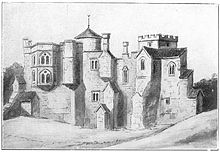
Isabella of Woodstock is, to some extent, an exception. She appears to have been very close to her parents, and spent most of her life at the English court. The eldest daughter and second child of Edward III and his queen, Philippa of Hainault, Isabella was born on 16 June 1332 at the royal Palace of Woodstock. As a child, Isabella shared a household with her older brother, Edward, later to be known as the Black Prince, and sister Joan, who was a year younger than her. The royal children’s household was governed by William of St Omer and his wife, Elizabeth.
Edward and Philippa had a large family, with at least 12 children (possibly more) of whom 9 survived infancy. They maintained a close relationship with their children often travelling with them; the older children, including Isabella, were with Philippa, in Antwerp, when their baby brother, Lionel, was born in 1338.
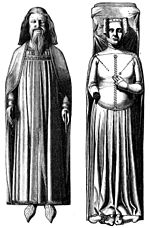
From her infancy, Edward was making plans for Isabella’s marriage: in 1335 negotiations were opened for her to marry Pedro the Cruel, the eldest son of the king of Castile, but Joan was sent in her place. Two of Pedro’s daughters, Constance and Isabella, would later marry Isabella’s brothers, John of Gaunt and Edmund of Langley, respectively. In 1338, plans were in motion for Isabella to marry the son of the Count of Flanders, in place of her sister Joan, now promised to Pedro; however, the count’s allegiance to the French Valois dynasty, added to English support for Flemish rebels, meant the proposals came to nought. In 1344 the proposed groom was a son of the Duke of Brabant, though as he was a descendant of Edward I, a papal dispensation was required.
Whilst awaiting the dispensation, however, the proposed marriage with the count of Flanders’ son, Louis de Male, was revived. The count’s death at Crecy in 1346 meant Louis was even less inclined to the match than his father, but he was facing increasing pressure from his subjects, who saw great advantage in an English alliance. The couple met in March 1347, where Louis promised to marry Isabella within a fortnight of Easter. Louis fled just days before the wedding was due to take place and instead married Marguerite de Brabant. In 1349 Isabella was offered in marriage to Charles IV of Bohemia, King of the Romans. But these plans came to nothing.
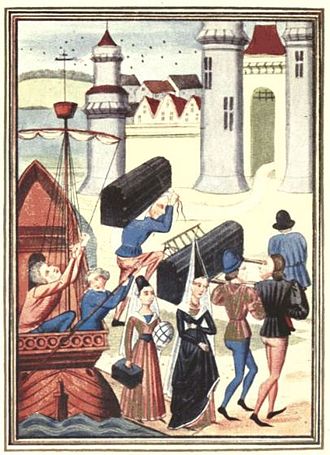
In 1351, aged 19, Edward III gave his consent for Isabella to marry Bernard, heir to the Lord Albret. Five ships were prepared to escort Isabella to Gascony and her new husband, but the English princess pointedly refused to embark and the marriage plans were abandoned. Edward III does not seem to have been too ‘put out’ by this. He continued to support Isabella and described her as ‘our very dear eldest daughter, whom we have loved with special affection.’ Edward indulged Isabella, she was with him almost constantly – more than any of his other children. In 1348, during a tournament in Lichfield, she was one of the ladies given blue and white robes – to match those of the knights – by the King. In 1354 Edward paid for a new balcony to be built outside Isabella’s suite of rooms at Woodstock, so that she would have a better view of the park. In 1358 King Edward gave her an annuity of 1,000 marks and in 1364 she was give the valuable wardship of Edmund (III) Mortimer, Earl of March and Ulster.
By late 1361 Isabella was her parents’ last surviving daughter. Her sister, Joan, 18 months her junior, had died of plague in France in 1348 whilst on her way to her marriage in Castile. And her younger sisters Mary and Margaret, just teenagers, died within a short time of each other in 1361; Mary had only been married for 2 months. Though there is no evidence that she exerted any political influence, Isabella was a regular at court, participating in the feasts for the Order of the Garter and in hunts; she was a frequent spectator at tournaments and was present at the Siege of Calais of 1346-7.
Isabella finally married in 1365, at Windsor, at the rather late age of 33, in what appears to have been a love match. Her husband, Enguerrand VII Lord of Coucy, was 7 years her junior, and a hostage for the fulfilment of the Treaty of Bretigny. On marrying Isabella he was released, without ransom, and created a knight of the Garter. In the hope that Enguerrand and Isabella would remain in England, Edward made Enguerrand Earl of Bedford in 1366 and, later, Count of Soissons.
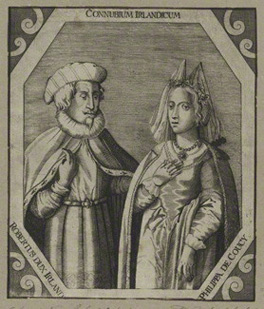
Two daughters followed quickly, in 1366 and 1367. Mary was born at the Chateau of Coucy, France, and would later marry Henry of Bar; and Philippa, who was born at Eltham and made a lady of the Garter in 1379, and would later marry Robert de Vere, Earl of Oxford and Duke of Ireland; de Vere, a favourite of Richard II, would cause a great scandal in 1387 when he rejected poor Philippa for a Bohemian woman.
As England and France moved towards war, Enguerrand left England for the continent and went on to fight in Italy. Isabella appears to have returned to England and remained at her father’s court, with her daughters. Edward’s will gave to his ‘very dear daughter’ Isabella, an income of 300 marks per year, until her daughters were married. Isabella and Enguerrand were briefly reunited in France in 1374, but Isabella then returned to England while Enguerrand pursued his claims to lands in Aargau and Alsace, as a grandson of Leopold I, duke of Austria. After another reunion in 1376, Isabella again returned to England, remaining there with her daughter Philippa. Mary remained in France with her father, becoming heir to her father’s French possessions. Enguerrand was now totally committed to France, his loyalty firmly with the Valois’.
On 26 August 1377, he renounced all his English honours in order to serve France.
Isabella received robes of the Order of the Garter in 1376. In 1379, she did so again, after her husband’s resignation of his English lands and titles, under the style ‘countess of Bedford’. Isabella had had a greater control over her own life than most English princesses, before and after her marriage, maintaining a great deal of independence, even within it. She was always a figure in her own right. She died before 4 May 1379 – although 1382 also has been suggested – and was laid to rest at the Greyfriars Church in Newgate, London. Isabella was one of the figures that graced her father’s tomb in Westminster Abbey, though the statuette has not survived. Neither has the statue that Enguerrand de Coucy erected, alongside his own, in the Celestine church at Soissons.
*
Further reading: Ian Mortimer The Perfect King: The Life of Edward III; Alison Weir Britain’s Royal Families; WM Ormrod The Reign of Edward III; Paul Johnson The Life and Times of Edward III; Roy Strong The Story of Britain.; Oxforddnb.com; The Oxford Companion to British History Edited by John Cannon; The Plantagenets, the Kings who Made England by Dan Jones; History Today Companion to British History Edited by Juliet Gardiner and Neil Wenborn; Brewer’s British Royalty by David Williamson; The Chronicles of Chivalry Edited by Elizabeth Hallam; The Mammoth Book of British Kings and Queens by Mike Ashley; The Plantagenets, the Kings that made Britain by Derek Wilson; Heroines of the Medieval World by Sharon Bennett Connolly.
Pictures: courtesy of Wikipedia.
*
My Books
Signed, dedicated copies of all my books are available through my online store.
OUT NOW! Scotland’s Medieval Queens

Scotland’s history is dramatic, violent and bloody. Being England’s northern neighbour has never been easy. Scotland’s queens have had to deal with war, murder, imprisonment, political rivalries and open betrayal. They have loved and lost, raised kings and queens, ruled and died for Scotland. From St Margaret, who became one of the patron saints of Scotland, to Elizabeth de Burgh and the dramatic story of the Scottish Wars of Independence, to the love story and tragedy of Joan Beaufort, to Margaret of Denmark and the dawn of the Renaissance, Scotland’s Medieval Queens have seen it all. This is the story of Scotland through their eyes.
‘Scotland’s Medieval Queens gives a thorough grounding in the history of the women who ruled Scotland at the side of its kings, often in the shadows, but just as interesting in their lives beyond the spotlight. It’s not a subject that has been widely covered, and Sharon is a pioneer in bringing that information into accessible history.’ Elizabeth Chadwick (New York Times bestselling author)
Available now from Amazon and Pen and Sword Books.
Also by Sharon Bennett Connolly:

Heroines of the Tudor World tells the stories of the most remarkable women from European history in the time of the Tudor dynasty, 1485-1603. These are the women who ruled, the women who founded dynasties, the women who fought for religious freedom, their families and love. Heroines of the Tudor World is now available for pre-order from Amberley Publishing and Amazon UK. Women of the Anarchy demonstrates how Empress Matilda and Matilda of Boulogne, unable to wield a sword themselves, were prime movers in this time of conflict and lawlessness. It shows how their strengths, weaknesses, and personal ambitions swung the fortunes of war one way – and then the other. Available from Bookshop.org, Amberley Publishing and Amazon UK. King John’s Right-Hand Lady: The Story of Nicholaa de la Haye is the story of a truly remarkable lady, the hereditary constable of Lincoln Castle and the first woman in England to be appointed sheriff in her own right. Available from all good bookshops Pen & Sword Books, bookshop.org and Amazon.

Defenders of the Norman Crown: The Rise and Fall of the Warenne Earls of Surrey tells the fascinating story of the Warenne dynasty, from its origins in Normandy, through the Conquest, Magna Carta, the wars and marriages that led to its ultimate demise in the reign of Edward III. Available from Pen & Sword Books, Amazon in the UK and US, and Bookshop.org. Ladies of Magna Carta: Women of Influence in Thirteenth Century England looks into the relationships of the various noble families of the 13th century, and how they were affected by the Barons’ Wars, Magna Carta and its aftermath; the bonds that were formed and those that were broken. It is now available in paperback and hardback from Pen & Sword, Amazon, and Bookshop.org. Heroines of the Medieval World tells the stories of some of the most remarkable women from Medieval history, from Eleanor of Aquitaine to Julian of Norwich. Available now from Amberley Publishing and Amazon, and Bookshop.org. Silk and the Sword: The Women of the Norman Conquest traces the fortunes of the women who had a significant role to play in the momentous events of 1066. Available now from Amazon, Amberley Publishing, and Bookshop.org.
Alternate Endings: An anthology of historical fiction short stories including Long Live the King… which is my take what might have happened had King John not died in October 1216. Available in paperback and kindle from Amazon.
Podcast:

Have a listen to the A Slice of Medieval podcast, which I co-host with Historical fiction novelist Derek Birks. Derek and I welcome guests, such as Bernard Cornwell, and discuss a wide range of topics in medieval history, from significant events to the personalities involved.
Every episode is also now available on YouTube.
*
Don’t forget! Signed and dedicated copies of all my books are available through my online store.
For forthcoming online and in-person talks, please check out my Events Page.
You can be the first to read new articles by clicking the ‘Follow’ button, liking our Facebook page or joining me on Twitter, Threads, Bluesky and Instagram.
*
©2015 Sharon Bennett Connolly FRHistS
 History... the interesting bits!
Reblogged this on History's Untold Treasures and commented:
H/T History… The Interesting Bits!
LikeLike
How fascinating! I wonder if anyone has written a book about her?
LikeLike
Not that I know of. If I ever find one, I’ll let you know. 🙂
LikeLike
HISTORICAL ROMANCE FICTION ….. http://shelfandstuff.blogspot.com/…/lady-royal-by-molly… i read this book when i was a junior in high school YEARS AGO !!!! The Lady Royal by Molly Costain Haycraft ==== “Edward III and his queen, Philippa had a lot of kids – about a dozen or so – and while the descendants of their sons would go on to fight each other a century later and be the subject of a number of books, not much is written about their daughters. The Lady Royal is about their oldest daughter, Isabel, a princess who managed to remained unmarried until she was in her early thirties, certainly unusual for the time.”
LikeLike
Thank you Patricia. 🙂
LikeLike
The only factual book I can think of that mentions her in any detail is A Distant Mirror by Barbara Tuchman, but the focus is more on her husband.
LikeLike
Thanks Brian.
LikeLike
It’s because Isabella was a girl, unfortunately. Philippa counts because her father was the son of a king. Isabella’s family would only have counted if all the descent in the make line – Yorkist and Lancastrian – had died out.
LikeLike
Have you any information on the Holland family from the Woodstock and area ?
LikeLike
Hi Jane. I’m afraid not. Sorry.
LikeLike
You could also read about Enguerrand VII Lord of Coucy in “A Distant Mirror” by Barbara Tuchman.
LikeLike