Wordly Women: Samantha Wilcoxson

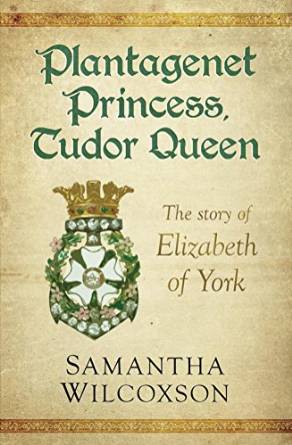
Today we are hopping across the pond for the next chat in my Wordly Women series. Joining me is Samantha Wilcoxson. Author of fiction novels mainly based in the late medieval and Tudor eras and and non-fiction books on the American Revolution, Samantha’s books – literally – span the Atlantic divide. Samantha has a knack for getting into the heads of the people she is writing about. Her book, Plantagenet Princess, Tudor Queen, about Elizabeth of York, is still one of the most insightful novels I have ever read.

Sharon: What got you into writing?

Samantha: What got you into writing? I have always loved reading and used to write dozens of book reviews every year. Many of those books were historical fiction and nonfiction. When I was considering ways to earn money while a stay-at-home mom, my husband suggested I write a book. I had never considered taking this step, so the first obstacle was deciding what I would want to write about. It didn’t take me long to settle on Elizabeth of York, and I quickly became passionate about the project. That novel turned into a series, and I’ve ventured into other historical eras since then.

Sharon: Tell us about your books.
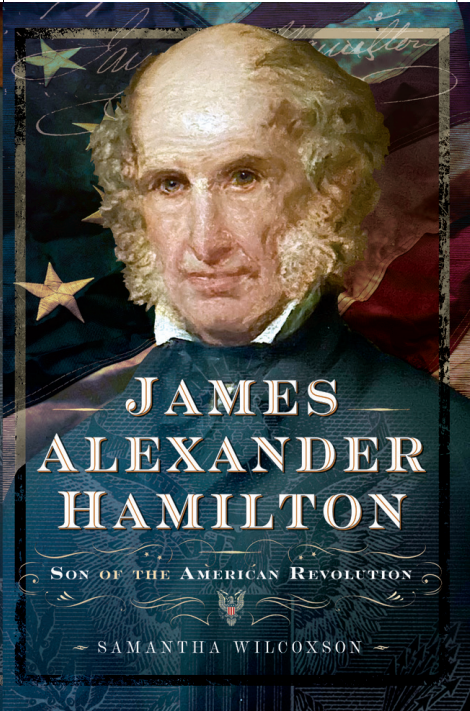
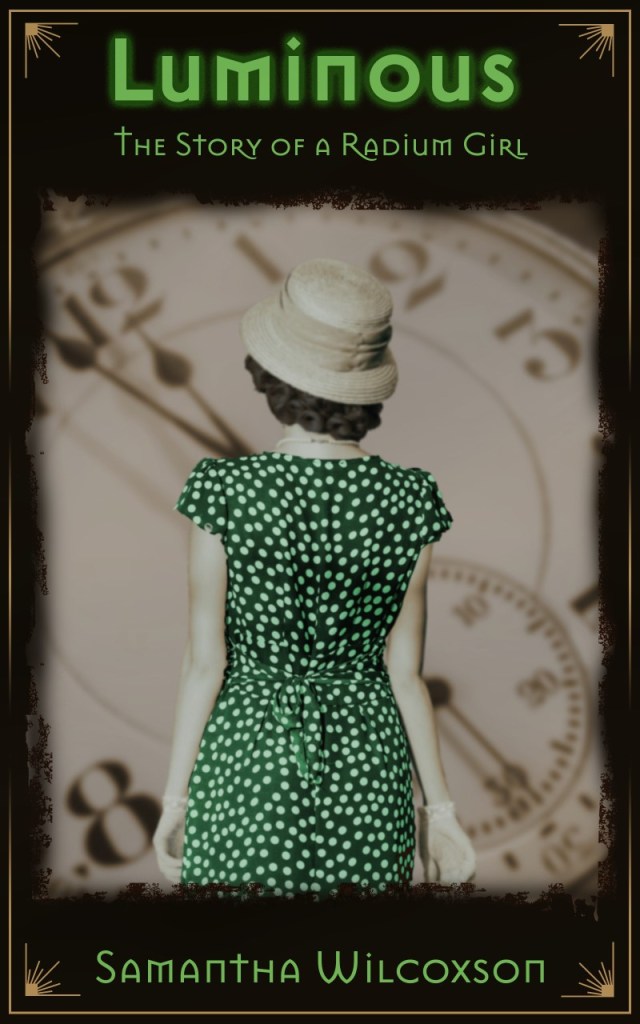
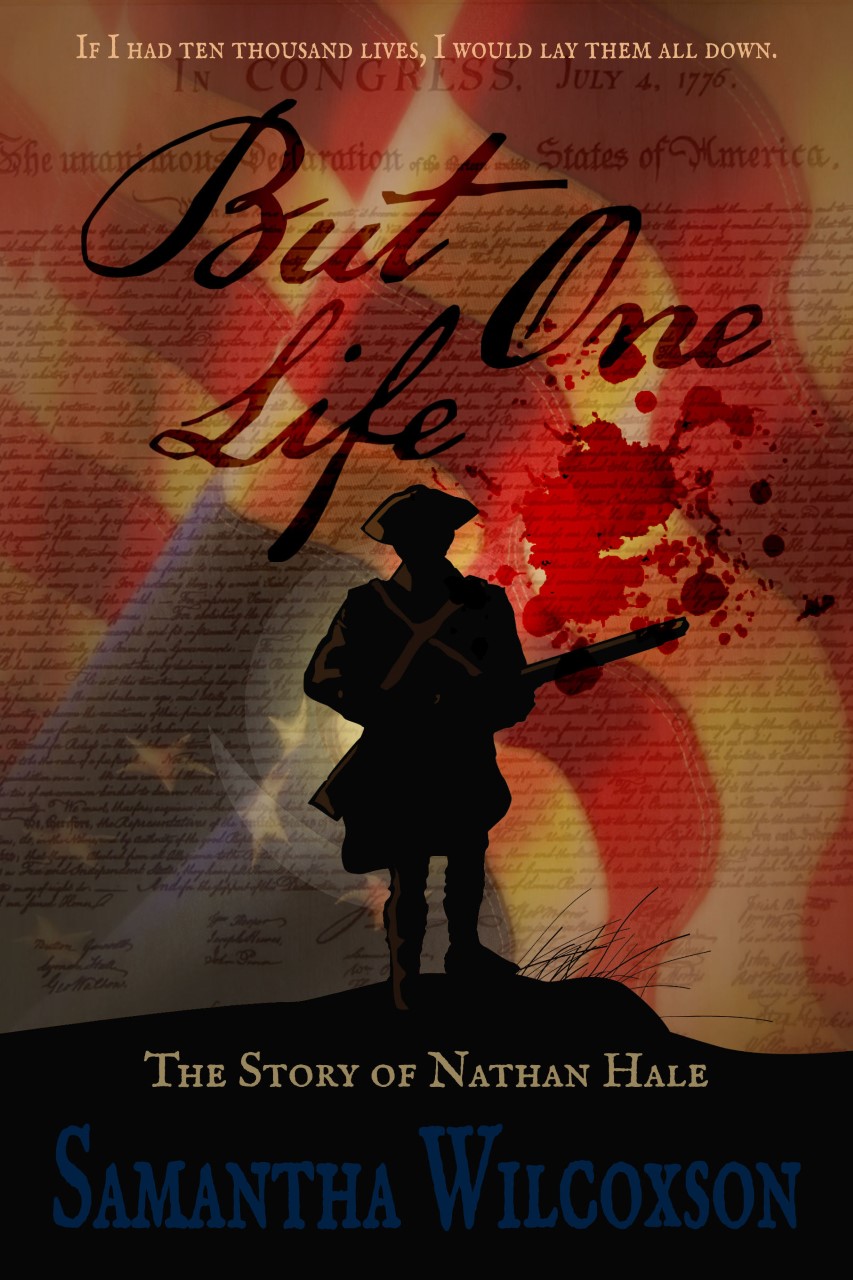
Samantha: Each of my novels explores the life of a real historical figure in a way that helps readers connect with them on a personal level. My Plantagenet Embers series includes three novels featuring Elizabeth of York, Margaret Pole, and Mary I. It also has three novellas that offer new points of view of the same events by focusing on Margaret Beaufort, Elizabeth Woodville, and Reginald Pole. Then I moved into US history with my next two novels. Luminous is biographical fiction of real life radium girl Catherine Wolfe Donohue, and But One Life explores the life of American Revolution soldier Nathan Hale. My nonfiction books are Women of the American Revolution and a newly released biography of James Alexander Hamilton.

Sharon: What attracted you to the Tudors?

Samantha: When I started writing the series that ended up covering the early Tudor era, I was actually obsessed with the Wars of the Roses. I thought Elizabeth of York was an unsung heroine, so I started with her with no real intention of writing about the Tudors! This is actually a great insight into my writing. I never know what is coming next.

Sharon: So, what is coming next?

Samantha: I am currently writing a trilogy set during the Wars of the Roses for Sapere Books. It includes multiple women’s points of view. For example, book one has chapters featuring Marguerite of Anjou, Cecily Neville, and Anne Beauchamp. That one is in editing, and I’m working on book two, which will add the perspective of Elizabeth Woodville and others.

Sharon: How do you approach researching your topic?
Samantha: This depends a lot on whether I’m writing fiction or nonfiction. For novels, I largely depend on biographies already written, but for nonfiction I look for more primary resources like personal letters and diaries. For either, I like to visit locations important to the people I’m writing about so that I can include details about the places they experienced.

Sharon: You also write US history non-fiction.

Samantha: Tell us your ‘favourite’ story you have come across in your research? My research into James Alexander Hamilton uncovered loads of interesting discoveries, partly because nobody else has really written about him. I held letters written between James and Andrew Jackson, Martin Van Buren, John Quincy Adams, and so many others. (Gotta admit, it was tempting to try sneak that JQA letter into my bag!) I think the most fun story I came across, besides John Quincy writing about being too old to stay up all night at a lively Hamilton party, was learning that James was part of the crew of the schooner America for which the America’s Cup is named.

Sharon: Tell us your least ‘favourite’ US history story you have come across in your research?

Samantha: I don’t know if I would call it a least favorite, but I decided to write a novel about Nathan Hale because I often came across quotes attributed to him such as, “I only regret that I have but one life to give for my country” but very little else about who Hale was. What happened in this young man’s life to create such bravery and patriotism? Few references to him offered much, so I decided to dig in and reveal the story of Nathan Hale before his famous execution during the American Revolution.

Sharon: Are there any other eras you would like to write about?
Samantha: I always have a few ideas brewing but am committed to the next couple of books on the Wars of the Roses right now. I have started a bit of research into a historical event that occurred near my home in Michigan in 1847 that I would like to consider for a future project. I’m not one of those writers who has the next five years planned out and I tend to impetuously strike out in new directions, so we’ll see what happens.

Sharon: And finally, what is the best thing about being a writer?

Samantha: Besides spending my day reading, writing, and learning about history, I love the flexibility of being a writer. I began as a stay-at-home mom, and I still appreciate the ability to easily set my work aside for a few days if one of my adult children needs anything. I’ve also made many friends in the writing community who make me feel less alone as a history nerd and have provided amazing support and encouragement for each of my book projects.

About the Author:

Samantha Wilcoxson is an author of emotive biographical fiction and nonfiction featuring history’s unsung heroes. Her novel Luminous has been named Book of the Year by Ruins & Reading and Yarde Book Reviews. Samantha’s most recent work is the first biography of James Alexander Hamilton, published by Pen & Sword History. She is currently writing a Wars of the Roses trilogy for Sapere Books. When not reading or writing, Samantha loves sharing trips to historic places with her family and spending time by the lake with a glass of wine.

Where to find Samantha Wilcoxson:

Website; Instagram; Amazon Author Page; Newsletter Signup; Goodreads; Pinterest; Twitter; Shop Direct; Audible

*

My books

Signed, dedicated copies of all my books are available through my online store.

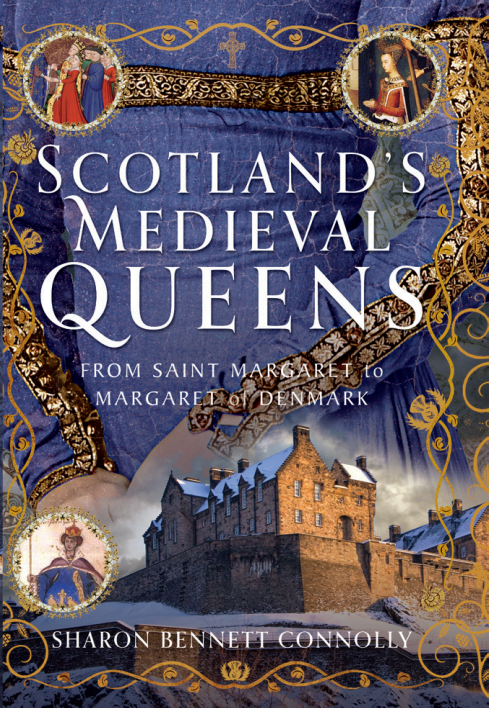
Out now: Scotland’s Medieval Queens

Scotland’s history is dramatic, violent and bloody. Being England’s northern neighbour has never been easy. Scotland’s queens have had to deal with war, murder, imprisonment, political rivalries and open betrayal. They have loved and lost, raised kings and queens, ruled and died for Scotland. From St Margaret, who became one of the patron saints of Scotland, to Elizabeth de Burgh and the dramatic story of the Scottish Wars of Independence, to the love story and tragedy of Joan Beaufort, to Margaret of Denmark and the dawn of the Renaissance, Scotland’s Medieval Queens have seen it all. This is the story of Scotland through their eyes.

Scotland’s Medieval Queens gives a thorough grounding in the history of the women who ruled Scotland at the side of its kings, often in the shadows, but just as interesting in their lives beyond the spotlight. It’s not a subject that has been widely covered, and Sharon is a pioneer in bringing that information into accessible history.’ Elizabeth Chadwick (New York Times bestselling author)

Available now from Amazon and Pen and Sword Books

Also by Sharon Bennett Connolly:
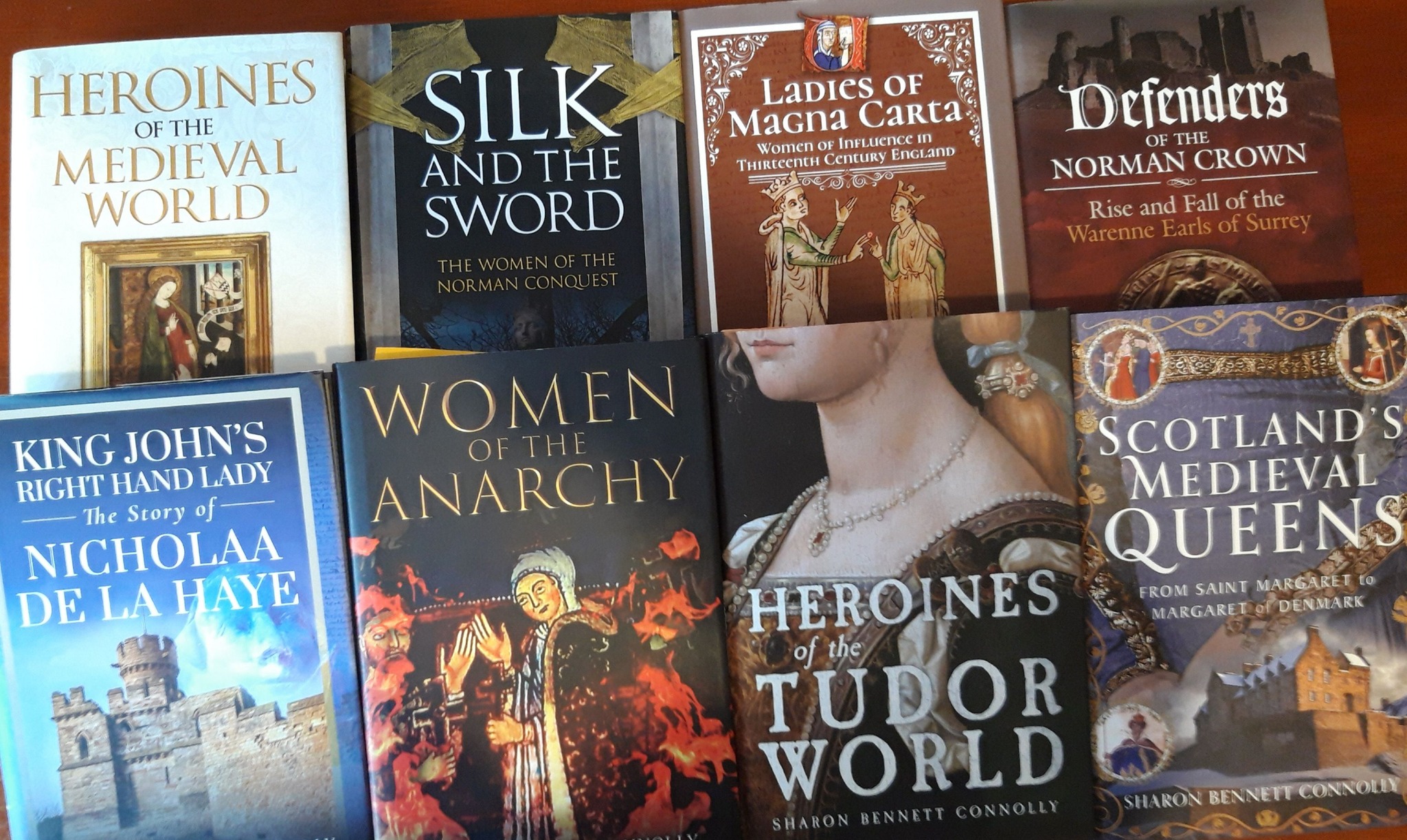
Heroines of the Tudor World tells the stories of the most remarkable women from European history in the time of the Tudor dynasty, 1485-1603. These are the women who ruled, the women who founded dynasties, the women who fought for religious freedom, their families and love. Heroines of the Tudor World is now available from Amberley Publishing and Amazon UK. Women of the Anarchy demonstrates how Empress Matilda and Matilda of Boulogne, unable to wield a sword themselves, were prime movers in this time of conflict and lawlessness. It shows how their strengths, weaknesses, and personal ambitions swung the fortunes of war one way – and then the other. Available from Bookshop.orgAmberley Publishing and Amazon UKKing John’s Right-Hand Lady: The Story of Nicholaa de la Haye is the story of a truly remarkable lady, the hereditary constable of Lincoln Castle and the first woman in England to be appointed sheriff in her own right. Available from all good bookshops Pen & Sword Booksbookshop.org and Amazon

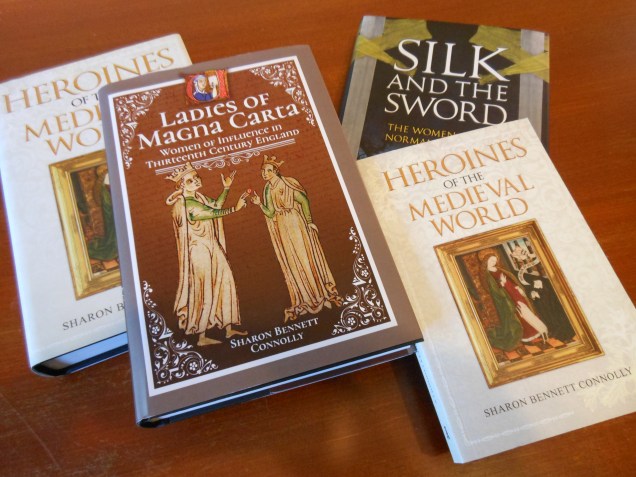
Defenders of the Norman Crown: The Rise and Fall of the Warenne Earls of Surrey tells the fascinating story of the Warenne dynasty, from its origins in Normandy, through the Conquest, Magna Carta, the wars and marriages that led to its ultimate demise in the reign of Edward III. Available from Pen & Sword BooksAmazon in the UK and US, and Bookshop.orgLadies of Magna Carta: Women of Influence in Thirteenth Century England looks into the relationships of the various noble families of the 13th century, and how they were affected by the Barons’ Wars, Magna Carta and its aftermath; the bonds that were formed and those that were broken. It is now available in paperback and hardback from Pen & SwordAmazon, and Bookshop.orgHeroines of the Medieval World tells the stories of some of the most remarkable women from Medieval history, from Eleanor of Aquitaine to Julian of Norwich. Available now from Amberley Publishing and Amazon, and Bookshop.orgSilk and the Sword: The Women of the Norman Conquest traces the fortunes of the women who had a significant role to play in the momentous events of 1066. Available now from Amazon,  Amberley Publishing, and Bookshop.org.

Alternate Endings: An anthology of historical fiction short stories including Long Live the King… which is my take what might have happened had King John not died in October 1216. Available in paperback and kindle from Amazon.

Podcast:

Have a listen to the A Slice of Medieval podcast, which I co-host with Historical fiction novelist Derek Birks. Derek and I welcome guests, such as Bernard Cornwell and Michael Jecks, and discuss a wide range of topics in medieval history, from significant events to the personalities involved. Every episode is also now available on YouTube.

*

Don’t forget! Signed and dedicated copies of all my books are available through my online store.

For forthcoming online and in-person talks, please check out my Events Page.

You can be the first to read new articles by clicking the ‘Follow’ button, liking our Facebook page or joining me on TwitterThreadsBluesky and Instagram.

*

©2025 Sharon Bennett Connolly, FRHistS and Samantha Wilcoxson
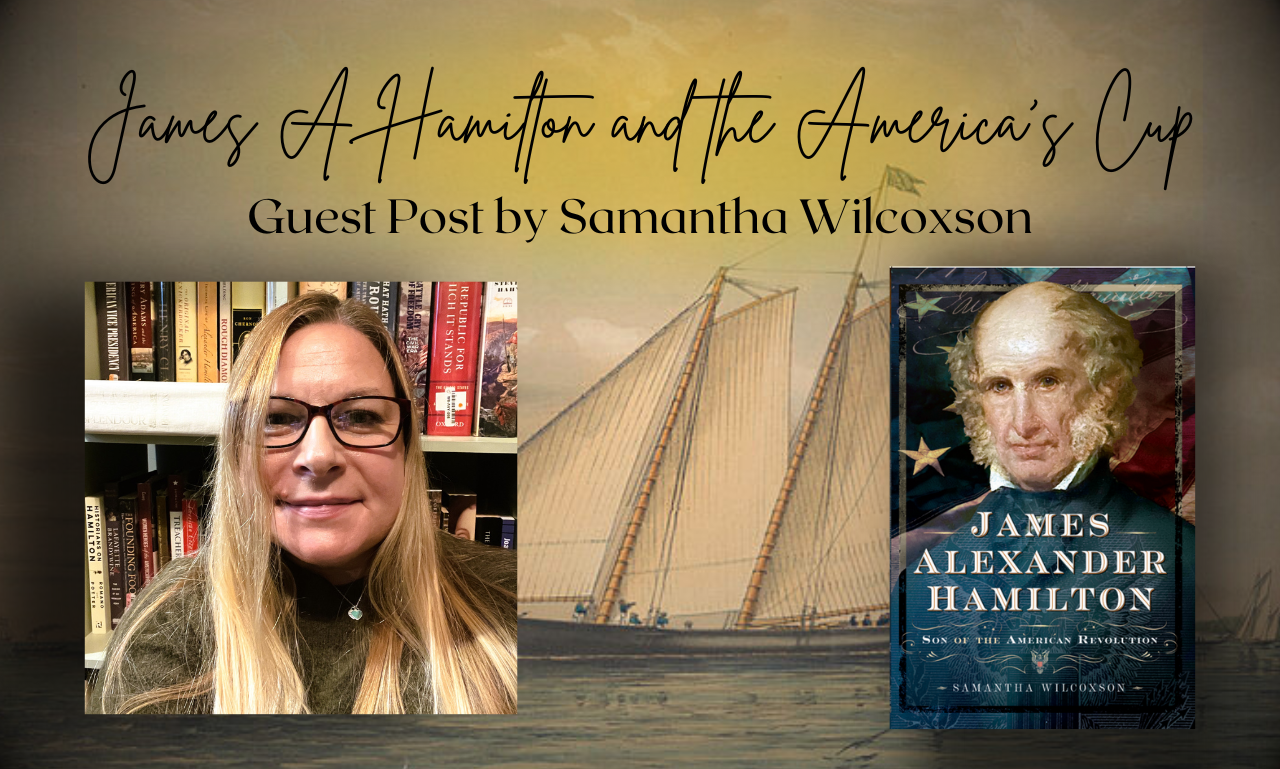
Guest Post: James A. Hamilton and the Americas Cup by Samantha Wilcoxson

Today, it is a pleasure to welcome Samantha Wilcoxson to History…the Interesting Bits with an article on James A. Hamilton. Samantha’s biography of Hamilton, James Alexander Hamilton: Son of the American Revolution.

James A. Hamilton and the Americas Cup

The America’s Cup has not always been called by that name. In 1851, an invitation came to the New York Yacht Club, the only yacht club in the United States at that time, from the Royal Yacht Squadron “to test the relative merits of the ships.” The British challengers did not anticipate any real contest from the Americans, given their relative inexperience in an arena long dominated by England’s seamen.

It was the same year as England’s Great Exhibition with its Crystal Palace, and national pride was running high. The New York Yacht Club decided to send a schooner named America. One of the ship’s owners was George Lee Schuyler, son-in-law to James Alexander Hamilton.

Schuyler was confident of the schooner’s capabilities and looked forward to seeing it compete against the British ships. Unfortunately, personal issues kept him at home, and he asked his father-in-law to join the crew of the America in his place.

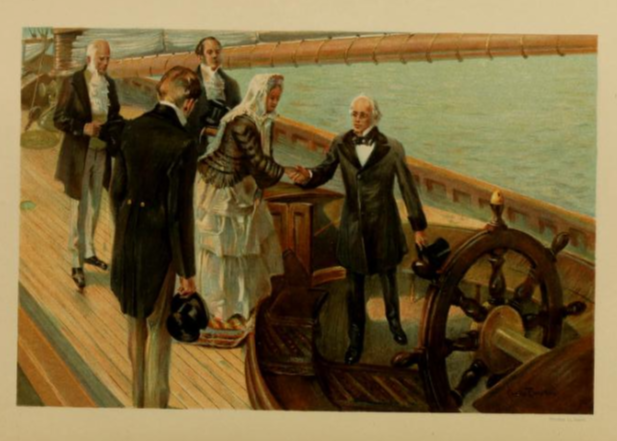
The crew greeting Queen Victoria and Prince Albert, James is the man on the far left

James was the third son of Alexander Hamilton, who had served as the first US treasury secretary and created the national bank. When traveling in Europe, James would often have official letters of introduction from presidents or cabinet members, but he recorded that he rarely used them. “My father’s name alone was my best passport to society.” In this case, it was his son-in-law’s boat that put him in the middle of historic events.

Among a field of sixteen ships, the America took off in a light wind on 22 August 1851. James compared them to race-horses breaking away from the starting line. Shockingly, the America quickly jumped into the lead. When Queen Victoria was informed that the US schooner was in the lead, she asked which was second. The response? “Your Majesty, there is no second.” The America had left all competition far behind.

The American schooner yacht

Following the victory, the Queen and Prince Albert boarded the America to offer their congratulations and were greeted by four crew members, including James A Hamilton. The Royal Yacht Squadron Cup, which the US team was awarded, became known as the America’s Cup, as did the annual regatta.

Read more about the 1851 America’s Cup and other James Alexander Hamilton adventures in my new biography, available through Pen & Sword and your favorite bookstore!

About the book:

Born in the year of the Constitutional Convention, James Alexander Hamilton was uniquely positioned to observe the early republic era and the formation of the experimental United States government. His father, Alexander Hamilton, had been the first US Treasury Secretary, an outspoken and controversial character who was killed in a duel when James was a teenager. With a lifelong devotion to his father’s memory, James advised men from Andrew Jackson and Martin Van Buren to Abraham Lincoln and Salmon P Chase on banking and constitutional matters.

Through his own talents and with the advantage of his father’s name, James served as temporary Secretary of State and District Attorney of New York. James enjoyed a close-knit family life with his wife, Mary Morris, at his Hudson River home named Nevis for his father’s birthplace. He was part of the crew of the yacht America, for which the America’s Cup is named, and on the committee for New York’s Crystal Palace in 1853. More importantly, he served his country through the War of 1812, Western Expansion, and the bloody Civil War. His first-hand account of these transformative events gives readers a priceless look at America’s past. James supported the abolition of slavery and wrote a draft of the Emancipation Proclamation before settling down to write his own Reminiscences that cover the first seventy-five years of US history. 

This biography makes James A Hamilton’s life and observations accessible to the modern reader and will leave you with a new appreciation for the Founders’ heirs who inherited the difficult work of building a nation.

To Buy the book:

James Alexander Hamilton: Son of the American Revolution.   

About the author:

Samantha Wilcoxson is an author of emotive biographical fiction and nonfiction featuring history’s unsung heroes. She loves sharing trips to historic places with her family and spending time by the lake with a glass of wine. Her most recent work is a biography of James Alexander Hamilton published by Pen & Sword History. Samantha is currently writing a Wars of the Roses trilogy for Sapere Books.

Social media:

Websitehttps://samanthawilcoxson.com
Instagramhttps://www.instagram.com/samantha_wilcoxson
Facebookhttps://www.facebook.com/PlantagenetEmbers/
Amazon Author Pagehttps://amazon.com/author/samanthawilcoxson
Newsletter Signuphttps://dashboard.mailerlite.com/forms/668153/107384163504489521/share

*

My Books

Signed, dedicated copies of all my books are available through my online store.

Out now: Scotland’s Medieval Queens

Scotland’s history is dramatic, violent and bloody. Being England’s northern neighbour has never been easy. Scotland’s queens have had to deal with war, murder, imprisonment, political rivalries and open betrayal. They have loved and lost, raised kings and queens, ruled and died for Scotland. From St Margaret, who became one of the patron saints of Scotland, to Elizabeth de Burgh and the dramatic story of the Scottish Wars of Independence, to the love story and tragedy of Joan Beaufort, to Margaret of Denmark and the dawn of the Renaissance, Scotland’s Medieval Queens have seen it all. This is the story of Scotland through their eyes.

Available now from Amazon and Pen and Sword Books

Also by Sharon Bennett Connolly:

Heroines of the Tudor World tells the stories of the most remarkable women from European history in the time of the Tudor dynasty, 1485-1603. These are the women who ruled, the women who founded dynasties, the women who fought for religious freedom, their families and love. Heroines of the Tudor World is now available for pre-order from Amberley Publishing and Amazon UK. Women of the Anarchy demonstrates how Empress Matilda and Matilda of Boulogne, unable to wield a sword themselves, were prime movers in this time of conflict and lawlessness. It shows how their strengths, weaknesses, and personal ambitions swung the fortunes of war one way – and then the other. Available from Bookshop.orgAmberley Publishing and Amazon UKKing John’s Right-Hand Lady: The Story of Nicholaa de la Haye is the story of a truly remarkable lady, the hereditary constable of Lincoln Castle and the first woman in England to be appointed sheriff in her own right. Available from all good bookshops Pen & Sword Booksbookshop.org and Amazon

Defenders of the Norman Crown: The Rise and Fall of the Warenne Earls of Surrey tells the fascinating story of the Warenne dynasty, from its origins in Normandy, through the Conquest, Magna Carta, the wars and marriages that led to its ultimate demise in the reign of Edward III. Available from Pen & Sword BooksAmazon in the UK and US, and Bookshop.orgLadies of Magna Carta: Women of Influence in Thirteenth Century England looks into the relationships of the various noble families of the 13th century, and how they were affected by the Barons’ Wars, Magna Carta and its aftermath; the bonds that were formed and those that were broken. It is now available in paperback and hardback from Pen & SwordAmazon, and Bookshop.orgHeroines of the Medieval World tells the stories of some of the most remarkable women from Medieval history, from Eleanor of Aquitaine to Julian of Norwich. Available now from Amberley Publishing and Amazon, and Bookshop.orgSilk and the Sword: The Women of the Norman Conquest traces the fortunes of the women who had a significant role to play in the momentous events of 1066. Available now from Amazon,  Amberley Publishing, and Bookshop.org.

Alternate Endings: An anthology of historical fiction short stories including Long Live the King… which is my take what might have happened had King John not died in October 1216. Available in paperback and kindle from Amazon.

Podcast:

Have a listen to the A Slice of Medieval podcast, which I co-host with Historical fiction novelist Derek Birks. Derek and I welcome guests, such as Bernard Cornwell and Michael Jecks, and discuss a wide range of topics in medieval history, from significant events to the personalities involved. Every episode is also now available on YouTube.

*

Don’t forget! Signed and dedicated copies of all my books are available through my online store.

For forthcoming online and in-person talks, please check out my Events Page.

You can be the first to read new articles by clicking the ‘Follow’ button, liking our Facebook page or joining me on TwitterThreadsBluesky and Instagram.

*

©2025 Sharon Bennett Connolly FRHistS and Samantha Wilcoxson
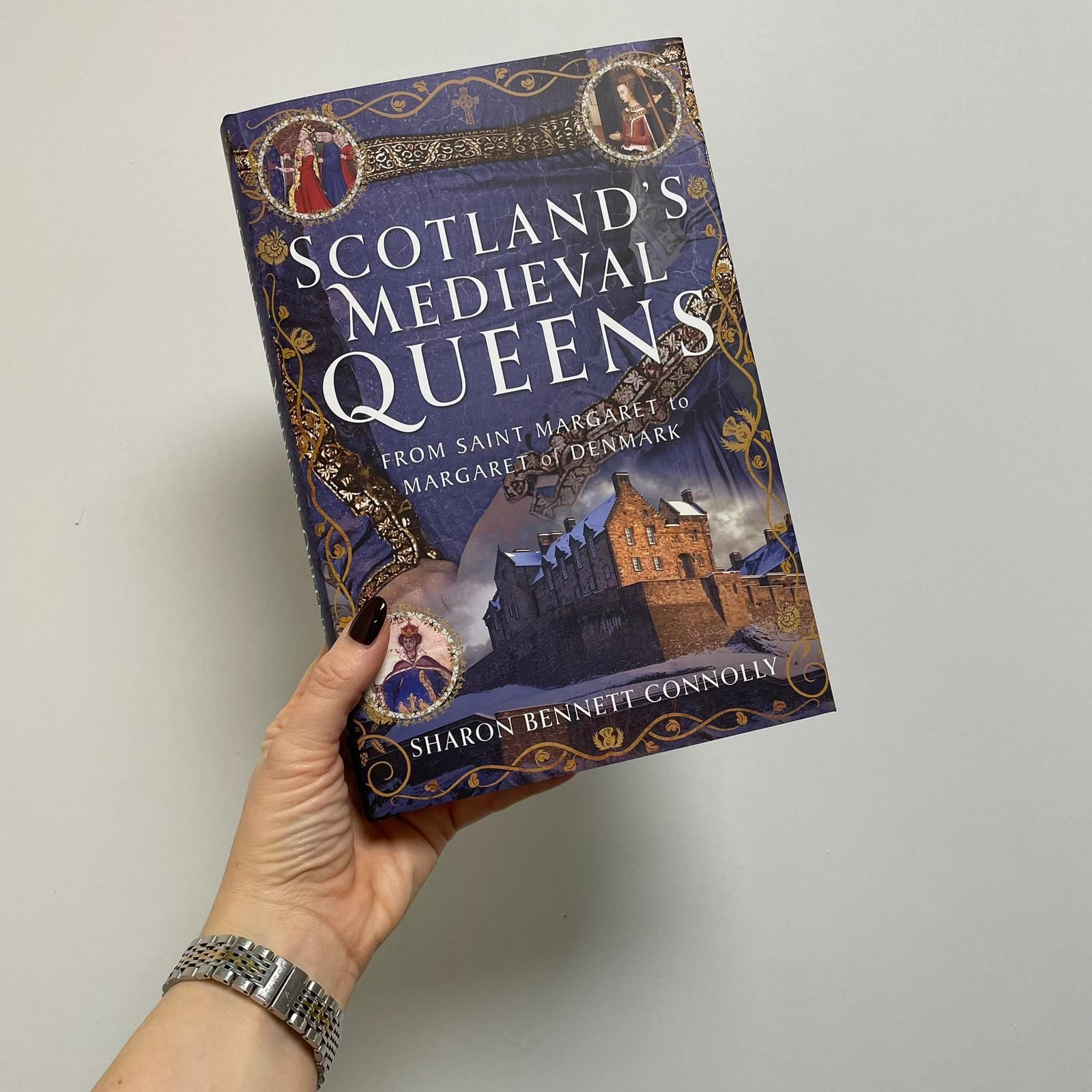


Book Launch: Scotland’s Medieval Queens

It is hard to believe – for me, anyway – that I have now published 8 books. 8! I am still waiting for my author copies of Scotland’s Medieval Queens: From Saint Margaret to Margaret of Denmark, to arrive. But she is out in the world. And I am so proud of this book, not least because it was inspired by my wonderful, history-loving son, Lewis, who instructed me to ‘set the record straight’ for Lady Macbeth. With a prologue dedicated to this maligned woman, labeled a murderer and a madwoman by William Shakespeare, I hope I have done just that. And then there are all the other incredible queens that have sat on Scotland’s throne. Women who have defended the realm, acted as peace weavers, governed for their sons and stood as stalwart supporters of their husbands.

I hope I have done their stories justice.

Zoom Book Launch Party

This is your personal invite to join the celebrations!

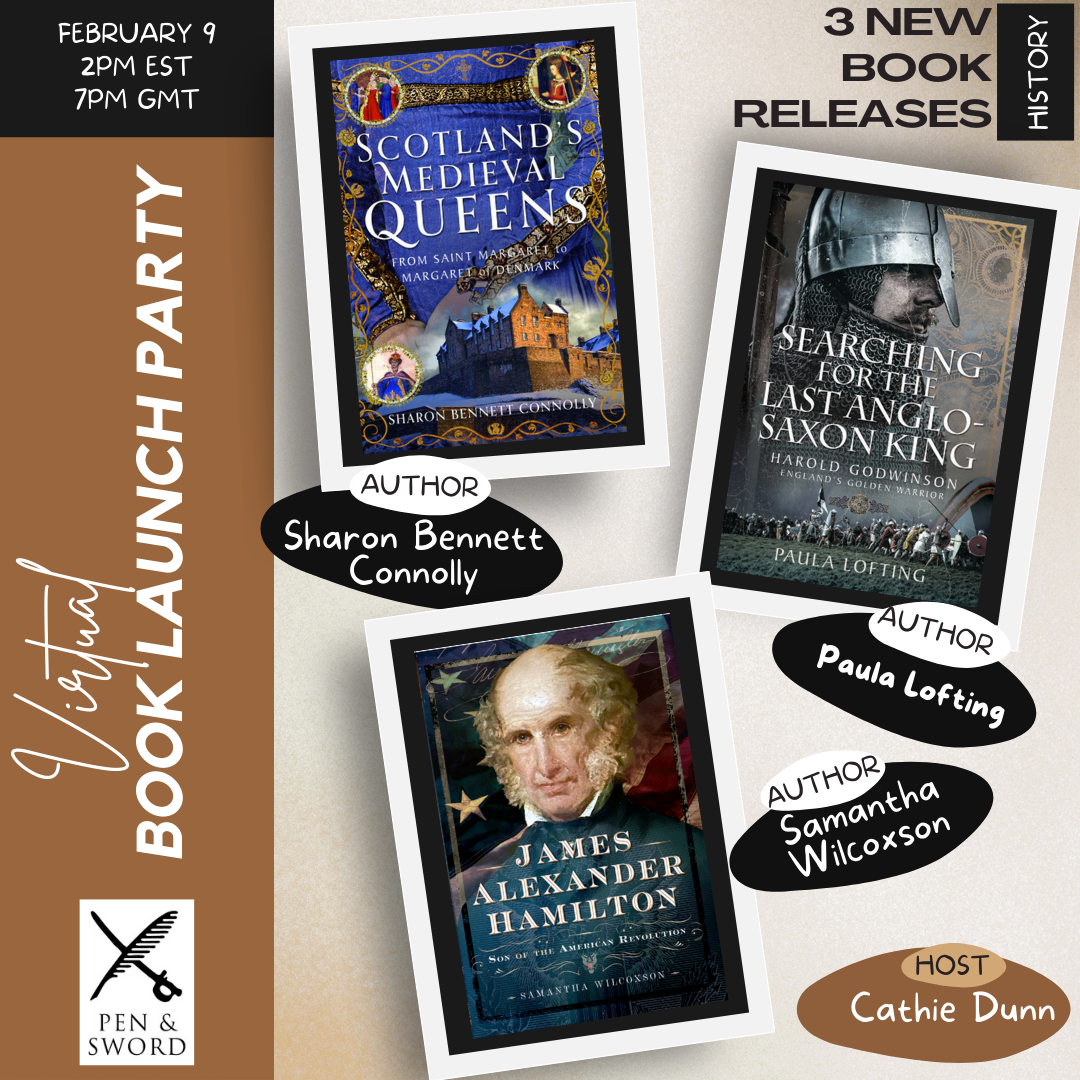
So, why not join me to celebrate the release of Scotland’s Medieval Queens by coming to the Zoom Book Launch Party, held alongside my friends Samantha Wilcoxson and Paula Lofting, who also have books out this week. Hosted by Cathie Dunn, we will each tell you a little about our books, answer questions and generally party!

This Sunday – 9 February 2025 at 7pm UK time.

It is free, you just need to reserve a spot.

Follow the Blog Tour:

Paula, Samantha and I are also taking part in a joint mini blog tour, with 6 days of articles and interviews. I kicked us off on Saturday with an article from Paula Lofting looking into King Harold’s Royal Lineage. Samantha was then interviewed on Paula Lofting’s Threads to the Past. And today, I am talking about one of the less well known queens of Scotland, Sybilla of Normandy with Samantha.

There are 3 more stops on the tour, with Samantha visiting History…the Interesting Bits on 5 February, Paula interviewing me on 6 February and Samantha interviewing Paula on 7 February.

Then party time on 9 February!

Podcast:

Have a listen to the latest episode of A Slice of Medieval podcast. In our Book Launch Special my co-host Derek Birks and I celebrate the launch of both our books. Scotland’s Medieval Queens meets A Guide to the Wars of the Roses. Every episode is also now available on YouTube.

About Scotland’s Medieval Queens: From Saint Margaret to Margaret of Denmark:

Scotland’s history is dramatic, violent and bloody. Being England’s northern neighbour has never been easy. Scotland’s queens have had to deal with war, murder, imprisonment, political rivalries and open betrayal. They have loved and lost, raised kings and queens, ruled and died for Scotland. From St Margaret, who became one of the patron saints of Scotland, to Elizabeth de Burgh and the dramatic story of the Scottish Wars of Independence, to the love story and tragedy of Joan Beaufort, to Margaret of Denmark and the dawn of the Renaissance, Scotland’s Medieval Queens have seen it all. This is the story of Scotland through their eyes.

Available now from Amazon and Pen and Sword Books

©2025 Sharon Bennett Connolly FRHistS 

Book Corner: Women of the American Revolution

Women of the American Revolution will explore the trials of war and daily life for women in the United States during the War for Independence. What challenges were caused by the division within communities as some stayed loyal to the king and others became patriots? How much choice did women have as their loyalties were assumed to be that of their husbands or fathers? The lives of women of the American Revolution will be examined through an intimate look at some significant women of the era. Some names will be familiar, such as Martha Washington who travelled to winter camps to care for her husband and rally the troops or Abigail Adams who ran the family’s farms and raised children during John’s long absences. Elizabeth Schuyler Hamilton is popular for her role in Hamilton the musical, but did you know she was also an early activist working tirelessly for multiple social causes? Decide for yourself if the espionage of Agent 355 or the ride of Sybil Ludington are history or myth. Not all American women served the side of the revolutionaries. Peggy Shippen gambled on the loyalist side and paid severe consequences. From early historian Mercy Otis Warren to Dolley Madison, who defined what it means to be a US First Lady, women of the American Revolution strived to do more than they had previously thought possible during a time of hardship and civil war.

I have to admit, I stepped right out of my comfort zone with Women of the American Revolution by Samantha Wilcoxson. And I know very little about the period – except there was something to do with tea and Boston Harbour – Boston, Massachusetts rather than Boston, Lincolnshire (I am definitely more familiar with the latter!). There was some chap called George Washington, too…

So I was going into this book with a very open mind, eager to learn all I could about the women who helped – or sometimes hindered – in the creation of the United States of America. Women of the American Revolution will certainly give readers a greater understanding of the American Revolution and War of Independence; it fills a gap in the study of the period and is long overdue.

Most books on the American Revolution concentrate on the politics or the military actions, but Samantha Wilcoxson has approached the familiar story from an under represented angle; the women. And what incredible women they were. Some are well known, such as Martha Washington Abigail Adams and Dolley Madison. Others less so famous, such as the mysterious Agent 355. And there is the story of Margaret Shippen Arnold, who was considered incapable of being complicit in her husband’s defection to the British – because she was a woman.

In addition to her household skills, Martha [Washington] was taught to be a lady while confined in corsets that helped form her figure and correct her posture. Virginia ladies of Martha’s time were trained to mimic British aristocracy in their manners and decorum. Simply walking and sitting could be a challenge in the full skirts that were the fashion. Martha apparently learned these skills well, because she flawlessly played the role of hostess as a married woman, even when thrust into the public world as America’s original First Lady (although that title was not used during her husband’s time in office). Her parents ensured that she could ride elegantly in a sidesaddle while maintaining perfect posture. Physical control and poise were also vital when learning to dance, a skill not to be underestimated in its importance in eighteenth century Virginia.

The objective would have been for her to eventually obtain a satisfactory husband, and in this Martha most certainly made her parents proud. Daniel Parke Custis belonged to the closest America had to an aristocracy. Rich and possessing thousands of acres of land, the Custis family was such a step up for Martha that Daniel’s father initially forbade his son to marry her. This is where one gains the first insight into the woman Martha would become. Though only eighteen years old, Martha courageously stood up to her future father-in-law. He had threatened to disinherit Daniel and throw the family silver into the street rather than allow Martha to use it, but she managed to charm him into giving his reluctant blessing. The couple was married when Martha was nineteen years old and her bridegroom was twenty years her senior. This age difference was not uncommon or a barrier to their happiness. The skills Martha had learned at the Dandridge home made her a competent manager of the larger Custis plantation, prophetically named White House.

A large enslaved population made it possible for Daniel and Martha to profitably run the Custis estate. Ne evidence exists that Martha believed owning slaves was immoral or wrong in any way. While she did not support cruel treatment or sales that broke up families, Martha also could not understand when enslaved people ran away from what she felt was a comfortable home. It was a lifestyle she had been born into and never questioned, even as the colonies strived toward their freedom.

Women of the American Revolution is a wonderful collection of the stories of the most remarkable women of the era. Through the historical record and their own letters Samantha Wilcoxson has brought these women back to life, their stories as vivid as they must have been over 200 years ago. The books combines the women’s involvement in the national and international politics and events of the day with their day-to-day lives as wives and mothers. It is an illuminating and informative book on so many levels.

Women of the American Revolution tells the story of these remarkable women, warts and all, but does not try to attach modern-day morals on people who lived so many generations ago. In this way, Samantha Wilcoxson does not ignore the women’s attitude to slavery, or to female emancipation, but explains them in the context of the time. The abundance of letters written by some of the women provide a unique insight into their minds, and into the times they lived in.

And I have to say Samantha Wilcoxson has written an eminently accessible book, whether you are knowledgeable of the era or not. Her research is thorough and impeccable and presented in a beautifully written volume that will stand proud in any library. By focusing on the women, Women of the American Revolution fills a gap in the history and study of the American Revolution. Without a study of the women of the time, no history of any period is complete.

This is Samantha Wilcoxson’s first foray into non-fiction but I truly hope she will write more!

Women of the American Revolution by Samantha Wilcoxson is an informative and entertaining read. I loved this book! And I learned so much! I cannot recommend it highly enough.

To Buy the Book:

Women of the American Revolution by Samantha Wilcoxson is available now from Amazon and Pen and Sword in the UK. It is available for pre-order on Amazon in the US and is now available worldwide from Book Depository.

About the Author:

Samantha Wilcoxson is an author of historical fiction and administrator of a history blog. She has written four full-length novels, three novellas, and two middle grade chapter books. Topics of her writing have ranged from the Wars of the Roses to America’s Civil Rights Movement. Samantha is passionate about history and exploring the personal side of events. In her writing, she urges the reader to truly experience what it might have felt like to live through a moment in history. Samantha’s most recent novel is biographical fiction featuring Catherine Donohue, one of America’s “radium girls.” She is currently working on a novelization of the life of Nathan Hale, and features in Hauntings, an anthology published by the Historical Writers Forum.

*

My books:

Signed, dedicated copies of all my books are available, please get in touch by completing the contact me form.

Defenders of the Norman Crown: The Rise and Fall of the Warenne Earls of Surrey tells the fascinating story of the Warenne dynasty, of the successes and failures of one of the most powerful families in England, from its origins in Normandy, through the Conquest, Magna Carta, the wars and marriages that led to its ultimate demise in the reign of Edward III. Defenders of the Norman Crown: Rise and Fall of the Warenne Earls of Surrey is now available from Pen & Sword BooksAmazon in the UK and US, Bookshop.org and Book Depository.

1 family. 8 earls. 300 years of English history!

Also by Sharon Bennett Connolly:

Ladies of Magna Carta: Women of Influence in Thirteenth Century England looks into the relationships of the various noble families of the 13th century, and how they were affected by the Barons’ Wars, Magna Carta and its aftermath; the bonds that were formed and those that were broken. It is now available in paperback and hardback from Pen & Sword,  AmazonBookshop.org and from Book Depository worldwide.

Heroines of the Medieval World tells the stories of some of the most remarkable women from Medieval history, from Eleanor of Aquitaine to Julian of Norwich. Available now from Amberley Publishing and Amazon, Bookshop.org and Book Depository.

Silk and the Sword: The Women of the Norman Conquest traces the fortunes of the women who had a significant role to play in the momentous events of 1066.  Available now from Amazon,  Amberley Publishing, Bookshop.org and Book Depository.

Alternate endings: An anthology of historical fiction short stories including Long Live the King… which is my stake what might have happened had King John not died in October 1216. Available in paperback and kindle from Amazon.

*

You can be the first to read new articles by clicking the ‘Follow’ button, liking our Facebook page or joining me on Twitter and Instagram.

*

©2022 Sharon Bennett Connolly FRHistS.

Guest Post: Revolutionary Female Friends by Samantha Wilcoxson

Today it is a pleasure to welcome Samantha Wilcoxson to History the Interesting Bits…. with an article about Mercy Otis Warren and her friend Catharine Macauley. Samantha’s new book Women of the American Revolution – her first non-fiction – provides a fabulous insight into the often-overlooked and severely underestimated women of the period. It is truly illuminating!

Revolutionary Female Friends: Mercy Otis Warren and Catharine Macaulay

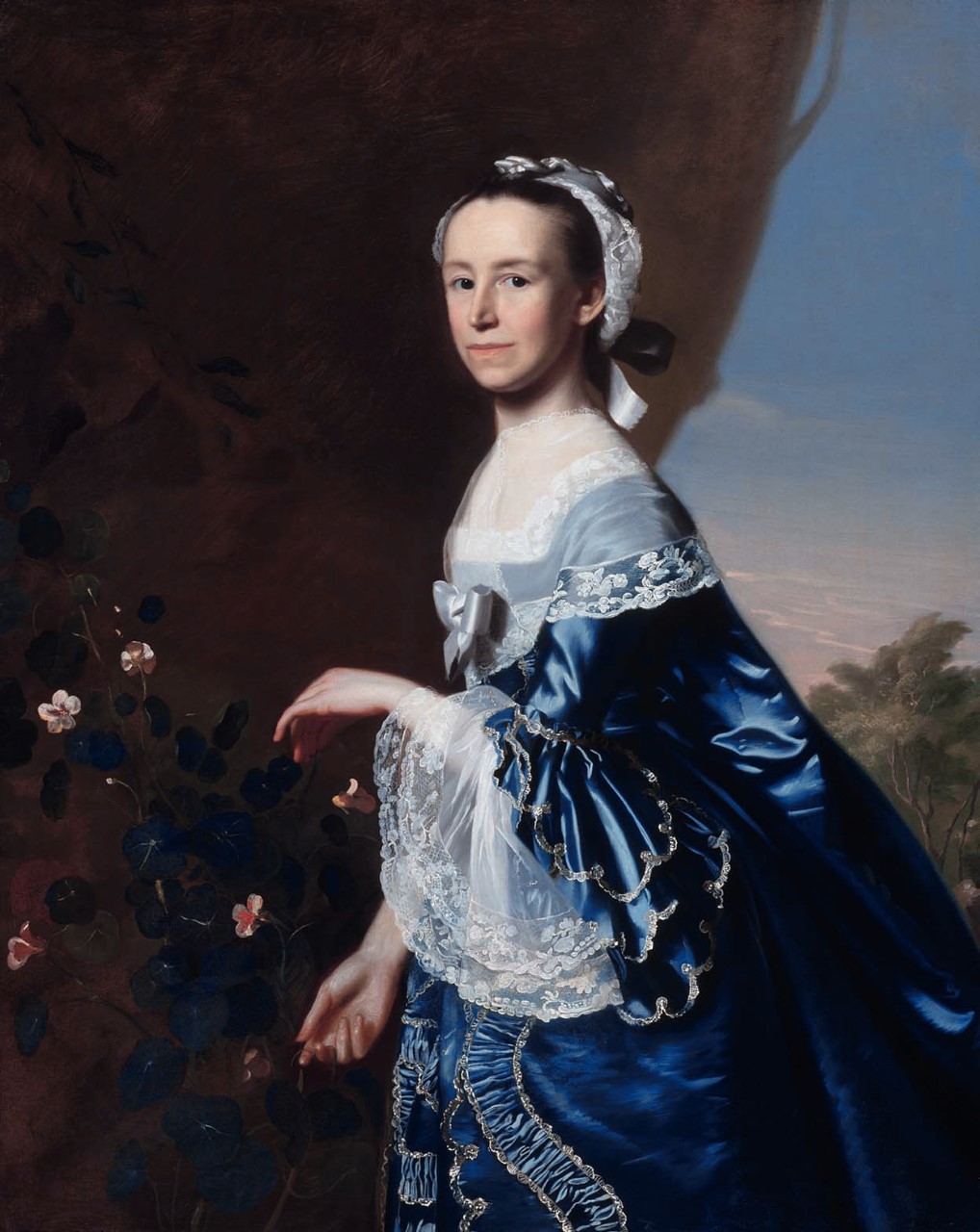
Mercy Otis Warren by John Singleton Copley

In July 1784, Catharine Macaulay arrived in America where she visited Mercy Otis Warren. One wonders if those around them appreciated the historic value of this meeting between two early female historians. Catharine in England and Mercy in America had each written multiple works responding to events of the day in an era when women were not expected to discuss politics let alone write about it. Finally meeting after years of letter writing, it must have been an exciting introduction.

Catharine was outspoken and published in her own name, while Mercy’s satirical plays had been published anonymously. Boldly writing to American patriots to offer her support, Catharine initially corresponded with Mercy’s brother, James Otis Jr, who Catharine wrote was ‘the great guardian of American liberty.’

When James suffered from mental instability following a beating by British customs agents, Mercy took over the correspondence. Both women made astute observations on the evolving political situation. In 1767, Macaulay prophetically wrote that a democratic republic was the ‘only form of government….capable of preserving dominion and freedom to the people.’ The following year, Mercy foresaw that when British soldiers arrived in Boston ‘The American War may be dated from the hostile parade of this day.’

Catharine watched the Revolution from a distance, supporting the American colonies and encouraging members of parliament to consider their position and negotiate rather than losing them altogether. The opposite course was taken with British troops sent to Boston in 1768 and the Coercive Acts passed in 1774. Mercy had an insider’s view of the Revolution. Her husband, another James, served as Paymaster-General, was appointed to the Continental Congress, and sat on the Continental Navy Board. While Mercy was a patriot, she worried about her five sons ‘who must buckle on the harness. And perhaps fall a sacrifice to the manes of liberty.’

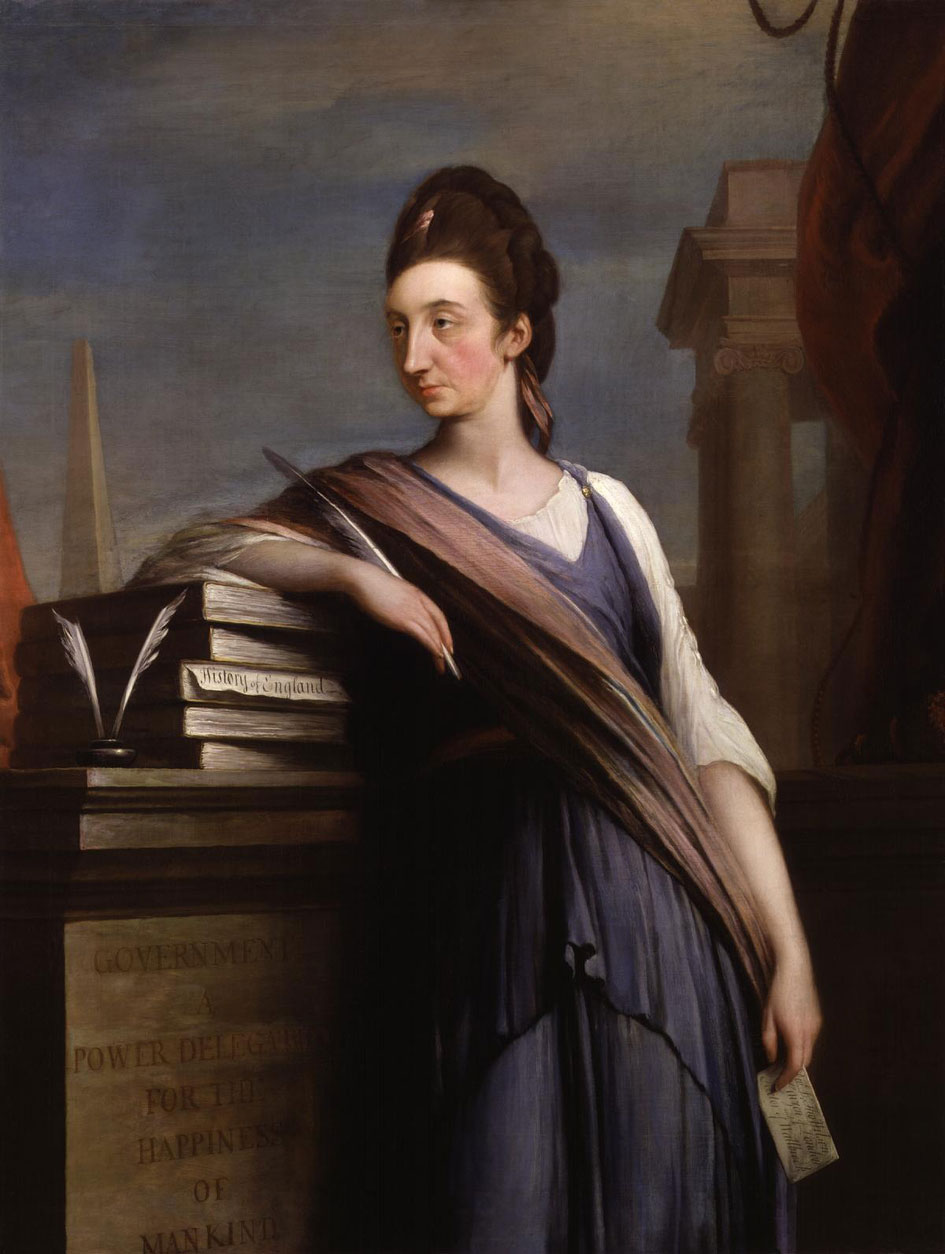
Catharine Macauley

When Mercy met Catharine in person for the first time in 1784, she had lost no sons to war, though one had been severely wounded. Perhaps it was not until this meeting that the women realized how different they were. Through letters which focused on their shared political ideas and observations, they may have been convinced that they held more in common that they did.

Catharine arrived in America with a new, young husband. William Graham was twenty-one when he married the forty-seven-year-old Catharine six years earlier. Mercy, who frequently gave her sons moral lectures in her letters, would have been shocked by this relationship and the rumors that Catherine also had an affair with her brother-in-law. The values of simplicity and frugality held by Mercy were not as closely held by Catharine, who patronized the Sans Souci, a fashionable club that Mercy believed was the sort of establishment that would lead the new nation into a rapid decline.

Despite a falling out over their differences on morality, Mercy and Catharine salvaged their friendship before Catharine left America. They continued their correspondence, debating the strengths and weaknesses of the proposed US Constitution as fervently as the men in congress.

Mercy opposed the ratification of the Constitution and attempted to influence state leaders with a pamphlet titled Observations on the New Constitution, and on the Federal and State Conventions by a Columbian Patriot. She was concerned that individual rights were not established in the Constitution. While some states requested the addition of a Bill of Rights, none made their ratification dependent upon it. In a moment of frustration over the course the country was taking, Mercy wrote to Catharine in 1789, ‘we are too poor for Monarchy, too wise for Despotism, and too dissipated, selfish, and extravagant for Republicanism.’

Mercy’s History

Catharine wrote a letter to George Washington, who she had met during her year in America, congratulating him ‘on the event which placed you at the head of the American government.’ She was also not afraid to share her opinions with him warning of growing inequality between two houses of legislature and the possibility of the ‘evils of Aristocracy’ which America had thus far been ‘exempt from.’

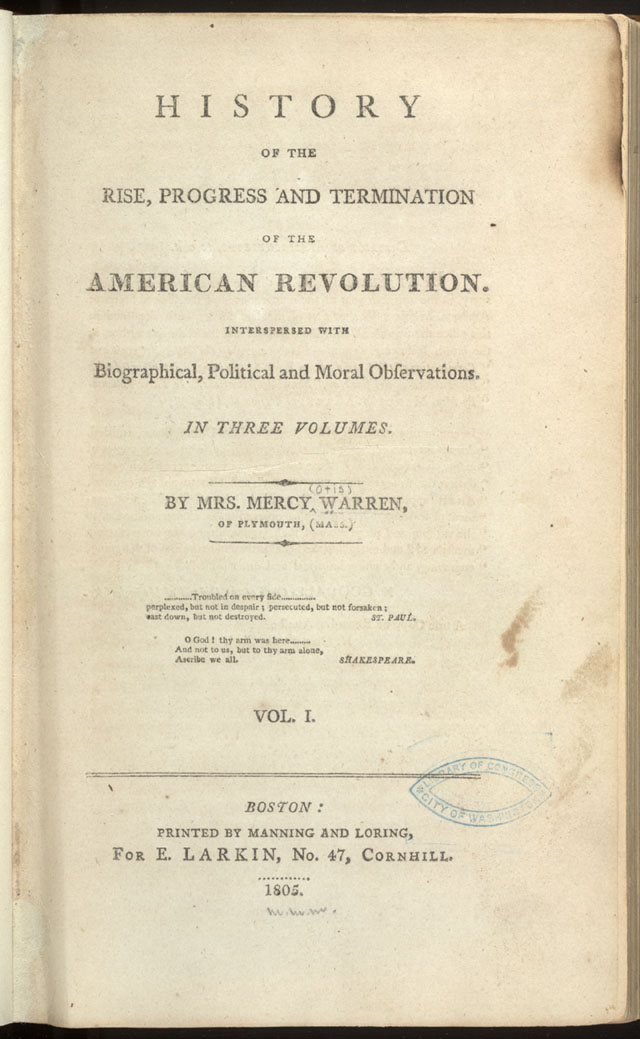
Mercy and Catharine, through their epistolatory relationship, discussed the French Revolution, the writing of Edmund Burke, women’s rights, and any number of topics that 18th century women were not meant to discuss. Their civil discourse came to an end with Catharine’s death on 22 June 1791. Mercy finally published her History of the Rise, Progress, and Termination of the American Revolution at age seventy-seven in 1805. She died on 19 October 1814 during the War of 1812, which solidified the independent status of the United States of America.

Sources:

The Muse of the Revolution: The Secret Pen of Mercy Otis Warren and the Founding of a Nation by Nancy Rubin Stuart https://www.mountvernon.org/library/digitalhistory/digital-encyclopedia/article/catharine-sawbridge-macaulay-graham-1731-1791/ https://allthingsliberty.com/2019/10/catharine-macaulay-her-final-gifts-to-america-and-france-1787-1791

To Buy the Book:

Women of the American Revolution by Samantha Wilcoxson is available now from Amazon and Pen and Sword in the UK. It is available for pre-order on Amazon in the US and is now available worldwide from Book Depository.

About the book:

Women of the American Revolution will explore the trials of war and daily life for women in the United States during the War for Independence. What challenges were caused by the division within communities as some stayed loyal to the king and others became patriots? How much choice did women have as their loyalties were assumed to be that of their husbands or fathers? The lives of women of the American Revolution will be examined through an intimate look at some significant women of the era.

Some names will be familiar, such as Martha Washington who travelled to winter camps to care for her husband and rally the troops or Abigail Adams who ran the family’s farms and raised children during John’s long absences. Elizabeth Schuyler Hamilton is popular for her role in Hamilton the musical, but did you know she was also an early activist working tirelessly for multiple social causes? Decide for yourself if the espionage of Agent 355 or the ride of Sybil Ludington are history or myth. Not all American women served the side of the revolutionaries. Peggy Shippen gambled on the loyalist side and paid severe consequences. From early historian Mercy Otis Warren to Dolley Madison, who defined what it means to be a US First Lady, women of the American Revolution strived to do more than they had previously thought possible during a time of hardship and civil war.

About the Author:

Samantha Wilcoxson is an author of historical fiction and administrator of a history blog. She has written four full-length novels, three novellas, and two middle grade chapter books. Topics of her writing have ranged from the Wars of the Roses to America’s Civil Rights Movement. Samantha is passionate about history and exploring the personal side of events. In her writing, she urges the reader to truly experience what it might have felt like to live through a moment in history. Samantha’s most recent novel is biographical fiction featuring Catherine Donohue, one of America’s “radium girls.” She is currently working on a novelization of the life of Nathan Hale, and features in Hauntings, an anthology published by the Historical Writers Forum.

*

My books:

Signed, dedicated copies of all my books are available, please get in touch by completing the contact me form.

Defenders of the Norman Crown: The Rise and Fall of the Warenne Earls of Surrey tells the fascinating story of the Warenne dynasty, of the successes and failures of one of the most powerful families in England, from its origins in Normandy, through the Conquest, Magna Carta, the wars and marriages that led to its ultimate demise in the reign of Edward III. Defenders of the Norman Crown: Rise and Fall of the Warenne Earls of Surrey is now available from Pen & Sword BooksAmazon in the UK and US, Bookshop.org and Book Depository.

1 family. 8 earls. 300 years of English history!

Also by Sharon Bennett Connolly:

Ladies of Magna Carta: Women of Influence in Thirteenth Century England looks into the relationships of the various noble families of the 13th century, and how they were affected by the Barons’ Wars, Magna Carta and its aftermath; the bonds that were formed and those that were broken. It is now available in paperback and hardback from Pen & Sword,  AmazonBookshop.org and from Book Depository worldwide.

Heroines of the Medieval World tells the stories of some of the most remarkable women from Medieval history, from Eleanor of Aquitaine to Julian of Norwich. Available now from Amberley Publishing and Amazon, Bookshop.org and Book Depository.

Silk and the Sword: The Women of the Norman Conquest traces the fortunes of the women who had a significant role to play in the momentous events of 1066.  Available now from Amazon,  Amberley Publishing, Bookshop.org and Book Depository.

*

You can be the first to read new articles by clicking the ‘Follow’ button, liking our Facebook page or joining me on Twitter and Instagram.

©2022 Sharon Bennett Connolly

Guest Post: Failed Spies: Hale and André by Samantha Wilcoxson

Today, is is a pleasure to welcome Samantha Wilcoxson to History … the Interesting Bits, with an article about the research into her latest novel, But One Life, set during the American Revolution.

Failed Spies: Hale and André

Espionage played an important role during the American Revolution, with both sides in the conflict experiencing some victories and tragic defeats in this area. British spymasters had the advantages of experience and expertise, while Americans benefited from working in their native land with a better idea of who could be trusted and who could not. Very early in the conflict, General George Washington stated his desperate need for knowledge of the enemy.

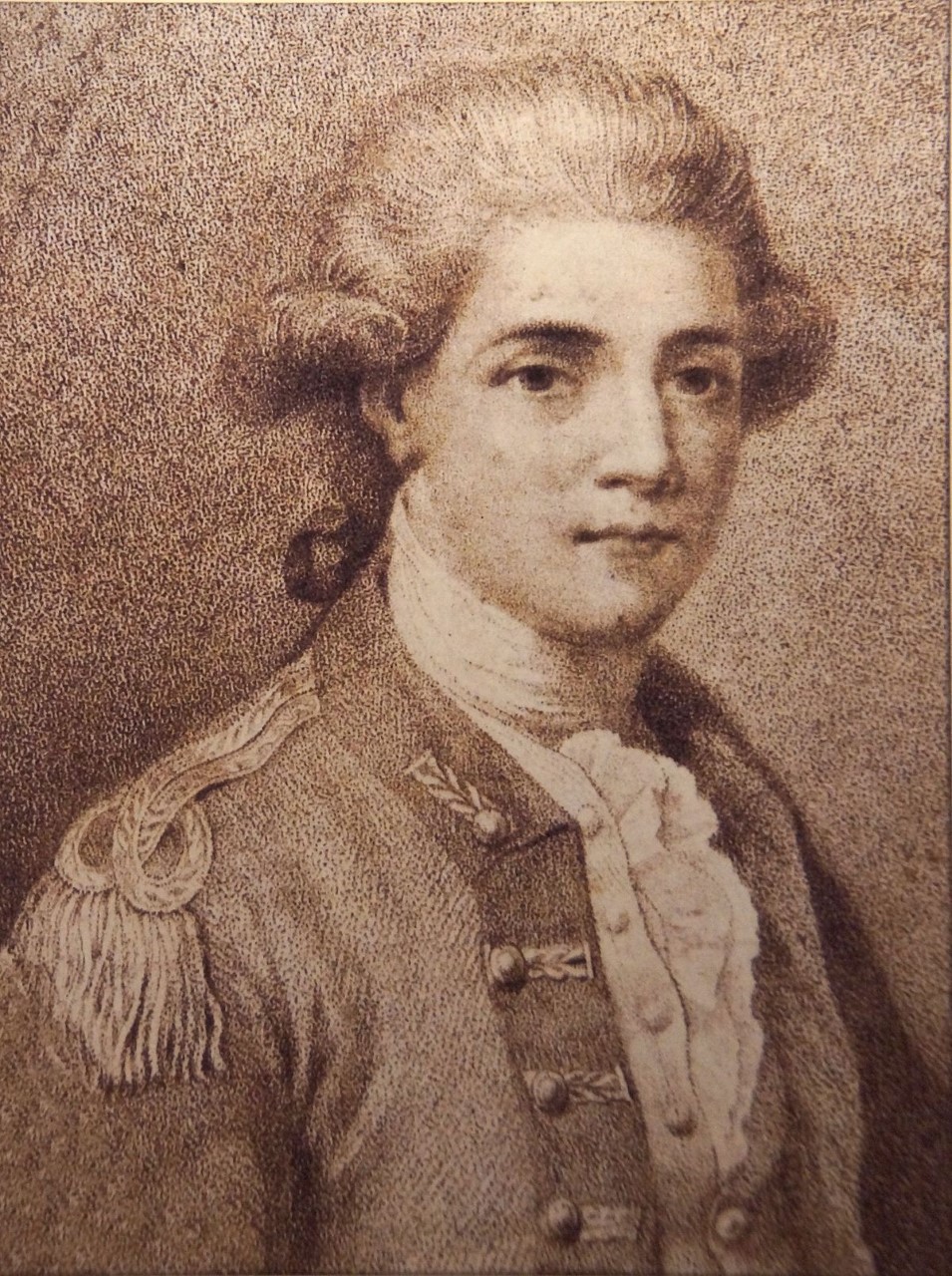
Major John André

‘I do most earnestly entreat you and General Clinton to exert yourselves to accomplish this most desirable end. Leave no stone unturned, nor do not stick at expense, to bring this to pass, as I was never more uneasy than on account of my want of knowledge on this score,’ Washington wrote to General William Heath seventeen days before Captain Nathan Hale was hanged as a rebel spy on 22 September 1776.

Today, Nathan Hale is remembered as the quintessential patriot. He was recently graduated from Yale when he joined the Continental Army with many other young men of his acquaintance. When he learned that a volunteer was needed to discover the information needed by Washington, he did not hesitate, despite the advice of many friends who insisted he was not well-suited to the mission.

It was not only because of his open, honest personality that they attempted to dissuade him. Spywork was considered a low, dishonorable duty. One friend, who tried to talk Hale out of his mission, reported later that Hale had insisted, ‘I wish to be useful, and every kind of service, necessary to the public good, becomes honorable by being necessary.’

Whether due to pride or excessive patriotism, Hale set forth upon a mission to Long Island, New York, his Yale diploma in hand to support his disguise as a Latin tutor. Hale had briefly served as a schoolmaster between graduation and army service, so his ruse should have come naturally to him. However, he was a trusting and friendly man, unlike the clever spy-catchers employed by the British. Within days of leaving his regiment, Hale was captured and executed, possibly with a paraphrase of Cato on his lips that his only regret was that he had but one life to give for his country. His body was left hanging for days to warn other would-be spies.

In the meantime, Major John André was making a name for himself in the British ranks as one who had connections and could get information. He was, like Hale, young, erudite, and eager to serve his country. André believed he had found the key to securing his future when he received correspondence from American General Benedict Arnold. The hero of Saratoga was willing to turn his coat for the right price.

Continental Commission for Nathan Hale

Arnold had married Peggy Shippen a month earlier, and she was friends, or possibly more, with André. Together, they convinced the general that the British would show him greater appreciation and compensation, and they were bound to win the war anyway. In the spring of 1780, Arnold informed André that he was expecting to gain command of West Point, an important series of forts that controlled traffic on the Hudson River. He was willing to turn it over to the British in return for cash and a position in British command.

On 21 September 1780, almost precisely four years after the death of Nathan Hale, John André was captured after a secret meeting with General Benedict Arnold to finalize their plan. He begged that Washington treat him as an officer rather than a spy.

‘Let me hope, Sir, that if aught in my character impresses you with esteem towards me, if aught in my misfortune marks me as the victim of policy and not resentment, I shall experience the operation of these feelings in your breast by being informed that I am not to die on a gibbet.’ Washington refused his request, and André was hanged on 2 October 1780.

Other American espionage efforts were more successful than Hale’s, most notably the Culper Spy Ring, managed by Hale’s good friend and Yale classmate, Benjamin Tallmadge. The names of those involved in this successful ring were not revealed until over a century after the war had ended. Tallmadge also played a part in John André’s capture. One can imagine he had a sense of justice served as Hale’s British counterpart shared his fate.

But One Life by Samantha Wilcoxson is now available from Amazon.

Sources:

Spies, Patriots, and Traitors: American Intelligence in the Revolutionary War by Kenneth A Daigler

Documentary Life of Nathan Hale by George D Seymour

The Life of John André: The Redcoat who Turned Benedict Arnold by DAB Ronald

To Buy the book:

But One Life is now available from Amazon

About the author:

Writer of historical fiction and sufferer of wanderlust, Samantha enjoys exploring the lives of historical figures through research and visiting historic places. Certain that no person is ever purely good or evil, she strives to reveal the deep emotions and motivations of historical figures, enabling readers to connect with them in a unique way. Samantha is an American writer with British roots and proud mother of three amazing young adults. She can frequently be found lakeside with a book in one hand and glass of wine in the other.

Samantha’s next project will take readers into the lives of women of the American Revolution – stay tuned!

*

My Books

Signed, dedicated copies of all my books are available, please get in touch by completing the contact me form.

Defenders of the Norman Crown: The Rise and Fall of the Warenne Earls of Surrey tells the fascinating story of the Warenne dynasty, of the successes and failures of one of the most powerful families in England, from its origins in Normandy, through the Conquest, Magna Carta, the wars and marriages that led to its ultimate demise in the reign of Edward III. Defenders of the Norman Crown: Rise and Fall of the Warenne Earls of Surrey is now available from Pen & Sword BooksAmazon in the UK and US, Bookshop.org and Book Depository.

1 family. 8 earls. 300 years of English history!

Also by Sharon Bennett Connolly:

Ladies of Magna Carta: Women of Influence in Thirteenth Century England looks into the relationships of the various noble families of the 13th century, and how they were affected by the Barons’ Wars, Magna Carta and its aftermath; the bonds that were formed and those that were broken. It is now available in paperback and hardback from Pen & Sword,  AmazonBookshop.org and from Book Depository worldwide.

Heroines of the Medieval World tells the stories of some of the most remarkable women from Medieval history, from Eleanor of Aquitaine to Julian of Norwich. Available now from Amberley Publishing and Amazon, Bookshop.org and Book Depository.

Silk and the Sword: The Women of the Norman Conquest traces the fortunes of the women who had a significant role to play in the momentous events of 1066.  Available now from Amazon,  Amberley Publishing, Bookshop.org and Book Depository.

*

You can be the first to read new articles by clicking the ‘Follow’ button, liking our Facebook page or joining me on Twitter and Instagram.

©2022 Sharon Bennett Connolly and Samantha Wilcoxson

Book Corner: Inspiration for Hauntings by Samantha Wilcoxson

Inspiration for Among the Lost

By Samantha Wilcoxson

My family and I took a trip to Traverse City, Michigan last autumn. While this trip had nothing to do with anything I was writing, my youngest son would be quick to tell you that I always find some sort of historic site to visit anywhere we go. In Traverse City, that place ended up being the former Northern Michigan Asylum, now reinvented as The Village at Grand Traverse Commons.

The Northern Michigan Asylum was built in 1883-1885, including Building 50, the main structure which is almost a quarter of a mile long. More buildings were added over the years to serve patients that were sent from around the state of Michigan. Men, women, and children were segregated in addition to patients being separated according to condition. ‘Beauty is therapy’ was a famous slogan, referring to founding Medical Superintendent Dr James Munson’s belief that the gorgeous natural surroundings of the area would help the patients heal.

Traverse City is gorgeous with the beautiful blue waters of the bay in the summer and an extraordinary kaleidoscope of trees in the autumn. Certainly, some did find healing in the natural surroundings. The buildings of the asylum were carefully crafted with high ceilings, transom windows, and rounded corners to create a bright, safe atmosphere. The grounds include a grove of trees where no two are alike. The variety was collected by Dr James Munson during his travels. One can envision what the place was like when it was new and filled with hopeful nurses and their charges.

However, as we toured the abandoned, dilapidated structures, it was just as easy to imagine that darker things had taken place as well. Old lead paint is peeling from the walls, and the lack of electricity forced us to light our way with flashlights. Shattered windows and graffiti brought to mind broken souls and nefarious deeds that might have taken place within those walls.

I had not planned on writing anything about the asylum, but when the suggestion of an anthology of historical ghost stories was put forward, I knew just where mine would take place. The mysterious steam tunnels and creamy stone structures topped by red spires suddenly seemed the perfect setting for a young nurse to encounter strange happenings. A ghost may not be the worst being she discovers.

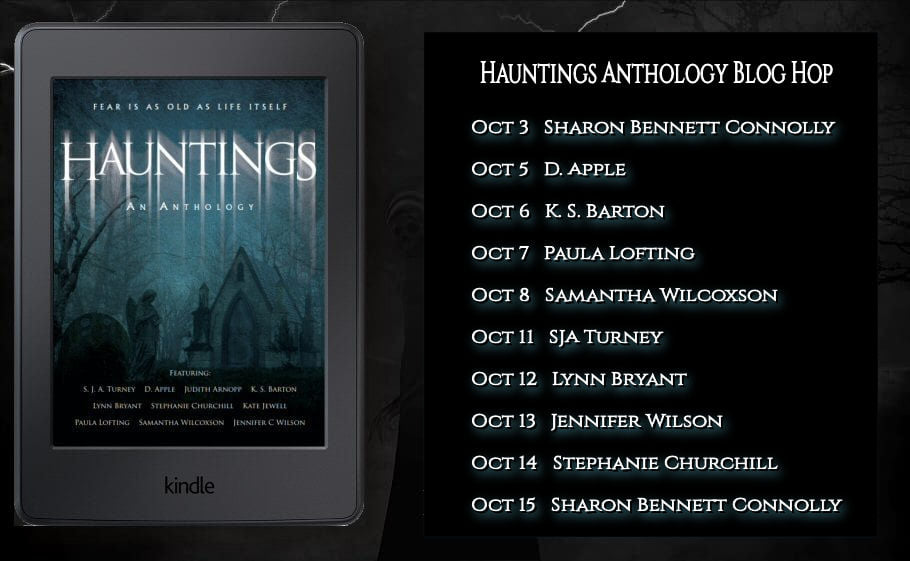
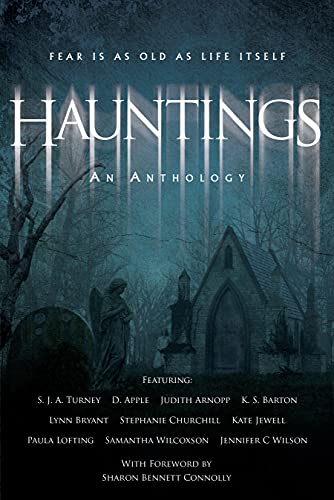
Hauntings

FEAR IS AS OLD AS TIME ITSELF
Chilling Tales that will take you through a labyrinth of historical horror.
You will encounter a tormented Roman general.
A Norse woman who must confront her terrifying destiny.
Meet a troubled Saxon brother, searching for his twin’s murderer.
A young nurse tries to solve the mysteries of an asylum for the insane.Down the passages of time, Henry VIII and Anne Boleyn wander through a haunted garden and elsewhere,
a lost slave girl is the soul survivor of a mass slaughter.

These are just a few of the eerie tales which ensure that Hauntings is not for the faint-hearted.

Hauntings is an anthology of stories that span 2,000 years of history. Featuring short stories by S.J.A. Turney, D. Apple, Judith Arnopp, K.S. Barton, Lynn Bryant, Paula Lofting, Stephanie Churchill, Samantha Wilcoxson, Jennifer C. Wilson and Kate Jewell, and with a foreword by yours truly!

now available as an ebook from Amazon in the UK and the US and will be available in paperback shortly.

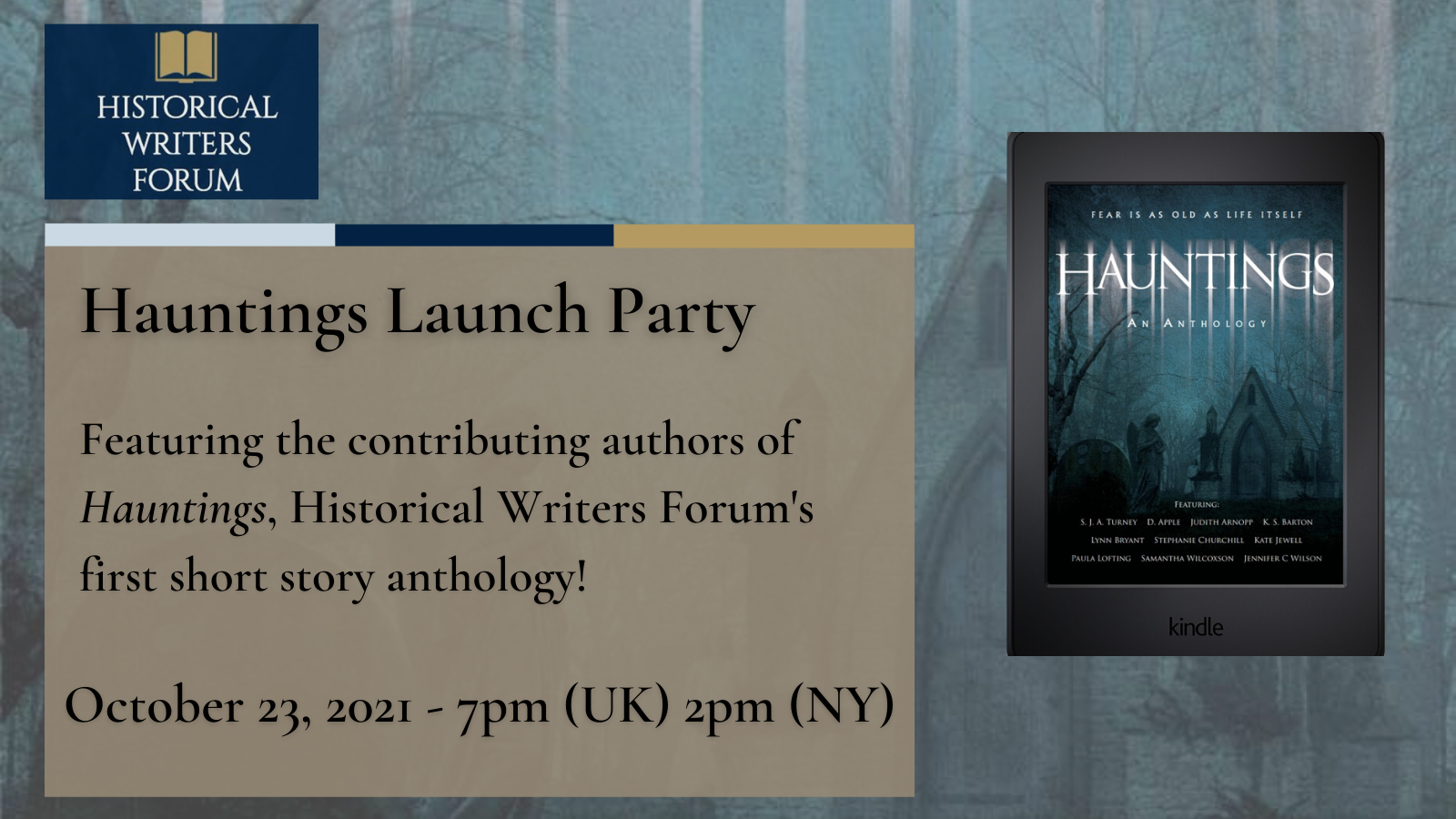
Hauntings Launch Party!

And we’re having a launch party over Zoom.

Meet the authors and hear the stories behind the stories. It’s free. Come and join us!

It’s on Saturday 23 October at 7pm (UK time) – 2 pm if you’re in New York! Book here!

My Books

Signed, dedicated copies of all my books are available, please get in touch by completing the contact me form.

Defenders of the Norman Crown: The Rise and Fall of the Warenne Earls of Surrey tells the fascinating story of the Warenne dynasty, of the successes and failures of one of the most powerful families in England, from its origins in Normandy, through the Conquest, Magna Carta, the wars and marriages that led to its ultimate demise in the reign of Edward III. Defenders of the Norman Crown: Rise and Fall of the Warenne Earls of Surrey is now available from Pen & Sword BooksAmazon in the UK and US and Book Depository.

1 family. 8 earls. 300 years of English history!

Also by Sharon Bennett Connolly:

Ladies of Magna Carta: Women of Influence in Thirteenth Century England looks into the relationships of the various noble families of the 13th century, and how they were affected by the Barons’ Wars, Magna Carta and its aftermath; the bonds that were formed and those that were broken. It is now available in paperback and hardback from Pen & Sword,  Amazon and from Book Depository worldwide.

Heroines of the Medieval World tells the stories of some of the most remarkable women from Medieval history, from Eleanor of Aquitaine to Julian of Norwich. Available now from Amberley Publishing and Amazon and Book Depository.

Silk and the Sword: The Women of the Norman Conquest traces the fortunes of the women who had a significant role to play in the momentous events of 1066.  Available now from Amazon,  Amberley Publishing, Book Depository.

*

You can be the first to read new articles by clicking the ‘Follow’ button, liking our Facebook page or joining me on Twitter and Instagram.

©2021 Sharon Bennett Connolly

Book Launch: Hauntings, An Anthology

FEAR IS AS OLD AS TIME ITSELF
Chilling Tales that will take you through a labyrinth of historical horror.
You will encounter a tormented Roman general.
A Norse woman who must confront her terrifying destiny.
Meet a troubled Saxon brother, searching for his twin’s murderer.
A young nurse tries to solve the mysteries of an asylum for the insane.

Down the passages of time, Henry VIII and Anne Boleyn wander through a haunted garden and elsewhere,
a lost slave girl is the soul survivor of a mass slaughter.

These are just a few of the eerie tales which ensure that Hauntings is not for the faint-hearted.

Hauntings, an Anthology

Since time immemorial, people have sat around the hearth, in the dark of night with storms raging outside, telling each other ghost stories. Even the fairy tales told to children over the centuries have bordered on horror stories, with a wicked stepmother here, an evil witch there and the candy-selling man who turned out to be a child-catcher; all just waiting to scare and horrify the unsuspecting. Many were moralising tales, told to scare children into being good. But the effects linger. As children become teenagers, they tell scarier stories, staying up late into the night on sleepovers and camping expeditions. The aim has always been to frighten and entertain with ever greater levels of horror, often shining torches into their faces at odd angles to create special effects.

The enduring need to push our fear to the limits has been with us since childhood.

Such camp-fire tales belie the fact that horror and ghost stories have a place deep in the culture of society. They have always been a way to explain the unexplainable.

We have all had that moment, that sense of being watched. But when we turn around, there is no one there…

Or seen that movement out of the corner of our eye…

The room suddenly turning cold for no reason…

The most famous incident of this kind gave birth to not only the vampire but also what is probably the most famous horror story of all time. And it started, as it always does, with a gathering of friends, in their late teens and early 20s, trying to shock and scare each other as a storm raged outside.

Europe had just emerged from its own horror story. Over twenty-five years of warfare had ignited with the French Revolution in 1789 and ended on the battlefield of Waterloo in June 1815, raging across Europe, from the Iberian Peninsula to frozen Russia and even venturing into Africa. A generation had grown up with the shadow of war looming over them. This man-made tragedy had been exacerbated by volcanic eruptions, famine and epidemics; the volcanic ash would cause 3 years of darkness, crop failure and cholera outbreaks. It was a time ripe for dark and desperate literary endeavours.

In the aftermath of Waterloo, a young couple, Mary Wollstonecraft Godwin, her lover Percy Bysshe Shelley, travelled to Lake Geneva in May 1816, ostensibly looking for rest and relaxation. Their party included their four-month-old baby and Mary’s stepsister, Claire Clairmont. At the time, Claire was pregnant with a child by Lord Byron, the ground-breaking poet whose personal affairs and love life had proved too scandalous for England. Most recently he had divorced his wife, abandoning his young daughter, Ada Lovelace, and, so rumour had it, pursued an affair with his own half-sister. Plagued by gossip and debt, he had left England for Europe. Claire, it seems, had decided to surprise her lover by following him.

Mary had fallen in love with Percy in 1814; the couple had run away together, despite Percy already being married, and travelled around Europe for the next 2 years. After Byron left England, a distraught Claire convinced Mary and Percy to travel to Geneva with her. A few days later, Byron—clearly unaware that Claire would be there—arrived in town. Mary, whose own love life not without controversy, sympathized with the scandalous poet.

With Percy and Lord Byron soon forming an intense friendship, the small party abandoned their various travel plans and rented properties close to each other along Lake Geneva. They would gather together in the long, dark, cold evening at the Villa Diodati, the stately mansion Byron had rented for his stay along with John Polidori, his doctor. They read poetry, argued, and talked late into the night. After three nights of the party being trapped inside by the raging storm, tensions were running high. Byron was annoyed by Claire’s obsessive attentions, Mary likewise had to fend off the unwanted attentions of the equally obsessive Doctor Polidori.

They spent their evenings reading horror stories and ghostly poems to each other until one night, they were given a challenge. Byron proposed they each write a ghost story that was better than the ones they had just read. Inspired by a tale of Byron’s, Polidori produced his novella “The Vampyre,” which would be published in 1819. It is the first work of fiction to include a blood-sucking hero—which may have been modelled on Byron himself. Mary took a little longer to settle on the subject of her story but after a long, sleepless night she produced her offering, Frankenstein, or the Modern Prometheus. Considering what happens when men play gods, and perhaps with the upheaval of the last three decades in her mind, she would later call the story her “hideous progeny”.

Frankenstein would be Mary Shelley’s enduring legacy and the inspiration for so many hopeful writers.

Fast forward a little over 200 hundred years. The year was 2020, the world was in the midst of a pandemic of horrifying proportions. Travel to the neighbouring town was frowned upon, you were allowed out for exercise once a day, families were forced apart, the schools closed and writers the world over were sat in their studies, or at their kitchen tables, tapping away on keyboards, alone, solitary…

Well, not quite…

We now have the internet, so when you are alone, you are still not totally alone. Once again, with the storm raging outside, a group of writers have come together, not in a luxury Swiss mansion, but via the miracle that is the internet. Despite the miles and oceans apart, and across the continents, these ten historical fiction authors were given a challenge: to write a ghost story, to regale each other with terrifying stories of ghosts and ghoulies. Through history and legend, from the legions of Rome to a spooky hotel, from Tudor England to an asylum for the insane, those who have suffered injustice may finally be laid to rest, those who have sought loved ones across the centuries may finally be reunited and those who have borne nightmares for past deeds may finally find peace.

A year after the idea first formed, those stories are set to be unleashed on the world.

Dare you read them?

Hauntings, an Anthology is dedicated to the memory of Sharon Penman, an amazing historical fiction writer, author of The Sunne in Splendour, who inspired so many of us to become writers ourselves.

Hauntings, an Anthology is an anthology of stories that span 2,000 years of history. Featuring short stories by S.J.A. Turney, D. Apple, Judith Arnopp, K.S. Barton, Lynn Bryant, Paula Lofting, Stephanie Churchill, Samantha Wilcoxson, Jennifer C. Wilson and Kate Jewell, and with a foreword by yours truly!

Hauntings, an Anthology is now available as an ebook from Amazon in the UK and the US and will be available in paperback shortly.

Hauntings Launch Party

And we’re having a launch party over Zoom.

Meet the authors and hear the stories behind the stories. It’s free. Come and join us!

It’s on Saturday 23 October at 7pm (UK time) – 2 pm if you’re in New York! Book here!

*

My Books

Signed, dedicated copies of all my books are available, please get in touch by completing the contact me form.

Defenders of the Norman Crown: The Rise and Fall of the Warenne Earls of Surrey tells the fascinating story of the Warenne dynasty, of the successes and failures of one of the most powerful families in England, from its origins in Normandy, through the Conquest, Magna Carta, the wars and marriages that led to its ultimate demise in the reign of Edward III. Defenders of the Norman Crown: Rise and Fall of the Warenne Earls of Surrey is now available from Pen & Sword BooksAmazon in the UK and US and Book Depository.

1 family. 8 earls. 300 years of English history!

Also by Sharon Bennett Connolly:

Ladies of Magna Carta: Women of Influence in Thirteenth Century England looks into the relationships of the various noble families of the 13th century, and how they were affected by the Barons’ Wars, Magna Carta and its aftermath; the bonds that were formed and those that were broken. It is now available in paperback and hardback from Pen & Sword,  Amazon and from Book Depository worldwide.

Heroines of the Medieval World tells the stories of some of the most remarkable women from Medieval history, from Eleanor of Aquitaine to Julian of Norwich. Available now from Amberley Publishing and Amazon and Book Depository.

Silk and the Sword: The Women of the Norman Conquest traces the fortunes of the women who had a significant role to play in the momentous events of 1066.  Available now from Amazon,  Amberley Publishing, Book Depository.

*

You can be the first to read new articles by clicking the ‘Follow’ button, liking our Facebook page or joining me on Twitter and Instagram.

©2021 Sharon Bennett Connolly

Guest Post: Luminous by Samantha Wilcoxson

It is a pleasure to welcome Samantha Wilcoxson to the blog as part of her Luminous Blog Tour.

Worker Exploitation at Radium Dial

By Samantha Wilcoxson

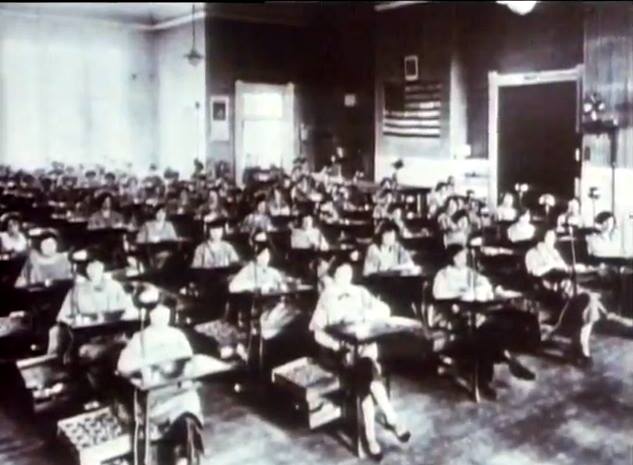
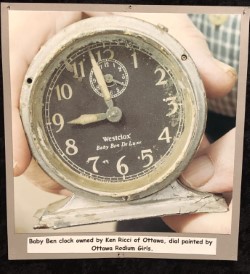
Radium Dial opened in Ottawa, Illinois in 1918 in response to the demand during World War I for luminous watches and instrument dials. The location was an old, brick school building with large rooms and big windows perfect for the fine painting required. The popularity of new glow-in-the-dark wristwatches kept the company in business after the war ended and provided many working class women with higher paying jobs than they could obtain elsewhere.

Catherine Donohue was one of the women who worked at Radium Dial, beginning in 1922. She and several of her coworkers suffered the effects of radium poisoning and fought for years to have their conditions recognized and covered by workers’ compensation legislation. Radium Dial continued operating and denying that they owed anything to the women they had slowly poisoned over their years of employment.

In 1936, Radium Dial closed their operations in the old high school and moved into a new building just a few blocks away. This new company was called Luminous Processes. It utilized much of Radium Dial’s assets and hired the same employees. The move had been a strategy to protect corporate assets from the lawsuits of former employees. When Catherine’s case was heard before the Illinois Industrial Commission, only $10,000 was available to be paid out to the several families suffering from radium poisoning.

Until 1978, Radium Dial continued operating under the name of Luminous Processes, their millions of dollars in profits protected from those employed before 1937, but that isn’t the worst of it. Radium Dial sold the old school to a meat packaging company, which experienced an exceptionally high rate of cancer in its employees and customers. When the building was demolished in 1968, the rubble was used as fill all around Ottawa, poisoning residents for decades.

At the new Luminous Processes building, employees continued to use radium without proper caution, also adding to the town’s high rates of cancer and other diseases. Sick workers were offered $100 each in severance pay to keep them from seeking legal action that they could ill-afford anyway. Luminous Processes wasn’t shut down until 1978. The company paid only $62,000 toward the millions of dollars of cleanup that is ongoing to this day by the Environmental Protection Agency.

Worker exploitation by Radium Dial is the subject of my newest novel, Luminous, which tells the story of Catherine Donohue, one of hundreds of young women who worked as dial painters in the 1920’s and 1930’s. Her struggle to have her illness recognized as radium poisoning and to have Radium Dial held responsible will stir up the emotions of any reader. The battle she fought helped to change workers’ compensation laws so that others would not suffer her fate. Although Catherine never dreamed of being a heroine, she changed the course of history.

About the Author:

Samantha Wilcoxson is a history enthusiast and avid traveler. Her published works include the Plantagenet Embers series with novels and novellas that explore the Wars of the Roses and early Tudor era. Luminous is her first foray into 20th century American history, but she suspects that it will not be her last. Samantha enjoys exploring the personal side of historic events and creating emotive, inspiring stories.

Important Links:

Universal Amazon Link for Luminous: mybook.to/luminous

Samantha’s Blog: https://samanthawilcoxson.blogspot.com/

Samantha on Social Media:

Facebook: https://www.facebook.com/PlantagenetEmbers/

Twitter: https://twitter.com/carpe_librum

Instagram: https://www.instagram.com/samantha_wilcoxson

Goodreads: https://www.goodreads.com/samanthajw

I would like ot say a huge ‘thank you’ to Samantha for a fabulous article, and wish her every success with Luminous: The Story of a Radium Girl.

*

My Books

Out Now!

Ladies of Magna Carta: Women of Influence in Thirteenth Century England will be released in the UK on 30 May 2020 and is now available for pre-order from Pen & SwordAmazon UK and from Book Depository worldwide. It will be released in the US on 2 September and is available for pre-order from Amazon US.

Also by Sharon Bennett Connolly:

Silk and the Sword: The Women of the Norman Conquest traces the fortunes of the women who had a significant role to play in the momentous events of 1066.  Available now from Amazon UK,  Amberley Publishing, Book Depository and Amazon US.

Heroines of the Medieval World tells the stories of some of the most remarkable women from Medieval history, from Eleanor of Aquitaine to Julian of Norwich. Available now from Amberley Publishing and Amazon UK, Amazon US and Book Depository.

*

You can be the first to read new articles by clicking the ‘Follow’ button, liking our Facebook page or joining me on Twitter and Instagram.

©2020 Sharon Bennett Connolly and Samantha Wilcoxson
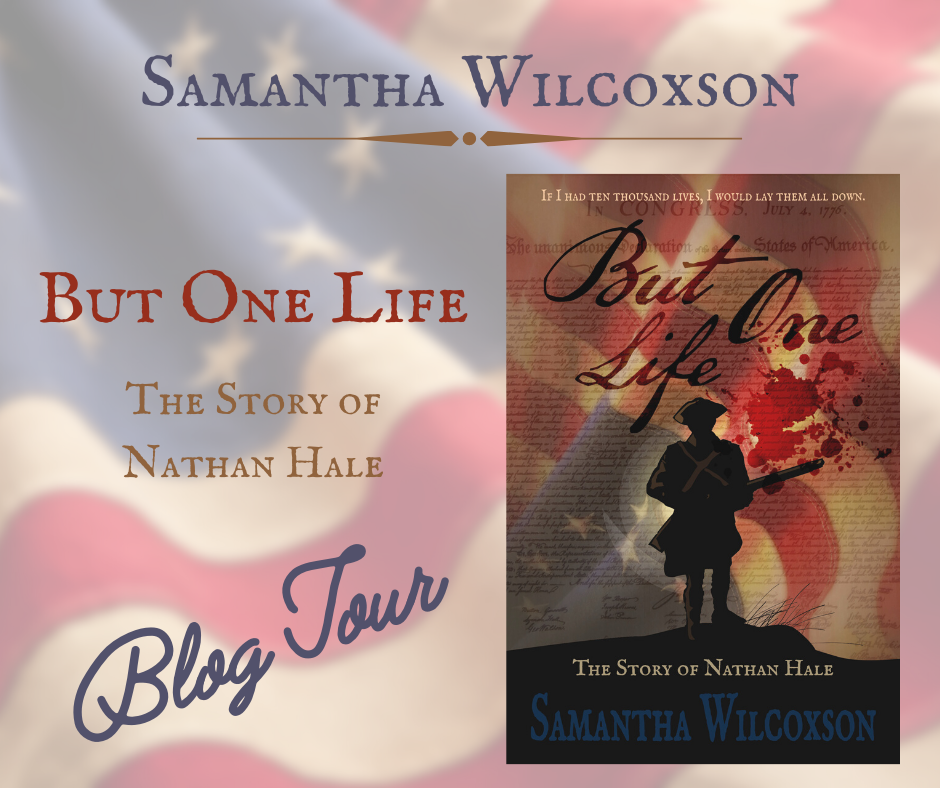
Book Corner: Queen of Martyrs, the Story of Mary I by Samantha Wilcoxson

‘God save the Queen! God save our good Queen Mary!’

When these words rang out over England, Mary Tudor thought her troubles were over. She could put her painful past – the loss of her mother and mistreatment at the hands of her father – behind her.

With her accession to the throne, Mary set out to restore Catholicism in England and find the love of a husband that she had long desired. But the tragedies in Mary’s life were far from over. How did a gentle, pious woman become known as ‘Bloody Mary’?

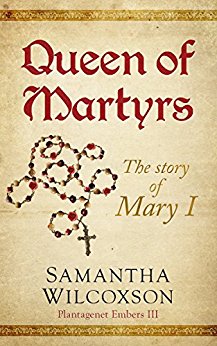
Queen of Martyrs, The Story of Mary I is the final book in Samantha Wilcoxson’s Plantagenet Embers series. It tells the story, in the third person, from the point of view of Mary I. Mary was the eldest daughter of King Henry I and England’s first ever queen regnant. Although part of a series, the book also works perfectly well as a standalone.

Samantha Wilcoxson has a unique writing style which makes her stand out from other Tudor storytellers. She gets into the mind of her main character and writes Mary’s story as if she’s seeing it through the queen’s own eyes. If Mary did not see something happen, then the reader does not know about it until the queen is informed. This distinctive writing style makes the book a personal journey, both for the subject and the reader.
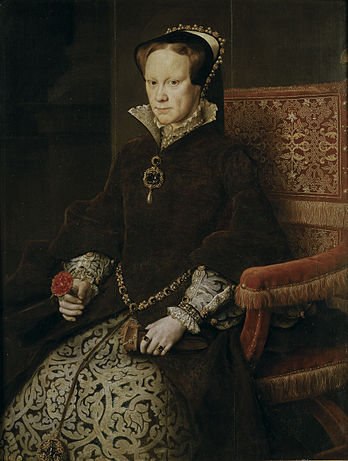
Mary I

Queen of Martyrs, The Story of Mary I tells the story of Mary I, from the time  of Henry VIII’s marriage to Katherine Parr, to her own death.Telling the story through Mary’s own eyes, we follow her personal and  public relationships, through her brother’s reign and the usurpation of Lady Jane Grey until she is sitting on the throne herself.

The novel demonstrates the human side of Mary I, her fears, insecurities and compassion, and her innate need to be loved; by her sister, her husband and her people. It shows her as a child of the Reformation, just as much as Elizabeth I, but on the opposing side. She is a queen struggling to do the right thing by her conscience and her people.

This compassionate portrayal helps to explain how the descent into the burning of protestants was not a plan, but a consequence of cumulative events and Mary’s own fear of displeasing God. Mary cuts a sad and lonely figure, desperate for love and constantly disappointed; by her father, her sister and, ultimately her husband.

With no children of her own, Mary doted upon Edward and Elizabeth in a way their father never would. She made her way now through the small, crowded room to her father’s other bastardized princess.

Elizabeth performed a perfect curtsy for her sister before letting her guard drop and offering a smile.

“I pray you are well, sister.” Elizabeth said with a sincerity of one unaware of the former bad feelings one has had toward them.

“My thanks to you and to God for seeing that I am indeed restored to health and am able to see a good friend and my dear father united in marriage.” As she said it, Mary was surprised to find that she meant it.

“I wish them great happiness,” Elizabeth agreed without emotion.

“You will find Katryn to be a loving mother, and she may be a calming presence for our father,” Mary encouraged her.

“Undoubtedly, you shall be proven correct.”

Sometimes Elizabeth’s habit of saying only what was expected could annoy, but Mary knew that she was simply doing her best to play her part to perfection. It was an effect of the quick succession of stepmothers and the gruesome connection between marriage and death that the young girl had witnessed.

What I love about this book is that it is Mary’s story. Elizabeth is a peripheral figure, making few appearances and always in her sister’s shadow. Philip of Spain is an unsympathetic character, desperate to get away from a marriage that he doesn’t want. The only character who is symbiotic with Mary is her cousin, Cardinal Reginald Pole, she sees him as an equal, in faith and outlook and he’s the only one she seems comfortable with.

Brilliantly researched, this is a sympathetic portrayal of a queen, known in many history books as Bloody Mary, who is often vilified and criticised for the burning of Protestants. Samantha Wilcoxson doesn’t just go with the flow, but manages to examine the queen’s life, loves and personal tragedies. In doing so, she shows us why the name of Bloody Mary is too simplistic for this complex woman who went through so much adversity before she ascended the throne.
Queen of Martyrs, The Story of Mary I is a wonderful, compassionate story of a frequently misunderstood woman. Samantha Wilcoxson’s writing style makes this an intimate portrayal of the Tudor queen, giving the reader a deep, personal relationship with the book and its subject, the queen’s story staying with them long after the last page has been turned.

*

Picture of Mary courtesy of Wikipedia.

*

My book, Heroines of the Medieval World,  is now available in hardback in the UK from both Amberley Publishing and Amazon UK and worldwide from Book Depository. It is also available on Kindle in both the UK and USA and will be available in Hardback from Amazon US from 1 May 2018.

You can be the first to read new articles by clicking the ‘Follow’ button, liking our Facebook page or joining me on Twitter.

©2017 Sharon Bennett Connolly