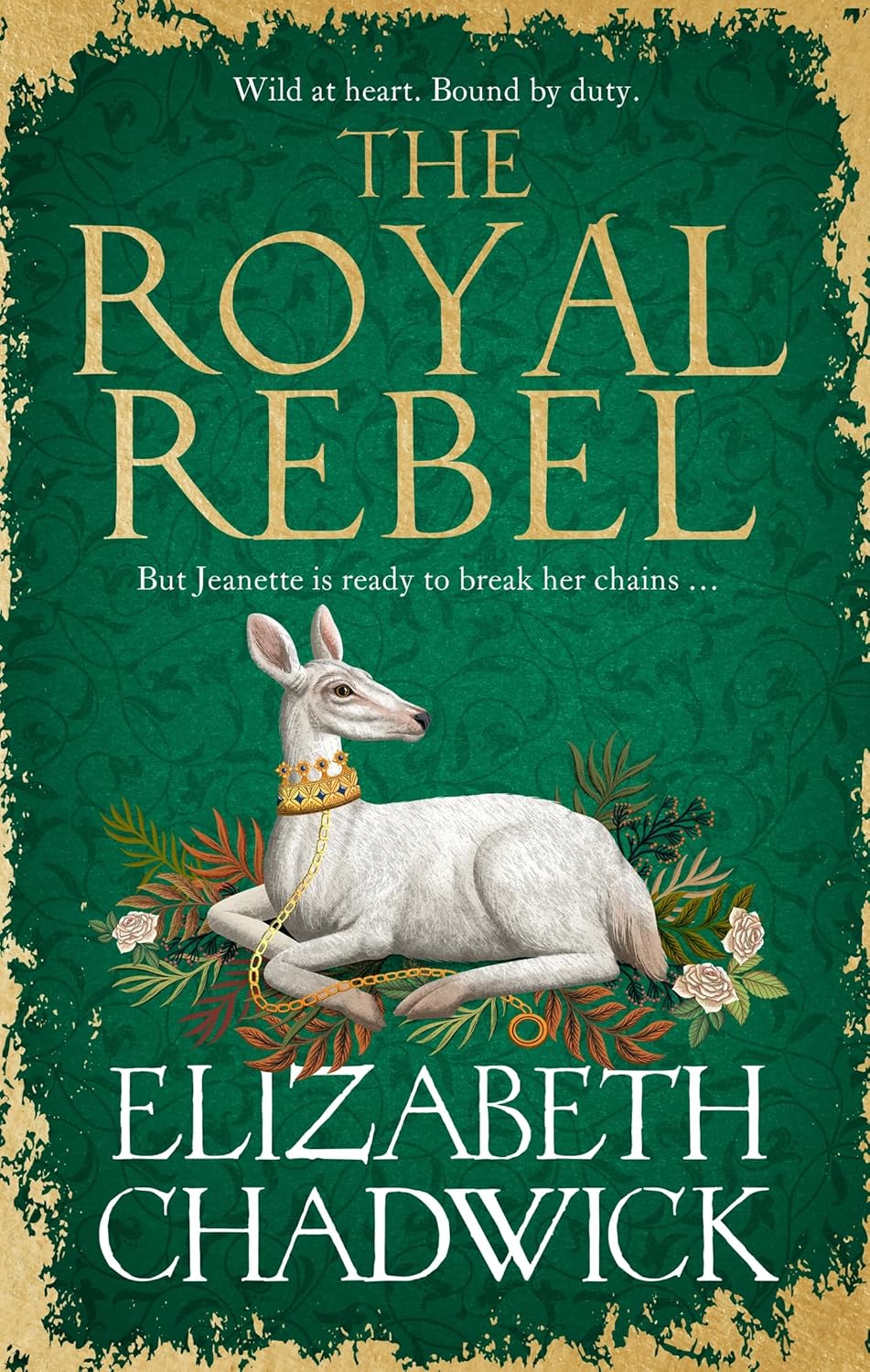
Book Corner: The Royal Rebel by Elizabeth Chadwick

1338: England has declared war on France, and Jeanette of Kent, cousin to King Edward III, says goodbye to her family and travels overseas with the royal court for the first time. Once in Antwerp, she is captivated by talented household knight Thomas Holland, just as he in turn is powerfully drawn to her.

Although both know their romance is forbidden, their love for each other grows stronger than the danger they face, and they marry in secret. But before they can make their tryst known, Thomas has to leave for war, and in his absence, Jeanette is forced into a second marriage and locked away from the world.

Then Thomas returns, and the real fight begins. As hostile family members battle to keep Jeanette and Thomas apart, the defiant lovers vow to be reunited – whatever the cost…

It is always the sign of a good book if the author can leave me in tears and send me through a range of emotions from beginning to end. In The Royal Rebel, Elizabeth Chadwick has achieved this and then some!

The controversy over Joan of Kent‘s first marriage is fascinating. There are so many possibilities and connotations. And so much politics! Girls in medieval times were not supposed to choose their own husbands. Marriage was a political alliance for noble families, not a love affair. Romance had nothing to do with it.

The Royal Rebel is the story of the most famous ‘love triangle’ of the14th century. Joan, the daughter of the Earl of Kent, secretly married Thomas Holland, who then went off on crusade for a year. In the mean time, Joan’s mother arranged her daughter’s marriage to William Montague, the heir to the earldom of Salisbury. It was a mutually beneficial marriage. Joan had royal blood, but tainted by the fact her father had been executed. While Montague was the heir to a large earldom but would benefit from a closer connection to the crown. Thomas Holland, on the other hand, was a household knight with few prospects and whose father had been executed for treason. And when he returned from crusading in Eastern Europe, due to financial constraints, he did not immediately lay claim to his wife.

It was a storyline worthy of a modern-day soap opera.

Thomas Holland took his claims that he and Joan were married all the way to Rome. The investigation into the marriage was long, drawn-out legalese, mired in canon law and I did wonder how Elizabeth Chadwick was going to make it interesting. Of course! I needn’t have feared. She draws out the tension, adds in the human element, family dynamics and political considerations and keeps the reader gripped to the very end – even though I already knew the outcome!

The next day, Jeanette [Joan of Kent], Joan, Hawise and several other ladies from the Queen’s chamber gathered to dole out arms to the poor at the monastery gates. Usually, the almoners and designated servants distributed the donations, but today, in thanksgiving, the Queen’s ladies were involved in the task, and as well as the food, small amounts of money and items of clothing were handed out.

Jeanette played her part with a whole heart and a wide and ready smile. She was in charge of dispensing the bread, while Joan ladled pottage into the bowls people had brought them. Thomas and Otto arrived with their retinues to assist and stand guard, and the loaves of bread and jugs of beer were soon emptied, and all the money and clothing gone.

‘Thank you,’ Jeanette said, smiling at Thomas as she gathered up the empty baskets.

‘It has been my pleasure, demoiselle.’

He had brought one of his old hoods and two thick blankets to give away and had provided a small purse of alms money. His manner towards the folk who had come to receive charity had been courteous and good-humoured. Jeanette had noted his common touch which did not detract from the authority he possessed to lead men and maintain his rank. He had tousled a small boy’s hair, and jested with a toothless old woman who had cackled at him with lecherous appreciation, saying if she had been thirty years younger…

Once more, he escorted her and the ladies back to the royal apartments, and carried the baskets himself.

‘You look like a housewife going to market,’ she said, amused and very aware of his presence at her side. Their pace was a saunter, eking out the moment.

‘Looks can be deceptive,’ he replied. ‘It is what lies beneath that matters.’

He leaned a little towards her, and Jeanette’s breath shortened.

‘Then I suppose that like all truth it is buried, and must be sought by diligent investigation,’ she said pertly, giving as good as she got, and was rewarded by a flash of his grin.

‘I have always found that to be the case, demoiselle,’ he said, as they came to the Queen’s door. ‘And usually well rewarded.’

The Royal Rebel by Elizabeth Chadwick is no mere romance. It is the story of a trying decade in the reign of Edward III. Just as he embarks on the Hundred Years War with France (I wonder if he would have been so keen, if someone had told him the war’s eventual name?), plague ravages Europe and the court is gripped by the scandal of Joan’, Thomas and William’s marital situation. The detail is impressive.

Elizabeth Chadwick is moving into a period new to her, the late medieval; away from the 12th and 13th centuries of which she is so familiar. Not that you would know it. Her research has been meticulous and her attention to detail, to the dress and customs of the period, is second-to-none. Elizabeth Chadwick has really thought about the circumstances involving the clandestine marriage of Joan of Kent and Tomas Holland – and the very public marriage of Joan and Willian Montague. And how all this came about! The plot is intricate but entirely plausible and answers several questions around the actions of the parties involved.

The Royal Rebel also highlights the quandary over inheritance that would always hang over Joan’s marriage to Montague whilst the question mark remained over the validity of their marriage. Would any children have even been legitimate? Joan’s frustrations over her treatment is palpable; not being allowed to be with her true husband, being ignored by her elders, not being believed and even being prevented from freely giving her testimony in the court case. The Salisburys even locked her up!

The Royal Rebel by Elizabeth Chadwick is not just a good read, it is an experience of life in the mid-14th century and not to be missed.

The Royal Rebel by Elizabeth Chadwick is most definitely among my Top 5 books of 2024. I cannot recommend it highly enough!

To Buy the Book:

The Royal Rebel by Elizabeth Chadwick is now available from Amazon and all good bookshops.

About the Author:

New York Times bestselling author Elizabeth Chadwick lives in a cottage in the Vale of Belvoir in Nottinghamshire with her husband and their three dogs. Her first novel, The Wild Hunt, won a Betty Trask Award, To Defy a King won the Romantic Novelist Association’s Historical Novel Prize and The Scarlet Lion was nominated by Richard Lee – founder of the Historical Novel Society – as one of the top ten historical novels of the last decade. She often lectures at conferences and historical venues, has been consulted for television documentaries and is a member of the Royal Historical Society.

Keep in touch with Elizabeth via her website, her blogs or on social media.

http://www.elizabethchadwick.com
twitter: @chadwickauthor
facebook: ElizabethChadwick

*

My Books:

Signed, dedicated copies of all my books are available through my online bookshop.

Coming 30 January 2025: Scotland’s Medieval Queens
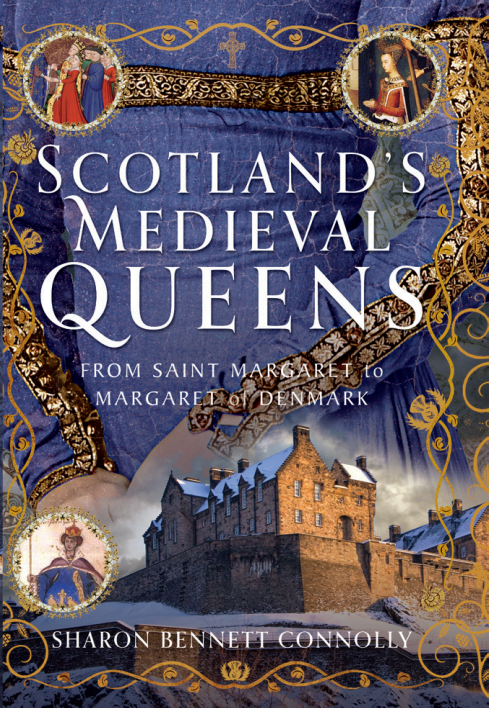
Scotland’s history is dramatic, violent and bloody. Being England’s northern neighbour has never been easy. Scotland’s queens have had to deal with war, murder, imprisonment, political rivalries and open betrayal. They have loved and lost, raised kings and queens, ruled and died for Scotland. From St Margaret, who became one of the patron saints of Scotland, to Elizabeth de Burgh and the dramatic story of the Scottish Wars of Independence, to the love story and tragedy of Joan Beaufort, to Margaret of Denmark and the dawn of the Renaissance, Scotland’s Medieval Queens have seen it all. This is the story of Scotland through their eyes.

Available for pre-order now.

Also by Sharon Bennett Connolly:
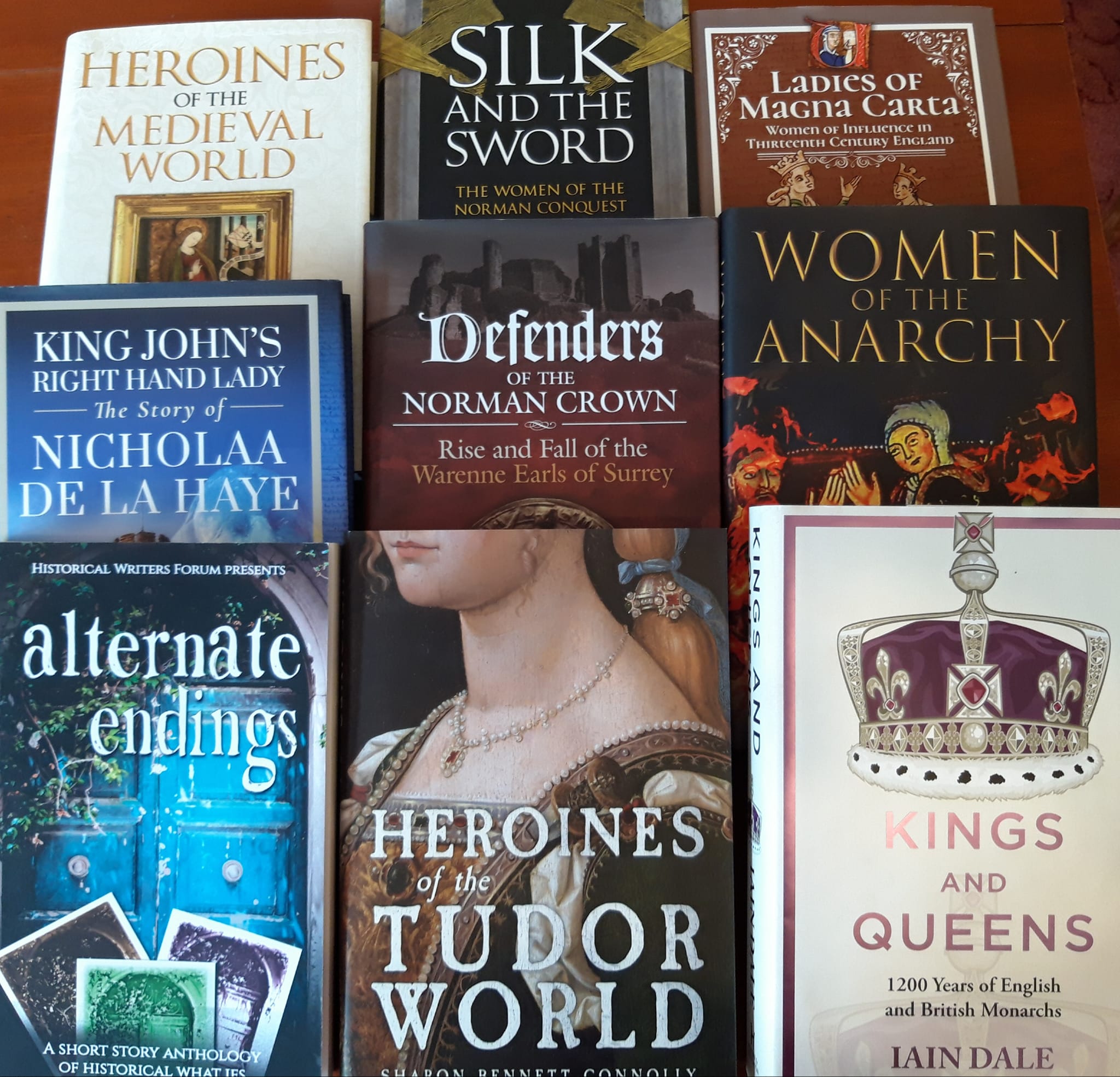
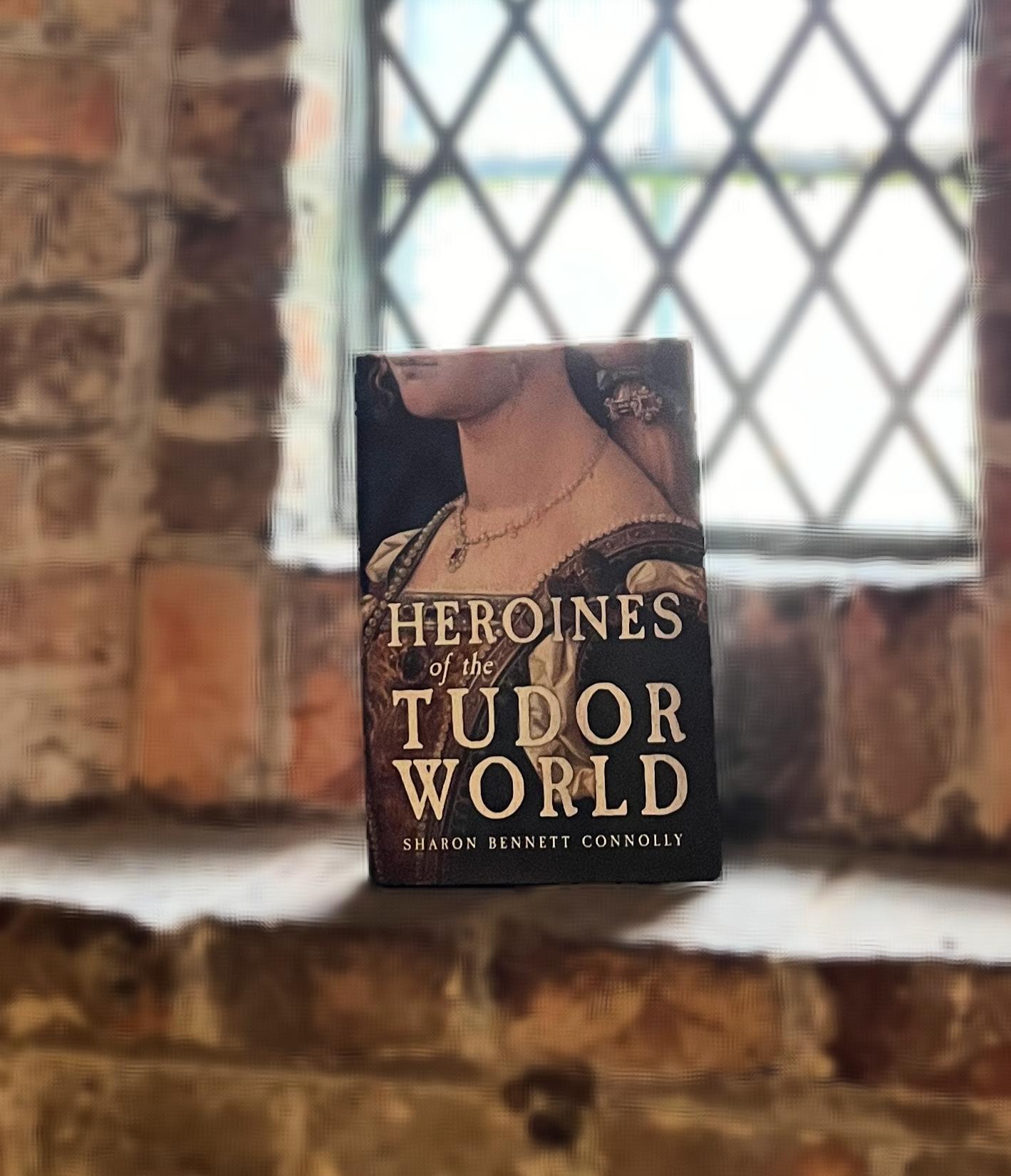
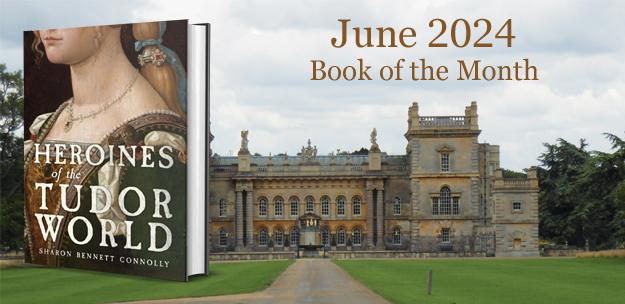
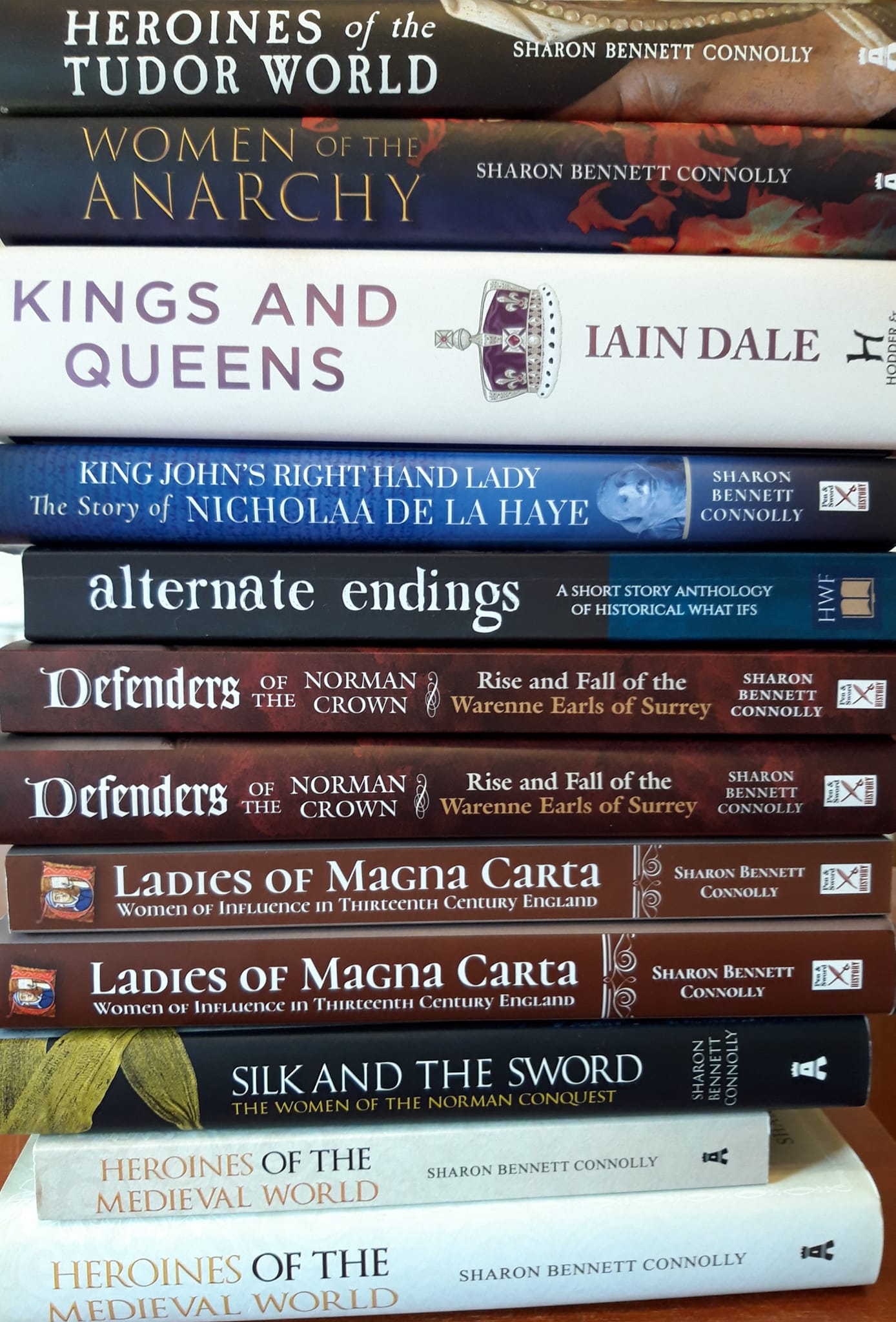
Heroines of the Tudor World tells the stories of the most remarkable women from European history in the time of the Tudor dynasty, 1485-1603. These are the women who ruled, the women who founded dynasties, the women who fought for religious freedom, their families and love. Heroines of the Tudor World is now available for pre-order from Amberley Publishing and Amazon UK. Women of the Anarchy demonstrates how Empress Matilda and Matilda of Boulogne, unable to wield a sword themselves, were prime movers in this time of conflict and lawlessness. It shows how their strengths, weaknesses, and personal ambitions swung the fortunes of war one way – and then the other. Available from Bookshop.orgAmberley Publishing and Amazon UKKing John’s Right-Hand Lady: The Story of Nicholaa de la Haye is the story of a truly remarkable lady, the hereditary constable of Lincoln Castle and the first woman in England to be appointed sheriff in her own right. Available from all good bookshops Pen & Sword Booksbookshop.org and Amazon

Defenders of the Norman Crown: The Rise and Fall of the Warenne Earls of Surrey tells the fascinating story of the Warenne dynasty, from its origins in Normandy, through the Conquest, Magna Carta, the wars and marriages that led to its ultimate demise in the reign of Edward III. Available from Pen & Sword BooksAmazon in the UK and US, and Bookshop.orgLadies of Magna Carta: Women of Influence in Thirteenth Century England looks into the relationships of the various noble families of the 13th century, and how they were affected by the Barons’ Wars, Magna Carta and its aftermath; the bonds that were formed and those that were broken. It is now available in paperback and hardback from Pen & SwordAmazon, and Bookshop.orgHeroines of the Medieval World tells the stories of some of the most remarkable women from Medieval history, from Eleanor of Aquitaine to Julian of Norwich. Available now from Amberley Publishing and Amazon, and Bookshop.orgSilk and the Sword: The Women of the Norman Conquest traces the fortunes of the women who had a significant role to play in the momentous events of 1066. Available now from Amazon,  Amberley Publishing, and Bookshop.org.

Alternate Endings: An anthology of historical fiction short stories including Long Live the King… which is my take what might have happened had King John not died in October 1216. Available in paperback and kindle from Amazon.

Podcast:

Have a listen to the A Slice of Medieval podcast, which I co-host with Historical fiction novelist Derek Birks. Derek and I welcome guests, such as Bernard Cornwell, and discuss a wide range of topics in medieval history, from significant events to the personalities involved, including Elizabeth Chadwick discussing her writing of The Royal Rebel as a guest for the 2024 HNS Conference’s Writing Medieval panel, alongside Matthew Harffy and David Gilman.

*

Don’t forget! Signed and dedicated copies of all my books are available through my online bookshop.

For forthcoming online and in-person talks, please check out my Events Page.

You can be the first to read new articles by clicking the ‘Follow’ button, liking our Facebook page or joining me on TwitterThreadsBluesky and Instagram.

©2024 Sharon Bennett Connolly FRHistS
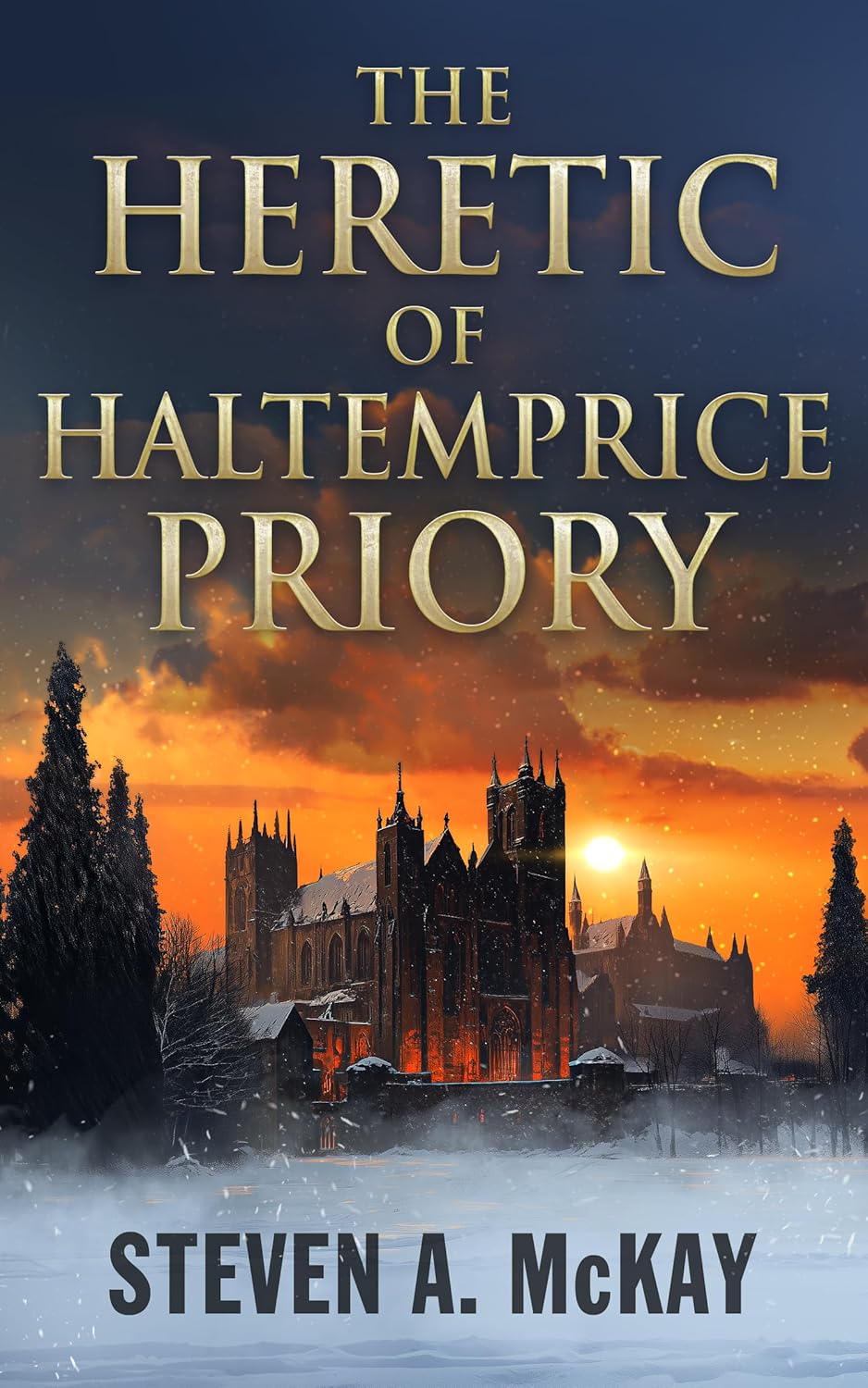
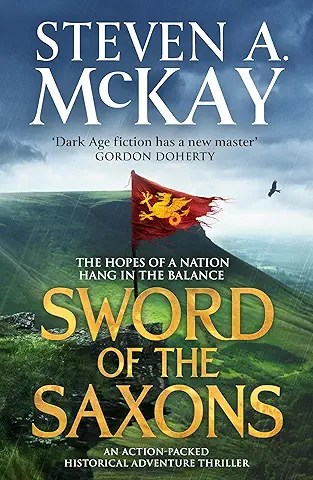
Book Corner: The Heretic of Haltemprice Priory by Steven A. McKay

England, c. AD 1330
Winter fast approaches in East Yorkshire and the dark, cold nights have brought more than just frost to the newly founded Haltemprice Priory. An oppressive pall hangs over the area like a smothering blanket, prompting one of the anxious monks to seek help from an old friend.
Robert Stafford, a friar from nearby Wakefield, has some experience in dealing with strange mysteries, having helped solve a number over the past few years. As he settles into Haltemprice however, things begin to escalate and the friar fears he might have bitten off far more than he can chew this time. Calling on his friends Will Scaflock and the bailiff John Little to work with him it seems they may face more than just earthly enemies as they battle the gloom crushing the spirit, and perhaps the very life, from the inhabitants of the priory.
One monk with a library of eldritch books seems to know much about the progressively more deadly troubles afflicting windswept, frostbitten Haltemprice, but is he a lunatic, a heretic, a murderer, or perhaps something even more terrifying?

Steven A. McKay’s idea of a “novella” stretches the truth a tad with The Heretic of Haltemprice Priory. It must be close to 50,000 words!

But who’s complaining?

Certainly not me!

I have been saying for years that Steven should do a full-length detective/mystery novel featuring Friar Tuck, Little John and Will Scarlet. And I suspect, this is as close as I’m going to get to one.

In The Heretic of Haltemprice Priory, Friar Tuck is called in by an old friend to discover the malaise that afflicts his priory. It is hard to pin down, but a sense of doom and gloom appears to infect not only the monks, but everyone within the priory’s walls. When Tuck realises the depths of the mystery, and the strange happenings that border on the occult, he calls for his old friends, Will and John, to help him solve the mystery.

“This is a very impressive priory,” he said, peering up and gesturing vaguely around, his hand casting long shadows in the candlelight. “I’d have thought the brothers and lay people living here would be happy with their new surroundings.”

“And yet…” Simon de Poher breathed, chewing his lip.

“And yet.” Tuck nodded. “I’ve hardly seen anyone so far, as if everyone is hiding, and those I have met seem nervous about something. Frightened even.”

The door to the cloister rattled at his words, pushed against the latch by the gusting wind outside.

De Poher swallowed again and looked up at the ceiling, as if he were begging God for guidance.

Tuck stood and walked to the nearest bookcase. He knew some of the library’s collection was valuable as some of the books were actually chained to the shelves so that they could not be lost or stolen. The shelves themselves were Brand new and had clearly been made by skilled carpenters, but many of the books on show were very old and Tuck hesitated to draw any out in case he damaged them.

“You’re right,” de Poher said behind him. “Everyone in Haltemprice seems to be anxious, including me.”

“Why?” Tuck asked, turning back to face him.

“Well, that’s the thing,” the cantor chuckled bleakly. “I have no idea.”

Tuck’s brow lifted and he leaned back thoughtfully. “You must have some clue, ” he stated.

“No,” the cantor said, shaking his head. Nothing has happened as far as I’m aware. No one has died violently, or threatened us, or, well, anything like that at all in the time we’ve been here. This place…” He trailed off, casting wary glances into the dark corners and atone particular section of books. “This place just seems to crush the spirit, which is unfathomable given it’s a house of God!” He cringed as he said the last few words, as if fearing he’s be struck down by a divine bolt of lightning or, perhaps, something less holy…

It is a strange tale.

But it is one that grabs you.

Steven A. McKay’s wonderful characters certainly keep you entertained. The strange goings-on are freaky, from sacrificed pigs to disturbed ancient graves. And books that border on the heretical. The reader will be as discomfited as the heroes themselves. And as determined to uncover the truth behind the priory’s place at the centre of events. Full of dark imagery and breathless suspense, The Heretic of Haltemprice Priory will keep you on the edge of your seat (and possibly behind it!).

Ok, I’m exaggerating a little. It is not too scary, rather it allows the reader to let his or her imagination wander into the dark corners of a monk’s cell – and mind. The supernatural elements leave the reader wondering if the mystery will ever – can ever – be solved. It also leaves the reader wanting more from Tuck, Scarlet and Little John. And with the arrival of a mysterious tinker at the end of the book, the hope is that we are going to get it!

The Heretic of Haltemprice Priory is perfect reading for a cold winter night by an open fire. But with all the lights on, just in case!

To Buy the Book:

The Heretic of Haltemprice Priory is now available from Amazon on Kindle and in paperback.

About the author:

Steven A McKay was born in Scotland in 1977 and always enjoyed studying history. He decided to write his Forest Lord novels after seeing a house called “Sherwood” when out at work one day. Since then he’s started a new series, the Warrior Druid of Britain Chronicles, and just completed a trilogy about Alfred the Great.

Steven used to be in a heavy metal band although he tend to just play guitar in his study these days. He did use those guitars to write the theme song for the podcast he co-hosts, Rock, Paper, Swords! with Matthew Harffy, though. Give it a listen, they’ve interviewed great guests like Diana Gabaldon, Simon Scarrow, Bernard Cornwell, Dan Jones and more.

*

My Books:

Signed, dedicated copies of all my books are available through my online bookshop.

Coming 30 January 2025: Scotland’s Medieval Queens

Scotland’s history is dramatic, violent and bloody. Being England’s northern neighbour has never been easy. Scotland’s queens have had to deal with war, murder, imprisonment, political rivalries and open betrayal. They have loved and lost, raised kings and queens, ruled and died for Scotland. From St Margaret, who became one of the patron saints of Scotland, to Elizabeth de Burgh and the dramatic story of the Scottish Wars of Independence, to the love story and tragedy of Joan Beaufort, to Margaret of Denmark and the dawn of the Renaissance, Scotland’s Medieval Queens have seen it all. This is the story of Scotland through their eyes.

Available for pre-order now.

Also by Sharon Bennett Connolly:

Heroines of the Tudor World tells the stories of the most remarkable women from European history in the time of the Tudor dynasty, 1485-1603. These are the women who ruled, the women who founded dynasties, the women who fought for religious freedom, their families and love. Heroines of the Tudor World is now available for pre-order from Amberley Publishing and Amazon UK. Women of the Anarchy demonstrates how Empress Matilda and Matilda of Boulogne, unable to wield a sword themselves, were prime movers in this time of conflict and lawlessness. It shows how their strengths, weaknesses, and personal ambitions swung the fortunes of war one way – and then the other. Available from Bookshop.orgAmberley Publishing and Amazon UKKing John’s Right-Hand Lady: The Story of Nicholaa de la Haye is the story of a truly remarkable lady, the hereditary constable of Lincoln Castle and the first woman in England to be appointed sheriff in her own right. Available from all good bookshops Pen & Sword Booksbookshop.org and Amazon

Defenders of the Norman Crown: The Rise and Fall of the Warenne Earls of Surrey tells the fascinating story of the Warenne dynasty, from its origins in Normandy, through the Conquest, Magna Carta, the wars and marriages that led to its ultimate demise in the reign of Edward III. Available from Pen & Sword BooksAmazon in the UK and US, and Bookshop.orgLadies of Magna Carta: Women of Influence in Thirteenth Century England looks into the relationships of the various noble families of the 13th century, and how they were affected by the Barons’ Wars, Magna Carta and its aftermath; the bonds that were formed and those that were broken. It is now available in paperback and hardback from Pen & SwordAmazon, and Bookshop.orgHeroines of the Medieval World tells the stories of some of the most remarkable women from Medieval history, from Eleanor of Aquitaine to Julian of Norwich. Available now from Amberley Publishing and Amazon, and Bookshop.orgSilk and the Sword: The Women of the Norman Conquest traces the fortunes of the women who had a significant role to play in the momentous events of 1066. Available now from Amazon,  Amberley Publishing, and Bookshop.org.

Alternate Endings: An anthology of historical fiction short stories including Long Live the King… which is my take what might have happened had King John not died in October 1216. Available in paperback and kindle from Amazon.

Podcast:

Have a listen to the A Slice of Medieval podcast, which I co-host with Historical fiction novelist Derek Birks. Now at over 50 episodes, Derek and I welcome guests, such as Bernard Cornwell, and discuss a wide range of topics in medieval history, from significant events to the personalities involved. In episode 18, Steven A. McKay joined us to discuss his Forest Lord series, and the legend of Robin Hood.

*

Don’t forget! Signed and dedicated copies of all my books are available through my online bookshop.

For forthcoming online and in-person talks, please check out my Events Page.

You can be the first to read new articles by clicking the ‘Follow’ button, liking our Facebook page or joining me on TwitterThreadsBluesky and Instagram.

©2024 Sharon Bennett Connolly FRHistS

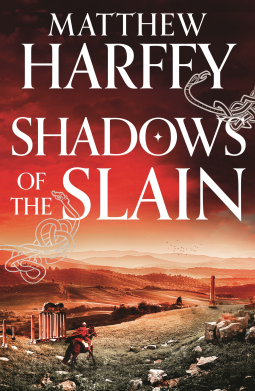
Book Corner: Shadows of the Slain by Matthew Harffy

AD 652. After surviving dark intrigues at the Merovingian court of Frankia, Beobrand is finally able to undertake the mission his queen set him: to escort a party of pilgrims to the holy city of Rome.

But Beobrand’s life is never easy. His party includes a scheming novice churchman whose ambition is boundless, and a mysterious envoy from Frankia.

Entering the lands of the Langobards, Beobrand discovers unexpected similarities to his native Northumbria in their speech and customs… and their willingness to spill blood.

The roads heading south are filled with danger. Meeting other pilgrims who have been attacked and robbed, Beobrand soon finds himself reluctantly responsible for their safety. Confronting brigands and robbers at every turn, they press on towards their goal.

But when Beobrand reaches the snakepit of ruins and relics that is Rome, his difficulties truly begin… and his homeland has never been further away.

In Shadows of the Slain, Matthew Harffy has once again given readers a fabulous adventure to devour in the latest instalment from the Bernicia Chronicles. Beobrand continues his journey to Rome and, as usual, he finds trouble along the way.

It is interesting to see Beobrand out of his comfort zone, in a place where he does not know the language and is relying on others to convey his needs and wishes. What he does discover is that politics and the pursuit of power is the same the world over. Beobrand has to navigate this in Rome – not always successfully. And it is hard to know who to trust when some are pursuing their own agendas and a supposed enemy may be a friend – or may not!

The one thing that you can say about Beobrand is that life is never boring!

“Do you think Wilfrid will cause more trouble?” Beobrand asked after they had ridden on in silence for a short while.

Coenred pondered for a moment.

“I don’t think he will risk Wulfwyn’s ire and public humiliation again.”

“Good,” said Beobrand. “We’ve had more tan enough strife on this trip.”

Coenred shifted in the saddle and looked at Wilfrid who rode apart from the others. After the encounter with the bandits in the mountains he had been persuaded to remove his gold rings and the gaudy chain he liked to wear around his neck, but he still stood out from the others with his bright clothes, a gift from the monarchs of Neustria. Beobrand and the others had also been presented with fine garments of silk and linen, but favoured plain travel garb for the journey.

“I don’t think he will repeat his mistake with Wulfwyn,” said Coenred. “I didn’t say he wouldn’t cause any trouble.”

Beobrand looked askance at him.

“That’s what I’m afraid of. Has this journey not already been punishment enough?”

Coenred knew Beobrand was thinking about his part in the death of Oswine, King of Deira and Queen Eanfled’s cousin. It was clear to any who knew of the events surrounding the king’s death that the queen, who had previously been warmly disposed towards Beobrand, had ordered him to escort Wilfrid to Roma as a form of chastisement. Beobrand had accepted the order without complaint. And Coenred knew that whatever the truth of the matter, Beobrand blamed himself just as much as anyone else for what had happened in Hunwald’s hall.

Coenred looked up at the pale sky. There was not a single cloud to be seen. He groaned as he stretched his back. He ached from so much riding. Perhaps he should walk in the afternoon.

Beobrand and his small band of gesithas, including the loyal Cynan, have been charged with escorting the ambitious monk, Wilfrid, to Rome. Wilfrid seems to be able to smell out power and influence and attach himself to the priests and nobles who can best serve his ambition, regardless of the trouble that causes everyone else. He is little liked among Beobrand’s small warband and even Coenred, the affable monk who is a long-time friend of Beobrand’s, finds Wilfrid hard to work with.

Shadows of the Slain is a wonderful, fast-paced read that keeps the reader engrossed to the very end. The action comes thick and fast. And Matthew very cleverly weaves within the storyline a reference to his other series, involving Hunlaf from his wonderful A Time for Swords series, but I will say no more on that…

In Shadows of the Slain, Matthew Harffy again brings the Dark Ages to life, demonstrating how colourful and diverse the 7th century could be. That Beobrand could even contemplate travelling from Northumberland to Rome is quite a feat; a journey that would have taken months to complete, and for which there would have been few maps.

And once his objective is achieved, he will have to start the return journey, which I am anticipating with great relish!

To Buy the Book:

Shadows of the Slain by Matthew Harffy is now available in Kindle, audio book and hardback.

About the Author:

Matthew Harffy lived in Northumberland as a child and the area had a great impact on him. The rugged terrain, ruined castles and rocky coastline made it easy to imagine the past. Decades later, a documentary about Northumbria’s Golden Age sowed the kernel of an idea for a series of historical fiction novels. The first of them is the action-packed tale of vengeance and coming of age, THE SERPENT SWORD.

Matthew has worked in the IT industry, where he spent all day writing and editing, just not the words that most interested him. Prior to that he worked in Spain as an English teacher and translator. Matthew lives in Wiltshire, England, with his wife and their two daughters.

For all the latest news and exclusive competitions, join Matthew online: http://www.matthewharffy.com; twitter.com/@MatthewHarffy; http://www.facebook.com/MatthewHarffyAuthor

*

My Books:

Signed, dedicated copies of all my books are available through my online bookshop.

Coming 30 January 2025: Scotland’s Medieval Queens

Scotland’s history is dramatic, violent and bloody. Being England’s northern neighbour has never been easy. Scotland’s queens have had to deal with war, murder, imprisonment, political rivalries and open betrayal. They have loved and lost, raised kings and queens, ruled and died for Scotland. From St Margaret, who became one of the patron saints of Scotland, to Elizabeth de Burgh and the dramatic story of the Scottish Wars of Independence, to the love story and tragedy of Joan Beaufort, to Margaret of Denmark and the dawn of the Renaissance, Scotland’s Medieval Queens have seen it all. This is the story of Scotland through their eyes.

Available for pre-order now.

Also by Sharon Bennett Connolly:

Heroines of the Tudor World tells the stories of the most remarkable women from European history in the time of the Tudor dynasty, 1485-1603. These are the women who ruled, the women who founded dynasties, the women who fought for religious freedom, their families and love. Heroines of the Tudor World is now available for pre-order from Amberley Publishing and Amazon UK. Women of the Anarchy demonstrates how Empress Matilda and Matilda of Boulogne, unable to wield a sword themselves, were prime movers in this time of conflict and lawlessness. It shows how their strengths, weaknesses, and personal ambitions swung the fortunes of war one way – and then the other. Available from Bookshop.orgAmberley Publishing and Amazon UKKing John’s Right-Hand Lady: The Story of Nicholaa de la Haye is the story of a truly remarkable lady, the hereditary constable of Lincoln Castle and the first woman in England to be appointed sheriff in her own right. Available from all good bookshops Pen & Sword Booksbookshop.org and Amazon

Defenders of the Norman Crown: The Rise and Fall of the Warenne Earls of Surrey tells the fascinating story of the Warenne dynasty, from its origins in Normandy, through the Conquest, Magna Carta, the wars and marriages that led to its ultimate demise in the reign of Edward III. Available from Pen & Sword BooksAmazon in the UK and US, and Bookshop.orgLadies of Magna Carta: Women of Influence in Thirteenth Century England looks into the relationships of the various noble families of the 13th century, and how they were affected by the Barons’ Wars, Magna Carta and its aftermath; the bonds that were formed and those that were broken. It is now available in paperback and hardback from Pen & SwordAmazon, and Bookshop.orgHeroines of the Medieval World tells the stories of some of the most remarkable women from Medieval history, from Eleanor of Aquitaine to Julian of Norwich. Available now from Amberley Publishing and Amazon, and Bookshop.orgSilk and the Sword: The Women of the Norman Conquest traces the fortunes of the women who had a significant role to play in the momentous events of 1066. Available now from Amazon,  Amberley Publishing, and Bookshop.org.

Alternate Endings: An anthology of historical fiction short stories including Long Live the King… which is my take what might have happened had King John not died in October 1216. Available in paperback and kindle from Amazon.

Podcast:

Have a listen to the A Slice of Medieval podcast, which I co-host with Historical fiction novelist Derek Birks. Derek and I welcome guests, such as Bernard Cornwell, and discuss a wide range of topics in medieval history, from significant events to the personalities involved, including episodes with Matthew Harffy as our guest, discussing the Saxons and as a guest for the 2024 HNS Conference’s Writing Medieval panel, alongside Elizabeth Chadwick and David Gilman

*

Don’t forget! Signed and dedicated copies of all my books are available through my online bookshop.

For forthcoming online and in-person talks, please check out my Events Page.

You can be the first to read new articles by clicking the ‘Follow’ button, liking our Facebook page or joining me on TwitterThreadsBluesky and Instagram.

©2024 Sharon Bennett Connolly FRHistS
The Works of Marie de France

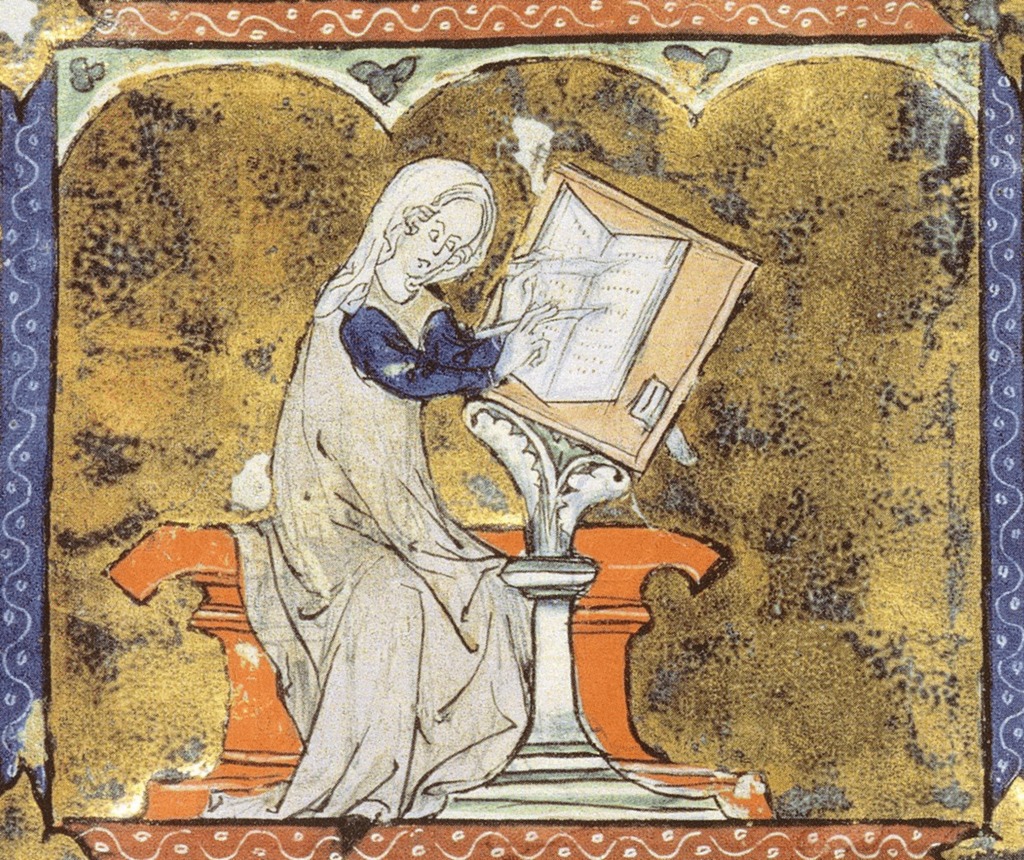
Marie de France from an illuminated manuscript

If you have visited the British Library’s latest exhibition, Medieval Women: In Their Own Words, you may have spotted the work of Marie de France. Marie was a poet in the late 12th century, who wrote three major works that can be definitively attributed to her, even though we don’t know who she was. All that is left of Marie is her work, and the vague notion that she comes from France, because she wrote in her Fables ‘Marie ai num, si sui de France’.1 The traditional view is that Marie was a Frenchwoman writing at the court of Henry II of England based on the fact that if she was writing in France, she wouldn’t have to say that she was from that country. However, France in the 12th century was far from one unified, indivisible country. In fact, it was a series of counties and duchies with their own rulers, who paid homage to the King of France; the French king’s own domains at the time were the Île-de- France, which incorporated Paris and its environs.

Another argument for Marie writing in England, is that her lais, her poetic verses, were dedicated to a ‘noble reis’, or ‘noble king’, and this is thought to be Henry II of England. However, it could just as easily been intended for Louis VII of France, or his son Philip II Augustus. In turn the Fables, an adaptation of Aesop’s Fables, were dedicated to a nobleman she identifies as ‘Count William’. There were several earls in England at the time who were named William, including William Marshal, Earl of Pembroke; William Longspée, Earl of Salisbury; and William Mandeville, Earl of Essex; or even the son of King Stephen, William of Blois, Earl of Warenne and Surrey. However, William was a common name at the time, even on the Continent, where you could find many a Guillaume.

Everything we think we know about who Marie was is pure conjecture. It has even been suggested that she was the illegitimate daughter of Geoffrey of Anjou, father of Henry II, and therefore a half-sister of Henry. She has also been variously identified as a nun at Reading Abbey, the abbess of Shaftesbury between 1181 and 1216, and Marie de Meulan, wife of Hugh Talbot of Cleuville.2 We do know that Marie had a knowledge of Latin and English, and a familiarity with the works of Ovid and Wace’s Brut, and wrote in an Anglo-Norman French.

“Marie de France presents her book of poems to Henry II of England” by Charles Abraham Chasselat

Her works have been dated to the second half of the 12th century, with her poetry, the lais, dating between 1160 and 1199, the Fables between 1160 and 1190, and her last work, the Espurgatoire, has been dated to after 1189 and possibly as late as 1215.3 L’Espurgatoire Seint Patriz (The Purgatory of St Patrick) is believed to have been written after 1189 as it appears to have been heavily reliant on the Latin text of Henry of Saltrey as her source, which was published around 1185. L’Espurgatoire is dedicated to ‘H. abbot of Sartis’, who may have been Hugh, Abbot of Wardon Abbey, in Bedfordshire, between 1173 and 1185 or 1186; the abbey was originally named St Mary de Sartis.4 The only surviving manuscript of this treatise is now stored in the Bibliothèque Nationale in Paris.

The lais were a series of twelve poems, many of which were drawn from Celtic legends. Only one is based on Arthurian legends, specifically the story of the lovers, Tristan and Iseult. Many of the lais were translated into Old Norse in the 13th century, while two, Lanval and Le Fresne were translated and adapted into Middle English in the 14th century. The lais were narratives, written in verse and intended to be set to music. One such included the lines; ‘when a good thing is well known, it flowers for the first time, and when it is praised by many, its flowers have blossomed.’5

Marie’s stories included fairy mistresses, twins separated at birth, and one relating the troubles of the wife of a werewolf. Her lais explored love and conflicting loyalties; they dealt with the issues of courtly behaviour and documented the struggles to fulfil the conflicting aims of individual needs and cultural expectations. They varied in length, with the shortest, Chevrefoil, having 118 lines and the longest, Eliduc, comprising 1,184 lines; this last was the story of a wife having to adapt when her husband brings home a second wife.

The Woman and the Wolf in Marie de France’s “Bisclavret”

Marie’s collection of Fables, known as Ysopets in French and written for the mysterious ‘Count William’, are based on the older Aesop’s Fables, from antiquity, but she also adapted and added to the original stories. The Fables, a rhyming collection of works, demonstrate Marie’s concern for the well-being of the lower classes and the poor, criticising the political and social conditions of the time. Her work was widely read and influential; the fable Del cok e del gupil (The Cock and the Fox) is one of the inspirations for Geoffrey Chaucer’s The Nun’s Priest’s Tale, written in the 15th century. Marie ends The Fables with an epilogue, in which she includes a plea to be remembered,

To end these tales I’ve here narrated
And into Romance tongue translate,
I’ll give my name for memory:
I am from France, my name’s Marie.
And it may hap that many a clerk
Will claim as his what is my work.
But such pronouncements I want not!
It’s folly to become forgot!6

Wherever she came from, geographically and socially, Marie de France was a keen observer of the social undercurrents of the time, incorporating them into her Lais and Fables. And we cannot say for certain that her work was produced in England, at the English court. With the Anglo-Norman empire stretching from the borders of Scotland to the borders of Spain she may have travelled within Henry II’s domains, but not necessarily with the court. Although we have few clues to her identity and origins, at least we have her works – her poetry through which she has lived on for more than eight centuries.

Notes:

1. ‘My name is Marie and I am from France’, quoted in Rethinking Marie by Dinah Hazell; 2. Marie (fl. c.1180–c.1189) (article) by Tony Hunt; 3. Rethinking Marie by Dinah Hazell 4. Marie (fl. c.1180–c.1189) (article) by Tony Hunt; 5. The Plantagenet Chronicles edited by Elizabeth Hallam; 6. Translated from; ‘Al finement de cest escrit, Que en romanz ai treité e dit, Me numerai pur remembrance: Marie ai num, si sui de France. Put cel ester que clerc plusur Prendreient sur eus mun labur. No voil que nul sur li le die! E il fet que fol ki sei ublie!’ Taken from Marie de France: Fables, edited and translated by Harriet Spiegel.

Images: Courtesy of Wikipedia

    Sources:

    Marie de France: Fables, edited and translated by Harriet Spiegel; Dinah Hazell, Rethinking Marie, (article) sfsu.edu; Tony Hunt, Marie (fl. c.1180–c.1189) (article), ODNB; Elizabeth Hallam, editor, The Plantagenet Chronicles;  The Plantagenets, the Kings who Made England by Dan Jones; History Today Companion to British History Edited by Juliet Gardiner and Neil Wenborn; he Plantagenets, the Kings that made Britain by Derek Wilson; England Under the Norman and Angevin Kings  by Robert Bartlett; Roy Strong The Story of Britain.

    *

    My Books:

    Signed, dedicated copies of all my books are available through my online bookshop.

    Coming 30 January 2025: Scotland’s Medieval Queens

    Scotland’s history is dramatic, violent and bloody. Being England’s northern neighbour has never been easy. Scotland’s queens have had to deal with war, murder, imprisonment, political rivalries and open betrayal. They have loved and lost, raised kings and queens, ruled and died for Scotland. From St Margaret, who became one of the patron saints of Scotland, to Elizabeth de Burgh and the dramatic story of the Scottish Wars of Independence, to the love story and tragedy of Joan Beaufort, to Margaret of Denmark and the dawn of the Renaissance, Scotland’s Medieval Queens have seen it all. This is the story of Scotland through their eyes.

    Available for pre-order now.

    Also by Sharon Bennett Connolly:

    Heroines of the Tudor World tells the stories of the most remarkable women from European history in the time of the Tudor dynasty, 1485-1603. These are the women who ruled, the women who founded dynasties, the women who fought for religious freedom, their families and love. Heroines of the Tudor World is now available for pre-order from Amberley Publishing and Amazon UK. Women of the Anarchy demonstrates how Empress Matilda and Matilda of Boulogne, unable to wield a sword themselves, were prime movers in this time of conflict and lawlessness. It shows how their strengths, weaknesses, and personal ambitions swung the fortunes of war one way – and then the other. Available from Bookshop.orgAmberley Publishing and Amazon UKKing John’s Right-Hand Lady: The Story of Nicholaa de la Haye is the story of a truly remarkable lady, the hereditary constable of Lincoln Castle and the first woman in England to be appointed sheriff in her own right. Available from all good bookshops Pen & Sword Booksbookshop.org and Amazon

    Defenders of the Norman Crown: The Rise and Fall of the Warenne Earls of Surrey tells the fascinating story of the Warenne dynasty, from its origins in Normandy, through the Conquest, Magna Carta, the wars and marriages that led to its ultimate demise in the reign of Edward III. Available from Pen & Sword BooksAmazon in the UK and US, and Bookshop.orgLadies of Magna Carta: Women of Influence in Thirteenth Century England looks into the relationships of the various noble families of the 13th century, and how they were affected by the Barons’ Wars, Magna Carta and its aftermath; the bonds that were formed and those that were broken. It is now available in paperback and hardback from Pen & SwordAmazon, and Bookshop.orgHeroines of the Medieval World tells the stories of some of the most remarkable women from Medieval history, from Eleanor of Aquitaine to Julian of Norwich. Available now from Amberley Publishing and Amazon, and Bookshop.orgSilk and the Sword: The Women of the Norman Conquest traces the fortunes of the women who had a significant role to play in the momentous events of 1066. Available now from Amazon,  Amberley Publishing, and Bookshop.org.

    Alternate Endings: An anthology of historical fiction short stories including Long Live the King… which is my take what might have happened had King John not died in October 1216. Available in paperback and kindle from Amazon.

    Podcast:

    Have a listen to the A Slice of Medieval podcast, which I co-host with Historical fiction novelist Derek Birks. Derek and I welcome guests, such as Bernard Cornwell, and discuss a wide range of topics in medieval history, from significant events to the personalities involved.

    *

    Don’t forget! Signed and dedicated copies of all my books are available through my online bookshop.

    For forthcoming online and in-person talks, please check out my Events Page.

    You can be the first to read new articles by clicking the ‘Follow’ button, liking our Facebook page or joining me on TwitterThreadsBluesky and Instagram.

    ©2024 Sharon Bennett Connolly FRHistS
    Interview with Gemma Hollman, author of Women in the Middle Ages

    This week, I have had the distinct pleasure of chatting with author and historian Gemma Hollman about her new book, Women in the Middle Ages: Illuminating the World of Peasants, Nuns, and Queen.

    I cannot wait to get my hands on this book!

    Sharon: Tell me about your new book, Women in the Middle Ages: Illuminating the World of Peasants, Nuns, and Queens

    Gemma: The book is an illustrated history which aims to shed light on the lives of medieval women. Focusing on roughly 500 years, from 1000 – 1500, I take a look at European women from all levels of society. By using surviving artwork, we see what the visual record can tell us about these women that might be lost in the written record. We often have this idea that the medieval period was a male-dominated world, with women at the sidelines, but this is not quite the case and art is an excellent place to see this. Women appear everywhere in it, but they were also very often the makers of it, too. Women ran households, worked in taverns and textile hubs, invested money in businesses, created books and paintings, saved souls through their prayers and ruled countries. And in a visually-dominated culture, where the majority of people were illiterate, women were able to leave their mark on tapestries, manuscripts, beads, bowls, and more. The book is hopefully a marvellous romp through time with something for anyone, whether it’s your first time learning about medieval women, or the hundredth book you’ve read.

    Sharon: What inspired you to write the book?

    Gemma: My first two books were biographies, and I already had a vision for my third book as another biography, but I was also keen to do something more general. I was pondering how to do this, when a contact at Abbeville Press got in touch with me and let me know they were wanting to publish an art book centred on medieval women. This immediately sparked dozens of ideas in my head, and a chat with my future editor revealed that we had very similar visions for the book. It seemed like the perfect opportunity to dive in, and I relished the idea of doing such an image-heavy book. There are so many beautiful objects and artworks from the medieval period that I haven’t had the chance to showcase in my previous books, and I was excited to learn something new myself. I didn’t want to regret turning it down, so I didn’t!

    Sharon: Do you have a favourite woman you highlighted in the book?

    Tamar of Georgia

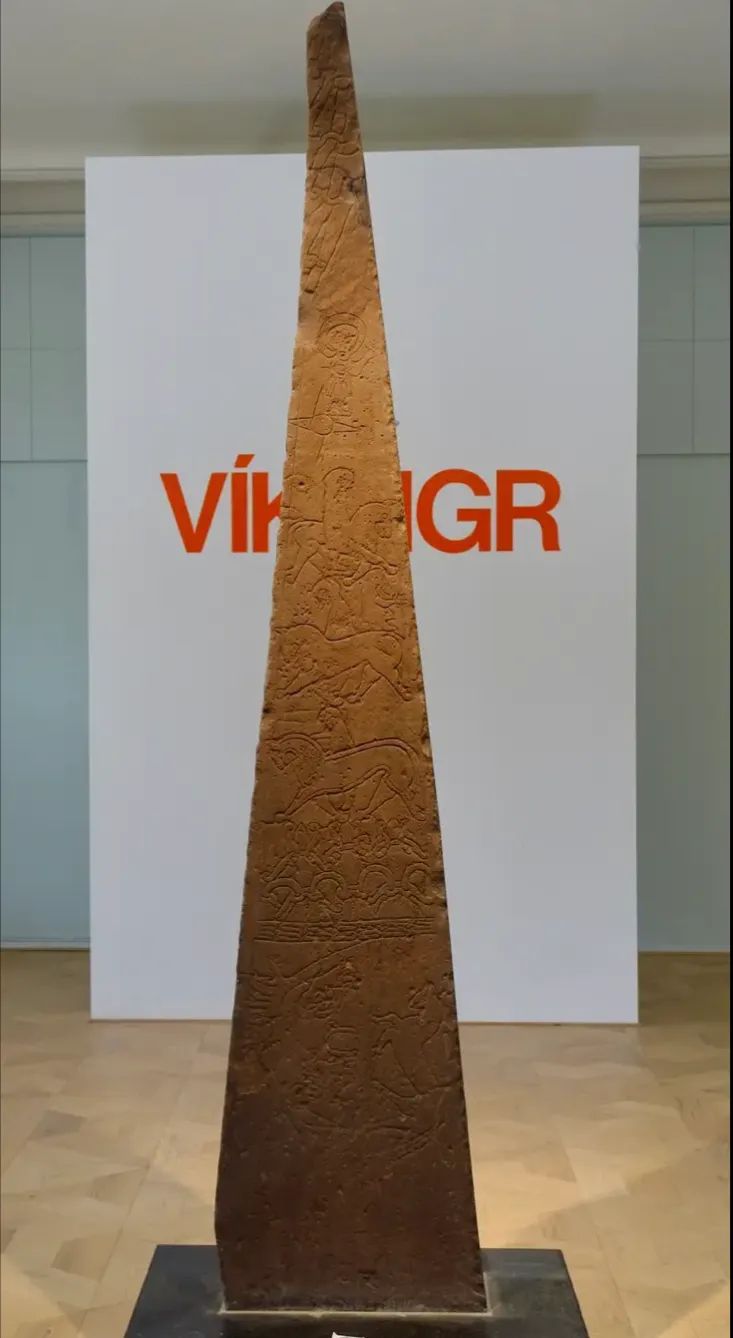
    Gemma: Oh gosh, that’s such a difficult question because there are so many featured within! I don’t know that I can pick just one, but certainly one of my favourite stories is that of Astrid, Gunnvor and the Dynna Stone. The Dynna Stone is an 11th century runestone from Norway that commemorates a woman named Astrid. It was erected in her memory by her mother, Gunnvor, and commemorates Astrid as “the handiest maiden in Hadeland”, suggesting Astrid was skilled at some kind of craft. We know little else about the two women, but the runestone is also important as being one of the earliest instances of Christian pictorial art in the country. In a book about medieval women and art, having an object commissioned by a woman for her daughter, who may also have been an artist of some form, is really special.

    Sharon: Who was the hardest person to write about?

    Gemma: I don’t know that I struggled so much to write about a particular person – I cover so many countries and centuries that there was always someone you could find – but more particular groups of people. Being someone who specialises much more on Western Europe, it was easy to think of examples of significant people to write about, but I was keen that the book would make sure to cover as much of Europe as possible, and so I sometimes had to do some real digging to find an example of a woman who fit in with what I was talking about from different regions. In the same vein, it was sometimes tricky finding specific examples of women to use in my Peasants and Professionals section. Although we do know the names of some craftswomen from the later Middle Ages, due to increased record-keeping, finding names of ordinary, lower-class women is really, really difficult. There were often few reasons for these women to turn up in the written record. This is, of course, where the art was an excellent filler, as we at least have visual representations of them, but it was almost impossible to tell individual stories of particular women in the same way as in other chapters.

    Sharon: Did you come across a particularly interesting or obscure character?

    Gemma: One woman who really struck a chord with me was Marietta Barovier, who was part of a well-known Venetian glassmaking family. Her father had invented cristallo glass, and had clearly given equal weighting to the talents of his daughter as well as his son. When he died, he bestowed his workshop to his two children jointly. Marietta gained a significant reputation of her own, and in the 1480s she invented the rosette or chevron bead, which became an iconic Venetian glass bead. Women in Italy were in many ways more restricted in the world of work than other women in Europe, and yet here you have a woman who was not only allowed equal inheritance, but became famous in her own right for her exceptional skill.

    Sharon: Was there a particular image or manuscript that struck you?

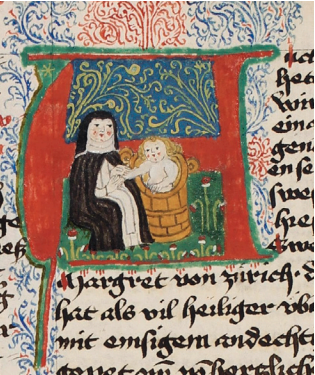
    Margaret von Zurich

    Gemma: Another difficult question as there are so many wonderful images! I think I’ll go with a simple little manuscript initial from a German nunnery. The picture shows a nun named Margaret von Zurich bathing the Christ Child in a barrel bath. It’s a very simple, small drawing, with some beautiful colour, and to modern eyes it is nothing extraordinary. But this small picture is actually incredibly subversive. The Catholic Church had forbidden women from touching Christ, and so not only was Margaret’s vision dangerous, but so was the recording of it in a manuscript. Religious women in Europe were often at the spearhead of reform and religious fervour, and this small drawing really succinctly demonstrates that.

    Sharon: Did you have to leave anyone out through time constraints, lack of images or word count? If so, who?

    Gemma: Oh, most certainly! The book is not very long by history book standards, and yet it aims to cover a continent and five centuries of history! I could have written so, so much more and there are always people you wish you could include or expand upon but can’t. In the early days of writing and researching, I realised I needed to find a way to narrow the scope a little to make the book somewhat more manageable, and so I made the decision to focus on Catholic Europe, which thus excluded many eastern countries. This was a disappointment as one woman I wrote about in a sample chapter was Queen Tamar of Georgia. She ruled from 1184 to 1213 and was the first woman to rule the country in her own right. Despite early objections to her reign, her time as queen went on to be seen as a Golden Age, and her story is so fascinating. It was a shame to have to cut her out, but maybe she can find her way in to a future project of mine!

    Sharon: What was your biggest challenge when writing about women in history?

    Dynna Stone

    Gemma: I think for this book in particular, it was trying to correctly balance what women did, with what people at the time thought about what women did. There was a lot of misogyny in the Middle Ages and so lots of written sources or pieces of art criticise women for working too much, for being too involved in politics, for being too promiscuous, for being too…. But we also have to remember that just a fraction of what existed in the medieval period has survived to today, and the people creating these sources were sometimes the very people most likely to criticise women – monks sequestered away from the world, courtiers who didn’t like submitting to female authority, and so on. And so just because we might have some of these thoughts that have made it to today, it doesn’t mean that everyone or even the majority of people thought that. You don’t want to belittle the struggles that women at the time went through; some women did lose their kingdoms because people wanted a male ruler instead, and some peasant women who had to work in taverns to support their families were derided as prostitutes. But those female leaders also had thousands of men willing to fight for them, and there were popular ballads and texts that praised women for all the hard work they did to keep their families afloat. And you also want to try and avoid praising certain women for their exceptionalism, especially when some of their contemporaries used exceptionalism as back-handed compliments, a way to deride the rest of the female sex.

    Sharon: What are you working on now?

    Gemma: I am now busy getting started on my next book! I’ve gone back to England and will be looking at the court of Richard II, and I’m really excited to see which threads I’ll choose to pull at. It’s such an interesting and tumultuous reign, there is plenty to choose from! But I am definitely keen to return to a similar style book as Women in the Middle Ages in the future so my mind is already whirring with possibilities…

    About the Author: 

    Gemma Hollman is a historian and author of The Queen and the Mistress: The Women of Edward III and Royal Witches: From Joan of Navarre to Elizabeth Woodville. A Fellow of the Royal Historical Society, she works full-time in the heritage industry whilst running her historical blog, Just History Posts. You can find Gemma on Twitter: @GemmaHAuthor, and Facebook: facebook.com/JustHistoryPosts,

    To Buy the book:

    You can buy Women in the Middle Ages: Illuminating the World of Peasants, Nuns, and Queen in the UK from Waterstones and Amazon. And in the US from Barnes & Noble and Amazon.

    *

    My Books:

    Signed, dedicated copies of all my books are available through my online store.

    OUT NOW! Heroines of the Tudor World

    Heroines of the Tudor World tells the stories of the most remarkable women from European history in the time of the Tudor dynasty, 1485-1603. These are the women who ruled, the women who founded dynasties, the women who fought for religious freedom, their families and love. These are the women who made a difference, who influenced countries, kings and the Reformation. In the era dominated by the Renaissance and Reformation, Heroines of the Tudor World examines the threats and challenges faced by the women of the era, and how they overcame them. From writers to regents, from nuns to queens, Heroines of the Tudor World shines the spotlight on the women helped to shape Early Modern Europe.

    Heroines of the Tudor World is now available for pre-order from Amberley Publishing and Amazon UK.

    Coming 30 January 2025: Scotland’s Medieval Queens

    Scotland’s history is dramatic, violent and bloody. Being England’s northern neighbour has never been easy. Scotland’s queens have had to deal with war, murder, imprisonment, political rivalries and open betrayal. They have loved and lost, raised kings and queens, ruled and died for Scotland. From St Margaret, who became one of the patron saints of Scotland, to Elizabeth de Burgh and the dramatic story of the Scottish Wars of Independence, to the love story and tragedy of Joan Beaufort, to Margaret of Denmark and the dawn of the Renaissance, Scotland’s Medieval Queens have seen it all. This is the story of Scotland through their eyes.

    Available for pre-order now.

    Also by Sharon Bennett Connolly:

    Women of the Anarchy demonstrates how Empress Matilda and Matilda of Boulogne, unable to wield a sword themselves, were prime movers in this time of conflict and lawlessness. It shows how their strengths, weaknesses, and personal ambitions swung the fortunes of war one way – and then the other. Available from Bookshop.orgAmberley Publishing and Amazon UKKing John’s Right-Hand Lady: The Story of Nicholaa de la Haye is the story of a truly remarkable lady, the hereditary constable of Lincoln Castle and the first woman in England to be appointed sheriff in her own right. Available from all good bookshops Pen & Sword Booksbookshop.org and AmazonDefenders of the Norman Crown: The Rise and Fall of the Warenne Earls of Surrey tells the fascinating story of the Warenne dynasty, from its origins in Normandy, through the Conquest, Magna Carta, the wars and marriages that led to its ultimate demise in the reign of Edward III. Available from Pen & Sword BooksAmazon in the UK and US, and Bookshop.org

    Ladies of Magna Carta: Women of Influence in Thirteenth Century England looks into the relationships of the various noble families of the 13th century, and how they were affected by the Barons’ Wars, Magna Carta and its aftermath; the bonds that were formed and those that were broken. It is now available in paperback and hardback from Pen & SwordAmazon, and Bookshop.orgHeroines of the Medieval World tells the stories of some of the most remarkable women from Medieval history, from Eleanor of Aquitaine to Julian of Norwich. Available now from Amberley Publishing and Amazon, and Bookshop.orgSilk and the Sword: The Women of the Norman Conquest traces the fortunes of the women who had a significant role to play in the momentous events of 1066. Available now from Amazon,  Amberley Publishing, and Bookshop.org.

    Alternate Endings: An anthology of historical fiction short stories including Long Live the King… which is my take what might have happened had King John not died in October 1216. Available in paperback and kindle from Amazon.

    Podcast:

    Have a listen to Gemma talking about the two women in the life of Edward III on the A Slice of Medieval podcast, which I co-host with Historical fiction novelist Derek Birks.

    *

    Don’t forget! Signed and dedicated copies of all my books are available through my online store.

    For forthcoming online and in-person talks, please check out my Events Page.

    You can be the first to read new articles by clicking the ‘Follow’ button, liking our Facebook page or joining me on TwitterThreads and Instagram.

    *

    ©2024 Sharon Bennett Connolly FRHistS and Gemma Hollman

    Guest Post: In the Footsteps of Royalty: Exploring the Plantagenets on Our First Historic Adventure by Maxine Sommer

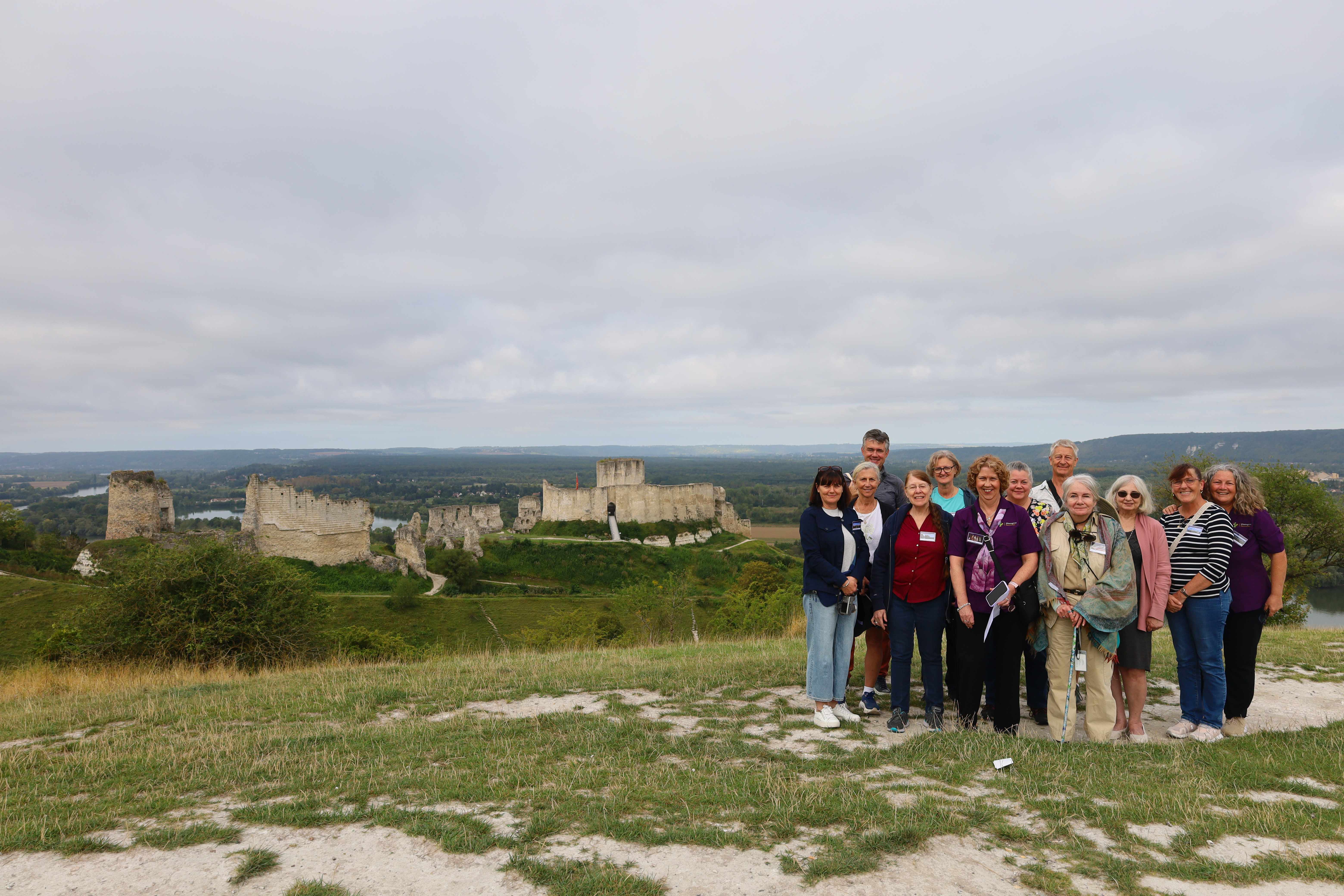
    Today, it is a pleasure to welcome my friend Maxine Sommer back to History…the Interesting Bits. This summer, Maxine led a tour group of History fans through France in search of the Plantagenets, stopping at some iconic landmarks associated with Henry II, Eleanor of Aquitaine and the rest of the most famous – and at times, infamous – medieval royal family.

    Over to Maxine….

    In the Footsteps of Royalty: Exploring the Plantagenets on Our First Historic Adventure

    “Journeying Through Medieval Masterpieces and Iconic Landmarks”

    Château Gaillard: A Castle of Triumph and Tragedy

    Château Gaillard

    From day one, we dove into history headfirst with a visit to the imposing ruins of Château Gaillard. Though often hailed as Richard the Lionheart’s crowning achievement, this fortress holds layers of much more history than that. In 1314, it became the prison of two daughters-in-law of King Philip IV, key figures in the infamous Tour de Nesle Affair, a scandal that rocked the French court. A couple of decades later, the castle played host to Scotland’s child king, David II, and his bride, offering a royal respite before his return to reclaim his kingdom.

    With the help of our brilliant guide Ange, we traced the rise and fall of Chateau Gaillard, from its hasty construction under Richard I to its swift capture by King Philip Augustus of France after John’s ill-fated reign. Standing among the weathered stone walls, it was easy to imagine its days of glory and power, but also to understand how quickly a once-unstoppable fortress could be toppled under weaker leadership. Chateau Gaillard’s story is not just one of medieval might but also a reminder of the delicate balance of power that shaped the Plantagenet era.

    The Magnificent Bayeux Tapestry: A Stitch in Time

    Though the Bayeux Tapestry predates the Plantagenets by nearly a century, it remains an essential highlight for anyone captivated by the medieval period. No amount of reading can prepare you for the sheer grandeur of this stunning masterpiece, meticulously crafted by hand to narrate the dramatic lead-up to the Norman invasion of England. The vibrant details leap to life, showcasing a vivid display that is nothing short of extraordinary.

    One moment that particularly struck me was a scene depicting King Harold’s hasty departure for Normandy—his men, so rushed, they left without their shoes, splashing barefoot through the water as they headed to their ships. It’s these small yet poignant details that bring the narrative to life, showcasing the dedication of the women who painstakingly wove this epic tale.

    Beyond the tapestry itself, the adjoining museum is a treasure trove of information, shedding light not just on this remarkable artifact but also on the broader historical context of the era. Visiting the Bayeux Tapestry is an unforgettable experience that will truly immerse you in the rich history of Normandy.

    Mont Saint-Michel: A Dreamlike Retreat

    Mont St Michel

    This tidal island certainly lives up to its UNESCO World Heritage status, sadly though, as with most sites like this, the allure of their fame can bring overwhelming crowds, making it challenging to fully appreciate their beauty. To create an unforgettable experience for my group, I arranged for us to stay overnight on the island—a decision that transformed our visit into something truly magical. As the day’s tourists departed, we found ourselves wandering the winding paths of Mont Saint-Michel in peaceful solitude. The island’s enchanting atmosphere became even more pronounced as twilight descended, allowing us to immerse ourselves in its rich history without the jostle of crowds.

    The journey across the causeway to Mont Saint-Michel feels like a step back in time, as the abbey loomed larger, the closer we got to the gate. Approaching the island in this way adds to the otherworldly feeling, transporting you to a different realm entirely.

    One of my guests, Dianne, perfectly captured the essence of our experience in her review: “The highlight for me was staying overnight on the island of Mont Saint-Michel. I will never forget watching the sun come up and the light making the abbey glow.” Her words echo the indescribable wonder we all felt, creating memories that will last a lifetime.

    Fontevraud Abbey: Where History, Serenity, and Culinary Splendour Meet

    Queen Eleanor at the Abbey

    For anyone captivated by the Plantagenets, a visit to Fontevraud Abbey—final resting place of the indomitable Eleanor of Aquitaine—is often a dream come true. Several of my group members had long wished to stand before her effigy, so it was clear that this site would be a highlight of our tour. Yet, what awaited us at Fontevraud far exceeded expectations.

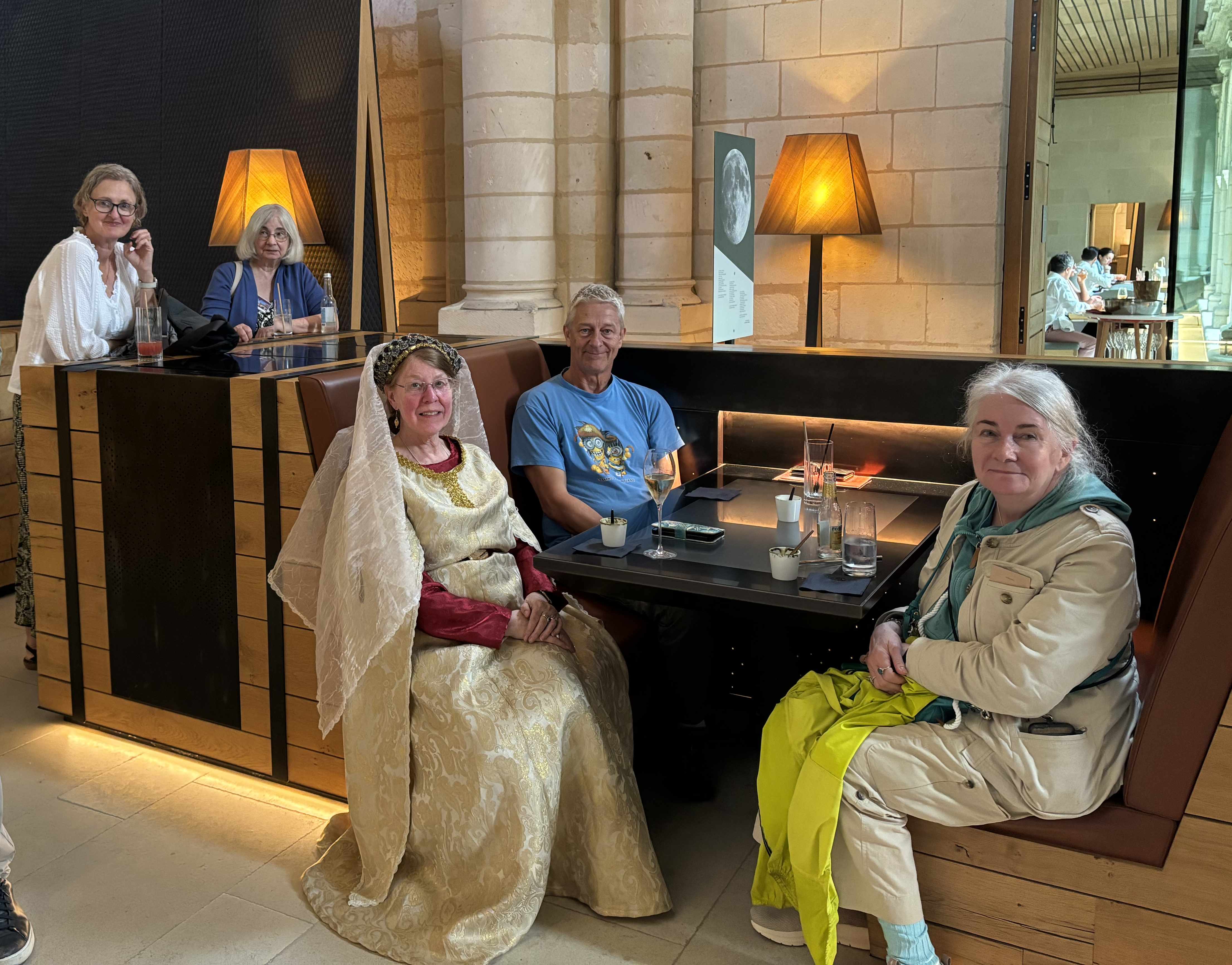
    Our stay at Fontevraud l’Hôtel, situated within the abbey grounds, offered the unique luxury of exploring the abbey well into the night, with its tranquil beauty only deepening as the moonlight bathed its ancient stones. But what truly made this visit unforgettable was the dining experience. I selected the abbey’s famed “lunar menu,” a modern interpretation of the simple yet refined meals once enjoyed by the monks and nuns who lived here centuries ago. What followed was a culinary journey that transcended time—an extraordinary feast of countless, artfully prepared courses that delighted the senses.

    To top it all off, we were treated to a special visit from “Queen Eleanor” herself, brought to life by our talented group member Donna in costume, creating an enchanting atmosphere that perfectly rounded out our unforgettable night at the Abbey.

    Guédelon: A Medieval Masterpiece in the Making

    Guedelon Medieval Site

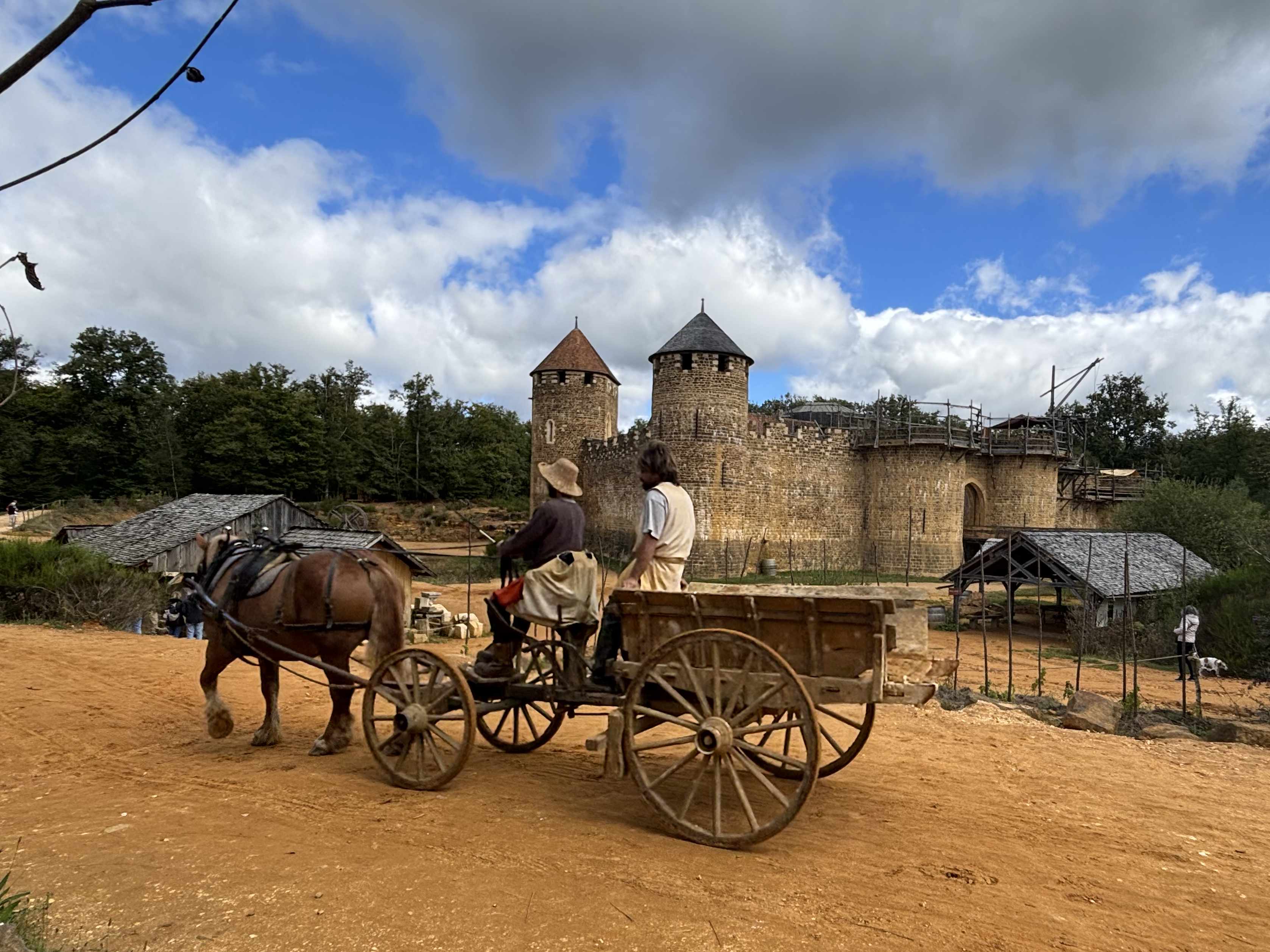
    Though its connection to the Plantagenets lies only in the era, Guédelon captivated us with its sheer ambition and authenticity. This extraordinary project, set within an unused quarry, is an ongoing attempt to build a 13th-century castle using only the materials and techniques of the medieval period. It was like stepping back in time—without the school excursion chaos! We had the chance to speak with the craftsmen, each dedicated to recreating history one stone at a time. It’s mind-boggling to witness the painstaking effort that goes into building each section of the castle by hand, giving us a new appreciation for the scale of historical construction.

    As we walked through Guédelon, I couldn’t help but reflect on Château Gaillard, which we visited earlier in the tour—a fortress that Richard the Lionheart had built in just two years. While Richard’s team had far more manpower in 1196, the ongoing construction of Guédelon, which began in 1997, has taken 27 years and is still far from complete.

    Adding to the authenticity, the village that houses the volunteers lives strictly by 13th-century standards. They grow their own food, dress in period-appropriate clothing, and cook using medieval techniques. It’s a living glimpse into the past and an absolute must-visit for history enthusiasts.

    “Unraveling the Tales of an Intriguing Plantagenet Legacy”

    Richard I, the Lionheart

    Château Châlus-Chabrol

    A Plantagenet-themed tour through France wouldn’t be complete without constant references to the Angevins. Unsurprisingly, Richard the Lionheart was a recurring figure throughout our journey, from the stunning ruins of Château Gaillard—Richard’s pride and joy—to his embalmed heart at Rouen Cathedral, and finally to Château Châlus-Chabrol, where he met his end after receiving a fatal crossbow wound. Along the way, there were lively debates about his merits as a king and husband, discussions that seemed to spill over into several coach rides and castle visits!

    But the most amusing conversation of all came after our visit to Château Châlus-Chabrol. According to local legend, Richard’s entrails were buried in the chapel of the castle where he died, the very castle he had been besieging when he was fatally wounded. As we travelled on, our group began to ponder this curious story—if Richard was the enemy, how likely was it that the castle’s defenders would have invited him into their chapel to die comfortably by the fire? Surely, the reality was less cozy than that! This debate sparked plenty of laughs and camaraderie, as we cheerfully unraveled the mystery of Richard’s final days. It was moments like this that truly made the tour so memorable, blending history with humour and shared insights.

    Henry II

    Chinon Castle

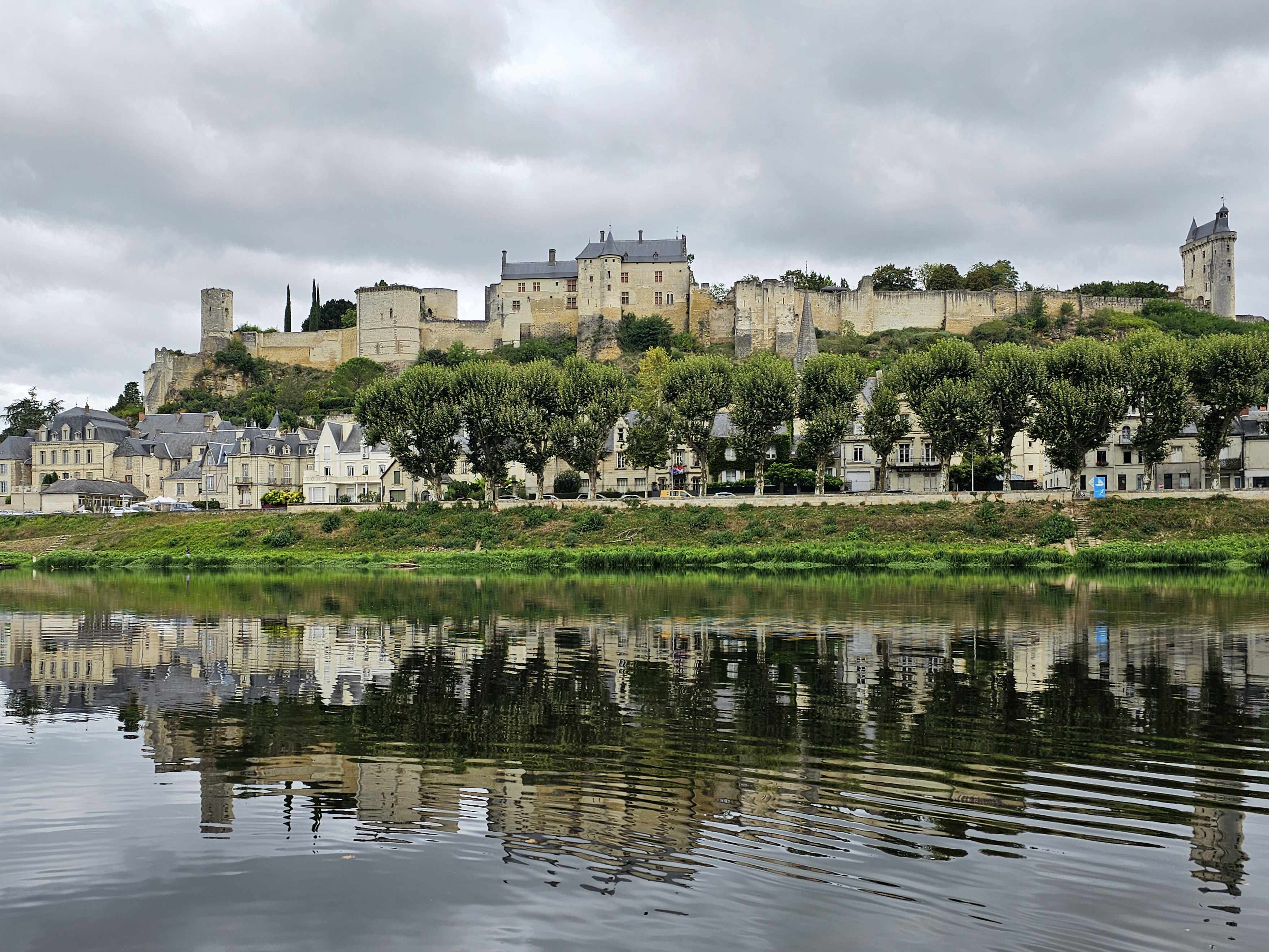
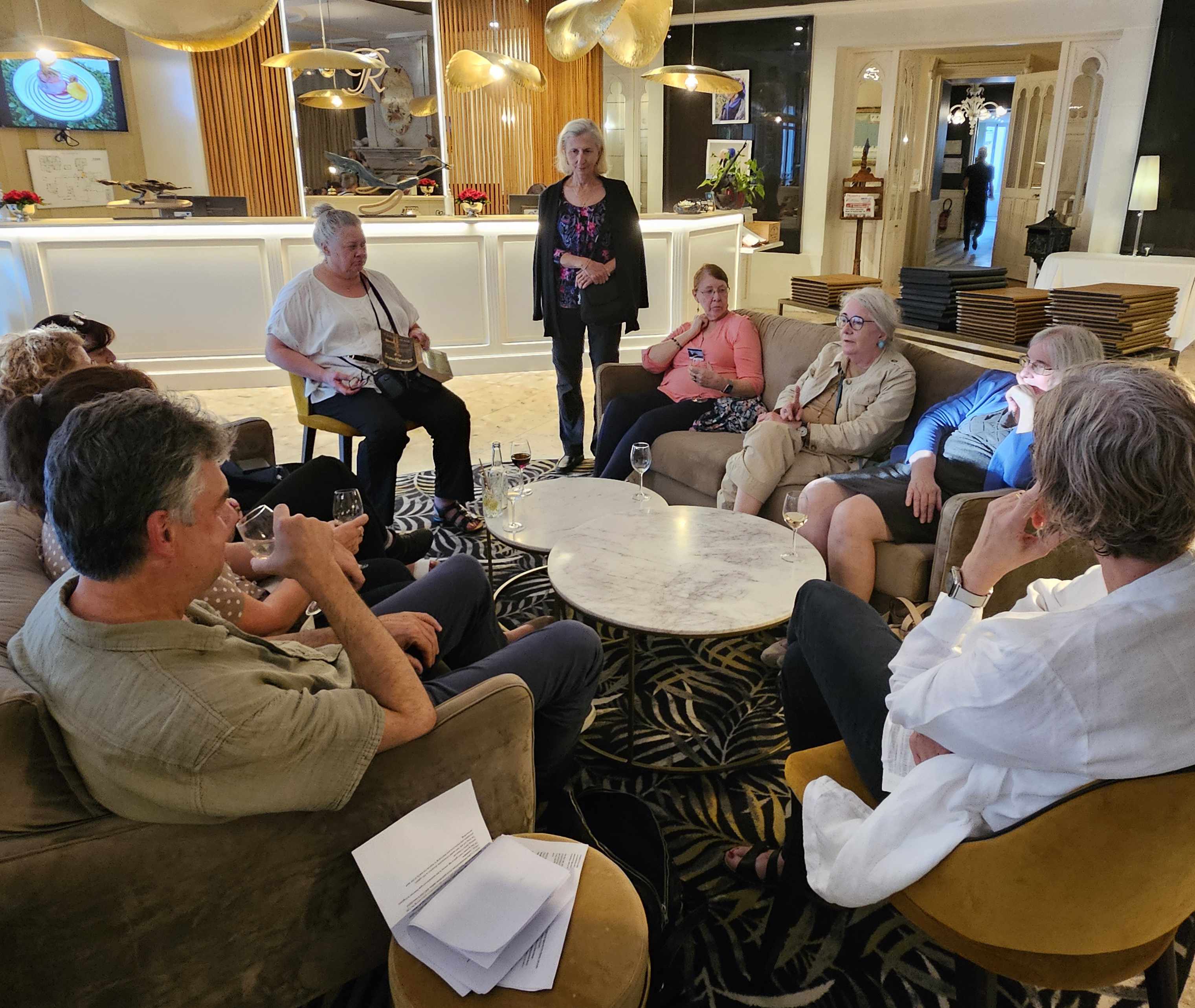
    On the evening of Day 4, just outside Poitiers, I arranged a lively group discussion before dinner, with the spotlight on none other than Henry II. The topic was particularly fitting after our earlier visit to the impressive Chinon Castle, a stronghold that played a key role in his reign. Over a glass or two of wine, our conversation quickly sparked debates about the enigmatic first Plantagenet king.

    For many, Henry II is synonymous with the infamous murder of Thomas Becket in December 1170—a crime that shocked Europe, with Becket killed on the very floor of Canterbury Cathedral. Henry’s tumultuous relationships with his sons, often called the ‘Devil’s Brood,’ and the long imprisonment of his formidable wife, Eleanor of Aquitaine, have painted a rather dark image of him in the pages of history. And yet, I have a dear friend who defends Henry passionately, believing history has judged him too harshly. This made me eager to hear the views of my group.

    I was not disappointed. What followed was a fascinating and animated discussion about Henry’s complexity, revealing both his flaws and strengths. Like many moments on our journey, everyone felt welcome to share their opinions, creating a warm and open exchange that deepened our collective understanding of this remarkable, yet often misunderstood, king.

    The Hundred Years’ War

    Group discussion: Hundred Years’ War

    Beyond the Angevins, one of the most pivotal topics of our journey through France was the prolonged struggle for the French crown between the Plantagenet kings of England and the Valois kings of France, famously known as The Hundred Years’ War. This conflict defined a significant part of Plantagenet history in France, so I was especially excited to organize another pre-dinner group discussion on Day 8.

    I am sure most of the group had read accounts of this struggle from an English perspective, however I was curious to explore its impact on the French people. Now, what better way to do that, than by hearing the insights of our

    exceptional guide, Ange, a native Frenchman, who provided a fresh and compelling view of the war from the French side. His perspective gave us a different and not unbalanced understanding of this conflict.

    It’s not often us history ‘nerds’ can engage in such thoughtful debates over a glass of wine, and this particular evening felt like another one of those perfect moments of camaraderie and learning that made our journey so incredible.

    Eleanor of Aquitaine

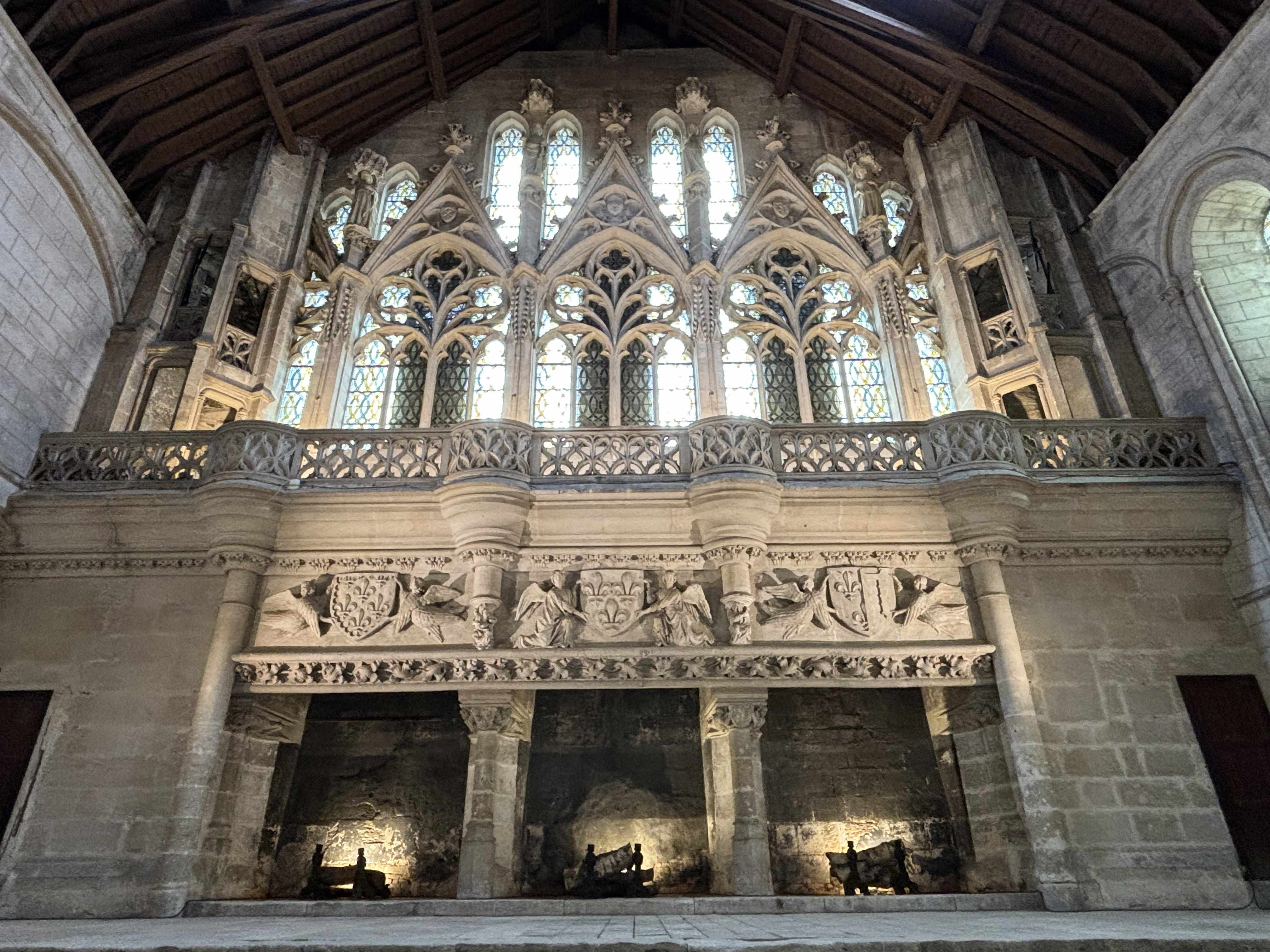
    Great Hall at Poitiers

    No 10-night Plantagenet-themed tour through France would be complete without a deep dive into the life of the most remarkable queen of them all, Eleanor of Aquitaine. Our journey took us to some of the most significant places in her life, from the serene beauty of Fontevraud Abbey, where we had the privilege of visiting her effigy and reflecting on her final days, to the lively city of Poitiers, where she held court with unmatched influence for so many years.

    We also ventured to Bordeaux, a region now synonymous with world-class wine, a commodity that owes much of its early prominence to Eleanor’s marriage to Henry, Duke of Normandy—later Henry II of England. Despite the challenges and turbulence of their union, the marriage of these two dynamic figures laid the foundation for a dynasty that ruled for 331 years.

    Our discussions about Eleanor were as vibrant as her extraordinary life. From her imprisonment at the hands of her own husband to her daring voyages to the Holy Land—one of which took place when she was nearly 70 years old—we marveled at her resilience and power. And finally, we reflected on the peace she found at Fontevraud, where she spent her final days in quiet reflection at the abbey she so loved.

    I hope you’ve enjoyed this glimpse into our amazing journey. For more stories and discoveries from my first tour, visit my blog and uncover all the memorable experiences we shared beyond just mere history: plantagenetdiscoveries.com.

    We’re gearing up for the next adventure in July, and you won’t want to miss it! Mention this article when you reach out http://www.plantagenetdiscoveries.com/contact for an exclusive discount—I’d love to welcome you on board for our next historical journey.

    *

    My Books:

    Signed, dedicated copies of all my books are available through my online store.

    OUT NOW! Heroines of the Tudor World

    Heroines of the Tudor World tells the stories of the most remarkable women from European history in the time of the Tudor dynasty, 1485-1603. These are the women who ruled, the women who founded dynasties, the women who fought for religious freedom, their families and love. These are the women who made a difference, who influenced countries, kings and the Reformation. In the era dominated by the Renaissance and Reformation, Heroines of the Tudor World examines the threats and challenges faced by the women of the era, and how they overcame them. From writers to regents, from nuns to queens, Heroines of the Tudor World shines the spotlight on the women helped to shape Early Modern Europe.

    Heroines of the Tudor World is now available for pre-order from Amberley Publishing and Amazon UK.

    Coming 30 January 2025: Scotland’s Medieval Queens

    Scotland’s history is dramatic, violent and bloody. Being England’s northern neighbour has never been easy. Scotland’s queens have had to deal with war, murder, imprisonment, political rivalries and open betrayal. They have loved and lost, raised kings and queens, ruled and died for Scotland. From St Margaret, who became one of the patron saints of Scotland, to Elizabeth de Burgh and the dramatic story of the Scottish Wars of Independence, to the love story and tragedy of Joan Beaufort, to Margaret of Denmark and the dawn of the Renaissance, Scotland’s Medieval Queens have seen it all. This is the story of Scotland through their eyes.

    Available for pre-order now.

    Also by Sharon Bennett Connolly:

    Women of the Anarchy demonstrates how Empress Matilda and Matilda of Boulogne, unable to wield a sword themselves, were prime movers in this time of conflict and lawlessness. It shows how their strengths, weaknesses, and personal ambitions swung the fortunes of war one way – and then the other. Available from Bookshop.orgAmberley Publishing and Amazon UKKing John’s Right-Hand Lady: The Story of Nicholaa de la Haye is the story of a truly remarkable lady, the hereditary constable of Lincoln Castle and the first woman in England to be appointed sheriff in her own right. Available from all good bookshops Pen & Sword Booksbookshop.org and AmazonDefenders of the Norman Crown: The Rise and Fall of the Warenne Earls of Surrey tells the fascinating story of the Warenne dynasty, from its origins in Normandy, through the Conquest, Magna Carta, the wars and marriages that led to its ultimate demise in the reign of Edward III. Available from Pen & Sword BooksAmazon in the UK and US, and Bookshop.org

    Ladies of Magna Carta: Women of Influence in Thirteenth Century England looks into the relationships of the various noble families of the 13th century, and how they were affected by the Barons’ Wars, Magna Carta and its aftermath; the bonds that were formed and those that were broken. It is now available in paperback and hardback from Pen & SwordAmazon, and Bookshop.orgHeroines of the Medieval World tells the stories of some of the most remarkable women from Medieval history, from Eleanor of Aquitaine to Julian of Norwich. Available now from Amberley Publishing and Amazon, and Bookshop.orgSilk and the Sword: The Women of the Norman Conquest traces the fortunes of the women who had a significant role to play in the momentous events of 1066. Available now from Amazon,  Amberley Publishing, and Bookshop.org.

    Alternate Endings: An anthology of historical fiction short stories including Long Live the King… which is my take what might have happened had King John not died in October 1216. Available in paperback and kindle from Amazon.

    Podcast:

    Have a listen to the A Slice of Medieval podcast, which I co-host with Historical fiction novelist Derek Birks. Derek and I welcome guests, such as Bernard Cornwell, and discuss a wide range of topics in medieval history, from significant events to the personalities involved.

    *

    Don’t forget! Signed and dedicated copies of all my books are available through my online store.

    For forthcoming online and in-person talks, please check out my Events Page.

    You can be the first to read new articles by clicking the ‘Follow’ button, liking our Facebook page or joining me on TwitterThreads and Instagram.

    *

    ©2024 Sharon Bennett Connolly FRHistS and Maxine Sommer
    Guest Post: Empresses, Saints and Female-Kings: The Four Great-Granddaughters of King Ladislaus the Elbow-High by Katarzyna Ogrodnik-Fujcik

    Today it is a pleasure to welcome my good friend, Kasia Ogrodnik to History…the Interesting Bits with a little bit of Polish history for us. I have been wanting to tell the story of King Jadwiga since writing about her in Heroines of the Medieval World. But Kasia is far better qualified to write about her compatriot, Poland’s famous female king and saint, and Jadwiga’s influential female relatives.

    So, over to Kasia…

    Empresses, Saints and Female-Kings: The Four Great-Granddaughters of King Ladislaus the Elbow-High

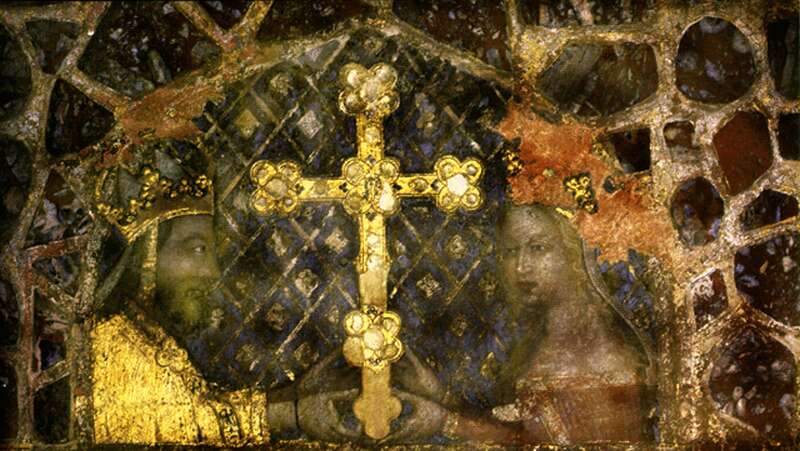
    Charles IV, King of Bohemia and Holy Roman Emperor and Anna of Schweidnitz [Anna Świdnicka], c. 1357, Chapel of St. Katherine, Karlstejn

    The night of 19 May 1365 saw a young girl leaving Pisa on horseback. With her hair loose, clad only in her nightgown she was galloping to safety after fire broke out in Palazzo degli Anziani. Judging by her looks no one would have guessed this girl was in fact Holy Roman Empress and Queen of Bohemia. 

    Anna of Schweidnitz, Silesia (today Poland), was the only child of Duke Henry II, the grandson of King Ladislaus the Elbow-High of Cracow (Poland). Upon her father’s death she was placed under the care of his elder brother, her uncle, Bolko II the Small. The ruler of the small, but politically important duchy, Bolko was the last independent Silesian Piast. Since Charles IV of Luxembourg intended to annex the entirety of Silesia to the Kingdom of Bohemia, Bolko’s duchy, being the only missing part, was crucial to his plans. To secure the Schweidnitz inheritance Charles married Anna and this is how her journey began. Of course, she was not the only great-granddaughter of King Ladislaus to make an illustrious career. His three other great-granddaughters were to leave their marks on the world, too, and indelible ones. Two of them were to be crowned ”kings” and one proclaimed  saint. 

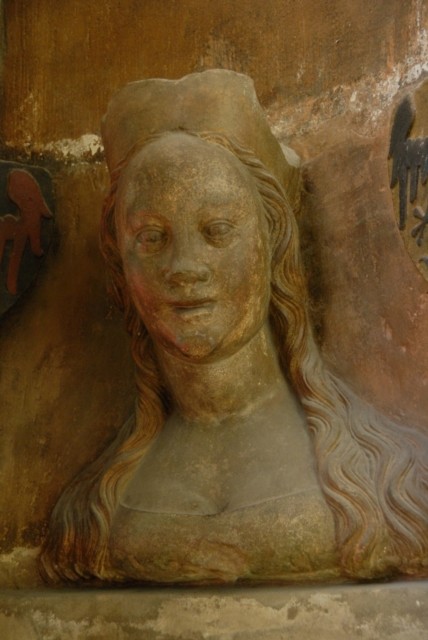
    Anna of Schweidnitz [Anna Świdnicka], bust in St Vitus Cathedral, Prague, c. 1370

    Anna of Schweidnitz (b.1339), Queen of Bohemia and Holy Roman Empress, was Charles IV of Luxembourg’s third wife. Initially she was betrothed to his son, Wenceslaus, but the boy died while still very young. His mother, Charles’s second wife died too shortly afterwards. To secure the Schweidnitz succession Charles decided to marry his late son’s fiancee himself. Anna was raised and educated at the splendid court of Queen Elizabeth of Poland (her late father’s aunt) at Buda, where she was sent by her uncle and official guardian, Duke Bolko II the Small. It was there where she and Charles were married in the closing days of  May 1353. Shortly afterwards the newlyweds returned to Prague and paid a visit to Schweidnitz, where the succession treaty was signed according to which the duchy was to be inherited by Anna and her children by Charles upon the death of her uncle Bolko and his wife Agnes of Habsburg. On 28 July 1353, Anna was crowned Queen of Bohemia and the following year, on 9 February 1354, Queen of Germany. The year 1355 saw the royal couple in Italy, where on Easter Sunday (5 April 1355) they were crowned Holy Roman Emperor and Holy Roman Empress in a splendid ceremony in the Basilica of Saint Peter, Rome.

    Anna and Charles’s first child, a daughter, Elizabeth, was born in 1358. Charles was overjoyed, but Anna felt she failed her husband (which we know thanks to her surviving correspondence with Petrarch). A much awaited son and heir arrived three years later, named Wenceslaus, traditional name of the rulers of Bohemia. He was to become Charles’ beloved and favoured child. Anna died on 11 July 1362, in childbirth, aged 23. The child did not survive, either, and they were buried together in St Vitus Cathedral, Prague. Anna was remembered for her personal charm and sweet nature. Not only did she receive a bluestocking education, but she was also considered one of the style icons of her time, her reputation as a great beauty resting on the surviving images created during her lifetime and shortly after her untimely death. Tradition has it that of Charles’ four wives it was Anna he loved most. Stricken with grief upon her passing, he did not remarry until a political situation forced him to. His fourth wife was Anna’s kin, Elizabeth of Pomerania, also great-granddaughter of King Ladislaus the Elbow-High. 

    Elizabeth of Pomerania (Eliška Pomořanská, Elżbieta Pomorska)

     
    Reliquary Shrine of Elizabeth of Poland, Queen of Hungary, Maria and Jadwiga’s paternal grandmother, attributed to Jean de Touyl, ca. 1350 . Metropolitan Museum of Art, New York

    Elizabeth was a daughter of Duke Bogusław the Great of Pomerania and Princess Elżbieta of Poland. In 1362 her maternal grandfather, King Casimir the Great of Poland together with his nephew, Louis the Great of Hungary, dukes of Austria and Bavaria formed a coalition against Charles IV of Luxembourg. The opposing parties found themselves on the verge of war, which did not break out, however, perhaps due to Anne of Schweidnitz’s untimely death. The rulers came to terms instead and a marriage was forged to consolidate their agreement. Charles was to marry Elizabeth. He was thrice her age, shorter than her and not very attractive. She was described as beautiful, full of life, and as fit as a fiddle. Stories had it that she could break horseshoes with her own hands. She was an avid horse rider and hunter. 

    The wedding ceremony was celebrated in Kraków on 21 May 1363. Afterwards the couple travelled together to Prague where Elizabeth was crowned Queen of Bohemia. Five years later her imperial coronation at Rome followed. Despite the age difference she and Charles got along well, being married for fifteen years. Their union produced six children, four of whom were to reach adulthood. Charles and Elizabeth’s eldest child, a daughter Anne, was to marry Richard II and become Queen Consort of England. Their son, Sigismund was to be crowned King of Bohemia, Hungary and Holy Roman Emperor. Charles IV died in 1378. Elizabeth herself was to outlive her husband for fifteen years. She died in 1393 and like his three wives before her, she was buried in St Vitus Cathedral, Prague.

    Mária [Mary] of Anjou, King of Hungary

    The coats of arms of Hungary and Poland, c. 1340. Treasury of Aachen Cathedral, Germany

    Mary was one of the three daughters of Louis the Great of Hungary and his second wife, Elizabeth of Bosnia. In 1379, Mary’s elder sister Catherine died, leaving her and her sister Jadwiga Louis’s sole surviving children. The matter of Polish succession had been on the agenda long before Mary was born. Upon King Casimir the Great’s death in 1370 his nephew, Mary’s father, Louis was crowned king of Poland. Initially it was Mary, who was to succeed him as the king of Poland, but the events took a different turn, and in the end she was replaced by her younger sister, Jadwiga [Hedwig]. 

    Mary was crowned “king” of Hungary on 17 September 1382, seven days after her father’s death. However, the idea of a female monarch was not popular among the Hungarian nobility. Many nobles considered Charles III of Naples, Mary’s distant cousin, the lawful heir. 

    Charles landed in Dalmatia in September 1385. In October Mary was married to Sigismund of Luxembourg, however, this  could not prevent Charles from entering the capital.  Mary was forced to renounce the throne and Charles’s coronation took place on 31 December 1385. He did not rule for long. Two months later, in February 1386, he was murdered, most probably at the instigation of Mary’s mother. Mary was restored, but in July she and her mother were captured by the dead king’s supporters. Famed for her beauty, but not for her political decisions, Mary’s mother met a violent end. After imprisonment by her opponents in Novigrad castle, she was found guilty of the murder of Charles III of Naples and strangled to death before her daughter’s own eyes, her body put on display, hanging on a rope from the castle walls. Mary survived and was rescued by her husband, Sigismund, who was crowned king of Hungary afterwards. Mary officially remained his co-ruler, but had no real influence on the government. She died on 17 May 1395 after falling from a horse during a hunting accident. She was pregnant at the time. Her prematurely born son did not survive either. 

    Jadwiga [Hedwig] of Anjou, king and patron saint of Poland

    Jadwiga and Maria, their mother and their sister Catherine as depicted on the St Simeon’s casket, Zadar, Croatia

    Mary’s younger sister, Hedwig was born on 18 February 1374, being the youngest of the three daughters of Louis the Great of Hungary and Elizabeth of Bosnia. 

    Both Mary and Jadwiga received a bluestocking education, Jadwiga both at the cultivated court of Hungary and in Vienna, at the court of her future father-in-law. Not only could Jadwiga read and write, but she also spoke fluent Latin and German. As the king of Poland she owned a big library and always  showed an active and generous support of scholars and learning institutions.

    Since Polish nobles did not like the idea of Mary’s consort, Sigismund of Bohemia, becoming de facto their king, they appealed to Elizabeth of Bosnia, the dowager queen, who had assumed regency, asking to send the younger of her two surviving daughters to Kraków. Elizabeth agreed and absolved the Polish nobles from the oath of loyalty they had pledged to Mary. 

    Jadwiga’s coronation took place on 16 October 1384 in Wawel Cathedral, Kraków, where she was crowned ”king” of Poland. On 18 January 1385 the Lithuanian delegation came to the capital and a meeting was held with the representatives of the Polish nobility. Jadwiga was to marry the ruler of pagan Lithuania, Jogaila. In the opening days of 1386, Jadwiga publicly called off her engagement to Wilhelm Habsburg and married newly baptised Jogaila, who was to come down in history under his new name, Władysław Jagiełło [Ladislaus Jagiellon]. At the time of their wedding she was twelve, he was thirty-five. Władyslaw was crowned king on 4 March 1386. 

    Despite her young age Jadwiga continued to play an active role in the administration and politics of her realm. She conducted the negotiations with the knights of the Teutonic Order, but also on the Hungarian front. Jadwiga conferred with her sister Mary on numerous occasions. Their meetings were held both in Hungary and in Lesser Poland. She also intervened in Lithuania, where she peacefully resolved dynastic disputes between the ruling fractions.

    Jadwiga’s tomb effigy from 1902 by Antoni Madeyski, Wawel Cathedral, Kraków, Poland. The queen’s earthly remains were transferred here from her original resting place at the high altar in 1949 and stayed here till 1987. Then they were transferred to the altar with the Black Crucifix

    She was famed for her charity and showing great care to the poor and the ill. Her active and generous support of scholars and learning institutions did not waver over the years. In her last will she donated all her jewelry, her rich dresses and other valuable objects to the Kraków Academy (the first Polish university founded by Kazimierz Wielki), now the Jagiellonian University. Additionally, she founded a dormitory for Polish students at the University of Prague. 

    Jadwiga died from complications in childbirth on 17 July 1399. She was twenty-five at the time. Her daughter did not survive, either. Almost immediately after her death, Jadwiga’s tomb became the focus of miracles and the destination of pilgrimages. Her cult flourished, with her canonization first mentioned during the funeral ceremony. However, it was to take seven centuries before she was actually canonised by Pope John Paul II. Ever since she has been recognised as patron saint of Poland and considered Polish national hero. 

    About the author:

    Katarzyna Ogrodnik-Fujcik specializes in British literature and history, her area of expertise being the first Plantagenets (the Angevins). She lives in Poland. She writes for different magazines and websites on Polish and European Middle Ages. She runs a blog dedicated to Henry the Young King. She consulted a BBC documentary on William Marshal.

    *

    My Books:

    Signed, dedicated copies of all my books are available through my online store.

    OUT NOW! Heroines of the Tudor World

    Heroines of the Tudor World tells the stories of the most remarkable women from European history in the time of the Tudor dynasty, 1485-1603. These are the women who ruled, the women who founded dynasties, the women who fought for religious freedom, their families and love. These are the women who made a difference, who influenced countries, kings and the Reformation. In the era dominated by the Renaissance and Reformation, Heroines of the Tudor World examines the threats and challenges faced by the women of the era, and how they overcame them. From writers to regents, from nuns to queens, Heroines of the Tudor World shines the spotlight on the women helped to shape Early Modern Europe.

    Heroines of the Tudor World is now available for pre-order from Amberley Publishing and Amazon UK.

    Coming 30 January 2025: Scotland’s Medieval Queens

    Scotland’s history is dramatic, violent and bloody. Being England’s northern neighbour has never been easy. Scotland’s queens have had to deal with war, murder, imprisonment, political rivalries and open betrayal. They have loved and lost, raised kings and queens, ruled and died for Scotland. From St Margaret, who became one of the patron saints of Scotland, to Elizabeth de Burgh and the dramatic story of the Scottish Wars of Independence, to the love story and tragedy of Joan Beaufort, to Margaret of Denmark and the dawn of the Renaissance, Scotland’s Medieval Queens have seen it all. This is the story of Scotland through their eyes.

    Available for pre-order now.

    Also by Sharon Bennett Connolly:

    Women of the Anarchy demonstrates how Empress Matilda and Matilda of Boulogne, unable to wield a sword themselves, were prime movers in this time of conflict and lawlessness. It shows how their strengths, weaknesses, and personal ambitions swung the fortunes of war one way – and then the other. Available from Bookshop.orgAmberley Publishing and Amazon UKKing John’s Right-Hand Lady: The Story of Nicholaa de la Haye is the story of a truly remarkable lady, the hereditary constable of Lincoln Castle and the first woman in England to be appointed sheriff in her own right. Available from all good bookshops Pen & Sword Booksbookshop.org and AmazonDefenders of the Norman Crown: The Rise and Fall of the Warenne Earls of Surrey tells the fascinating story of the Warenne dynasty, from its origins in Normandy, through the Conquest, Magna Carta, the wars and marriages that led to its ultimate demise in the reign of Edward III. Available from Pen & Sword BooksAmazon in the UK and US, and Bookshop.org

    Ladies of Magna Carta: Women of Influence in Thirteenth Century England looks into the relationships of the various noble families of the 13th century, and how they were affected by the Barons’ Wars, Magna Carta and its aftermath; the bonds that were formed and those that were broken. It is now available in paperback and hardback from Pen & SwordAmazon, and Bookshop.orgHeroines of the Medieval World tells the stories of some of the most remarkable women from Medieval history, from Eleanor of Aquitaine to Julian of Norwich. Available now from Amberley Publishing and Amazon, and Bookshop.orgSilk and the Sword: The Women of the Norman Conquest traces the fortunes of the women who had a significant role to play in the momentous events of 1066. Available now from Amazon,  Amberley Publishing, and Bookshop.org.

    Alternate Endings: An anthology of historical fiction short stories including Long Live the King… which is my take what might have happened had King John not died in October 1216. Available in paperback and kindle from Amazon.

    Podcast:

    Have a listen to the A Slice of Medieval podcast, which I co-host with Historical fiction novelist Derek Birks. Derek and I welcome guests, such as Bernard Cornwell, and discuss a wide range of topics in medieval history, from significant events to the personalities involved.

    *

    Don’t forget! Signed and dedicated copies of all my books are available through my online store.

    For forthcoming online and in-person talks, please check out my Events Page.

    You can be the first to read new articles by clicking the ‘Follow’ button, liking our Facebook page or joining me on TwitterThreads and Instagram.

    *

    ©2024 Sharon Bennett Connolly FRHistS and Katarzyna Ogrodnik-Fujcik
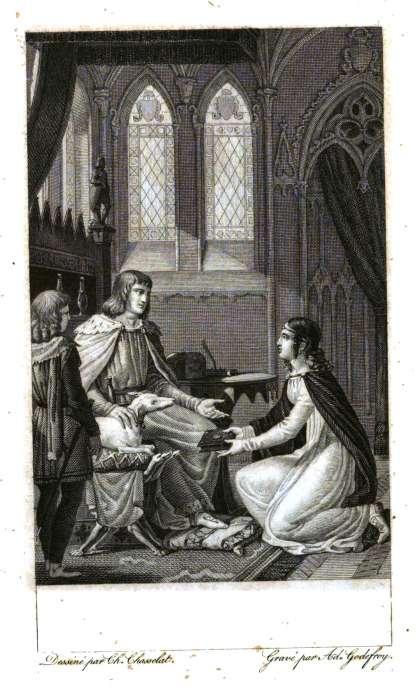
    The Battle of the Standard

    History ... the Interesting Bits
    King Stephen

    22 August is a famous date in history. The Battle of Bosworth, on 22 August 1485 is often seen as the end of one era and the beginning of another: the end of the medieval age and the beginning of the early modern. It was the end of the royal line of the Plantagenets, begun under Henry II in 1154 and ended with the death of Richard III on that fateful August day. It was the advent of, arguably, the most famous royal house in history: the house of Tudor, which ruled England from 1485 to 1603.

    But Bosworth was not the only battle fought on English soil on 22 August. 347 years before, during the period known to history as the Anarchy, when King Stephen stole the English throne from his cousin Empress Matilda. At Northallerton in North Yorkshire, an English army faced a Scots army in what would come to be known as the Battle of the Standard; between the forces of King Stephen and those of his wife’s uncle – and also the uncle of Empress Matilda – David I, King of Scots.

    On his marriage to Matilda de Senlis, arranged by his brother-in-law King Henry, David acquired lands in Northampton, Bedford, Cambridge and Huntingdon, as well as lands stretching from South Yorkshire to Middlesbrough, which would become known as the ‘honour of Huntingdon’. By the first Treaty of Durham, agreed in February 1136, at which David had refused to do homage to Stephen but allowed his son to do so, young Henry was given Doncaster and the lordship of Carlisle. He also received his mother’s inheritance, the honour and earldom of Huntingdon, paying homage for these lands to King Stephen at York. At Stephen’s Easter court that same year, Henry sat at the king’s right hand, his royal birth giving him precedence ahead of the English earls. This infuriated Earl Ranulf of Chester, who had wanted Carlisle for himself, and Simon (II) de Senlis, Henry’s older half-brother, who maintained a rival claim to the Huntingdon lands.

    History ... the Interesting Bits
    David I King of Scots

    The two barons withdrew from the court in disgust. As the grandson of Earl Waltheof, Henry also demanded the earldom of Northumberland. When Stephen refused to relinquish it, Scottish raids into Northumberland were renewed. David was ostensibly arguing that he was supporting his niece, Empress Matilda, in her struggle with Stephen over the English crown, though his actual motives were far from selfless. The Gesta Stephani was generous in assessing the Scots king’s dilemma:

    In Scotland, which borders on England, with a river fixing the boundary between the two kingdoms, there was a king of a gentle heart, born of religious parents and equal to them in his just way of living. Since he had in the presence of King Henry, together with the other magnates of the kingdom, or rather first of all of them, bound himself with an oath that on King Henry’s death he would recognise no-one as his successor except his daughter or her heir, he was greatly vexed that Stephen had come to take the tiller of the kingdom of the English. But because it had been planned and carried out by the barons themselves without consulting him he wisely pondered the ultimate result and waited quietly for some time to see what end the enterprise would come.1

    In the early months of 1138, David had exploited Stephen’s preoccupation with the siege of Bedford Castle to lead a foray into Northumberland. The Scots king was apparently spurred on by a letter from Empress Matilda ‘stating that she had been disinherited and deprived of the kingdom promised to her on oath, that the laws had been made of no account, justice trampled under foot, the fealty of the barons of England and the compact to which they had sworn broken and utterly disregarded, and therefore she humbly and mournfully besought him to aid her as a relation, since she was abandoned, and assist her as one bound to her by oath, since she was in distress’.2

    History ... the Interesting Bits
    Empress Matilda depicted in an image from the Gospels of Henry the Lion.

    Whether acting in response to his niece’s pleas or to pursue his own interests, David had moved south in January 1138. He had besieged Wark Castle and led a chevauchée further south. However, he had retreated into the Scottish borders when Stephen brought a substantial force against him. From Roxburgh, David awaited the departure of the English army before renewing his campaign. The Scots ventured across the border, once again, on 8 April, this time targeting the coastal regions of Northumberland and County Durham in a campaign of plunder and waste. Stephen was now tied up in the south in campaigns against various rebel barons, including William Fitz Alan, who was married to a niece of Robert, Earl of Gloucester, and Arnulf of Hesdin, who held Shrewsbury Castle against the king.

    Robert of Gloucester, Empress Matilda’s illegitimate half-brother, had finally made a move in favour of his sister, issuing Stephen with a diffidatio, a chivalric device which was a formal statement of renunciation of allegiance and homage. According to William of Malmesbury, Robert ‘sent representatives and abandoned friendship and faith with the king in the traditional way, also renouncing homage, giving as the reason that his action was just, because the king had both unlawfully claimed the throne and disregarded, not to say betrayed, all the faith he had sworn to him’.3

    David took advantage of these distractions and again crossed the River Tees with a Scottish army in July. He sent two Scottish barons to lay siege to Wark Castle while he headed further south. Eustace fitz John, deprived of Bamburgh Castle by King Stephen but still in control of Alnwick, chose to add his own forces to those of King David. The army marched past Bamburgh until the garrison, believing themselves impregnable, taunted the Scots from the safety of the castle’s formidable walls. The Scots promptly attacked, breaking down the barricades and killing everyone in the castle. Bernard de Baliol was then sent north by King Stephen and he and Robert de Bruce were tasked with discussing terms with the Scots. The proposal was that if the Scots went home, Prince Henry would be given the earldom of Northumberland. David rejected the offer.

    Stephen, it seems, was beset on all sides, with invaders on his northern borders, rebellion within his kingdom and trouble across the Channel in Normandy. He employed all his senior commanders in putting out the fires – including his wife, Queen Matilda. In the late summer of 1138, following the capitulation of Shrewsbury, Stephen had hanged that town’s entire garrison, learning from his leniency at Exeter. He then ‘besieged Dover with a strong force on the landward side, and sent word to [Queen Matilda’s] friends and kinsmen and dependents in Boulogne to blockade the force by sea. The people of Boulogne proved obedient, gladly carried out their lady’s commands and, with a great fleet of ships, closed the narrow strait to prevent the garrison receiving any supplies.’4 This military pressure, combined with the persuasive power of Robert de Ferrers, father-in-law of the rebel garrison’s commander, Walchelin Maminot, caused Walchelin to surrender to the queen, in late August or early September. The retribution meted out to the Shrewsbury garrison was probably another persuasive argument to the recalcitrant defenders.

    History ... the Interesting Bits
    Coin of Prince Henry of Scotland

    David had overplayed his hand by allowing his troops from Galloway to plunder the countryside, thus uniting the northern barons in their determination to put an end to these all-too-frequent Scottish forays into England. With Stephen, his loyal generals and his wife occupied with rebels in the south of England, the defence of the north fell to Thurstan, Archbishop of York since 1115 and nearing his seventieth year. Placing the archbishop in command was a move which would prevent baronial squabbling over seniority. Thurstan called for a crusade against the Scots and mustered his army at York. The Scots refused all offers of negotiations, so the archbishop marched his force to Northallerton in Yorkshire, just 30 miles north-west of York. Calling upon holy favour, the army was preceded by the banners of St Peter, St John of Beverly and St Wilfrid of Ripon, flying on a mast which itself was mounted on a carriage.

    On 22 August 1138, with the carriage supporting the standards placed on the summit of the southernmost of two hillocks next to the Darlington road, the troops were arrayed to the front of their standards. Above the emblems of the saints a banner read, ‘Body of the Lord, to be their standard-bearer and the leader of their battle.’5 It is from this pious display that the ensuing clash, the Battle of the Standard, would get its name. The English forces were formed in three groups, with dismounted men-at-arms in the front rank, a body of knights around the standards and the shire levies deployed at the rear and on both flanks. The Scots were drawn up on the northern hillock, with men-at-arms and archers in the front and the poorly equipped men from Galloway and the Highlanders in the rear. The unarmoured men from Galloway complained bitterly about being placed in the rear and demanded the rightful place of honour in the front of the battleline, to the extent that King David, against his better judgement, granted them their wish to spearhead the attack. Prince Henry took command of the right flank, comprising the troops from Strathclyde and the eastern Lowlands and a body of mounted knights. The left was formed of men from the western Highlands. The king led the small reserve, made up of the men from Moray and the eastern Highlands.

    The presence of the apostle and two Yorkshire saints in their force, arrayed against a foe containing a contingent of Picts, led to a sense among the English that they were on a noble crusade. According to Henry of Huntingdon, the Bishop of Durham then gave a stirring speech before the bishops and priests retreated from the field:

    History ... the Interesting Bits
    Memorial to the Battle of the Standard, Northallerton

    … Rouse yourselves, then, gallant soldiers, and bear down on an accursed enemy with the courage of your race and in the presence of God. Let not their impetuosity shake you, since the many tokens of our valour do not deter them. They do not cover themselves with armour in war; you are in the constant practice of arms in time of peace, that you may be at no loss in the chances at the day of battle. Your head is covered with the helmet, your breast with a coat of mail, your legs with greaves and your whole body with shield. Where can the enemy strike you when he finds you sheathed in steel … It is not so much the multitude of a host, as the valour of a few which is decisive. Numbers, without discipline, are a hindrance to success in the attack and to retreat in defeat. Your ancestors were often victorious when they were but a few against many…6

    As the English soldiers shouted out ‘Amen! Amen!’ in response to the bishop’s speech, the Scottish army advanced with their own battle cry of ‘Alban! Alban!’ on their lips. The men of Galloway launched the initial attack and ‘bore down on the English mailed knights with a cloud of darts and their long spears’.7 The unclothed Galwegians had no protection against the hail of arrows and English swords, though their sheer ferocity saw them temporarily breach the English front rank. Even so, they could get no further: ‘The whole army of English and Normans stood fast around the Standard in one solid body.’8 It was a stalemate that Prince Henry attempted to break by leading a mounted charge against the English forces. Although he sustained heavy losses, the prince broke through the English ranks and continued towards the enemy’s rear, reaching the horse lines. The English closed ranks before the Scots foot soldiers could take advantage of the gap created by the prince’s charge.

    Henry of Huntingdon reserves praise for the prince: ‘[David’s] brave son, heedless of what his countrymen were doing, and inspired only by his ardour for the fight and for glory, made a fierce attack, with the remnant of the fugitives on the enemy’s ranks … But this body of cavalry could by no means make any impression against men sheathed in armour, and fighting on foot in a close column; so that they were compelled to retire with wounded horses and shattered lances, after a brilliant but unsuccessful attack.’9 Finding himself marooned behind enemy lines, the prince ordered his men to discard any identifying badges and mingle with the English forces until they could escape. The ruse worked and the prince was able to make his way back to Carlisle.

    According to Huntingdon, the men of Galloway were put to flight when their chief fell, pierced by an arrow. Fighting along the line, and having seen what befell the Galwegians, the remainder of the Scots army began to falter. Seeing that the battle was lost, men began to flee. It began as a trickle, but soon the greater part of the army was in retreat. King David had chosen the greatest of the Scottish knights as his personal guard, and they remained steadfast almost to the last. Once they saw the battle was lost, they persuaded the king to call for his horse and retreat rather than risk death or capture. Henry of Huntingdon reports 11,000 Scottish dead against few English casualties, with Gilbert de Lacy’s brother the only English knight to fall on the field of battle.

    The English, however, failed to pursue the fleeing Scots. David was therefore able to march his surviving army north to join the forces that had been besieging Wark Castle since June. Satisfied that they had seen off the Scottish threat, the English had withdrawn, leaving only a small contingent in the field to reduce Eustace fitz John’s castle at Malton. Negotiations for peace could then begin:

    History ... the Interesting Bits
    Durham Cathedral

    After the war between the two kings had lasted for a long time, created terrible disorder, and brought widespread calamity, a peace mission was sent out by God’s will; travelling to and fro between the two kings, who were exhausted by the slaughter, destruction, ceaseless anxieties, and hardships, the envoys succeeded in restoring harmony between them.10

    A truce was arranged at Carlisle at the end of September 1138 and negotiations for a lasting peace began in earnest. On 9 April 1139, the Treaty of Durham was concluded between King Stephen and David of Scotland. As part of the treaty, Henry of Scotland would marry Ada de Warenne, daughter of William de Warenne, 2nd Earl of Warenne and Surrey. Not that peace would prevent King David from continuing to aid his niece, Empress Matilda, in her struggles against King Stephen, but that is another story.

    Notes:

    1. K. R. Potter (trans.), Gesta Stephani; 2. ibid; 3. William of Malmesbury quoted in Matthew Lewis, Stephen and Matilda’s Civil War: Cousins of Anarchy; 4. John of Worcester quoted in Patricia A. Dark, The Career of Matilda of Boulogne as Countess and Queen in England, 1135-1152; 5. Matthew Lewis, Stephen and Matilda’s Civil War; 6. Thomas Forester (trans. and ed.), The Chronicle of Henry of Huntingdon. Comprising the history of England, from the invasion of Julius Caesar to the accession of Henry II. Also,the Acts of Stephen, King of England and Duke of Normandy; 7. ibid; 8. ibid; 9. ibid; 10. Ordericus Vitalis, The Ecclesiastical History of Orderic Vitalis, 1075-1143, book XIII.

    Images:

    King David, King Stephen, Empress Matilda and the coin of Prince Henry of Scotland are courtesy of Wikipedia. All photos are ©2024 Sharon Bennett Connolly FRHistS
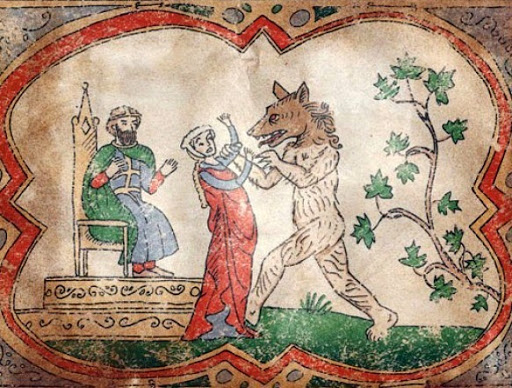
    Sources:

    Potter, K. R. (trans.), Gesta Stephani; Matthew Lewis, Stephen and Matilda’s Civil War: Cousins of Anarchy; Patricia A. Dark, The Career of Matilda of Boulogne as Countess and Queen in England, 1135-1152; Thomas Forester (trans. and ed.), The Chronicle of Henry of Huntingdon. Comprising the history of England, from the invasion of Julius Caesar to the accession of Henry II. Also, the Acts of Stephen, King of England and Duke of Normandy; David Smurthwaite, The Complete Guide to the Battlefields of Britain; David Crouch, The Reign of King Stephen; Keith Stringer, ‘Henry, Earl of Northumberland (c. 1115-1152)’, Oxforddnb.com; G.W.S. Barrow, ‘David I (c. 1185-1153)’, Oxforddnb.com; Keith Stringer, ‘Ada [née Ada de Warenne], countess of Northumberland (c. 1123-1178)’, Oxforddnb.com; Victoria Chandler, ‘Ada de Warenne, Queen Mother of Scotland (c. 1123-1178)’, The Scottish Historical Review, Vol. 60, no. 170; Farrer, W. and C. T. Clay (eds), Early Yorkshire Charters, Volume 8: The Honour of Warenne; Henry of Huntingdon, The History of the English People 1000–1154; Catherine Hanley, Matilda: Empress, Queen, Warrior; Marjorie Chibnall, The Empress Matilda: Queen Consort, Queen Mother and Lady of the English; Edmund King, King Stephen.

    *

    My Books

    Signed, dedicated copies of all my books are available through my online store.

    Out now: Scotland’s Medieval Queens

    Books by Sharon Bennett Connolly

    Scotland’s history is dramatic, violent and bloody. Being England’s northern neighbour has never been easy. Scotland’s queens have had to deal with war, murder, imprisonment, political rivalries and open betrayal. They have loved and lost, raised kings and queens, ruled and died for Scotland. From St Margaret, who became one of the patron saints of Scotland, to Elizabeth de Burgh and the dramatic story of the Scottish Wars of Independence, to the love story and tragedy of Joan Beaufort, to Margaret of Denmark and the dawn of the Renaissance, Scotland’s Medieval Queens have seen it all. This is the story of Scotland through their eyes.

    Scotland’s Medieval Queens gives a thorough grounding in the history of the women who ruled Scotland at the side of its kings, often in the shadows, but just as interesting in their lives beyond the spotlight. It’s not a subject that has been widely covered, and Sharon is a pioneer in bringing that information into accessible history.’ Elizabeth Chadwick (New York Times bestselling author)

    Available now from Amazon and Pen and Sword Books

    Also by Sharon Bennett Connolly:

    Books by Sharon Bennett Connolly

    Heroines of the Tudor World tells the stories of the most remarkable women from European history in the time of the Tudor dynasty, 1485-1603. These are the women who ruled, the women who founded dynasties, the women who fought for religious freedom, their families and love. Heroines of the Tudor World is now available from Amberley Publishing and Amazon UK. Women of the Anarchy demonstrates how Empress Matilda and Matilda of Boulogne, unable to wield a sword themselves, were prime movers in this time of conflict and lawlessness. It shows how their strengths, weaknesses, and personal ambitions swung the fortunes of war one way – and then the other. Available from Bookshop.orgAmberley Publishing and Amazon UKKing John’s Right-Hand Lady: The Story of Nicholaa de la Haye is the story of a truly remarkable lady, the hereditary constable of Lincoln Castle and the first woman in England to be appointed sheriff in her own right. Available from all good bookshops Pen & Sword Booksbookshop.org and Amazon

    Defenders of the Norman Crown: The Rise and Fall of the Warenne Earls of Surrey tells the fascinating story of the Warenne dynasty, from its origins in Normandy, through the Conquest, Magna Carta, the wars and marriages that led to its ultimate demise in the reign of Edward III. Available from Pen & Sword BooksAmazon in the UK and US, and Bookshop.orgLadies of Magna Carta: Women of Influence in Thirteenth Century England looks into the relationships of the various noble families of the 13th century, and how they were affected by the Barons’ Wars, Magna Carta and its aftermath; the bonds that were formed and those that were broken. It is now available in paperback and hardback from Pen & SwordAmazon, and Bookshop.orgHeroines of the Medieval World tells the stories of some of the most remarkable women from Medieval history, from Eleanor of Aquitaine to Julian of Norwich. Available now from Amberley Publishing and Amazon, and Bookshop.orgSilk and the Sword: The Women of the Norman Conquest traces the fortunes of the women who had a significant role to play in the momentous events of 1066. Available now from Amazon,  Amberley Publishing, and Bookshop.org.

    Alternate Endings: An anthology of historical fiction short stories including Long Live the King… which is my take what might have happened had King John not died in October 1216. Available in paperback and kindle from Amazon.

    Podcast:

    Have a listen to the A Slice of Medieval podcast, which I co-host with Historical fiction novelist Derek Birks. Derek and I welcome guests, such as Bernard Cornwell and discuss a wide range of topics in medieval history, from significant events to the personalities involved. There are now over 70 episodes to listen to!

    Every episode is also now available on YouTube.

    *

    Don’t forget! Signed and dedicated copies of all my books are available through my online bookshop.

    For forthcoming online and in-person talks, please check out my Events Page.

    You can be the first to read new articles by clicking the ‘Follow’ button, liking our Facebook page or joining me on TwitterThreadsLinkedIn, Bluesky and Instagram.

    ©2024 Sharon Bennett Connolly FRHistS

    Book Corner: In the Shadows of Castles by G.K. Holloway

    It’s the 1060s, and William of Normandy is establishing a new and brutal regime in England, but there are those who would defy him. As Norman soldiers spread like a plague across the land, resistance builds, but will it be enough to topple William and restore the rightful king to his throne? The English have the courage to fight, but the Normans, already victorious at Hastings, now build castles seeking to secure their tenuous foothold in these lands.

    And what of the people caught up in these catastrophic events? Dispossessed but not defeated, their lives ripped apart, the English struggle for freedom from tyranny; amongst them, caught up in the turmoil, are a soldier, a thane and two sisters. As events unfold, their destinies become intertwined, bringing drastic changes that alter their lives forever.

    Firmly embedded in the history of the Conquest, ‘In the Shadows of Castles’ is ultimately a story of love, hope and survival in a time of war.

    A few years ago I read and reviewed G.K. Holloway’s fabulous novel 1066: What Fates Impose. It was the story of the most fateful year in English history, of Harold II, William the Conqueror and the Norman Conquest of England. The story revolved around the relationship between William and Harold and their ultimate, fatal confrontation at the Battle of Hastings. In the Shadows of Castles opens where 1066: What Fates Impose ended, with the English defeated and William the Conqueror receiving the submission of England’s earls and the atheling Edgar, who had hoped to take the crown himself.

    In the Shadows of Castles feels more personal than did 1066: What Fates Impose. It is less concerned with the great events in history and concentrates more on the life and experience of Bondi, a housecarl who had been in the service of King Harold and was now a part of the English ‘resistance’. Bondi’s experiences in trying to halt the wholesale takeover of England contrast with King William’s systematic replacement of English lords with Norman ones and of handing out the lands, of those English killed at Hastings, to hie faithful followers.

    In the Shadows of Castles follows the experiences of the English resistance, which culminates in the Harrying of the North over the winter of 1069-1070. The English fight back wherever and whenever they can against the relentless onslaught of the Norman army. Helped – and hindered – by the Danes, Bondi and his friends are forced to become fugitives after being separated from their forces. But there are lighter moments, where Bondi finds friendship and love in those surrounding him. And support from locals who risk everything to help the cause.

    By mid-afternoon, everyone in London knew of the housecarls’ fate. People wondered if the future held the same in store for them. One of those unaware of the slaughter was Bondi Wynstanton. At the Blue Anchor, a small group talked animatedly at the bar.

    ‘The Normans set fire to Berkamsted barracks,’ one man said.

    ‘What?’

    ‘They burned down the barracks, and no one’s left alive,’ the man said.

    ‘Nobody? Are you sure?’

    ‘I am. I’d make myself scarce,’ the man said, looking at the dragon tattoos on Bondi’s arms. ‘Go to the great hall. Somebody might help you.’

    Bondi was still coming to terms with the news as he slinked across London’s back streets. The town seemed divided. One half contained the English, sullen and resentful behind their walls. The other was a Norman city, composed of two motte-and-bailey fortifications. It was as if each part of the city held the other under siege. In this atmosphere, Merleswein called the thanes together in London’s great hall. Bondi arrived just as the meeting started. It was a heated affair, acrimonious and loud.

    Merleswein stood up. ‘Thank you all for coming,’ he said. Gradually, the noise abated.

    ‘You’re all aware of what happened the other night,’ Merleswein said. ‘We need to decide what we are to do next. I, for one, will leave London at the earliest opportunity. If you want to come with me or join me in Lincoln, you’re welcome. If you meet any housecarls, bring them with you.’

    ‘What of Edgar and the earls? Why aren’t they here?’ an old thane said.

    ‘William is keeping them close, but don’t concern yourself. They will have word of what’s happening and know they can join us if they escape.’

    ‘So, they are prisoners, then?’ the old thane said. ‘What are we going to do?’

    ‘Those who are able should go to Lincoln. William won’t bother us there. He would have to send his entire army to bring us back, and he won’t do that. When we’ve formed up there, we’ll make plans.’

    ‘What if we can’t get away? Some of us have families and work here,’ someone yelled.

    ‘All I can do for now is offer hospitality in Lincoln. Everyone is welcome,’ Merleswein said.

    There was a general stir as people discussed what to do.

    Merleswein took his seat and turned to Waltheof. ‘Do you think many of them will accept my invitation?’ he said.

    ‘No. Not unless they’ve lost everything. Those who still have a home or a business will stay here, hoping it won’t happen again. It will be those who have nothing to lose who follow you.’

    While they were talking, Bondi made his way over to them.

    ‘Excuse me, my lord.’

    Merleswein looked down at him from the dais. ‘Bondi, isn’t it?’

    ‘That’s right, my lord.’

    ‘If I were you, I’d get as far away from London as possible.’

    ‘I’ve considered that, so I’m going to Ireland.’

    ‘Why Ireland?’ Merleswein said.

    ‘I was there with King Harold when I was a boy. I heard his mother, Lady Gytha and Edyth, his wife, were going there to join his sons. My guess is they’ll be coming back with an atmy, so I thought I’d join them.’

    ‘And avenge your fallen comrades?’

    G.K. Holloway brilliantly captures the confusion among the English as the implications of their defeat at Hastings dawns upon them. He expertly captures the hope, despair and confusion that must have been rife among the conquered English. He does not shy away from the hard facts and more unpleasant aspects of war, nor of conquest, especially for the women. His knowledge of the history of the period has been used to recreate the world of 1066 and the years following.

    Although the Normans are the bad guys in In the Shadows of Castles it was good to see William de Warenne, one of the subjects of my own research, given a prominent role among William the Conqueror‘s retinue. Indeed, G.K. Holloway has ensured that he used historical personages wherever possible and staying true to their story, which adds a sense of authenticity to the novel.

    G.K Holloway takes us on a sweeping trek through England and even into Scotland and Denmark, following the story of the conquered English and triumphant Normans. The post-Conquest years were years of struggle and betrayal on both sides and In the Shadows of Castles draws the reader into this amazing story. The characters are authentic, deep and beautifully written. You can almost imagine yourself in the Yorkshire of a thousand years ago!

    And entertaining and engaging novel, In the Shadows of Castles is an excellent read and I cannot wait to read the next instalment in the story, Fire in the Fens.

    About the Author:

    G. K. Holloway did several jobs after leaving school before taking A Levels at his local college and later a degree in History and Politics at Coventry University. Once he had graduated, he spent the next twenty years working in education in and around Bristol. After reading a biography about Harold Godwinson, he studied the late Anglo-Saxon era in detail and discovered a time of papal plots, court intrigues, family feuds, loyalties, betrayals, assassinations and a few battles. When he had enough material to weave together fact and fiction, he produced his award-winning novel, ‘1066: What Fates Impose’, the first in a series about the Norman Conquest. G. K. Holloway lives in Bristol with his wife and two children.

    Visit G K Holloway’s website http://www.gkholloway.co.uk

    GK Holloway’s books on Amazon

    *

    My Books

    Signed, dedicated copies of all my books are available through my online bookshop.

    OUT NOW! Heroines of the Tudor World

    Heroines of the Tudor World tells the stories of the most remarkable women from European history in the time of the Tudor dynasty, 1485-1603. These are the women who ruled, the women who founded dynasties, the women who fought for religious freedom, their families and love. These are the women who made a difference, who influenced countries, kings and the Reformation. In the era dominated by the Renaissance and Reformation, Heroines of the Tudor World examines the threats and challenges faced by the women of the era, and how they overcame them. From writers to regents, from nuns to queens, Heroines of the Tudor World shines the spotlight on the women helped to shape Early Modern Europe.

    Heroines of the Tudor World is now available for pre-order from Amberley Publishing and Amazon UK.

    Also by Sharon Bennett Connolly:

    Women of the Anarchy demonstrates how Empress Matilda and Matilda of Boulogne, unable to wield a sword themselves, were prime movers in this time of conflict and lawlessness. It shows how their strengths, weaknesses, and personal ambitions swung the fortunes of war one way – and then the other. Available from Bookshop.orgAmberley Publishing and Amazon UKKing John’s Right-Hand Lady: The Story of Nicholaa de la Haye is the story of a truly remarkable lady, the hereditary constable of Lincoln Castle and the first woman in England to be appointed sheriff in her own right. Available from all good bookshops Pen & Sword Booksbookshop.org and AmazonDefenders of the Norman Crown: The Rise and Fall of the Warenne Earls of Surrey tells the fascinating story of the Warenne dynasty, from its origins in Normandy, through the Conquest, Magna Carta, the wars and marriages that led to its ultimate demise in the reign of Edward III. Available from Pen & Sword BooksAmazon in the UK and US, and Bookshop.org

    Ladies of Magna Carta: Women of Influence in Thirteenth Century England looks into the relationships of the various noble families of the 13th century, and how they were affected by the Barons’ Wars, Magna Carta and its aftermath; the bonds that were formed and those that were broken. It is now available in paperback and hardback from Pen & Sword,  Amazon, and Bookshop.orgHeroines of the Medieval World tells the stories of some of the most remarkable women from Medieval history, from Eleanor of Aquitaine to Julian of Norwich. Available now from Amberley Publishing and Amazon, and Bookshop.orgSilk and the Sword: The Women of the Norman Conquest traces the fortunes of the women who had a significant role to play in the momentous events of 1066. Available now from Amazon,  Amberley Publishing, and Bookshop.org.

    Alternate Endings: An anthology of historical fiction short stories including Long Live the King… which is my take what might have happened had King John not died in October 1216. Available in paperback and kindle from Amazon.

    Podcast:

    Have a listen to the A Slice of Medieval podcast, which I co-host with Historical fiction novelist Derek Birks. Derek and I welcome guests, such as Bernard Cornwell and discuss a wide range of topics in medieval history, from significant events to the personalities involved. There’s even an episode on Robin Hood from Steven A. McKay. There are now over 40 episodes to listen to!

    *

    Don’t forget! Signed and dedicated copies of all my books are available through my online bookshop.

    For forthcoming online and in-person talks, please check out my Events Page.

    You can be the first to read new articles by clicking the ‘Follow’ button, liking our Facebook page or joining me on Twitter and Instagram.

    ©2024 Sharon Bennett Connolly FRHistS
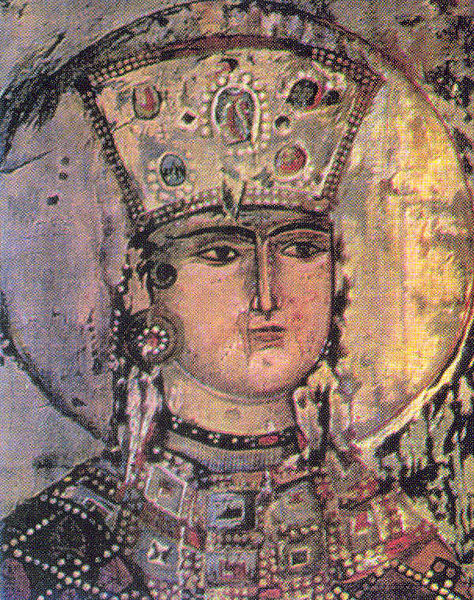
    Book Corner: Sword of the Saxons by Steven A. McKay

    A war to shape the future of a nation.

    Betrayed by his kinsmen, his forces overrun by Danes, King Alfred of Wessex has retreated deep into the marshes of his homeland, lying in wait for his chance at redemption.

    The scourge of the heathen horde that has ravaged the kingdom for decades is at its peak. Led by the fearsome Viking warlord Guthrum, the fate of the men, women, and children at their mercy appears all but sealed. But underestimate the great king at your peril…

    Gathering allies and bannermen to his cause, and building a strategy that will hopefully ensure victory, Alfred sets out to undermine the strength of the complacent invaders, and establish Wessex as the greatest territory in the British Isles.

    A final showdown awaits. Not only with Guthrum and his savage warriors, but with destiny. As the battle lines are drawn, the destiny of not just Wessex, but of every Anglo-Saxon in Britain, rests firmly on Alfred’s shoulders.

    An utterly ferocious and gripping adventure, covering the fascinating middle years of Alfred the Great’s reign, one of Britain’s most influential monarchs.

    War is coming!

    At last! the second book in Steven A McKay’s new Alfred the Great series has arrived. To be fair to Steven, we haven’t had long to wait, even though it felt like an age. The problem was, we left King Alfred at the end of The Heathen Horde, rather down on his luck and looking like things could only get even worse. So it has been agony, waiting for Sword of the Saxons, to see how Steven would get Alfred out of it. We all know the history, Alfred is defeated and seeks shelter in the marshes of Athelney, burns some cakes in order to learn patience and then comes back with a vengeance. So we did know that Alfred’s defeat was not the end of the matter. However, when you get caught up in the story, you need more!

    And leaving Alfred, defeated and a fugitive, was a difficult pill to swallow.

    King Alfred is the hero who fought to defeat the Danish and Norse invaders – collectively known as the Vikings by many – and unite the disparate kingdoms of England under one king. The kingdom of England would not come to pass in his lifetime, but he started the fight that would be continued by his son and daughter – Edward the Elder and Æthelflæd, Lady of the Mercians – and completed by his grandson, Athelstan, the first King of England.

    Sword of the Saxons picks up where The Heathen Horde left off and takes us on Alfred’s journey to not only survive in the marshes, but rebuild his army, renew alliances and begin the fight back. In Sword of the Saxons, King Alfred becomes the leader that England needed, and demonstrates the abilities, both martial and political, that justify his epithet of ‘the Great’.

    ‘I can almost – almost! – understand Ealdorman Wealdmar giving in to the Danes without a fight,’ Wulfric said to Alfred as they rode towards the little coastal village of Bryn on the outskirts of the Somerset marshes. ‘But his son, Diuma? Refusing to let us into the town when he knew the Danes were hunting us? Gods, I was starting to like the an, and I believed he was a fiercely loyal thane to you, my lord.’

    Alfred cleared his throat and spat into the bushes on the side of the road, disgust twisting his features at the memory of the night Wulfric was referring to. ‘So did I,’ he growled. ‘But it seems Diuma was only ever loyal to himself.’ He shook his head and made a cutting motion with his hand. ‘I might possibly be able to forgive some of the men who’ve betrayed me, like Ealdorman Wulfhere. Perhaps they felt like they had no choice. But Diuma? I treated him like a friend. And Brycgstow? That was far enough away from any of Guthrum’s forces to be a target for them! No, Diuma has no excuse for what he’s done. I hope the sea-wolves bleed him and his father dry, and then, eventually, I’ll come face to face with them and hear their excuses before…’ He trailed off, jaw clenched, knuckles white as he gripped his horse’s reins.

    There were only two other men with them that morning, for they were merely riding to collect a few supplies but, more importantly, to make sure the good people of Bryn knew that Alfred was still very much alive and hadn’t abandoned his kingdom despite Guthrum’s invasion. The king believed it did the people good to see him in person, rather than his hearth-warriors simply carrying word of his survival to the towns and villages located around Athelney’s marshes. He was a man, after all, not a myth.

    ‘When are we going to send out word to gather the fyrd, lord?’ The question came from one of the other riders who’d accompanied them, a small but sturdily built warrior called Dunstan. He’d been thane of a village in the north of Wessex which had been utterly destroyed six years earlier, by a party of Northmen led by Jarl Ubba. After that, Dunstan pledged himself to Alfred and now served as one of his fiercest hearth-warriors.

    The fourth man in the small group was the sentry from the previous night, Aedan, and he too looked with interest at Alfred, wondering what his reply would be to Dunstan’s question.

    The king shook his head slowly. ‘In truth, I don’t know,’ he admitted. ‘I’d like to make sure we have the support of as many people as possible in these nearby settlements. We need to know we can call upon a decent sized fyrd from the lands around Athelney before we look at enlisting people in towns further away.’ He noticed Dunstan and Aedan sharing uncertain glances. ‘I know you two are desperate to take the fight to Guthrum, but we can’t afford to act rashly. First, we build our foundation here in Sumosaete, and then we move on from there.’

    With The Heathen Horde, it took me a few chapters to get into the story, to stop comparing Steven A. McKay’s version of King Alfred with the Alfred of Bernard Cornwell – and it took me a while to stop expected Uhtred of Bebbanburg to turn up and save the day, but in Sword of the Saxons Steven has made King Alfred his own. He portrays the great battles his way, has created a hero in Alfred that the reader can get behind wholeheartedly. He is much more likeable than Bernard Cornwell’s King Alfred! Less judgmental…

    Alongside Alfred the Great and his family, Steven A. McKay has created a wealth of characters with varying degrees of loyalty to the king. All must be moulded together to fight Guthrum and his men. I have to admit, I love the portrayal of Æthelflæd, Alfred’s oldest daughter and soon to be the Lady of the Mercians. She is a young woman who knows her duty – but also knows her worth and her abilities. She is very much the Æthelflæd I imagine.

    Sword of the Saxons is the beginning of the fight back against the invaders. It shows King Alfred coming into his own, becoming the great leader who we know today. He has setbacks, he has doubts, and he has to overcome illness. But this is the Alfred who will lead the reconquest of England that will be completed by his grandson. Steven A. Mckay achieves a wonderful balance, between telling the personal stories of his characters and presenting the great history that they are living through.

    It is a gripping read. The fast-paced story leaves the reader breathless – and reading into the early hours! I have no hesitation in recommending Sword of the Saxons to anyone and everyone. Read it! you will not be disappointed.

    Buy Sword of the Saxons

    About the author:

    Steven A. McKay was born in Scotland in 1977 and always enjoyed studying history. He decided to write his Forest Lord novels after seeing a house called “Sherwood” when he was out at work one day. Since then he’s started a new series, the Warrior Druid of Britain Chronicles. In 2021 the Xbox game HOOD: Outlaws and Legends was released, featuring his writing, which Steven says was just a fantastic experience. Steven used to be in a heavy metal band although he tends to just play guitar in his study these days. He did use those guitars to write the theme song for the podcast he co-host, Rock, Paper, Swords! with Matthew Harffy, though.

    *

    My Books

    Signed, dedicated copies of all my books are available through my online bookshop.

    OUT NOW! Heroines of the Tudor World

    Heroines of the Tudor World tells the stories of the most remarkable women from European history in the time of the Tudor dynasty, 1485-1603. These are the women who ruled, the women who founded dynasties, the women who fought for religious freedom, their families and love. These are the women who made a difference, who influenced countries, kings and the Reformation. In the era dominated by the Renaissance and Reformation, Heroines of the Tudor World examines the threats and challenges faced by the women of the era, and how they overcame them. From writers to regents, from nuns to queens, Heroines of the Tudor World shines the spotlight on the women helped to shape Early Modern Europe.

    Heroines of the Tudor World is now available for pre-order from Amberley Publishing and Amazon UK.

    Also by Sharon Bennett Connolly:

    Women of the Anarchy demonstrates how Empress Matilda and Matilda of Boulogne, unable to wield a sword themselves, were prime movers in this time of conflict and lawlessness. It shows how their strengths, weaknesses, and personal ambitions swung the fortunes of war one way – and then the other. Available from Bookshop.orgAmberley Publishing and Amazon UKKing John’s Right-Hand Lady: The Story of Nicholaa de la Haye is the story of a truly remarkable lady, the hereditary constable of Lincoln Castle and the first woman in England to be appointed sheriff in her own right. Available from all good bookshops Pen & Sword Booksbookshop.org and AmazonDefenders of the Norman Crown: The Rise and Fall of the Warenne Earls of Surrey tells the fascinating story of the Warenne dynasty, from its origins in Normandy, through the Conquest, Magna Carta, the wars and marriages that led to its ultimate demise in the reign of Edward III. Available from Pen & Sword BooksAmazon in the UK and US, and Bookshop.org

    Ladies of Magna Carta: Women of Influence in Thirteenth Century England looks into the relationships of the various noble families of the 13th century, and how they were affected by the Barons’ Wars, Magna Carta and its aftermath; the bonds that were formed and those that were broken. It is now available in paperback and hardback from Pen & Sword,  Amazon, and Bookshop.orgHeroines of the Medieval World tells the stories of some of the most remarkable women from Medieval history, from Eleanor of Aquitaine to Julian of Norwich. Available now from Amberley Publishing and Amazon, and Bookshop.orgSilk and the Sword: The Women of the Norman Conquest traces the fortunes of the women who had a significant role to play in the momentous events of 1066. Available now from Amazon,  Amberley Publishing, and Bookshop.org.

    Alternate Endings: An anthology of historical fiction short stories including Long Live the King… which is my take what might have happened had King John not died in October 1216. Available in paperback and kindle from Amazon.

    Podcast:

    Have a listen to the A Slice of Medieval podcast, which I co-host with Historical fiction novelist Derek Birks. Derek and I welcome guests, such as Bernard Cornwell and discuss a wide range of topics in medieval history, from significant events to the personalities involved. There’s even an episode on Robin Hood from Steven A. McKay. There are now over 40 episodes to listen to!

    *

    Don’t forget! Signed and dedicated copies of all my books are available through my online bookshop.

    For forthcoming online and in-person talks, please check out my Events Page.

    You can be the first to read new articles by clicking the ‘Follow’ button, liking our Facebook page or joining me on Twitter and Instagram.

    ©2024 Sharon Bennett Connolly FRHistS