‘This is the history of that most sacred vessel that is named by men the Holy Grail, wherein the precious blood of Our Saviour was received on the day that He was crucified that He might redeem His followers from the pains of Hell.’
It is not known when The Book of the Grail was first written, or by whom. In this version of Percival’s quest for the Holy Grail, the world of Arthurian legend is brought alive. Predating the popular tales of Mallory and Tennyson, this forgotten account – revived by E. C. Coleman from its Middle English translation – presents us with a vivid story full of the moral import and sacred wisdom of its time of telling.
Following Chrétien de Troyes’ earlier poem, Perceval, le Conte du Graal, many surprises and deviations lie in store for those familiar with Arthurian lore. The test of the Sword in the Stone has now become a sword and an arrow, drawn from stone columns; Sir Kay is not the good knight of the other versions; Merlin makes only a brief appearance; and Queen Guinevere suffers a tragedy rather than experiencing a love affair with Lancelot. In this complete and uncorrupted version, the darkness and fears of the thirteenth century are illuminated by moments of chivalry, adventure and religious piety.
Reading E.C. Coleman’s new adaptation of the The Book of the Holy Grail by Josephus is just not enough. This book has to be devoured in its entirety. The author has taken great care in translating the story from Middle English, keeping the original atmosphere of the book while making it accessible to the modern reader. The book is pure pleasure for any lover of the Arthurian legends. All the heroes are present, battling lions, evil knights and trying always to prove their worth and follow the codes of chivalry.
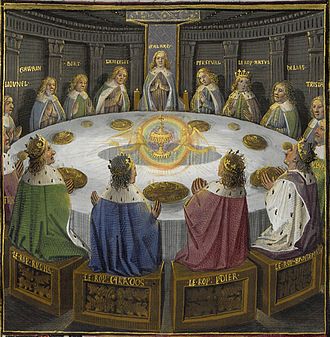
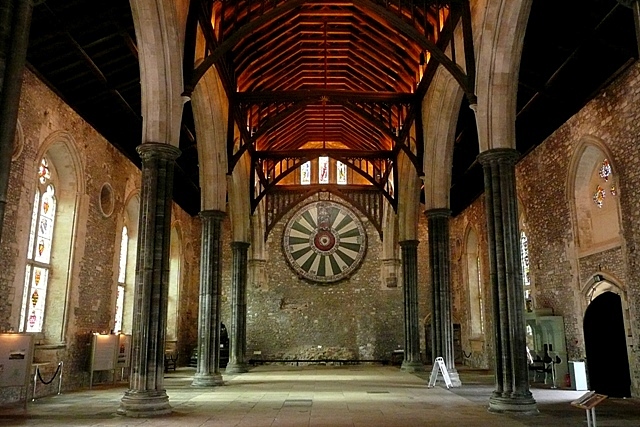
King Arthur, the Round Table and the Holy Grail
The story differs in places from the more-familiar versions of the legend. Merlin only plays a minor role and the story focuses mainly on the adventures of Gawain, Lancelot and Percival. Although the main tenet of the story is the knights’ quest to find the Holy Grail, they are faced with many challenges and smaller quests throughout their journeys.
In The Book of the Holy Grail by Josephus our heroes face some fantastical beasts, such as lions, griffons and dragons. The bad guys are knights of pure evil, who have turned from God and war upon the innocent and women and children, throwing them from their homes and castles. The evil knights live in creepy castles, ruled by cruel men and protected by strange beasts; while the good, virtuous knights are sent out into the world by King Arthur, to bring his lands back to God and to recover the Holy Grail.
The story moves at an incredible pace, with a new adventure on nearly every page. The heroes are strong, brave and wonderful fighters, always looking to prove their worth in a valiant joust. Strange damsels hold the story together, explaining events and appearing whenever the heroes need a new direction, or a new quest. The story is full of kings and lords with strange names; such as the King of Castle Mortal, the King Hermit, Clamados of the Forest of Shadows. The ladies are often given designations, rather than names, such as the Widow Lady. There are damsels who have no hair or are forced to walk everywhere, who will only be restored once the Holy Grail has been recovered.
On the morrow, when he had heard Mass, Gawain departed and rode to the fairest land he had ever beheld. The meadows were many coloured with flowers, the rivers flowed clear and full with wholesome fishes, and the forest aboundeth with wild deer and hermitages. One night he came upon a hermitage wherein the good man had not gone forth for forty years. When he seeth Gawain the hermit looked forth from the window and sayeth, ‘A good welcome to you, Sire.’
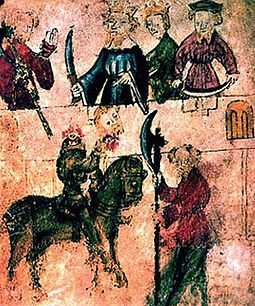
Sir Gawain and the Green Knight
‘And may God give you joy.’ sayeth Gawain. ‘Will you give me lodging this night?’
‘I cannot, Sire, for none hath entered herein for forty years but myself and I have sworn to allow none other in but God. But, Sire, if you continue but a little further you will see a castle wherein all good knights are lodged.’
‘What is the name of this castle?’
‘It is the castle of the goof Fisher King and is surrounded by plentiful waters and is of the fairest setting under God. But they will only lodge good knights.’
‘May God grant that I may be amongst that company. Before I go thither good hermit, will you hear my confession for I must be cleansed of all sin?’
‘Gladly,’ sayeth the hermit and heard him of Gawain’s true repenting.
The hermit the continued to say, ‘Sire, if God is willing, do not forget to ask that which the other knight forgot. Be not afraid at what you see at the entrance to the chapel and ride on without fear. Worship at the holy chapel within the castle for there is where the flame of the Holy Spirit comes down each day for the most Holy Grail and the point of the lance that is presented there.’
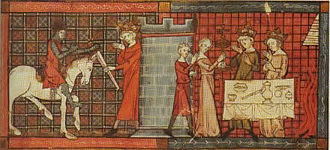
Percival
The flowery language adds to the atmosphere of the book and helps to recreate the Arthurian world. Gawain, Lancelot and Percival are the knights of legend we all know from Mallory; honourable, noble and great warriors. I love the way the book has them fighting their own quests, narrowly missing each other, or one not recognising the other because he has changed his shield; but once in a while, they join together to complete a greater quest, or give aid where one is wounded. The camaraderie and mutual respect of the Grail Knights and the Knights of the Round Table help to make this an amazing book.
This is the ultimate adventure story, from where all other adventure stories, stories of war and valour and of good versus evil find their origins; and this fact shines through on every page. Its a fabulous book to read – and devour – for any fan of the Arthurian Legends.
*
My book, Heroines of the Medieval World, is now available in hardback in the UK from both Amberley Publishing and Amazon UK and worldwide from Book Depository. It is also available on Kindle in both the UK and USA and will be available in Hardback from Amazon US from 1 May 2018.
Be the first to read new articles by clicking the ‘Follow’ button, liking our Facebook page or joining me on Twitter.
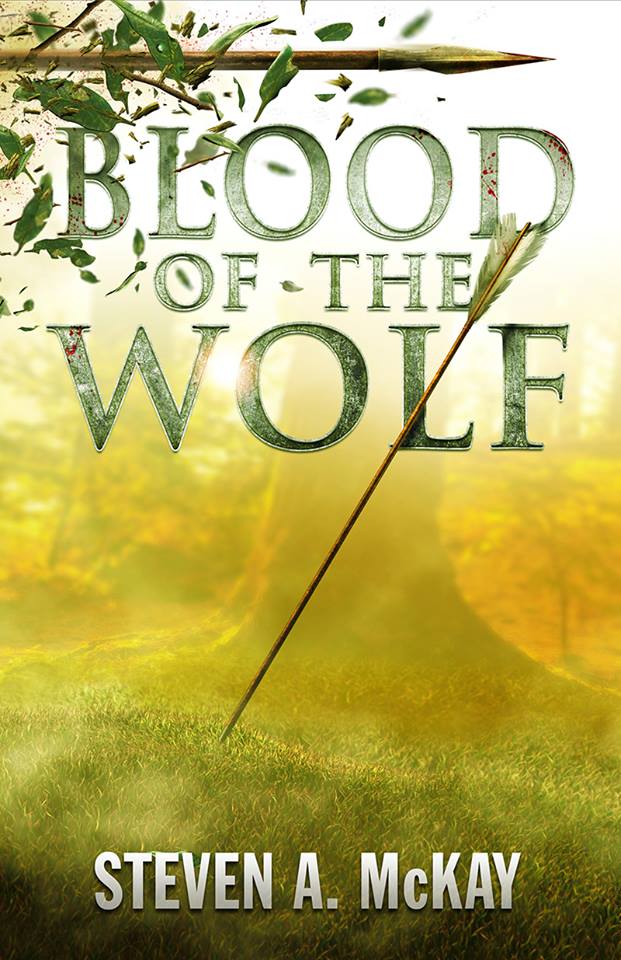
My latest book review, of Steven A. McKay’s latest novel, Blood of the Wolf, the final novel of his stunning Forest Lord series, a wonderful new reworking the legend of Robin Hood has gone live over at The Review today!
With Blood of the Wolf, Steven A McKay has definitely saved the best to last! The fourth and concluding part of his fabulous Forest Lord series sees Robin and his band of Merry Men reunited and embarking on one final adventure together, facing a most formidable foe; a new and particularly vicious band of outlaws. This book has everything: suspense, action and enduring friendships that are tested to their limits. Old and new enemies make the reader eager to see Robin win through, and a few surprises along the way make this a thoroughly entertaining and gripping novel.
It leads you on a desperate chase through the forests, in the halls of the Sheriff’s castles and into the villages of England …
To read the full review of this fantastic novel – and to enter the prize draw and be in with a chance of winning a paperback copy in the giveaway, simply visit The Review and leave a comment. Good luck!
*
My book, Heroines of the Medieval World, is now available in hardback in the UK from both Amberley Publishing and Amazon UK and worldwide from Book Depository. It is also available on Kindle in both the UK and USA and will be available in Hardback from Amazon US from 1 May 2018.
Be the first to read new articles by clicking the ‘Follow’ button, liking our Facebook page or joining me on Twitter.
After writing an article about Edward the Martyr the other week, I thought it only fair to take a look at the other side of the story and write about Ælfthryth, England’s first ever crowned queen and Edward’s stepmother – and possible murderer.
Author Annie Whitehead researched Ælfthryth for her book Alvar the Kingmaker and rather likes her. So she can’t be all bad – can she?
Ælfthryth was probably born around 945; the daughter of Ealdorman Ordgar of Devon and an unknown woman who is said to have been descended from the royal family. As you can imagine, after the passage of more than 1,000 years, nothing is known of her childhood; although she had a least one sibling, a brother, Ordulf, who was founder of Tavistock Abbey. She was married around the age of 11 to Æthelwold, the son of Æthelstan Half-King (I have to do a post about him! What a name!) and ealdorman of East Anglia.
Æthelwold died in 962, probably in a hunting accident, although there were rumours of murder on the orders of his wife’s supposed lover, King Edgar. Edgar and Æthelwold would have known each other very well. After being orphaned as a baby, Edgar was raised in Æthelstan’s household alongside his own sons; of whom Æthelwold was one of the youngest. Some stories have Edgar wielding the dagger himself, while others don’t even mention murder. Whether the suspicion arose at the time of the event, or following Ælfthryth’s marriage to Edgar 2 years later, is also unclear.
Edgar’s marital history was already chequered. Ælfthryth could be Edgar’s second or third wife; she was certainly the third relationship by which children were born. Edgar’s first wife, Æthelfled “the Fair”, was the mother of his eldest son, Edward (the Martyr). Following Æthelfled’s death, Edgar had a relationship with Wulfryth from which a daughter, Edith, was born around 963/964. The sources are uncertain as to whether or not Edgar and Wulfryth married, and some even suggest that she was a nun Edgar had seduced; although this may be confusion due to the fact that Wulfryth entered a convent shortly after Edith was born. Edith joined her mother in the abbey at Wilton, where Wulfryth eventually became abbess; in time both mother and daughter would be venerated locally as saints.
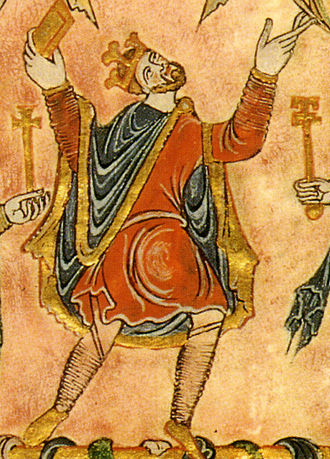
King Edgar the Peaceable
Ælfthryth and Edgar were married in 964 and were soon the parents of 2 sons; Edmund and Æthelred. Despite having an older half-brother, Edward, it is Edmund who appears as Edgar’s acknowledged heir; his name being above that of Edward’s in a charter of 966, witnessed by both boys, which founded the New Minster at Winchester. Poor Ælfthryth must have been distraught when, in 971 and still only a child of about 7, young Edmund died.
The grandson of Edward the Elder, and great-grandson of Alfred the Great, Edgar had been king since 959; however on 11 May 973 he had a coronation, at Bath Abbey. Whether this was his first coronation, or a second ceremony seems to be still debated by historians. Edgar was about 30 and the venerated Archbishop Dunstan of Canterbury officiated. It is the first known coronation of a queen of England, Ælfthryth.
According to the Oxford Dictionary of National Biography there is a near contemporary account of the coronation, which depicts Ælfthryth feasting with many abbots and abbesses, wearing a silken gown sewn with pearls and precious stones. The coronation was an important display for Edgar and Ælfthryth, as a way to emphasise the legitimacy of their union, especially given Edgar’s marital history, and the claims of their children as Edgar’s heirs. Ælfthryth’s new position as a consecrated queen would give her surviving son, Æthelred, seniority over Edgar’s oldest son, Edward, whose mother was never queen.
However, when it came down to it, Æthelred’s tender age was held against him, when Ælfthryth’s security was destroyed just 3 years later. King Edgar died unexpectedly at the young age of 32. With their eldest son dead and the youngest only 7 years old, the crown went to Edgar’s eldest son, the 12/13-year-old Edward. Edward faced opposition when Ælfthryth pressed Æthelred’s claim, supported by several leading figures, including Bishop Æthelwold of Winchester and her first husband’s brother, Æthelwine, ealdorman of East Anglia.
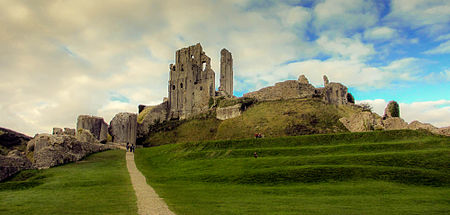
Corfe Castle, Dorset
However, with the backing of the revered, future saint, Archbishop Dunstan it was Edward who was crowned. Following his coronation Edward honoured his father’s promises to his wife, confirming the gift of jurisdiction over the whole of Dorset as Ælfthryth’s dower. As a consequence, Ælfthryth and her son, Æthelred, settled at Corfe, in the Purbeck Hills; it was a large estate surrounding a defensive mound, which would later become the Norman stronghold of Corfe Castle.
And it was at Corfe on 18th March 978 that Ælfthryth’s reputation was irrevocably damaged, following a visit from 16-year-old King Edward. Whether Edward had been out hunting, or was in the area to specifically visit his stepmother and half-brother seems to be uncertain. However, he did send a message that he would be calling on them and Ælfthryth’s retainers were awaiting the young king at the gate, when he arrived with a small retinue. Still sitting in the saddle he was handed a drink; and stabbed. It must have been a horrific sight, as the king’s horse panicked and bolted, racing off with Edward’s foot stuck in the stirrup and the dying king being dragged along behind.
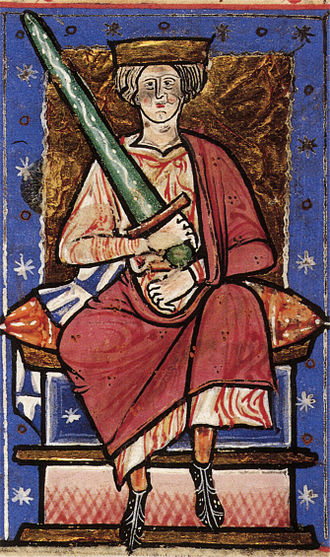
Æthelred II the Unready
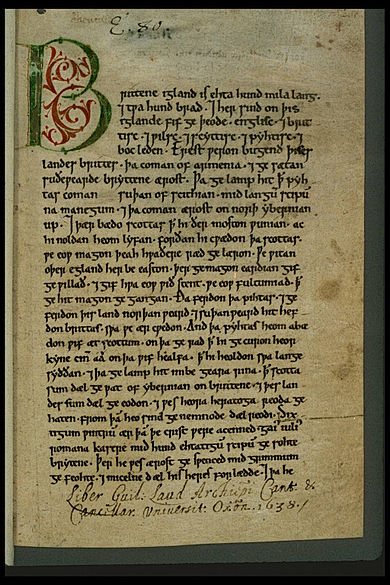
The Anglo-Saxon Chronicle recorded:
No worse deed than this was ever done by the English nation since they first sought the land of Britain. Men murdered him, but God hath magnified him. He was in life an earthly king. He is now after death a heavenly saint.¹
Although Edward’s brother, Æthelred, only around 10 years old but now king of England, was above suspicion due to his age, Ælfthryth had no such protection. Some traditions go so far as to accuse Ælfthryth of wielding the dagger herself. However, while most believe she was complicit in the murder, it is by no means certain and it is entirely possible that court malcontents, who had migrated to Æthelred’s corner, were responsible for the murder.
Ælfthryth rode out the ensuing furore and with her son as the new king, Ælfthryth was exonerated of any complicity; amid the necessity of stabilising the country, establishing the new reign and rescuing England’s reputation. Æthelred was crowned at Kingston, Surrey, on 4th May 979, a year after his brother’s death and just a few months after the reburial of Edward’s remains, with great ceremony, at Shaftesbury. A council was established to assist the young king in ruling the country, probably involving Queen Ælfthryth, who may have acted as regent during Æthelred’s minority; it also included the aging Dunstan, Archbishop of Canterbury, Æthelwold, bishop of Winchester, and Ælfhere, ealdorman of Mercia.
As Dowager Queen Ælfthryth’s dower lands in Rutland and east Suffolk helped to extend West Saxon rule over East Anglia as a whole.
Even when Æthelred was old enough to rule alone, Ælfthryth did not retire entirely. Following her son’s marriage to Ælfgifu of York, it was Ælfthryth who seems to have had the responsibility of raising their first-born son and ætheling, Æthelstan. Æthelstan died aged about 20 in 1014, 2 years before his father, and spoke warmly of his grandmother in his will. Æthelred and Ælfgifu had over 10 children together, including Æthelred’s eventual successor in 1016, Edmund II Ironside, before Ælfgifu died; Æthelred then married Emma of Normandy, mother of England’s future kings, Harthacnut by her 2nd husband, King Cnut, and Edward the Confessor by Æthelred.
As queen Ælfthryth had substantial influence over the nunneries of England; she ousted the abbess of Barking, a cousin of Edgar’s second wife, Wulfthryth. She endowed convents at Amesbury and Wherwell; her granddaughter would eventually become abbess of the latter.
The Anglo-Saxon Chronicle, Peterborough
And it was to Wherwell that the queen did eventually retire from the limelight, sometime before the year 1000, dying there on 17 November in either 999, 1000 or 1001.
Over a thousand years later Ælfthryth’s actions and reputation are still being debated by historians. While it is not inconceivable that she played a part in Edward the Martyr’s death, we also have to be aware that women of power and influence were much vilified in Medieval times; a strong, independent woman would be blamed for many crimes, simply because she dared to know her own mind….
While I am not entirely convinced of her innocence, neither am I certain of her guilt.
Ælfthryth’s career and influence, however, stretched far beyond that one action. As the first crowned queen of England, her prestige and honour is incomparable with those who had gone before her. And it is telling, perhaps, that her daughter-in-law, Ælfgifu of York, was never crowned, nor was accorded the title while her Ælfthryth still lived. The next crowned Queen of England was Æthelred’s second wife, Emma of Normandy, who married the king after his mother’s death.
*
Footnotes:
¹ Anglo-Saxon Chronicle quoted by Martin Wall in The Anglo-Saxons in 100 Facts.
*
Pictures:
Courtesy of Wikipedia
Sources:
Brewer’s British Royalty by David Williamson; Britain’s Royal Families, the Complete Genealogy by Alison Weir; The Wordsworth Dictionary of British History by JP Kenyon; The Anglo-Saxons in 100 Facts by Martin Wall; Kings, Queens, Bones and Bastards by David Hilliam; The Mammoth Book of British kings & Queens by Mike Ashley; The Oxford Companion to British History Edited by John Cannon; oxforddnb.com.
*
My Books:
Signed, dedicated copies of all my books are available through my online bookshop.
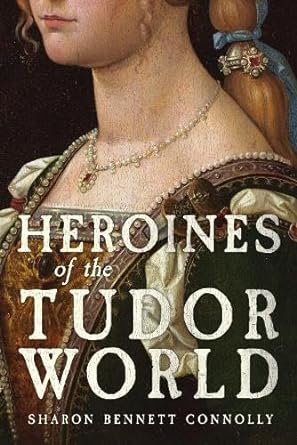
Coming on 15 June 2024: Heroines of the Tudor World
Heroines of the Tudor World tells the stories of the most remarkable women from European history in the time of the Tudor dynasty, 1485-1603. These are the women who ruled, the women who founded dynasties, the women who fought for religious freedom, their families and love. These are the women who made a difference, who influenced countries, kings and the Reformation. In the era dominated by the Renaissance and Reformation, Heroines of the Tudor World examines the threats and challenges faced by the women of the era, and how they overcame them. From writers to regents, from nuns to queens, Heroines of the Tudor World shines the spotlight on the women helped to shape Early Modern Europe.
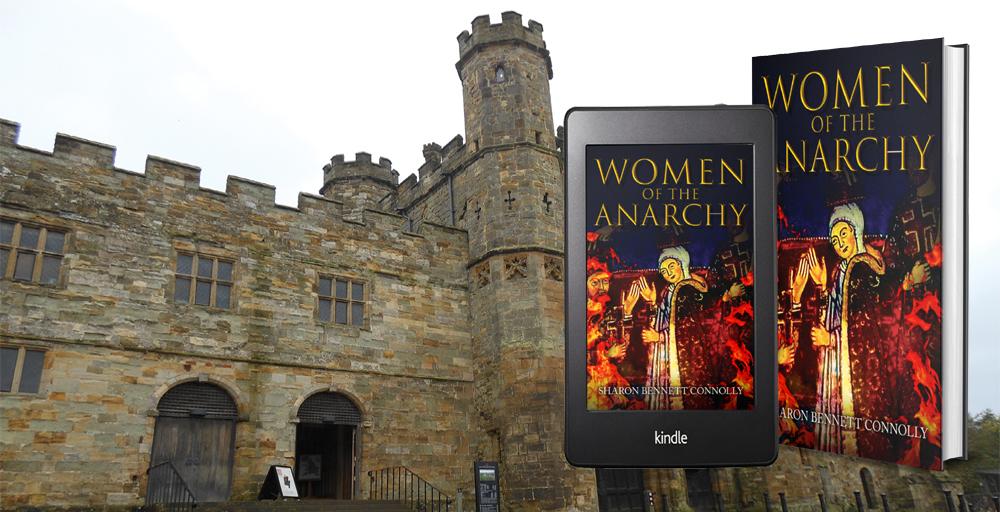
Two cousins. On the one side is Empress Matilda, or Maud. The sole surviving legitimate child of Henry I, she is fighting for her birthright and that of her children. On the other side is her cousin, Queen Matilda, supporting her husband, King Stephen, and fighting to see her own son inherit the English crown. Women of the Anarchy demonstrates how these women, unable to wield a sword, were prime movers in this time of conflict and lawlessness. It show how their strengths, weaknesses, and personal ambitions swung the fortunes of war one way – and then the other.
King John’s Right-Hand Lady: The Story of Nicholaa de la Haye is the story of a truly remarkable lady, the hereditary constable of Lincoln Castle and the first woman in England to be appointed sheriff in her own right. It is is available from King John’s Right-Hand Lady: The Story of Nicholaa de la Haye is the story of a truly remarkable lady, the hereditary constable of Lincoln Castle and the first woman in England to be appointed sheriff in her own right. Available from all good bookshops or direct from Pen & Sword Books, bookshop.org and Amazon. Defenders of the Norman Crown: The Rise and Fall of the Warenne Earls of Surrey tells the fascinating story of the Warenne dynasty, from its origins in Normandy, through the Conquest, Magna Carta, the wars and marriages that led to its ultimate demise in the reign of Edward III. Available from Pen & Sword Books, Amazon in the UK and US, and Bookshop.org.
Alternate Endings: An anthology of historical fiction short stories including Long Live the King… which is my take what might have happened had King John not died in October 1216. Available in paperback and kindle from Amazon.
Podcast:
Have a listen to theA Slice of Medieval podcast, which I co-host with Historical fiction novelist Derek Birks. Derek and I welcome guests, such as Bernard Cornwell and Elizabeth Chadwick, and discuss a wide range of topics in medieval history, from significant events to the personalities involved.
*
Don’t forget!Signed and dedicated copies of all my books are available through my online bookshop.
For forthcoming online and in-person talks, please check out my Events Page.
You can be the first to read new articles by clicking the ‘Follow’ button, liking our Facebook page or joining me on Twitterand Instagram.
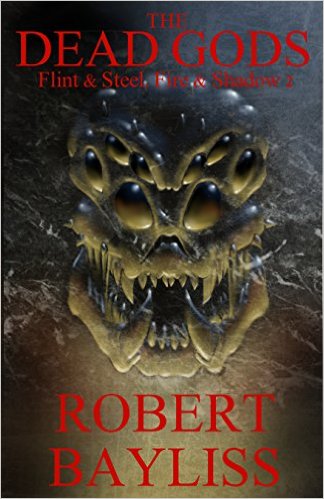
Read my review of Robert Bayliss‘s The Dead Gods: Flint & Steel, Fire & Shadow 2.
“After encountering the dark god of Acaross, the Taleeli Commander Kaziviere finds himself transported into the heart of that shadowy realm. Perplexed by the Commander’s disappearance the Sun Shard wielder Tuan, his comrade Bronic, Klesh the Flinter and Kaziviere’s lover Tamzine, embark on a quest to find him.
As war between Acaross and Taleel draws ever nearer Kaziviere discovers the horrific nature of the Messiah of Shadows and his monstrous children, The Dead Gods.”
The Dead Gods: Flint & Steel, Fire & Shadow 2 is a beautiful tale of the fantasy genre, with an atmosphere straight out of the medieval world. I am very much a fan of historical fiction, or modern-day archaeological thrillers. Fantasy is a whole new genre for me, so I had no idea what to expect when I opened the cover of The Dead Gods. It was a complete surprise to me – and a very pleasant one. It took me way out of my reading comfort zone and yet had me enthralled from the first page.
The Dead Gods is the second book in the Flint & Steel, Fire & Shadow book series,but you wouldn’t know it. From the beginning the book works well as a standalone, with the events of the first book revealed as memories in the thoughts of the main protagonists in a way that is subtle and not overwhelming. Ingeniously, the author makes the past all a part of the present. The back story is introduced as I go along, when it is needed to explain a person or event, rather than in huge lumps that take you away from the actual story.
Robert Bayliss cleverly draws on aspects of various eras to create a fantasy world of magic, myth and adventure. Every detail is intricately woven in an amalgamation of the medieval, early modern, and the supernatural. Packed full of action, suspense and mystery – and some suitably demonic bad guys; the story moves rapidly, leaving you few moments to take a breath – or even let out the breath you weren’t aware you’d been holding for at least the last two pages!
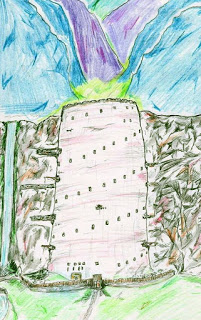
Fortress of Tiers
The narrative is wonderfully descriptive, the language evocative:
There was a hammering at the door and a voice demanded from the other side, “Dogel! We heard a noise, is anything ill?”
“Wait,” Kaziviere said. “We will need supplies and clothes.” The girl grinned. “you don’t like what you see?” she said, facing the gladiator in her nakedness. “there is no time, savage!” she hissed. “If you want to live, jump!” She launched herself from the window and was gone. Behind him he heard the door being tentatively opened. On the floor the dogel gasped, his eyes looking wildly around from his battered face.
“Tamzine!” Kaziviere said, casting his spell of hope into the world.
The lead character are wonderful creations, with their own powers to enthrall the reader. Braebec, Kaziviere, Tuan and Tamzine are heroes of the highest caliber. Each has his, or her, own strengths and weaknesses; confronting enemies head-on, while maintaining their humanity at some considerable cost. They fight to the bitter end and prove themselves worthy of the time you’ve invested in getting to know them.
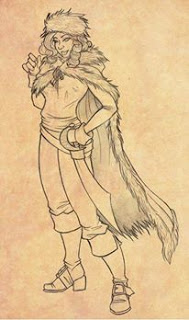
Princess Karla
The villains are superbly nasty and supernatural, to the point of making you subconsciously cringe as you read about them (although only occasionally). They attract the worst of humanity to their cause.
The contrast between the human heroes and the other-worldly villains provides a brilliant contrast for the reader, making it easy to root for the heroes. We are also introduced to characters our heroes meet along the way, who act as foils and distraction to the bad guys – and the heroes. People such as the alluring Princess Karla and her father, the Khan, have their own agendas that could divert our heroes from their purpose.
To be honest, my review can’t ever do this book justice. It fascinates and enthralls as it entertains. In short, you will have to read it to believe it. But beware, once it has you in its grip, you will be absorbed into this strange world until the very last page. And it will leave you desperate to read the next installment ….
*
My book, Heroines of the Medieval World, is now available in hardback in the UK from both Amberley Publishing and Amazon UK and worldwide from Book Depository. It is also available on Kindle in both the UK and USA and will be available in Hardback from Amazon US from 1 May 2018.
Be the first to read new articles by clicking the ‘Follow’ button, liking our Facebook page or joining me on Twitter.
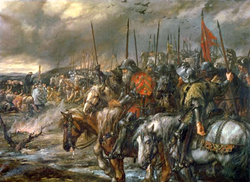
This Sunday, 25th of October 2015, marks the 600th anniversary of the Battle of Agincourt. One of the greatest battles in English history, it epitomises the pinnacle of English successes against their traditional enemy, France, during the epic struggle of the Hundred Years War. But what started it all?
The origins of the Hundred Years War go back 200 years before its outbreak, to Henry II. His marriage to Eleanor of Aquitaine meant he was not only Duke of Normandy in the north of France, but Duke of Aquitaine in the south. And his accession to the English throne in 1154 brought all these French possessions to the crown of England. This made for the awkward position that the sovereign of England was technically a vassal of the King of France, causing no end of squabbles and friction for years to come.
Wars broke out frequently and the French gradually ate away at England’s French possessions.
It all came to a head with a crisis in the French monarchy. When Philip IV, the Fair, of France, died in 1314, he was successively succeeded by each of his 3 sons; Louis X, Philip V and Charles IV. Only one of these kings produced a son, King John the Posthumous was born 5 months after the death of Louis X, his father, and lived – and ruled – for only 5 days. Following the death of the baby king Philip V seized the crown, effectively disinheriting Louis X’s daughter, Jeanne.
Although Salic Law was known in France, it generally related to property and had never actually been used to decide the succession to the crown. However, Philip V made certain that it would be from now on, by having the Estates General declare that women were not eligible to succeed to the throne of France.
Unfortunately for the French royal family, both Philip V and his successor, his brother, Charles IV, only had daughters. Charles IV died in 1328, leaving his wife, Jeanne d’Evreux, pregnant; a regency council was set up to rule the country, until the child’s birth. However, Jeanne gave birth to a daughter, Blanche, and France had to find a new king.
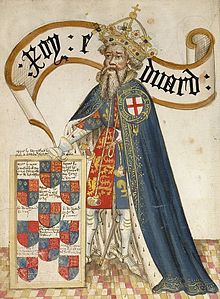
One candidate was Edward III of England. Edward was the oldest grandson of Philip IV through his daughter Isabella of France, Queen of Edward II of England. However, Edward III was only 15 years old and England – and Edward – were controlled by Edward’s mother, Isabella of France, and her lover, Roger Mortimer, who had deposed and possibly murdered Edward’s father, Edward II. Edward’s claim came through his mother – and he was English.
The assembly of French notables, convened to decide who should be king, declared: “It had never been seen or known that the kingdom of France should be subject to the government of the King of England.“
As a result, they chose another as their king; the nephew of Philip IV, Philip of Valois, Count of Anjou and Maine. Philip was in his thirties, with a 9-year-old son, and had been Regent during Jeanne’s pregnancy.
Edward III initially agreed to pay homage to Philip VI, who was crowned in 1329, for his French possessions. However, he was still a minor and under the tutelage of his mother and Mortimer. When Edward took control of his kingdom, in 1330, he had a change of heart. Irked by Philip’s support for the Scots, and encouraged by local conflicts in Guyenne, Edward questioned the validity of his oath to Philip, made while he was still a minor. And in 1337 Edward III declared war.
Initial English successes devastated France: the French fleet was destroyed at Sluys in 1340, and Edward III ravaged the French countryside, in a great chevauchee. In an attempt to bring the French to battle Edward’s ‘scorched-earth’ policy saw towns besieged, convents and monasteries ransacked and the people displaced. The French were eventually brought to battle at Crecy in 1346, where their cavalry was destroyed. The fall of Calais followed in 1347.
In 1356, at the Battle of Poitiers, the English, under the Black Prince (Edward, Prince of Wales) captured France’s king, John II the Good. John was sent to England – where he died in 1364, still awaiting the payment of his vast ransom.
The 1360 Treaty of Bretigny was the crowning success of England’s war, with Edward III taking possession of almost a third of France.
Although technically at peace, the two countries kept picking at each other – each supporting opposing factions in places of mutual interest, such as Brittany. In then end, with the failing health of the Black Prince, and and aging Edward III, a resurgent France emerged under Charles V; which saw English possessions reduced to a few ports and their environs by 1380.
After 1389 truces between France and England were almost continuous. Richard II married Isabella of Valois, daughter of Charles VI, in 1396, as part of a 28 year truce.
Charles VI had suffered from madness since 1392 and France had started to implode. The king was surrounded by bad councillors and factions, such as the Armagnacs and Burgundians, had riven the country apart with their in-fighting. Many parts of France were ruled almost totally independent of central government.
However, with the turn of the century, the English had problems of their own and were unable to take advantage of France’s woes. Richard II was imprisoned and, later, murdered by the usurping Henry IV, who spent his reign preoccupied by troubles and rebellions in England.
Henry IV and his son, the future Henry V were divided as to which French factions they should support; Henry IV preferred the Armagnacs, while the Prince of Wales supported the Burgundians.
With the death of Henry IV, and the accession of Henry V, English ambitions turned to France yet again. Almost immediately, Henry laid claim to his inheritance in France. he made a pretense of negotiating for peace, while preparing for war. He would accept nothing less than the total reinstatement of the Plantagenet possessions in France.
There is an, almost certainly, apocryphal story of Henry V taking up arms against the French after they jokingly sent him a set of tennis balls, suggesting that he stick to such ‘childish’ occupations, for which he had established a reputation during his father’s reign.
Henry saw war with France as a way of diverting the interests of the great nobles away from internal conflicts, thus restoring and maintaining order at home. With peace negotiations faltering, and having dealt with several plots to displace him from his throne – the last of which, the Southampton Plot was foiled in the first week of August 1415 – Henry V and his army arrived in Normandy on 13th August 1415 and laid siege to Harfleur.
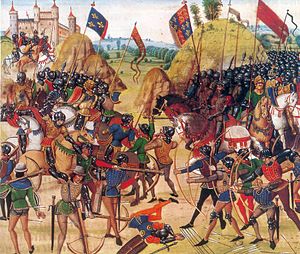
Harfleur held until 23rd September, by which time Henry’s army of about 10,000 was greatly depleted by dysentery. He was making for Calais – and England – when, on 25th October, he came face-to-face with the French.
I have always had a soft spot for the Arthurian Romances. I love the legend of King Arthur and really hope that there was a historical Arthur who inspired the original tales. His Knights of the Round Table are held up as models of chivalry throughout Europe.
And the recent discovery of some wonderful wall paintings of Lancelot du Lac in a Ducal Tower in Siedlęcin in Poland is simply incredible.
Rodengo, Schmalkalden and Siedlęcin: Where Did the Knights of the Round Table Go?
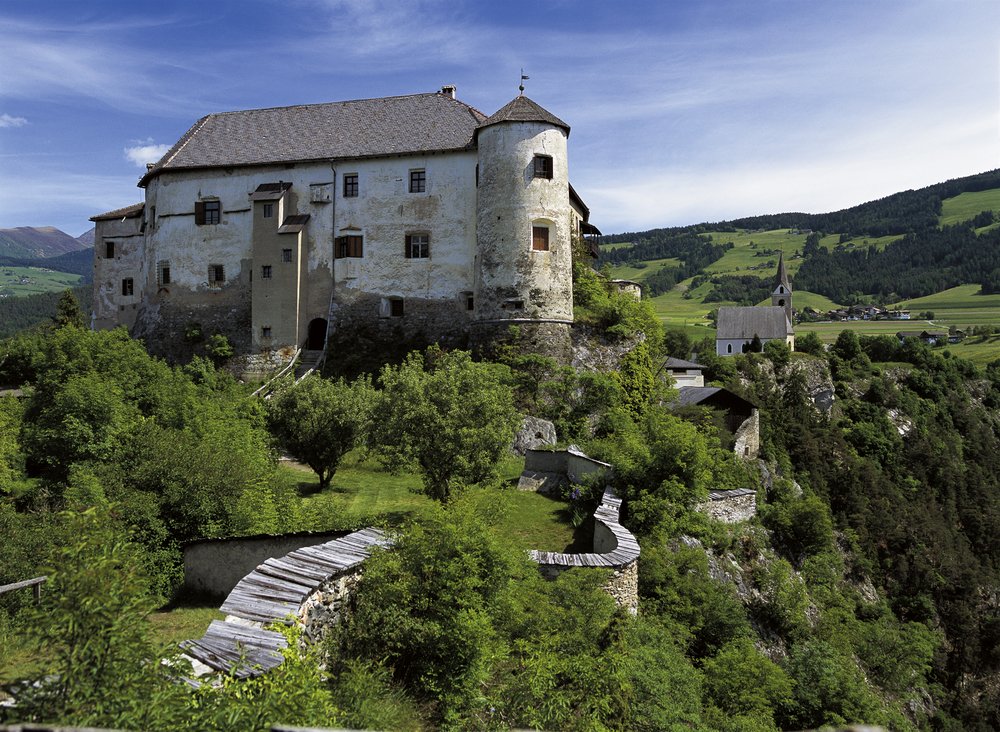
Castel Rodengo
King Arthur is mortally wounded and taken to the isle of Avalon, the cream of the crop – his best knights dead. With their passing the age of chivalric deeds and marvelous exploits is over.
Is it really? After all, what the king and his knights have left behind is an extensive body of literature and next to Arthur himself, each of the knights has his own story to be told and retold. And their stories have been retold many times in several versions in different languages.
Some of Arthur’s knights were so celebrated that their fame spread from the literary world to the world of art, music and architecture.
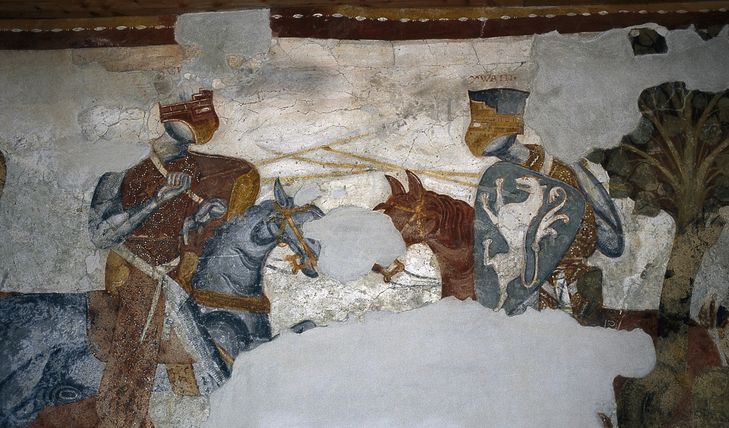
Rodengo murals (detail)
Today I am going to focus on the two of these knights, both very popular and with an enormous impact on the literary world. Yvain and Lancelot, for they are the ones, became the main characters of Chretien de Troyes’ romances and many other poets and writers that followed and based their versions on Chretien’s.
A few groups of the wall paintings, for example, presenting their deeds and exploits survive scattered across Europe. The most famous murals are certainly those painted by Sir Lancelot himself in the Prose Lancelot, but let me take a closer look at those painted on the walls of medieval castles, towers and houses.
Yvain was beside himself. everything he heard upset him, and everything he saw tormented him. He wished he were far away in a land so wild that no one would know where to look for him…
(from Yvain ou le Chevalier au lion)
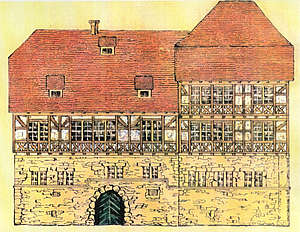
Hessenhof in Schmalkalden in the Middle Ages
One look at Castel Rodengo mounted on a hilltop covered with thick verdure is enough to give the impression that Yvain’s wish has come true, fortunately the surrounding land is not as wild as it may seem and everyone has a chance to visit and admire the wall paintings preserved inside the former castle chapel, dedicated to St Nicholas. Dating back to the 1220s, the cycle depicts the story of Ivain as told by Chretien de Troyes and Hartmann von Aue and is an “extraordinary document without known precedent: the oldest surviving representation in the monumental arts of the High Middle Ages of a profane narrative subject in the context of profane architecture”. Little wonder that the discovery of the murals in 1973 caused a great sensation.
Schmalkalden wall paintings (detail)
The castle itself was built c.1140 near Bressanone, in the South Tirol, and is known variously as Schloss Rodenegg or Rodeneck after its first owner’s surname: Federico I di Rodank. From the late 16th century to the 1970s, the paintings remained hidden under cover of vaulting and flooring. Eleven Yvain scenes represent the episodes from the first half of the epic, with the end of the story not depicted which led to speculations that the paintings were created before Hartmann completed his poem.
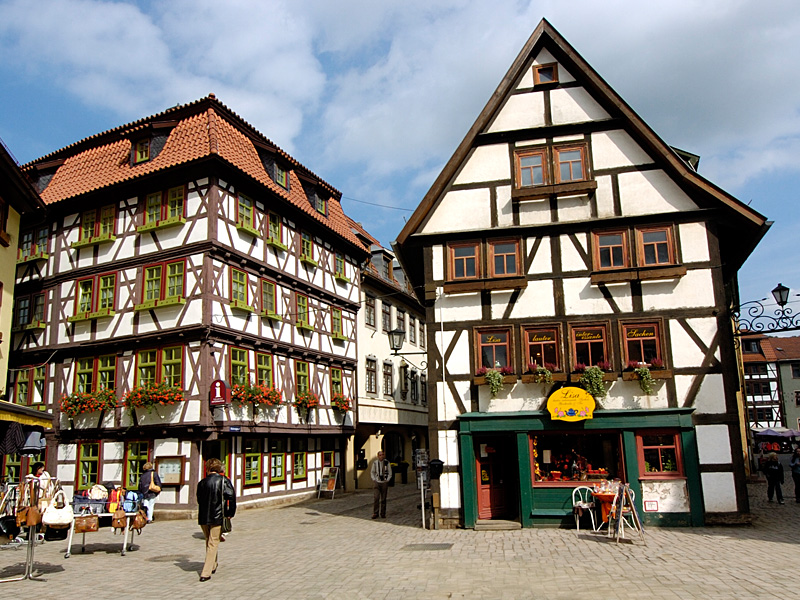
In further search for Ivain we move from the north-east of Italy to the central Germany, where in the small town of Schmalkalden, Thuringia, one more fine example of the remarkable wall paintings survive in the basement of the 13th-century Hessenhof house. This cycle is more extensive than the one at Rodengo, the surviving 26 scenes having been probably created between 1220 and 1230. The knightly adventure presented in them is shown as a game and courtly leisure. The Schmalkalden murals are the oldest surviving secular wall paintings in Germany.
Schmalkalden in Thuringia today
My lady, it’s not fitting to speak of this, but take pity on him, for he loves you more than himself; God help me, when he came I knew nothing of his thoughts except that he was afraid of being recognized, and he never revealed anything else to me. (from The Prose Lancelot)
Henry I of Jawor was the 3rd son of Bolko I The Strict and Beatrice of Brandenburg, he was born in the early 1290s. His father died while Henry was still a child and it was not until 1312 that Henry assumed control of his Duchy of Jawor. Situated in Lower Silesia, it was only Henry’s political acumen that kept Jawor independent from its larger neighbour, Bohemia, despite other Silesian Dukes were swearing fealty to Bohemia’s king, John the Blind.
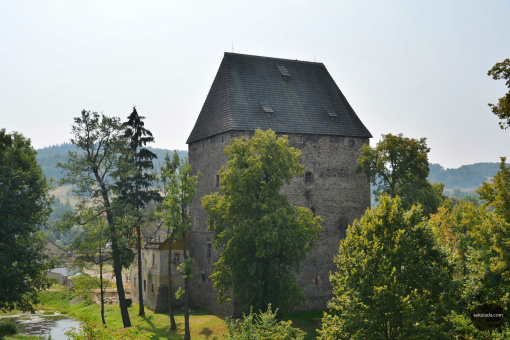
Ducal tower of Siedlęcin (sekulada.com)
After joining a coalition against King John Henry married Agnes of Bohemia, only daughter of the late king Wenceslaus II of Bohemia by his 2nd wife, Elizabeth of Poland. Although the marriage proved childless it did make Henry a rival claimant to Agnes’s half-brother, King John, for the Bohemian throne.
The Ducal Tower at Siedlecin was built by Henry shortly after he assumed control of Jawor. One of the most important medieval residences in Central Europe, the Medieval mural paintings are in the great hall, on the 2nd floor of the keep. Commissioned in 1345 by Duke Henry, they remained unfinished following the Duke’s death in 1346.
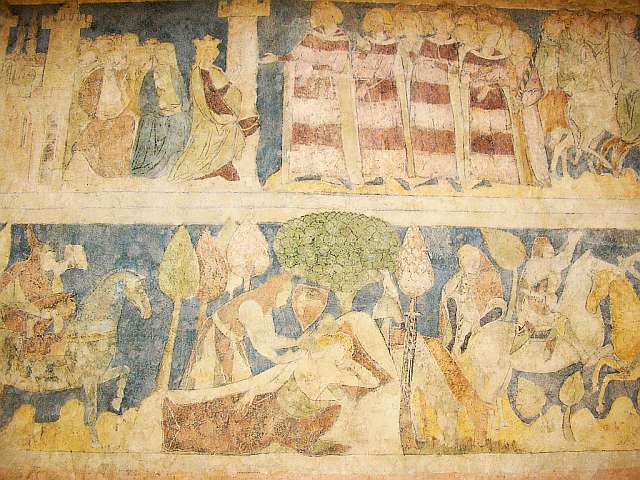
Arthurian legends were very popular in the courts of Medieval Poland and Silesia,, but these paintings are the earliest surviving examples. Sir Lancelot managed to hide unidentified in the ducal tower of Siedlęcin for almost 700 years.
Siedlęcin wall paintings
Fortunately his true identity was revealed, for today the Siedlęcin is the only place in the world where Lancelot wall paintings have been preserved in situ. The true subject matter of these remarkable 14th-century murals was not recognised until 1990s.
Their major conservation was carried out in 2006, actually saving them, for they were in a very poor condition – they had been almost lost due to perfunctory conservation process carried out in the 1930s. The Siedlęcin group includes representations of the scenes from the Vulgate Lancelot, which were to be the main source of Sir Thomas Malory’s romances in the 15th century…….
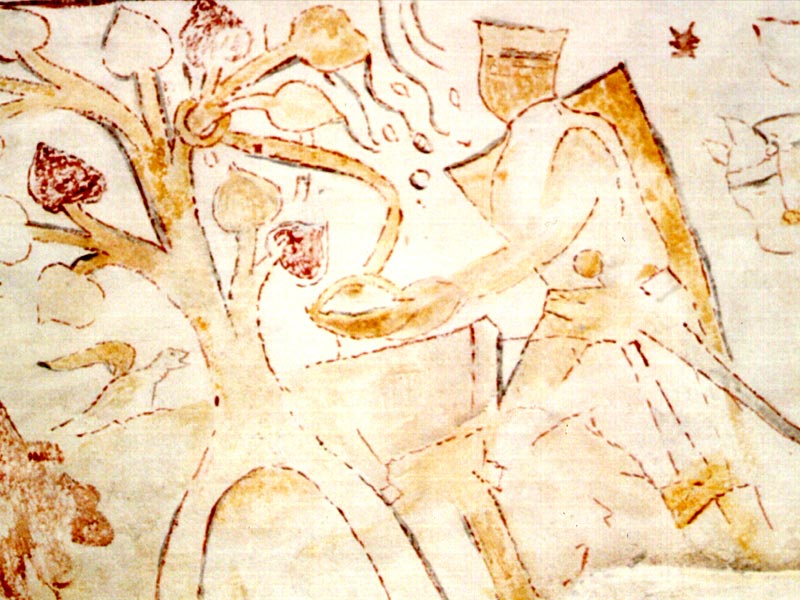
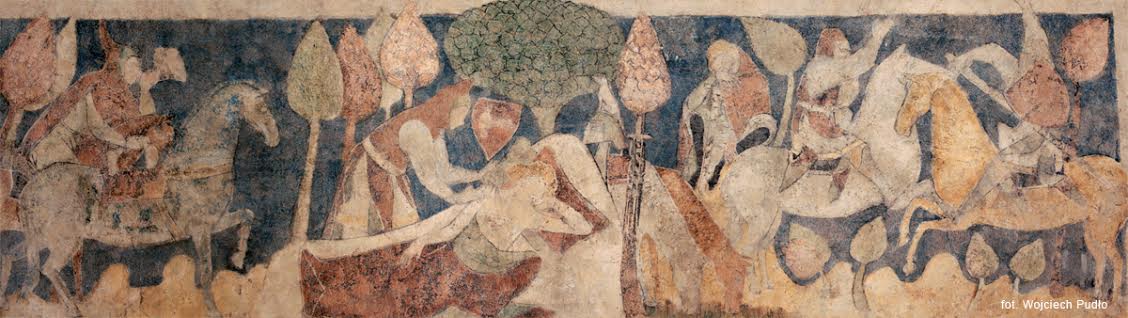
There are 4 scenes depicting the court of Camelot. The 1st shows Arthur’s queen Guinevere with her ladies, followed by Guinevere’s kidnapping by Meleagant and her rescue by Arthur’s champion, Lancelot. Below these are representations of Lancelot and his cousin, Lionel; Lancelot asleep under an apple tree and Lionel sleeping on guard. Then we see a duel between Lancelot and Tarquin and Lancelot with Arthur’s brother, Sir Kay.
The unfinished portion depicts a duel between Lancelot and Sagramour and the healing of Urry de Hongre…..
Siedlęcin murals
Today Siedlęcin really is the only place in the world where you can still admire the Lancelot paintings preserved in situ.
*
For more details on the Ducal Tower at Siedlecin, just click here.
*
Photos courtesy of: Winchester – Wikipedia, Castel Rodengo – Valle Isarco, Rodengo murals – sentres.com, Schmalkalden – romoe.com, Hessenhof and the wall paintings – schmalkalden.com, Ducal tower od Siedlęcin – sekulada.com, Siedlęcin murals – L.Bartosik (Go Lower Silesia), Siedlęcin murals – Wojciech Pudło
*
Sources: Le Gof, Jacques. The Medieval Imagination. The University of Chicago, 1992; Allaire, Gloria. The Arthur of the Italians: The Arthurian Legend in Medieval Literature and Culture. University of Wales Press, 2014; Lacy, Norris. The New Arthurian Encyclopedia; Lacy, Norris. A Companion to Chrétien de Troyes, D.S. Brewer, 2005; Witkowski, Jacek Szlachetna a wielce zalosna opowiecs o Panu Lancelocie z Jeziora;Wierssing, Johannes. Schmalkalden. Eine kleine stadt mit grosser Geschichte. 2013; Lupack, Alan. Oxford Guide to Arthurian Literature and Legend. Oxford University Press, 2007; The Norton Anthology of English Literature (Norton Topics Online); Ducal tower of Siedlęcin
*
My book, Heroines of the Medieval World, is now available in hardback in the UK from both Amberley Publishing and Amazon UK and worldwide from Book Depository. It is also available on Kindle in both the UK and USA and will be available in Hardback from Amazon US from 1 May 2018.
Be the first to read new articles by clicking the ‘Follow’ button, liking our Facebook page or joining me on Twitter.
‘This is the history of that most sacred vessel that is named by men the Holy Grail, wherein the precious blood of Our Saviour was received on the day that He was crucified that He might redeem His followers from the pains of Hell.’









 History... the interesting bits!