Guest Post: Childbirth and the Victorian Workhouse by Jessica Cox

Today it is an absolute pleasure to welcome Jessica Cox to History…the Interesting Bits with a guest article offering insight into her newly released book, Confinement: The Hidden History of Maternal Bodies in Nineteenth-Century Britain

Childbirth and the Victorian Workhouse
by Jessica Cox

‘The patient […] stretched out her hand towards the child. The surgeon deposited it in her arms. She imprinted her cold white lips passionately on its forehead; passed her hands over her face; gazed wildly round; shuddered; fell back – and died’

So ends the life of the eponymous hero’s mother in the opening of Charles Dickens’s Oliver Twist (1838). Her infant son initially appears likely to follow in her footsteps:

For some time he lay gasping on a little flock mattress, rather unequally poised between this world and the next: the balance being decidedly in favour of the latter. Now, if, during this brief period, Oliver had been surrounded by careful grandmothers, anxious aunts, experienced nurses, and doctors of profound wisdom, he would most inevitably and indubitably have been killed in no time. There being nobody by, however, but a pauper old woman, who was rendered rather misty by an unwonted allowance of beer; and a parish surgeon who did such matters by contract; Oliver and Nature fought out the point between them.

Though fictional, the circumstances of Oliver’s birth reflect those of many thousands of babies born in the workhouses of Victorian Britain. Between 1861 and 1865 in London alone, almost twelve thousand women gave birth in workhouses. Giving birth in the workhouse was risky, with an average maternal mortality rate of 0.8 per cent. Overall, maternal mortality rates remained relatively steady throughout the Victorian period, with approximately one in two hundred births (0.5 per cent) resulting in the death of the mother, but this varied according to circumstances and locale. As these figures suggest, the maternal mortality risk in workhouses was somewhat higher than average, and in some of these institutions, it was higher still: in Islington workhouse in 1865, for instance, it was over five per cent.

Clerkenwell Workhouse 1882

As Dickens’s description suggests, Oliver’s survival was against the odds. Infant mortality was high throughout the Victorian period – averaging around twenty per cent, but as high as fifty per cent in some areas. Amongst infants born in the workhouse whose mothers died in childbirth, it was even higher. If mother and baby did survive, they might be relocated to the workhouse nursery, and, as with the lying-in wards, these places were often far from sanitary, and unlikely to contribute to the recovery of mothers or the healthy development of infants. The Medical Officer at the Strand Workhouse in London included a description of the nursery there when testifying to a House of Commons select committee looking at conditions in the workhouse in 1861:

[The nursery] was a wretchedly damp and miserable room, nearly always overcrowded with young mothers and their infant children. That death relieved these young women of their illegitimate offspring was only what was to be expected, and that frequently the mothers followed in the same direction was only too true. I used to dread to go into this ward, it was so depressing. Scores and scores of distinctly preventable deaths of both mothers and children took place during my continuance in office through their being located in this horrible den.

The care which Oliver and his mother received also parallels the reality for many birthing women who ended up in one of Britain’s many workhouses. Such places, as the above description suggests, were often unsanitary, and medical assistance could not be guaranteed, though of course medical aid was no guarantee of a successful outcome anyway – especially in lying-in wards such as those found in the workhouses, where infections could be easily spread between patients. Whilst all workhouses were required to employ a medical officer, he was not necessarily summonsed to births, and in some instances, women were attended in childbirth only by fellow paupers. Whilst Dickens is guilty of perpetuating the stereotype of the drunken, incompetent midwife in his fiction (Martin Chuzzlewit’s Mrs Gamp being the most notable example), it was nonetheless the case that many of the women who gave birth in the Victorian workhouse received inadequate – and sometimes no – medical attention.
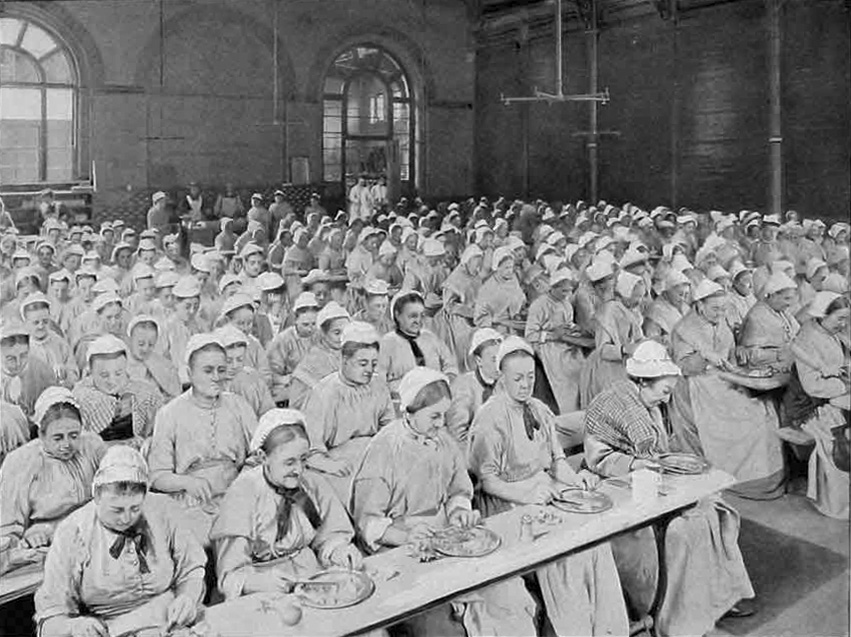
Dinnertime at St Pancras Workhouse, London, 1911

Like many of those born in the workhouse, Oliver Twist is illegitimate. The various lying-in hospitals in Victorian Britain, which provided support for poorer women in childbirth, typically offered aid only to married women, so poor unmarried mothers often had no choice but to attend the workhouse. By and large, these were far from welcoming institutions: concerns were raised about women taking advantage of the care provided and entering the workhouse too early. This resulted in some women being turned away. In one tragic case in 1857, an eighteen-year old woman was turned away from Bradford Workhouse after the matron decided the birth was not imminent. Shortly afterwards, she collapsed in the street, where she gave birth to a stillborn child without any medical assistance. In addition, some workhouses participated in the widespread moral condemnation of unmarried mothers, by forcing them to wear particular colours or items of clothing as a marker of their ‘disgrace’.

Despite the harsh conditions and attitudes associated with giving birth in the workhouse, it did at least – assuming the mother survived – allow for rest after childbirth: women were generally permitted to stay in the lying-in ward for one month following delivery. Whilst there is no doubt that the workhouse was not a particularly desirable option, all things considered, the alternative for poorer women was often to return to hard labour – domestic or paid – soon after giving birth. Prior to the establishment of the National Health Service, the workhouse represented one of the only means of state support for poorer citizens. Today, women who once would have had little choice but to give birth in the workhouse, risking their own and their babies’ lives, have undisputed rights to hospital and medical care. The last workhouses in Britain closed their doors in 1948 – the same year the NHS was formed.

Jessica Cox’s book Confinement: The Hidden History of Maternal Bodies in Nineteenth-Century Britain is published by The History Press and is available now.

About the book:

Covering a fascinating period of population growth, high infant mortality and deep social inequality, rapid medical advances and pseudoscientific quackery, Confinement is the untold history of pregnancy and childbirth in Victorian Britain.

During the nineteenth century, having children was frequently viewed as a woman’s central function and destiny – and yet the pregnant and postnatal body, as well as the birthing room, are almost entirely absent from the public conversation and written histories of the period. Confinement corrects this omission by exploring stories of pregnancy and motherhood across this period. Drawing on a range of contemporary sources, Jessica Cox charts the maternal experiences of women, examining fertility, pregnancy, miscarriage, childbirth, maternal mortality, unwanted pregnancies, infant loss, breastfeeding, and postnatal bodies and minds.

From the royal family to inhabitants of the workhouse, this absorbing history reveals what motherhood was truly like for the women of nineteenth-century Britain.

About the author:

Jessica Cox is a Reader in English Literature at Brunel University, London. She specialises in maternal histories, Victorian sensation fiction, the Brontes, and neo-Victorianism.

*

My Books

Signed, dedicated copies of all my books are available, please get in touch by completing the contact me form.
Out now: King John’s Right-Hand Lady: The Story of Nicholaa de la Haye

In a time when men fought and women stayed home, Nicholaa de la Haye held Lincoln Castle against all-comers, gaining prominence in the First Baron’s War, the civil war that followed the sealing of Magna Carta in 1215. A truly remarkable lady, Nicholaa was the first woman to be appointed sheriff in her own right. Her strength and tenacity saved England at one of the lowest points in its history. Nicholaa de la Haye is one woman in English history whose story needs to be told…

King John’s Right-Hand Lady: The Story of Nicholaa de la Haye is now available from Pen & Sword Booksbookshop.org and Amazon.

Coming 15 January 2024: Women of the Anarchy

On the one side is Empress Matilda, or Maud. The sole surviving legitimate child of Henry I, she is fighting for her birthright and that of her children. On the other side is her cousin, Queen Matilda, supporting her husband, King Stephen, and fighting to see her own son inherit the English crown. Both women are granddaughters of St Margaret, Queen of Scotland and descendants of Alfred the Great of Wessex. Women of the Anarchy demonstrates how these women, unable to wield a sword, were prime movers in this time of conflict and lawlessness. It show how their strengths, weaknesses, and personal ambitions swung the fortunes of war one way – and then the other.

Available for pre-order from Amberley Publishing and Amazon UK.

Also by Sharon Bennett Connolly:

Defenders of the Norman Crown: The Rise and Fall of the Warenne Earls of Surrey tells the fascinating story of the Warenne dynasty, of the successes and failures of one of the most powerful families in England, from its origins in Normandy, through the Conquest, Magna Carta, the wars and marriages that led to its ultimate demise in the reign of Edward III. Defenders of the Norman Crown: Rise and Fall of the Warenne Earls of Surrey is now available from Pen & Sword BooksAmazon in the UK and US, and  Bookshop.org.

Ladies of Magna Carta: Women of Influence in Thirteenth Century England looks into the relationships of the various noble families of the 13th century, and how they were affected by the Barons’ Wars, Magna Carta and its aftermath; the bonds that were formed and those that were broken. It is now available in paperback and hardback from Pen & Sword,  Amazon, and Bookshop.org.

Heroines of the Medieval World tells the stories of some of the most remarkable women from Medieval history, from Eleanor of Aquitaine to Julian of Norwich. Available now from Amberley Publishing and Amazon, and Bookshop.org.

Silk and the Sword: The Women of the Norman Conquest traces the fortunes of the women who had a significant role to play in the momentous events of 1066. Available now from Amazon,  Amberley Publishing, and Bookshop.org.

Alternate Endings: An anthology of historical fiction short stories including Long Live the King… which is my take what might have happened had King John not died in October 1216. Available in paperback and kindle from Amazon.

Podcast:

Have a listen to the A Slice of Medieval podcast, which I co-host with Historical fiction novelist Derek Birks. Derek and I welcome guests, such as Bernard Cornwell and discuss a wide range of topics in medieval history, from significant events to the personalities involved.

*

For forthcoming online and in-person talks, please check out my Events Page.

You can be the first to read new articles by clicking the ‘Follow’ button, liking our Facebook page or joining me on Twitter and Instagram.

©2023 Jessica Cox and Sharon Bennett Connolly FRHistS
Guest Post: Children of the House of Cleves by Heather R Darsie

Today it is an honour and pleasure to open the blog tour for Heather R. Darsie’s latest book, Children of the House of Cleves: Anna and Her Siblings. You may remember that Heather wrote a fabulous biography of Anna of Cleves, Henry VIII’s fourth wife, a few years back. She has now followed that up with a look into Anna’s family.

Mental Illness in the House of Cleves

By Heather R. Darsie, J.D.

The von der Mark family, particularly once it came to the mental health of Anna of Cleves’ fraternal nephew Johann Wilhelm, was marred with mental health issues. Unfortunately, it is impossible to diagnose individuals from hundreds of years ago with afflictions that the modern person would recognize. To that end, terms from the time are rather simplistic.

Anna of Cleves’ family did not appear to have any serious mental health concerns on her father Johann III’s side, although Johann was regarded as being simple-minded. Madness featured on the maternal, Jülich-Berg side of Anna’s family. Her mother Maria of Jülich-Berg’s paternal grandfather, Gerhard of Jülich-Berg. He, “fell in and out of madness, beginning when William was still an infant…” That eventually led to William’s regency on the late 15th century, until Gerhard died.

William’s daughter Maria, mother of Anna and her siblings, was said to have died in a fit of rage. She was recognized as an intelligent, capable woman in her lifetime. Beyond her heartbroken rage at the end of her life, there is nothing to hint that Gerhard’s mental instability was passed down to Maria.

Anna’s brother Wilhelm is difficult to discern. After a series of strokes in his forties and fifties, Wilhelm occasionally suffered from a mental stupor. Whether it was from the strokes or a mental disorder is hard to sort. However, whatever his post-stroke limitations, a regency was never necessary during Wilhelm’s long reign as Duke of Jülich-Cleves-Berg.

Anna’s second sister-in-law through Wilhelm, Maria von Habsburg, was prone to fits of melancholy. Sometimes, the fits, or what the modern person might suspect to be depression, could be quite intense. She was one of Juana the Mad’s granddaughters, after all.

With the exception of perhaps Gerhard of Jülich-Berg, no one in the family was quite as mad as Anna’s nephew, Johann Wilhelm of Jülich-Cleves-Berg. Johann Wilhelm’s peculiar disposition began presenting itself in his youth, although it was easy enough to put him away in a religious establishment. Unfortunately, by the time he became a young man, there was no hiding his infirmity.

Again, there are really only glimpses of what ailed Johann Wilhelm. At times, he seemed to have entered an almost catatonic state. At other times, he seemed perfectly lucid, but was highly paranoid.

As the decades rolled on and Anna’s brother Wilhelm sought method after method of treating Johann Wilhelm, nothing worked. Multiple doctors saw him, including a known quack. Even witches were consulted in hopes of curing Johann Wilhelm, but nothing worked. On top of Johann Wilhelm’s mental illness, he failed to conceive any children.

Likely motivated by her own desperation for a child, Johann Wilhelm’s wife arranged an exorcism for him,

“The exorcism, which began around 5 September 1599, was violent, but started off harmlessly enough. Johann Wilhelm and members of his court were at Hambach Castle [near the city of Jülich], then being used by the duke as a hunting lodge. Foreign priests … and their religious retinue awaited Johann Wilhelm and his company as they returned from a hunting excursion. The priests gathered in Hambach Castle’s galleries to greet Johann Wilhelm, who was immediately apprehensive when he saw them. According to the report, Johann Wilhelm behaved strangely toward them because, “he was able to think or suspect without a doubt that the priests or monks are not being called for in vain, but are called to the place for the sake of the cause” of exorcising him.

Aside from dispossessing Johann Wilhelm of whatever demon was harassing him, the monks and priests wished to remove any impediment to Johann Wilhelm’s marriage bed…. The hope was that God would make them fruitful. Johann Wilhelm was keenly aware that the United Duchies needed an heir, especially since his first marriage was childless.”

What follows is a curious description of the efforts to which the priests went in cleansing Johann Wilhelm of the demon or demons whom they believed were vexing him. It was a shameful event.

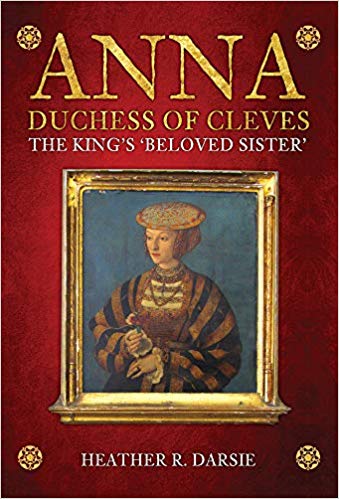
If this excerpt piqued your interest, consider reading Children of the House of Cleves: Anna and Her Siblings, set for release in the UK on 15 June 2023 and in the US/Internationally on 12 September 2023. Can’t wait until September? The US Kindle version is released on 15 June, too! You might also like to read Heather R. Darsie’s biography on Anna of Cleves, the first researched and written from the German perspective, Anna, Duchess of Cleves: The King’s Beloved Sister.

Children of the House of Cleves: Anna and Her Siblings is available from Amberley Publishing and Amazon in the UK and US

About the Author:

Heather R. Darsie is an independent researcher in the US specializing in early modern history. She focuses on researching the Holy Roman Empire and England in the early 16th century. She is the author of ‘Anna, Duchess of Cleves’ and ‘Catherine of Aragon – Spanish Princess’. Her primary career is as an attorney. She runs the website MaidensAndManuscripts.com.

Sources & Suggested Reading

1. Darsie, Heather R. Children of the House of Cleves: Anna and Her Siblings. Stroud: Amberley (2023).

2. Darsie, Heather R. Anna, Duchess of Cleves: The King’s Beloved Sister. Stroud: Amberley (2019).

*

My Books:

Signed, dedicated copies of all my books are available, please get in touch by completing the contact me form.

Out Now!

King John’s Right-Hand Lady: The Story of Nicholaa de la Haye is now available for pre-order from Pen & Sword Booksbookshop.org and Amazon UK. (I will hopefully have a US release date shortly)

In a time when men fought and women stayed home, Nicholaa de la Haye held Lincoln Castle against all-comers. Not once, but three times, earning herself the ironic praise that she acted ‘manfully.’ Nicholaa gained prominence in the First Baron’s War, the civil war that followed the sealing of Magna Carta in 1215.

A truly remarkable lady, Nicholaa was the first woman to be appointed sheriff in her own right. Her strength and tenacity saved England at one of the lowest points in its history. Nicholaa de la Haye is one woman in English history whose story needs to be told…

Coming 15 January 2024: Women of the Anarchy

On the one side is Empress Matilda, or Maud. The sole surviving legitimate child of Henry I, she is fighting for her birthright and that of her children. On the other side is her cousin, Queen Matilda, supporting her husband, King Stephen, and fighting to see her own son inherit the English crown. Both women are granddaughters of St Margaret, Queen of Scotland and descendants of Alfred the Great of Wessex. Women of the Anarchy demonstrates how these women, unable to wield a sword, were prime movers in this time of conflict and lawlessness. It show how their strengths, weaknesses, and personal ambitions swung the fortunes of war one way – and then the other.

Available for pre-order from Amberley Publishing and Amazon UK.

Also by me:

Defenders of the Norman Crown: The Rise and Fall of the Warenne Earls of Surrey tells the fascinating story of the Warenne dynasty, of the successes and failures of one of the most powerful families in England, from its origins in Normandy, through the Conquest, Magna Carta, the wars and marriages that led to its ultimate demise in the reign of Edward III. Defenders of the Norman Crown: Rise and Fall of the Warenne Earls of Surrey is now available from Pen & Sword BooksAmazon in the UK and US, and  Bookshop.org.

Ladies of Magna Carta: Women of Influence in Thirteenth Century England looks into the relationships of the various noble families of the 13th century, and how they were affected by the Barons’ Wars, Magna Carta and its aftermath; the bonds that were formed and those that were broken. It is now available in paperback and hardback from Pen & Sword,  Amazon, and Bookshop.org.

Heroines of the Medieval World tells the stories of some of the most remarkable women from Medieval history, from Eleanor of Aquitaine to Julian of Norwich. Available now from Amberley Publishing and Amazon, and Bookshop.org.

Silk and the Sword: The Women of the Norman Conquest traces the fortunes of the women who had a significant role to play in the momentous events of 1066. Available now from Amazon,  Amberley Publishing, and Bookshop.org.

Alternate Endings: An anthology of historical fiction short stories including Long Live the King… which is my take what might have happened had King John not died in October 1216. Available in paperback and kindle from Amazon.

*

Podcast:

Have a listen to my A Slice of Medieval podcast:

For forthcoming online and in-person talks, please check out my Events Page.

You can be the first to read new articles by clicking the ‘Follow’ button, liking our Facebook page or joining me on Twitter and Instagram.

*

©2023 Heather R. Darsie and Sharon Bennett Connolly FRHistS
Guest Post: Researching the Elizabethan Court, by Tony Riches

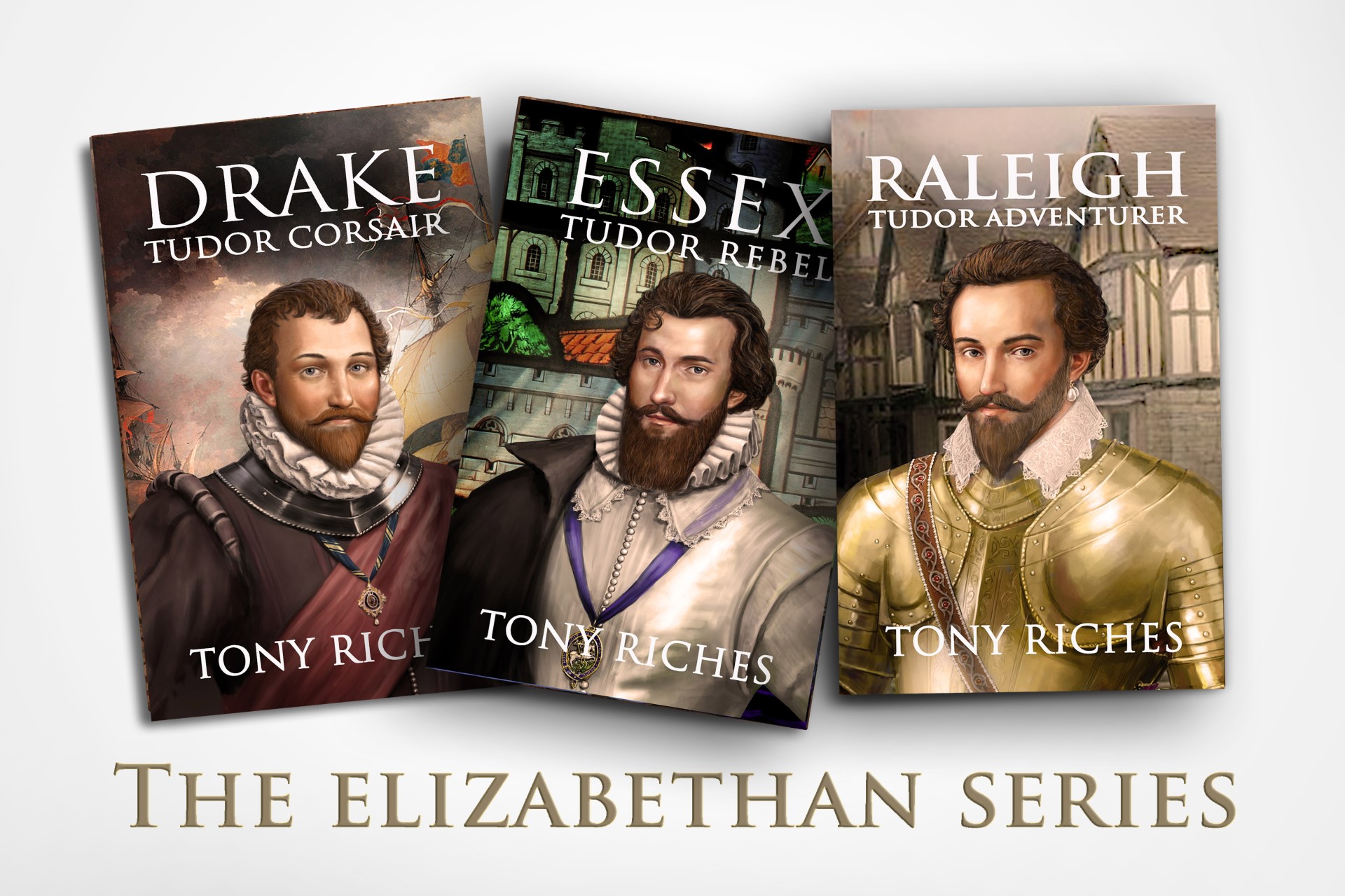
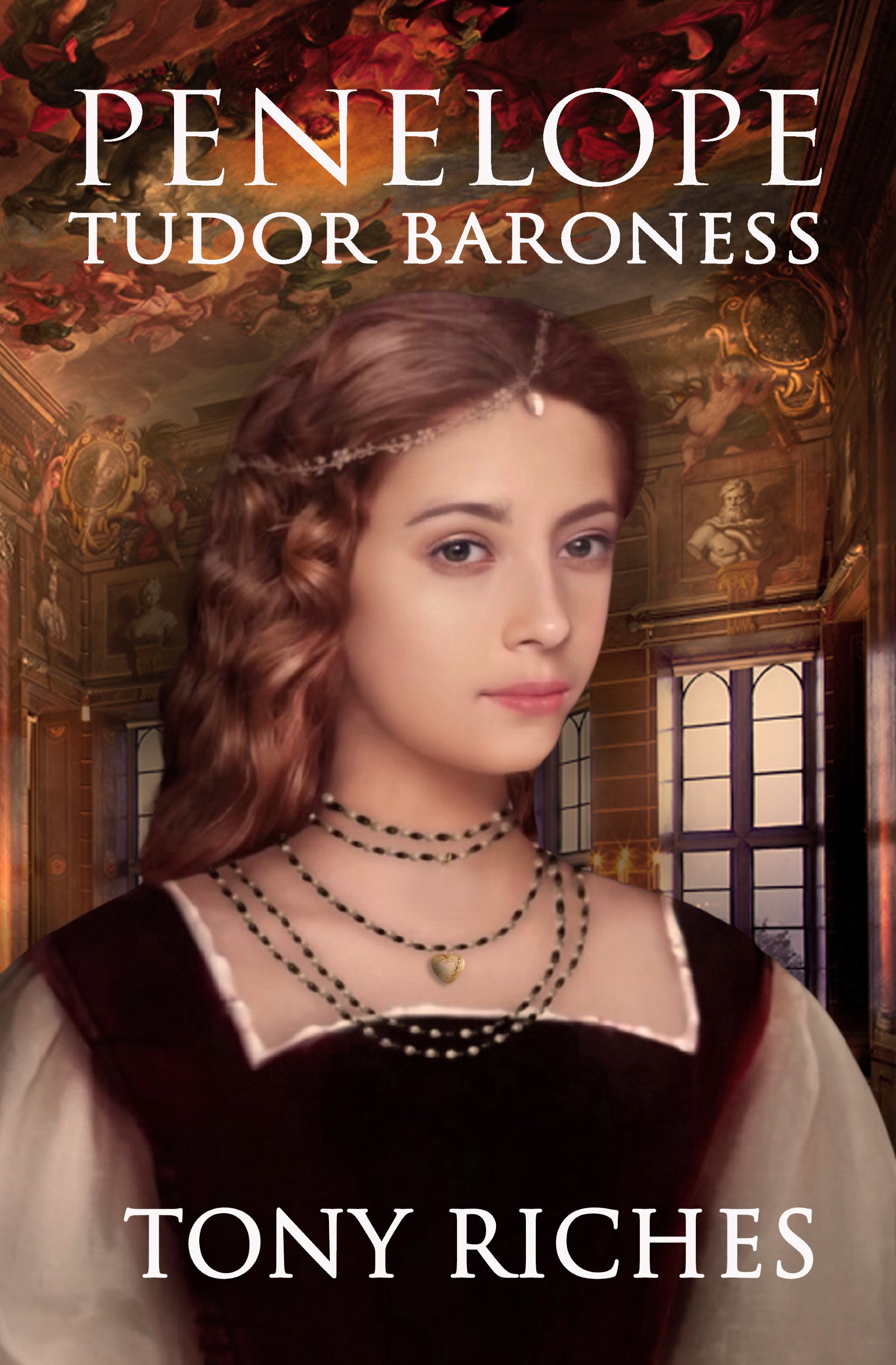
Today, it is an absolute pleasure to welcome my friend and fellow author Tony Riches to History…the Interesting Bits to talk about the research behind his latest book Penelope – Tudor Baroness, the fourth book in his Elizabethan series.

Researching the Elizabethan Court, by Tony Riches

I’ve spent the past five years immersed in the strange world of the court of Queen Elizabeth I researching my Elizabethan series. I wanted to keep the books as historically accurate and consistent as possible. My favourite source is Marion E. Colthorpe’s fascinating website, ‘The Elizabethan Court Day by Day’. This is the result of her decades of research, and includes details of other useful sources.

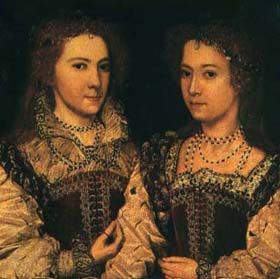
Penelope and her sister Dorothy (Wikimedia Commons)

To show the many complex facets of the last Tudor queen, I decided the first three books of the series would see her through the eyes of three of her favourites, Drake, Essex, and Raleigh – each of whom knew a different side of their queen. Drake was in awe of her, and showered her with (looted) jewels, Essex was like the son she never had, and Raleigh was the captain of her guard.

These are to be followed by books about three of Queen Elizabeth’s ladies. Less well known, they all had close contact with her, a certain amount of influence with her advisors, and the opportunity to see behind the queen’s carefully contrived façade.

I chose the life of Lady Penelope Devereux as the fourth book in Elizabethan series. Penelope’s great-grandmother was Queen Elizabeth I’s aunt, Mary Boleyn. Her father was Sir Walter Devereux, 1st Earl of Essex, and her mother was Lady Lettice Knollys, banished from court for her secret marriage to the queen’s great favourite, Sir Robert Dudley.

A famous beauty, Penelope was well educated, an accomplished dancer and musician. Fluent in Italian, French and Spanish. Penelope became a prominent figure in the courts of Queen Elizabeth I and King James I. She was also involved in political intrigue, influencing the succession and her brother’s ill-fated Essex rebellion.

A measure of the challenges in researching Elizabethan ladies is the range and number of primary sources, such as letters. When I researched Penelope’s brother Robert for my book Essex – Tudor Rebel, I had Walter Bourchier Devereux’s ‘Lives and Letters of the Devereux, Earls of Essex’ – a two volume collection of his letters and papers, complete with detailed analysis and context.

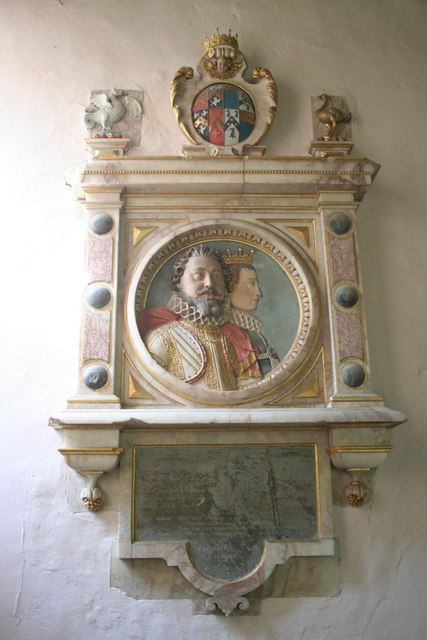
Baron Robert Rich (Wikimedia Commons)

In Penelope’s case, I managed to track down only twenty-seven letters in English, six in French and seven letters in Spanish. Interestingly, many use code words or are deliberately obscure, although analysis of them all reveal an invaluable sense of Penelope’s character, and how she related to others.

I began my research expecting Penelope to have been greatly disadvantaged by her mother’s banishment from court, yet she became a Maid of Honour to Queen Elizabeth until her stepfather, Sir Robert Dudley arranged her marriage to Baron Rich. (An unlikely choice of husband for her, he was the grandson of Richard Rich, Thomas Cromwell’s right hand man in the Dissolution of the monasteries.)

Another surprise was the inconsistent records of Penelope’s many children. Some biographers have them in the wrong order and others omit some entirely. The situation is not helped by the question of who their fathers were, and several premature or stillbirths with no baptism. My solution was to create my own list from the best information I could find, (and I updated her Wikipedia page accordingly.)

To avoid too many spoilers, I shall not say here what I made of her brother accusing Penelope of encouraging his rebellion, or her relationship with Queen Elizabeth after he was executed for treason. Her story does take readers past the end of the Tudors with the death of Elizabeth, and how she became a lady of the bedchamber to Queen Anne.

Lord Byron’s saying ‘Tis strange — but true; for truth is always strange; Stranger than fiction; if it could be told.’ is proven right by my research. Although historical fiction, I have only had to ‘fill in the gaps’, and believe my new book is therefore one of the most comprehensive accounts of Penelope’s amazing story.

Tony Riches

About the book:

Penelope – Tudor Baroness (Book Four of The Elizabethan Series)

Penelope’s life is full of love and scandal. The inspiration for Sir Philip Sidney’s sonnet Astrophel and Stella, she is inevitably caught up in her brother Robert’s fateful rebellion.

A complex and fascinating woman, her life is a story of love, betrayal, and tragedy. Discover how Penelope charms her way out of serious charges of treason, adultery, and forgery, and becomes one of the last truly great ladies of the Tudor court.

A maid of honour to Queen Elizabeth, Penelope outlives the end of the Tudors with the death of the old queen and the arrival of King James, becoming a favourite lady-in-waiting to the new queen, Anne of Denmark.

“This is the story of a woman who lived life on her own terms, and one that will stay with you long after you finish reading it.”

To Buy the Book:

Amazon US: https://www.amazon.com/dp/B0C78KDRK3

Amazon UK: https://www.amazon.co.uk/dp/B0C78KDRK3

Amazon CA: https://www.amazon.ca/dp/B0C78KDRK3

Amazon AU: https://www.amazon.com.au/dp/B0C78KDRK3

About the Author:

Tony Riches is a full-time UK author of Tudor historical fiction. He lives with his wife in Pembrokeshire, West Wales and is a specialist in the lives of the early Tudors. As well as his new Elizabethan series, Tony’s historical fiction novels include the best-selling Tudor trilogy and his Brandon trilogy, (about Charles Brandon and his wives). For more information about Tony’s books please visit his website tonyriches.com and his blog, The Writing Desk and find him on Facebook and Twitter @tonyriches.

Find Tony at: Amazon UK: https://www.amazon.co.uk/Tony-Riches/e/B006UZWOXA Amazon US: https://www.amazon.com/Tony-Riches/e/B006UZWOXA Website: https://www.tonyriches.com/ Writing blog: https://tonyriches.blogspot.com/ Twitter: https://twitter.com/tonyriches Facebook: https://www.facebook.com/tonyriches.author Instagram: https://www.instagram.com/tonyriches.author/ TikTok: https://www.tiktok.com/@tonyriches.author Podcasts: https://tonyriches.podbean.com/ Goodreads: https://www.goodreads.com/author/show/5604088.Tony_Riches

*

My Books:

Signed, dedicated copies of all my books are available, please get in touch by completing the contact me form.

King John’s Right-Hand Lady: The Story of Nicholaa de la Haye is now available for pre-order from Pen & Sword Booksbookshop.org and Amazon UK. (I will hopefully have a US release date shortly)

In a time when men fought and women stayed home, Nicholaa de la Haye held Lincoln Castle against all-comers. Not once, but three times, earning herself the ironic praise that she acted ‘manfully.’ Nicholaa gained prominence in the First Baron’s War, the civil war that followed the sealing of Magna Carta in 1215.

A truly remarkable lady, Nicholaa was the first woman to be appointed sheriff in her own right. Her strength and tenacity saved England at one of the lowest points in its history. Nicholaa de la Haye is one woman in English history whose story needs to be told…

Also by me:

Defenders of the Norman Crown: The Rise and Fall of the Warenne Earls of Surrey tells the fascinating story of the Warenne dynasty, of the successes and failures of one of the most powerful families in England, from its origins in Normandy, through the Conquest, Magna Carta, the wars and marriages that led to its ultimate demise in the reign of Edward III. Defenders of the Norman Crown: Rise and Fall of the Warenne Earls of Surrey is now available from Pen & Sword BooksAmazon in the UK and US, and  Bookshop.org.

Ladies of Magna Carta: Women of Influence in Thirteenth Century England looks into the relationships of the various noble families of the 13th century, and how they were affected by the Barons’ Wars, Magna Carta and its aftermath; the bonds that were formed and those that were broken. It is now available in paperback and hardback from Pen & Sword,  Amazon, and Bookshop.org.

Heroines of the Medieval World tells the stories of some of the most remarkable women from Medieval history, from Eleanor of Aquitaine to Julian of Norwich. Available now from Amberley Publishing and Amazon, and Bookshop.org.

Silk and the Sword: The Women of the Norman Conquest traces the fortunes of the women who had a significant role to play in the momentous events of 1066. Available now from Amazon,  Amberley Publishing, and Bookshop.org.

Alternate Endings: An anthology of historical fiction short stories including Long Live the King… which is my take what might have happened had King John not died in October 1216. Available in paperback and kindle from Amazon.

*

Podcast:

Have a listen to my A Slice of Medieval podcast

For forthcoming online and in-person talks, please check out my Events Page.

You can be the first to read new articles by clicking the ‘Follow’ button, liking our Facebook page or joining me on Twitter and Instagram.

*

©2023 Tony Riches and Sharon Bennett Connolly FRHistS
Guest Post: The Crown Sild by Toni Mount

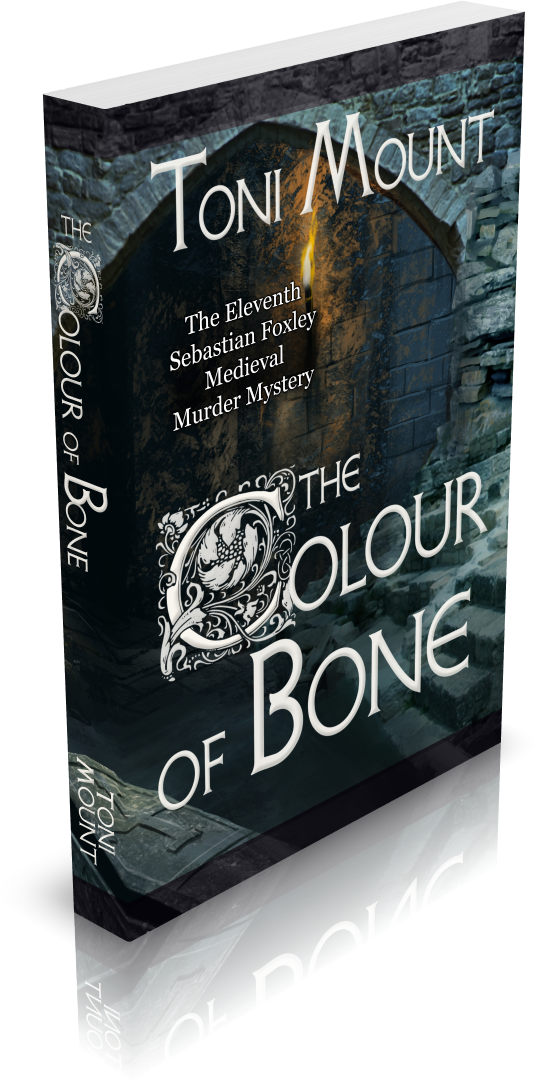
Today, it is a pleasure to welcome author Toni Mount to the History … the Interesting Bits to celebrate the release of the latest instalment of Toni’s Seb Foxley mysteries.

The Crown Sild, Cheapside, London  

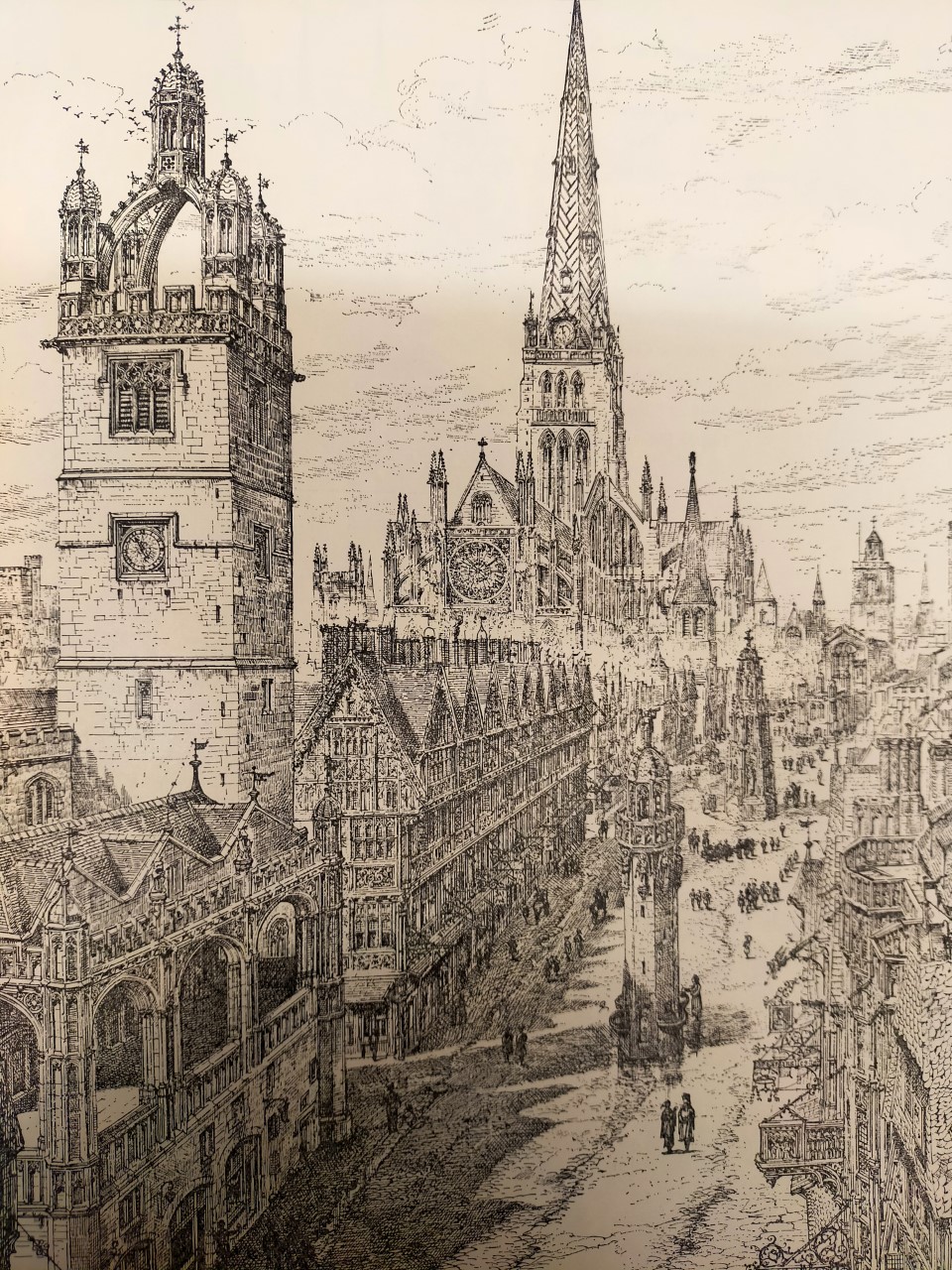
When I began writing my new Sebastian Foxley medieval murder mystery, The Colour of Bone, I had never heard of the Crown Sild but it came to my attention when I was lucky enough to be given a wonderful book of drawings: Old London – Illustrated [1962]. The book contains numerous reconstructed scenes of medieval London and Westminster by H.W. Brewer [d.1903] with explanatory texts and there, in Plate 10, ‘Cheapside from the east’, was a marvellously ornate two-storey Gothic building on the south side of London’s main east-west thoroughfare, labelled ‘Crown Sild or Sildam’. What on earth was it? I was intrigued. 

In the text, discussing the church of St Mary-le-Bow, it tells us: 

In front of Bow Church was a costly building of stone, known as the “Crown Sild” or “Sildam”, with an open arcade in the upper story (sic) facing the street, which was used by Royalty and their visitors for witnessing tournaments, pageants and processions. The tower of the present church has a balcony overlooking the street, placed there by Wren to commemorate the “Crown Sild”. 

Surprisingly for this ‘costly building of stone’, I discovered that ‘sild’ is the medieval word for a shed! That’s a very posh shed. ‘Wren’ is Sir Christopher who rebuilt the church after it was destroyed during the Great Fire of London in 1666, along with the ‘shed’ next door. But why was the Sild built, what was it used for and is there any evidence of it remaining?  

The story goes that the Sild was constructed by King Edward III, following a disaster in September 1331. The king planned to hold a magnificent tournament to celebrate the birth of his son and heir, Prince Edward of Woodstock [later known as the Black Prince] the year before. The tournament would take place in the heart of the City of London, in its widest street, Cheapside. Carpenters were commissioned to build a large wooden grandstand for Queen Philippa and her ladies to sit and watch the spectacle in comfort. King Edward would take part in tournament himself, a risky endeavour since fatalities were not unknown but he was young and daring and determined to impress the ladies and his fellow knights. 

However, it wasn’t the king who almost came to grief that day.  

As the queen and her ladies took their places on the cushioned benches among the flower garlands and bunting, the hastily constructed wooden grandstand began to creak and groan, then to sway and crack before it gave way beneath the royal and noble spectators. The whole edifice collapsed to the great horror of those looking on, including the king. By a miracle, no one was killed but there must have been injuries among the ladies, although the queen was badly shaken but otherwise unharmed. The hot-blooded king’s rage was terrible. 

He ordered that all the carpenters involved in the construction of the grandstand be arrested and hanged forthwith, there and then, on the spot. Fortunately, the queen was a shocked by this as by her brush with death and had wits enough to go on her knees before her irate husband. She begged him to spare the carpenters and, willing to grant her every wish at that moment, Edward let the carpenters live. He also insisted that the tournament continue as planned. A disaster wasn’t going to deter this royal showman. But, for any future, similar events in Cheapside, he wasn’t going to risk the queen’s life in the hands of those incompetent carpenters. Instead, he commissioned the stone masons to build a permanent grandstand at the best vantage point beside St Mary-le-Bow Church, fit for royalty with all the comforts and shelter from the weather. This was the Crown Sild. 

We don’t know how often royalty made use of it. Tournaments were held more frequently at Smithfield, outside the city walls, where there was far more space for the crowds. But the procession of the monarch on the eve of their coronation travelled from the Tower of London to Westminster Palace via Cheapside so the citizens could see the new king or queen and the sild would be the best viewpoint. Other processions, pageants, street festivals and entertainments took place in Cheapside too and the last royal spectators to use the sild for such an event were Henry VIII and Queen Anne Boleyn.  

By the later fifteenth century, when not in use by VIPs, the lower level was rented by the Vintners’ Company and used as storage for their barrels of wine. This is the sild as I describe it in my novel The Colour of Bone when Seb Foxley, the artist-cum-sleuth, his family and friends pay to watch the street entertainments from this ‘royal box’ with disastrous consequences which have nothing to do with it collapsing beneath them – you’ll have to read the book if you want to know what happens. 

At the head of this blog, I also asked whether there is any evidence of the Crown Sild remaining today? I don’t know what may lie among the foundations of the shops and office buildings along modern Cheapside, constructed after the devastation of the bombing during World War II but back in Victorian times, a letter was written concerning it. Here are the relevant bits from a letter written by Thomas Lott, Esq. F.S.A. to Sir Henry Ellis, K.H., Secretary of the Society of Antiquities on 19th December 1844, ‘describing some remains of ancient buildings to the west side of Bow Churchyard’:  

Dear Sir, 

…It is not generally known that there exist, in its immediate neighbourhood, subterranean 

architectural remains, although evidently of a later date, yet of a very interesting character. 

Having occasion to inspect several of the houses on the west side of Bow Church-yard, the property of the parish, I was surprised, on descending into the cellars, to find (as the foundation of three of the houses) stone vaultings of very substantial masonry. 

On a subsequent visit (accompanied by my friend Mr. Chaffers, who has kindly assisted me in describing the place), we found beneath the house No. 5, occupied by Messrs. Groucock, a square vaulted chamber, 12 feet by 7 feet 3 inches in height, with a slightly pointed arch of ribbed masonry, similar to some of those of the Old London Bridge. We were informed that 

there had been, in the centre of the floor, an excavation, which appeared formerly to have been used as a bath, but which was now arched over and converted into a cesspool. 

Proceeding northwards towards Cheapside, we found what appeared to be a continuation of the vault, beneath the houses Nos. 4 and 3. The arch of the vault here is plain, not ribbed, and more pointed. The masonry appears, from an aperture made to the warehouse above, to be of considerable thickness. This vault or crypt is 7 feet in height from the floor to the crown of 

the arch, and is 9 feet in width, and 18 feet long. Beneath the house No. 4 is an outer vault. The entrance to both these vaults is by a depressed Tudor arch with plain spandrils, 6 feet high, the thickness of the walls about 4 feet. 

In the thickness of the eastern wall, in the vault of the house No. 3, are cut triangular-headed niches, similar to those in which in ancient ecclesiastical edifices the basins containing the holy water, and sometimes lamps, were placed. … In some other parts of these vaults are modern imitations of these recesses. The vaulting beneath the house No. 2, appears to have been destroyed to add convenience to the warehouses; but the buildings, of which these are the vestiges, appear to have extended to Cheapside; for beneath a house in Cheapside, in a direct line with these buildings, and close to the street, is a massive stone wall. 

I cannot think they were any portion of the Grammar School which Stowe says “was let out in the reign of Henry VIIth for fowr shillings a year, and a cellar for two shillings the year; two vaults under the church for fifteen shillings both.” 

The Sild – the building in the bottom left hand corner.

Mr. Chaffers seems disposed to think these may be the remains of the stone building erected by Edward the Third, from which to view the processions, jousts, &c. described thus by Stowe: “Within the north side of St Mary Bow, towards West Cheape, standeth one fair building of stone called in record Sildam, SL shed, &c. King Edward IIIrd. upon occasion, (viz. the falling of the wooden scaffold) caused this sild or shed to be made and strongly to be built of stone for himself, the Queen, and other estates, to stand in them to behold the joustings and other shows at their pleasure, and this house for a long time after served to that use, namely, in the reigns of Edward IIIrd and Richard IInd; but, in the year 1410, Henry IVth confirmed the said shed or building to Stephen Spilman and others, by the name of one new sildam, shed, or building, with shops, cellars, and edifices appertaining, called Crown Silde or Tamer Silde, situate in West Cheape, and in the parish of St Mary de Arcubus.” 

According to the same author, notwithstanding this grant, the kings of England still occasionally repaired to the same building to view the shows; and we find a century afterwards, that “Henry VIIIth, his Queen, and nobles frequently came here to behold the great marching watches on the eves of St John and St Peter; remaining there until the morning.” 

Thus it will be seen that this sild or shed, strongly built of stone, still remained in Stowe’s time, two hundred and fifty years after its erection, darkening (as Stowe says) the doors and windows on that side of the church. Mr. Chaffers states, it has been thought that the Crown sild stood on the spot between the tower of the present church and Bow Lane; but he does not think, from Stowe’s account, such could have been the case, as Stowe, speaking of Cordwainers Street, afterwards Hosier Lane, then Bow Lane, says:

“This street begins by West Cheape, and St Mary Bow Church is the head thereof on the west side, and runneth down south.” Had such a spacious building as the Crown-sild been situated between the church and Cheapside, Stowe would doubtless have mentioned it. There is no doubt, it was Crown property, as it now pays a trifling fee-farm rent to the Crown.  

If this building was erected for purposes of a domestic kind … since the original building was destroyed, which was probably in the fire of London … there are no old maps of the parish to throw any light on the subject, nor do the ancient city maps and plans, which profess to contain elevations of the buildings, assist in the discovery. 

I hazard no opinion on this matter, contenting myself with having thus drawn attention to it from those whose greater experience, more extensive research, and leisure opportunities will enable them to form a more correct judgment…  

I remain, dear Sir, 

Your faithful obedient Servant, 

THOMAS LOTT. 

So now you know as much as I do.  

As to whether the Crown Sild stood to the east or west side of St Mary-le-Bow Church, Brewer’s drawing shows it to the east whereas, if Lott’s friend Mr Chaffers is correct in thinking they had found its ancient vaults, it was to the west. Perhaps we shall never know. But you can have my version of the Crown Sild where traumatic events happen, if you read my latest Sebastian Foxley medieval murder mystery, The Colour of Bone.  

*

The Colour of Bone by Toni Mount:

It’s May 1480 in the City of London.

When workmen discover the body of a nun in a newly-opened tomb, Seb Foxley, a talented artist and bookseller is persuaded to assist in solving the mystery of her death when a member of the Duke of Gloucester’s household meets an untimely end. Evil is again abroad the crowded, grimy streets of medieval London and even in the grandest of royal mansions.

Some wicked rogue is setting fires in the city and no house is safe from the hungry flames. Will Seb and his loved ones come to grief when a man returns from the dead and Seb has to appear before the Lord Mayor?

Join our hero as he feasts with royalty yet struggles to save his own business and attempts to unravel this latest series of medieval mysteries.

About the author:

Toni Mount is a best-selling author of medieval non-fiction books. She is the creator of the Sebastian Foxley series of medieval murder mysteries and her work focuses on the ordinary lives of fascinating characters from history. She has a first class honours degree from the Open University and a Master degree by research from the University of Kent however her first career was as a scientist which brings an added dimension to her writing. Her detailed knowledge of the medieval period helps her create believable characters and realistic settings based on years of detailed study. You can find Toni at:

www.tonimount.com

https://www.amazon.co.uk/Toni-Mount/e/B0034P0FF8/

https://www.facebook.com/toni.mount.10/

https://twitter.com/tonihistorian

*

My Books:

Signed, dedicated copies of all my books are available, please get in touch by completing the contact me form.

Coming 30 May 2023!

King John’s Right-Hand Lady: The Story of Nicholaa de la Haye is now available for pre-order from Pen & Sword Books and Amazon UK. (I will hopefully have a US release date shortly)

In a time when men fought and women stayed home, Nicholaa de la Haye held Lincoln Castle against all-comers. Not once, but three times, earning herself the ironic praise that she acted ‘manfully’. Nicholaa gained prominence in the First Baron’s War, the civil war that followed the sealing of Magna Carta in 1215.

A truly remarkable lady, Nicholaa was the first woman to be appointed sheriff in her own right. Her strength and tenacity saved England at one of the lowest points in its history. Nicholaa de la Haye is one woman in English history whose story needs to be told…

Also by Sharon Bennett Connolly:

Defenders of the Norman Crown: The Rise and Fall of the Warenne Earls of Surrey tells the fascinating story of the Warenne dynasty, of the successes and failures of one of the most powerful families in England, from its origins in Normandy, through the Conquest, Magna Carta, the wars and marriages that led to its ultimate demise in the reign of Edward III. Defenders of the Norman Crown: Rise and Fall of the Warenne Earls of Surrey is now available from Pen & Sword BooksAmazon in the UK and US, Bookshop.org and Book Depository.

Ladies of Magna Carta: Women of Influence in Thirteenth Century England looks into the relationships of the various noble families of the 13th century, and how they were affected by the Barons’ Wars, Magna Carta and its aftermath; the bonds that were formed and those that were broken. It is now available in paperback and hardback from Pen & Sword,  AmazonBookshop.org and from Book Depository worldwide.

Heroines of the Medieval World tells the stories of some of the most remarkable women from Medieval history, from Eleanor of Aquitaine to Julian of Norwich. Available now from Amberley Publishing and Amazon, Bookshop.org and from Book Depository worldwide.

Silk and the Sword: The Women of the Norman Conquest traces the fortunes of the women who had a significant role to play in the momentous events of 1066. Available now from Amazon,  Amberley Publishing, Bookshop.org and Book Depository.

Alternate Endings: An anthology of historical fiction short stories including Long Live the King… which is my take what might have happened had King John not died in October 1216. Available in paperback and kindle from Amazon.

*

You can be the first to read new articles by clicking the ‘Follow’ button, liking our Facebook page or joining me on Twitter and Instagram.

©2023 Sharon Bennett Connolly FRHistS and Toni Mount
Guest Post: Revolutionary Female Friends by Samantha Wilcoxson

Today it is a pleasure to welcome Samantha Wilcoxson to History the Interesting Bits…. with an article about Mercy Otis Warren and her friend Catharine Macauley. Samantha’s new book Women of the American Revolution – her first non-fiction – provides a fabulous insight into the often-overlooked and severely underestimated women of the period. It is truly illuminating!

Revolutionary Female Friends: Mercy Otis Warren and Catharine Macaulay

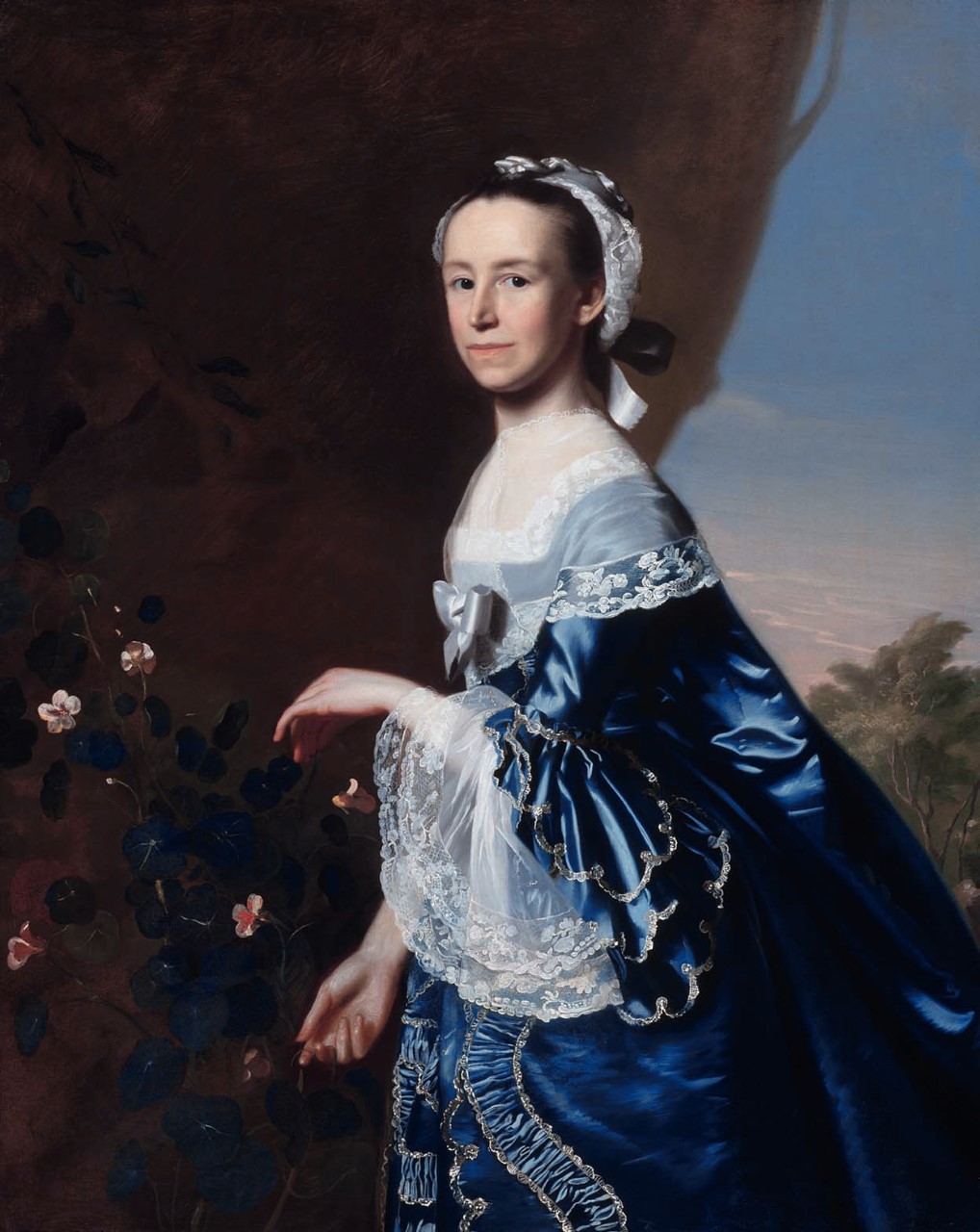
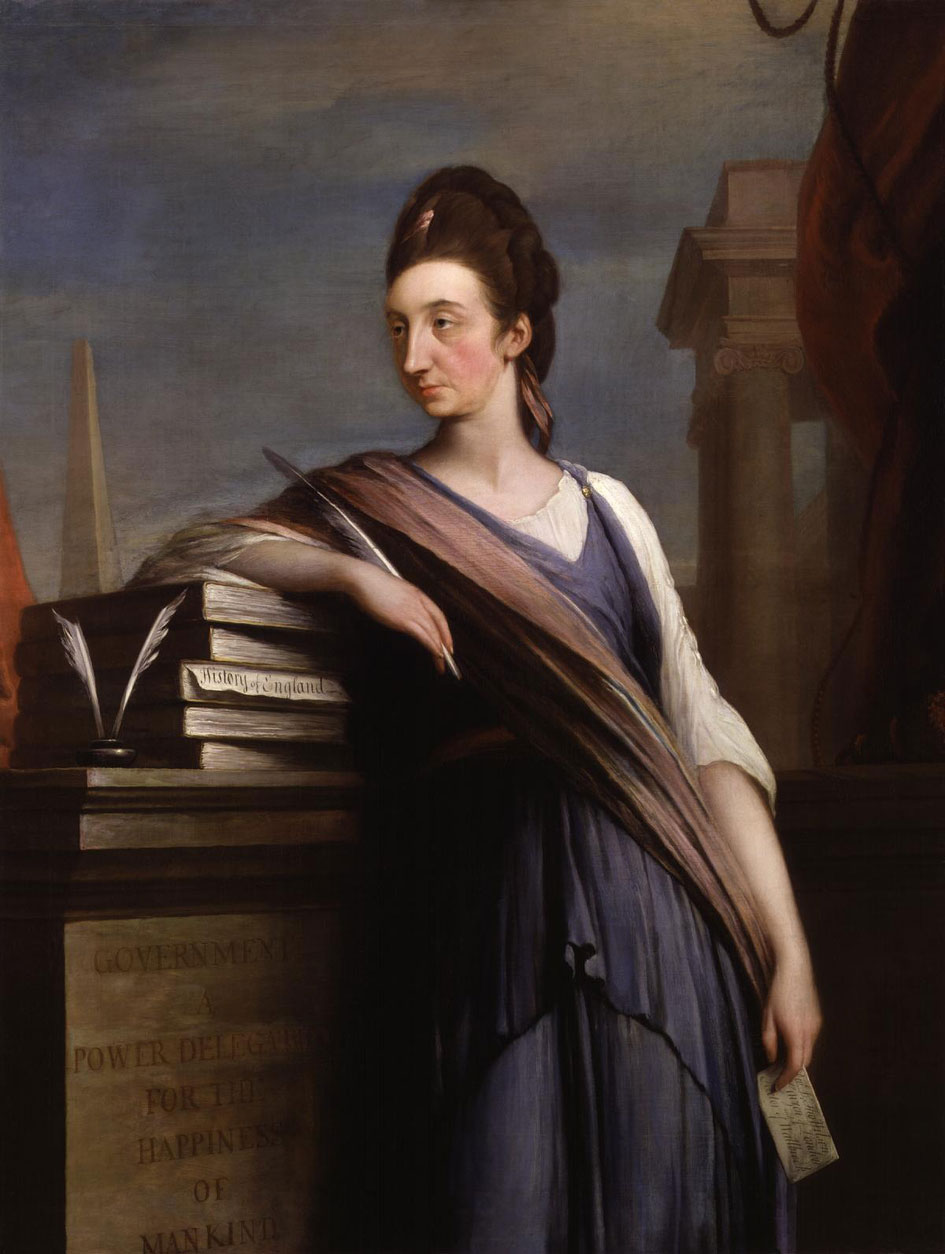
Mercy Otis Warren by John Singleton Copley

In July 1784, Catharine Macaulay arrived in America where she visited Mercy Otis Warren. One wonders if those around them appreciated the historic value of this meeting between two early female historians. Catharine in England and Mercy in America had each written multiple works responding to events of the day in an era when women were not expected to discuss politics let alone write about it. Finally meeting after years of letter writing, it must have been an exciting introduction.

Catharine was outspoken and published in her own name, while Mercy’s satirical plays had been published anonymously. Boldly writing to American patriots to offer her support, Catharine initially corresponded with Mercy’s brother, James Otis Jr, who Catharine wrote was ‘the great guardian of American liberty.’

When James suffered from mental instability following a beating by British customs agents, Mercy took over the correspondence. Both women made astute observations on the evolving political situation. In 1767, Macaulay prophetically wrote that a democratic republic was the ‘only form of government….capable of preserving dominion and freedom to the people.’ The following year, Mercy foresaw that when British soldiers arrived in Boston ‘The American War may be dated from the hostile parade of this day.’

Catharine watched the Revolution from a distance, supporting the American colonies and encouraging members of parliament to consider their position and negotiate rather than losing them altogether. The opposite course was taken with British troops sent to Boston in 1768 and the Coercive Acts passed in 1774. Mercy had an insider’s view of the Revolution. Her husband, another James, served as Paymaster-General, was appointed to the Continental Congress, and sat on the Continental Navy Board. While Mercy was a patriot, she worried about her five sons ‘who must buckle on the harness. And perhaps fall a sacrifice to the manes of liberty.’

Catharine Macauley

When Mercy met Catharine in person for the first time in 1784, she had lost no sons to war, though one had been severely wounded. Perhaps it was not until this meeting that the women realized how different they were. Through letters which focused on their shared political ideas and observations, they may have been convinced that they held more in common that they did.

Catharine arrived in America with a new, young husband. William Graham was twenty-one when he married the forty-seven-year-old Catharine six years earlier. Mercy, who frequently gave her sons moral lectures in her letters, would have been shocked by this relationship and the rumors that Catherine also had an affair with her brother-in-law. The values of simplicity and frugality held by Mercy were not as closely held by Catharine, who patronized the Sans Souci, a fashionable club that Mercy believed was the sort of establishment that would lead the new nation into a rapid decline.

Despite a falling out over their differences on morality, Mercy and Catharine salvaged their friendship before Catharine left America. They continued their correspondence, debating the strengths and weaknesses of the proposed US Constitution as fervently as the men in congress.
Mercy opposed the ratification of the Constitution and attempted to influence state leaders with a pamphlet titled Observations on the New Constitution, and on the Federal and State Conventions by a Columbian Patriot. She was concerned that individual rights were not established in the Constitution. While some states requested the addition of a Bill of Rights, none made their ratification dependent upon it. In a moment of frustration over the course the country was taking, Mercy wrote to Catharine in 1789, ‘we are too poor for Monarchy, too wise for Despotism, and too dissipated, selfish, and extravagant for Republicanism.’

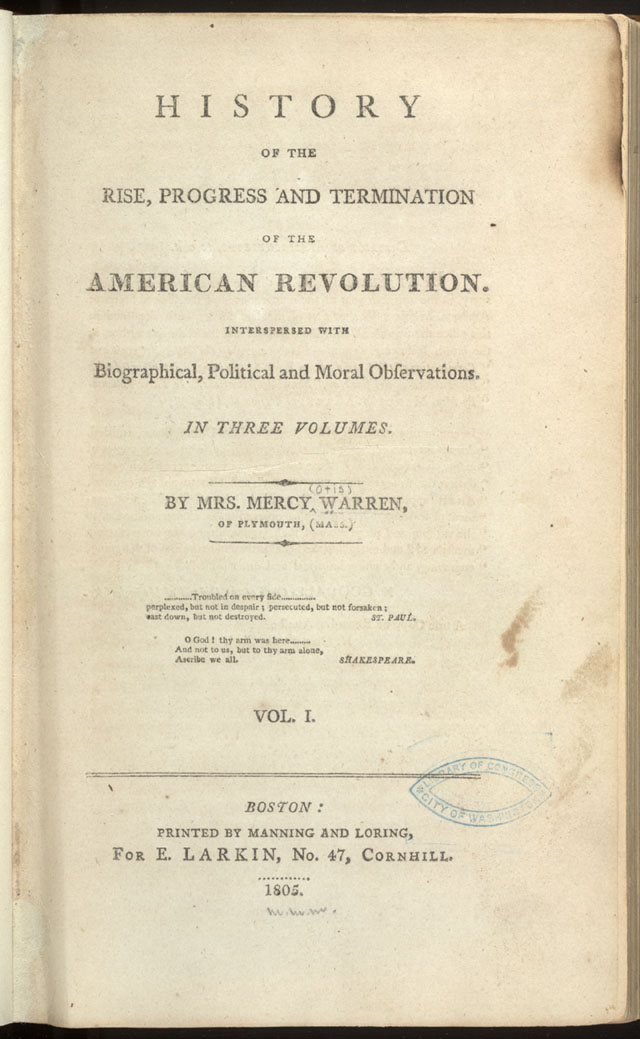
Mercy’s History

Catharine wrote a letter to George Washington, who she had met during her year in America, congratulating him ‘on the event which placed you at the head of the American government.’ She was also not afraid to share her opinions with him warning of growing inequality between two houses of legislature and the possibility of the ‘evils of Aristocracy’ which America had thus far been ‘exempt from.’

Mercy and Catharine, through their epistolatory relationship, discussed the French Revolution, the writing of Edmund Burke, women’s rights, and any number of topics that 18th century women were not meant to discuss. Their civil discourse came to an end with Catharine’s death on 22 June 1791. Mercy finally published her History of the Rise, Progress, and Termination of the American Revolution at age seventy-seven in 1805. She died on 19 October 1814 during the War of 1812, which solidified the independent status of the United States of America.

Sources:

The Muse of the Revolution: The Secret Pen of Mercy Otis Warren and the Founding of a Nation by Nancy Rubin Stuart https://www.mountvernon.org/library/digitalhistory/digital-encyclopedia/article/catharine-sawbridge-macaulay-graham-1731-1791/ https://allthingsliberty.com/2019/10/catharine-macaulay-her-final-gifts-to-america-and-france-1787-1791

To Buy the Book:

Women of the American Revolution by Samantha Wilcoxson is available now from Amazon and Pen and Sword in the UK. It is available for pre-order on Amazon in the US and is now available worldwide from Book Depository.

About the book:

Women of the American Revolution will explore the trials of war and daily life for women in the United States during the War for Independence. What challenges were caused by the division within communities as some stayed loyal to the king and others became patriots? How much choice did women have as their loyalties were assumed to be that of their husbands or fathers? The lives of women of the American Revolution will be examined through an intimate look at some significant women of the era.

Some names will be familiar, such as Martha Washington who travelled to winter camps to care for her husband and rally the troops or Abigail Adams who ran the family’s farms and raised children during John’s long absences. Elizabeth Schuyler Hamilton is popular for her role in Hamilton the musical, but did you know she was also an early activist working tirelessly for multiple social causes? Decide for yourself if the espionage of Agent 355 or the ride of Sybil Ludington are history or myth. Not all American women served the side of the revolutionaries. Peggy Shippen gambled on the loyalist side and paid severe consequences. From early historian Mercy Otis Warren to Dolley Madison, who defined what it means to be a US First Lady, women of the American Revolution strived to do more than they had previously thought possible during a time of hardship and civil war.

About the Author:

Samantha Wilcoxson is an author of historical fiction and administrator of a history blog. She has written four full-length novels, three novellas, and two middle grade chapter books. Topics of her writing have ranged from the Wars of the Roses to America’s Civil Rights Movement. Samantha is passionate about history and exploring the personal side of events. In her writing, she urges the reader to truly experience what it might have felt like to live through a moment in history. Samantha’s most recent novel is biographical fiction featuring Catherine Donohue, one of America’s “radium girls.” She is currently working on a novelization of the life of Nathan Hale, and features in Hauntings, an anthology published by the Historical Writers Forum.

*

My books:

Signed, dedicated copies of all my books are available, please get in touch by completing the contact me form.

Defenders of the Norman Crown: The Rise and Fall of the Warenne Earls of Surrey tells the fascinating story of the Warenne dynasty, of the successes and failures of one of the most powerful families in England, from its origins in Normandy, through the Conquest, Magna Carta, the wars and marriages that led to its ultimate demise in the reign of Edward III. Defenders of the Norman Crown: Rise and Fall of the Warenne Earls of Surrey is now available from Pen & Sword BooksAmazon in the UK and US, Bookshop.org and Book Depository.

1 family. 8 earls. 300 years of English history!

Also by Sharon Bennett Connolly:

Ladies of Magna Carta: Women of Influence in Thirteenth Century England looks into the relationships of the various noble families of the 13th century, and how they were affected by the Barons’ Wars, Magna Carta and its aftermath; the bonds that were formed and those that were broken. It is now available in paperback and hardback from Pen & Sword,  AmazonBookshop.org and from Book Depository worldwide.

Heroines of the Medieval World tells the stories of some of the most remarkable women from Medieval history, from Eleanor of Aquitaine to Julian of Norwich. Available now from Amberley Publishing and Amazon, Bookshop.org and Book Depository.

Silk and the Sword: The Women of the Norman Conquest traces the fortunes of the women who had a significant role to play in the momentous events of 1066.  Available now from Amazon,  Amberley Publishing, Bookshop.org and Book Depository.

*

You can be the first to read new articles by clicking the ‘Follow’ button, liking our Facebook page or joining me on Twitter and Instagram.

©2022 Sharon Bennett Connolly

Guest Post: First Impressions and their Consequences by Anna Belfrage

It is always a pleasure to welcome my good friend and fellow author, Anna Belfrage, to History…the Interesting Bits. Anna’s fabulous new Castilian Saga is a pleasure to read – and I will be posting a review of the latest instalment, Her Castilian Heart, shortly. But, for now, Anna is here to tell us about how she met the hero and the story that developed…

First impressions and their consequences.

The first time I met Robert FitzStephan, he had his arms full of apple blossom.

“Sorry,” he said, squeezing by me on the narrow stairs, “I have a wife to make amends to.” And off he went, leaving me in the damp gloom with a flaring torch the only source of light. I suppose this is when I should clarify that this was not an IRL (in real life) meeting: no, all of this happened in my roomy brain, an ever-expanding universe in which my characters pop up out of nowhere, demanding I tell their stories.

Robert FitzStepahn left an impression of light eyes and a HUGE nose and. . .

“Not that huge,” he protests, setting a finger to the rather impressive protuberance.

“No, it isn’t,” his wife, Noor says (apparently, the apple blossom did the trick) She gives me a severe look. “And one should not make fun of people because of their looks.”

“I wasn’t,” I try. After all, Robert is tall and broad and strong and. . .

Noor gives me another glare. “He’s mine!”

Of course. I don’t want a medieval man—I don’t live in that era, no matter that I write about it.

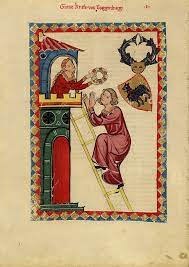
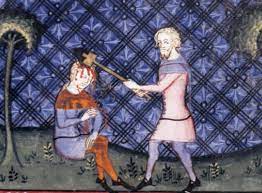
A Courting Man, Codex Manesse

Now, aside from being tall and all that, Robert is a self-made man, a man whose years of loyal service to his king, Edward I, were rewarded when the king gave him Noor—Eleanor d’Outremer—in marriage. With Noor came a fortified manor and some lands—and an indirect blood-tie to Queen Eleanor. Not that being related to the queen is necessarily a boon.

Initially, the Robert and Noor marriage had its bumps—as described in His Castilian Hawk. Like when Robert realised Noor was related to the princes of Gwynedd and that the orphan she’d taken in was the unknown son of the rebellious Dafydd ap Gruffyd, former prince whose head now adorned London Bridge. Should the king find out about the child, he’d lock the toddler up with the child’s unfortunate brothers in Bristol Castle and potentially sever Robert’s head for harbouring him. Our hero was somewhat torn between his loyalties to his liege and those to his wife. . .

“Never,” Robert says. “I am the king’s man, but my wife comes first.”  

Aww. . . Such a nice quality in a man!

Noor’s decision to take in the orphan was to have consequences, especially once Queen Eleanor began suspecting who the child was. Which was how Robert and Noor found themselves unofficially exiled to Aragon and Castile—arriving just in time for Robert to participate in the battle of Col de Panissars, where the king of Aragon defeated the French who’d attempted to invade his country under the of a crusade. Their sojourn on the Iberian Peninsula was fraught with adventure and danger, as described in The Castilian Pomegranate.

In Her Castilian Heart, Robert and Noor are safely back in England. Well, safely may not be the right word, what with Robert’s half-brother wanting to murder him, but still. Plus, the queen remains suspicious of their foundling, and God alone knows what an irate queen may do. This time, the events are woven round King Edward’s attempts to broker peace between the pope, the king of France and the king of Aragon—that failed French effort to invade Aragon, a.k.a. the Aragonese Crusade, has caused quite a political mess.

King Edward’s reasons for involving himself are to some extent personal: one of his daughters is contracted to marry King Alfonso of Aragon, but the pope has threatened him with brimstone and sulphur if he allows his daughter to do so without the pope’s explicit permission. Which isn’t forthcoming, as the pope is seriously ticked off about the fact that Aragon has taken Sicily back from Charles d’Anjou. The pope has a much better relationship with the Angevin than with the king of Aragon—maybe because he excommunicated Alfonso’s father for having supported the Sicilians when they rebelled against years of Angevin oppression (and then consolidated Sicily as part of his kingdom)

Philippe of France wants restitution for the loss of the crown of Aragon—which is rather odd, seeing as Aragon wasn’t his to begin with, but the young French king has not lived down the humiliation of losing to Aragon. Young Alfonso wants peace—but not at the expense of relinquishing Sicily, and no way is he going to compensate the French for invading his kingdom! In fact, they should compensate him!

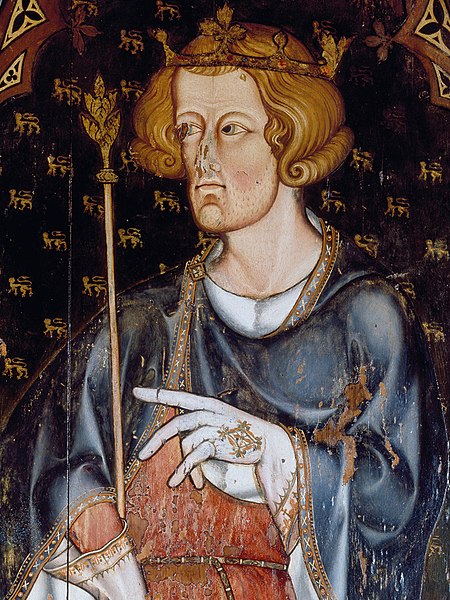
King Edward I

King Edward is faced with quite the balancing act: how is he to placate the pope, somehow knock some sense into the young hot-headed kings and deliver a treaty that will hold? And on top of all this, King Edward has an ailing wife and the rebellious Welsh to handle! Not that he involves himself in the actual fighting win Wales—he leaves the rekindled Welsh uprising to Robert to handle together with Roger Mortimer.

Her Castilian Heart was originally supposed to be the final book in this series, but as Robert has as yet not shared the reason for having to placate his wife with apple blossom, I still have more stories to tell about Robert, Noor, their foundling Lionel—and the brave and rebellious Welsh. King Edward may think he has the Welsh dragon tamed, but he is wrong—oh, so wrong!

About Her Castilian Heart:

Blood is not always thicker than water…

At times a common bloodline is something of a curse—or so Robert FitzStephan discovers when he realises his half-brother, Eustace de Lamont, wants to kill him.  

A murderous and greedy brother isn’t Robert’s only challenge.  He and his wife, Noor, also have to handle their infected relationship with a mightily displeased Queen Eleanor—all because of their mysterious little foundling whom they refuse to abandon or allow the queen to lock away.

Eustace is persistent. When Robert’s life hangs in the balance, it falls to Noor to do whatever it takes to rip them free from the toothy jaws of fate. Noor may be a woman, but weak she is not, and in her chest beats a heart as brave and ferocious as that of a lioness. But will her courage be enough to see them safe?

To buy the book:

Her Castilian Heart is available now from: http://myBook.to/HEART

About the author:

Had Anna been allowed to choose, she’d have become a professional time-traveller. No luck there, so instead she became a financial professional with two absorbing interests; history and writing. These days, Anna combines an exciting day-job with a large family and her writing endeavours. Plus she always finds the time to try out new recipes, chase down obscure rose bushes and initiate a home renovation scheme or two.

Anna has authored the acclaimed time travelling series The Graham Saga , set in 17th century Scotland and Maryland, as well as the equally acclaimed medieval series The King’s Greatest Enemy.

Anna has also published The Wanderer, a fast-paced contemporary romantic suspense trilogy with paranormal and time-slip ingredients. Her September 2020 release, His Castilian Hawk is a story of loyalty and love set against the complications of Edward I’s invasion of Wales in the late 13th century.

Her most recent release, The Whirlpools of Time , is a time travel romance set against the backdrop of brewing rebellion in the Scottish highlands.

All of Anna’s books have been awarded the IndieBRAG Medallion, she has several Historical Novel Society Editor’s Choices, and one of her books won the HNS Indie Award in 2015. She is also the proud recipient of several Reader’s Favorite medals as well as having won various Gold, Silver and Bronze Coffee Pot Book Club awards.

Find out more about Anna, her books and enjoy her eclectic historical blog on her website, www.annabelfrage.com 

Social Media Links:

Website: www.annabelfrage.com; Twitter: https://twitter.com/abelfrageauthor; Facebook: https://www.facebook.com/annabelfrageauthor; Instagram: https://instagram.com/annabelfrageauthor; Book Bub: https://www.bookbub.com/profile/anna-belfrage; Amazon Author Page: http://Author.to/ABG; Goodreads: https://www.goodreads.com/author/show/6449528.Anna_Belfrage

*

My Books:

Signed, dedicated copies of all my books are available, please get in touch by completing the contact me form.

Defenders of the Norman Crown: The Rise and Fall of the Warenne Earls of Surrey tells the fascinating story of the Warenne dynasty, of the successes and failures of one of the most powerful families in England, from its origins in Normandy, through the Conquest, Magna Carta, the wars and marriages that led to its ultimate demise in the reign of Edward III. Defenders of the Norman Crown: Rise and Fall of the Warenne Earls of Surrey is now available from Pen & Sword BooksAmazon in the UK and US, Bookshop.org and Book Depository.

1 family. 8 earls. 300 years of English history!

Also by Sharon Bennett Connolly:

Ladies of Magna Carta: Women of Influence in Thirteenth Century England looks into the relationships of the various noble families of the 13th century, and how they were affected by the Barons’ Wars, Magna Carta and its aftermath; the bonds that were formed and those that were broken. It is now available in paperback and hardback from Pen & Sword,  AmazonBookshop.org and from Book Depository worldwide.

Heroines of the Medieval World tells the stories of some of the most remarkable women from Medieval history, from Eleanor of Aquitaine to Julian of Norwich. Available now from Amberley Publishing and Amazon, Bookshop.org and Book Depository.

Silk and the Sword: The Women of the Norman Conquest traces the fortunes of the women who had a significant role to play in the momentous events of 1066.  Available now from Amazon,  Amberley Publishing, Bookshop.org and Book Depository.

*

You can be the first to read new articles by clicking the ‘Follow’ button, liking our Facebook page or joining me on Twitter and Instagram.

*

©2022 Sharon Bennett Connolly.

Guest Post: Failed Spies: Hale and André by Samantha Wilcoxson

Today, is is a pleasure to welcome Samantha Wilcoxson to History … the Interesting Bits, with an article about the research into her latest novel, But One Life, set during the American Revolution.

Failed Spies: Hale and André

Espionage played an important role during the American Revolution, with both sides in the conflict experiencing some victories and tragic defeats in this area. British spymasters had the advantages of experience and expertise, while Americans benefited from working in their native land with a better idea of who could be trusted and who could not. Very early in the conflict, General George Washington stated his desperate need for knowledge of the enemy.

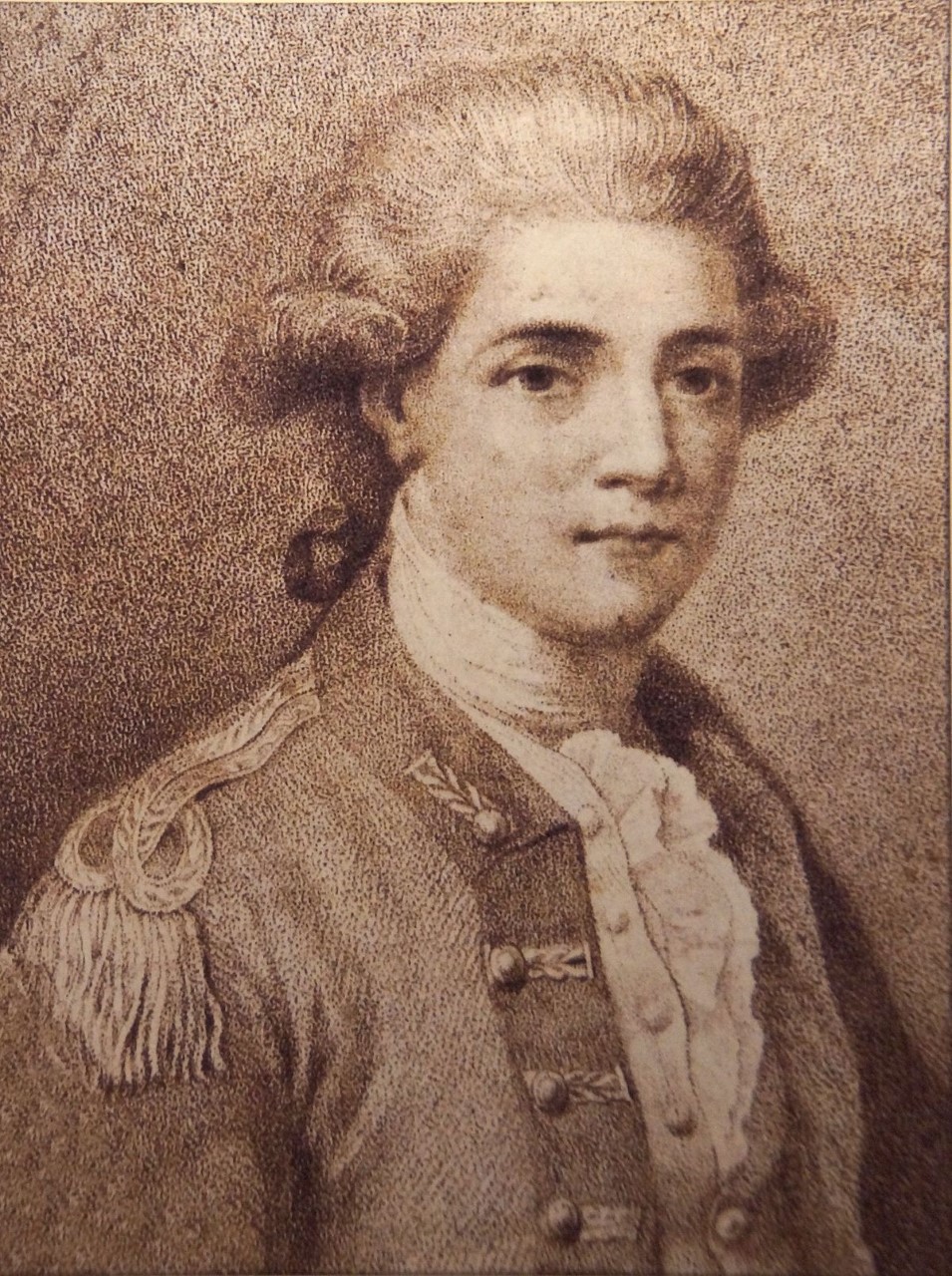
Major John André

‘I do most earnestly entreat you and General Clinton to exert yourselves to accomplish this most desirable end. Leave no stone unturned, nor do not stick at expense, to bring this to pass, as I was never more uneasy than on account of my want of knowledge on this score,’ Washington wrote to General William Heath seventeen days before Captain Nathan Hale was hanged as a rebel spy on 22 September 1776.

Today, Nathan Hale is remembered as the quintessential patriot. He was recently graduated from Yale when he joined the Continental Army with many other young men of his acquaintance. When he learned that a volunteer was needed to discover the information needed by Washington, he did not hesitate, despite the advice of many friends who insisted he was not well-suited to the mission.

It was not only because of his open, honest personality that they attempted to dissuade him. Spywork was considered a low, dishonorable duty. One friend, who tried to talk Hale out of his mission, reported later that Hale had insisted, ‘I wish to be useful, and every kind of service, necessary to the public good, becomes honorable by being necessary.’

Whether due to pride or excessive patriotism, Hale set forth upon a mission to Long Island, New York, his Yale diploma in hand to support his disguise as a Latin tutor. Hale had briefly served as a schoolmaster between graduation and army service, so his ruse should have come naturally to him. However, he was a trusting and friendly man, unlike the clever spy-catchers employed by the British. Within days of leaving his regiment, Hale was captured and executed, possibly with a paraphrase of Cato on his lips that his only regret was that he had but one life to give for his country. His body was left hanging for days to warn other would-be spies.

In the meantime, Major John André was making a name for himself in the British ranks as one who had connections and could get information. He was, like Hale, young, erudite, and eager to serve his country. André believed he had found the key to securing his future when he received correspondence from American General Benedict Arnold. The hero of Saratoga was willing to turn his coat for the right price.

Continental Commission for Nathan Hale

Arnold had married Peggy Shippen a month earlier, and she was friends, or possibly more, with André. Together, they convinced the general that the British would show him greater appreciation and compensation, and they were bound to win the war anyway. In the spring of 1780, Arnold informed André that he was expecting to gain command of West Point, an important series of forts that controlled traffic on the Hudson River. He was willing to turn it over to the British in return for cash and a position in British command.

On 21 September 1780, almost precisely four years after the death of Nathan Hale, John André was captured after a secret meeting with General Benedict Arnold to finalize their plan. He begged that Washington treat him as an officer rather than a spy.

‘Let me hope, Sir, that if aught in my character impresses you with esteem towards me, if aught in my misfortune marks me as the victim of policy and not resentment, I shall experience the operation of these feelings in your breast by being informed that I am not to die on a gibbet.’ Washington refused his request, and André was hanged on 2 October 1780.

Other American espionage efforts were more successful than Hale’s, most notably the Culper Spy Ring, managed by Hale’s good friend and Yale classmate, Benjamin Tallmadge. The names of those involved in this successful ring were not revealed until over a century after the war had ended. Tallmadge also played a part in John André’s capture. One can imagine he had a sense of justice served as Hale’s British counterpart shared his fate.

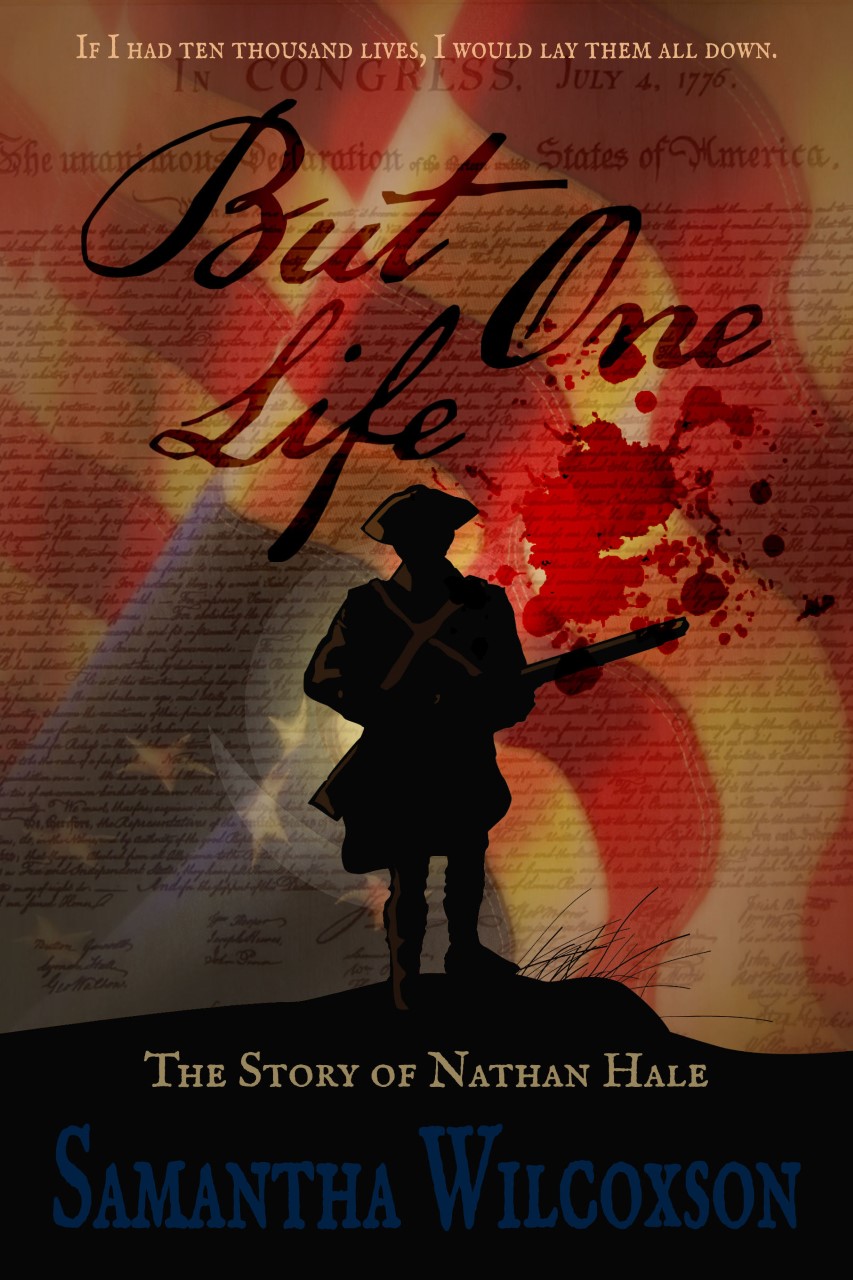
But One Life by Samantha Wilcoxson is now available from Amazon.

Sources:

Spies, Patriots, and Traitors: American Intelligence in the Revolutionary War by Kenneth A Daigler

Documentary Life of Nathan Hale by George D Seymour

The Life of John André: The Redcoat who Turned Benedict Arnold by DAB Ronald

To Buy the book:

But One Life is now available from Amazon

About the author:

Writer of historical fiction and sufferer of wanderlust, Samantha enjoys exploring the lives of historical figures through research and visiting historic places. Certain that no person is ever purely good or evil, she strives to reveal the deep emotions and motivations of historical figures, enabling readers to connect with them in a unique way. Samantha is an American writer with British roots and proud mother of three amazing young adults. She can frequently be found lakeside with a book in one hand and glass of wine in the other.

Samantha’s next project will take readers into the lives of women of the American Revolution – stay tuned!

*

My Books

Signed, dedicated copies of all my books are available, please get in touch by completing the contact me form.

Defenders of the Norman Crown: The Rise and Fall of the Warenne Earls of Surrey tells the fascinating story of the Warenne dynasty, of the successes and failures of one of the most powerful families in England, from its origins in Normandy, through the Conquest, Magna Carta, the wars and marriages that led to its ultimate demise in the reign of Edward III. Defenders of the Norman Crown: Rise and Fall of the Warenne Earls of Surrey is now available from Pen & Sword BooksAmazon in the UK and US, Bookshop.org and Book Depository.

1 family. 8 earls. 300 years of English history!

Also by Sharon Bennett Connolly:

Ladies of Magna Carta: Women of Influence in Thirteenth Century England looks into the relationships of the various noble families of the 13th century, and how they were affected by the Barons’ Wars, Magna Carta and its aftermath; the bonds that were formed and those that were broken. It is now available in paperback and hardback from Pen & Sword,  AmazonBookshop.org and from Book Depository worldwide.

Heroines of the Medieval World tells the stories of some of the most remarkable women from Medieval history, from Eleanor of Aquitaine to Julian of Norwich. Available now from Amberley Publishing and Amazon, Bookshop.org and Book Depository.

Silk and the Sword: The Women of the Norman Conquest traces the fortunes of the women who had a significant role to play in the momentous events of 1066.  Available now from Amazon,  Amberley Publishing, Bookshop.org and Book Depository.

*

You can be the first to read new articles by clicking the ‘Follow’ button, liking our Facebook page or joining me on Twitter and Instagram.

©2022 Sharon Bennett Connolly and Samantha Wilcoxson

Guest Post: The Dark Earth by Gordon Doherty

Today it is a pleasure to welcome author Gordon Doherty to History … the Interesting Bits. Gordon’s latest novel The Dark Earth is the 6th book in his Empires of Bronze series. And it is a scorcher! literally! Look out for my review in the coming weeks. But in the meantime, here’s Gordon to tell us about the meaning behind the title.

The Dark Earth

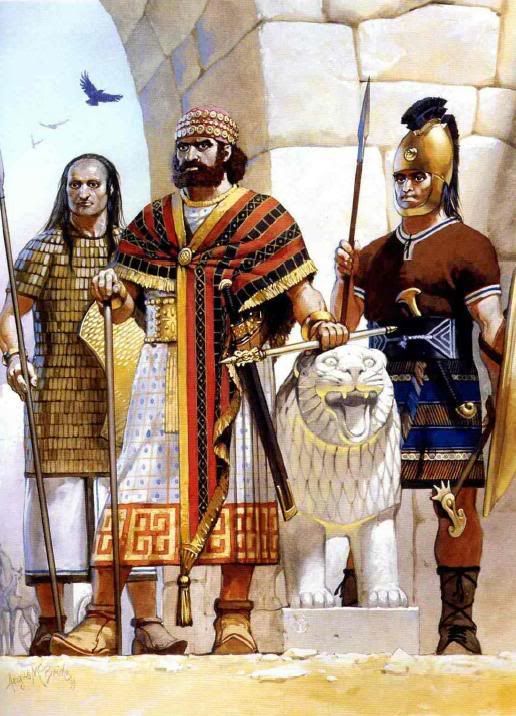
Hattusa

The Dark Earth’? Cool book title… but what does it actually mean?

As a book title, ‘The Dark Earth‘ sounds probably quite ominous and mysterious. But there’s more to it than that.

The book tells the story of the catastrophic change that occurred in the era known as the Bronze Age Collapse – a period of a few decades beginning around 1230 BC, when the mighty empires of the near east world were blasted into oblivion or battered into a pale shadow of their former selves.

The tale is told from the point of view of the Hittite Empire, arguably *the* superpower of the age, having only recently seen off the mighty Pharaoh Ramesses II of Egypt at the epic Battle of Kadesh.

Yet come 1170 BC, the Hittites were gone, their Anatolian heartlands a deserted, windswept, drought-ravaged wasteland, their great cities lying in tumbled heaps, their power but a memory. This was a time of earthquakes, invaders, famine, death and destruction… a veritable end of days.

And that is where the relevance of the title arises: Hittite tradition (interpreted from the tablets excavated from their ruined cities) speaks of an afterlife realm known as – you guessed it – ‘The Dark Earth‘.

This is no paradise-like Elysium or Valhalla. No, this is a sinister and unsettling place, somewhere deep underground where “Bloodless shades wander, not recognising one another. They eat mud and drink muddy water”. It is described as having “Seven ringed walls round the palace of the Goddess of death, and seven gatekeepers at each barrier.”

The Hittites were pantheistic, worshipping mountains, trees, rivers, everything around them. They used to believe that pits, holes and shafts, graves, springs, caves or wells were potential routes into this land of the dead.

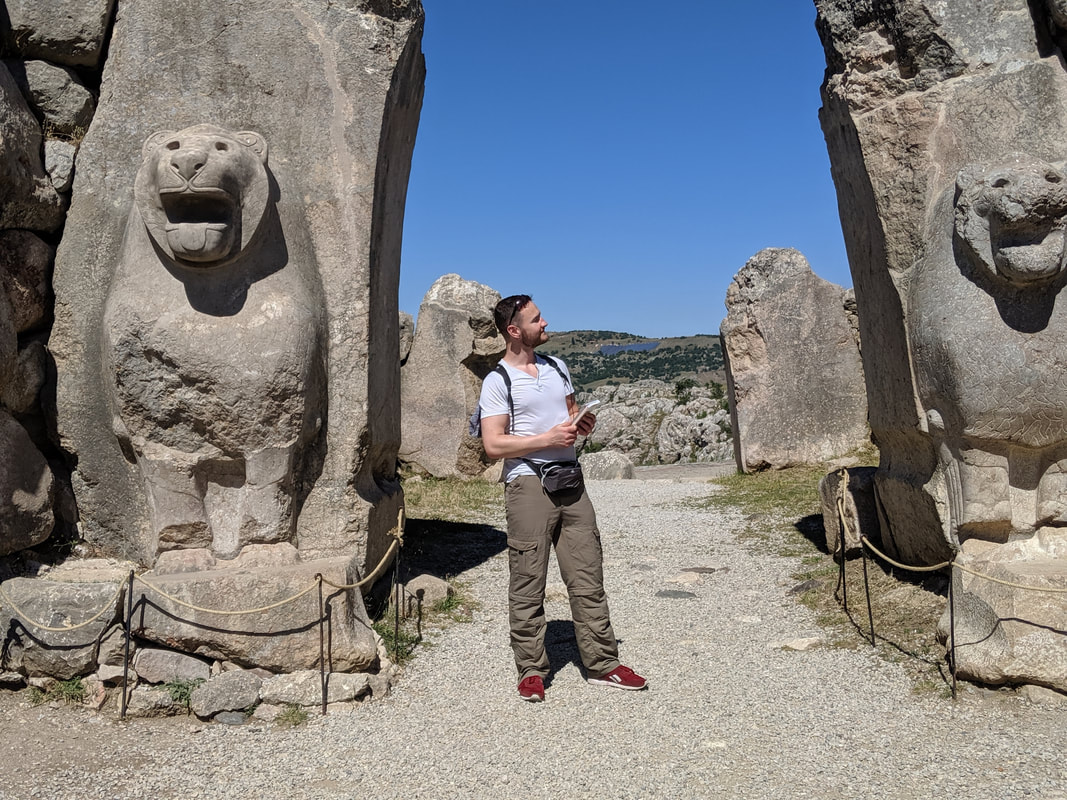
Hattusa today

This was perhaps by reinforced by the lore of the Goddess Ishtar’s descent into the underworld. Within the ruins of Hattusa, the massive Hittite capital, there is even a stone-lined stairwell that descends into the hillside upon which the city is built, and this is thought to have been known as ‘The Gateway to the Dark Earth.’

So there you go. The novel tells the story of the death of a mighty empire. But there is so much more to it than that. Every ending is a new beginning, after all…

*

To buy The Dark Earth:

Links: · Amazon: http://getbook.at/eob6 · Apple: https://books.apple.com/us/book/empires-of-bronze-the-dark-earth-empires-of-bronze-6/id1620805899 · Google: https://play.google.com/store/books/details?id=N1ZuEAAAQBAJ · Kobo: https://www.kobo.com/gb/en/ebook/empires-of-bronze-the-dark-earth-empires-of-bronze-6 · SW: https://www.smashwords.com/books/view/1142101 · BandN: https://www.barnesandnoble.com/w/empires-of-bronze-gordon-doherty/1141388565?ean=2940165840036

About the Book

Hattusa

The time will come, as all times must, when the world will shake, and fall to dust…

1237 BC: It is an age of panic. The great empires are in disarray – ravaged by endless drought, shaken by ferocious earthquakes and starved of precious tin. Some say the Gods have abandoned mankind.

When Tudha ascends the Hittite throne, the burden of stabilising the realm falls upon his shoulders. Despite his valiant endeavours, things continue to disintegrate; allies become foes, lethal plots arise, and enemy battle horns echo across Hittite lands.

Hattusa

Yet this is nothing compared to the colossal, insidious shadow emerging from the west. Crawling unseen towards Tudha’s collapsing Hittite world comes a force unlike any ever witnessed; an immeasurable swarm of outlanders, driven by the cruel whip of nature, spreading fire and destruction: the Sea Peoples.

Every age must end. The measure of a man is how he chooses to face it.

*

About the author:

Gordon is a Scottish writer, addicted to reading and writing historical fiction. His novels have been Amazon smash-hits, and have gone on to be translated and published in Russia, Italy and Greece.

Gordon Doherty

Gordon’s love of history was first kindled by visits to the misty Roman ruins of Britain and the sun-baked antiquities of Turkey and Greece. His expeditions since have taken him all over the world and back and forth through time (metaphorically, at least), allowing him to write tales of the later Roman Empire, Byzantium, Classical Greece and even the distant Bronze Age.

For exciting news, extracts and exclusive content from Gordon:

Visit http://www.gordondoherty.co.uk

Follow him on Twitter @GordonDoherty

Follow his author page on http://www.facebook.com/gordon.doherty

Subscribe to his YouTube channel: http://www.youtube.com/c/GordonDohertyAuthor

*

My Books

Signed, dedicated copies of all my books are available, please get in touch by completing the contact me form.

Defenders of the Norman Crown: The Rise and Fall of the Warenne Earls of Surrey tells the fascinating story of the Warenne dynasty, of the successes and failures of one of the most powerful families in England, from its origins in Normandy, through the Conquest, Magna Carta, the wars and marriages that led to its ultimate demise in the reign of Edward III. Defenders of the Norman Crown: Rise and Fall of the Warenne Earls of Surrey is now available from Pen & Sword BooksAmazon in the UK and US, Bookshop.org and Book Depository.

1 family. 8 earls. 300 years of English history!

Also by Sharon Bennett Connolly:

Ladies of Magna Carta: Women of Influence in Thirteenth Century England looks into the relationships of the various noble families of the 13th century, and how they were affected by the Barons’ Wars, Magna Carta and its aftermath; the bonds that were formed and those that were broken. It is now available in paperback and hardback from Pen & Sword,  AmazonBookshop.org and from Book Depository worldwide.

Heroines of the Medieval World tells the stories of some of the most remarkable women from Medieval history, from Eleanor of Aquitaine to Julian of Norwich. Available now from Amberley Publishing and Amazon, Bookshop.org and Book Depository.

Silk and the Sword: The Women of the Norman Conquest traces the fortunes of the women who had a significant role to play in the momentous events of 1066.  Available now from Amazon,  Amberley Publishing, Bookshop.org and Book Depository.

*

You can be the first to read new articles by clicking the ‘Follow’ button, liking our Facebook page or joining me on Twitter and Instagram.

©2022 Sharon Bennett Connolly and Gordon Doherty

Guest Post: Researching the Life of Sir Walter Raleigh by Tony Riches

It is a pleasure to welcome author Tony Riches to History…the Interesting Bits today. Tony is a fabulous storyteller who has just released the final book in his Tudor Adventurers series.

We have had Sir Francis Drake, the Earl of Essex and now we have the remarkable story of Sir Walter Raleigh. Tony is here to tell us a little bit about his research in Raleigh: Tudor Adventurer.

Researching the life of Sir Walter Raleigh

Tudor adventurer, courtier, explorer and poet, Sir Walter Raleigh has been called the last true Elizabethan.

My books aim to be as factually accurate as possible, with the creative use of fiction reserved for breathing life into my characters, and adding a sense of the places where they lived. I like to spend the summer months visiting actual locations and tracking down primary sources. In the research for my new book, Raleigh – Tudor Adventurer, I also studied Raleigh’s surviving letters and papers.

Public Domain letter from Sir Walter Raleigh to Lady Elizabeth (Bess) Raleigh,
endorsed: “Sir W. Rawley to his wiefe.”

Raleigh was a prodigious letter writer, but his personal archive was scattered widely, with many of his papers thought to be lost. Fortunately, the late Tudor historians, Joyce Youings and Agnes Latham discovered over two hundred of Raleigh’s letters, and Agnes Latham also collected Raleigh’s poetry, adding her invaluable commentary.

As well as offering me an authentic sense of Raleigh’s ‘voice’, these letters were a great help in sorting out the often confusing timeline of events. I was of aware of Raleigh’s tendency to exaggerate, flatter and posture in his writing, but there is no better way to develop an understanding of his motives. Here is an example of a surviving letter from Raleigh to his wife, Bess, which shows how difficult they can be to transcribe.

The next main source of information on Raleigh’s life was the fascinating Folgerpedia resource, ‘The Elizabethan Court Day by Day,’ created by Marion E. Colthorpe. This searchable archive provided me with access to a wealth of invaluable details, and clues for deeper research. The archive began as an investigation into the people and places visited by Queen Elizabeth I on her ‘progresses’, and the entertainments presented before her. It gradually expanded to trace the whereabouts of the queen on every day throughout her long reign, what she was doing, often what she was saying, and who her companions were.

Raleigh’s cell in the Tower of London (author’s photo)

Finally, my travels have taken me to rural Devon and Dorset, and in Raleigh’s footsteps across the sea to Ireland, where I visited the city of Cork and the harbour of Youghal, where he was briefly Mayor and had a house named ‘Myrtle Grove. I also visited the Tower of London and the cell where Raleigh was imprisoned.

My research has revealed Sir Walter Raleigh’s strengths and weaknesses, as a courtier and failed politician, soldier and poet, a man ready to speak up for the poor and to honour his debts. My hope is that my new book, Raleigh – Tudor Adventurer, will help readers see beyond the myths and half-truths, and have a better understanding of the man who has been called the last true Elizabethan.

Reference:

‘The Elizabethan Court Day by Day,’ by Marion E. Colthorpe, is licensed under an Attribution-ShareAlike 4.0 International license,m and can be found at https://folgerpedia.folger.edu/The_Elizabethan_Court_Day_by_Day

Book Links:

Amazon US: https://www.amazon.com/dp/B09Z98J183

Amazon UK: https://www.amazon.co.uk/dp/B09Z98J183

Amazon CA: https://www.amazon.ca/dp/B09Z98J183

Amazon AU: https://www.amazon.com.au/dp/B09Z98J183

About the author:

Tony Riches is a full-time UK author of Tudor historical fiction. He lives with his wife in Pembrokeshire, West Wales and is a specialist in the lives of the early Tudors. As well as his new Elizabethan series, Tony’s historical fiction novels include the best-selling Tudor trilogy and his Brandon trilogy, (about Charles Brandon and his wives). For more information about Tony’s books please visit his website tonyriches.com and his blog, The Writing Desk and find him on Facebook and Twitter @tonyriches

*

My Books

Signed, dedicated copies of all my books are available, please get in touch by completing the contact me form.

Defenders of the Norman Crown: The Rise and Fall of the Warenne Earls of Surrey tells the fascinating story of the Warenne dynasty, of the successes and failures of one of the most powerful families in England, from its origins in Normandy, through the Conquest, Magna Carta, the wars and marriages that led to its ultimate demise in the reign of Edward III. Defenders of the Norman Crown: Rise and Fall of the Warenne Earls of Surrey is now available from Pen & Sword BooksAmazon in the UK and US, Bookshop.org and Book Depository.

1 family. 8 earls. 300 years of English history!

Also by Sharon Bennett Connolly:

Ladies of Magna Carta: Women of Influence in Thirteenth Century England looks into the relationships of the various noble families of the 13th century, and how they were affected by the Barons’ Wars, Magna Carta and its aftermath; the bonds that were formed and those that were broken. It is now available in paperback and hardback from Pen & Sword,  AmazonBookshop.org and from Book Depository worldwide.

Heroines of the Medieval World tells the stories of some of the most remarkable women from Medieval history, from Eleanor of Aquitaine to Julian of Norwich. Available now from Amberley Publishing and Amazon, Bookshop.org and Book Depository.

Silk and the Sword: The Women of the Norman Conquest traces the fortunes of the women who had a significant role to play in the momentous events of 1066.  Available now from Amazon,  Amberley Publishing, Bookshop.org and Book Depository.

*

You can be the first to read new articles by clicking the ‘Follow’ button, liking our Facebook page or joining me on Twitter and Instagram.

©2022 Sharon Bennett Connolly and Tony Riches

Guest Post: Playing the Lute by Toni Mount

Today it is a pleasure to welcome historian and novelist Toni Mount to my blog, to talk about the latest instalment in her fabulous Seb Foxley mysteries, The Colour of Rubies. Which is released today. Toni is here to tell us all about her research into the lute. Over to Toni….

In my tenth and latest Seb Foxley medieval murder mystery, The Colour of Rubies, the hero needs to get to know his fellow clerks in the King’s Scriptorium at Westminster Palace for one of them may be a murderer!

Queen Elizabeth I playing a lute, c.1580
A miniature by Nicholas Hilliard (c.1547 – 1619)
Trustee of the Will of the 8th Earl of Berkeley
Digital picture kindly supplied by Martin Shepherd

In the case of the Chief Clerk, Hal Sowbury, who plays the lute, Seb has his colleague give him a few basic beginner’s lessons on the instrument. Since I have no knowledge whatsoever of lutes, except that they’re stringed instruments something like a guitar, this aspect of the novel required some research. I discovered the most useful website was https://www.wikihow.com/Play-the-Lute because it comes with diagrams and written instructions. The YouTube videos were good but I couldn’t keep up, making notes, but they did show how the lute should be held correctly.

I learned the correct terminology: they’re not called ‘strings’, they’re ‘courses’ and come in pairs except for the single course at the bottom, known as the ‘chanterelle’, yes, just like the mushroom. Basic lutes have 6 or sometimes 8 courses but some can have quite a few more, may be up to 12. For Seb, I thought 6 was enough. The main body of the lute, the sound-box, is known as the ‘bowl’ and it should rest on your right thigh. The bowl has a central cut-out design, the ‘rose’, to let the sound out and this can be ornate and beautiful. The thin part is the ‘neck’ with frets for fingering, ending in the ‘peg-box’ with pegs to tune the courses.

This miniature of Queen Elizabeth I playing the lute is dated to exactly a century later than Seb’s lessons and, apparently, the sloping shoulders of the bowl and the long neck make this an English lute, not a Genoese instrument like Hal Sowbury’s which would have a more rounded bowl and shorter neck. There is much expert discussion about the lute in this image, whether there is French influence in the design and how accurate is the artist’s depiction of it. Apparently, Queen Elizabeth really could play the lute – and the virginals though, to her disgust, Mary, Queen of Scots, was said to be far more accomplished on this keyboard instrument – but it’s thought the processes and circumstances of the portrait make it unlikely that it was painted on an actual occasion of royal music-making. It’s more likely to be symbolic, suggesting the harmony of the English body politic [definitely a fiction in the 1580s] and a reference to the musical interests of the Carey family who commissioned it.

But for Seb’s lessons, like a modern guitarist, he has to learn the fingering of the basic chords with his left hand and how to play the courses with his right. Interestingly, one YouTube video stressed that the thumb must stroke downwards quite gently, brushing the courses, while the index finger plucks upwards. I hope that’s correct because that’s what Hal instructs Seb to do in his first attempt at making music on the lute.

The anatomy of a lute [https://sunnylazic.com/shawm/]

Unfortunately – or perhaps fortunately for me with my meagre knowledge – Seb has the opportunity for only a couple of lessons with Hal before his employment in Westminster’s scriptorium comes to an end but, who knows, maybe one day he will have another chance to learn to play the lute. We are already familiar with Seb’s love of singing and choral talent, so he must have a musician’s ear and probably the gift of perfect pitch. With an artist’s dexterity, I’m sure his nimble fingers will soon master their positions on the frets and the brushing and plucking of the courses to make beautiful music.

So music gives a lighter side to the action in my new novel but if you want to join Seb, his family and friends on their exploits in medieval London and Westminster, stealing down dark alleyways, waiting nervously in opulent chambers and freezing their fingers off in the icy scriptorium where a murderer lurks, the spying and other dirty deeds aplenty, I’m afraid you’ll have to read the book: The Colour of Rubies, by Toni Mount, published 5th May 2022.

Follow the blog tour:

About the book:

Murder lurks at the heart of the royal court in the rabbit warren of the Palace of Westminster. The year is 1480. Treason is afoot amongst the squalid grandeur and opulent filth of this medieval world of contrasts. Even the Office of the King’s Secretary hides a dangerous secret.

Meeting with lords and lackeys, clerks, courtiers and the mighty King Edward himself, can Seb Foxley decipher the encoded messages and name the spy?

Will Seb be able to prevent the murder of the most important heir in England?

All will be revealed as we join Seb Foxley and his abrasive brother Jude in the latest intriguing adventure amid the sordid shadows of fifteenth-century London.

Praise for Toni Mount’s The Colour of Rubies

Tony Riches, author of The Tudor Trilogy “An evocative masterclass in storytelling.” Carol McGrath, author of the She-wolves trilogy “I was utterly transported – It’s superb”. “What a plot. What characters. Perfect pitch”.

“I loved the relationship between Seb and Jude”.

“The Colour of Rubies is a totally immersive experience as richly stitched as one of King Edward IV’s gorgeous tapestries. This cleverly plotted novel with its twists and turns will keep a reader page turning late into the night until the book’s final scenes. Sebastian and Jude are wonderfully realised personalities with similar emotions, concerns, fears and hopes we have have today. Their medieval London felt real and intriguing to me with unexpected dangers lurking in alleyways. I felt as if I was walking in Sebastian’s footsteps. With this thrilling novel Toni Mount has shown herself a master of medieval suspense. More please”.

Praise for Toni Mount’s Sebastian Foxley Medieval Murder Series

Tracy Borman, historian and broadcaster “An atmospheric and compelling thriller that takes the reader to the dark heart of medieval London.”

Matthew Lewis author of Richard III Loyalty Binds Me “Toni Mount continues to delight with the superbly crafted Seb Foxley mysteries. Impeccable research and sculpted characters combine with an engaging narrative to create another irresistible story. This series goes from strength to strength, and I’m already looking forward to the next instalment”

J.P. Reedman, author of the I, RICHARD PLANTAGENET series: “Sebastian Foxley is the Cadfael of the 15th century”.

“The Sebastian Foxley Medieval Mystery Series by Toni Mount is not only filled by dastardly murders and gripping intrigue but contains many well-researched historical facts from the Wars of the Roses era”

Samantha Willcoxson, author & historian “Toni Mount is simply brilliant”.

“If you love CJ Sansom’s Matthew Shardlake (and I do) you will love Toni’s Sebastian Foxley”.

“From learning how a 15th century scrivener created illuminated manuscripts to venturing within the dank tunnels beneath the Tower of London, Toni is an artist who completely immerses the reader in another time and place and always leaves one eager for the next book.”

Stephanie Churchill, author of historical fiction and epic fantasy “Leave it to Seb to unravel another international spiderweb of intrigue, betrayal, murder, and deceit. Our flawed, loveable hero has done it again. And at the end of it all, his future is looking brighter than ever. I cannot wait to find out what happens to him next!”

Sharon Bennet Connolly, author and medieval historian “A beautifully crafted mystery that brings the dark, dangerous streets of medieval London to life. Toni Mount is a magician with words, weaving a captivating story in wonderful prose. The Colour of Evil is, to put it simply, a pleasure to read.”

Rosalie Gilbert, medieval historian and author “The author’s knowledge of medieval history shines through the narrative in the small details which enhance the story woven into it. The details about the inside workings of medieval trade practices lent themselves perfectly for a background to murder and deceit”.

“Recommended for lovers of historic fiction.”

Joanne R Larner author of Richard Liveth Yet trilogy: “I always look forward to a new ‘Colour of…’ book. I can’t wait to see what escapades Seb Foxley and his brother, Jude, get up to next. They, and all the characters, are endearing and colourful. The books are always well written, conjuring 15th century London into the reader’s mind and the plots are excellent!’

Mel Starr bestselling author of the Hugh de Singleton chronicles: “If I believed in reincarnation I would be willing to think that Toni Mount lived a previous life in 15th century London. The scents, the sights, the tastes of the late Middle Ages are superbly rendered.”

*

About the Author:

Toni Mount is the author of several successful non-fiction books including How to Survive in Medieval England and the number one best-seller, Everyday Life in Medieval England. Her speciality is the lives of ordinary people in the Middle Ages and her enthusiastic understanding of the period allows her to create accurate, atmospheric settings and realistic characters for her medieval mysteries. Her main character, Sebastian Foxley is a humble but talented medieval artist and was created as a project as part of her university diploma in creative writing. Toni earned her history BA from The Open University and her Master’s Degree from the University of Kent by completing original research into a unique 15th century medical manuscript.

Toni writes regularly for both The Richard III Society and The Tudor Society and is a major contributor to MedievalCourses.com. As well as writing, Toni teaches history to adults, and is a popular speaker to groups and societies.

*

My Books

Signed, dedicated copies of all my books are available, please get in touch by completing the contact me form.

Defenders of the Norman Crown: The Rise and Fall of the Warenne Earls of Surrey tells the fascinating story of the Warenne dynasty, of the successes and failures of one of the most powerful families in England, from its origins in Normandy, through the Conquest, Magna Carta, the wars and marriages that led to its ultimate demise in the reign of Edward III. Defenders of the Norman Crown: Rise and Fall of the Warenne Earls of Surrey is now available from Pen & Sword BooksAmazon in the UK and US, Bookshop.org and Book Depository.

1 family. 8 earls. 300 years of English history!

Also by Sharon Bennett Connolly:

Ladies of Magna Carta: Women of Influence in Thirteenth Century England looks into the relationships of the various noble families of the 13th century, and how they were affected by the Barons’ Wars, Magna Carta and its aftermath; the bonds that were formed and those that were broken. It is now available in paperback and hardback from Pen & Sword,  AmazonBookshop.org and from Book Depository worldwide.

Heroines of the Medieval World tells the stories of some of the most remarkable women from Medieval history, from Eleanor of Aquitaine to Julian of Norwich. Available now from Amberley Publishing and Amazon, Bookshop.org and Book Depository.

Silk and the Sword: The Women of the Norman Conquest traces the fortunes of the women who had a significant role to play in the momentous events of 1066.  Available now from Amazon,  Amberley Publishing, Bookshop.org and Book Depository.

*

You can be the first to read new articles by clicking the ‘Follow’ button, liking our Facebook page or joining me on Twitter and Instagram.

©2022 Sharon Bennett Connolly