Guest Post: Feisty Females: Writing Lincolnshire’s Medieval Women by Rosanna McGlone

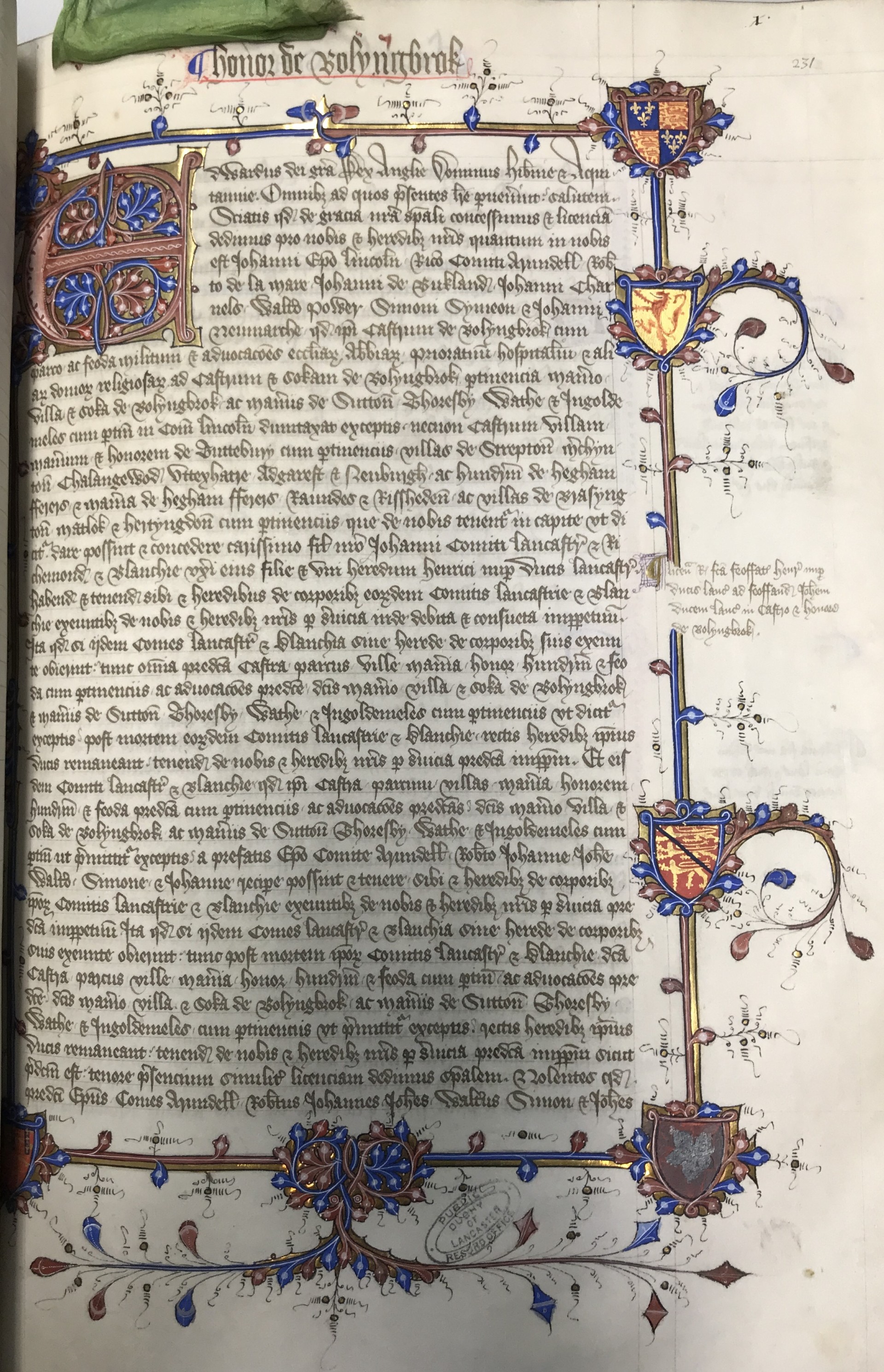
The great Cowcher Book
The Great Cowcher Book

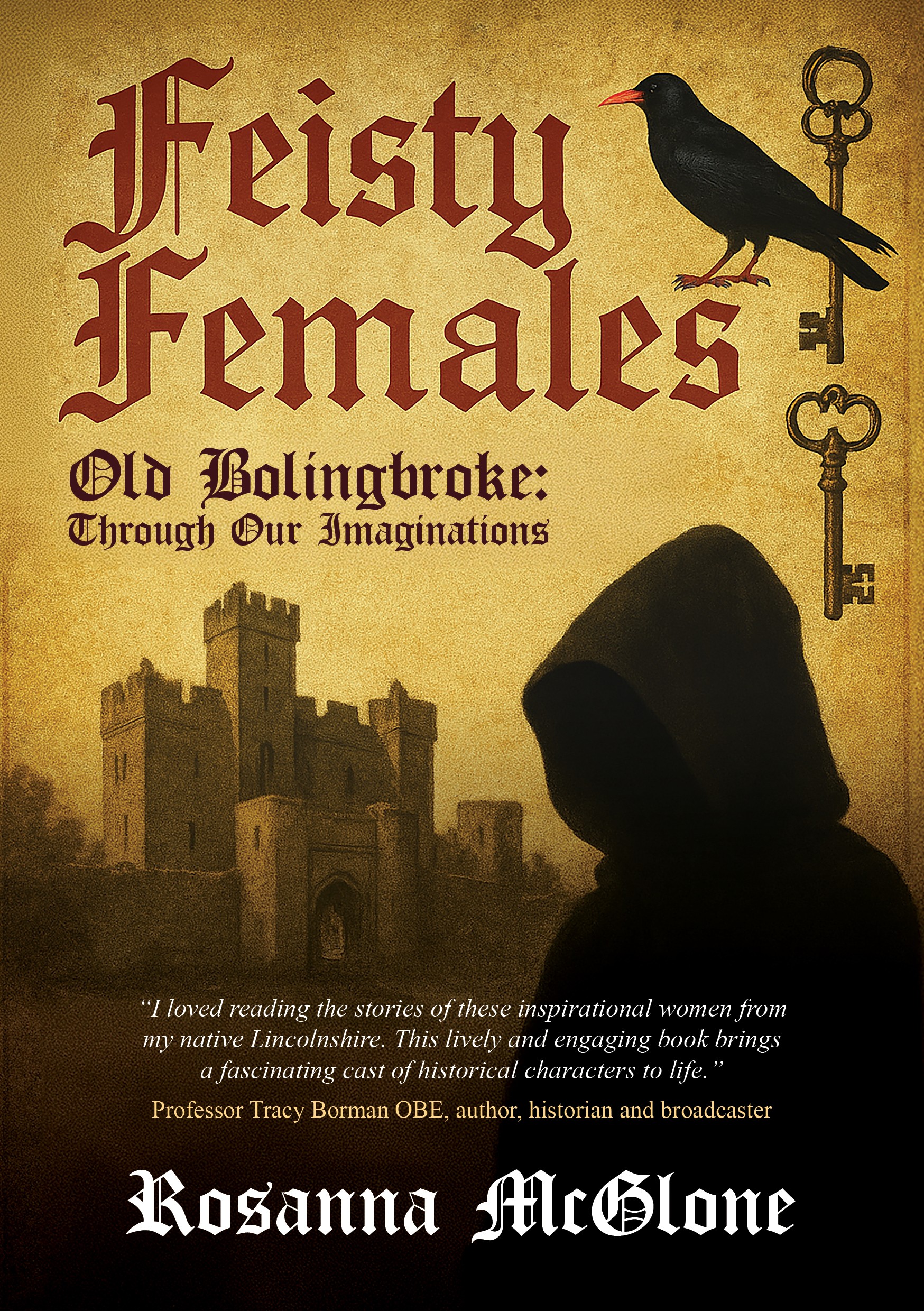
It is a pleasure to welcome my good friend Rosanna McGlone to History … the Interesting Bits to chat about her new book, Feisty Females, a series of short stories inspired by The Great Cowcher Book. Although Feisty Females is Rosanna’s ‘baby’, I feel like its Godmother as we have chatted frequently, over coffee, about the women she included, included Nicholaa de la Haye, Alice de Lacey, Blanche of Lancaster and Gwenllian of Wales – women my readers, I know, are well acquainted with!

Rosanna would meet me, armed with questions about the history of these women and the world they lived in. Then she went away and came back having put her own mark on their stories. And what a fascinating collection of stories it is!

It is a joy to see this project come to fruition. So, over to Rosanna to tell you a little about the process of researching and writing Feisty Females: Old Bolingbroke through our Imaginations.

Feisty Females: Writing Lincolnshire’s Medieval Women by Rosanna McGlone

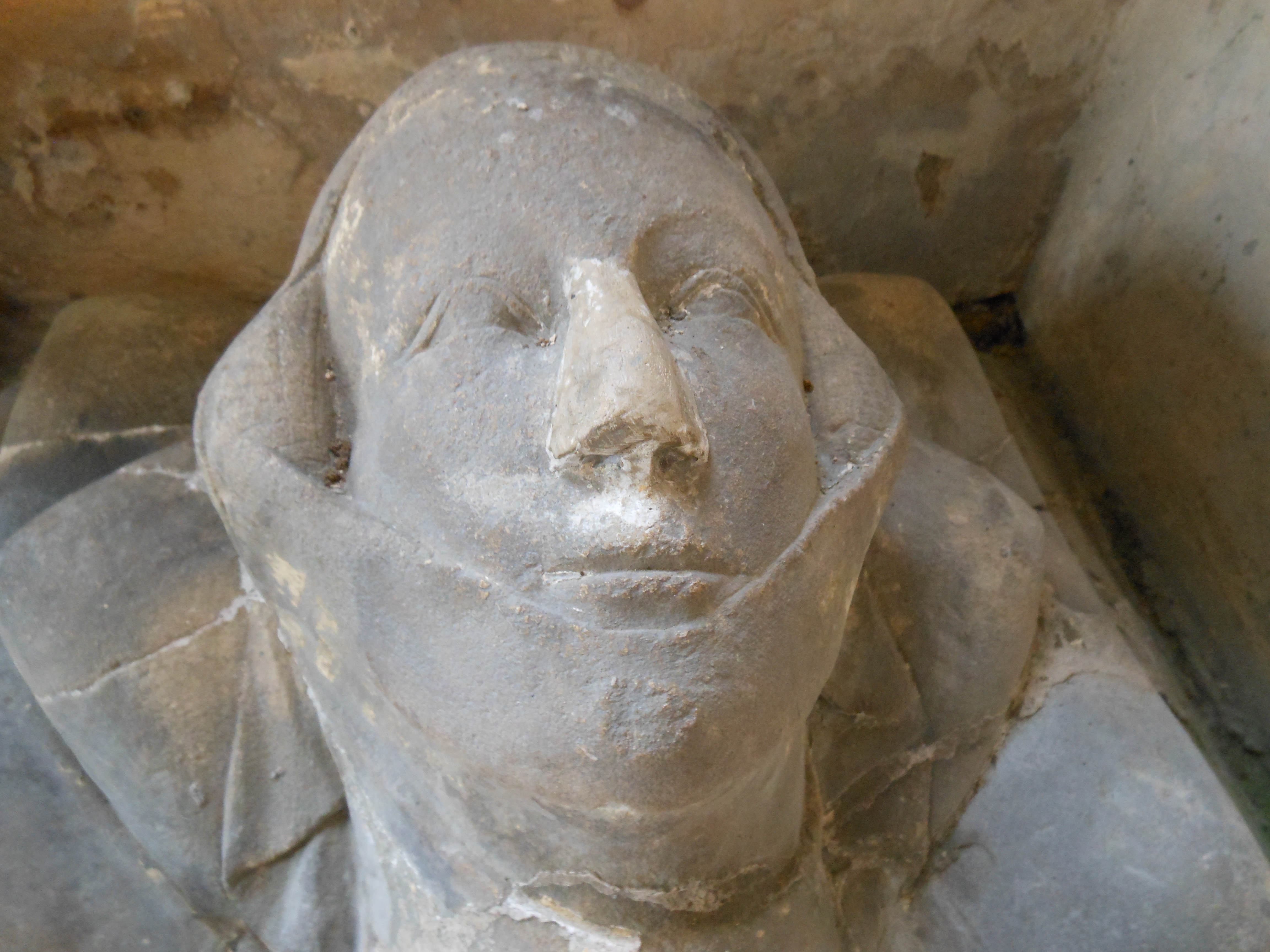
Henry IV effigy
Henry IV, Canterbury Cathedral

You’ve heard of the Domesday Book, right? But do you know the second most important medieval record book? If you don’t, let me reassure you. Until I received this commission, neither did I. According to staff at the National Archives it’s The Great Cowcher Book, a medieval land registry commissioned by Henry IV to provide a record of lands within the Duchy of Lancaster. Receiver General John Leventhorpe was assigned to visit the 18,000 hectares of rural estates in England and Wales including Cheshire and Lancashire in the West and The Honor of Bolingbroke in Lincolnshire in the East which make up the Duchy of Lancaster. In doing so, he gathered a total of 161 folios and 2,433 charters written in either Latin or medieval French.

What exactly do the two volumes of The Great Cowcher Book contain? As well as including transactions such as the bestowing of Old Bolingbroke Castle to John of Gaunt and his wife Blanche of Lancaster, the book also covers more minor land transactions between people of much lower status.

Additionally, the Great Cowcher Book provides a record of disputes which had been brought before the court seeking resolution.

I was commissioned, and funded, by a number of organisations including the Arts Council, Lincoln County Council, the community of Old Bolingbroke and others to write a creative response to this unique material. Thus, it is from this medieval register that my book of short stories, Feisty Females: Old Bolingbroke through our Imaginations was crafted.

Feisty Females

The beautiful medieval manuscripts have recently been translated into English and I received the information on a rather less romanticised, Excel spreadsheet! The columns display the following headings, however not all of them have been populated for each of the more than 5,000 entries: regnal year, name of vendor, name of buyer, land to be purchased; witnesses to the contract; any special conditions, the original language of the manuscript.

As I poured over in excess of 1,200 entries pertaining to The Honor of Bolingbroke, my key focus, I was struck by the names: Walter son of Andrew; Adam, Hugh, Odo Galle of Saltfletby; Gilbert, Ranulf, Clement Prior of Spaldying, William de Rusmar, Henry de Lascy, Simon le Bret, God and his church.

Where were all of the women? As I note in the introduction to my book, His-tory is so often that, a record of the past through the male lens. For me, it was important to offer a different perspective. Out of the more than 5,000 entries within the Great Cowcher Book there are few female landowners. Yet, I was mindful that any females who did appear would have something remarkable about them to succeed in the male dominated medieval world.

Nicholaa de la Haye effigy
Tomb effigy of Nicholaa de la Haye

Women such as Nicholaa de la Haye, the first female Sheriff of Lincoln and Castellan of Lincoln Castle who withstood not one, but three separate sieges on the castle and earned the respect of King John himself.

Another feisty female for whom I have particular affection is Alice de Lacy, a woman whose story is too incredible to be true, at least that’s what I thought when I read it. Kidnappings, rape, imprisonment by the king, threats of being burnt to death, really how could I possibly capture all of Alice’s turbulent life in a mere 3,000 words? The answer is, I couldn’t. Therefore, I focused upon the catalyst for her troubles, her inheritance. Two bizarre childhood accidents occurred to her brothers which, in my opinion, determined the course of Alice’s life. Firstly, her young brother Edmund fell down a well at Denbigh Castle and died. Then, barely six months later, her other brother, John fell off the battlements at Pontefract Castle. He too perished leaving Alice- still a child herself- as sole heir to her parents, Henry de Lacy, Earl of Lincoln, and Margaret Longespee, Countess of Salisbury.

Whilst all of the other stories are set in medieval times, for Alice’s story I use the framework of a police interview in which she is pushed to reveal the truth of those inciting incidents.

The women with the most charters in the Great Cowcher Book is Hawise de Quincy, first Countess of Lincoln, who has a remarkable 40 entries. Whilst the vast majority of these relate to land acquisitions, the one upon which my tale focuses concerns a dispute was between Hawise and Philip de Kyma. To quote the Great Cowcher, this disagreement was

‘…concerning a certain obstruction of a certain watercourse made by the said Philip in Torp to the nuisance of the port of the said Hawise in Weynfled. Because it was then clear the land of both sides of that watercourse towards the port of Weynfled is of the said Philip…’

And so on… In essence, Philip de Kyma was preventing Hawise de Quincy from accessing her port and, therefore, the valuable port fees. So, what was she to do? This is what my story explores. Does pragmatism work, or must Hawise resort to womanly wiles?

Gwenllian of Wales
Memorial to Gwenllian, Sempringham Priory

An incredibly wronged female in Feisty Females is Gwenllian, the last Princess of Wales who was incarcerated in a Lincolnshire Priory from which there was little chance of escape, unless she had inside help…

In all cases, bar one, the women come from the Great Cowcher book, however in Matilda’s case my desire to write on the specific topic of that story arose first, based on a certain building referenced in The Great Cowcher. Matilda’s Story begins thus:

It was the day after Candlemas that we held my brother’s funeral. There was just one problem: he wasn’t dead.

It has been a pleasure to learn more about these characters and to bring them to life for readers, giving them voices after 800 years, or more, of silence. The book is a celebration of the female power which was understood by Chaucer who, himself, makes an appearance in Blanche’s Story. In the epigraph to my book Chaucer describes women thus:

‘And what is better than wisedoom? Womman.

And what is better than a good woman? Nothyng.’1

*

Notes: 1. Geoffrey Chaucer, ‘The Tale of Melibee’ The Canterbury Tales.

Images: The Great Cowcher Book (DL 42/2, fol. 231r, the property of His Majesty The King in Right of His Duchy of Lancaster and is reproduced by permission of the Chancellor and Council of the Duchy of Lancaster.); Photos of Henry IV, Nicholaa de la Haye and Gwenllian of Wales are ©Sharon Bennett Connolly FRHistS.

To Buy the Book:

Just click on the link to buy: Feisty Females

About the Author:

Rosanna McGlone

Rosanna McGlone is a writer and journalist. Her book, The Process of Poetry -which explores the development of early drafts of poems by some of the country’s leading poets- was number 1 on Amazon and featured on Radio 4’s Front Row. The sequel, The Making of a Poem, focuses on the work of Australian foremost poets. She has written more than 100 features for the national press, including: The GuardianThe IndependentThe Sydney Morning Herald and The Australian. Rosanna has written memoirs, community plays and collected oral histories. Feisty Females, a creative response to The Great Cowcher Book, a medieval book, is out on June 8th 2025.

To find out more follow Rosanna at @rosannamcglone.bsky.social

*

My Books:

Signed, dedicated copies of all my books are available through my online bookshop.

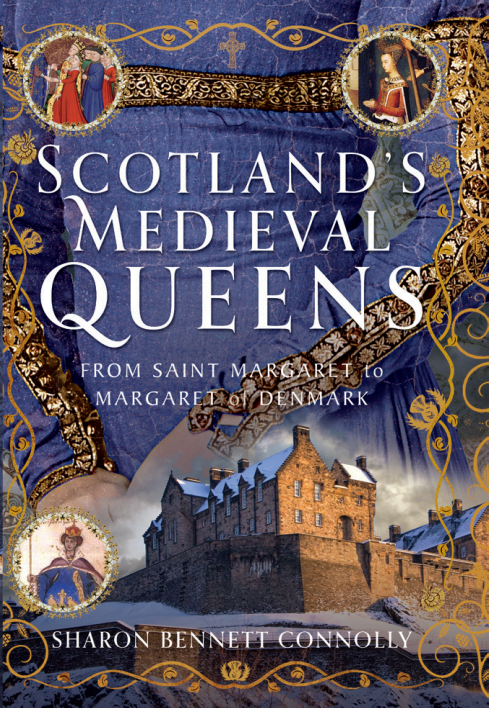
Out Now! Scotland’s Medieval Queens

Books by Sharon Bennett Connolly

Scotland’s history is dramatic, violent and bloody. Being England’s northern neighbour has never been easy. Scotland’s queens have had to deal with war, murder, imprisonment, political rivalries and open betrayal. They have loved and lost, raised kings and queens, ruled and died for Scotland. From St Margaret, who became one of the patron saints of Scotland, to Elizabeth de Burgh and the dramatic story of the Scottish Wars of Independence, to the love story and tragedy of Joan Beaufort, to Margaret of Denmark and the dawn of the Renaissance, Scotland’s Medieval Queens have seen it all. This is the story of Scotland through their eyes.

Scotland’s Medieval Queens gives a thorough grounding in the history of the women who ruled Scotland at the side of its kings, often in the shadows, but just as interesting in their lives beyond the spotlight. It’s not a subject that has been widely covered, and Sharon is a pioneer in bringing that information into accessible history.’ Elizabeth Chadwick (New York Times bestselling author)

Available now from Amazon and Pen and Sword Books

Also by Sharon Bennett Connolly:

Books by Sharon Bennett Connolly

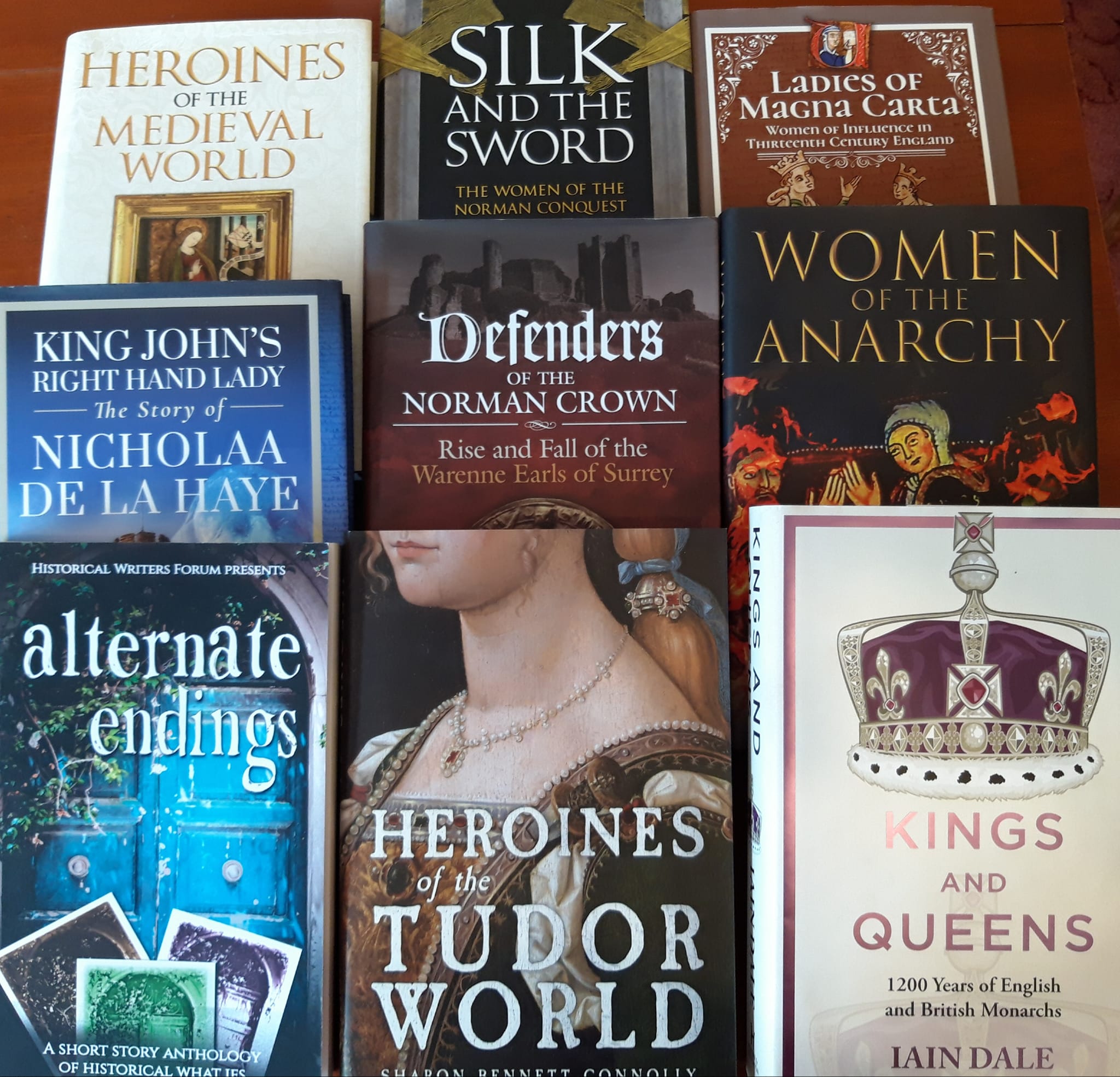
Heroines of the Tudor World tells the stories of the most remarkable women from European history in the time of the Tudor dynasty, 1485-1603. These are the women who ruled, the women who founded dynasties, the women who fought for religious freedom, their families and love. Heroines of the Tudor World is now available for pre-order from Amberley Publishing and Amazon UK. Women of the Anarchy demonstrates how Empress Matilda and Matilda of Boulogne, unable to wield a sword themselves, were prime movers in this time of conflict and lawlessness. It shows how their strengths, weaknesses, and personal ambitions swung the fortunes of war one way – and then the other. Available from Bookshop.orgAmberley Publishing and Amazon UKKing John’s Right-Hand Lady: The Story of Nicholaa de la Haye is the story of a truly remarkable lady, the hereditary constable of Lincoln Castle and the first woman in England to be appointed sheriff in her own right. Available from all good bookshops Pen & Sword Booksbookshop.org and Amazon

Royal Historical Society

Defenders of the Norman Crown: The Rise and Fall of the Warenne Earls of Surrey tells the fascinating story of the Warenne dynasty, from its origins in Normandy, through the Conquest, Magna Carta, the wars and marriages that led to its ultimate demise in the reign of Edward III. Available from Pen & Sword BooksAmazon in the UK and US, and Bookshop.orgLadies of Magna Carta: Women of Influence in Thirteenth Century England looks into the relationships of the various noble families of the 13th century, and how they were affected by the Barons’ Wars, Magna Carta and its aftermath; the bonds that were formed and those that were broken. It is now available in paperback and hardback from Pen & SwordAmazon, and Bookshop.orgHeroines of the Medieval World tells the stories of some of the most remarkable women from Medieval history, from Eleanor of Aquitaine to Julian of Norwich. Available now from Amberley Publishing and Amazon, and Bookshop.orgSilk and the Sword: The Women of the Norman Conquest traces the fortunes of the women who had a significant role to play in the momentous events of 1066. Available now from Amazon,  Amberley Publishing, and Bookshop.org.

Alternate Endings: An anthology of historical fiction short stories including Long Live the King… which is my take what might have happened had King John not died in October 1216. Available in paperback and kindle from Amazon.

Podcast:

A Slice of Medieval

Have a listen to the A Slice of Medieval podcast, which I co-host with Historical fiction novelist Derek Birks. Derek and I welcome guests, such as Bernard Cornwell and Michael Jecks, and discuss a wide range of topics in medieval history, from significant events to the personalities involved. 

Every episode is also now available on YouTube.

*

Don’t forget! Signed and dedicated copies of all my books are available through my online store.

For forthcoming online and in-person talks, please check out my Events Page.

You can be the first to read new articles by clicking the ‘Follow’ button, liking our Facebook page or joining me on TwitterThreadsBluesky and Instagram.

*

©2025 Sharon Bennett Connolly, FRHistS and Rosanna McGlone

Queen of Scots

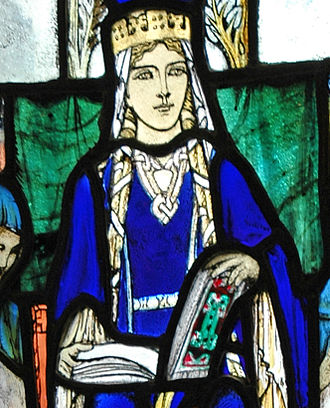
St Margaret, Queen of Scots

The Queens of Scots of the medieval era are a fascinating variety of women and I can only hope that I have done them justice in my latest book, Scotland’s Medieval Queens: From St Margaret to Margaret of Denmark.

Scottish history is fascinating! It is violent, politically charged and passionate. Being inconveniently situated on England’s northern border was never easy for Scotland, but it has made for some great stories over the centuries. Scotland’s story is often that of brother against brother, ambition and family rivalries causing feuds that threatened the stability of the crown itself. Such fissures, of course, grew and ruptured with the aid of English interference and encouragement. The King of England was always happy to play one side off against the other if it weakened Scotland’s position.

And Scotland’s medieval queens, be they Scottish, English, Danish or French, formed a big part of that story.

More often than not, these disputes north and south of the border were resolved in peace treaties, sealed by wedding bells. A number of English princesses and noblewomen found themselves married to Scotland’s kings as a consequence.

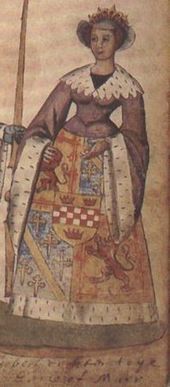
Queen Elizabeth de Burgh

For over 400 years, Shakespeare’s version of Lady Macbeth has been the woman most people are familiar with. In the bard’s famous drama, also known as ‘The Scottish Play’, Lady Macbeth is not even given her name. Presented as a scheming, manipulative woman, Shakespeare did as good a hatchet job on Gruoch, a royal princess in her own right, as he had on Richard III. Unfortunately, there is no society established to repair Gruoch’s reputation.

The scheming, ambitious woman who will stop at nothing to put her husband on the Scottish throne – and commit murder to keep him there. But is that the real Lady Macbeth? The story of Queen Gruoch, Lady Macbeth, is one shrouded in mystery, tantalisingly obscure. If only we could know more. The lack of information on Gruoch makes it easy for Shakespeare’s interpretation to be accepted as fact, but it is more than likely an injustice to a woman who survived her first husband’s gruesome death, protected her son and came to an agreement with Macbeth to become his wife, securing her son’s future in the process, and later becoming queen as a consequence.

Queen Gruoch is the first queen of Scots for whom we have a name.

From the highly educated and pious Margaret of Wessex to the glamorous Margaret of Denmark, their lives and experiences tell the story of their nation. Some, such as Matilda de Senlis and Ermengarde de Beaumont, barely make an impression on history, though merely by producing a son, they each guaranteed that Scotland would persevere. And Isabella de Warenne, wife of John Balliol, who is a ghost on the pages of Scotland’s history. And it is not that these made no impression. Their influence was in the domestic sphere, raising children and supporting their husbands, rather than on the political or the international stage. Although Isabella’s story is even more obscure by the fact all mention of the Balliol dynasty was forbidden by the Bruce regime.

Marrying an English princess, for example, did not always guarantee the peace with England that was intended. As the wife of Alexander II, Joan of England did her best to maintain cordial relations with her brother Henry III, often using private letters to broker diplomatic solutions. And Henry III’s own daughter Margaret, in marrying Alexander III, brought Scotland more years of peace with England. As a consequence, Scotland and England enjoyed over 70 years of peaceful relations. These years were shattered dramatically by the deaths of Alexander III, his three children and his little granddaughter, Margaret, the Maid of Norway. Little Margaret’s death left the Scots throne vacant, with thirteen Competitors vying for the crown, staking their claims as Edward I of England acted as adjudicator.

Margaret, Maid of Norway

Edward I took advantage of this to try to assert his overlordship of Scotland, but William Wallace, Robert the Bruce and countless others pushed back, ushering in decades of war with England, the Scottish Wars of Independence.

Edward III’s sister Joan of the Tower was to have no such legacy of peace as the earlier Joan and Queen Margaret could boast. Her brother’s ambition would blight her marriage for years. Edward leant his support to the rival claimant to the Scottish throne, Edward Balliol. If he had not been so keen to exploit Scotland’s dynastic divisions, maybe Joan and David II would have had a happier marriage. We will never know.

One cannot help but feel sympathy for Elizabeth de Burgh, seeing her fortunes rise and fall at the whim of England’s king, Edward I, held captive for eight years when she should have been sitting in splendour on Scotland’s throne.

Or poor Marjorie Bruce, whose childhood was torn from her by that same English king, held far away from everyone she loved, only to be married as she tasted freedom, and dead in childbirth by the age of 19. Passed over for the throne because she was a woman, she still managed to give birth to a dynasty, the Stewarts.

Joan Beaufort, Queen of Scots

Scotland was the first nation in the British Isles to accept a queen regnant when Margaret, Maid of Norway, was recognised as its queen in 1290. How her queenship would have developed, we have no way of knowing. The poor girl died before she even landed in mainland Scotland. Her significance is in that she was proclaimed queen and the possibilities that heralded, even if it got no further. We can only speculate as to how a successful rule by a queen regnant in the thirteenth century may have changed the lives and experiences of women in subsequent centuries. Her death was a tragedy, not just to her family, but to women’s rights to rule.

But then again, as her father-in-law, it may well be that Edward I would have taken Scotland under his wing … and never let go.

Although we have charters and chronicles, and evidence of religious and charitable donations, most of these women remain elusive. They are enigmas.

We do not – and cannot – know them intimately as the one thing that is missing is their own voice. Their thoughts and personalities are lost to us. Even letters to family members are often formulaic and rarely speak of their true feelings, of their happiness – or not – and their cares and concerns for themselves. We know what they endured for the sake of Scotland, the risk of death in childbirth, the grief of lost children, or the grief of no children. Every woman in medieval Europe was exposed to similar experiences. Scottish queens, however, had to endure imprisonment, scheming noblemen and the early deaths of their husbands more times than they should have had to.

Anabella Drummond, Queen of Scots

But, once in a while, we come across a marriage that is a true partnership. A love story, even. And we discover moments of affection, of amusement, of unity and mutual support. Little moments that remind us that these people are not just stories. They are lives that were lived to the full, however short or long a time they had.

Scotland’s story is often violent and suffered greatly from the machinations if its powerful southern neighbour. However, Scotland did emerge from the Middle Ages as, still, an independent, sovereign nation. And Scotland’s medieval queens had each made their own contribution to the country’s continuing survival and independence. From Saint Margaret – even from Gruoch – to Margaret of Denmark, each queen, to varying degrees of success, made their own indelible imprint on Scotland’s remarkable story.

Images:

Courtesy of Wikipedia

Selected Bibliography:

John of Fordun’s Chronicle of the Scottish Nation; Walter Bower, Scotichronicon; Andrew Wyntoun, The orygynale cronykil of Scotland; Calendar of documents relating to Scotland preserved in Her Majesty’s Public Record Office; Richard Oram, editor, The Kings and Queens of Scotland; Rosalind K. Marshall, Scottish Queens 1034–1714; Nigel Tranter, The Story of Scotland; David Ross Scotland, History of a Nation; Liber pluscardensis, edited by Felix James Henry Skene; Mediaeval chronicles of Scotland: the chronicles of Melrose and Holyrood, translated by Joseph Stephenson; The Chronicle of Lanercost, edited by Sir Herbert Maxwell; The Ecclesiastical History of England and Normandy by Ordericus Vitalis; The historie and cronicles of Scotland … by Robert Lindesay of Pitscottie, 3 volumes, A.J.G. Mackay, editor.

*

My books

Signed, dedicated copies of all my books are available through my online store.

Out now: Scotland’s Medieval Queens

Scotland’s history is dramatic, violent and bloody. Being England’s northern neighbour has never been easy. Scotland’s queens have had to deal with war, murder, imprisonment, political rivalries and open betrayal. They have loved and lost, raised kings and queens, ruled and died for Scotland. From St Margaret, who became one of the patron saints of Scotland, to Elizabeth de Burgh and the dramatic story of the Scottish Wars of Independence, to the love story and tragedy of Joan Beaufort, to Margaret of Denmark and the dawn of the Renaissance, Scotland’s Medieval Queens have seen it all. This is the story of Scotland through their eyes.

Scotland’s Medieval Queens gives a thorough grounding in the history of the women who ruled Scotland at the side of its kings, often in the shadows, but just as interesting in their lives beyond the spotlight. It’s not a subject that has been widely covered, and Sharon is a pioneer in bringing that information into accessible history.’ Elizabeth Chadwick (New York Times bestselling author)

Available now from Amazon and Pen and Sword Books

Also by Sharon Bennett Connolly:

Heroines of the Tudor World tells the stories of the most remarkable women from European history in the time of the Tudor dynasty, 1485-1603. These are the women who ruled, the women who founded dynasties, the women who fought for religious freedom, their families and love. Heroines of the Tudor World is now available for pre-order from Amberley Publishing and Amazon UK. Women of the Anarchy demonstrates how Empress Matilda and Matilda of Boulogne, unable to wield a sword themselves, were prime movers in this time of conflict and lawlessness. It shows how their strengths, weaknesses, and personal ambitions swung the fortunes of war one way – and then the other. Available from Bookshop.orgAmberley Publishing and Amazon UKKing John’s Right-Hand Lady: The Story of Nicholaa de la Haye is the story of a truly remarkable lady, the hereditary constable of Lincoln Castle and the first woman in England to be appointed sheriff in her own right. Available from all good bookshops Pen & Sword Booksbookshop.org and Amazon

Defenders of the Norman Crown: The Rise and Fall of the Warenne Earls of Surrey tells the fascinating story of the Warenne dynasty, from its origins in Normandy, through the Conquest, Magna Carta, the wars and marriages that led to its ultimate demise in the reign of Edward III. Available from Pen & Sword BooksAmazon in the UK and US, and Bookshop.orgLadies of Magna Carta: Women of Influence in Thirteenth Century England looks into the relationships of the various noble families of the 13th century, and how they were affected by the Barons’ Wars, Magna Carta and its aftermath; the bonds that were formed and those that were broken. It is now available in paperback and hardback from Pen & SwordAmazon, and Bookshop.orgHeroines of the Medieval World tells the stories of some of the most remarkable women from Medieval history, from Eleanor of Aquitaine to Julian of Norwich. Available now from Amberley Publishing and Amazon, and Bookshop.orgSilk and the Sword: The Women of the Norman Conquest traces the fortunes of the women who had a significant role to play in the momentous events of 1066. Available now from Amazon,  Amberley Publishing, and Bookshop.org.

Alternate Endings: An anthology of historical fiction short stories including Long Live the King… which is my take what might have happened had King John not died in October 1216. Available in paperback and kindle from Amazon.

Podcast:

Have a listen to the A Slice of Medieval podcast, which I co-host with Historical fiction novelist Derek Birks. Derek and I welcome guests, such as Bernard Cornwell and Michael Jecks, and discuss a wide range of topics in medieval history, from significant events to the personalities involved. Every episode is also now available on YouTube.

*

Don’t forget! Signed and dedicated copies of all my books are available through my online store.

For forthcoming online and in-person talks, please check out my Events Page.

You can be the first to read new articles by clicking the ‘Follow’ button, liking our Facebook page or joining me on TwitterThreadsBluesky and Instagram.

*

©2025 Sharon Bennett Connolly, FRHistS

‘Margaret of Logie, of high and noble birth’

Joan of the Tower, Queen of Scotland

When she died in September 1362, Joan of the Tower (also known as Joan Makepeace) had been Queen of Scots for thirty-three years. She had never borne a child, nor is there any mention of her ever having become pregnant. So, on her death, David II was still without a son and heir. The heir to the Scottish throne was Robert Stewart, the nephew he despised, who had six legitimate sons by 1362.

Following the murder of his lover, Katherine Mortimer, in 1360, and before Joan’s death, King David had fallen in love with Margaret Drummond. The first reference to Margaret and David’s relationship is in a charter of 20 January 1363, to the Friars Preacher, for the souls of David himself and of ‘our beloved’ Margaret Logie. Margaret was the daughter of a lowly Scottish knight, Sir Malcolm Drummond. She had been married to Sir John Logie of Logie and had at least one son, also called John.

The relationship with Margaret further alienated David’s heir, Robert Stewart, who was involved in a violent feud with Margaret’s brothers, John and Maurice Drummond. It also threatened to disinherit Robert, should Margaret give birth to a son. This could explain Robert’s involvement in a rebellion early in 1363, in which a petition was presented to the king, demanding that he set aside Margaret and dismiss his current advisers.

Despite the opposition to the relationship, ‘in the year 1363, the aforesaid lord David, king of Scotland, took to wife, at Inchmurdach, a great lady, named Margaret of Logie, of high and noble birth, and born in his kingdom; and he endowed her with many lands and possessions, and raised her to reign in honour with him, with the royal diadem.’1 They were married at Inchmurdoch, in the Fife manor house of the Bishop of St Andrews, though ‘Thai ware togiddyr bot schort quhile.’2

Crest badge of the Clan Drummond

According to the chroniclers, Margaret was very beautiful, but her character left much to be desired, ‘With the aim therefore of providing for the succession to the kingdom from the fruit of her womb (if God granted it), King David chose a most beautiful lady, Margaret Logie, the widow of John Logie, perhaps not so much for the excellence of her character as a woman as for the pleasure he took in her desirable appearance.’3 Once married, David gave preferential treatment to Margaret’s family, granting them lands and prestigious marriages. One such marriage, possibly inspired by Margaret herself, was between her niece, Annabella Drummond, and John, the eldest son and heir of Robert Stewart.

If Margaret herself did not produce a son and heir for Scotland, her niece might one day become queen. This must have angered Robert Stewart, who was still embroiled in the feud with Margaret’s brothers. Demonstrating her own influence over King David, in the winter of 1368, the queen went as far as to persuade her husband to order the arrest and imprisonment of Robert and some of his sons. The continued lack of an heir, however, may have begun to rankle with King David, who released his nephew after a short time. David also favoured his stepson. On 6 December 1363, John Logie, ‘the son of the Queen of Scotland’, was among the ‘divers lords and others, who came to England in the retinue of the K. of Scotland about a treaty of peace between the Kings’ and was gifted ‘a parcelgilt cup, weight 75s., value 6l. 5s. 4d’.4 He received further gifts such as that on 16 December 1365, when the king ‘of Scotland, Sir Archibald, and other lords of Scotland came to Annandale, and gave seisin of it to one John de Logy son of the Queen of Scotland’.5

Annabella Drummond, Margaret’s niece

The Liber Pluscardensis suggests that the queen, knowing David was tiring of her, faked a pregnancy in order to maintain her influence over her husband, and save her marriage. It did not work. Margaret is always portrayed as an ‘arrogant, demanding wife’, and it may be that she was, though I cannot help but wonder that harsh words are used to describe her because she was lowly born, the daughter of a mere knight, rather than a princess. She was seen as unworthy for the high office to which David had elevated her. It cannot have been easy for her, being reminded constantly of her low social position in respect of the others who surrounded the king. It would go some way to explain her haughty attitude; she was trying to live up to her queenship. David had also started an affair with Agnes Dunbar, sister of George, Earl of March.

Whether it was for the lack of an heir, the demanding nature of his wife, or a desire to marry a new love, the result was the same: ‘he lived with her for a short time, [but following animosity that arose between them,] he divorced her about the beginning of Lent 1369.’6 King David applied for a divorce, which was granted, relegating Margaret to the position of ‘Lady Margaret Logie, onetime Queen’. Margaret, however, was not going to go quietly and live in retirement on the pension of £100 a year the king had awarded her. Margaret decided to appeal to a higher power and

On this account she secretly boarded a ship in the Firth of Forth [well supplied with money] and made for the papal court. She arrived at Avignon where the pope was then to be found. By making an appeal she transferred her case there, and disturbed the whole kingdom by her legal action. And so once the king’s proctors had travelled to the apostolic see, the case was bitterly disputed, and the pleading between the advocates of the contending parties was so prolonged that a book compiled from that source and certified by notarial marks is longer [in] wordage (in my judgment, for I who have written this have seen this pleading) than the contents of the text of four Psalters. For her case was many times committed for hearing by auditors and cardinals, so that if she had lived, she would have subjected the kingdom to an interdict; but she died on a pilgrimage to Rome.7

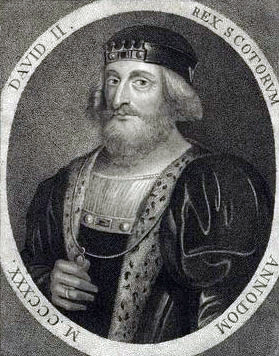
David II, King of Scots


King David II Bruce died, childless, at Edinburgh Castle on 22 February 1371, having reigned for forty-two of his forty-seven years. The king’s death did not stop Margaret from continuing with her lawsuit against him for some years, despite how much it was costing the former queen. There was a

Notarial instrument dated 23d June 1372, attesting obligation of same date by the Lady Margaret Queen of Scotland, widow of the late David Bruys K. of Scotland, acknowledging a loan of 500 marks from Adam Franceys and two other London merchants, made to her at Avignon, repayable at Caleys at Pentecost following. Done in the house of the said Queen Margaret at Avignon ut supra.8

Scotland was under the threat of a papal interdict as a result. Reprieve only came with Margaret’s death, during a pilgrimage to Rome in early 1375. The rule of the house of Bruce had lasted just sixty-five years and had been punctuated by the country’s fight for Scotland’s sovereignty. Eventually, however, it was not England that ensured the downfall of the House of Bruce. It was the failure of King David to have an heir.

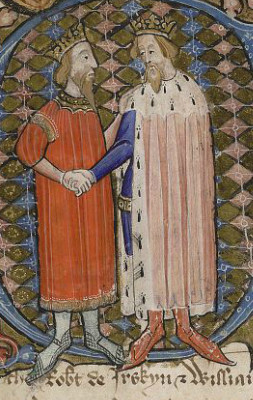
David II (left) and Edward III

There is always a tendency to blame the woman when a king dies childless, but the fact that David was married twice and had a number of mistresses, but never became a father, even of an illegitimate child, would suggest that the problem lay with David. Though the point is moot.

In the end, David’s heir was his nephew, as he had been from the moment David ascended the throne. David was succeeded by the first of the Stewart kings, Robert II, son of Robert the Bruce’s eldest daughter, Marjorie and her husband, Walter Stewart. The royal House of Stewart would rule Scotland until 1714 and England from 1603 until 1714.

Notes:

1. John of Fordun’s Chronicle of the Scottish Nation; 2. ‘They were together but a short while’, Wyntoun, The orygynale cronykil of Scotland; 3. Bower, Scotichronicon, V 7; 4. Calendar of documents relating to Scotland, Vol. 4, no. 93; 5. ibid.; 6. Bower, Scotichronicon, V 7; 7. ibid,; 8. Calendar of documents relating to Scotland, Vol. 4, no. 197

Bibliography:

John of Fordun’s Chronicle of the Scottish Nation; Walter Bower, Scotichronicon; Andrew Wyntoun, The orygynale cronykil of Scotland; Calendar of documents relating to Scotland preserved in Her Majesty’s Public Record Office; Richard Oram, editor, The Kings and Queens of Scotland; Rosalind K. Marshall, Scottish Queens 1034–1714; Ian Mortimer, The Perfect King: The Life of Edward III, Father of the English Nation; Dr Callum Watson, ‘Ane Lady Bricht’: A Life of Annabella Drummond, Queen of Scots, c. 1350–1401; Bruce Webster, Margaret [née Margaret Drummond], Oxforddnb.com; Nigel Tranter, The Story of Scotland; B. Webster, ‘David II and the Government of Fourteenth-Century Scotland’ (article); David Ross Scotland, History of a Nation; Phil Carradice, Robert the Bruce: Scotland’s True Braveheart; G. Barrow ‘The Aftermath of War: Scotland and England in the late Thirteenth and early Fourteenth Centuries’ (article); Colm MacNamee, Robert Bruce: Our Most Valiant Prince and Lord; Stephen Spinks, Robert the Bruce: Champion of a Nation; Fiona J. Warson, Robert the Bruce; Bruce Webster, ‘David II’, Oxforddnb.com

*

My Books

Signed, dedicated copies of all my books are available through my online bookshop.

Out now: Scotland’s Medieval Queens

Scotland’s history is dramatic, violent and bloody. Being England’s northern neighbour has never been easy. Scotland’s queens have had to deal with war, murder, imprisonment, political rivalries and open betrayal. They have loved and lost, raised kings and queens, ruled and died for Scotland. From St Margaret, who became one of the patron saints of Scotland, to Elizabeth de Burgh and the dramatic story of the Scottish Wars of Independence, to the love story and tragedy of Joan Beaufort, to Margaret of Denmark and the dawn of the Renaissance, Scotland’s Medieval Queens have seen it all. This is the story of Scotland through their eyes.

Available now from Amazon and Pen and Sword Books

Also by Sharon Bennett Connolly:

Heroines of the Tudor World tells the stories of the most remarkable women from European history in the time of the Tudor dynasty, 1485-1603. These are the women who ruled, the women who founded dynasties, the women who fought for religious freedom, their families and love. Heroines of the Tudor World is now available for pre-order from Amberley Publishing and Amazon UK. Women of the Anarchy demonstrates how Empress Matilda and Matilda of Boulogne, unable to wield a sword themselves, were prime movers in this time of conflict and lawlessness. It shows how their strengths, weaknesses, and personal ambitions swung the fortunes of war one way – and then the other. Available from Bookshop.orgAmberley Publishing and Amazon UKKing John’s Right-Hand Lady: The Story of Nicholaa de la Haye is the story of a truly remarkable lady, the hereditary constable of Lincoln Castle and the first woman in England to be appointed sheriff in her own right. Available from all good bookshops Pen & Sword Booksbookshop.org and Amazon

Defenders of the Norman Crown: The Rise and Fall of the Warenne Earls of Surrey tells the fascinating story of the Warenne dynasty, from its origins in Normandy, through the Conquest, Magna Carta, the wars and marriages that led to its ultimate demise in the reign of Edward III. Available from Pen & Sword BooksAmazon in the UK and US, and Bookshop.orgLadies of Magna Carta: Women of Influence in Thirteenth Century England looks into the relationships of the various noble families of the 13th century, and how they were affected by the Barons’ Wars, Magna Carta and its aftermath; the bonds that were formed and those that were broken. It is now available in paperback and hardback from Pen & SwordAmazon, and Bookshop.orgHeroines of the Medieval World tells the stories of some of the most remarkable women from Medieval history, from Eleanor of Aquitaine to Julian of Norwich. Available now from Amberley Publishing and Amazon, and Bookshop.orgSilk and the Sword: The Women of the Norman Conquest traces the fortunes of the women who had a significant role to play in the momentous events of 1066. Available now from Amazon,  Amberley Publishing, and Bookshop.org.

Alternate Endings: An anthology of historical fiction short stories including Long Live the King… which is my take what might have happened had King John not died in October 1216. Available in paperback and kindle from Amazon.

Podcast:

Have a listen to the A Slice of Medieval podcast, which I co-host with Historical fiction novelist Derek Birks. Derek and I welcome guests, such as Bernard Cornwell and discuss a wide range of topics in medieval history, from significant events to the personalities involved. Every episode is also now available on YouTube.

*

Don’t forget! Signed and dedicated copies of all my books are available through my online bookshop.

For forthcoming online and in-person talks, please check out my Events Page.

You can be the first to read new articles by clicking the ‘Follow’ button, liking our Facebook page or joining me on Twitter and Instagram.

©2025 Sharon Bennett Connolly FRHistS

Wordly Women: Toni Mount

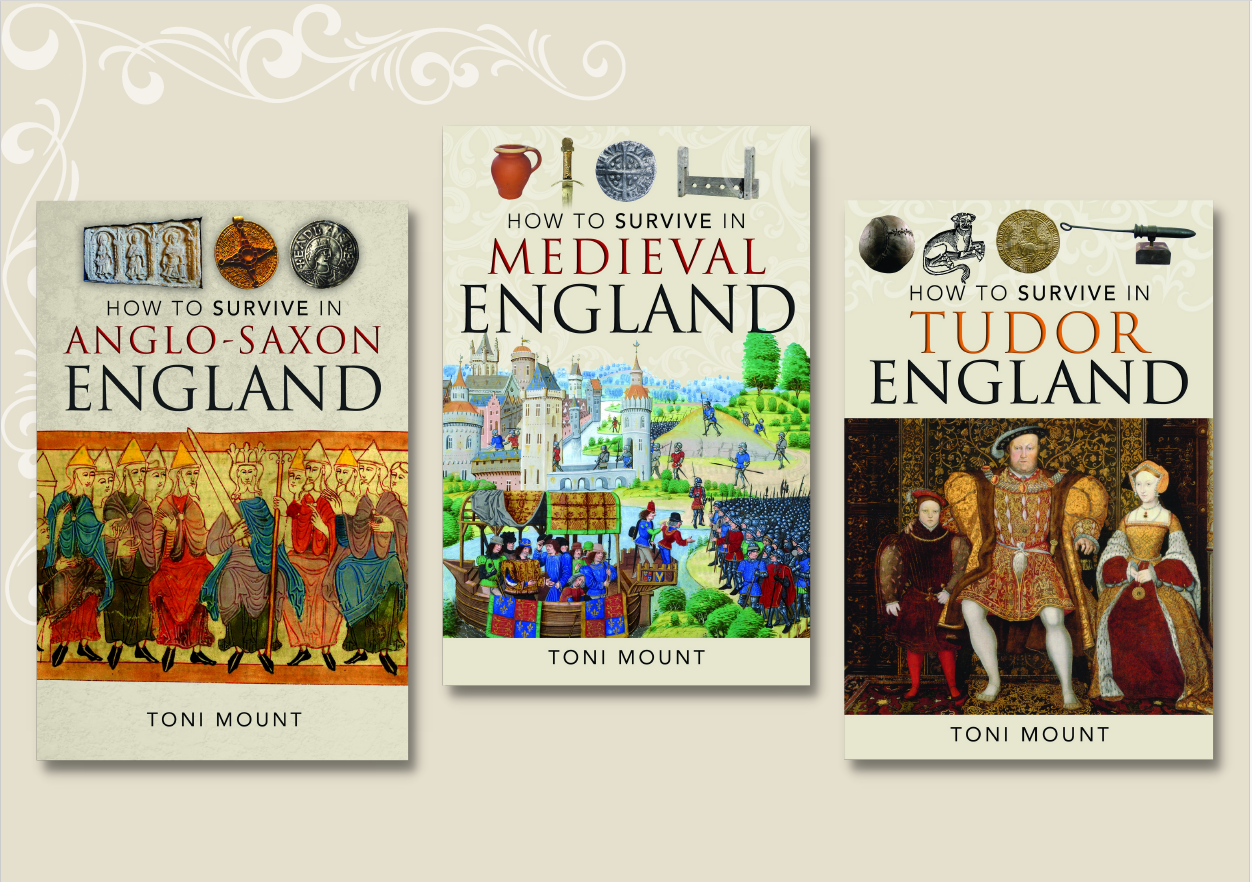
In today’s spotlight on Wordly Women, I welcome my good friend, novelist and historian, Toni Mount back to History… the Interesting Bits. Toni writes the fabulous Seb Foxley mystery novels and the non-fiction series How to Survive in…

Sharon: What got you into writing?

Toni: I’ve always been a story-teller. Aged 6, when the teacher was called away – before the days of teaching assistants – she would have me sit at the front of the class and tell them a story. It was usually a mix of various fairytales with princes, princesses, witches and dragons. I like to think I became more sophisticated when I started writing them down in English Composition lessons aged 7 or 8. My imagined ‘First Flight of Concorde’ – the supersonic plane – won the school prize and my head has been full of stories for as long as I can remember. A good many have made it to the page but not all.

Sharon: You write both fiction and non-fiction – is one harder than the other?

Toni: Fiction needs your own ideas; in non-fiction the facts are there, waiting for you to use. Since my novels are as authentic to the period as I can make them, but without the ‘gadzooks’ and ‘forsooths’, they take as much research as the non- fiction books. In both cases, I’m looking to tell a good story. The difference is that non-fiction may have gaps where historians don’t know the answers, such as what was Edward II thinking when he gave Piers Gaveston the queen’s jewellery but in a novel the writer is allowed to tell you why.

Sharon: Tell us about your books.

Toni: I’ve had 30+ books published, half of them novels. My most successful non-fiction books are ‘Everyday Life in Medieval London’ and ‘Medieval Medicine’ both published by Amberley, and ‘How to Survive in Medieval England’ published by Pen & Sword which was recently a no.1 best seller on Amazon. The How to Survive series – my fourth: ‘How to Survive in Ration-Book Britain’ is due to be out in November 2025 – is written for the armchair time-traveller and puts a light-hearted slant on history. ‘How to Survive in Tudor England’ and ‘How to Survive in Anglo-Saxon England’ are the other titles.

My Sebastian Foxley Medieval Murder Mystery series has quite a following – book 13 ‘The Colour of Darkness’ has just gone off to the publisher MadeGlobal. Seb is a London-based scribe and illuminator in the 1470s-80s whose eye for detail means he spots clues that others miss to solve crimes. Many are true crimes which were recorded in the Mayor’s Court Rolls and remain unsolved – until now. I love the way my characters take over the story, sometimes doing things that never occurred to me. Seb has become a family member, so much so that my sons commissioned a portrait of him for my 65th birthday and it hangs above the fireplace.

Sharon: What attracts you to the period?

Toni: Whether fact or fiction, the Plantagenet period from the 1150s to 1485 is by far the most intriguing for me. Who doesn’t love to puzzle out a mystery? But modern policing is too boring to write about with so much paperwork, hours of CCTV footage to trawl through, fingerprinting, DNA, ballistics, etc. Give me Sherlock Holmes with his magnifying glass every time. The medieval period has even fewer technical complications.

Sharon: Who is your favourite medieval or Tudor personality and why?

Toni: Richard III obviously. I love the controversy. Was he a saint or a sinner? Or simply a human being?

Sharon: Who is your least favourite medieval or Tudor personality and why?

Toni: Henry VIII – a vicious paranoid megalomaniac. What’s to like? (Sharon: I could not agree more!)

Sharon: How do you approach researching your topic?
Toni: I read all I can around the subject; get a feel for the period and ‘live it’ in my head. As I write, if I realise I don’t know something, I make a note of it, check it out and list sources as I go. This is vital for a book which will have references and footnotes but even if I’m working on a novel, I may want to return to a source for further info or to mention it in my Author’s Notes – this is where I tell readers what’s true in the novel, which characters really existed, etc. In ‘The Colour of Darkness’, I did additional research into Medieval Mystery Plays and the ‘Duke of Exeter’s Daughter [a torture device], among other things. For the next novel, I’m reading up on medieval ships and firearms – I think it’s time somebody got shot with a ‘gunne’.

Sharon: Tell us your ‘favourite’ medieval or Tudor story you have come across in your research.

Toni: John/Eleanor Rykenor was a cross-dresser in the 1390s. He claimed to have had sex with nuns ‘as a man’ and didn’t charge them for it but did charge a group of Oxford priests-in-training for his services ‘as a woman’. He/she also said he’d spent a year or more living as a man’s wife. When caught in flagranti in a stable, wearing women’s attire and charging a man for sex, as Eleanor she appeared in court. The authorities weren’t sure what crime to charge her with – homosexuality wasn’t made a criminal offence until Tudor times – so she was charged with misrepresenting the product for sale, i.e. advertising her services as a female without having the appropriate ‘equipment’ for the job. She had to pay a fine for flouting what we would call the Trades Description Act. John/Eleanor is a character in my Foxley novels although he/she lived a century before they’re set. I couldn’t resist using such a fantastic character.

Sharon: Tell us your least ‘favourite’ medieval or Tudor story you have come across in your research.

Toni: The discovery of RIII’s skeleton in a Leicester car park ruined my first ever trilogy [written in 1980s and unpublished]. My premise for the series of novels was that Richard, though wounded, survives the battle of Bosworth and goes on to have further adventures. Henry Tudor, frustrated when he can’t find Richard’s corpse to prove the king is dead, substitutes a crippled beggar to be buried instead. I was about to rewrite the trilogy when the dig discovered the bones and DNA proved it was Richard. How annoying!

Sharon: Are there any other eras you would like to write about?

Toni: Apart from writing about the medieval and Tudor eras, I’ve also written a Victorian who dunnit – ‘The Death Collector’ – making use of unsolved murders from the 1880s, including those attributed to Jack the Ripper. That was great fun to write and I fancy doing a sequel. Also, I wrote a non-fiction book ‘The World of Isaac Newton’ and I think Isaac, with his brilliant brain, has definite possibilities as a sleuth. I’ve published books ranging from Anglo-Saxon England to the 1950s and everything in between has at least been touched upon. Maybe more on the Anglo-Saxons would be interesting.

Sharon: What are you working on now?

Toni: The next novel is brewing: ‘The Colour of Malice’ and two self-published booklets are being prepped. ‘Medieval Christmas’ will do what it says on the tin. ‘Warriors – Men-o’-War’ is a very different beast as a collection of my short stories, something I’ve not done before, from Agincourt to Afghanistan. There are no new titles for non-fiction books at the moment.

Sharon: And finally, what is the best thing about being a writer?

Toni: Playing God with characters [in fiction] and the beauty of words – choosing how best to express your ideas and imaginings on the page. Marvellous!

About the Author:

Toni studies, teaches and writes about medieval history. She is a successful author writing the popular Sebastian Foxley medieval murder series and several non-fiction volumes, including her collection of How to Survive in books. She has created several online courses for http://www.MedievalCourses.com, she teaches history to adults and is an experienced speaker giving talks to groups and societies. Toni enjoys attending history events as a costumed interpreter and is a member of the Research Committee of the Richard III Society.

Toni earned her Masters Degree by Research from the University of Kent in 2009 through study of a medieval medical manuscript held at the Wellcome Library in London. Her first-class honours degree, Diploma in Literature and Creative Writing and her Diploma in European Humanities are from the Open University. Toni also holds a Cert. Ed (in Post-Compulsory Education and Training) from the University of Greenwich.

Find Toni Mount’s books here

Find Toni on Social Media:

Amazon; Website; Seb Foxley website; Facebook: Medieval England Facebook; Seb Foxley Facebook; Twitter

*

My books

Signed, dedicated copies of all my books are available through my online store.

Out now: Scotland’s Medieval Queens

Scotland’s history is dramatic, violent and bloody. Being England’s northern neighbour has never been easy. Scotland’s queens have had to deal with war, murder, imprisonment, political rivalries and open betrayal. They have loved and lost, raised kings and queens, ruled and died for Scotland. From St Margaret, who became one of the patron saints of Scotland, to Elizabeth de Burgh and the dramatic story of the Scottish Wars of Independence, to the love story and tragedy of Joan Beaufort, to Margaret of Denmark and the dawn of the Renaissance, Scotland’s Medieval Queens have seen it all. This is the story of Scotland through their eyes.

Available now from Amazon and Pen and Sword Books

Also by Sharon Bennett Connolly:
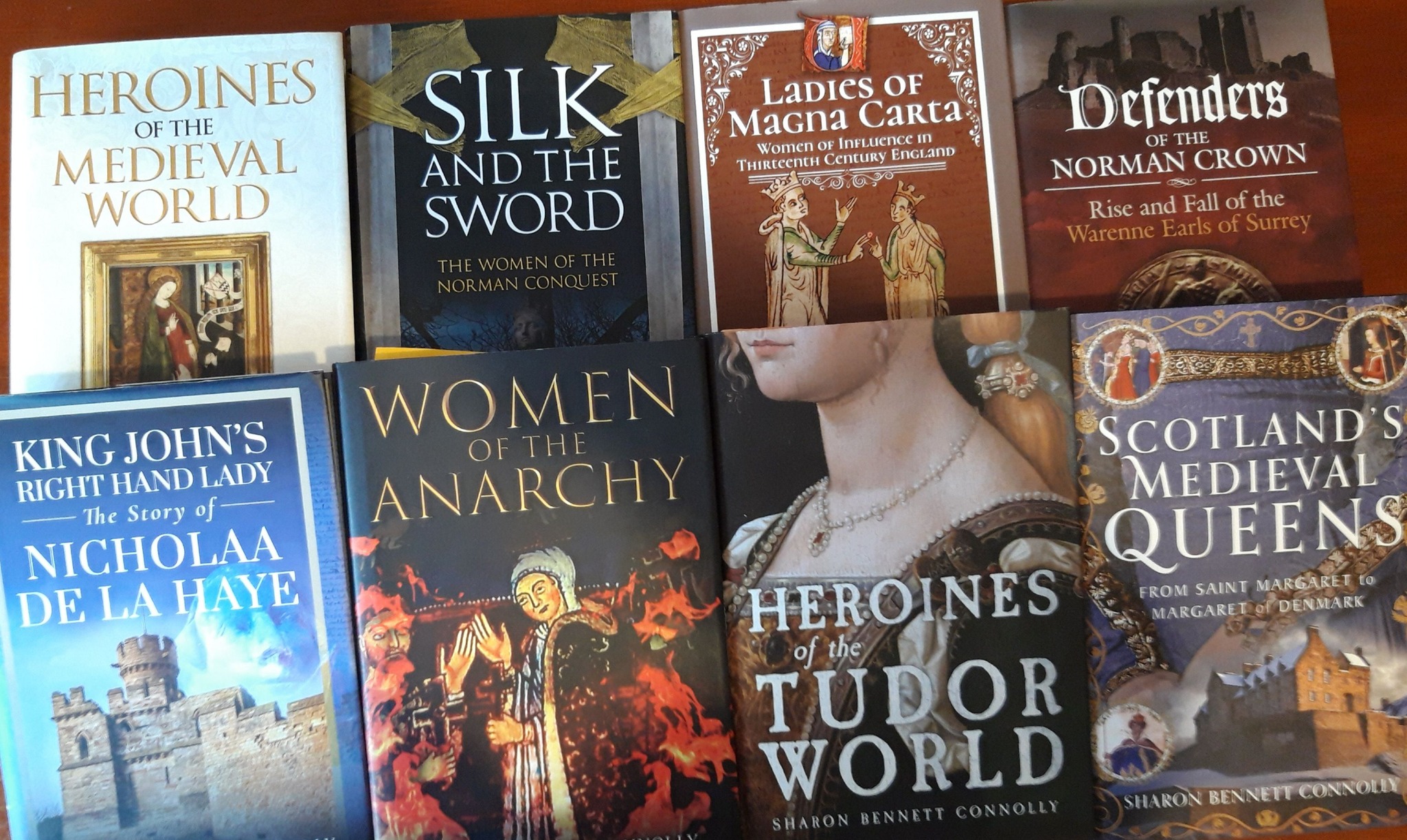
Heroines of the Tudor World tells the stories of the most remarkable women from European history in the time of the Tudor dynasty, 1485-1603. These are the women who ruled, the women who founded dynasties, the women who fought for religious freedom, their families and love. Heroines of the Tudor World is now available for pre-order from Amberley Publishing and Amazon UK. Women of the Anarchy demonstrates how Empress Matilda and Matilda of Boulogne, unable to wield a sword themselves, were prime movers in this time of conflict and lawlessness. It shows how their strengths, weaknesses, and personal ambitions swung the fortunes of war one way – and then the other. Available from Bookshop.orgAmberley Publishing and Amazon UKKing John’s Right-Hand Lady: The Story of Nicholaa de la Haye is the story of a truly remarkable lady, the hereditary constable of Lincoln Castle and the first woman in England to be appointed sheriff in her own right. Available from all good bookshops Pen & Sword Booksbookshop.org and Amazon

Defenders of the Norman Crown: The Rise and Fall of the Warenne Earls of Surrey tells the fascinating story of the Warenne dynasty, from its origins in Normandy, through the Conquest, Magna Carta, the wars and marriages that led to its ultimate demise in the reign of Edward III. Available from Pen & Sword BooksAmazon in the UK and US, and Bookshop.orgLadies of Magna Carta: Women of Influence in Thirteenth Century England looks into the relationships of the various noble families of the 13th century, and how they were affected by the Barons’ Wars, Magna Carta and its aftermath; the bonds that were formed and those that were broken. It is now available in paperback and hardback from Pen & SwordAmazon, and Bookshop.orgHeroines of the Medieval World tells the stories of some of the most remarkable women from Medieval history, from Eleanor of Aquitaine to Julian of Norwich. Available now from Amberley Publishing and Amazon, and Bookshop.orgSilk and the Sword: The Women of the Norman Conquest traces the fortunes of the women who had a significant role to play in the momentous events of 1066. Available now from Amazon,  Amberley Publishing, and Bookshop.org.

Alternate Endings: An anthology of historical fiction short stories including Long Live the King… which is my take what might have happened had King John not died in October 1216. Available in paperback and kindle from Amazon.

Podcast:

Have a listen to the A Slice of Medieval podcast, which I co-host with Historical fiction novelist Derek Birks. Derek and I welcome guests, such as Bernard Cornwell, Elizabeth Chadwick and Michael Jecks, and discuss a wide range of topics in medieval history, from significant events to the personalities involved. Every episode is also now available on YouTube.

*

Don’t forget! Signed and dedicated copies of all my books are available through my online store.

For forthcoming online and in-person talks, please check out my Events Page.

You can be the first to read new articles by clicking the ‘Follow’ button, liking our Facebook page or joining me on TwitterThreadsBluesky and Instagram.

*

©2025 Sharon Bennett Connolly, FRHistS and Toni Mount
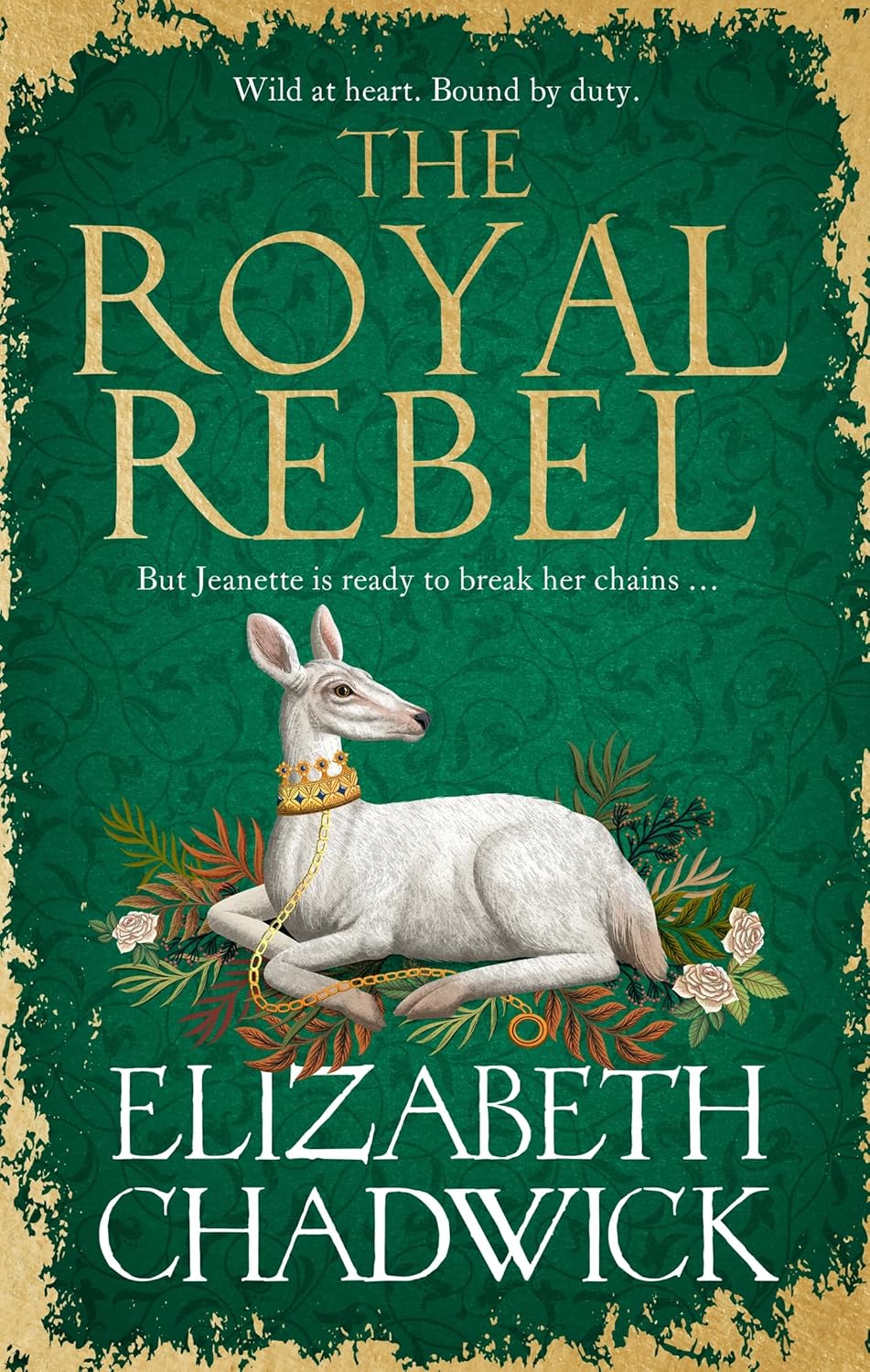
Book Corner: The Royal Rebel by Elizabeth Chadwick

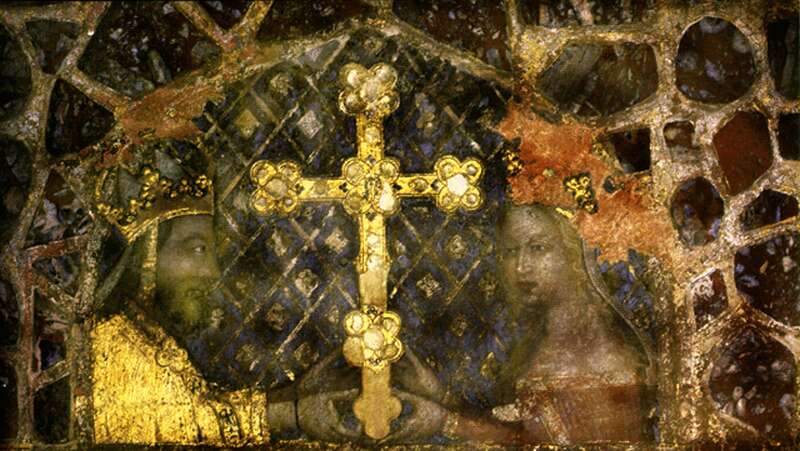
1338: England has declared war on France, and Jeanette of Kent, cousin to King Edward III, says goodbye to her family and travels overseas with the royal court for the first time. Once in Antwerp, she is captivated by talented household knight Thomas Holland, just as he in turn is powerfully drawn to her.

Although both know their romance is forbidden, their love for each other grows stronger than the danger they face, and they marry in secret. But before they can make their tryst known, Thomas has to leave for war, and in his absence, Jeanette is forced into a second marriage and locked away from the world.

Then Thomas returns, and the real fight begins. As hostile family members battle to keep Jeanette and Thomas apart, the defiant lovers vow to be reunited – whatever the cost…

It is always the sign of a good book if the author can leave me in tears and send me through a range of emotions from beginning to end. In The Royal Rebel, Elizabeth Chadwick has achieved this and then some!

The controversy over Joan of Kent‘s first marriage is fascinating. There are so many possibilities and connotations. And so much politics! Girls in medieval times were not supposed to choose their own husbands. Marriage was a political alliance for noble families, not a love affair. Romance had nothing to do with it.

The Royal Rebel is the story of the most famous ‘love triangle’ of the14th century. Joan, the daughter of the Earl of Kent, secretly married Thomas Holland, who then went off on crusade for a year. In the mean time, Joan’s mother arranged her daughter’s marriage to William Montague, the heir to the earldom of Salisbury. It was a mutually beneficial marriage. Joan had royal blood, but tainted by the fact her father had been executed. While Montague was the heir to a large earldom but would benefit from a closer connection to the crown. Thomas Holland, on the other hand, was a household knight with few prospects and whose father had been executed for treason. And when he returned from crusading in Eastern Europe, due to financial constraints, he did not immediately lay claim to his wife.

It was a storyline worthy of a modern-day soap opera.

Thomas Holland took his claims that he and Joan were married all the way to Rome. The investigation into the marriage was long, drawn-out legalese, mired in canon law and I did wonder how Elizabeth Chadwick was going to make it interesting. Of course! I needn’t have feared. She draws out the tension, adds in the human element, family dynamics and political considerations and keeps the reader gripped to the very end – even though I already knew the outcome!

The next day, Jeanette [Joan of Kent], Joan, Hawise and several other ladies from the Queen’s chamber gathered to dole out arms to the poor at the monastery gates. Usually, the almoners and designated servants distributed the donations, but today, in thanksgiving, the Queen’s ladies were involved in the task, and as well as the food, small amounts of money and items of clothing were handed out.

Jeanette played her part with a whole heart and a wide and ready smile. She was in charge of dispensing the bread, while Joan ladled pottage into the bowls people had brought them. Thomas and Otto arrived with their retinues to assist and stand guard, and the loaves of bread and jugs of beer were soon emptied, and all the money and clothing gone.

‘Thank you,’ Jeanette said, smiling at Thomas as she gathered up the empty baskets.

‘It has been my pleasure, demoiselle.’

He had brought one of his old hoods and two thick blankets to give away and had provided a small purse of alms money. His manner towards the folk who had come to receive charity had been courteous and good-humoured. Jeanette had noted his common touch which did not detract from the authority he possessed to lead men and maintain his rank. He had tousled a small boy’s hair, and jested with a toothless old woman who had cackled at him with lecherous appreciation, saying if she had been thirty years younger…

Once more, he escorted her and the ladies back to the royal apartments, and carried the baskets himself.

‘You look like a housewife going to market,’ she said, amused and very aware of his presence at her side. Their pace was a saunter, eking out the moment.

‘Looks can be deceptive,’ he replied. ‘It is what lies beneath that matters.’

He leaned a little towards her, and Jeanette’s breath shortened.

‘Then I suppose that like all truth it is buried, and must be sought by diligent investigation,’ she said pertly, giving as good as she got, and was rewarded by a flash of his grin.

‘I have always found that to be the case, demoiselle,’ he said, as they came to the Queen’s door. ‘And usually well rewarded.’

The Royal Rebel by Elizabeth Chadwick is no mere romance. It is the story of a trying decade in the reign of Edward III. Just as he embarks on the Hundred Years War with France (I wonder if he would have been so keen, if someone had told him the war’s eventual name?), plague ravages Europe and the court is gripped by the scandal of Joan’, Thomas and William’s marital situation. The detail is impressive.

Elizabeth Chadwick is moving into a period new to her, the late medieval; away from the 12th and 13th centuries of which she is so familiar. Not that you would know it. Her research has been meticulous and her attention to detail, to the dress and customs of the period, is second-to-none. Elizabeth Chadwick has really thought about the circumstances involving the clandestine marriage of Joan of Kent and Tomas Holland – and the very public marriage of Joan and Willian Montague. And how all this came about! The plot is intricate but entirely plausible and answers several questions around the actions of the parties involved.

The Royal Rebel also highlights the quandary over inheritance that would always hang over Joan’s marriage to Montague whilst the question mark remained over the validity of their marriage. Would any children have even been legitimate? Joan’s frustrations over her treatment is palpable; not being allowed to be with her true husband, being ignored by her elders, not being believed and even being prevented from freely giving her testimony in the court case. The Salisburys even locked her up!

The Royal Rebel by Elizabeth Chadwick is not just a good read, it is an experience of life in the mid-14th century and not to be missed.

The Royal Rebel by Elizabeth Chadwick is most definitely among my Top 5 books of 2024. I cannot recommend it highly enough!

To Buy the Book:

The Royal Rebel by Elizabeth Chadwick is now available from Amazon and all good bookshops.

About the Author:

New York Times bestselling author Elizabeth Chadwick lives in a cottage in the Vale of Belvoir in Nottinghamshire with her husband and their three dogs. Her first novel, The Wild Hunt, won a Betty Trask Award, To Defy a King won the Romantic Novelist Association’s Historical Novel Prize and The Scarlet Lion was nominated by Richard Lee – founder of the Historical Novel Society – as one of the top ten historical novels of the last decade. She often lectures at conferences and historical venues, has been consulted for television documentaries and is a member of the Royal Historical Society.

Keep in touch with Elizabeth via her website, her blogs or on social media.

http://www.elizabethchadwick.com
twitter: @chadwickauthor
facebook: ElizabethChadwick

*

My Books:

Signed, dedicated copies of all my books are available through my online bookshop.

Coming 30 January 2025: Scotland’s Medieval Queens

Scotland’s history is dramatic, violent and bloody. Being England’s northern neighbour has never been easy. Scotland’s queens have had to deal with war, murder, imprisonment, political rivalries and open betrayal. They have loved and lost, raised kings and queens, ruled and died for Scotland. From St Margaret, who became one of the patron saints of Scotland, to Elizabeth de Burgh and the dramatic story of the Scottish Wars of Independence, to the love story and tragedy of Joan Beaufort, to Margaret of Denmark and the dawn of the Renaissance, Scotland’s Medieval Queens have seen it all. This is the story of Scotland through their eyes.

Available for pre-order now.

Also by Sharon Bennett Connolly:

Heroines of the Tudor World tells the stories of the most remarkable women from European history in the time of the Tudor dynasty, 1485-1603. These are the women who ruled, the women who founded dynasties, the women who fought for religious freedom, their families and love. Heroines of the Tudor World is now available for pre-order from Amberley Publishing and Amazon UK. Women of the Anarchy demonstrates how Empress Matilda and Matilda of Boulogne, unable to wield a sword themselves, were prime movers in this time of conflict and lawlessness. It shows how their strengths, weaknesses, and personal ambitions swung the fortunes of war one way – and then the other. Available from Bookshop.orgAmberley Publishing and Amazon UKKing John’s Right-Hand Lady: The Story of Nicholaa de la Haye is the story of a truly remarkable lady, the hereditary constable of Lincoln Castle and the first woman in England to be appointed sheriff in her own right. Available from all good bookshops Pen & Sword Booksbookshop.org and Amazon

Defenders of the Norman Crown: The Rise and Fall of the Warenne Earls of Surrey tells the fascinating story of the Warenne dynasty, from its origins in Normandy, through the Conquest, Magna Carta, the wars and marriages that led to its ultimate demise in the reign of Edward III. Available from Pen & Sword BooksAmazon in the UK and US, and Bookshop.orgLadies of Magna Carta: Women of Influence in Thirteenth Century England looks into the relationships of the various noble families of the 13th century, and how they were affected by the Barons’ Wars, Magna Carta and its aftermath; the bonds that were formed and those that were broken. It is now available in paperback and hardback from Pen & SwordAmazon, and Bookshop.orgHeroines of the Medieval World tells the stories of some of the most remarkable women from Medieval history, from Eleanor of Aquitaine to Julian of Norwich. Available now from Amberley Publishing and Amazon, and Bookshop.orgSilk and the Sword: The Women of the Norman Conquest traces the fortunes of the women who had a significant role to play in the momentous events of 1066. Available now from Amazon,  Amberley Publishing, and Bookshop.org.

Alternate Endings: An anthology of historical fiction short stories including Long Live the King… which is my take what might have happened had King John not died in October 1216. Available in paperback and kindle from Amazon.

Podcast:

Have a listen to the A Slice of Medieval podcast, which I co-host with Historical fiction novelist Derek Birks. Derek and I welcome guests, such as Bernard Cornwell, and discuss a wide range of topics in medieval history, from significant events to the personalities involved, including Elizabeth Chadwick discussing her writing of The Royal Rebel as a guest for the 2024 HNS Conference’s Writing Medieval panel, alongside Matthew Harffy and David Gilman.

*

Don’t forget! Signed and dedicated copies of all my books are available through my online bookshop.

For forthcoming online and in-person talks, please check out my Events Page.

You can be the first to read new articles by clicking the ‘Follow’ button, liking our Facebook page or joining me on TwitterThreadsBluesky and Instagram.

©2024 Sharon Bennett Connolly FRHistS
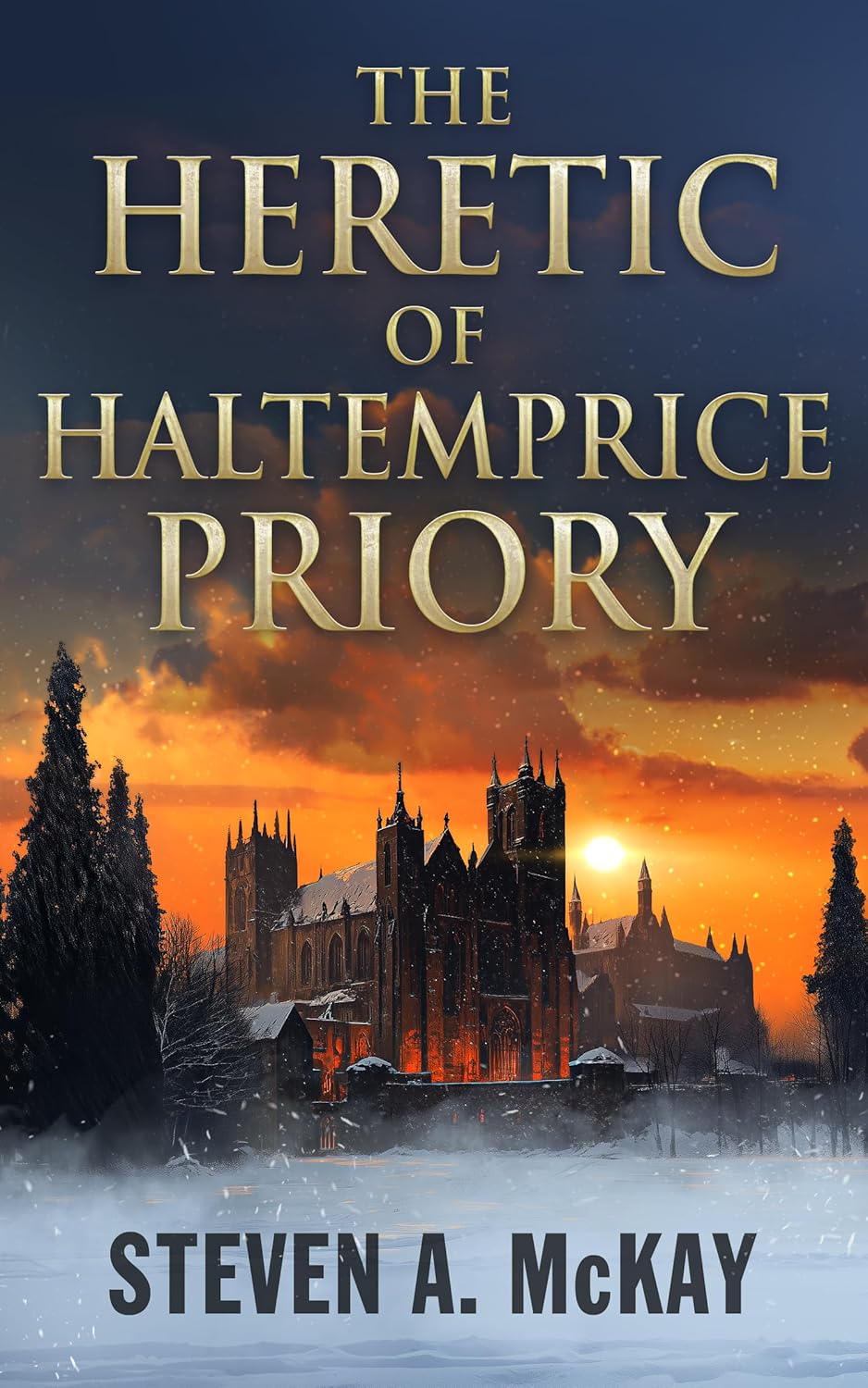
Book Corner: The Heretic of Haltemprice Priory by Steven A. McKay

England, c. AD 1330
Winter fast approaches in East Yorkshire and the dark, cold nights have brought more than just frost to the newly founded Haltemprice Priory. An oppressive pall hangs over the area like a smothering blanket, prompting one of the anxious monks to seek help from an old friend.
Robert Stafford, a friar from nearby Wakefield, has some experience in dealing with strange mysteries, having helped solve a number over the past few years. As he settles into Haltemprice however, things begin to escalate and the friar fears he might have bitten off far more than he can chew this time. Calling on his friends Will Scaflock and the bailiff John Little to work with him it seems they may face more than just earthly enemies as they battle the gloom crushing the spirit, and perhaps the very life, from the inhabitants of the priory.
One monk with a library of eldritch books seems to know much about the progressively more deadly troubles afflicting windswept, frostbitten Haltemprice, but is he a lunatic, a heretic, a murderer, or perhaps something even more terrifying?

Steven A. McKay’s idea of a “novella” stretches the truth a tad with The Heretic of Haltemprice Priory. It must be close to 50,000 words!

But who’s complaining?

Certainly not me!

I have been saying for years that Steven should do a full-length detective/mystery novel featuring Friar Tuck, Little John and Will Scarlet. And I suspect, this is as close as I’m going to get to one.

In The Heretic of Haltemprice Priory, Friar Tuck is called in by an old friend to discover the malaise that afflicts his priory. It is hard to pin down, but a sense of doom and gloom appears to infect not only the monks, but everyone within the priory’s walls. When Tuck realises the depths of the mystery, and the strange happenings that border on the occult, he calls for his old friends, Will and John, to help him solve the mystery.

“This is a very impressive priory,” he said, peering up and gesturing vaguely around, his hand casting long shadows in the candlelight. “I’d have thought the brothers and lay people living here would be happy with their new surroundings.”

“And yet…” Simon de Poher breathed, chewing his lip.

“And yet.” Tuck nodded. “I’ve hardly seen anyone so far, as if everyone is hiding, and those I have met seem nervous about something. Frightened even.”

The door to the cloister rattled at his words, pushed against the latch by the gusting wind outside.

De Poher swallowed again and looked up at the ceiling, as if he were begging God for guidance.

Tuck stood and walked to the nearest bookcase. He knew some of the library’s collection was valuable as some of the books were actually chained to the shelves so that they could not be lost or stolen. The shelves themselves were Brand new and had clearly been made by skilled carpenters, but many of the books on show were very old and Tuck hesitated to draw any out in case he damaged them.

“You’re right,” de Poher said behind him. “Everyone in Haltemprice seems to be anxious, including me.”

“Why?” Tuck asked, turning back to face him.

“Well, that’s the thing,” the cantor chuckled bleakly. “I have no idea.”

Tuck’s brow lifted and he leaned back thoughtfully. “You must have some clue, ” he stated.

“No,” the cantor said, shaking his head. Nothing has happened as far as I’m aware. No one has died violently, or threatened us, or, well, anything like that at all in the time we’ve been here. This place…” He trailed off, casting wary glances into the dark corners and atone particular section of books. “This place just seems to crush the spirit, which is unfathomable given it’s a house of God!” He cringed as he said the last few words, as if fearing he’s be struck down by a divine bolt of lightning or, perhaps, something less holy…

It is a strange tale.

But it is one that grabs you.

Steven A. McKay’s wonderful characters certainly keep you entertained. The strange goings-on are freaky, from sacrificed pigs to disturbed ancient graves. And books that border on the heretical. The reader will be as discomfited as the heroes themselves. And as determined to uncover the truth behind the priory’s place at the centre of events. Full of dark imagery and breathless suspense, The Heretic of Haltemprice Priory will keep you on the edge of your seat (and possibly behind it!).

Ok, I’m exaggerating a little. It is not too scary, rather it allows the reader to let his or her imagination wander into the dark corners of a monk’s cell – and mind. The supernatural elements leave the reader wondering if the mystery will ever – can ever – be solved. It also leaves the reader wanting more from Tuck, Scarlet and Little John. And with the arrival of a mysterious tinker at the end of the book, the hope is that we are going to get it!

The Heretic of Haltemprice Priory is perfect reading for a cold winter night by an open fire. But with all the lights on, just in case!

To Buy the Book:

The Heretic of Haltemprice Priory is now available from Amazon on Kindle and in paperback.

About the author:

Steven A McKay was born in Scotland in 1977 and always enjoyed studying history. He decided to write his Forest Lord novels after seeing a house called “Sherwood” when out at work one day. Since then he’s started a new series, the Warrior Druid of Britain Chronicles, and just completed a trilogy about Alfred the Great.

Steven used to be in a heavy metal band although he tend to just play guitar in his study these days. He did use those guitars to write the theme song for the podcast he co-hosts, Rock, Paper, Swords! with Matthew Harffy, though. Give it a listen, they’ve interviewed great guests like Diana Gabaldon, Simon Scarrow, Bernard Cornwell, Dan Jones and more.

*

My Books:

Signed, dedicated copies of all my books are available through my online bookshop.

Coming 30 January 2025: Scotland’s Medieval Queens

Scotland’s history is dramatic, violent and bloody. Being England’s northern neighbour has never been easy. Scotland’s queens have had to deal with war, murder, imprisonment, political rivalries and open betrayal. They have loved and lost, raised kings and queens, ruled and died for Scotland. From St Margaret, who became one of the patron saints of Scotland, to Elizabeth de Burgh and the dramatic story of the Scottish Wars of Independence, to the love story and tragedy of Joan Beaufort, to Margaret of Denmark and the dawn of the Renaissance, Scotland’s Medieval Queens have seen it all. This is the story of Scotland through their eyes.

Available for pre-order now.

Also by Sharon Bennett Connolly:

Heroines of the Tudor World tells the stories of the most remarkable women from European history in the time of the Tudor dynasty, 1485-1603. These are the women who ruled, the women who founded dynasties, the women who fought for religious freedom, their families and love. Heroines of the Tudor World is now available for pre-order from Amberley Publishing and Amazon UK. Women of the Anarchy demonstrates how Empress Matilda and Matilda of Boulogne, unable to wield a sword themselves, were prime movers in this time of conflict and lawlessness. It shows how their strengths, weaknesses, and personal ambitions swung the fortunes of war one way – and then the other. Available from Bookshop.orgAmberley Publishing and Amazon UKKing John’s Right-Hand Lady: The Story of Nicholaa de la Haye is the story of a truly remarkable lady, the hereditary constable of Lincoln Castle and the first woman in England to be appointed sheriff in her own right. Available from all good bookshops Pen & Sword Booksbookshop.org and Amazon

Defenders of the Norman Crown: The Rise and Fall of the Warenne Earls of Surrey tells the fascinating story of the Warenne dynasty, from its origins in Normandy, through the Conquest, Magna Carta, the wars and marriages that led to its ultimate demise in the reign of Edward III. Available from Pen & Sword BooksAmazon in the UK and US, and Bookshop.orgLadies of Magna Carta: Women of Influence in Thirteenth Century England looks into the relationships of the various noble families of the 13th century, and how they were affected by the Barons’ Wars, Magna Carta and its aftermath; the bonds that were formed and those that were broken. It is now available in paperback and hardback from Pen & SwordAmazon, and Bookshop.orgHeroines of the Medieval World tells the stories of some of the most remarkable women from Medieval history, from Eleanor of Aquitaine to Julian of Norwich. Available now from Amberley Publishing and Amazon, and Bookshop.orgSilk and the Sword: The Women of the Norman Conquest traces the fortunes of the women who had a significant role to play in the momentous events of 1066. Available now from Amazon,  Amberley Publishing, and Bookshop.org.

Alternate Endings: An anthology of historical fiction short stories including Long Live the King… which is my take what might have happened had King John not died in October 1216. Available in paperback and kindle from Amazon.

Podcast:

Have a listen to the A Slice of Medieval podcast, which I co-host with Historical fiction novelist Derek Birks. Now at over 50 episodes, Derek and I welcome guests, such as Bernard Cornwell, and discuss a wide range of topics in medieval history, from significant events to the personalities involved. In episode 18, Steven A. McKay joined us to discuss his Forest Lord series, and the legend of Robin Hood.

*

Don’t forget! Signed and dedicated copies of all my books are available through my online bookshop.

For forthcoming online and in-person talks, please check out my Events Page.

You can be the first to read new articles by clicking the ‘Follow’ button, liking our Facebook page or joining me on TwitterThreadsBluesky and Instagram.

©2024 Sharon Bennett Connolly FRHistS
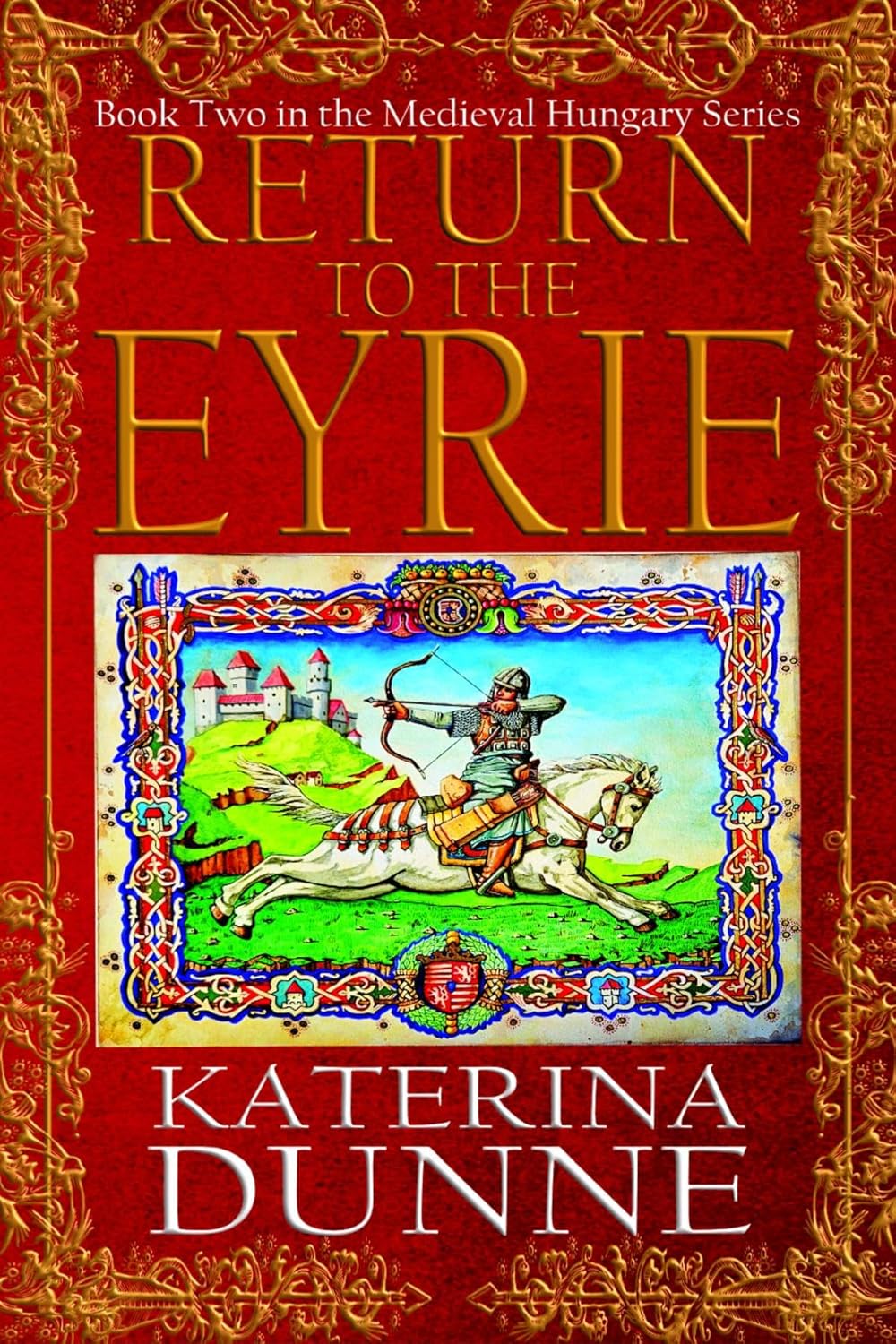
Book Corner: Return to the Eyrie by Katerina Dunne

Honour, revenge, and the quest for justice.

Belgrade, Kingdom of Hungary, 1470

Raised in exile, adolescent noblewoman Margit Szilágyi dreams of returning to her homeland of Transylvania to avenge her father’s murder and reclaim her stolen legacy. To achieve this, she must break the constraints of her gender and social status and secretly train in combat. When the king offers her a chance at justice, she seizes it – even if it means disguising herself as a man to infiltrate the vultures’ nest that now occupies her ancestral ‘eyrie’. Plagued by childhood trauma and torn between two passionate loves, Margit faces brutal battles, her murderous kin’s traps and inner demons on her quest for vengeance. Only by confronting the past can she reclaim her honour – if she can survive long enough to see it through. Return to the Eyrie is an epic coming-of-age tale of a young woman’s unwavering pursuit of justice and destiny in 15th century Hungary.

A couple of years ago, I had the pleasure of reading and reviewing Lord of the Eyrie by Katerina Dunne, a novel set in late medieval Hungary. It was a fascinating introduction to a country whose History I know very little about. And the story was incredible, a family drama, with vivid battle scenes and intricately woven plotlines. It certainly left me wanting more. It was an absolute pleasure to read. So, when Katerina told me she had written a sequel, I jumped at the chance to read it. I was intrigued as to how the story would continue.

And it is a stunning sequel to Lord of the Eyrie, following the daughter of Sandor, the hero in the first book, who is trying to find out exactly what happened to her father. She also wants to clear his name. unscrupulous enemies branded Sandor a traitor. Margit aims to prove he wasn’t.

Margit grew up without family, protected by her nurse and her father’s best friend, and knowing that she had been deprived of her inheritance and position in the world. The search for the truth drives her. But she is not the traditional Hungarian girl. A born leader, she learns to fight – against her father’s enemies and against the life that is planned out for her.

In the lambent glow of the oil lamp, Ahmed traced a thumb down the flat of Margit’s blade, carefully like touching a precious gem. “Beautiful,” he murmured.

“Will you show me how to use it?”

Fixed on the etching, Ahmed’s eyes narrowed, and his forehead wrinkled as though his mind was caughter by a distant recollection. “Where did you find this?”

Margit swallowed back her sudden apprehension. “Why do you ask?”

“You didn’t steal it, did you?”

“No!” She snatched the dagger from Ahmed’s hand, placed it back in its box and slammed the lid shut. “It’s mine.” She wrapped her arms about her precious possession.

“Why are you so angry?” Adnan ventured but shrank back at once, cowering under her fierce gaze.

“Forgive me,” Ahmed said. “I don’t know the family, but I remember the coat of arms.”

Margit’s stomach tightened. “You do?”

“An old story. Some other time. You don’t keep Erzsi waiting outside.”

He waved Margit away, but she let the canvas bag with her other gifts drop from her shoulder. “Erzsi will not mind waiting. Please, tell me.”

Ahmed cleared his throat. His eyes wandered away to times long past. “When Sultan Mehmed besieged Belgrade fifteen years ago, I fought beside Janissaries against Hunyadi’s army -“

“General Janos Hunyadi? The king’s late father?” Margit interrupted him, eyes wide open with excitement.

The general was her own father’s overlord. Hungary’s bravest protector as Imre always referred to him, tearing every time he uttered his name.

Ahmed nodded. “Yes. His defenders trapped us in the town. I killed many but then saw this tall and skilled knight. No Shield; just a sword in one hand and axe in the other, slaying Janissaries like untrained peasants.” He pointed at Margit’s box. “He wore this coat of arms. I thought I must stop him. I attacked. But I never fought anyone like him. By Allah, he had no fear; didn’t care if he lives or dies.”

Margit is a wonderful heroine, determined to seek out the truth, and to forge her own path. Not always aware of, or concerned for, the feelings of others, the teenager searches out her own destiny and confronts her enemies, putting herself and those who love her in danger.

Margit is not always a likeable heroine. She is sometimes selfish. But, she is a teenage girl who has lost practically everything – family, home, identity. In trying to recover what is lost, she becomes a more sympathetic character, learning to compromise and reach an understanding with those around her. The reader will become invested in her journey.

Return to the Eyrie by Katerina Dunne is set in medieval Hungary, a land which Katerina Dunne recreates in astonishing detail. The landscape, the settlements, castles and people help to draw the reader into the story. Hungary is a land rich in resources but beset by enemies, both within and without, and the heroine, Margit, must navigate not only national politics, international enemies but also her own identity as a young woman and the daughter of an accused traitor.

It is a wonderful, rich and absorbing story. I highly recommend it!

To Buy the Book:

Return to the Eyrie is available in paperback and on Kindle from Amazon – and is currently only 49p, so snap it up!

About the author:

Katerina Dunne is the pen-name of Katerina Vavoulidou. Originally from Athens, Greece, Katerina has been living in Ireland since 1999. She has a degree in English Language and Literature from the University of Athens, an MA in Film Studies from University College Dublin and an MPhil in Medieval History from Trinity College Dublin. While she used to write short stories for family and friends in her teenage years, she only took up writing seriously in 2016-17, when she started work on her first novel.

Katerina’s day job is in financial services, but in her free time she enjoys reading historical fiction and watching historically-themed movies and TV series. She is passionate about history, especially medieval history, and her main area of interest is 13th to 15th century Hungary. Although the main characters of her stories are fictional, Katerina uses real events and personalities as part of her narrative in order to bring to life the fascinating history of the medieval Kingdom of Hungary, a location and time period not so well-known to English-speaking readers.

*

My Books:

Signed, dedicated copies of all my books are available through my online bookshop.

Coming 30 January 2025: Scotland’s Medieval Queens

Scotland’s history is dramatic, violent and bloody. Being England’s northern neighbour has never been easy. Scotland’s queens have had to deal with war, murder, imprisonment, political rivalries and open betrayal. They have loved and lost, raised kings and queens, ruled and died for Scotland. From St Margaret, who became one of the patron saints of Scotland, to Elizabeth de Burgh and the dramatic story of the Scottish Wars of Independence, to the love story and tragedy of Joan Beaufort, to Margaret of Denmark and the dawn of the Renaissance, Scotland’s Medieval Queens have seen it all. This is the story of Scotland through their eyes.

Available for pre-order now.

Also by Sharon Bennett Connolly:

Heroines of the Tudor World tells the stories of the most remarkable women from European history in the time of the Tudor dynasty, 1485-1603. These are the women who ruled, the women who founded dynasties, the women who fought for religious freedom, their families and love. Heroines of the Tudor World is now available for pre-order from Amberley Publishing and Amazon UK. Women of the Anarchy demonstrates how Empress Matilda and Matilda of Boulogne, unable to wield a sword themselves, were prime movers in this time of conflict and lawlessness. It shows how their strengths, weaknesses, and personal ambitions swung the fortunes of war one way – and then the other. Available from Bookshop.orgAmberley Publishing and Amazon UKKing John’s Right-Hand Lady: The Story of Nicholaa de la Haye is the story of a truly remarkable lady, the hereditary constable of Lincoln Castle and the first woman in England to be appointed sheriff in her own right. Available from all good bookshops Pen & Sword Booksbookshop.org and Amazon

Defenders of the Norman Crown: The Rise and Fall of the Warenne Earls of Surrey tells the fascinating story of the Warenne dynasty, from its origins in Normandy, through the Conquest, Magna Carta, the wars and marriages that led to its ultimate demise in the reign of Edward III. Available from Pen & Sword BooksAmazon in the UK and US, and Bookshop.orgLadies of Magna Carta: Women of Influence in Thirteenth Century England looks into the relationships of the various noble families of the 13th century, and how they were affected by the Barons’ Wars, Magna Carta and its aftermath; the bonds that were formed and those that were broken. It is now available in paperback and hardback from Pen & SwordAmazon, and Bookshop.orgHeroines of the Medieval World tells the stories of some of the most remarkable women from Medieval history, from Eleanor of Aquitaine to Julian of Norwich. Available now from Amberley Publishing and Amazon, and Bookshop.orgSilk and the Sword: The Women of the Norman Conquest traces the fortunes of the women who had a significant role to play in the momentous events of 1066. Available now from Amazon,  Amberley Publishing, and Bookshop.org.

Alternate Endings: An anthology of historical fiction short stories including Long Live the King… which is my take what might have happened had King John not died in October 1216. Available in paperback and kindle from Amazon.

Podcast:

Have a listen to the A Slice of Medieval podcast, which I co-host with Historical fiction novelist Derek Birks. Derek and I welcome guests, such as Bernard Cornwell, and discuss a wide range of topics in medieval history, from significant events to the personalities involved.

*

Don’t forget! Signed and dedicated copies of all my books are available through my online bookshop.

For forthcoming online and in-person talks, please check out my Events Page.

You can be the first to read new articles by clicking the ‘Follow’ button, liking our Facebook page or joining me on TwitterThreadsBluesky and Instagram.

©2024 Sharon Bennett Connolly FRHistS
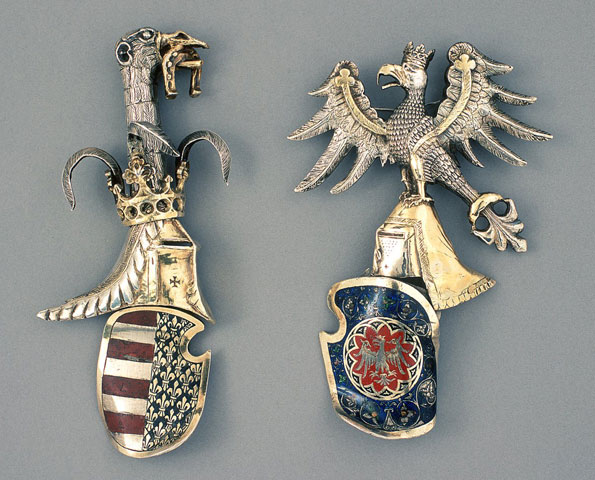
Guest Post: Empresses, Saints and Female-Kings: The Four Great-Granddaughters of King Ladislaus the Elbow-High by Katarzyna Ogrodnik-Fujcik

Today it is a pleasure to welcome my good friend, Kasia Ogrodnik to History…the Interesting Bits with a little bit of Polish history for us. I have been wanting to tell the story of King Jadwiga since writing about her in Heroines of the Medieval World. But Kasia is far better qualified to write about her compatriot, Poland’s famous female king and saint, and Jadwiga’s influential female relatives.

So, over to Kasia…

Empresses, Saints and Female-Kings: The Four Great-Granddaughters of King Ladislaus the Elbow-High

Charles IV, King of Bohemia and Holy Roman Emperor and Anna of Schweidnitz [Anna Świdnicka], c. 1357, Chapel of St. Katherine, Karlstejn

The night of 19 May 1365 saw a young girl leaving Pisa on horseback. With her hair loose, clad only in her nightgown she was galloping to safety after fire broke out in Palazzo degli Anziani. Judging by her looks no one would have guessed this girl was in fact Holy Roman Empress and Queen of Bohemia. 

Anna of Schweidnitz, Silesia (today Poland), was the only child of Duke Henry II, the grandson of King Ladislaus the Elbow-High of Cracow (Poland). Upon her father’s death she was placed under the care of his elder brother, her uncle, Bolko II the Small. The ruler of the small, but politically important duchy, Bolko was the last independent Silesian Piast. Since Charles IV of Luxembourg intended to annex the entirety of Silesia to the Kingdom of Bohemia, Bolko’s duchy, being the only missing part, was crucial to his plans. To secure the Schweidnitz inheritance Charles married Anna and this is how her journey began. Of course, she was not the only great-granddaughter of King Ladislaus to make an illustrious career. His three other great-granddaughters were to leave their marks on the world, too, and indelible ones. Two of them were to be crowned ”kings” and one proclaimed  saint. 

Anna of Schweidnitz [Anna Świdnicka], bust in St Vitus Cathedral, Prague, c. 1370

Anna of Schweidnitz (b.1339), Queen of Bohemia and Holy Roman Empress, was Charles IV of Luxembourg’s third wife. Initially she was betrothed to his son, Wenceslaus, but the boy died while still very young. His mother, Charles’s second wife died too shortly afterwards. To secure the Schweidnitz succession Charles decided to marry his late son’s fiancee himself. Anna was raised and educated at the splendid court of Queen Elizabeth of Poland (her late father’s aunt) at Buda, where she was sent by her uncle and official guardian, Duke Bolko II the Small. It was there where she and Charles were married in the closing days of  May 1353. Shortly afterwards the newlyweds returned to Prague and paid a visit to Schweidnitz, where the succession treaty was signed according to which the duchy was to be inherited by Anna and her children by Charles upon the death of her uncle Bolko and his wife Agnes of Habsburg. On 28 July 1353, Anna was crowned Queen of Bohemia and the following year, on 9 February 1354, Queen of Germany. The year 1355 saw the royal couple in Italy, where on Easter Sunday (5 April 1355) they were crowned Holy Roman Emperor and Holy Roman Empress in a splendid ceremony in the Basilica of Saint Peter, Rome.

Anna and Charles’s first child, a daughter, Elizabeth, was born in 1358. Charles was overjoyed, but Anna felt she failed her husband (which we know thanks to her surviving correspondence with Petrarch). A much awaited son and heir arrived three years later, named Wenceslaus, traditional name of the rulers of Bohemia. He was to become Charles’ beloved and favoured child. Anna died on 11 July 1362, in childbirth, aged 23. The child did not survive, either, and they were buried together in St Vitus Cathedral, Prague. Anna was remembered for her personal charm and sweet nature. Not only did she receive a bluestocking education, but she was also considered one of the style icons of her time, her reputation as a great beauty resting on the surviving images created during her lifetime and shortly after her untimely death. Tradition has it that of Charles’ four wives it was Anna he loved most. Stricken with grief upon her passing, he did not remarry until a political situation forced him to. His fourth wife was Anna’s kin, Elizabeth of Pomerania, also great-granddaughter of King Ladislaus the Elbow-High. 

Elizabeth of Pomerania (Eliška Pomořanská, Elżbieta Pomorska)

 
Reliquary Shrine of Elizabeth of Poland, Queen of Hungary, Maria and Jadwiga’s paternal grandmother, attributed to Jean de Touyl, ca. 1350 . Metropolitan Museum of Art, New York

Elizabeth was a daughter of Duke Bogusław the Great of Pomerania and Princess Elżbieta of Poland. In 1362 her maternal grandfather, King Casimir the Great of Poland together with his nephew, Louis the Great of Hungary, dukes of Austria and Bavaria formed a coalition against Charles IV of Luxembourg. The opposing parties found themselves on the verge of war, which did not break out, however, perhaps due to Anne of Schweidnitz’s untimely death. The rulers came to terms instead and a marriage was forged to consolidate their agreement. Charles was to marry Elizabeth. He was thrice her age, shorter than her and not very attractive. She was described as beautiful, full of life, and as fit as a fiddle. Stories had it that she could break horseshoes with her own hands. She was an avid horse rider and hunter. 

The wedding ceremony was celebrated in Kraków on 21 May 1363. Afterwards the couple travelled together to Prague where Elizabeth was crowned Queen of Bohemia. Five years later her imperial coronation at Rome followed. Despite the age difference she and Charles got along well, being married for fifteen years. Their union produced six children, four of whom were to reach adulthood. Charles and Elizabeth’s eldest child, a daughter Anne, was to marry Richard II and become Queen Consort of England. Their son, Sigismund was to be crowned King of Bohemia, Hungary and Holy Roman Emperor. Charles IV died in 1378. Elizabeth herself was to outlive her husband for fifteen years. She died in 1393 and like his three wives before her, she was buried in St Vitus Cathedral, Prague.

Mária [Mary] of Anjou, King of Hungary

The coats of arms of Hungary and Poland, c. 1340. Treasury of Aachen Cathedral, Germany

Mary was one of the three daughters of Louis the Great of Hungary and his second wife, Elizabeth of Bosnia. In 1379, Mary’s elder sister Catherine died, leaving her and her sister Jadwiga Louis’s sole surviving children. The matter of Polish succession had been on the agenda long before Mary was born. Upon King Casimir the Great’s death in 1370 his nephew, Mary’s father, Louis was crowned king of Poland. Initially it was Mary, who was to succeed him as the king of Poland, but the events took a different turn, and in the end she was replaced by her younger sister, Jadwiga [Hedwig]. 

Mary was crowned “king” of Hungary on 17 September 1382, seven days after her father’s death. However, the idea of a female monarch was not popular among the Hungarian nobility. Many nobles considered Charles III of Naples, Mary’s distant cousin, the lawful heir. 

Charles landed in Dalmatia in September 1385. In October Mary was married to Sigismund of Luxembourg, however, this  could not prevent Charles from entering the capital.  Mary was forced to renounce the throne and Charles’s coronation took place on 31 December 1385. He did not rule for long. Two months later, in February 1386, he was murdered, most probably at the instigation of Mary’s mother. Mary was restored, but in July she and her mother were captured by the dead king’s supporters. Famed for her beauty, but not for her political decisions, Mary’s mother met a violent end. After imprisonment by her opponents in Novigrad castle, she was found guilty of the murder of Charles III of Naples and strangled to death before her daughter’s own eyes, her body put on display, hanging on a rope from the castle walls. Mary survived and was rescued by her husband, Sigismund, who was crowned king of Hungary afterwards. Mary officially remained his co-ruler, but had no real influence on the government. She died on 17 May 1395 after falling from a horse during a hunting accident. She was pregnant at the time. Her prematurely born son did not survive either. 

Jadwiga [Hedwig] of Anjou, king and patron saint of Poland

Jadwiga and Maria, their mother and their sister Catherine as depicted on the St Simeon’s casket, Zadar, Croatia

Mary’s younger sister, Hedwig was born on 18 February 1374, being the youngest of the three daughters of Louis the Great of Hungary and Elizabeth of Bosnia. 

Both Mary and Jadwiga received a bluestocking education, Jadwiga both at the cultivated court of Hungary and in Vienna, at the court of her future father-in-law. Not only could Jadwiga read and write, but she also spoke fluent Latin and German. As the king of Poland she owned a big library and always  showed an active and generous support of scholars and learning institutions.

Since Polish nobles did not like the idea of Mary’s consort, Sigismund of Bohemia, becoming de facto their king, they appealed to Elizabeth of Bosnia, the dowager queen, who had assumed regency, asking to send the younger of her two surviving daughters to Kraków. Elizabeth agreed and absolved the Polish nobles from the oath of loyalty they had pledged to Mary. 

Jadwiga’s coronation took place on 16 October 1384 in Wawel Cathedral, Kraków, where she was crowned ”king” of Poland. On 18 January 1385 the Lithuanian delegation came to the capital and a meeting was held with the representatives of the Polish nobility. Jadwiga was to marry the ruler of pagan Lithuania, Jogaila. In the opening days of 1386, Jadwiga publicly called off her engagement to Wilhelm Habsburg and married newly baptised Jogaila, who was to come down in history under his new name, Władysław Jagiełło [Ladislaus Jagiellon]. At the time of their wedding she was twelve, he was thirty-five. Władyslaw was crowned king on 4 March 1386. 

Despite her young age Jadwiga continued to play an active role in the administration and politics of her realm. She conducted the negotiations with the knights of the Teutonic Order, but also on the Hungarian front. Jadwiga conferred with her sister Mary on numerous occasions. Their meetings were held both in Hungary and in Lesser Poland. She also intervened in Lithuania, where she peacefully resolved dynastic disputes between the ruling fractions.

Jadwiga’s tomb effigy from 1902 by Antoni Madeyski, Wawel Cathedral, Kraków, Poland. The queen’s earthly remains were transferred here from her original resting place at the high altar in 1949 and stayed here till 1987. Then they were transferred to the altar with the Black Crucifix

She was famed for her charity and showing great care to the poor and the ill. Her active and generous support of scholars and learning institutions did not waver over the years. In her last will she donated all her jewelry, her rich dresses and other valuable objects to the Kraków Academy (the first Polish university founded by Kazimierz Wielki), now the Jagiellonian University. Additionally, she founded a dormitory for Polish students at the University of Prague. 

Jadwiga died from complications in childbirth on 17 July 1399. She was twenty-five at the time. Her daughter did not survive, either. Almost immediately after her death, Jadwiga’s tomb became the focus of miracles and the destination of pilgrimages. Her cult flourished, with her canonization first mentioned during the funeral ceremony. However, it was to take seven centuries before she was actually canonised by Pope John Paul II. Ever since she has been recognised as patron saint of Poland and considered Polish national hero. 

About the author:

Katarzyna Ogrodnik-Fujcik specializes in British literature and history, her area of expertise being the first Plantagenets (the Angevins). She lives in Poland. She writes for different magazines and websites on Polish and European Middle Ages. She runs a blog dedicated to Henry the Young King. She consulted a BBC documentary on William Marshal.

*

My Books:

Signed, dedicated copies of all my books are available through my online store.

OUT NOW! Heroines of the Tudor World

Heroines of the Tudor World tells the stories of the most remarkable women from European history in the time of the Tudor dynasty, 1485-1603. These are the women who ruled, the women who founded dynasties, the women who fought for religious freedom, their families and love. These are the women who made a difference, who influenced countries, kings and the Reformation. In the era dominated by the Renaissance and Reformation, Heroines of the Tudor World examines the threats and challenges faced by the women of the era, and how they overcame them. From writers to regents, from nuns to queens, Heroines of the Tudor World shines the spotlight on the women helped to shape Early Modern Europe.

Heroines of the Tudor World is now available for pre-order from Amberley Publishing and Amazon UK.

Coming 30 January 2025: Scotland’s Medieval Queens

Scotland’s history is dramatic, violent and bloody. Being England’s northern neighbour has never been easy. Scotland’s queens have had to deal with war, murder, imprisonment, political rivalries and open betrayal. They have loved and lost, raised kings and queens, ruled and died for Scotland. From St Margaret, who became one of the patron saints of Scotland, to Elizabeth de Burgh and the dramatic story of the Scottish Wars of Independence, to the love story and tragedy of Joan Beaufort, to Margaret of Denmark and the dawn of the Renaissance, Scotland’s Medieval Queens have seen it all. This is the story of Scotland through their eyes.

Available for pre-order now.

Also by Sharon Bennett Connolly:

Women of the Anarchy demonstrates how Empress Matilda and Matilda of Boulogne, unable to wield a sword themselves, were prime movers in this time of conflict and lawlessness. It shows how their strengths, weaknesses, and personal ambitions swung the fortunes of war one way – and then the other. Available from Bookshop.orgAmberley Publishing and Amazon UKKing John’s Right-Hand Lady: The Story of Nicholaa de la Haye is the story of a truly remarkable lady, the hereditary constable of Lincoln Castle and the first woman in England to be appointed sheriff in her own right. Available from all good bookshops Pen & Sword Booksbookshop.org and AmazonDefenders of the Norman Crown: The Rise and Fall of the Warenne Earls of Surrey tells the fascinating story of the Warenne dynasty, from its origins in Normandy, through the Conquest, Magna Carta, the wars and marriages that led to its ultimate demise in the reign of Edward III. Available from Pen & Sword BooksAmazon in the UK and US, and Bookshop.org

Ladies of Magna Carta: Women of Influence in Thirteenth Century England looks into the relationships of the various noble families of the 13th century, and how they were affected by the Barons’ Wars, Magna Carta and its aftermath; the bonds that were formed and those that were broken. It is now available in paperback and hardback from Pen & SwordAmazon, and Bookshop.orgHeroines of the Medieval World tells the stories of some of the most remarkable women from Medieval history, from Eleanor of Aquitaine to Julian of Norwich. Available now from Amberley Publishing and Amazon, and Bookshop.orgSilk and the Sword: The Women of the Norman Conquest traces the fortunes of the women who had a significant role to play in the momentous events of 1066. Available now from Amazon,  Amberley Publishing, and Bookshop.org.

Alternate Endings: An anthology of historical fiction short stories including Long Live the King… which is my take what might have happened had King John not died in October 1216. Available in paperback and kindle from Amazon.

Podcast:

Have a listen to the A Slice of Medieval podcast, which I co-host with Historical fiction novelist Derek Birks. Derek and I welcome guests, such as Bernard Cornwell, and discuss a wide range of topics in medieval history, from significant events to the personalities involved.

*

Don’t forget! Signed and dedicated copies of all my books are available through my online store.

For forthcoming online and in-person talks, please check out my Events Page.

You can be the first to read new articles by clicking the ‘Follow’ button, liking our Facebook page or joining me on TwitterThreads and Instagram.

*

©2024 Sharon Bennett Connolly FRHistS and Katarzyna Ogrodnik-Fujcik
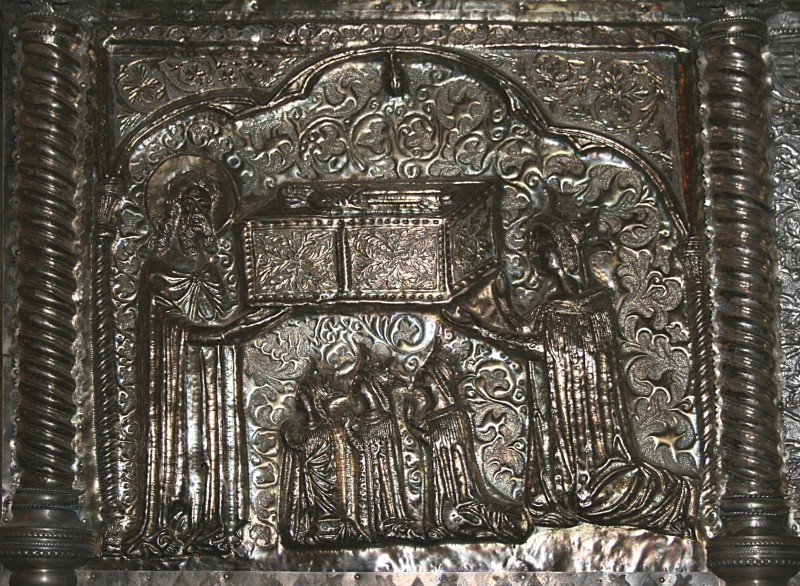
Warenne Family Ties

Seal of John de Warenne, 6th earl of Warenne and Surrey

In the reign of Edward I, when asked Quo Warranto – by what warrant he held his lands – John de Warenne, the 6th earl of Surrey, is said to have drawn a rusty sword, claiming “My ancestors came with William the Bastard, and conquered their lands with the sword, and I will defend them with the sword against anyone wishing to seize them”

When I started writing Defenders of the Norman Crown: Rise and Fall of the Warenne Earls of Surrey, I expected to find a healthy – or, rather, unhealthy – level of sibling rivalry. After all, this family was related to both the Norman and Plantagenet royal families, neither of whom are renowned for any sort of brotherly love.

You only have to look at the warring antics of Robert Curthose, William II and Henry I, to imagine the level of sibling rivalry involved in Norman times. The three brothers fought over who should have Normandy and England after their father’s death, to the extent that Robert Curthose ended up the prisoner of his little brother, Henry I, for the last 30 years of his life. The Plantagenets were little better, with Prince – later King – John trying to steal his brother’s throne while Richard I was imprisoned in Germany.

William de Warenne, 1st Earl Warenne, Trinity Church, Southover.

With these examples in mind, I was surprised to discover that the Warennes were a rather functional bunch as far as family goes. They went out of their way to help and support each other, even to the extent of half-siblings and in-laws. William de Warenne, the first earl of Warenne and Surrey (often referred to, simply, as Earl Warenne), pursued a private feud with English freedom fighter, Hereward the Wake, after he murdered William’s brother-in-law, Frederic. 

The Warenne (Hyde) Chronicle claims that Hereward, ‘Among his other crimes, by trickery he killed Frederick, brother[-in-law] of Earl William of Warenne, a man distinguished by lineage and possessions, who one night was surrounded in his own house.’ Following Frederic’s murder, according to the Chronicle, ‘such discord arose between Hereward and William that it could not be settled by any reparation nor in any court.’ According to the Gesta Herewardi, Frederic was planning to capture or kill Hereward, who struck first by killing Frederic.

William de Warenne was determined to get his revenge; he attempted to ambush Hereward at a place called Earith. One of William’s men tried unsuccessfully to bribe Hereward’s men to betray him. William was unhorsed when Hereward fired an arrow at him; it rebounded from William’s mailcoat, but the force of the shot saw William fall from his horse and rendered unconscious as he hit the ground. The ambush having failed, William de Warenne then appears in the Gesta Herewardi with an angry outburst against the Norman knight Deda, who had given a eulogistic account of the rebels on the Isle of Ely. According to the Liber Eliensis, William ‘flared up with weighty indignation, and alleged that he [Deda] had been inveigled by a bribe and was lying.’

St Pancras Priory, Lewes, the Warenne family mausoleum

William de Warenne, the second Earl Warenne, continued the tradition of looking out for family, when his younger brother, Rainald, was captured by King Henry I. In 1105 Rainald de Warenne was among the supporters of Robert Curthose, Duke of Normandy and Henry I’s oldest brother, who captured and imprisoned Robert fitz Hamon, a friend of King Henry, intending to ransom him. Henry saw fitz Hamon’s capture as an opportunity to deal decisively with Normandy, though he claimed he was invading not out of ambition, but to protect the church and the poor people of Normandy. 

Henry invaded in the spring of 1106. Rainald de Warenne was captured by Henry’s forces during a skirmish at the fortified Abbey of Saint-Pierre-sur-Dive. The abbot there had been plotting with Duke Robert to trap Henry, offering to hand over the castle to the English king, while sequestering Rainald de Warenne, Robert de Stuteville and their men within, ready to seize Henry as soon as he entered. Suspecting treachery, Henry arrived at daybreak with a force of 700 men-at-arms and took the garrison completely by surprise, capturing the duke’s men and burning the castle to the ground.

The sources vary, but Rainald was released either shortly before or shortly after the battle of Tinchebrai – the final, decisive battle between the royal Norman brother. Orderic Vitalis claims that William de Warenne served as one of King Henry’s chief commanders at Tinchebrai and that Rainald was released shortly before the battle. Grateful for his brother’s release, Earl William urged his men to fight the king’s cause with the utmost determination. 

According to the Warenne (Hyde) Chronicle, however, Rainald was not released until after the battle, when he was ‘reluctantly handed back to his brother, who pleaded for him to Henry.’ Whichever is correct, the result was the same, Rainald was now free, thanks to the insistence and loyalty of his older brother.

Warenne shield of blue and gold check, Trinity Church, Southover.

In the next generation, the children and stepchildren of William de Warenne, the 2nd Earl Warenne, got on remarkably well together. William had married Isabel de Vermandois, the widow of the recently deceased Robert de Beaumont, Earl of Leicester. Isabel was already the mother of 9 children, including the famous twins Robert and Waleran de Beaumont, when she married William, with whom the chronicler Henry of Huntingdon claims she was having an affair, even before her husband died. 

With William, Isabel had a further 5 children, 3 boys and 2 girls. Earl Warenne was at King Henry I’s deathbed, alongside his son, also named William de Warenne (the future 3rd Earl Warenne), and stepsons, Waleran and Robert de Beaumont. When the 2nd Earl Warenne died, it was Waleran de Beaumont who became the head of the combined, and rather large, Beaumont/Warenne family. Indeed, Waleran and William de Warenne, 3rd Earl Warenne, having grown tired of the Anarchy – the war between King Stephen and Empress Matilda which lasted from 1135 to 1154 – departed on Crusade together in 1147. Unfortunately, William de Warenne was killed at the Battle of Mount Cadmus in January 1148, and Waleran returned home alone.

A touching story from just before his departure on crusade relates to the 3rd Earl Warenne and his two younger brothers, Reginald and Ralph de Warenne. The earl held a dedication ceremony for the new church at St Pancras Priory, Lewes, the mausoleum of the Warenne family, founded by the 1st earl and his wife, Gundrada. In the accompanying charter, the earl endowed the priory, in which his father and grandparents were buried, and where his mother would soon be laid to rest, with the tenth penny of his rents and ‘giving it seisin thereof by hair from his own head and that of Ralph de Warenne his brother, cut with a knife by Henry, bishop of Winchester, before the altar.’ 

It is not hard to imagine how moving a ceremony this must have been, two brothers kneeling before the altar to have their hair cut by the bishop of Winchester, Henry of Blois, the brother of King Stephen. The scene is made all the more poignant in hindsight, knowing that the third earl never returned from the crusade on which he was about to embark.

Conisbrough Castle

And when the 3rd Earl Warenne failed to return from the Holy Land, it was down to his younger brother, Reginald, to look after the family interests and those of his brother’s sole surviving heir, William’s daughter, Isabel de Warenne, the 4th Countess of Warenne and Surrey. Isabel, though still only a child, had been married to King Stephen’s youngest son, William of Blois, probably before her father’s departure to the Holy Land. Isabel’s second husband, Hamelin, the illegitimate half-brother of Henry II, built the great keep at Conisbrough Castle.

Hamelin and Isabel’s son, William de Warenne, the 5th earl, looked out for the interests of his niece, Alice de Lusignan, in her struggles with the crown, both under King John and Henry III, to secure her inheritance of Tickhill Castle in Yorkshire.

Such examples of the earls taking care of their family, and working in alliance with their in-laws, was to be a feature of every generation down to the 7th and last earl, John II de Warenne, who was given the custody and care of his cousin, Edward Balliol, the son of John Balliol, the deposed King of Scots, around 1307. The Warenne earls, to a man, looked after their relations, both near and far. In the story of a family, it is quite fitting – and highly unusual – that the Warenne earls appear to have always put family first.

*

Images:

Are ©2023 Sharon Bennett Connolly FRHistS except the seal of John de Warenne, which is courtesy of Wikimedia Commons
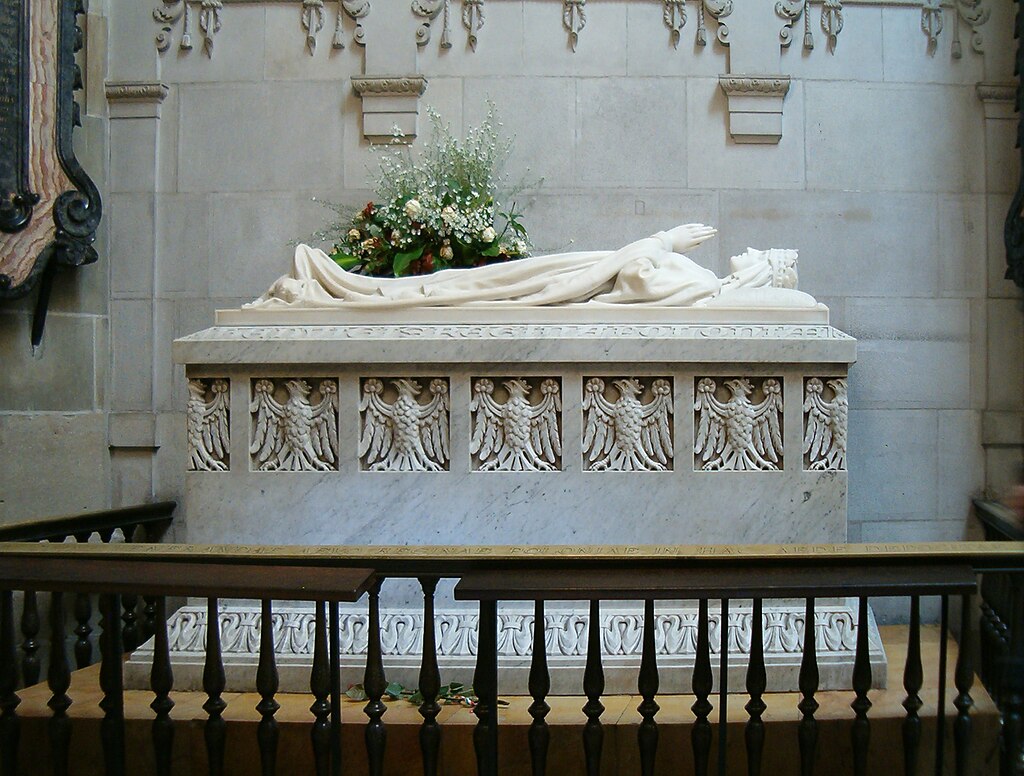
Sources:

Robert Bartlett, England Under the Norman and Angevin Kings; Dan Jones, The Plantagenets; Donald Matthew, King Stephen; Medieval Lands Project on the Earls of Surrey, Conisbrough Castle; Farrer, William and Charles Travis Clay, editors, Early Yorkshire Charters, Volume 8: The Honour of Warenne; Morris, Marc King John: Treachery, Tyranny and the Road to Magna Carta; Church, Stephen, King John: England, Magna Carta and the Making of a Tyrant; doncasterhistory.co.uk; A History of the County of Sussex: Volume 2 edited by William Page; W.H. Blaauw, On the Early History of Lewes Priory, and its Seals, with extracts from a MS. Chronicle, Sussex Archaeological Collections; Rev. John Watson, Memoirs of the Ancient Earls of Warren and Surrey, and Their Descendants to the Present Time, Volume I;  Odo of Deuil, De Profectione Ludovici VII in Orientem; magnacharta.com; Cokayne, G.E., The Complete Peerage, Vol. XII; Henry of Huntingdon, The Chronicle of Henry of Huntingdon; Elisabeth van Houts and Rosalind C. Love, The Warenne (Hyde) Chronicle.

*

My Books

Christmas is coming!

Signed, dedicated copies of all my books are available through my online bookshop.

Coming 15 January 2024: Women of the Anarchy

On the one side is Empress Matilda, or Maud. The sole surviving legitimate child of Henry I, she is fighting for her birthright and that of her children. On the other side is her cousin, Queen Matilda, supporting her husband, King Stephen, and fighting to see her own son inherit the English crown. Both women are granddaughters of St Margaret, Queen of Scotland and descendants of Alfred the Great of Wessex. Women of the Anarchy demonstrates how these women, unable to wield a sword, were prime movers in this time of conflict and lawlessness. It show how their strengths, weaknesses, and personal ambitions swung the fortunes of war one way – and then the other.

Available for pre-order from Amberley Publishing and Amazon UK.

Coming on 15 June 2024: Heroines of the Tudor World

Heroines of the Tudor World tells the stories of the most remarkable women from European history in the time of the Tudor dynasty, 1485-1603. These are the women who ruled, the women who founded dynasties, the women who fought for religious freedom, their families and love. These are the women who made a difference, who influenced countries, kings and the Reformation. In the era dominated by the Renaissance and Reformation, Heroines of the Tudor World examines the threats and challenges faced by the women of the era, and how they overcame them. Some famous, some infamous, some less well known, including Anne Boleyn, Elizabeth Barton, Catherine de Medici, Bess of Hardwick and Elizabeth I. From writers to regents, from nuns to queens, Heroines of the Tudor World shines the spotlight on the women helped to shape Early Modern Europe.

Heroines of the Tudor World is now available for pre-order from Amberley Publishing and Amazon UK.

Also by Sharon Bennett Connolly:

King John’s Right-Hand Lady: The Story of Nicholaa de la Haye is the story of a truly remarkable lady. Nicholaa de la Haye was the hereditary constable of Lincoln Castle and the first woman in England to be appointed sheriff in her own right. Her strength and tenacity saved England at one of the lowest points in its history. Nicholaa de la Haye is one woman in English history whose story needs to be told… King John’s Right-Hand Lady: The Story of Nicholaa de la Haye is now available from Pen & Sword Booksbookshop.org and Amazon.

Defenders of the Norman Crown: The Rise and Fall of the Warenne Earls of Surrey tells the fascinating story of the Warenne dynasty, of the successes and failures of one of the most powerful families in England, from its origins in Normandy, through the Conquest, Magna Carta, the wars and marriages that led to its ultimate demise in the reign of Edward III. Defenders of the Norman Crown: Rise and Fall of the Warenne Earls of Surrey is now available from Pen & Sword BooksAmazon in the UK and US, and Bookshop.org.

Ladies of Magna Carta: Women of Influence in Thirteenth Century England looks into the relationships of the various noble families of the 13th century, and how they were affected by the Barons’ Wars, Magna Carta and its aftermath; the bonds that were formed and those that were broken. It is now available in paperback and hardback from Pen & Sword,  Amazon, and Bookshop.org.

Heroines of the Medieval World tells the stories of some of the most remarkable women from Medieval history, from Eleanor of Aquitaine to Julian of Norwich. Available now from Amberley Publishing and Amazon, and Bookshop.org.

Silk and the Sword: The Women of the Norman Conquest traces the fortunes of the women who had a significant role to play in the momentous events of 1066. Available now from Amazon,  Amberley Publishing, and Bookshop.org.

Alternate Endings: An anthology of historical fiction short stories including Long Live the King… which is my take what might have happened had King John not died in October 1216. Available in paperback and kindle from Amazon.

Podcast:

Have a listen to the A Slice of Medieval podcast, which I co-host with Historical fiction novelist Derek Birks. Derek and I welcome guests, such as Bernard Cornwell, and discuss a wide range of topics in medieval history, from significant events to the personalities involved.

*

Don’t forget! Signed and dedicated copies of all my books are available through my online bookshop.

For forthcoming online and in-person talks, please check out my Events Page.

You can be the first to read new articles by clicking the ‘Follow’ button, liking our Facebook page or joining me on Twitter and Instagram.

*

©2023 Sharon Bennett Connolly FRHistS
Guest Post: the Historical Rabbit Hole by Maxine Sommer

Today I have the pleasure of welcoming Maxine Sommer to History…the Interesting Bits, a lover of Medieval History, if ever there was one. Next year, Maxine will run her first History tours through England and France, following the trail of the Plantagenets.

I fell down a rabbit hole…

And emerged into a historical realm alive with chivalry, intrigue and power struggles.

You may ask what on earth would impel an unassuming middle-aged woman who only braved her first flight outside Australia at the age of 41, to decide to create a tour company specializing in historical-themed tours of France and the UK. The answer my friends resides within the above-mentioned rabbit hole.

I simply picked up a book.

That’s right, imagine if you will, a moment some two decades past when destiny beckoned me towards an unexpected treasure. I have always been an avid reader, but in recent years my enthusiasm for this pastime had been stifled by adulthood’s demands, not least the nurturing of five children. Now it was time… full of excitement at the thought of once again becoming engrossed in a magnificent tale, I explored my sister’s book-laden shelves. I finally opted for one from her collection – as it turns out, a choice guided by the inexplicable precision of fate’s hand. And so dear readers, I found myself totally absorbed within the pages of “The Sunne in Splendour”, penned by the astounding Sharon Kay Penman. The chronicle of Richard III, a monarch enshrouded in a tapestry of infamy, though totally unfamiliar to me at the time, seized my imagination with a tenacious grip. Unbelievably, history, a subject I had spurned in my school days, suddenly beckoned irresistibly. It is a huge book, definitely not for the faint-hearted, and I read it in record time… staying up until the wee hours of the morning because I simply could not put it down. After finishing this, and guided by an unyielding curiosity, I became a well-known visitor to my local library, searching for more of Sharon’s books. The next one I read was “When Christ and his Saints Slept” and with it came the realization that each page was opening another facet of history’s dramatic picture.

Alfred the Great coin

I quickly became totally hooked on this genre, my fascination knew no borders, enjoying tales that ranged from the illustrious King Alfred the Great and the Vikings, to the turmoil of the 18th century. Like a mosaic artist, I pieced together a chronology that unfolded across centuries, each novel augmenting my list of captivating historical figures. Yet in the labyrinth of historical sagas, one dynasty held me spellbound – the indomitable Plantagenets, sovereigns who reigned for more than three centuries, and totally transformed England’s destiny.

The following decade saw me immerse myself in an array of historical fiction, discovering all I could about this powerful dynasty. I even ventured into the uncharted territory of non-fiction, a realm I had never before explored for mere enjoyment. During this time, an unexpected, and slightly off-track obsession took root: the enthralling “Outlander” series by Diana Gabaldon, a time-travelling tale of the final 1745 Jacobite rebellion in Scotland. I was ecstatic when this saga leapt from page to screen in 2014. With recent images of the series in my mind and fueled with a life-long desire to see Scotland, a travel adventure beckoned. Plans were made, the saving began and with much excitement, my sister and I finally embarked on the gruelling 24hr flight to Glasgow in June 2017, to begin an Outlander adventure. We had a ball, and I found that I thoroughly enjoyed the small group atmosphere, which was both friendly and welcoming. Having the services of a Tour Manager as well as a local Tour Guide made our adventure not only personal but truly unique. Little did I realise then that this tour would kindle the spark for my future endeavours.

While the Scottish adventure might not have directly concerned the Plantagenets, my love for this era showed no sign of dimming. My interest was captivated by so many of the historical figures of the time, names like Eleanor of Aquitaine, Edward the Black Prince, and William Marshal, the greatest knight of the Middle Ages, and the power behind five of the Plantagenet kings. Reminiscing on the amazing time I had in Scotland, I began to search for a themed tour in France based on the Plantagenets, surely there had to be one. Unfortunately, and to my absolute disappointment, my search yielded no results whatsoever. The seeds planted in my mind by my tour in Scotland began to take root, a vision took form, and I dared to dream. It would be the words of one of my dearest friends that eventually gave me that final push… she simply said “Max, what is stopping you”? And thus, the idea of Plantagenet Discoveries was born, and I began to read and research the people, history and places I planned to visit.

The Gallery of Kings, Lincoln Cathedral

I worked on convincing my best friend of 30 years to come with me on this epic journey as she too was fascinated with medieval history, and after much deliberation, she decided to join me on this life-changing adventure. Together we embarked on a rollercoaster of meticulous planning, fervent study of tourism and business, and ceaseless research, we even began French lessons. For almost two years we navigated the crazy path between ordinary life, family obligations, our full-time jobs, and all that was necessary to get a new tour business off the ground. Remarkably, the onset of Covid-19 was a blessing in disguise as it allowed us ample planning time. Financial contributions were huge, our optimism continued to grow, and we remained positive this dream would become a reality. That dream was a tour company where we could share our passion for this incredible part of history. It would be a unique small group experience for our guests that would be fun, friendly, and informative, while providing them with the utmost in personal service. With the help of my wonderful son Chris (who happens to be a Digital Marketing Head for an advertising agency), we finally unveiled our website and social media presence in August 2022, it is very handy having our own personal social media guru.

Our flight bookings were confirmed, and the countdown began to September 2nd when we would fly to France and England for our reconnaissance mission. Chris and his partner Martin, who live in Sweden, met us and we enjoyed a short stay in the beautiful city of Paris before we headed off to explore. Serving as chauffeurs for a month, the boys skillfully navigated us across the landscapes of both France and England. While laughter and fun were in abundance, our schedule proved relentless, every moment earmarked for visits to hotels and historic sites, as well as the perpetual task of tending to our social media presence, which is almost a part-time job in itself. The return journey home on September 30th found us both weary to the bone, but looking at the task ahead of us with a mixture of excitement and enthusiasm.

I feel the need to divert off track here for a bit and talk about an extraordinary event that happened during our travels. It was the 8th of September 2022 – a date etched in history as Queen Elizabeth II passed away. For an Australian like me, the surrealism of being present during such a pivotal moment defies description. I will always remember the news reaching us as we ate dinner at a lovely little outdoor café in the historic city of Le Mans, France. For me, the sadness I felt was only surpassed by the profound local response to her death. The French people echoed the lament, and as we travelled around France our shared grief forged connections with all those we encountered. Our foresight in procuring Eurostar tickets months prior to our travels provided us with easy passage across the channel, despite the masses attempting to reach London for the funeral which was scheduled for the 19th of September. As it happened, this was the very day we planned to depart the city, casting us into the logistics of travel amidst large crowds and road closures. Bad timing you would say – well at first that is exactly what I thought. Gradually however, the irony of this situation dawned on me like an epiphany, fate actually has magnificent timing. On a reconnaissance adventure, where we were tracing the footsteps of bygone royalty, we found ourselves in London during the most momentous historic event that most of us will ever see in our lifetime. Up until now we could only read about or imagine the impact that the death of a monarch would have on its people, and yet here we were, given the opportunity of witnessing it firsthand. An entire nation, and a significant part of the world, ground to a halt, queue’s stretched for days as the people sought a final glimpse of their queen. There was an extraordinary sense of ‘something’ that is impossible to verbalise. The myriad of emotions were tangible, sadness, fear, apprehension, but above all an overwhelming sense of loss. We stood there, participants in a sombre yet pivotal chapter of history, another thread woven into the tapestry of the past.

Effigy of Eleanor of Aquitaine, Fontevrault Abbey

But let us return to our narrative, in the spirit of determination, Deb and I set to work. One of the main challenges we faced was the time difference, Australia’s vast isolation meant that all correspondence depended on email. This works fine if you receive responses, but all too often, this does not happen. If it came to having to make phone calls, which it often did, navigating time zones together with full-time working hours certainly is not an easy task. It involves a well-managed calendar I can tell you.

Then there was the language barrier, a real hurdle in communication. It is simple to translate a digital document or email, but when it comes to phone calls, it can be more challenging. I found in France, that many people speak English, occasionally however, challenges arise due to a lack of fluency. I remember the night we stayed at Chateau Castel Novel (a stunning 12th-century castle in central France), we were served the most beautiful and enticing appetizer. The room abounded with laughter as we tried to find out exactly what this dish was made from. The path to success lay in the beacon of humour, for those willing to chuckle at their own linguistic escapades. The mood lightened, communication flowed, and we discovered that the dish was in fact made from potato. With the spirit of laughter as our guide, we began to sow the seeds of rapport, nurturing relationships that we hope will stand the test of time.

Earlier this year, life, often the master of unforeseen twists, dealt us our biggest blow. Due to personal reasons, Deb found herself at a crossroads, her only choice to step away from the venture entirely. The fallout was profound – for us both, it felt like the world had momentarily lost its rhythm. Amid our devastation, a realization emerged that life weaves its own threads of trial and triumph, and God’s plan does not always align with ours, compelling us to soldier on, adapting and accepting.

I am now navigating these waters unaccompanied, and while the quiet absence of another’s counsel is sorely missed, I’ve discovered a reservoir of resilience and unwavering optimism. I have come to terms with my solo voyage, and each wave of uncertainty is met with an anchor of positivity. Numbers were slow initially, but now a silver lining peeks through the clouds in the form of bookings and deposits, heralding the success of my long-anticipated adventure in September 2024.

For me, this has been more than just a business endeavour, it has been a story of remarkable personal growth and transformation. My life has echoed with the mantra “Every day is a school day”, a truth etched into the fabric of my experience. A habit of burying my head in the sand has given way to a newfound tenacity, a willingness to face challenges head-on.

Edward I and Eleanor of Castile, Lincoln Cathedral

As I reach the closing chapter of this article, I can’t help but radiate my enthusiasm. My passion and my vision are no longer confined within the chambers of my imagination, this dream has now become a reality. And you know what is even more fantastic – along the journey, I have found my tribe, and I couldn’t be happier about that!!

So, if this story has resonated with you, I invite you to delve deeper by visiting http://www.plantagenetdiscoveries.com. There, amidst the pages, you will unearth not only the itineraries of our tours, but the musings of heart, encapsulated in my blog posts. You can also follow me on both Facebook and Instagram @plantagenetdiscoveries and I have a friendly Facebook group community where we share photos and stories of medieval history and travel. http://www.facebook.com/groups/loversofmedievalhistorytravel

And for all those among Sharon’s incredible community, a special treat awaits – a 10% discount on each tour, with an additional 5% for the adventurous souls embracing the Back-to-Back option.

Join me on this extraordinary time-travel adventure as we let the echoes of history guide our steps, but more importantly, as we make incredible friendships and memories that will be sure to last a lifetime.

Max

*

My Books

Christmas is coming!

Signed, dedicated copies of all my books are available through my online bookshop.

Coming 15 January 2024: Women of the Anarchy

On the one side is Empress Matilda, or Maud. The sole surviving legitimate child of Henry I, she is fighting for her birthright and that of her children. On the other side is her cousin, Queen Matilda, supporting her husband, King Stephen, and fighting to see her own son inherit the English crown. Both women are granddaughters of St Margaret, Queen of Scotland and descendants of Alfred the Great of Wessex. Women of the Anarchy demonstrates how these women, unable to wield a sword, were prime movers in this time of conflict and lawlessness. It show how their strengths, weaknesses, and personal ambitions swung the fortunes of war one way – and then the other.

Available for pre-order from Amberley Publishing and Amazon UK.

Also by Sharon Bennett Connolly:

Out nowKing John’s Right-Hand Lady: The Story of Nicholaa de la Haye is the story of a truly remarkable lady. Nicholaa de la Haye was the hereditary constable of Lincoln Castle and the first woman in England to be appointed sheriff in her own right. Her strength and tenacity saved England at one of the lowest points in its history. Nicholaa de la Haye is one woman in English history whose story needs to be told…

King John’s Right-Hand Lady: The Story of Nicholaa de la Haye is now available from Pen & Sword Booksbookshop.org and Amazon.

Defenders of the Norman Crown: The Rise and Fall of the Warenne Earls of Surrey tells the fascinating story of the Warenne dynasty, of the successes and failures of one of the most powerful families in England, from its origins in Normandy, through the Conquest, Magna Carta, the wars and marriages that led to its ultimate demise in the reign of Edward III. Defenders of the Norman Crown: Rise and Fall of the Warenne Earls of Surrey is now available from Pen & Sword BooksAmazon in the UK and US, and Bookshop.org.

Ladies of Magna Carta: Women of Influence in Thirteenth Century England looks into the relationships of the various noble families of the 13th century, and how they were affected by the Barons’ Wars, Magna Carta and its aftermath; the bonds that were formed and those that were broken. It is now available in paperback and hardback from Pen & Sword,  Amazon, and Bookshop.org.

Heroines of the Medieval World tells the stories of some of the most remarkable women from Medieval history, from Eleanor of Aquitaine to Julian of Norwich. Available now from Amberley Publishing and Amazon, and Bookshop.org.

Silk and the Sword: The Women of the Norman Conquest traces the fortunes of the women who had a significant role to play in the momentous events of 1066. Available now from Amazon,  Amberley Publishing, and Bookshop.org.

Alternate Endings: An anthology of historical fiction short stories including Long Live the King… which is my take what might have happened had King John not died in October 1216. Available in paperback and kindle from Amazon.

Podcast:

Have a listen to the A Slice of Medieval podcast, which I co-host with Historical fiction novelist Derek Birks. Derek and I welcome guests, such as Bernard Cornwell, and discuss a wide range of topics in medieval history, from significant events to the personalities involved.

*

Don’t forget! Signed and dedicated copies of all my books are available through my online bookshop.

For forthcoming online and in-person talks, please check out my Events Page.

You can be the first to read new articles by clicking the ‘Follow’ button, liking our Facebook page or joining me on Twitter and Instagram.

*

©2023 Maxine Sommer and Sharon Bennett Connolly FRHistS