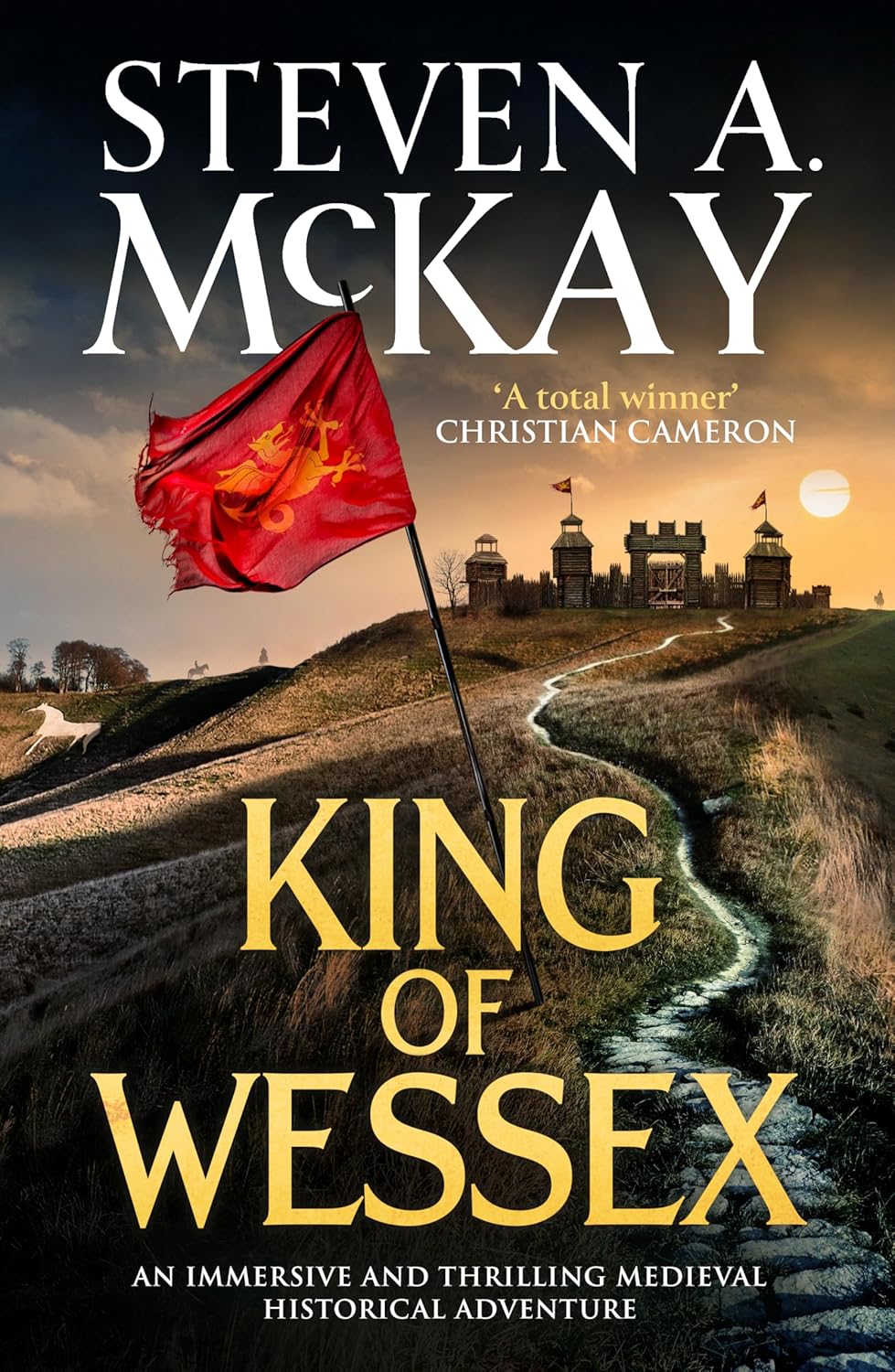
Book Corner: King of Wessex by Steven A. McKay

His reign must come to an end. But his legacy will live on forever.

After thwarting the scourge of the Viking hordes that had decimated Britain for decades, King Alfred assured a period of peace and prosperity for the kingdom of Wessex. The dream of uniting all Anglo-Saxons under one, noble banner seems closer than ever before.

But his enemies are not ones to be taken lightly. For even as Alfred works to ensure the fate of his descendants for centuries to come, a fearsome warlord, Haesten, gathers his warriors for a brutal assault upon the shores of Alfred’s territories.

As the battle lines are drawn, as the true power of this new and terrifying threat comes into its own, the ageing king knows in his heart that things will be different this time round. For as strong as his land, his birthright, his Wessex, has become, the consequences of defeat have never been more terrible.

For one who has gained everything… has everything to lose.

What an incredible adventure it has been!

In his Alfred the Great trilogy, Steven A. McKay has brought the late 9th century to life, retelling the story of Wessex’s stand against the constant incursions of the Norse and the Danes, known collectively as the Vikings. Many fans of Bernard Cornwell will recognise the great enemy of King of Wessex as having been a regular character in his The Last Kingdom series: Haesten. Haesten was the last great enemy that Alfred faced before his death, in a four-year war that ravaged Wessex.

But in King of Wessex, Alfred is no longer fighting alone. He has the help of his daughter, Æthelflæd, now Lady of Mercia, and her husband, Æthelred. His son, Edward, no longer a child, is leading armies of his own. This family affair allows Alfred to defend his kingdom from all sides at once, moving armies to face new threats, knowing his back is covered.

What sets this series apart, however, is the relationships of the characters and King of Wessex shows just how far these relationships have developed. Alfred’s friend and captain Wulfric is a constant by his side. His wife, Ealhswith, gives wise counsel and overlooks his flaws (I am not sure I could overlook the womanising!) And having watched his children mature, Alfred now has to trust them to be his captains and his allies. But Alfred, though getting older and still suffering from the same health issues that would often see him doubled over in pain, is still the man in command. And the man to be beaten.

There were men in Mercia’s Witan who offered, or perhaps demanded would be more accurate, to take control while Aethelred was unwell, but Aethelflaed was not having that.

‘You?’ The thane who asked the question gaped at her incredulously. ‘But you’re a woman!’

Aethelflaed’s lip curled, and she rolled her eyes at him. He was a tall man, very broad of shoulder with a thick, dark beard and hard eyes. She knew she had to deal with him in the right way, or the rest of the gathered Witan would never take her seriously. So much was riding on these next few moments. ‘I am indeed a woman, Morcar. Well spotted. Not much gets past you I see.’

Some of the other council members sniggered and Aethelflaed took note of them. She’d been taught that such information, the dynamics of the Witan such as who liked who and who would like to murder whom, was always useful to know. Similarly, Morcar’s reaction to her gentle but very public insult would also be worth noting.

‘No need to be glib, my lady,’ the big man replied dryly, rather surprising Aethelflaed for she’d half expected him to grow angry at her. That he didn’t was definitely a point in his favour and belied his fierce looks. ‘You know what I mean,’ he went on. ‘Women don’t usually rule in Mercia.’

‘It would only be temporary,’ Aerthelflaed replied, standing up and walking around the hall, eyeing the mostly middle-aged men who formed the Witan. ‘Until my husband is over his illness.’

‘And what if he does not get over it?’ a red-faced, bulbous-nosed man asked bluntly.

‘Then we’d need to look at the matter again, Edgar,’ Aethelflaed barked, annoyed at the question for she’d grown close to Aethelred in the relatively short time they’d been married. ‘But, for now,’ she stopped walking right behind Edgar who was forced to turn in his chair and crane his neck upwards to see her, ‘my husband is alive, and I shall take his place as head of the Witan.’

‘But you’re not even Mercian,’ Edgar argued.

‘I am Mercian now,’ Aethelflaed retorted, her patience growing thin with the dense thane who had actually got to his feet, forcing her to look up at him now. ‘I married your ealdorman, Aethelred, didn’t I? Or does marriage not count for anything these days?’

Edgar shook his head, clearly annoyed. He was only a little taller than her, with thinning white hair, and he ground his teeth as he glared at her, almost as if he wanted to take her over his knee and smack her backside like a naughty child. ‘You might have married Aethelred,’ he growled, ‘but you are your father’s daughter first and foremost. Your loyalty lies with Wessex, not Mercia.’

‘Surely it’s the same thing?’ Aethelflaed asked in a low voice, her steely eyes boring into his.

‘What? Because Alfred has declared himself king of all the Angles and Saxons?’ Edgar asked. His breath was sour and Aethelflaed realised he was drunk.

‘Yes,’ she replied, as if it was obvious. ‘My father is the only king Mercia has, since Aethelred is but an ealdorman. I would remind you, Edgar, that King Alfred, and his fyrd, are the only things standing in the way of the Danes overrunning Mercia completely.’

‘Are you calling us cowards now?’ the inebriated thane demanded, his flushed features contrasting deeply with his white hair. ‘You’re lucky you’re not a man, or I’d show you the men of Mercia are not afraid of anything.’

He was so angry at her that flecks of spittle struck her face as he ranted. And, as he went on, he actually reached out and grasped her sleeve, digging his fingers into her bicep.

Instinctively, Aethelflaed grabbed his hand, twisting his wrist and forcing him to spin around so he was facing the table again. Despite knowing she’d done enough, she could not keep her temper in check and thrust her knee into the back of his, making him stumble and, as he went down, she pushed his face, hard, into the trencher of meat and cheese that he’d been eating from.

I love Aethelflaed!

After three books, Steven A. McKay’s characters are so well developed that you know how they will react to certain situations. Alfred is thoughtful and looks for advice from his captains and churchmen. Edward is still learning, and looks to his father as an example. Aethelflaed is feisty whereas her mother is calm and dependable. Wulfric, the loyal captain, is good in a fight but has his own axe to grind and looks for ways to give Alfred the advantage.

Haesten and his wife, Ulfhild, are bloodthirsty, ruthless and, apparently, unstoppable.

It makes for a fascinating novel, with father, son, daughter and son-in-law each having a role to play in starting the fight back that would lead to a united England. Thanks to the legacy of The Last Kingdom, the story is familiar to many, but Steven A. McKay has made it all his own. King of Wessex, like The Heathen Horde before it and Sword of the Saxons before that, is a fabulously absorbing read. You can practically smell the blood and hear the noise of battle; the clash of swords, the screams of the dying and the shouted orders of Alfred and his captains.

My only regret is that the series is now over. I would have loved to see it continue to the reign of Athelstan and the Battle of Brunanburh – but then, I suppose, it wouldn’t be the story of King Alfred, would it?

As it is, Steven A. McKay has all the ingredients for a riveting good read and he uses them to his best advantage, to create a story that grabs the reader from the very first page. Itis exciting, thought-provoking and will bring a tear to your eye at the end. It is well worth the journey. King of Wessex is a novel that is not to be missed!

Buy the book!

About the author:

Steven A. McKay was born in Scotland in 1977. He is the author of two previous series of historical fiction, following Robin Hood and the warrior-druid Bellicus in post-Roman Britain. He plays the guitar, is the co-host of historical adventure podcast Rock, Paper, Swords! along with author Matthew Harffy, and lives just outside Glasgow with his wife and children.

*

My books

Signed, dedicated copies of all my books are available through my online store.

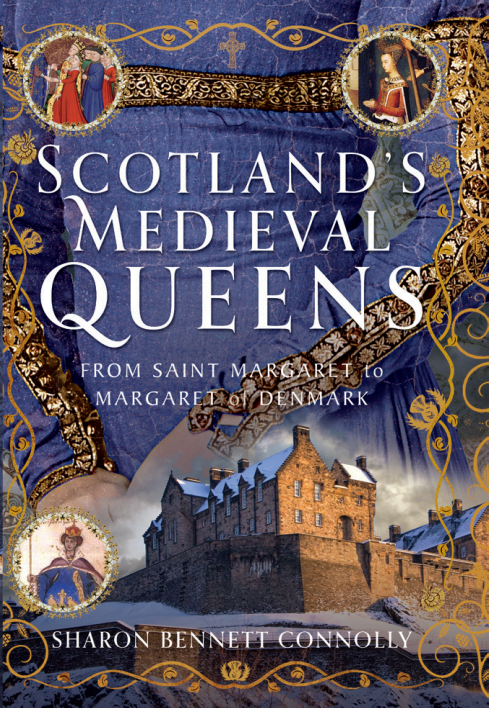
Out now: Scotland’s Medieval Queens

Scotland’s history is dramatic, violent and bloody. Being England’s northern neighbour has never been easy. Scotland’s queens have had to deal with war, murder, imprisonment, political rivalries and open betrayal. They have loved and lost, raised kings and queens, ruled and died for Scotland. From St Margaret, who became one of the patron saints of Scotland, to Elizabeth de Burgh and the dramatic story of the Scottish Wars of Independence, to the love story and tragedy of Joan Beaufort, to Margaret of Denmark and the dawn of the Renaissance, Scotland’s Medieval Queens have seen it all. This is the story of Scotland through their eyes.

Available now from Amazon and Pen and Sword Books

Also by Sharon Bennett Connolly:

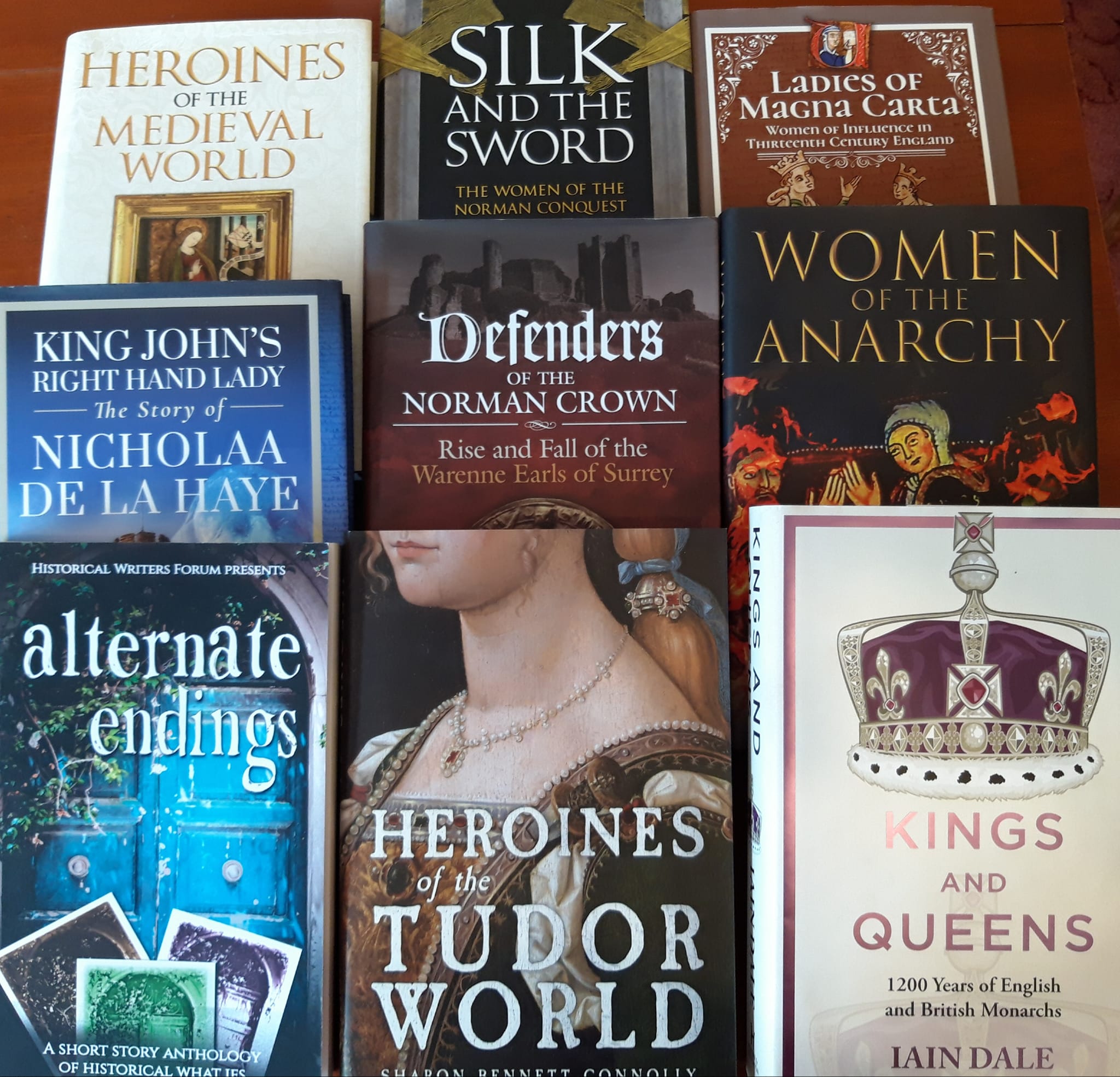
Heroines of the Tudor World tells the stories of the most remarkable women from European history in the time of the Tudor dynasty, 1485-1603. These are the women who ruled, the women who founded dynasties, the women who fought for religious freedom, their families and love. Heroines of the Tudor World is now available for pre-order from Amberley Publishing and Amazon UK. Women of the Anarchy demonstrates how Empress Matilda and Matilda of Boulogne, unable to wield a sword themselves, were prime movers in this time of conflict and lawlessness. It shows how their strengths, weaknesses, and personal ambitions swung the fortunes of war one way – and then the other. Available from Bookshop.orgAmberley Publishing and Amazon UKKing John’s Right-Hand Lady: The Story of Nicholaa de la Haye is the story of a truly remarkable lady, the hereditary constable of Lincoln Castle and the first woman in England to be appointed sheriff in her own right. Available from all good bookshops Pen & Sword Booksbookshop.org and Amazon

Defenders of the Norman Crown: The Rise and Fall of the Warenne Earls of Surrey tells the fascinating story of the Warenne dynasty, from its origins in Normandy, through the Conquest, Magna Carta, the wars and marriages that led to its ultimate demise in the reign of Edward III. Available from Pen & Sword BooksAmazon in the UK and US, and Bookshop.orgLadies of Magna Carta: Women of Influence in Thirteenth Century England looks into the relationships of the various noble families of the 13th century, and how they were affected by the Barons’ Wars, Magna Carta and its aftermath; the bonds that were formed and those that were broken. It is now available in paperback and hardback from Pen & SwordAmazon, and Bookshop.orgHeroines of the Medieval World tells the stories of some of the most remarkable women from Medieval history, from Eleanor of Aquitaine to Julian of Norwich. Available now from Amberley Publishing and Amazon, and Bookshop.orgSilk and the Sword: The Women of the Norman Conquest traces the fortunes of the women who had a significant role to play in the momentous events of 1066. Available now from Amazon,  Amberley Publishing, and Bookshop.org.

Alternate Endings: An anthology of historical fiction short stories including Long Live the King… which is my take what might have happened had King John not died in October 1216. Available in paperback and kindle from Amazon.

Podcast:

Have a listen to the A Slice of Medieval podcast, which I co-host with Historical fiction novelist Derek Birks. Derek and I welcome guests, such as Bernard Cornwell and Michael Jecks, and discuss a wide range of topics in medieval history, from significant events to the personalities involved. Every episode is also now available on YouTube.

*

Don’t forget! Signed and dedicated copies of all my books are available through my online store.

For forthcoming online and in-person talks, please check out my Events Page.

You can be the first to read new articles by clicking the ‘Follow’ button, liking our Facebook page or joining me on TwitterThreadsBluesky and Instagram.

*

©2025 Sharon Bennett Connolly, FRHistS


Wordly Women: Helene Harrison

I have been inspired by the British Library’s Medieval women: In Their Own Words exhibition to launch a series of interviews featuring women writers of History, Wordly Women, to give us an insight into their books, their writing habits and themselves. My guinea pig – er, I mean – first Author Spotlight is the wonderful Helene Harrison, author of two fabulous books on the Tudors, with a third on the way.

So, over to my chat with Helene…

Sharon: What got you into writing non-fiction?

Helene: ’ve always enjoyed research, no matter on what topic. But it was during my A Levels that I really got into history, which then developed at university during my undergraduate and postgraduate degrees. When I finished my undergraduate degree in 2012, I started my blog, Tudor Blogger, because I felt a bit bereft, even though I was about to start my postgraduate degree. It took off from there really, as I started reviewing history books in my collection on my blog and then publishers started to send me books to review. I was then approached by my publisher to ask if I was interested in writing a book for them and that’s how writing non-fiction came about really. I’d always wanted to, but I didn’t think anyone would actually be interested in reading them.

Sharon: Tell us about your books.

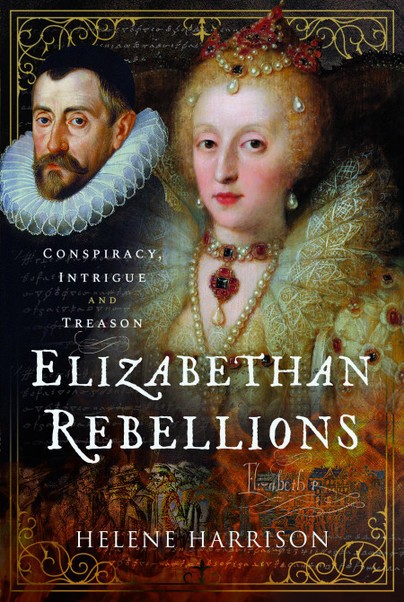
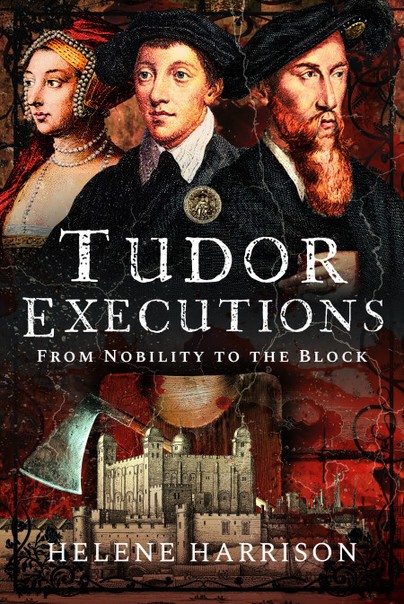
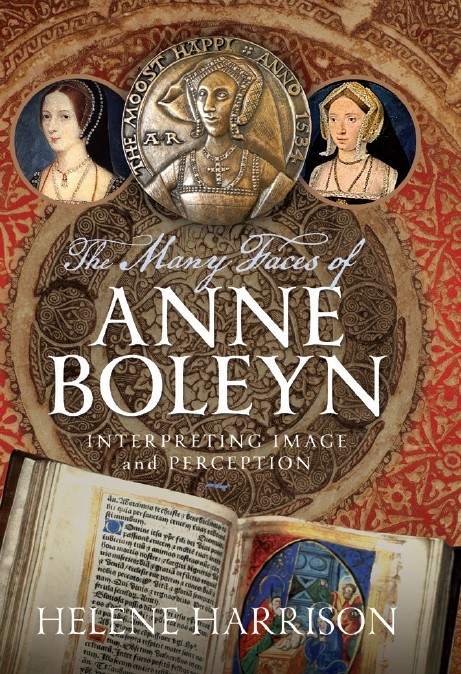
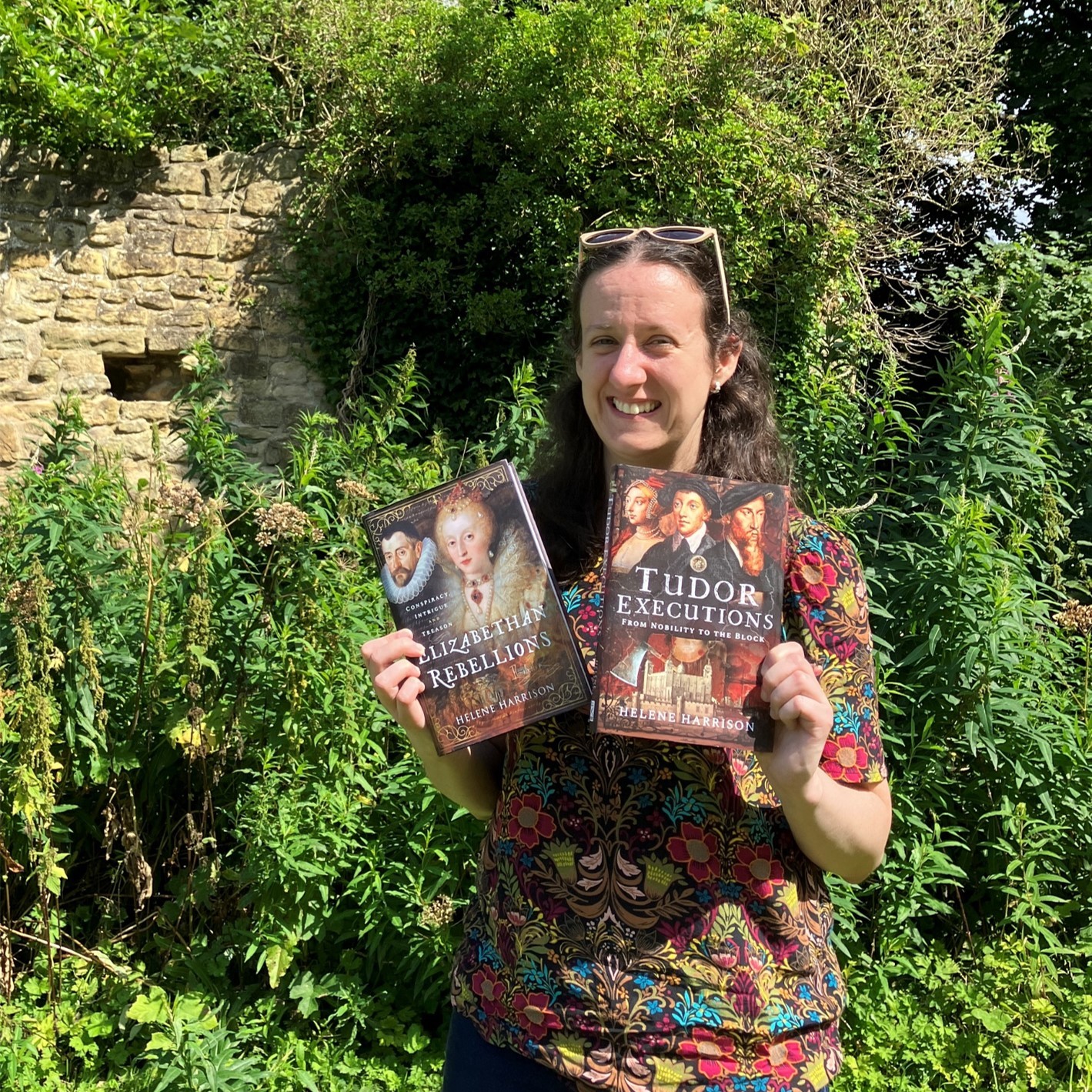
Helene: My first book was ‘Elizabethan Rebellions: Conspiracy, Intrigue and Treason’ which was published in January 2023. It still didn’t really feel real that I was a published author even when I held it in my hands! My second book ‘Tudor Executions: From Nobility to the Block’ was then published in July 2024. I’d been researching Tudor executions and treason as an interest for several years anyway, so I had a lot of the background in my head already. My third book ‘The Many Faces of Anne Boleyn: Interpreting Image and Perception’ is due to be released in July 2025 and is now available for preorder. This upcoming one is the one I’m, I think, most nervous about. It has developed from my undergraduate and postgraduate history degrees which looked at Anne Boleyn’s public image (undergraduate) and then at perceptions in literature and film (postgraduate). This book combines the two and builds more on it. I didn’t feel quite ready to write this book when I wrote my first two, but this felt like the right time.

Sharon: What attracts you to the Tudors?

Helene: When I was doing my A Levels, I did a module on Tudor Rebellions, which is really where I delved into Tudor research, though I had some very basic knowledge before that. My GCSE had been in modern world history, so I didn’t really have an earlier chance to do proper research on the Tudors. At university I did modules on early modern women’s history which included witchcraft and women in power which ignited my passion for Anne Boleyn and Elizabeth I. Showtime’s TV show, The Tudors finished its final series while I was at university, and that just added to my interest, wanting to know what was real and what was fiction, and that really fuelled the subjects of my dissertations. But I think that what really attracts me to the Tudors today is that they seem to be quite a unique dynasty, but that their blood still feeds down into the royal family today. The Tudors won the throne in battle, and that was the last time an English monarch died in battle, and we also see the advent of successful female monarchy. England rises as a global power, and we begin to see the reach extending beyond the British Isles in an age of exploration, great literature, and new ways of exercising power.

Sharon: Who is your favourite Tudor and why?

Helene: This will probably be the same answer as a lot of people, but Anne Boleyn. She is such a fascinating figure, more than the first beheaded wife of Henry VIII. Her upbringing was singular for a woman of her class, being raised at the courts of the Low Countries and France, exposed to new religious ideas and with an exoticism which marked her out at the English court. Anne was at the centre of massive changes happening in England, in many ways the catalyst for them, and that’s why she has held my interest for so many years. But I do also have a soft spot for Anne of Cleves, and I’m fascinated by Mary Boleyn and her daughter, Catherine Carey Knollys, as well.

Sharon: Who is your least favourite Tudor and why?

Helene: I often think it’s difficult to have a least favourite Tudor because they’re all fascinating in their own ways, even those that perhaps aren’t very likeable. I find Henry, Lord Darnley, the second husband of Mary Queen of Scots, quite difficult to like, but then the suspicious circumstances surrounding his death are so interesting! I also find it very difficult to find redeeming qualities in Thomas Howard, 3rd Duke of Norfolk, who saw two nieces, a nephew, and a niece-in-law, as well as his own son, executed, but always managed to save himself. In the sources he comes across as very cold and self-serving, willing to do whatever it took to save himself, even if it meant his own family being executed. But he was active over a large period of the first half of the long Tudor century, so he is important to study.

Sharon: How do you approach researching your topic?

Helene: Often it depends on the topic! With my second book ‘Tudor Executions’ I had a lot of the secondary source knowledge already, and quite a bit of the primary source knowledge. With my first book ‘Elizabethan Rebellions’ there was a lot more that I didn’t know, so I wanted to make sure that I covered as much as I could from both primary and secondary sources. But I always think it’s important to make sure that you go back to the original sources as much as possible and form your own opinions. Others might disagree with what you think, but I think that it’s important you know your own thoughts before reading those of others otherwise you might be unduly influenced by them. With my third book ‘The Many Faces of Anne Boleyn’, this was a very different approach to research because I knew the primary and secondary sources really well anyway from nearly 15 years of reading and research, but this book does a close analysis of a selection of sources including television, film, novels, and theatre, so there was a lot of analysis of those with comparisons to primary and secondary sources. I started by going back to my undergraduate and postgraduate dissertations, then branching out from there to know what I thought at the time and how my opinions have changed, which they have in some ways! So that was a really interesting way of approaching it, and very different to things I’ve done before!

Sharon: Tell us your ‘favourite’ Tudor execution story.

Helene: Hmm, tricky! Anne Boleyn is always an interesting one, but I know it so well that I thought it would be a relatively easy chapter to write, but I went so far over my word count on that chapter that I really had to work to trim it back! I was very aware that I wanted each chapter to be the same length so that one person wasn’t getting more attention than any other. I did achieve that! I find the Earl of Warwick’s story interesting, but also so sad to write about. Nathen Amin’s work on the Tudor Pretenders was invaluable in working on that chapter. It’s the first execution I discuss in the book and the only one under Henry VII so I was very aware of that, and of how unjust it was, so that may have been my favourite chapter to write actually. The Earl of Warwick was imprisoned in the Tower for fourteen years before his execution, and he was only 24 when he died. It just seems like such a wasted life.

Sharon: Tell us your ‘favourite’ Elizabethan rebellion story.

Helene: My favourite of the rebellions to write about was undoubtedly the Babington Plot of 1586. There was so much intrigue with that one. The Ridolfi and Throckmorton Plots never really quite got off the ground, and neither did Babington, but we have the added knowledge that it was the Babington Plot that led directly to the execution of Mary Queen of Scots, which was really a pivotal moment in Elizabeth’s reign, and in the history of monarchy in the British Isles as well. The Babington Plot had letters being smuggled in beer barrels, ciphers and codes, international conspiracy and plots to invade, and it all being known about seemingly from the beginning by the English government. How far was it all manipulated by Francis Walsingham? The early spy networks of Walsingham his codebreaker Thomas Phelippes I could have written so much more about!

Sharon: Are there any other eras you would like to write about?

Helene: I am fascinated by the royal women of the Wars of the Roses – Margaret of Anjou, Jacquetta of Luxembourg, Elizabeth Woodville, Margaret Beaufort, and Isobel and Anne Neville. I would like to write more about them in the future, perhaps just on my blog though, as there do seem to be more books about them coming out now, both fiction and non-fiction. But if I hadn’t done by undergraduate dissertation on Anne Boleyn and started all of this, my second choice was to do something on the Holocaust. Very different, I know! My grandma was Austro-Polish and was in a labour camp during the Second World War before she moved to England, so that personal connection, in a way, to it I think has just made me more interested. It’s the psychology that I struggle to understand more than anything. I also have an interest in the Jack the Ripper case, though there is so much written on that, I don’t think my kind of amateurish interest will merit much in the way of writing.

Sharon: What are you working on now?

Helene: I am currently waiting for my final set of edits for my third book ‘The Many Faces of Anne Boleyn: Interpreting Image and Perception’ which I then need to index, which is always time-consuming to do right. I am also currently writing my fourth book, also for Pen and Sword, which is about Henry VIII’s Great Matter and his quest for an heir, which has been really interesting to delve into; I wanted to look at it from a people perspective rather than the parliamentary and legal standpoint, how it affected the people involved at different stages and how Henry VIII changed throughout. I’m just over halfway writing that one now, and I am commissioned for a fifth book after that, though I’m keeping mum on the topic of that one for the time being, though it is still firmly in the Tudor period!

Sharon: And finally, what is the best thing about being a writer?

Helene: That one’s easy actually! The best thing I’ve found about being a writer is the history community. Blogging is one thing, but when you’re writing and publishing, you become part of this community, and everyone is so lovely and helpful, and I’ve made some wonderful friends and met some lovely people through it. Amy McElroy and I released our first books on the same day back in January 2023 and have since twice met up in person in London, going to exhibitions at the National Portrait Gallery and British Library. It is definitely the engagement with like-minded people that is so great, and though I was incredibly nervous doing podcast interviews at the start, now I’m a lot more relaxed and I think that’s because the people you’re talking to are just as passionate about history as you are, and they are just so great at putting you at ease and they want you to succeed.

Huge thanks to Helene for such a fascinating discussion. Do take a look at her books – the links are below.

About the Author:

Helene Harrison studied at the University of Northumbria in Newcastle, achieving both a BA and MA in History before going on to complete an MSc in Library Management. Her passion for Tudor history started when studying for A Levels and completing a module on Tudor rebellions. Her master’s dissertation focused on portrayals of Anne Boleyn through the centuries, from contemporary letters to modern TV and film adaptations. Now she writes two blogs, one Tudor history and one book-related, and works in the university library of her alma mater. In her spare time, she loves visiting royal palaces and snuggling up with a book or embroidery project. Her previous books are ‘Elizabethan Rebellions: Conspiracy, Intrigue and Treason’ and ‘Tudor Executions: From Nobility to the Block’, both published by Pen and Sword. Her third book, ‘The Many Faces of Anne Boleyn: Interpreting Image and Perception’, is due out in July 2025.

Where to find Helene:

Website Substack Facebook Instagram Blue SkyThreads

To buy Helene’s books:

Elizabethan Rebellions: Conspiracy, Intrigue and Treason is available from Pen & Sword Books (though you can contact me directly on social media or through my website if you would like a signed copy of Rebellions). Tudor Executions: From Nobility to the Block is also available from Pen & Sword Books. The Many Faces of Anne Boleyn: Interpreting Image and Perception is currently only available for preorder through Amazon and Waterstones

*

My books

Signed, dedicated copies of all my books are available through my online store.

Out now: Scotland’s Medieval Queens

Scotland’s history is dramatic, violent and bloody. Being England’s northern neighbour has never been easy. Scotland’s queens have had to deal with war, murder, imprisonment, political rivalries and open betrayal. They have loved and lost, raised kings and queens, ruled and died for Scotland. From St Margaret, who became one of the patron saints of Scotland, to Elizabeth de Burgh and the dramatic story of the Scottish Wars of Independence, to the love story and tragedy of Joan Beaufort, to Margaret of Denmark and the dawn of the Renaissance, Scotland’s Medieval Queens have seen it all. This is the story of Scotland through their eyes.

Available now from Amazon and Pen and Sword Books

Also by Sharon Bennett Connolly:

Heroines of the Tudor World tells the stories of the most remarkable women from European history in the time of the Tudor dynasty, 1485-1603. These are the women who ruled, the women who founded dynasties, the women who fought for religious freedom, their families and love. Heroines of the Tudor World is now available for pre-order from Amberley Publishing and Amazon UK. Women of the Anarchy demonstrates how Empress Matilda and Matilda of Boulogne, unable to wield a sword themselves, were prime movers in this time of conflict and lawlessness. It shows how their strengths, weaknesses, and personal ambitions swung the fortunes of war one way – and then the other. Available from Bookshop.orgAmberley Publishing and Amazon UKKing John’s Right-Hand Lady: The Story of Nicholaa de la Haye is the story of a truly remarkable lady, the hereditary constable of Lincoln Castle and the first woman in England to be appointed sheriff in her own right. Available from all good bookshops Pen & Sword Booksbookshop.org and Amazon

Defenders of the Norman Crown: The Rise and Fall of the Warenne Earls of Surrey tells the fascinating story of the Warenne dynasty, from its origins in Normandy, through the Conquest, Magna Carta, the wars and marriages that led to its ultimate demise in the reign of Edward III. Available from Pen & Sword BooksAmazon in the UK and US, and Bookshop.orgLadies of Magna Carta: Women of Influence in Thirteenth Century England looks into the relationships of the various noble families of the 13th century, and how they were affected by the Barons’ Wars, Magna Carta and its aftermath; the bonds that were formed and those that were broken. It is now available in paperback and hardback from Pen & SwordAmazon, and Bookshop.orgHeroines of the Medieval World tells the stories of some of the most remarkable women from Medieval history, from Eleanor of Aquitaine to Julian of Norwich. Available now from Amberley Publishing and Amazon, and Bookshop.orgSilk and the Sword: The Women of the Norman Conquest traces the fortunes of the women who had a significant role to play in the momentous events of 1066. Available now from Amazon,  Amberley Publishing, and Bookshop.org.

Alternate Endings: An anthology of historical fiction short stories including Long Live the King… which is my take what might have happened had King John not died in October 1216. Available in paperback and kindle from Amazon.

Podcast:

Have a listen to the A Slice of Medieval podcast, which I co-host with Historical fiction novelist Derek Birks. Derek and I welcome guests, such as Bernard Cornwell and Michael Jecks, and discuss a wide range of topics in medieval history, from significant events to the personalities involved. Every episode is also now available on YouTube.

*

Don’t forget! Signed and dedicated copies of all my books are available through my online store.

For forthcoming online and in-person talks, please check out my Events Page.

You can be the first to read new articles by clicking the ‘Follow’ button, liking our Facebook page or joining me on TwitterThreadsBluesky and Instagram.

*

©2025 Sharon Bennett Connolly, FRHistS and Helene Harrison
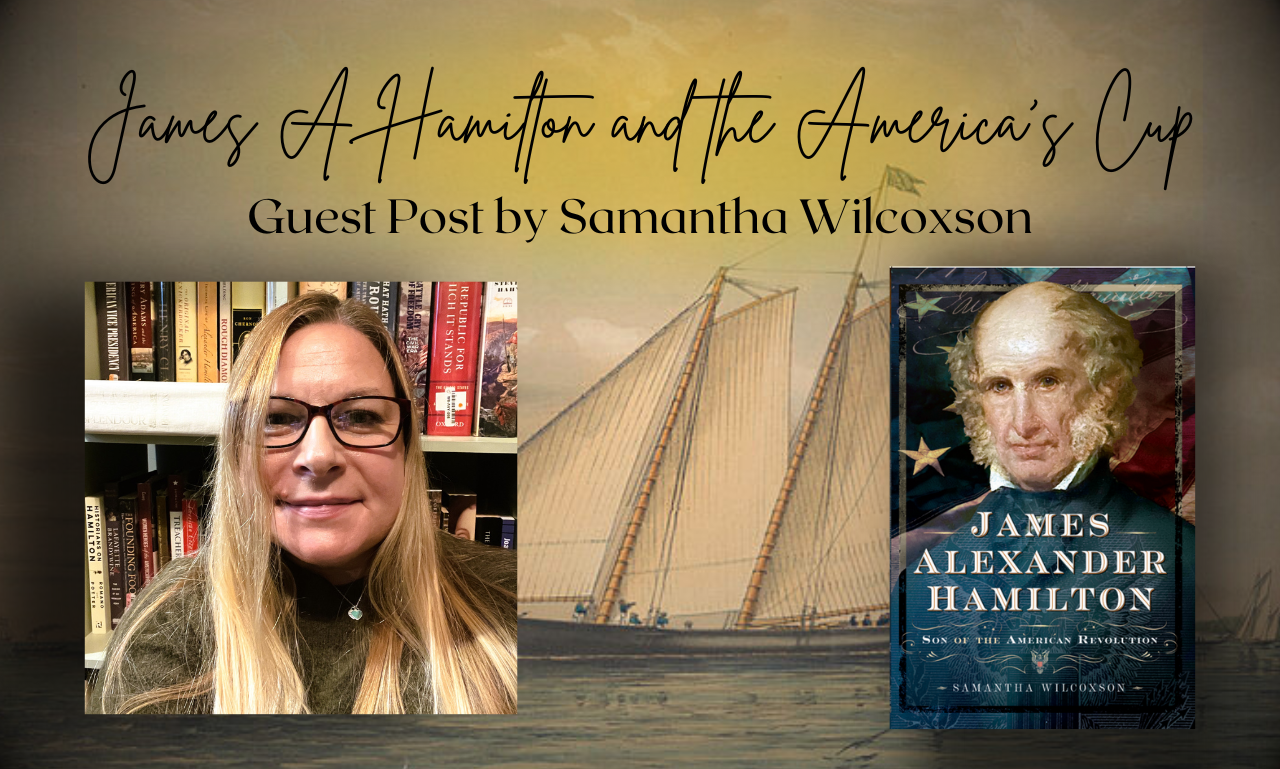
Guest Post: James A. Hamilton and the Americas Cup by Samantha Wilcoxson

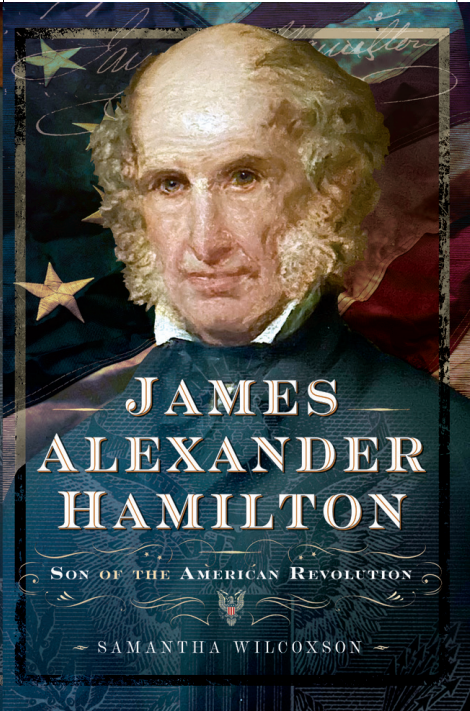
Today, it is a pleasure to welcome Samantha Wilcoxson to History…the Interesting Bits with an article on James A. Hamilton. Samantha’s biography of Hamilton, James Alexander Hamilton: Son of the American Revolution.

James A. Hamilton and the Americas Cup

The America’s Cup has not always been called by that name. In 1851, an invitation came to the New York Yacht Club, the only yacht club in the United States at that time, from the Royal Yacht Squadron “to test the relative merits of the ships.” The British challengers did not anticipate any real contest from the Americans, given their relative inexperience in an arena long dominated by England’s seamen.

It was the same year as England’s Great Exhibition with its Crystal Palace, and national pride was running high. The New York Yacht Club decided to send a schooner named America. One of the ship’s owners was George Lee Schuyler, son-in-law to James Alexander Hamilton.

Schuyler was confident of the schooner’s capabilities and looked forward to seeing it compete against the British ships. Unfortunately, personal issues kept him at home, and he asked his father-in-law to join the crew of the America in his place.

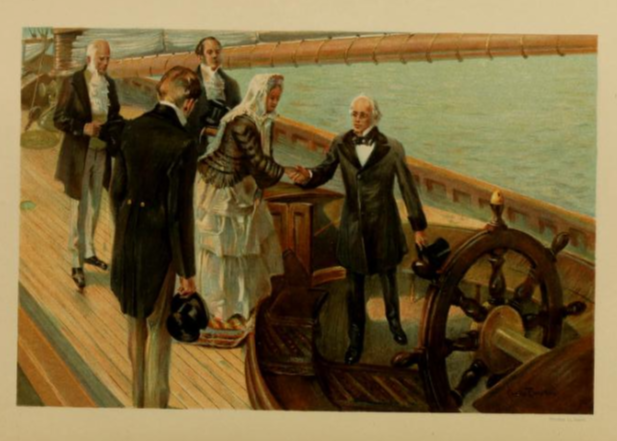
The crew greeting Queen Victoria and Prince Albert, James is the man on the far left

James was the third son of Alexander Hamilton, who had served as the first US treasury secretary and created the national bank. When traveling in Europe, James would often have official letters of introduction from presidents or cabinet members, but he recorded that he rarely used them. “My father’s name alone was my best passport to society.” In this case, it was his son-in-law’s boat that put him in the middle of historic events.

Among a field of sixteen ships, the America took off in a light wind on 22 August 1851. James compared them to race-horses breaking away from the starting line. Shockingly, the America quickly jumped into the lead. When Queen Victoria was informed that the US schooner was in the lead, she asked which was second. The response? “Your Majesty, there is no second.” The America had left all competition far behind.

The American schooner yacht

Following the victory, the Queen and Prince Albert boarded the America to offer their congratulations and were greeted by four crew members, including James A Hamilton. The Royal Yacht Squadron Cup, which the US team was awarded, became known as the America’s Cup, as did the annual regatta.

Read more about the 1851 America’s Cup and other James Alexander Hamilton adventures in my new biography, available through Pen & Sword and your favorite bookstore!

About the book:

Born in the year of the Constitutional Convention, James Alexander Hamilton was uniquely positioned to observe the early republic era and the formation of the experimental United States government. His father, Alexander Hamilton, had been the first US Treasury Secretary, an outspoken and controversial character who was killed in a duel when James was a teenager. With a lifelong devotion to his father’s memory, James advised men from Andrew Jackson and Martin Van Buren to Abraham Lincoln and Salmon P Chase on banking and constitutional matters.

Through his own talents and with the advantage of his father’s name, James served as temporary Secretary of State and District Attorney of New York. James enjoyed a close-knit family life with his wife, Mary Morris, at his Hudson River home named Nevis for his father’s birthplace. He was part of the crew of the yacht America, for which the America’s Cup is named, and on the committee for New York’s Crystal Palace in 1853. More importantly, he served his country through the War of 1812, Western Expansion, and the bloody Civil War. His first-hand account of these transformative events gives readers a priceless look at America’s past. James supported the abolition of slavery and wrote a draft of the Emancipation Proclamation before settling down to write his own Reminiscences that cover the first seventy-five years of US history. 

This biography makes James A Hamilton’s life and observations accessible to the modern reader and will leave you with a new appreciation for the Founders’ heirs who inherited the difficult work of building a nation.

To Buy the book:

James Alexander Hamilton: Son of the American Revolution.   

About the author:

Samantha Wilcoxson is an author of emotive biographical fiction and nonfiction featuring history’s unsung heroes. She loves sharing trips to historic places with her family and spending time by the lake with a glass of wine. Her most recent work is a biography of James Alexander Hamilton published by Pen & Sword History. Samantha is currently writing a Wars of the Roses trilogy for Sapere Books.

Social media:

Websitehttps://samanthawilcoxson.com
Instagramhttps://www.instagram.com/samantha_wilcoxson
Facebookhttps://www.facebook.com/PlantagenetEmbers/
Amazon Author Pagehttps://amazon.com/author/samanthawilcoxson
Newsletter Signuphttps://dashboard.mailerlite.com/forms/668153/107384163504489521/share

*

My Books

Signed, dedicated copies of all my books are available through my online store.

Out now: Scotland’s Medieval Queens

Scotland’s history is dramatic, violent and bloody. Being England’s northern neighbour has never been easy. Scotland’s queens have had to deal with war, murder, imprisonment, political rivalries and open betrayal. They have loved and lost, raised kings and queens, ruled and died for Scotland. From St Margaret, who became one of the patron saints of Scotland, to Elizabeth de Burgh and the dramatic story of the Scottish Wars of Independence, to the love story and tragedy of Joan Beaufort, to Margaret of Denmark and the dawn of the Renaissance, Scotland’s Medieval Queens have seen it all. This is the story of Scotland through their eyes.

Available now from Amazon and Pen and Sword Books

Also by Sharon Bennett Connolly:

Heroines of the Tudor World tells the stories of the most remarkable women from European history in the time of the Tudor dynasty, 1485-1603. These are the women who ruled, the women who founded dynasties, the women who fought for religious freedom, their families and love. Heroines of the Tudor World is now available for pre-order from Amberley Publishing and Amazon UK. Women of the Anarchy demonstrates how Empress Matilda and Matilda of Boulogne, unable to wield a sword themselves, were prime movers in this time of conflict and lawlessness. It shows how their strengths, weaknesses, and personal ambitions swung the fortunes of war one way – and then the other. Available from Bookshop.orgAmberley Publishing and Amazon UKKing John’s Right-Hand Lady: The Story of Nicholaa de la Haye is the story of a truly remarkable lady, the hereditary constable of Lincoln Castle and the first woman in England to be appointed sheriff in her own right. Available from all good bookshops Pen & Sword Booksbookshop.org and Amazon

Defenders of the Norman Crown: The Rise and Fall of the Warenne Earls of Surrey tells the fascinating story of the Warenne dynasty, from its origins in Normandy, through the Conquest, Magna Carta, the wars and marriages that led to its ultimate demise in the reign of Edward III. Available from Pen & Sword BooksAmazon in the UK and US, and Bookshop.orgLadies of Magna Carta: Women of Influence in Thirteenth Century England looks into the relationships of the various noble families of the 13th century, and how they were affected by the Barons’ Wars, Magna Carta and its aftermath; the bonds that were formed and those that were broken. It is now available in paperback and hardback from Pen & SwordAmazon, and Bookshop.orgHeroines of the Medieval World tells the stories of some of the most remarkable women from Medieval history, from Eleanor of Aquitaine to Julian of Norwich. Available now from Amberley Publishing and Amazon, and Bookshop.orgSilk and the Sword: The Women of the Norman Conquest traces the fortunes of the women who had a significant role to play in the momentous events of 1066. Available now from Amazon,  Amberley Publishing, and Bookshop.org.

Alternate Endings: An anthology of historical fiction short stories including Long Live the King… which is my take what might have happened had King John not died in October 1216. Available in paperback and kindle from Amazon.

Podcast:

Have a listen to the A Slice of Medieval podcast, which I co-host with Historical fiction novelist Derek Birks. Derek and I welcome guests, such as Bernard Cornwell and Michael Jecks, and discuss a wide range of topics in medieval history, from significant events to the personalities involved. Every episode is also now available on YouTube.

*

Don’t forget! Signed and dedicated copies of all my books are available through my online store.

For forthcoming online and in-person talks, please check out my Events Page.

You can be the first to read new articles by clicking the ‘Follow’ button, liking our Facebook page or joining me on TwitterThreadsBluesky and Instagram.

*

©2025 Sharon Bennett Connolly FRHistS and Samantha Wilcoxson


Book Launch: Scotland’s Medieval Queens

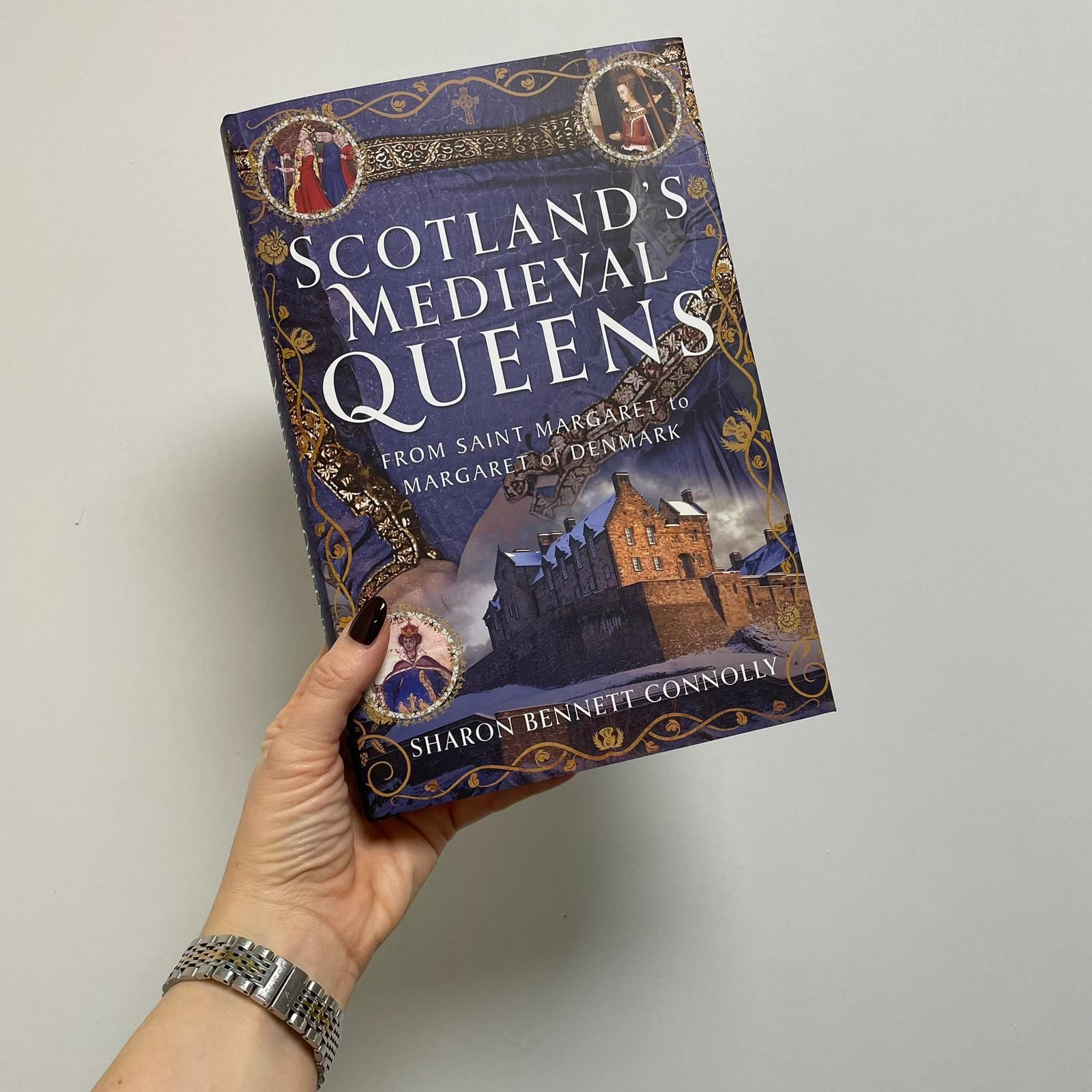
It is hard to believe – for me, anyway – that I have now published 8 books. 8! I am still waiting for my author copies of Scotland’s Medieval Queens: From Saint Margaret to Margaret of Denmark, to arrive. But she is out in the world. And I am so proud of this book, not least because it was inspired by my wonderful, history-loving son, Lewis, who instructed me to ‘set the record straight’ for Lady Macbeth. With a prologue dedicated to this maligned woman, labeled a murderer and a madwoman by William Shakespeare, I hope I have done just that. And then there are all the other incredible queens that have sat on Scotland’s throne. Women who have defended the realm, acted as peace weavers, governed for their sons and stood as stalwart supporters of their husbands.

I hope I have done their stories justice.

Zoom Book Launch Party

This is your personal invite to join the celebrations!

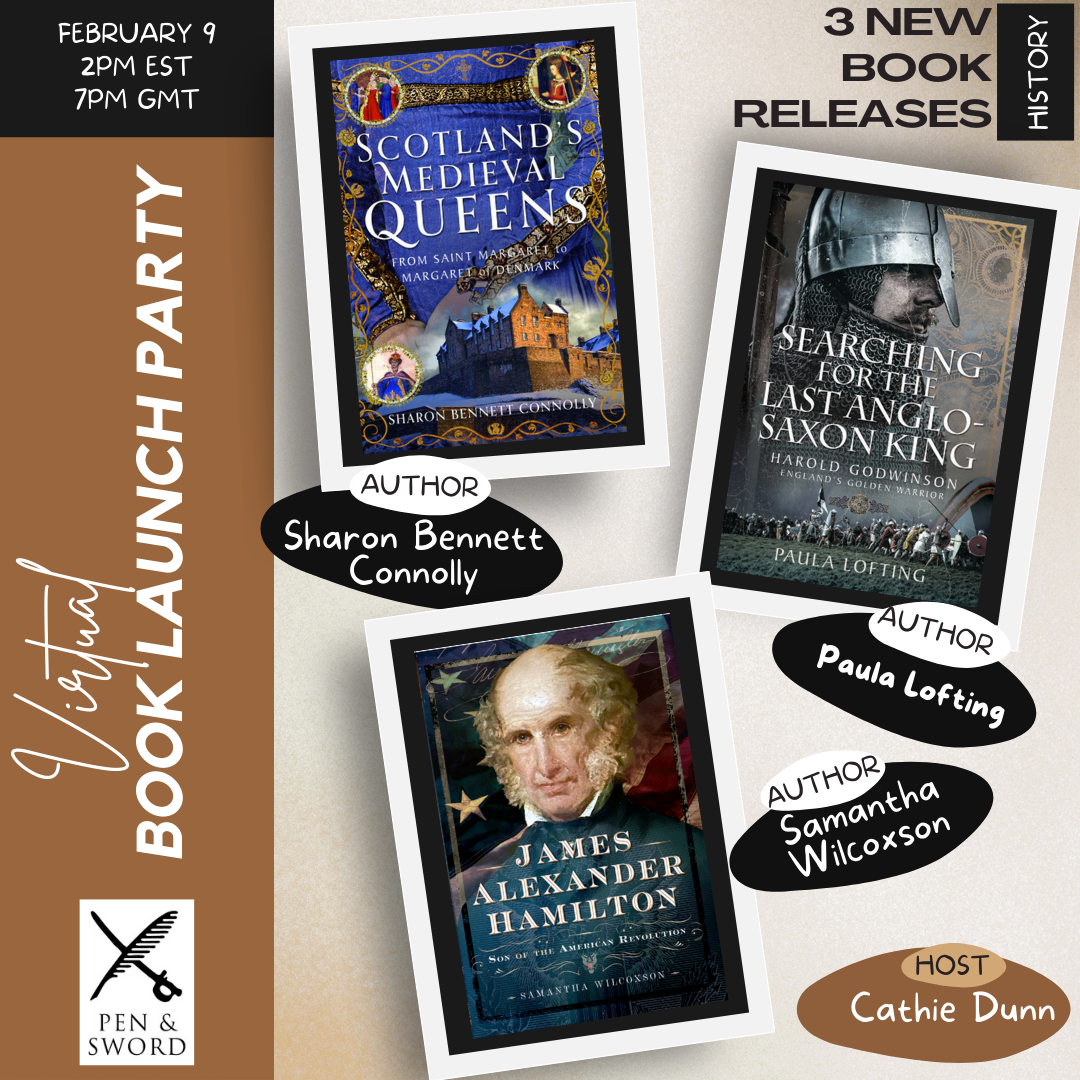
So, why not join me to celebrate the release of Scotland’s Medieval Queens by coming to the Zoom Book Launch Party, held alongside my friends Samantha Wilcoxson and Paula Lofting, who also have books out this week. Hosted by Cathie Dunn, we will each tell you a little about our books, answer questions and generally party!

This Sunday – 9 February 2025 at 7pm UK time.

It is free, you just need to reserve a spot.

Follow the Blog Tour:

Paula, Samantha and I are also taking part in a joint mini blog tour, with 6 days of articles and interviews. I kicked us off on Saturday with an article from Paula Lofting looking into King Harold’s Royal Lineage. Samantha was then interviewed on Paula Lofting’s Threads to the Past. And today, I am talking about one of the less well known queens of Scotland, Sybilla of Normandy with Samantha.

There are 3 more stops on the tour, with Samantha visiting History…the Interesting Bits on 5 February, Paula interviewing me on 6 February and Samantha interviewing Paula on 7 February.

Then party time on 9 February!

Podcast:

Have a listen to the latest episode of A Slice of Medieval podcast. In our Book Launch Special my co-host Derek Birks and I celebrate the launch of both our books. Scotland’s Medieval Queens meets A Guide to the Wars of the Roses. Every episode is also now available on YouTube.

About Scotland’s Medieval Queens: From Saint Margaret to Margaret of Denmark:

Scotland’s history is dramatic, violent and bloody. Being England’s northern neighbour has never been easy. Scotland’s queens have had to deal with war, murder, imprisonment, political rivalries and open betrayal. They have loved and lost, raised kings and queens, ruled and died for Scotland. From St Margaret, who became one of the patron saints of Scotland, to Elizabeth de Burgh and the dramatic story of the Scottish Wars of Independence, to the love story and tragedy of Joan Beaufort, to Margaret of Denmark and the dawn of the Renaissance, Scotland’s Medieval Queens have seen it all. This is the story of Scotland through their eyes.

Available now from Amazon and Pen and Sword Books

©2025 Sharon Bennett Connolly FRHistS 

Guest Post: Was Harold of Royal Lineage? by Paula Lofting

What do you do when 3 friends have books coming out all on the same day? You arrange a mini blog tour, of course. Myself, Paula Lofting and Samantha Wilcoxson all have new non-fiction books published this week, with Pen & Sword Books, so the 3 of us are hosting each other across our blogs, with an article and an interview from each. And I’m kicking us off today.

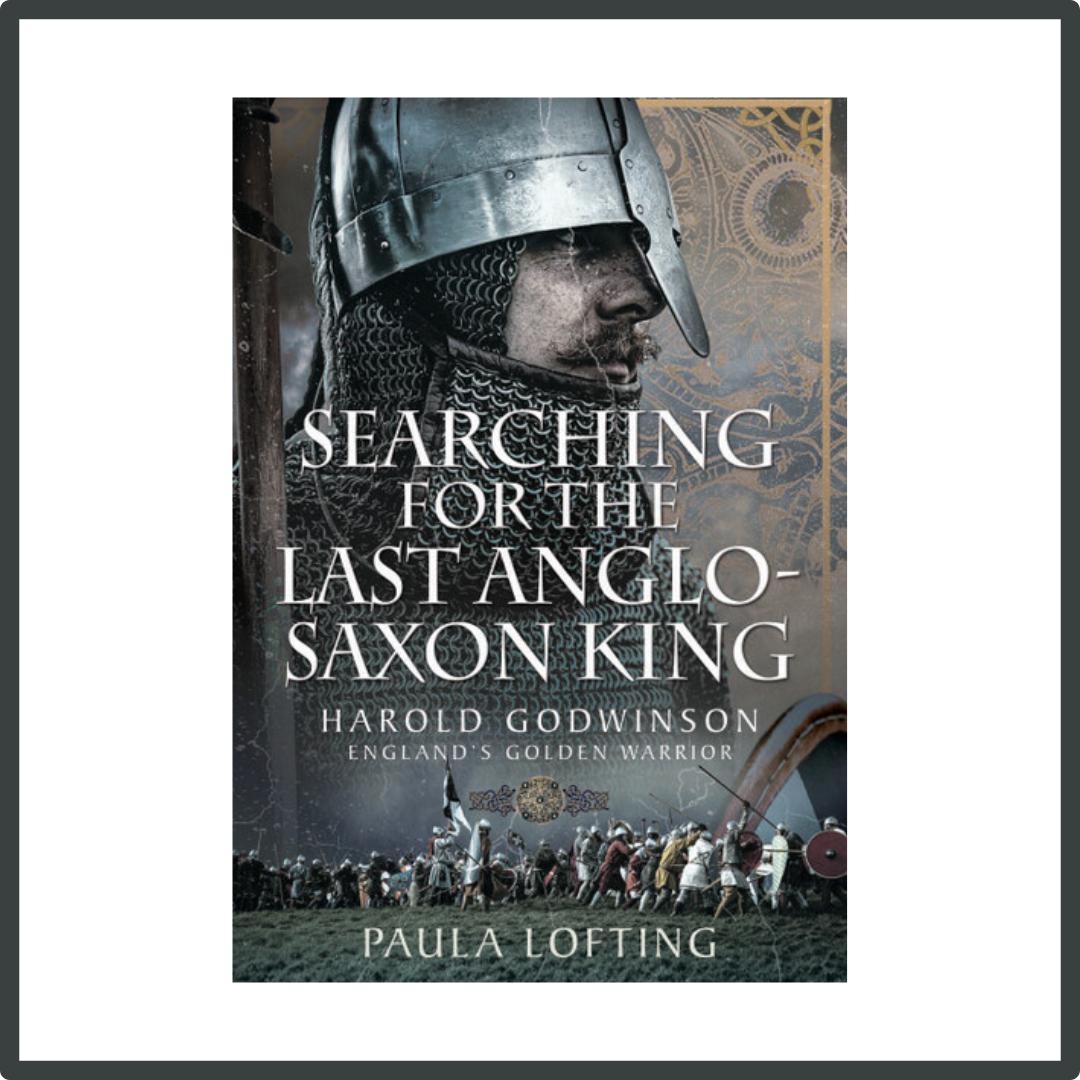
It is a pleasure to welcome Paula Lofting to History…the Interesting Bits with an article on Harold Godwinson – King Harold II. Paula’s first foray into the realm of non-fiction, Searching for the Last Anglo-Saxon King, is now available.

Was Harold Godwinson of Royal Lineage

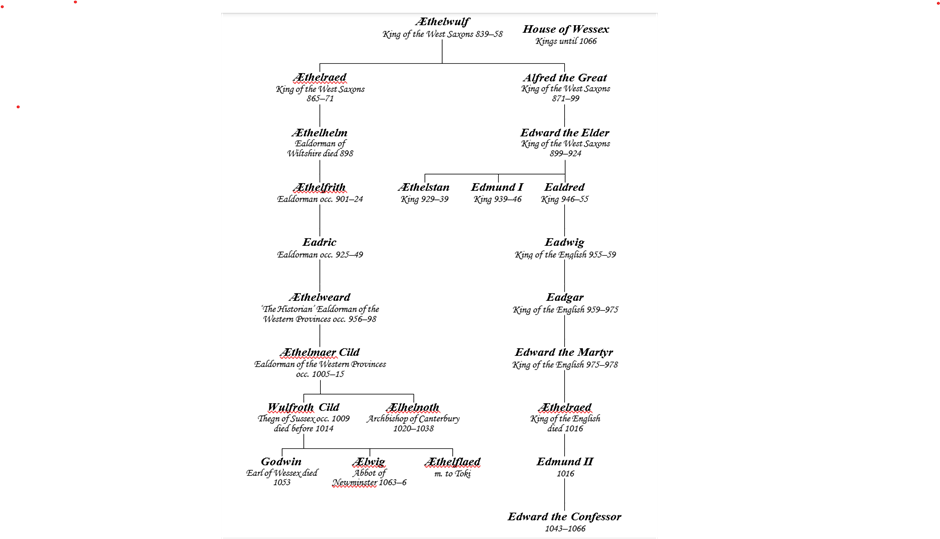
Some enthusiasts of the period have been quite taken with the idea that Harold Godwinson was able to trace his ancestry back to Æthelwulf, King of the West Saxons. The original idea came from historian, Alfred Anscombe, and later, genealogist, Lundie W. Barlow. It was taken up as authentic by author Frank Barlow, who has written many works on the period. From his book The House of Godwin, we can read his take on this. Through the will of Prince Æthelstan, son and heir of Æthelred the Unready, we are able pinpoint the man referred to as ‘Godwin, son of Wulfnoth’ being the father of Godwin. According to Frank Barlow, Lundie Barlow (no relation) studied the descent of some of the estates that Wulfnoth held. By treating Wulfnoth, as the son of Æthelmӕr Cild, ealdorman of the western provinces, Anscombe and Lundie believed that the Sussex thegn inherited Compton from his mother, suggesting that the royal blood was passed on through her.

But there is an issue with this theory. To make sense of the concept that Harold was descended from the royal House of Wessex, it was pertinent to explore theories that concern two males named Æthelmær. Both could be said to be candidates for Harold’s great-grandfather. The first Æthelmӕr listed in Anscombe and Lundie’s family tree we shall refer to as Cild. This chap was the son of Æthelweard the historian shown on the modified Anscombe/Barlow family tree.

This theory can be easily dispelled, for Æthelmær Cild was alive and active in the same generation as Wulfnoth himself, making him too young to have fathered Wulfnoth. Secondly, the interests of Æthelweard and Æthelmӕr Cild were concentrated in the areas west of Wessex, whilst Wulfnoth is specifically noted in the Anglo-Saxon Chronicle as a ‘Sussex thegn’.

The other Æthelmær, whom we shall refer to as Æthelmær Two, was one of several brothers of the infamous ealdorman, Eadric Sreona. Now their father was a man called Æthelric. The theory that this particular Æthelmær was the father of Wulfnoth Cild, originated with John of Worcester, which seems to have caused the confusion that led to Anscombe, then Lundie, being convinced that he was the father of Wulfnoth.

There is also a problem with this Æthelmær, as we shall see. Eadric and his brothers were the sons of a man called Æthelric and not Æthelweard the Historian, said to be the patriarch of the previous Æthelmær Cild, whose pedigree can be traced back to former kings of Wessex. Confused? Yes, so was I. But there is more.

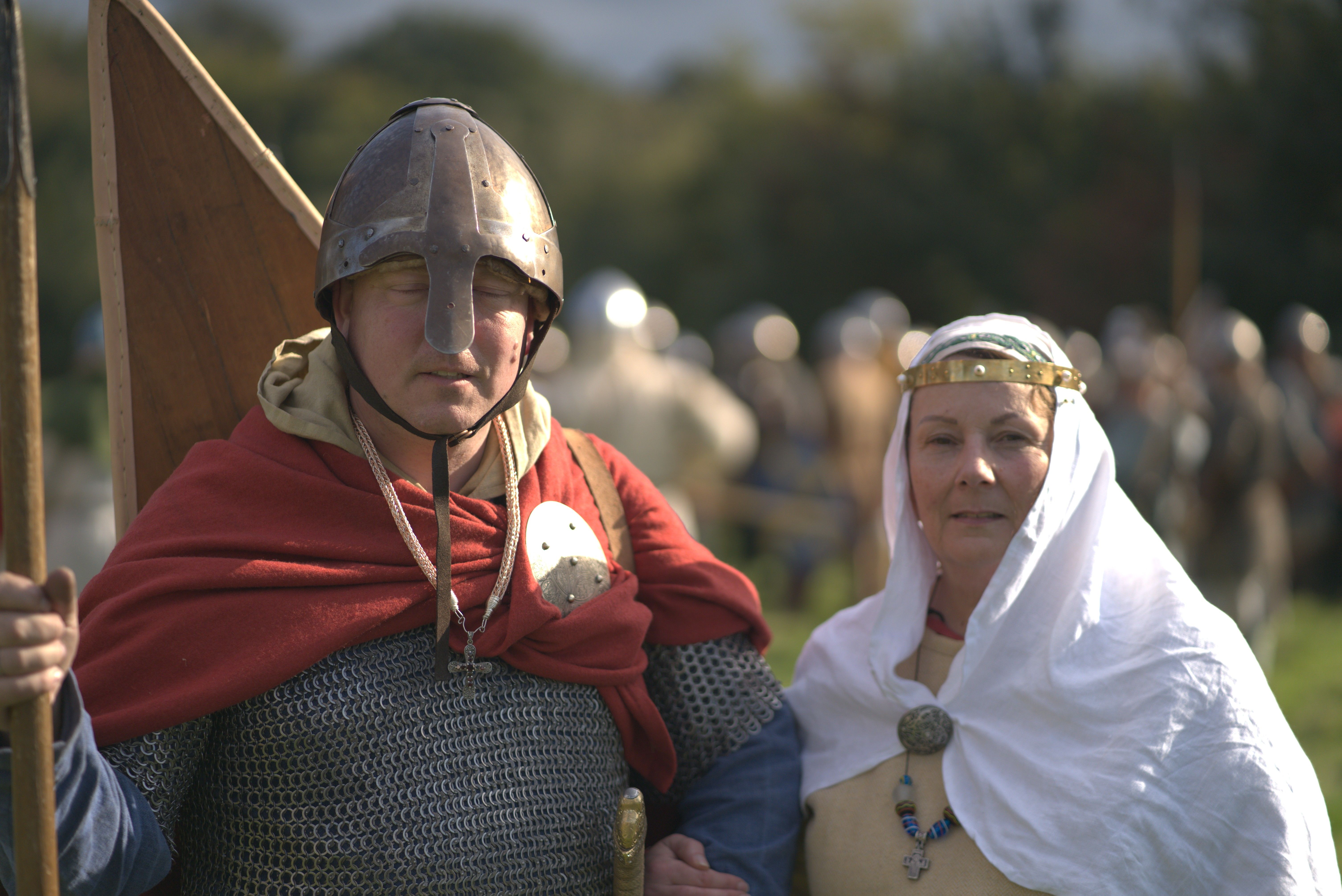
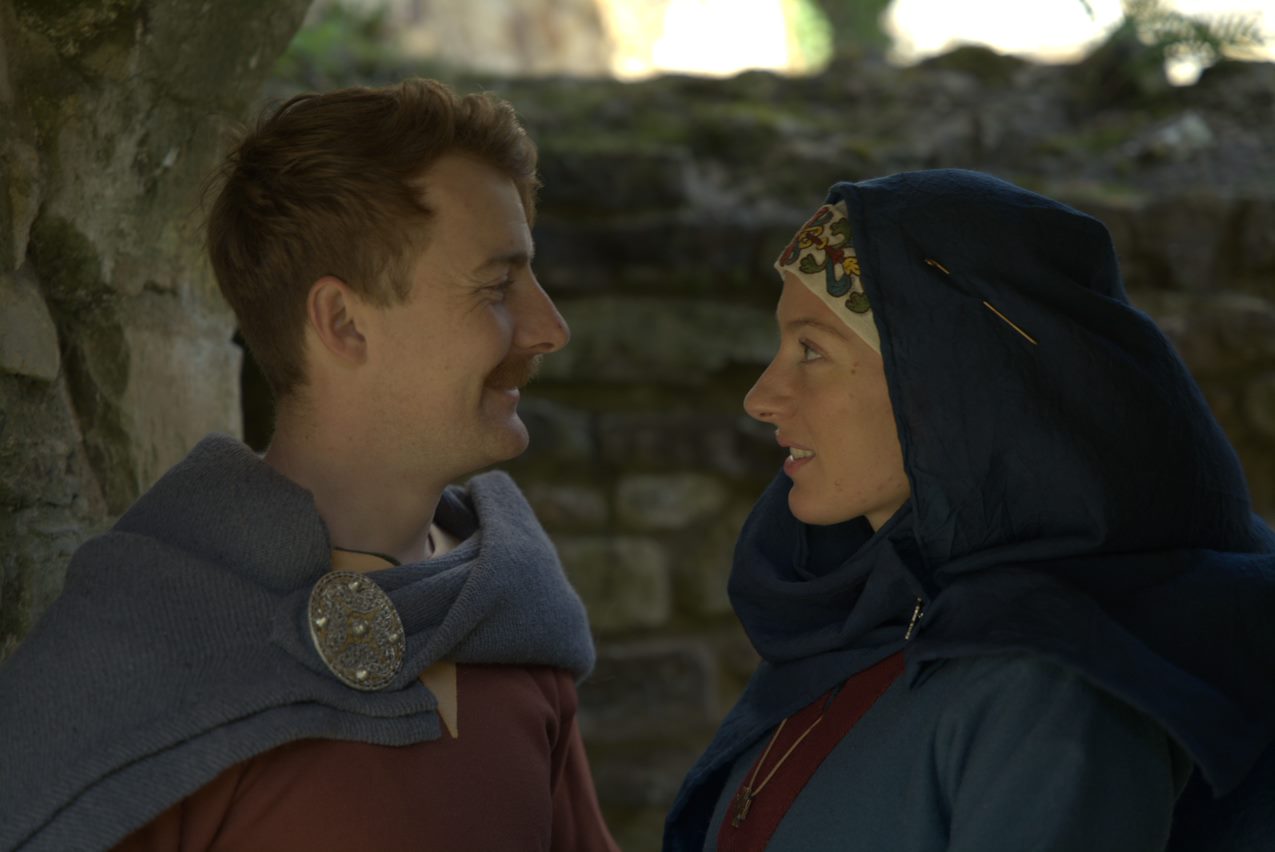
‘Gytha and Godwin’ portrayed by me and Jeppe Christensen

Through the will left by Æthelstan, we have identified that Earl Godwin, (d. 1053) was the son of Wulfnoth Cild and Harold Godwinson’s father. Nothing is known of Godwin’s mother, but he has been cautiously accredited with possible siblings. One such sibling being the lady Æthelflӕd, named in the family tree that Barlow cites in his book. This woman was the owner of land in Buckinghamshire and was married to a man called Toki. The estate was gifted to his wife by her father, a man called Wulfnoth, who was connected to Godwin’s son, Leofwin, who held the estate thirty years later. This does not confirm, however, that this particular Wulfnoth was the chap who fathered Godwin. According to the Prosopography of Anglo-Saxon England data base, there were sixty-nine individuals with the name Wulfnoth. Most of them were in the money minting business, so it is somewhat difficult to identify the right man however the link to Godwin’s son owning the lands of Toki and Æthelflӕd is intriguing.

It has been mentioned that Godwin had a brother, Ælfwig, abbot of New Minster in Winchester. He is said to have died at Hastings and is referred to as an uncle of King Harold’s. If true, he would have been an old man to have fought in the battle, so it is unlikely he was the brother of Godwin.

As it stands it is difficult to find any solid ground for believing that the Godwinsons were of royal pedigree despite the evidence produced by A. Anscombe/L. Barlow, and Frank Barlow, and it is unrealistic to assume that the family would not have known and used it to their advantage, especially against King William the Conqueror (r. 1066‒1087). We could say it is not impossible that Harold did, and it was suppressed by the Normans, but there is no supporting evidence, which makes it doubtful. It also seems unlikely that either of the two Æthelmӕrs had fathered Wulfnoth. As Ann Williams confirms, Æthelmӕr Cild, who appears in the royal family’s tree, was of the same generation as Wulfnoth. Furthermore, he was from Devonshire. Wulfnoth was referred to as a Sussex thegn by the E version of the Anglo- Saxon Chronicle (ASC).

Harold and Eadith

Æthelmӕr number two, can also be discounted because the father of this Æthelmӕr was called Æthelric and Æthelmӕr Cild’s father was known as Æthelweard. Also, number two does not appear in the royal family tree of Wessex, suggesting that he had no royal heritage at all. He was also of the same generation as Wulfnoth. As we see, there is nothing to connect either Æthelmӕr with Wulfnoth, apart from an error made by John of Worcester, which many historians confuse as the same Æthelmӕr.

In contrast to efforts made to prove Anscombe’s and (Lundie) Barlow’s theory correct, Peter Rex, in his book on Harold’s life, refers to the Hyde Chronicle which describes Godwin as a man of low birth. This is not a contemporary source and was written in the thirteenth century for the de Warennes, whose dislike of Godwin is evident. Alternative stories of a ‘lowly’ Godwin’s rise to fame speak of him as a farmer’s boy, who, whilst cow–herding, came across a Dane called Ulf, lost and detached from his men after the Battle of Sherston. Godwin offered to help him, and a grateful Ulf took him into his service. These tales have more to do with myth than anything based in reality and do not account for Godwin being left land in Æthelstan’s will which is a whole other story for another time.

You might say that not having English royal pedigree should have dismissed Harold from any right the throne. He was not the son of a king, and therefore this lack of royal blood would have discounted him. In fact, Harold was descended from royal stock. It was just not the right one. His mother, Gytha, was the daughter of the fascinatingly named Thorgils Sprakaleggr (strut leg) who was the grandson of Harold Bluetooth making Gytha the great granddaughter of a King of Denmark and Norway and a second cousin of King Cnut the Great. So, although Harold was of royal lineage, it wasn’t the right one. Therefore, we could give the same consideration to Duke William of Normandy, who fought against King Harold and claimed victory over him on the 14 October 1066. But William had no connection to England, or the lands or the language. The boy Edgar Ætheling, who had been proclaimed as Edward’s heir was too young to face the invasions threatening Anglo-Saxon England. A strong leader was what was needed at the time, and royal blood or not, Harold was that man.

Do look out for the continuation of the blog tour tomorrow on Threads to the Past

*

About the book:

Harold Godwinson occupied his place in the chronicles for more than twenty years after bursting onto the political sphere when he was barely out of his teens. His role in English history has always been overshadowed by his failure to defend his crown and country against the might of William the Conqueror and his invaders. His demise at the hands of a Franco-Norman hit squad wrought the death knell of Anglo-Saxon rule. Reigning for just ten months, Harold’s accomplishments as dux Anglorum, and later king of England, were undermined by the Norman propaganda that was waged against his memory, long after his grisly end in 1066.

But just who was this man, who some historians recall as one of England’s greatest rulers? What were his origins? Is there any truth that he could trace his ancestry to the House of Wessex, and did he really usurp the throne from Duke William, the Bastard of Normandy? In this re-examining of this great historical figure of the eleventh century, we glean new theories and ideas not only about Harold’s life, but also questions historians have pondered upon for years. Did Edward really offer the throne to William? And how much of William’s claim was truth or fiction?

Paula Lofting presents a thoughtful and careful critique of the previous research. Examining his life through a telescopic view of the primary sources, she offers the reader a more accurate evaluation of who he was, how he died, and what happened to his remains after his death on a field near Hastings on October 1066.

About the author:

Paula Lofting is the author of an eleventh-century saga, Sons of the Wolf, and is working on book three in the series. She has also written articles for magazines like Historical Times and contributed to Iain Dale’s recent Kings and Queens with an essay on Edmund Ironside. Lofting’s love for Anglo-Saxon/Viking/Norman re-enactment with Regia Anglorum is a great tool for her writing. She is also a psychiatric nurse with nineteen years’ experience and enjoys spending time with her family, three grown-up children and two grandchildren. This is Lofting’s first foray into the realms of historical non-fiction, and she hopes it will not be her last. She also has been commissioned to write a biography on Edmund Ironside with Pen & Sword which is currently in progress.

Website : www.threadstothepast.com, Fb: https://www.facebook.com/Wulfsuna?locale=en_GB, Instagram: https://www.instagram.com/paulaloftingwilcox/, x: https://x.com/longshippub, mybook.to/Haroldpreorder

*

My Books

Signed, dedicated copies of all my books are available through my online store.

Out now: Scotland’s Medieval Queens

Scotland’s history is dramatic, violent and bloody. Being England’s northern neighbour has never been easy. Scotland’s queens have had to deal with war, murder, imprisonment, political rivalries and open betrayal. They have loved and lost, raised kings and queens, ruled and died for Scotland. From St Margaret, who became one of the patron saints of Scotland, to Elizabeth de Burgh and the dramatic story of the Scottish Wars of Independence, to the love story and tragedy of Joan Beaufort, to Margaret of Denmark and the dawn of the Renaissance, Scotland’s Medieval Queens have seen it all. This is the story of Scotland through their eyes.

Available now from Amazon and Pen and Sword Books

Also by Sharon Bennett Connolly:

Heroines of the Tudor World tells the stories of the most remarkable women from European history in the time of the Tudor dynasty, 1485-1603. These are the women who ruled, the women who founded dynasties, the women who fought for religious freedom, their families and love. Heroines of the Tudor World is now available for pre-order from Amberley Publishing and Amazon UK. Women of the Anarchy demonstrates how Empress Matilda and Matilda of Boulogne, unable to wield a sword themselves, were prime movers in this time of conflict and lawlessness. It shows how their strengths, weaknesses, and personal ambitions swung the fortunes of war one way – and then the other. Available from Bookshop.orgAmberley Publishing and Amazon UKKing John’s Right-Hand Lady: The Story of Nicholaa de la Haye is the story of a truly remarkable lady, the hereditary constable of Lincoln Castle and the first woman in England to be appointed sheriff in her own right. Available from all good bookshops Pen & Sword Booksbookshop.org and Amazon

Defenders of the Norman Crown: The Rise and Fall of the Warenne Earls of Surrey tells the fascinating story of the Warenne dynasty, from its origins in Normandy, through the Conquest, Magna Carta, the wars and marriages that led to its ultimate demise in the reign of Edward III. Available from Pen & Sword BooksAmazon in the UK and US, and Bookshop.orgLadies of Magna Carta: Women of Influence in Thirteenth Century England looks into the relationships of the various noble families of the 13th century, and how they were affected by the Barons’ Wars, Magna Carta and its aftermath; the bonds that were formed and those that were broken. It is now available in paperback and hardback from Pen & SwordAmazon, and Bookshop.orgHeroines of the Medieval World tells the stories of some of the most remarkable women from Medieval history, from Eleanor of Aquitaine to Julian of Norwich. Available now from Amberley Publishing and Amazon, and Bookshop.orgSilk and the Sword: The Women of the Norman Conquest traces the fortunes of the women who had a significant role to play in the momentous events of 1066. Available now from Amazon,  Amberley Publishing, and Bookshop.org.

Alternate Endings: An anthology of historical fiction short stories including Long Live the King… which is my take what might have happened had King John not died in October 1216. Available in paperback and kindle from Amazon.

Podcast:

Have a listen to the A Slice of Medieval podcast, which I co-host with Historical fiction novelist Derek Birks. Derek and I welcome guests, such as Bernard Cornwell, and discuss a wide range of topics in medieval history, from significant events to the personalities involved. Every episode is also now available on YouTube.

*

Don’t forget! Signed and dedicated copies of all my books are available through my online store.

For forthcoming online and in-person talks, please check out my Events Page.

You can be the first to read new articles by clicking the ‘Follow’ button, liking our Facebook page or joining me on TwitterThreadsBluesky and Instagram.

*

©2025 Sharon Bennett Connolly FRHistS and Paula Lofting