Book Corner: Reliquary by Prue Batten

1196AD

Lyon

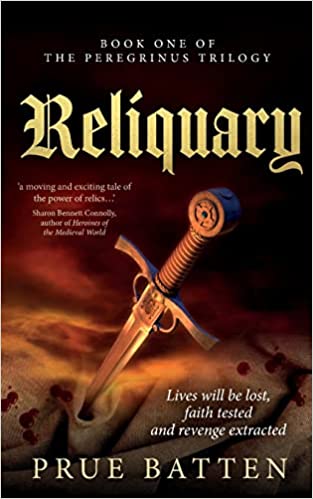
Relics can move mountains, so history relays. They cure the sick, promise success, enable whole kingdoms to win wars.

A fragment of byssus lies in a small chest and its very existence underlines the life of Christ and the meaning behind the Holy Church. Its power can only be wondered at.

It is the kind of relic which inspires heroic deeds and . . . murder.

An elderly nun and a returned crusader are all that stands between the world’s most sanctified relic and a Templar knight who craves it for his own purpose.

From Constantinople to Caen, from Venice to Viviers, from Rome to Rouen, relics are traded like pepper and frankincense, silk and silver, lapis and alum. Sold to the highest bidder.

Who then should pay the highest price of all for a fragment of aged cloth?

Is the highest price surely . . . and inevitably . . . death?

My first thought on looking at Reliquary by Prue Batten was what a gorgeous cover!

As to the book, it was fabulous!

I loved Reliquary!

Reliquary brings together a disparate group of heroes with one aim – to get a newly acquired relic safely to its destination, which is a small, impoverished convent in France. It is a moving and exciting tale of the power of relics and friendship in Europe in the aftermath of the Third Crusade.

Faced by powerful enemies, including the weather, and set in the aftermath of the Third Crusade, Reliquary is a gripping tale, replete with action, adventure and intrigue. The clever plotline is enacted by wonderful, flawed characters with whom the reader cannot help but to feel an affinity. Prue Batten has written a marvellous, gripping tale of a comradeship forged against the avaricious greed of the rich and powerful.

Beautiful imagery.

‘We need a relic.’

‘Pardon,’ the Obedientiary put down her mug of watered wine and stared at the Prioress.

‘We need a relic,’ the Prioress replied. Younger than the Obedientiary, she had blue eyes. One could almost say guileless, had it not been for the veil of iron behind the heavenly colour. The Obedientiary had observed those eyes harden to molten steel, and as strong, many times. Especially when senior prelates had visited the priory with the express purpose of wanting it closed because of its small population and lack of fame and fortune. As the Prioress spoke now, her eyes darkened – a tint reminiscent of the forge as the smithy honed blades for those who sought to arm themselves.

‘Something to bring the pilgrims,’ she continued, rubbing the worn edge of the table as if the smooth rhythm might settle the uneven nature of her thoughts. ‘In short, to bring us monies. We are only a few leagues away from the Chemin de Compostelle…’

In fact, the Obedientiary knew this. The Via Arena, beloved of pilgrims, passed through Jumeaux, following the river that trickled and sometimes flowed, not far from Esteil.

‘I cannot fight off these crows of canons for much longer. I have been communicating with Mother Abbess at Fontevrault and she agrees that we must find a way to improve Esteil’s fortunes. In between times, she has said she will do what she can, but in my view it will be little, perhaps nothing.’

Esteil was situated within Fontevrault’s purview. Occasionally, the mother house dispensed funds to smaller houses in distress. It also kept a weather eye on the spiritual well being of the houses, but most small convents were expected to contribute to the continuance – temporal and spiritual. Survival of the fittest, thought the Obedientiary.

Outside, the wood pigeons cooed and the hens that lay smooth brown eggs pecked and clucked as if they understood the Prioress’s concerns. Someone walked past in clogs, the beat of their steps on the stones of the cloister the only sound apart from the birds. Perhaps the midday meal was done and the sisters were beginning to file out of the refectory to attend to their yard duties – the physic garden, the provender garden, the hens or the orchard. Or perhaps some of their small number were copying in the scriptorium, or stitching within the solar. Right now, the Obedientiary should be there, checking that her three stitching novices had begun their afternoon’s work on a cope while there was any sort of light.

‘And what is our value, Mère Gisela?’ she asked. ‘Are we any better or worse than other such small houses like ourselves? How do we argue our value when we are less than twenty sisters?’

‘Indeed, and despite what we do every day, what we accomplish in the scriptorium and with our threads, it is apparently not enough.’ The Prioress sighed and rubbed at the smooth skin of her hands. One folding over the other, rubbing this way, rubbing that as if her young bones ached. ‘God help us. Despite the quality of our scribes and the skill of our needlewomen, such work is not enough to plead our cause. Which is why I say we need a relic.’

Prue Batten’s wonderful array of characters, from the non-worldly Sister Cecile to the war-weary Henri de Montbrisson, and their band of friends and allies, help to make Reliquary a truly memorable novel.

For any fan of medieval historical fiction, Reliquary is a tale not to be missed. It is one of those books that will have you reading ‘just one more chapter’ long into the early hours. A thoroughly enjoyable historical fiction thriller – it will have you on the edge of your seat from beginning to end.

Prue Batten has crafted a novel that draws the reader in and keeps a hold of them until the very end. It is impossible to put down!

And the best thing about Reliquary? It is the first in a new series – and I can’t wait to read more!

Reliquary is now available from Amazon.

My Books

Signed, dedicated copies of all my books are available, please get in touch by completing the contact me form.

Defenders of the Norman Crown: The Rise and Fall of the Warenne Earls of Surrey tells the fascinating story of the Warenne dynasty, of the successes and failures of one of the most powerful families in England, from its origins in Normandy, through the Conquest, Magna Carta, the wars and marriages that led to its ultimate demise in the reign of Edward III. Defenders of the Norman Crown: Rise and Fall of the Warenne Earls of Surrey is now available from Pen & Sword BooksAmazon in the UK and US and Book Depository.

1 family. 8 earls. 300 years of English history!

Also by Sharon Bennett Connolly:

Ladies of Magna Carta: Women of Influence in Thirteenth Century England looks into the relationships of the various noble families of the 13th century, and how they were affected by the Barons’ Wars, Magna Carta and its aftermath; the bonds that were formed and those that were broken. It is now available in paperback and hardback from Pen & Sword,  Amazon and from Book Depository worldwide.

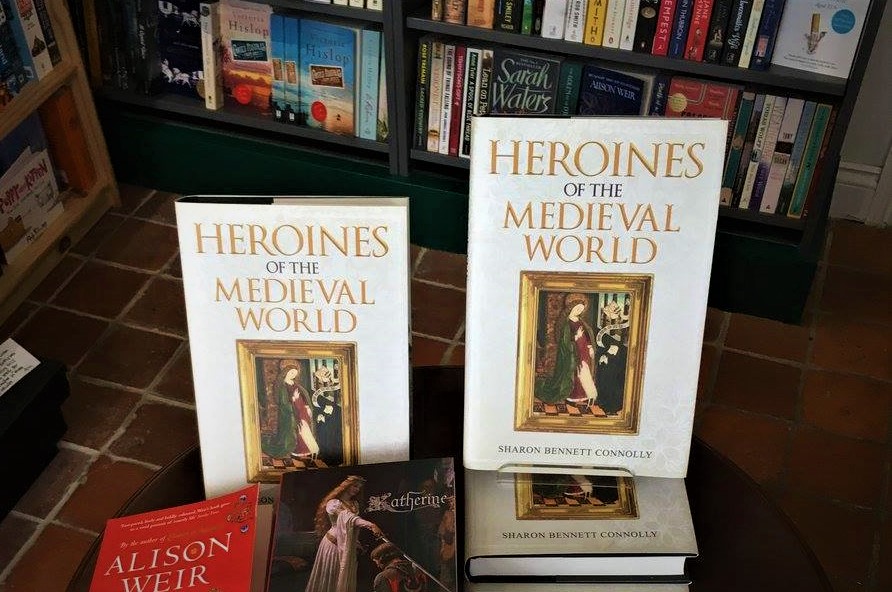
Heroines of the Medieval World tells the stories of some of the most remarkable women from Medieval history, from Eleanor of Aquitaine to Julian of Norwich. Available now from Amberley Publishing and Amazon and Book Depository.

Silk and the Sword: The Women of the Norman Conquest traces the fortunes of the women who had a significant role to play in the momentous events of 1066.  Available now from Amazon,  Amberley Publishing, Book Depository.

*

You can be the first to read new articles by clicking the ‘Follow’ button, liking our Facebook page or joining me on Twitter and Instagram.

©2021 Sharon Bennett Connolly
Book Corner: Interview with novelist Prue Batten

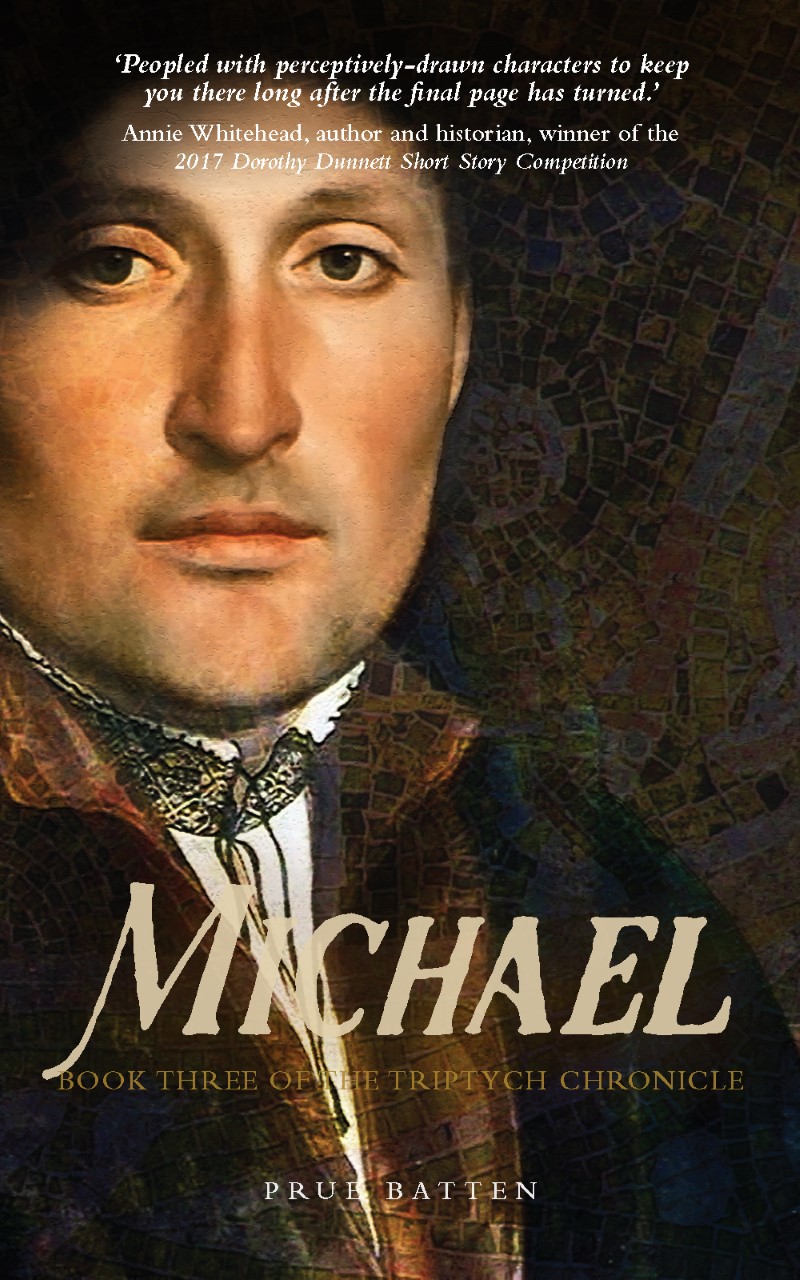
It is with great pleasure that I welcome Prue Batten to the blog today, on the very day of the release of her latest novel, Michael. Hi Prue, thanks so much for agreeing to an interview on History… the Interesting Bits. Welcome.

Thanks so much Sharon for inviting me.

What made you become a writer?

I don’t think I have ever really consciously thought about ‘being’ a writer. Writing has been an art-form I have loved from Grade Three, rather like painting or sketching. I used to write little prose pieces to describe scenes or events, be they imaginary or real. Even from such a young age, the use of words would make me contented and it was something at which I excelled at school. As I grew older, nothing changed. I learned other art-forms of course, but writing stayed with me. The chance to place novels before readers was mere serendipity but that’s a whole other story…

Where do you find the inspiration for your stories?

In the case of my fantasies, inanimate things like embroideries, paperweights, a Japanese cloth made of paper and silk called shifu. And most lately, as I begin another fantasy – maps and cabinets of curiosity.

Tell us a little about the book you have written so far.

The book I have just finished writing and which will be released this July, is the final in an historical fiction trilogy entitled The Triptych Chronicle. The book is called Michael. The trilogy is about the insidious rivalries of trade in the twelfth century and essentially, each novel is a standalone, but they fit together like fingers in gloves to make a series. Tobias, Book One, is about the theft of the infamous Tyrian purple dye from the Byzantine empire and is set in Constantinople. The second, Guillaume, involves the same trading house, but a different location, Lyon, and is about the discovery of the Waldensian Bible. Michael is set back in Constantinople where byssus, an enigmatic silk woven from mollusc tendrils, arouses jealousies. The underlying thread in the three books is revenge and each of the three men are good friends and employees of the trading house, Gisborne-ben Simon…

Please, tell me about your new book, Michael.

The blurb reads thus but like all blurbs, seems to change on a daily basis as one tries to tweak it!

Michael Sarapion, merchant and thief, returns to Byzantine Constantinople from which he fled the year before in fear of his life. In his company is Tobias, the dwarf brother of an icon thief and Ahmed, an Arab galleymaster with secrets.

Michael is filled with grief and fury, intending vengeance for a treasure lost to him twelve years before. He must trust in priests, defy the empire and guard those dearest to him as he searches, because he understands that to restore what is rightfully his, he must kill… or be killed.

In this final standalone to The Triptych Chronicle trilogy, Michael, Tobias and the stalwarts of the House of Gisborne-ben Simon will slice a swathe through the Byzantine city, with those who challenge them hard on their heels.

How do you organise you writing day – do you write every day?

I try with minimal success. Some days, I’m lucky if I write 150 words. Some days I’ve written up to 2000. But if I have a ‘writing day’, I begin with business. I clear my emails and social media and then I sit and read the previous chapter to the point where I must continue. I write with a pen and A4 paper, so the pages are filled with cross-hatching and bold black lines. When I have about 10-12 pages written, and having edited it (many times), I will then transcribe to the computer which is another edit in itself.

What is your favourite thing about being a writer?

Seclusion, placing myself elsewhere, concentration of the mind, being mindful. Also, I am one of the few writers that seems to love working with the editor. It’s akin to working with a swimming coach. Writing is so solitary and once the editor steps in, there’s a chance to lay out ideas and styles. I always visualise my editor striding up and down the pool beside me, shouting out instructions as I swim laps. I have a good relationship with my editor!

What is your least favourite thing about being a writer?

Finishing the first draft! And once the book is as polished as it can be, and is published, watching my dashboards to see if anybody buys it.

How do you see social media (such as Facebook and Twitter), is it a blessing, a hindrance, or a necessary evil?

A blessing. I love social media for two reasons. One is that solitude issue. Social media enables one to break out of the bubble and communicate with kindred spirits everywhere – be they writers or readers. The other is that living as far south of the globe as one can go without falling off the end of the world, I get to meet and make friends with people I might never meet otherwise. I think to take those friendships through the years, even if I cease being a writer, is the most wonderful gift.

What is your favourite period in history, and why?

It’s the late Medieval period. In my case, the late twelfth century. To me, it’s as close as one can get to the Renaissance without being surrounded by the flamboyance of that timeframe. There was so much beautiful religious art in the period, the strengthening of trade with the east, religious excitement (as with the Waldensians – almost a Reformation!) and exploration. As spices and other exotic goods moved into Europe from the east, food styles changed, clothing styles changed. And I still haven’t mentioned politics… 

What story would you really like to tell, but haven’t written yet?

A fictional version of my ancestor’s story. I am descended from a convict who was tried and sentenced to transportation to Van Diemen’s Land from England in the 1800’s. His sentence for stealing two sheep was fourteen years, essentially a death sentence, and yet he took his carpentry skills with him and managed to survive to become a free man. And here I am…

Who is your favourite historical character and why?

Prue Batten

Nicholas de Fleury from the House of Niccolo series by Dorothy Dunnett. He is a brilliantly Macchiavellian character who Dorothy set in the Renaissance, and it was his merchant intrigue that set me researching what trade may have been like three hundred years earlier. Effectively my medieval merchants laid the groundwork for Renaissance merchants like Niccolo. How I would love to converse with DD about that…

Who are your favourite authors who inspire you?

So many, through the years, beginning with Rosemary Sutcliffe as a teenager.

Others are Dorothy Dunnett, Mary Stewart, Simon Turney, Matthew Harffy, Michael Jecks, and Christian Cameron, Kathryn Gauci and Elisabeth Storrs in the hist.fict genre.  In fantasy? Tolkein, Juliet Marillier and Cecilia Dart Thornton. In contemporary fiction? Jan Ruth,  GS Johnston, Jilly Cooper. And they are all just a few of many exceptional names.

What is your favourite all-time book , the one that you cannot do without?

May I have two?

Niccolo Rising. Who cannot fail to be drawn in by three drunk men sailing downriver in the Duke of Burgundy’s bath tub!

Anne of Green Gables by LM. Montgomery because there’s always ‘scope for the imagination’.

What is the one piece of advice that you would give an aspiring writer?

Write because you love words. Read more words. And take your time. It’s worth the wait…

Thanks you so much, Sharon, for taking an interest in my work and my life. My books may be purchased by following this link: http://author.to/pruebatten

Thank you Prue, for taking the time to respond with such in-depth, thoughtful answers. I can’t wait to read Michael!

About Prue Batten:

Prue Batten has been an indie writer since 2008 when her first novel, a fantasy entitled The Stumpwork Robe, was published in a POD exercise funded by the UK Arts Council.

Since then, she has indie published three further books of the fantasy quartet which won awards, six historical fiction novels, some of which have also won awards, and an illustrated childrens’ book, through her own imprint, Darlington Press. She has also worked with writers of excellence to publish anthologies to raise money for cancer research and has a long-term collaboration with an American miniature press for whom she writes short stories.

For more information, go to:  http://www.pruebatten.com

Facebook: http://www.facebook.com/Prue.Batten.writer
Pinterest: http://pinterest.com/pruebatten

*

My books

Heroines of the Medieval World tells the stories of women, famous, infamous and unknown, who shaped the course of medieval history. It is available in hardback in the UK from both Amberley Publishing and Amazon UK. It is now available in Hardback from Amazon US  and worldwide from Book Depository.

From Emma of Normandy, wife of both King Cnut and Aethelred II to Saint Margaret, a descendant of Alfred the Great himself, Silk and the Sword: the Women of the Norman Conquest traces the fortunes of the women who had a significant role to play in the momentous events of 1066. Silk and the Sword: the Women of the Norman Conquest will be released in the UK on 15 November 2018 and is available for pre-order on Amazon UKAmberley Publishing and Book Depository.

You can be the first to read new articles by clicking the ‘Follow’ button, liking our Facebook page or joining me on Twitter.

*

©2018 Sharon Bennett Connolly