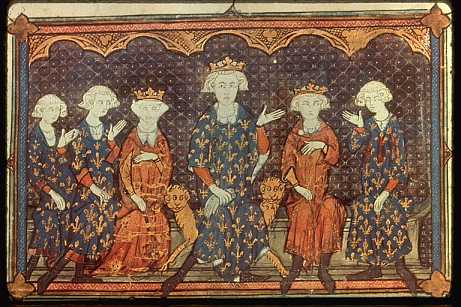
In the early years of the 14th Century, scandal rocked the French monarchy to its core and inadvertently contributed to the end of the Capetian dynasty.
1314 was a tumultuous year for France; the final act in the destruction of the Knights Templars was played out when Grand Master, Jacques de Molay and the Preceptor of Normandy, Geoffrey de Charney, were burned to death on the Ile de la Cite.
De Molay is said to have cursed Philip IV, King of France, and his descendants from the flames. Philip IV would be dead within a year and his dynasty’s rule over France would end with the death of his youngest son, Charles IV, in 1328.
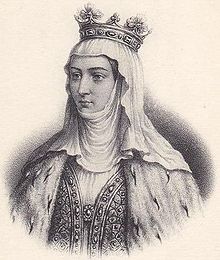
Philip’s eldest son and heir, Louis, was married to Marguerite de Burgundy. Louis seems to have been a hard person to live with – his nickname was Louis the Quarreler – and the marriage was said to be very unhappy. A daughter, Jeanne, would survive childhood to eventually become Queen of Navarre.
The second son, Philip, was married to Marguerite’s cousin, Jeanne d’Artois and Charles, the youngest, was married to Jeanne’s sister, Blanche d’Artois.
The royal scandal of 1314 was supposedly uncovered due to 2 rather innocuous items; silk purses.

On an earlier visit to France Isabella of France, wife of Edward II of England, had given silk purses to her sisters-in-law, as souvenirs of the knighting of her 3 brothers, Louis, Philip and Charles, the sons of Philip IV.
When she visited again in 1314, Isabella saw these same silk purses on the belts of 2 knights of the French court; brothers Gautier and Philippe d’Aunay. When Isabella brought this to her father’s attention, the matter was investigated and the brothers were put under surveillance.
The 2 knights, it seems, were meeting with the princesses in secret. The whole scandal became known as the Tour de Nesle Affair, as the clandestine meetings were supposed to have taken place in this small palace on the outskirts of Paris (although some sources suggest that events happened at Philip IV’s country retreat of Maubuisson Abbey).
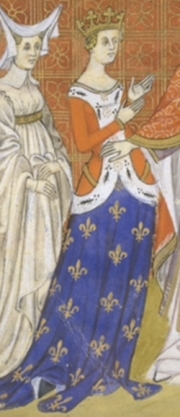
Whatever the location, the affair was discovered; all 3 princesses were arrested and questioned. When confronted in a secret court, Marguerite and Blanche confessed to adultery with the d’Aunay brothers. Their heads were shaved and they were sent to life imprisonment in Chateau Gaillard.
Blanche’s sister, Jeanne, fared better; she was also arrested, and placed under guard at the Chateau Dourdan. Her marriage with Philip was a very happy one, and it seems she was only guilty of knowing of the affairs. Philip defended his wife before the Paris Parlement and, with Philip’s support, Jeanne pleaded her innocence to the king, and was allowed to return to her husband and the court.
The 2 knights were arrested and, after being questioned and tortured, they confessed to the adultery and were condemned to death for the crime of ‘lese majeste’. The unfortunate brothers were castrated and ‘broken on the wheel’ – they were strapped to large wheels, which were spun while their limbs were shattered with iron bars. And finally, they were decapitated.
Of the princesses, Marguerite’s imprisonment was the most severe. She was badly treated and some sources suggest she was held in a cell at the top of the donjon, open to the elements.

On his accession to the throne in November 1314, Louis X applied to the Pope for an annulment of the marriage. However, Pope Clement V died before he could grant the divorce and no new Pope would be elected until 1316. Shortly after Clement’s death, however, Marguerite conveniently died – probably strangled on the orders of Louis.

Louis married Clemence of Hungary, but died in June 1316, whilst Clemence was pregnant with their son. Jean I the Posthumous, was born and died in November of the same year and the crown passed to Louis’ brother, Philip V – with Jeanne d’Artois (by then Countess of Burgundy) at his side.
Philip died in 1322, leaving only daughters and the crown passed to his brother. On his accession, Charles divorced Blanche – still in an underground cell in Chateau Gaillard – and transferred her to a monastery at Gavray, in Normandy, where she became a nun, dying there the following year.
Charles IV died in February 1328, leaving his 3rd wife, Jeanne d’Evreux, pregnant. In April 1328, she gave birth to a daughter, Blanche. The birth of a daughter led to the succession crisis, with arguments arising that a woman could not inherit the French throne. Although Salic Law had only previously been relevant to landed inheritance, and never before applied to the crown, it was now used to invoke to remove the surviving daughters of the 3 Valois kings from the succession. The crown now passed to Charles’ closest relative through the male line; his cousin, Philip of Valois, grandson of Philip III.
Edward III of England, however, as the only grandson of Philip IV, through his mother, pursued his own claim to the French throne and used it as a motive to launch the Hundred Years’ War.
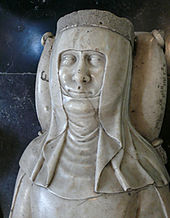
Salic Law, however, was not in force in Navarre, a kingdom which had come to the French crown when Jeanne I of Navarre had married Philip IV. Louis’ daughter, Jeanne, therefore inherited Navarre as Jeanne II, despite the questions that the scandal raised over her parentage.
It has been suggested that the Tour de Nesle Affair was all an elaborate plot to destabilise the French monarchy, but most historians believe the adultery took place. The harsh punishments reflected the need for queens and princesses to be above reproach, and the parentage of their children to be beyond question. The scandal cast a long shadow on the last years of the Capetian dynasty, with neither of the 3 brothers producing a son to carry on their line.
*
Sources: Pierre Goubert The Course of French History; Paul Doherty Isabella and the Strange Death of Edward II; J Huizinga The Waning of the Middle Ages; H.G. Koenigsberger Medieval Europe 400-1500; maison-hantee.com; herodote.net; histoirefrance.net.
Pictures taken from Wikipedia.
*
My Books:
Signed, dedicated copies of all my books are available through my online store.
Out now: Scotland’s Medieval Queens

Scotland’s history is dramatic, violent and bloody. Being England’s northern neighbour has never been easy. Scotland’s queens have had to deal with war, murder, imprisonment, political rivalries and open betrayal. They have loved and lost, raised kings and queens, ruled and died for Scotland. From St Margaret, who became one of the patron saints of Scotland, to Elizabeth de Burgh and the dramatic story of the Scottish Wars of Independence, to the love story and tragedy of Joan Beaufort, to Margaret of Denmark and the dawn of the Renaissance, Scotland’s Medieval Queens have seen it all. This is the story of Scotland through their eyes.
Available now from Amazon and Pen and Sword Books
Also by Sharon Bennett Connolly:
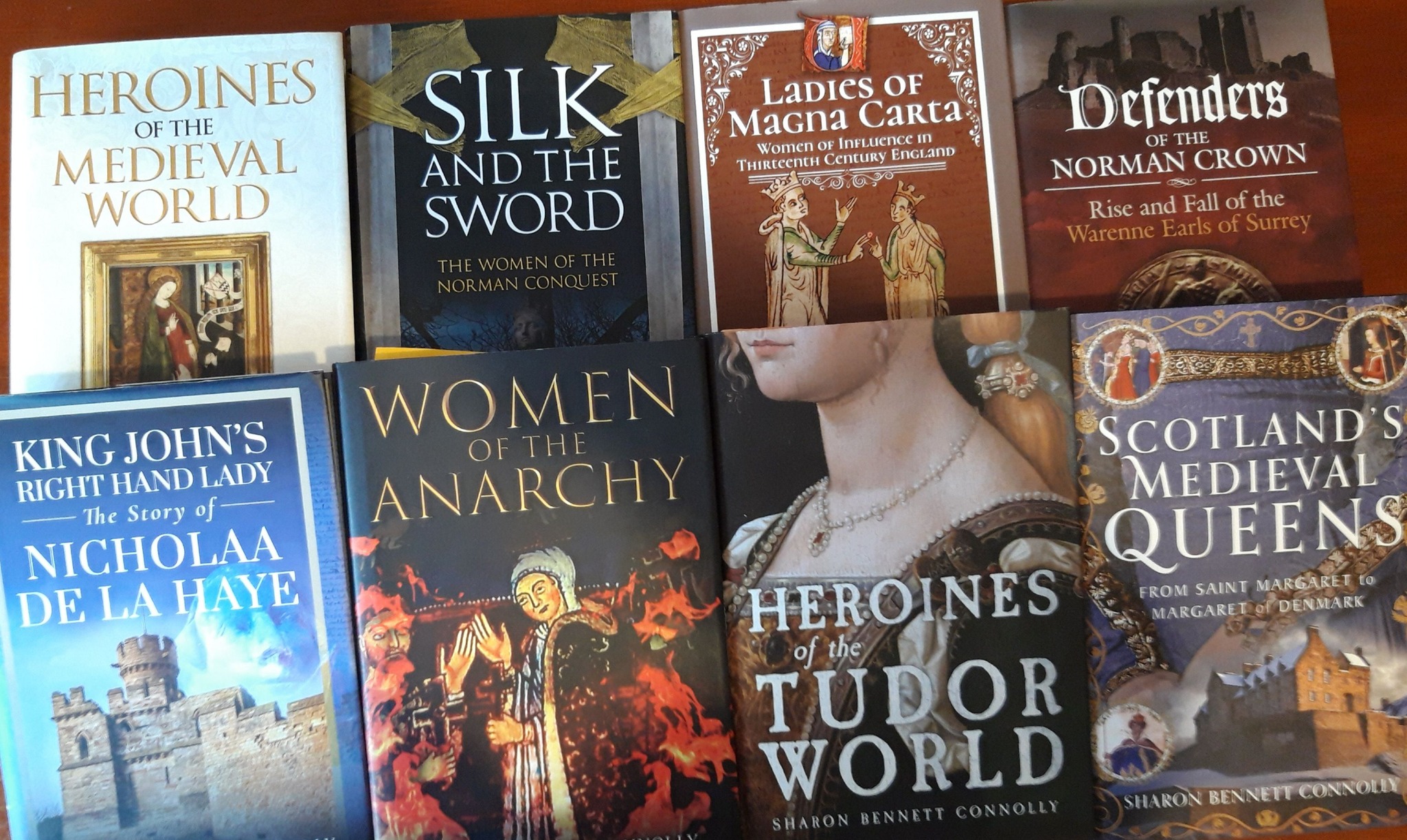
Heroines of the Tudor World tells the stories of the most remarkable women from European history in the time of the Tudor dynasty, 1485-1603. These are the women who ruled, the women who founded dynasties, the women who fought for religious freedom, their families and love. Heroines of the Tudor World is now available for pre-order from Amberley Publishing and Amazon UK. Women of the Anarchy demonstrates how Empress Matilda and Matilda of Boulogne, unable to wield a sword themselves, were prime movers in this time of conflict and lawlessness. It shows how their strengths, weaknesses, and personal ambitions swung the fortunes of war one way – and then the other. Available from Bookshop.org, Amberley Publishing and Amazon UK. King John’s Right-Hand Lady: The Story of Nicholaa de la Haye is the story of a truly remarkable lady, the hereditary constable of Lincoln Castle and the first woman in England to be appointed sheriff in her own right. Available from all good bookshops Pen & Sword Books, bookshop.org and Amazon.

Defenders of the Norman Crown: The Rise and Fall of the Warenne Earls of Surrey tells the fascinating story of the Warenne dynasty, from its origins in Normandy, through the Conquest, Magna Carta, the wars and marriages that led to its ultimate demise in the reign of Edward III. Available from Pen & Sword Books, Amazon in the UK and US, and Bookshop.org. Ladies of Magna Carta: Women of Influence in Thirteenth Century England looks into the relationships of the various noble families of the 13th century, and how they were affected by the Barons’ Wars, Magna Carta and its aftermath; the bonds that were formed and those that were broken. It is now available in paperback and hardback from Pen & Sword, Amazon, and Bookshop.org. Heroines of the Medieval World tells the stories of some of the most remarkable women from Medieval history, from Eleanor of Aquitaine to Julian of Norwich. Available now from Amberley Publishing and Amazon, and Bookshop.org. Silk and the Sword: The Women of the Norman Conquest traces the fortunes of the women who had a significant role to play in the momentous events of 1066. Available now from Amazon, Amberley Publishing, and Bookshop.org.
Alternate Endings: An anthology of historical fiction short stories including Long Live the King… which is my take what might have happened had King John not died in October 1216. Available in paperback and kindle from Amazon.
Podcast:

Have a listen to the A Slice of Medieval podcast, which I co-host with Historical fiction novelist Derek Birks. Derek and I welcome guests, such as Bernard Cornwell and Michael Jecks, and discuss a wide range of topics in medieval history, from significant events to the personalities involved. Every episode is also now available on YouTube.
*
Don’t forget! Signed and dedicated copies of all my books are available through my online store.
For forthcoming online and in-person talks, please check out my Events Page.
You can be the first to read new articles by clicking the ‘Follow’ button, liking our Facebook page or joining me on Twitter, Threads, Bluesky and Instagram.
*
©2015 Sharon Bennett Connolly, FRHistS
 History... the interesting bits!