Today it is a pleasure to welcome Toni Mount to History … the Interesting Bits as a stop on her ‘The Colour of Shadows’ Blog Tour. The Colour of Shadows is the latest instalment in Toni’s Sebastian Foxley Medieval Murder Mysteries series.
So it’s over to Toni
Whores and Winchester Geese – Prostitution in Medieval London
by Toni Mount

In my new Sebastian Foxley murder-mystery novel The Colour of Shadows, set in medieval London, some of the action takes place on the south side of London Bridge, in a seedy brothel known as ‘The Mermaid’. Mermaids were believed by medieval folk to seduce mariners, luring them to their deaths at sea. This nasty trait made ‘The Mermaid’ a most suitable name for a house of ill-repute in medieval Southwark but what was life really like for the unfortunate women, forced to earn their living in such places?
Prostitution is said to be the oldest profession. If you’re wondering, the second oldest is spying – both are mentioned in the Bible. Throughout history, prostitution has been seen as a necessary fact of life, for the most part tolerated by civic authorities, if rarely approved. In medieval London, the city tried to regulate the work of ‘common women’, confining them to particular areas, such as Cock Lane, in the north-west, near Newgate. But better yet was to keep them outside the city, out of sight and, hopefully, out of mind, across the Thames in Southwark, where they wouldn’t sully the city’s precious reputation. The Liberty of the Clink was an area in Southwark that, although actually in Surrey, was exempt from the jurisdiction of the county’s sheriff and came under the authority of the Bishop of Winchester. The bishop’s London residence, Winchester House, was built in the liberty, originally surrounded by parkland. Because the liberty lay outside the jurisdiction of the City of London and that of the county authorities of Surrey, some activities forbidden in those areas were permitted here.
In 1161 the bishop was granted the power to license prostitutes and brothels in the liberty and the women became known as ‘Winchester Geese’. To be ‘bitten by a Winchester goose’ meant to contract a venereal disease and ‘goose bumps’ was slang for the symptoms of the disease. Medieval attitudes to prostitution were mixed. Sex was only for procreation but, if it couldn’t be helped, at least the geese prevented good Christian men falling into even worse practices – like sodomy or masturbation – seen as mortal crimes by the church – so prostitution was a kind of safety valve for wicked desires and had the added benefit of filling the bishop’s coffers. When the poor Geese died, they had the final indignity of being buried in unconsecrated ground. The Cross Bones graveyard in Southwark has been preserved by local residents and a little memorial set up to commemorate the Winchester Geese.
Clients would come by boat from a jetty at Stew Lane in the city across the river to avoid being questioned if they went through the gates at London Bridge and, of course, the gates were closed after dusk. As clients approached the south bank, they’d see signs with the brothels’ names, painted on the white walls of detached houses surrounded by gardens. In early Tudor times, there were the Bear’s Head, the Cross Keys, the Gun, the Castle, the Crane, the Cardinal’s Hat, the Bell and the Swan. Under the direction of the Bishop of Winchester there were some restrictions: the brothels were not permitted to open on Sundays or religious days. There was also some attempt to stop prostitution getting out of hand, with a fine of twenty shillings should any ‘woman of the bordello… draw any man by his gown or by his hood or any other thing’. And the ordinances were meant to protect the prostitutes as well, requiring that women were not held against their will. Whether that actually happened is up for debate. We have some fascinating poll tax records documenting the extent of the ‘trade’, including those from 1381, recording seven local ‘stew-mongers’ each keeping between two and six ‘servants’, the latter probably a mix of both servants and prostitutes. Others are said to have worked on a ‘freelance’ basis, operating out of the likes of Paris Garden, the manor next to the Clink, or St Thomas’ Hospital.

By the time Henry VI came to the throne in 1422, the Southwark stews were at the peak of their profitability and the money flooding in allowed many stew-holders to buy themselves freehold property elsewhere in Southwark. Some used these additional properties to open inns or taverns which doubled as illegal brothels in Borough High Street, but that was only the beginning of the trouble their new riches brought. In order to serve on a fifteenth-century jury, you had to be a property-owner, which was taken as evidence you had a stake in society and could be trusted to take your responsibilities in court seriously. This gave the newly propertied stew-holders another opportunity for corruption. By hiring out their services to the highest bidder, stew-holders on the jury could deliver whatever verdict their paymasters required.
In 1473, Elizabeth Butler was visiting a friend’s London house when she met Thomas Boyd for the first time. Boyd offered her a job as a domestic servant at what he said was a Bankside inn, promising good pay and excellent working conditions. She accepted and went with him to the inn, where she quickly realised the place was actually a brothel and Boyd was its manager. Far from the light housekeeping duties his original offer implied, Boyd’s real plan was for Elizabeth to join his stable of whores. ‘He would have compelled me to do such things and service as other his servants done there’, she later testified. When Elizabeth refused to sell herself, Boyd claimed she owed him rent and took her to the Bishop of Winchester’s court, demanding a cash sum so large he knew she could never hope to pay it. The court found Elizabeth Butler guilty and gaoled her when she admitted she had no money. That was exactly what Boyd had hoped would happen. He’d be happy to get her out of gaol by cancelling her debt, he said – but only if she did what he wanted on Bankside. Elizabeth was stubborn and still refused. After three weeks in the Bishop’s Clink prison, she somehow managed to get a petition to the Bishop of Durham, pleading with him to get her case heard in the higher court of Chancery. She got as far as a hearing before London’s City Chamberlain, but frustratingly that’s where the records run out.
We have a couple of other fragments of court cases from the fifteenth century which also shed a little light on crime and punishment in the stews. In April 1439, for example, a known bawd named Margaret Hathewyck was charged with procuring a young girl called Isabel Lane for a group of men from Lombardy. ‘Isabel was deflowered against her will for money paid to the said Margaret’, the City Chamberlain’s court rolls say. After the Lombards had finished with Isabel, Hathewycke delivered her to a Bankside brothel ‘for immoral purposes with a certain gentlemen on four occasions against her will’. Hathewyck’s name appears at about this time among the list of prisoners sent to the Clink, where she seems to have served a long twenty-year sentence – such sentences were unusual, except for debt. Either that, or Hathewyck may have been a repeat offender who happened to be ‘inside’ each time the inmates were listed.
Another Bankside stewholder got what was coming to him in 1494 – and for a very similar offence to Boyd’s crime above. ‘Upon the second day of July, was set upon the pillory a bawd of the stews named Thomas Toogood’, Fabyan’s Great Chronicle reports. ‘The which before the mayor was proved guilty that he enticed two women dwelling at Queenhythe to become his servants and to have men in common within his house’.
Health issues
John of Gaddesden, an English doctor writing in the early 14th century, had some advice for women on how to protect themselves against venereal disease. Immediately after sex with any suspect man, he said, the woman should jump up and down, run backwards down the stairs and inhale some pepper to make herself sneeze. Next, she should tickle her vagina with a feather dipped in vinegar to flush infected sperm out of her body, then wash her genitals thoroughly in a concoction of roses and herbs boiled in vinegar. It’s hard to imagine anyone actually following this advice – let alone one of the girls in Southwark’s stews. It would have puzzled the customer she’d just serviced for one thing, and running backwards downstairs sounds an excellent way to break your neck. Other doctors writing at about the same time as Gaddesden had equally eccentric remedies of their own, but at least everyone now recognised that diseases such as gonorrhoea were spread by sexual intercourse and that in itself was a big step forward.
In 1321, King Edward II had founded the Lock Hospital in Southwark as a treatment centre for ‘lepers’, the name then used for anyone with sores and skin lesions. It was located less than a mile from the stews of Bankside and, unsurprisingly, it soon started to specialise in VD cases. ‘Lock Hospital’ can still be found in slang dictionaries today as a generic term for any VD clinic. Southwark’s lucrative trade gave it such place names as Codpiece Lane, Cuckold Court and Sluts’ Hole.
During the Plague, in 1349, Edward III suspended Parliament to let MPs escape London for the relative safety of the countryside. Anyone else rich enough to flee the capital got out too. But Southwark’s brothels remained open throughout the plague years, despite official warnings that casual copulation with multiple partners increased the risk of infection. Henry Knighton, a fourteenth-century chronicler who lived through the Black Death, says the stews were actually busier than ever during the plague years.
Legislation
In 1351, the City of London passed an ordinance that ‘lewd or common women’ must wear a striped hood to identify themselves and refrain from beautifying their clothes with any fur trim or fancy lining. At that time, any woman not of noble birth could be described as ‘common’ so the ordinance seemed to cover almost every female in the city. London’s proud womenfolk weren’t going to have men dictating what they could wear, so most ignored the ordinance and challenged any constable to arrest them, if he dared. When Edward III added his own authority to this law three years later, he was careful to specify it applied only to
London’s ‘common whores’. The striped hoods and lack of decorative trim, his proclamation declared, would ‘set a deformed mark on foulness to make it appear more odious’.
Some working girls continued to live inside the city walls but commuted to Cock Lane near Newgate or over the bridge to Southwark to earn their daily crust – perhaps finding somewhere to change on the way. But it wasn’t long before they were banned from even lodging in the city and subject to very heavy penalties for doing so. A 1383 ordinance required whores caught in London to have their heads shaved and then be carted through the streets in a special wagon while minstrels played all around them to attract a crowd. The girl herself would have to wear that trademark hood as the cart carried her through town to the nearest prison, where she’d be placed in a pillory and publicly whipped. In 1393, these rules were tightened further, saying no prostitute must go about or lodge’ in London or its suburbs, but ‘keep themselves in the places thereto assigned, that is to say, the stews on the other side of the Thames and in Cock Lane’. Offenders could face all the penalties I’ve mentioned and have their identifying hood confiscated too.
Henry V’s contribution was to ban London’s City aldermen and other respectable citizens from letting out any building they owned to tenants ‘charged or indicted of an evil and vicious life’. This was clearly aimed at the many churchmen, noblemen, City officials and wealthy merchants who happily rented out their property to known stewholders. There were only so many houses to be had in the Bankside’s licensed area, so anyone lucky enough to own a building there could command premium rents if he let it be turned into a brothel so there was a powerful financial incentive to accept stewholders as tenants and that’s what the king’s ordinance was up against. It must have been simple enough to arrange your affairs to circumvent the new law – perhaps by renting your building out through a middleman – whatever the case, the ban had little effect.
In 1436, Parliament heard an urgent petition from a group of Southwark citizens complaining that illegal brothels were still operating along the length of Borough High Street. ‘Many women have been ravished and brought to evil living’, the petition said, ‘Neighbours and strangers are oft-time robbed and murdered’. Parliament responded by declaring once again that stewhouses must be restricted to the licensed area provided – but gave no clue as to how this might be achieved. In 1460, Henry VI set up a commission of twenty respectable citizens from both Southwark and London to consider the problem. They recommended that the City of London send men into Southwark to remove any prostitutes or stewholders found operating away from Bankside and if necessary imprison them, but the War of the Roses deposed him just a few months after the commission’s report, so he had little chance to act. The new king, Edward IV, took a more relaxed view of the Winchester Geese – perhaps because his own habits left him little room to criticise what went on in Southwark. The only significant measure he took to regulate them was a 1479 royal proclamation that all the licensed Bankside stews should clearly identify themselves by painting their riverside walls entirely white. Each house had its own symbol painted like a pub sign on the same wall and – as often as not – a couple of enticing whores shouting from a riverside window to attract boat-bound customers. There are also references to Edward IV banning whores from wearing aprons – an ordinary woman’s badge of respectability – so they couldn’t pretend to be decent townsfolk. But another source says the apron ban was a twelfth-century ordinance.
Another matter
In London, on 11th December 1395, John Rykener was arrested in a stable in Sopers Lane, just off Cheapside, caught in an ‘unmentionable act’ with John Britby. Rykener was dressed as a woman, calling himself ‘Eleanor’, an embroideress. When he appeared before the mayor, still in women’s clothing, he admitted to similar offences with one Carmelite friar, two Franciscans, three Oxford scholars, three chaplains and six foreign men, charging them for the pleasure. However, he’d also given his services – as a man – to numerous women, including nuns, for free. It seems the authorities were mystified by such behaviour and, rather than punishing him for his ‘unmentionable acts’, which could have resulted in Rykener burning at the stake, they prosecuted him for misrepresenting himself as a woman and, therefore, ‘confusing’ his male customers and failing to provide them with the ‘womanly services’ they’d paid for. In other words, he’d broken the ‘trades’ descriptions act’, medieval style.
About the Author: Toni Mount

I’m an author, a history teacher, an experienced speaker – and an enthusiastic life-long-learner. I’m a member of the Research Committee of the Richard III Society and a library volunteer where I lead a Creative Writing group. I regularly give talks to groups and societies and attend history events as a costumed interpreter. I write for a variety of history magazines and have created seven online courses for http://www.MedievalCourses.com
I earned my Masters Degree by Research from the University of Kent in 2009 through study of a medieval medical manuscript held at the Wellcome Library in London. My BA (with First-class Honours), my Diploma in Literature and Creative Writing and my Diploma in European Humanities are from the Open University. My Cert. Ed (in Post-Compulsory Education and Training) is from the University of Greenwich.
I have a strong online following with my various social media and web pages: http://www.ToniMount.com http://www.SebastianFoxley.com http://www.facebook.com/toni.mount.10 http://www.facebook.com/medievalengland http://www.facebook.com/medievalmedicine http://www.facebook.com/sebfoxley http://www.twitter.com/tonihistorian
My works to date include:
Self-Published:
2007 The Medieval Housewife and Women of the Middle-ages; 2009 (updated 2015) Richard III King of Controversy; 2013 Dare they be Doctors.
Amberley Publishing:
2014 (Hb) Everyday Life in Medieval London; 2015 (Hb) Dragon’s Blood and Willow Bark: the mysteries of medieval medicine; 2015 (Pb) The Medieval Housewife: & Other Women of the Middle Ages; 2015 (Pb) Everyday Life in Medieval London; 2016 (Pb) Medieval Medicine: Its Mysteries and Science (the renamed paperback version of Dragon’s Blood & Willow Bark); 2016 (Hb) A Year in the Life of Medieval England; 2019 (Pb) A Year in the Life of Medieval England; 2020 (Hb) The World of Isaac Newton
Pen & Sword:
2021 (Pb) How to survive in Medieval England; 2021 (Pb) An affectionate look at sex in medieval England
MadeGlobal Publishing:
The Sebastian Foxley Medieval Murder Mysteries series: 2016 The Colour of Poison; 2016 The Colour of Gold; 2017 The Colour of Cold Blood; 2017 The Colour of Betrayal; 2018 The Colour of Murder; 2018 The Colour of Death; 2019 The Colour of Lies; 2020 The Colour of Shadows
2018 The Death Collector (A Victorian Melodrama)
MedievalCourses.com:
2015 Everyday Life of Medieval Folk 2015 Heroes and Villains 2016 Richard III and the Wars of the Roses 2016 Warrior Kings of England: The Story of the Plantagenet Dynasty; 2017 Crime and Punishment; 2017 The English Reformation: A Religious Revolution 2018 The Roles of Medieval and Tudor Women
*
My Books
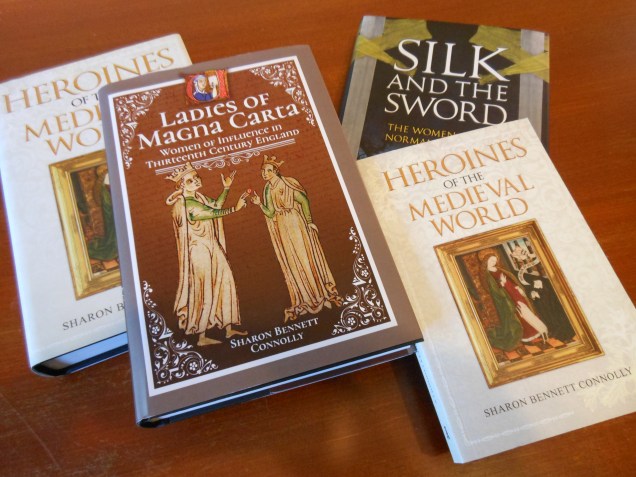
Ladies of Magna Carta: Women of Influence in Thirteenth Century England looks into the relationships of the various noble families of the 13th century, and how they were affected by the Barons’ Wars, Magna Carta and its aftermath; the bonds that were formed and those that were broken. It is now available from Pen & Sword, Amazon and from Book Depository worldwide.

Also by Sharon Bennett Connolly:
Silk and the Sword: The Women of the Norman Conquest traces the fortunes of the women who had a significant role to play in the momentous events of 1066. Available now from Amazon, Amberley Publishing, Book Depository.
Heroines of the Medieval World tells the stories of some of the most remarkable women from Medieval history, from Eleanor of Aquitaine to Julian of Norwich. Available now from Amberley Publishing and Amazon and Book Depository.
*
You can be the first to read new articles by clicking the ‘Follow’ button, liking our Facebook page or joining me on Twitter and Instagram.
©2020 Sharon Bennett Connolly





 History... the interesting bits!